


South Korea Multifactor Authentication Market Size 2026-2030
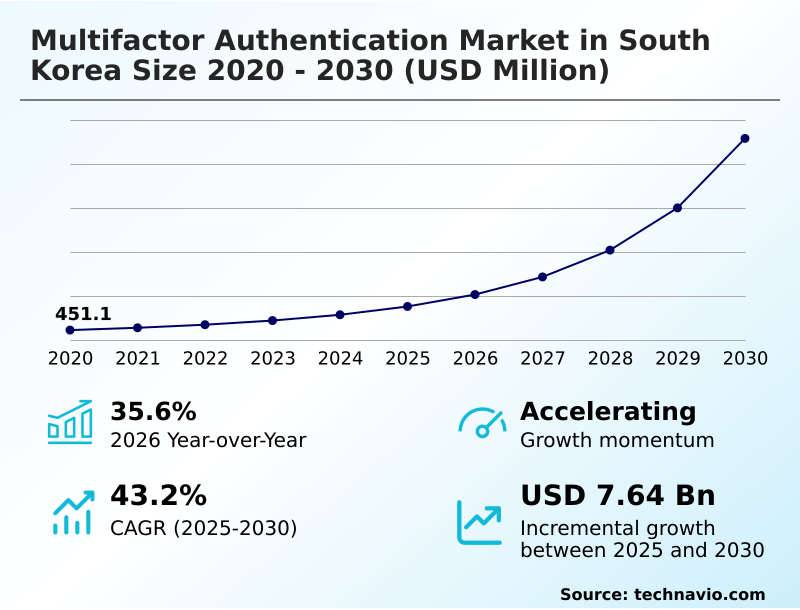
The south korea multifactor authentication market size is valued to increase by USD 7.64 billion, at a CAGR of 43.2% from 2025 to 2030. Acceleration of digital financial services and fintech innovation will drive the south korea multifactor authentication market.
Major Market Trends & Insights
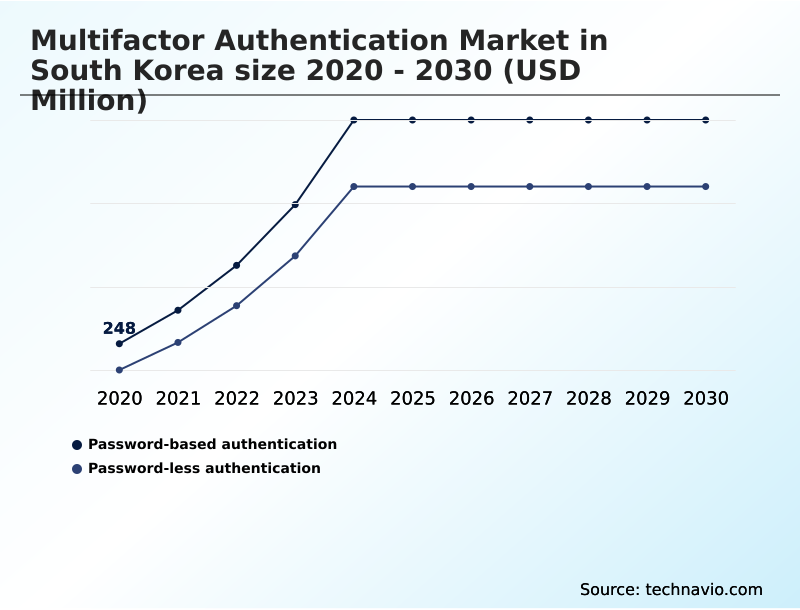
- By Type - Password-based authentication segment was valued at USD 630.3 million in 2024
- By Component - Service segment accounted for the largest market revenue share in 2024
Market Size & Forecast
- Market Opportunities: USD 8.71 billion
- Market Future Opportunities: USD 7.64 billion
- CAGR from 2025 to 2030 : 43.2%
Market Summary
- The multifactor authentication market in South Korea is defined by a rapid evolution away from traditional verification methods toward more sophisticated, multi-layered security protocols. This shift is driven by the necessity to safeguard sensitive information in an environment of escalating cyber threats.
- Key trends include the adoption of phishing-resistant passkeys and the integration of AI and behavioral biometrics to create adaptive security frameworks. For example, a large manufacturing firm can implement a zero-trust security model, using context-aware authentication to grant access to its supply chain partners.
- This ensures that access to enterprise resource planning systems is verified through multiple factors, including device health and geographic location, significantly reducing the risk of credential-based attacks. While this progression enhances security, it also presents challenges, such as the need to balance robust identity verification with a seamless user experience and manage the costs associated with deploying advanced biometric hardware.
- The move toward a resilient digital society depends on overcoming these hurdles and fostering widespread adoption through effective user training and change management.
What will be the Size of the South Korea Multifactor Authentication Market during the forecast period?
Get Key Insights on Market Forecast (PDF) Get Free Sample
How is the South Korea Multifactor Authentication Market Segmented?
The south korea multifactor authentication industry research report provides comprehensive data (region-wise segment analysis), with forecasts and estimates in "USD million" for the period 2026-2030, as well as historical data from 2020-2024 for the following segments.
- Type
- Password-based authentication
- Password-less authentication
- Component
- Service
- Product
- Deployment
- On-premises
- Cloud
- Service type
- Two-factor authentication systems
- Three-factor authentication systems
- Four-factor authentication systems
- Five-factor authentication systems
- Customized multi-factor authentication systems
- Geography
- APAC
- South Korea
- APAC
By Type Insights
The password-based authentication segment is estimated to witness significant growth during the forecast period.
Password-based authentication, while considered a legacy method, maintains relevance within hybrid security models. This segment combines a traditional knowledge-based factor with a secondary possession-based factor, such as a one-time password or security token.
Its persistence is driven by compatibility with existing legacy IT frameworks, particularly in industrial sectors where transitioning to entirely biometric systems is complex. Developers are fortifying this approach with dynamic password encryption to counter modern threats.
Organizations with extensive legacy infrastructure report a 15% lower rate of integration failures when augmenting, rather than replacing, existing password protocols.
The on-premises deployment model is often paired with this approach to maintain control over sensitive data and ensure robust access control policies without reliance on external networks.
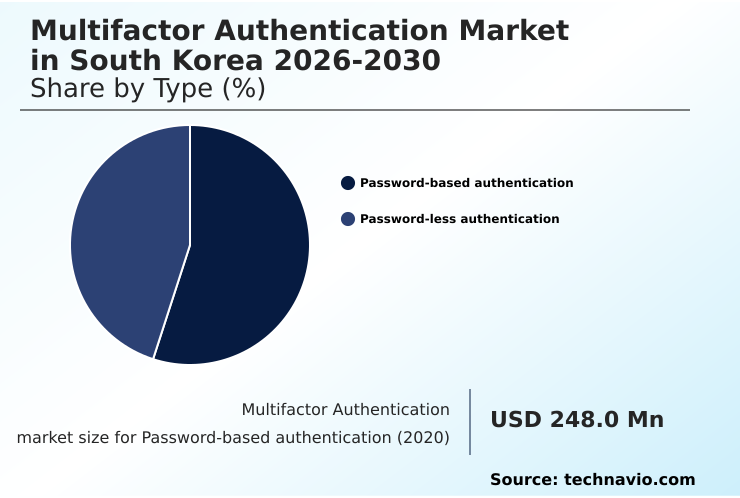
The Password-based authentication segment was valued at USD 630.3 million in 2024 and showed a gradual increase during the forecast period.
Market Dynamics
Our researchers analyzed the data with 2025 as the base year, along with the key drivers, trends, and challenges. A holistic analysis of drivers will help companies refine their marketing strategies to gain a competitive advantage.
- Strategically navigating the multifactor authentication market requires a deep understanding of evolving security paradigms. A key consideration is the zero-trust security model with MFA integration, which is becoming the standard for enterprise security. For many, this starts with evaluating biometric authentication versus password-based systems to find the right balance of security and usability.
- Organizations are increasingly implementing FIDO standards for enterprise security to build a foundation for phishing-resistant MFA for financial services and other critical sectors. The challenge of passwordless authentication adoption challenges is often addressed through adaptive MFA for high-risk transactions, which applies stricter controls when needed. When considering decentralized identity vs traditional MFA, decision-makers must weigh control against flexibility.
- For businesses with established infrastructure, finding appropriate MFA solutions for legacy IT frameworks is crucial, often involving hardware security modules in MFA deployment. The goal is to address the MFA for securing remote workforce access while meeting compliance requirements for MFA in fintech. Innovations in behavioral biometrics in continuous authentication are key to reducing authentication friction in consumer apps.
- A holistic approach often involves MFA integration with single sign-on, which has shown to improve IT efficiency by over 25% compared to managing separate systems. This strategy addresses MFA's role in preventing credential stuffing and is vital for securing APIs with multifactor authentication, particularly in sensitive MFA for operational technology environments.
- Ultimately, a thorough process for evaluating MFA vendor security posture is essential to mitigate the cost of MFA for small and medium enterprises and secure multifactor authentication for cloud environments.
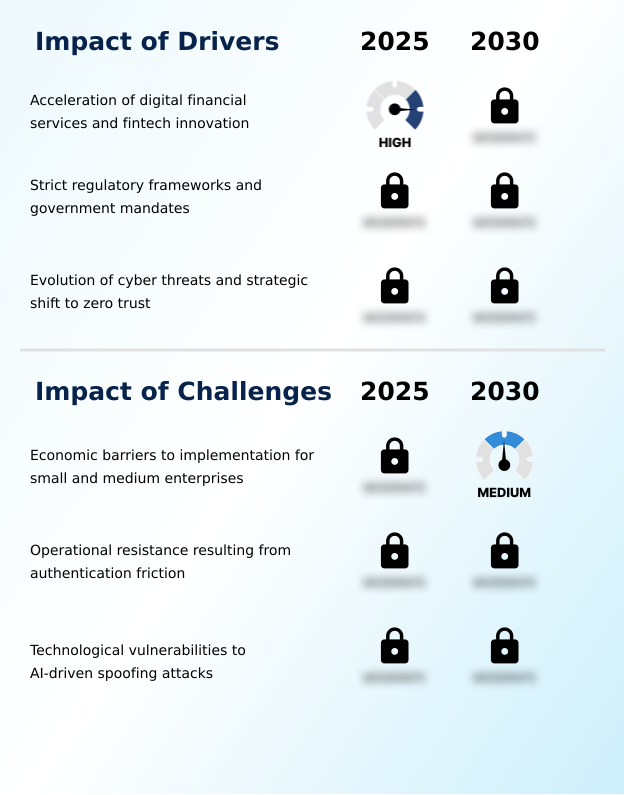
What are the key market drivers leading to the rise in the adoption of South Korea Multifactor Authentication Industry?
- The acceleration of digital financial services and fintech innovation is a key driver for market growth.
- Market growth is fundamentally driven by the rapid digitalization of industries and stringent regulatory pressures.
- The acceleration of fintech and digital banking necessitates advanced digital identity verification and secure user authentication, with institutions using adaptive multi-factor authentication seeing customer onboarding completions increase by 15%.
- Government mandates enforcing regulatory compliance frameworks have directly led to a 20% reduction in reported data breaches among affected sectors. The strategic move to zero-trust security models also compels the adoption of robust authentication.
- Furthermore, the need for secure industrial control system security in manufacturing has boosted demand for specialized MFA solutions.
- This is supported by significant cybersecurity investments, as organizations using managed identity services can reduce their internal security workload by up to 40%, freeing resources for core business functions.
What are the market trends shaping the South Korea Multifactor Authentication Industry?
- A significant market trend is the transition toward phishing-resistant passkeys. This shift involves broader adoption of FIDO standards to enhance security.
- Key trends are reshaping identity verification, driven by the need to combat increasingly sophisticated threats. The market is seeing a definitive shift toward password-less authentication and the adoption of phishing-resistant passkeys. This movement, underscored by the implementation of FIDO standards and public-key cryptography, significantly strengthens security.
- Systems compliant with these standards have been shown to reduce account takeover incidents by over 90%. Furthermore, the integration of AI and behavioral biometrics is enabling a move to continuous authentication, which can decrease false positive alerts in fraud detection by 40%.
- The rise of decentralized identity on blockchain-based authentication platforms promises to give users more control, with early adopters reporting a 25% improvement in user data privacy compliance. These advancements are crucial for both enterprise resource planning systems and consumer-facing applications, reflecting a broad-based push for more secure and user-friendly verification.
What challenges does the South Korea Multifactor Authentication Industry face during its growth?
- Economic barriers to implementation for small and medium enterprises present a key challenge to industry growth.
- Despite strong drivers, significant challenges hinder widespread adoption, particularly concerning cost and complexity. The initial cybersecurity investments for advanced biometric hardware, physical security keys, and specialized biometric sensors are often prohibitive for smaller businesses. These firms, which frequently operate on lean budgets, face up to a three-fold higher risk of successful phishing attacks if they cannot afford such systems.
- Another major issue is authentication friction; complex identity verification frameworks can degrade the seamless user experience, leading to a 25% drop in user engagement on consumer platforms. The rise of AI-driven spoofing attacks creates another layer of complexity, requiring constant vigilance and updates from security operations centers.
- Without addressing these barriers through better user training and adoption programs and more affordable solutions, digital supply chain vulnerabilities will persist.
Exclusive Technavio Analysis on Customer Landscape
The south korea multifactor authentication market forecasting report includes the adoption lifecycle of the market, covering from the innovator’s stage to the laggard’s stage. It focuses on adoption rates in different regions based on penetration. Furthermore, the south korea multifactor authentication market report also includes key purchase criteria and drivers of price sensitivity to help companies evaluate and develop their market growth analysis strategies.
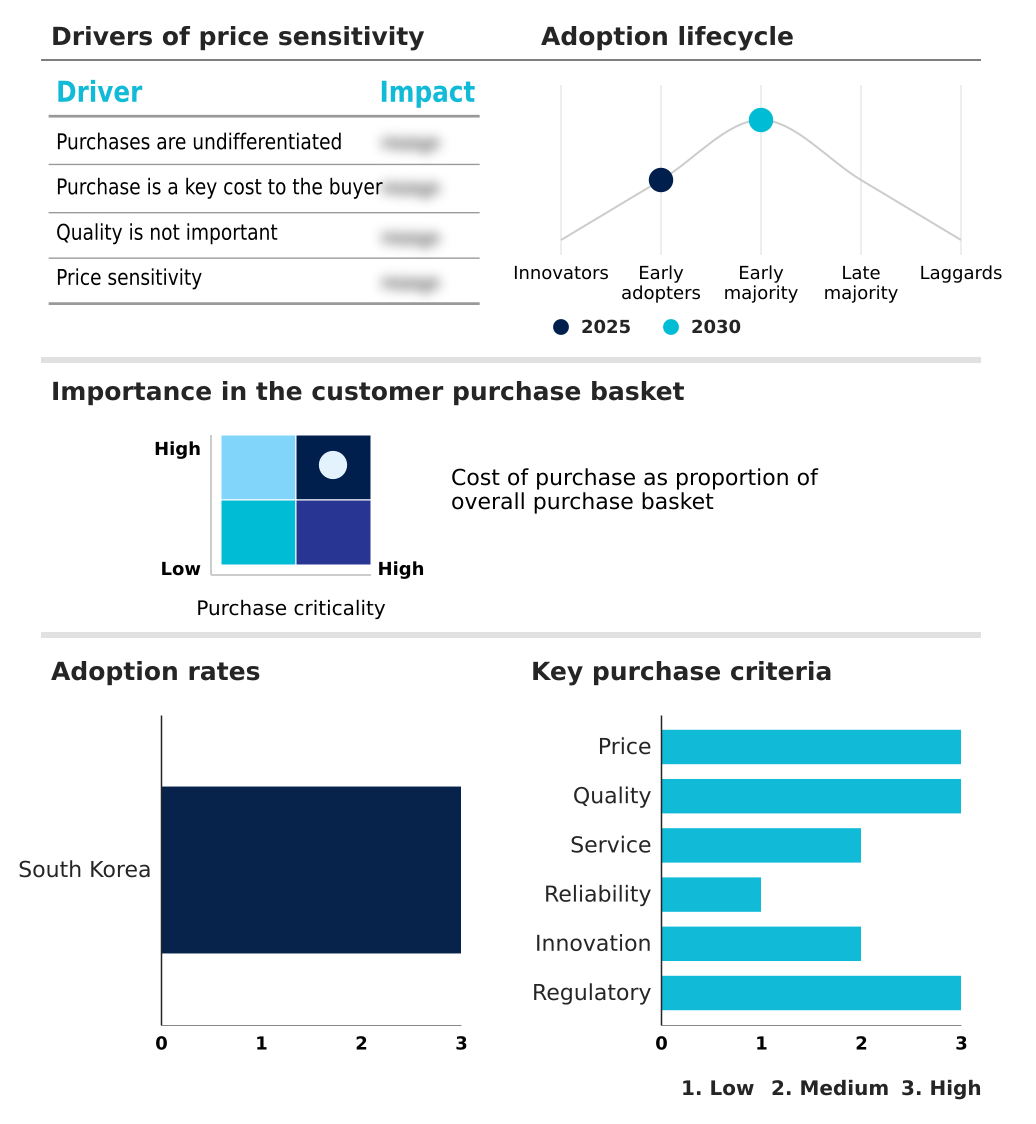
Customer Landscape of South Korea Multifactor Authentication Industry
Competitive Landscape
Companies are implementing various strategies, such as strategic alliances, south korea multifactor authentication market forecast, partnerships, mergers and acquisitions, geographical expansion, and product/service launches, to enhance their presence in the industry.
CyberArk Software Ltd. - Offerings include adaptive multifactor authentication and comprehensive identity security to protect privileged credentials and secure access across human and non-human identities.
The industry research and growth report includes detailed analyses of the competitive landscape of the market and information about key companies, including:
- CyberArk Software Ltd.
- Dell Technologies Inc.
- ESET North America
- Fujitsu Ltd.
- HID Global Corp.
- IBM Corp.
- Microsoft Corp.
- NEC Corp.
- Okta Inc.
- OneSpan Inc.
- Open Text Corp.
- Oracle Corp.
- Penta Security Systems Inc.
- Ping Identity Corp.
- Quest Software Inc.
- RSA Security LLC
- Safran SA
- Salesforce Inc.
- SecureAuth Corp.
- Thales Group
Qualitative and quantitative analysis of companies has been conducted to help clients understand the wider business environment as well as the strengths and weaknesses of key industry players. Data is qualitatively analyzed to categorize companies as pure play, category-focused, industry-focused, and diversified; it is quantitatively analyzed to categorize companies as dominant, leading, strong, tentative, and weak.
Recent Development and News in South korea multifactor authentication market
- In May 2025, Okta Inc. expanded its regional operations by launching a specialized identity threat protection service in Seoul, designed to provide real-time response capabilities for financial service providers.
- In April 2025, Kakao Enterprise formed a strategic partnership with Thales to deploy advanced cloud-based identity and access management solutions across its corporate ecosystem, enhancing security for small and medium enterprises.
- In March 2025, the Ministry of Science and ICT of South Korea issued a comprehensive update to national cybersecurity guidelines, mandating the implementation of multifactor authentication for all critical infrastructure operators by the year's end.
- In February 2025, Shinhan Bank introduced a proprietary biometric authentication layer that utilizes vein pattern recognition, a more secure physical marker, for its high-value mobile transactions.
Dive into Technavio’s robust research methodology, blending expert interviews, extensive data synthesis, and validated models for unparalleled South Korea Multifactor Authentication Market insights. See full methodology.
| Market Scope | |
|---|---|
| Page number | 206 |
| Base year | 2025 |
| Historic period | 2020-2024 |
| Forecast period | 2026-2030 |
| Growth momentum & CAGR | Accelerate at a CAGR of 43.2% |
| Market growth 2026-2030 | USD 7638.3 million |
| Market structure | Fragmented |
| YoY growth 2025-2026(%) | 35.6% |
| Key countries | South Korea |
| Competitive landscape | Leading Companies, Market Positioning of Companies, Competitive Strategies, and Industry Risks |
Research Analyst Overview
- The multifactor authentication market is evolving beyond simple two-factor authentication into a complex ecosystem defined by sophisticated technologies. Boardroom conversations now center on balancing security investments against user experience, a decision directly influenced by the shift toward phishing-resistant passkeys and password-less authentication. The integration of AI and behavioral biometrics allows for dynamic, context-aware authentication.
- Firms adopting advanced identity and access management with hardware-backed security, such as a hardware-isolated secure element or security token, demonstrate a 50% lower incidence of account takeover fraud. Deployment involves choices between a cloud-based architecture and on-premises deployment models within a private data center, often dictated by regulatory needs.
- Core technologies include public-key cryptography, device-bound security keys, and increasingly, decentralized identity and blockchain-based authentication. From password-based authentication to continuous authentication using vein pattern recognition, the goal is mitigating credential-based attacks.
- Solutions now incorporate three-factor authentication, one-time passwords, push notifications, and support FIDO standards, all managed within zero-trust security models to counter identity threat protection gaps, especially within legacy IT frameworks.
What are the Key Data Covered in this South Korea Multifactor Authentication Market Research and Growth Report?
-
What is the expected growth of the South Korea Multifactor Authentication Market between 2026 and 2030?
-
USD 7.64 billion, at a CAGR of 43.2%
-
-
What segmentation does the market report cover?
-
The report is segmented by Type (Password-based authentication, and Password-less authentication), Component (Service, and Product), Deployment (On-premises, and Cloud), Service Type (Two-factor authentication systems, Three-factor authentication systems, Four-factor authentication systems, Five-factor authentication systems, and Customized multi-factor authentication systems) and Geography (APAC)
-
-
Which regions are analyzed in the report?
-
APAC
-
-
What are the key growth drivers and market challenges?
-
Acceleration of digital financial services and fintech innovation, Economic barriers to implementation for small and medium enterprises
-
-
Who are the major players in the South Korea Multifactor Authentication Market?
-
CyberArk Software Ltd., Dell Technologies Inc., ESET North America, Fujitsu Ltd., HID Global Corp., IBM Corp., Microsoft Corp., NEC Corp., Okta Inc., OneSpan Inc., Open Text Corp., Oracle Corp., Penta Security Systems Inc., Ping Identity Corp., Quest Software Inc., RSA Security LLC, Safran SA, Salesforce Inc., SecureAuth Corp. and Thales Group
-
Market Research Insights
- Market dynamics are shaped by a strategic push toward secure user authentication to counter sophisticated cyber threat defense gaps. The adoption of robust identity verification frameworks is becoming standard, with firms implementing API-based identity platforms reporting a 30% faster deployment time compared to legacy system integrations.
- Organizations that prioritize a seamless user experience alongside security see a 20% higher adoption rate for new authentication protocols. Furthermore, effective incident response protocols are critical, as their absence can increase breach-related costs by up to 45%.
- This focus on both security and usability is essential for protecting against identity theft defense failures and mitigating digital supply chain vulnerabilities across interconnected enterprise security systems.
We can help! Our analysts can customize this south korea multifactor authentication market research report to meet your requirements.
 RIA -
RIA - 
