


Sparkling Water Market Size 2026-2030
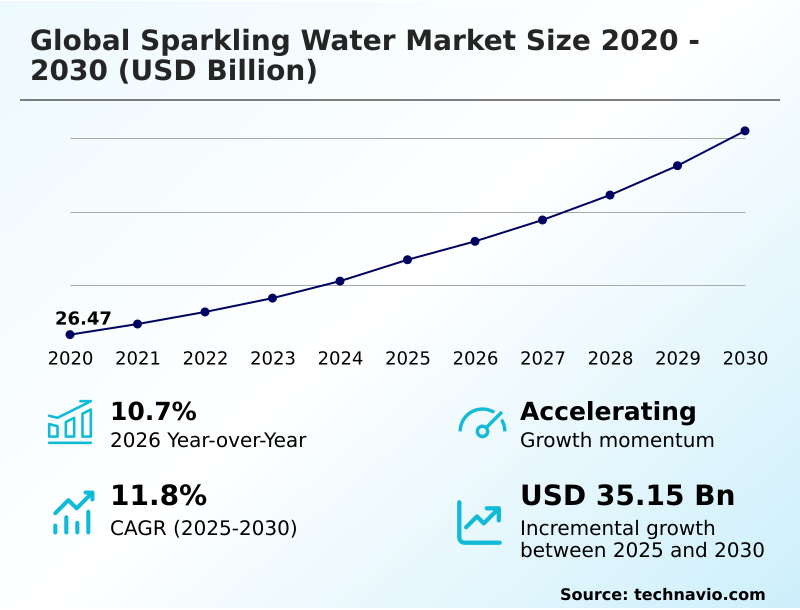
The sparkling water market size is valued to increase by USD 35.15 billion, at a CAGR of 11.8% from 2025 to 2030. Increasing consumer health consciousness levels will drive the sparkling water market.
Major Market Trends & Insights
- North America dominated the market and accounted for a 43.1% growth during the forecast period.
- By Distribution Channel - Hypermarkets segment was valued at USD 18.41 billion in 2024
- By Product - Unflavored sparkling water segment accounted for the largest market revenue share in 2024
Market Size & Forecast
- Market Opportunities: USD 55.58 billion
- Market Future Opportunities: USD 35.15 billion
- CAGR from 2025 to 2030 : 11.8%
Market Summary
- The Sparkling Water Market is defined by a significant consumer migration away from sugary soft drinks toward healthier hydration choices. This shift is fueling rapid innovation in product formulation, where clean label ingredient sourcing and the development of zero-calorie beverage formulation are paramount.
- Key trends include the integration of functional ingredients, such as electrolyte-infused hydration and natural caffeine integration, to appeal to wellness-oriented consumers. Simultaneously, the industry is grappling with the need for more sustainable packaging solutions, driving investment in recycled PET bottling and recycled aluminum can manufacturing. A critical operational challenge involves managing volatile supply chains.
- For instance, a firm might implement an AI-driven inventory management system to forecast regional demand for specific botanical flavor infusion products, ensuring efficient distribution from smart bottling plant automation facilities while maintaining cold chain integrity monitoring to preserve quality and effervescence retention technology across the logistics network. This strategic balancing of innovation, sustainability, and operational excellence characterizes the competitive landscape.
What will be the Size of the Sparkling Water Market during the forecast period?
Get Key Insights on Market Forecast (PDF) Get Free Sample
How is the Sparkling Water Market Segmented?
The sparkling water industry research report provides comprehensive data (region-wise segment analysis), with forecasts and estimates in "USD million" for the period 2026-2030, as well as historical data from 2020-2024 for the following segments.
- Distribution channel
- Hypermarkets
- On-trade and independent retailers
- Convenience stores
- Online
- Product
- Unflavored sparkling water
- Flavored sparkling water
- Packaging
- Plastic bottles
- Cans
- Glass bottles
- Geography
- North America
- US
- Canada
- Mexico
- Europe
- Germany
- UK
- France
- APAC
- China
- Japan
- India
- Middle East and Africa
- UAE
- Saudi Arabia
- South Africa
- South America
- Brazil
- Argentina
- Rest of World (ROW)
- North America
By Distribution Channel Insights
The hypermarkets segment is estimated to witness significant growth during the forecast period.
Hypermarkets remain the dominant distribution channel, leveraging vast retail shelf space optimization and high consumer foot traffic to drive volume. These outlets facilitate direct comparison of various healthy hydration options, from private label to premium brands.
The successful execution of in-store promotions is critical, with data indicating that targeted campaigns can lift sales of new products by over 25%.
As the beverage premiumization trend continues, hypermarkets are adapting by expanding sections for artisanal beverage production and specialty drink market offerings, influencing the entire beverage distribution networks.
This channel's ability to offer bulk and multipack formats reinforces its importance for routine consumer purchases, solidifying its central role in the market.
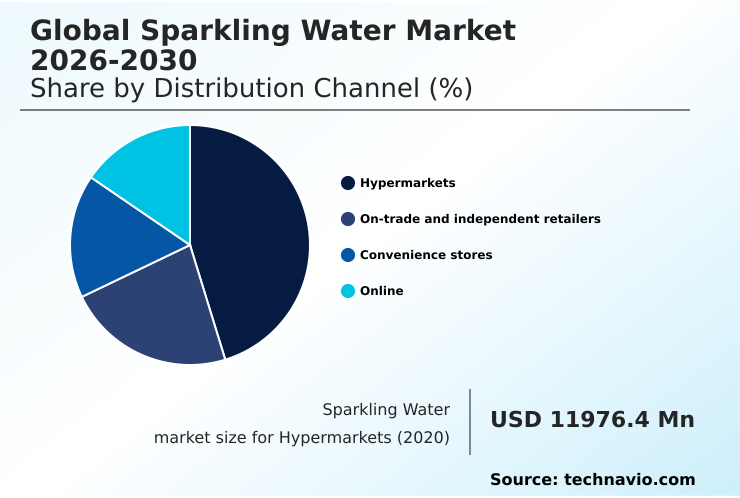
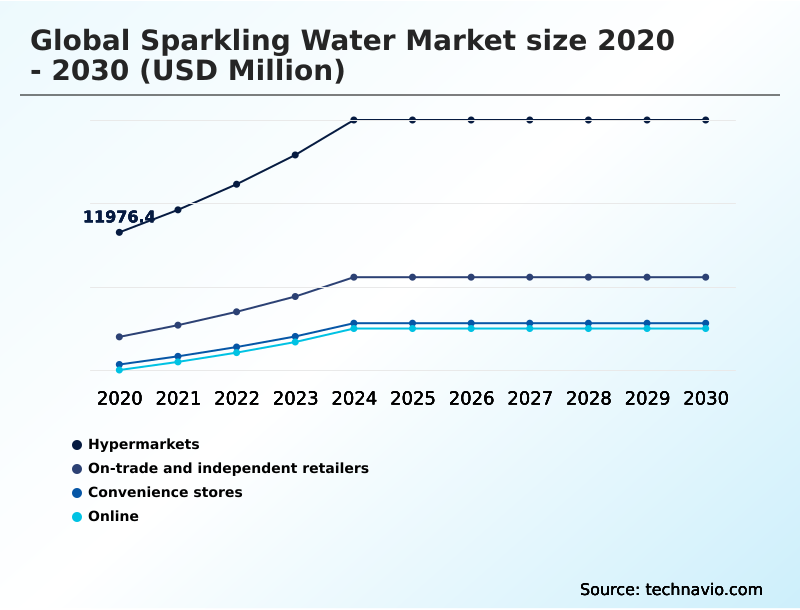
The Hypermarkets segment was valued at USD 18.41 billion in 2024 and showed a gradual increase during the forecast period.
Regional Analysis
North America is estimated to contribute 43.1% to the growth of the global market during the forecast period.Technavio’s analysts have elaborately explained the regional trends and drivers that shape the market during the forecast period.
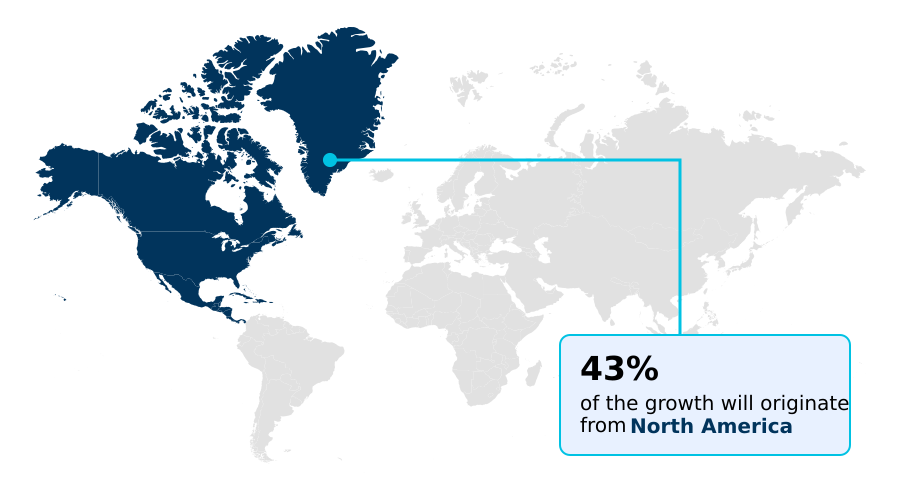
See How Sparkling Water Market Demand is Rising in North America Get Free Sample
The market's geographic landscape is diverse, with North America leading innovation in on-the-go packaging design and contributing over 43% of the market's incremental growth.
This region's focus on a direct-to-consumer subscription models contrasts with Europe, where a deep-rooted tradition of premium water sourcing and artesian spring water sourcing underpins the market.
In Europe, the emphasis is on premium glass bottle production and mixology-grade mixer quality.
Meanwhile, the APAC region is expanding at a rate nearly a full percentage point higher than Europe, driven by urbanization and rising health awareness, creating demand for home carbonation device compatibility and lightweight bottle design to serve new consumer segments.
Market Dynamics
Our researchers analyzed the data with 2025 as the base year, along with the key drivers, trends, and challenges. A holistic analysis of drivers will help companies refine their marketing strategies to gain a competitive advantage.
- The strategic landscape of the Global Sparkling Water Market 2026-2030 is heavily influenced by the impact of sugar tax on sparkling water, which has accelerated consumer trends in flavored sparkling water. This has pushed companies to innovate, leading to the growth of functional sparkling water beverages and a focus on the health benefits of unflavored sparkling water.
- In response, sustainable packaging in the beverage industry has become a critical competitive differentiator, forcing a constant comparison of plastic vs aluminum packaging and bolstering recycling initiatives for beverage containers. The demand for premium non-alcoholic drinks is met with the use of botanical infusions in carbonated drinks, aligning with the clean label sparkling water market.
- E-commerce strategies for beverage brands are becoming essential to manage the impact of online retail on water sales, especially for navigating supply chain challenges for water bottling. Companies that successfully adopt advanced distribution channels for craft beverages have seen their logistics efficiency improve by over 15% compared to legacy systems.
- This is vital for capitalizing on rapidly changing flavor trends in the carbonated water market, the role of sparkling water in mixology, and managing the complex logistics of temperature-controlled beverage transport. This dynamic environment also creates private label opportunities in sparkling water, requiring unique marketing strategies for healthy hydration and innovations in beverage carbonation technology.
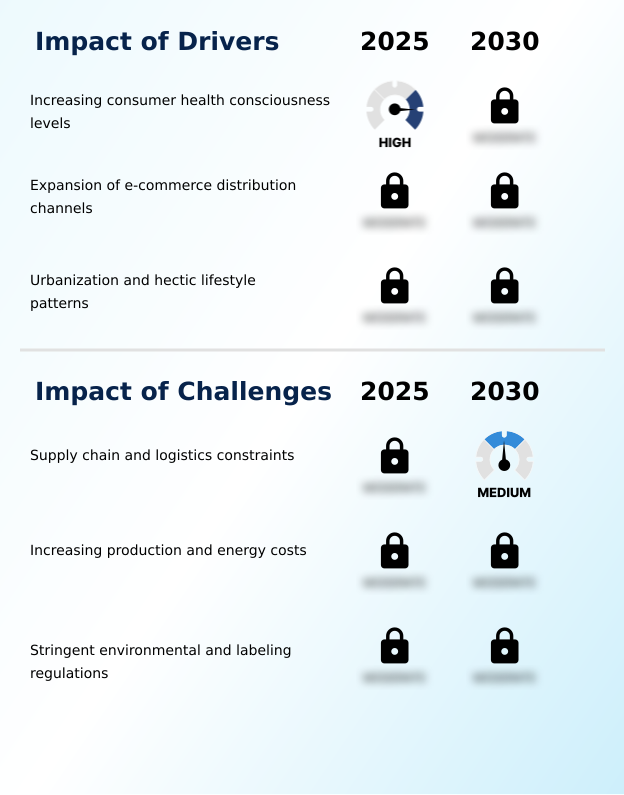
What are the key market drivers leading to the rise in the adoption of Sparkling Water Industry?
- Increasing consumer health consciousness is a key driver for the market's growth.
- The primary driver for the market is a global shift toward healthy hydration options, as consumers actively seek unsweetened beverage alternatives.
- This mindful consumption trend is a direct response to rising health awareness, with sugar-free beverage choices becoming a default for many.
- The demand for natural and organic ingredients and transparent ingredient labeling has pushed companies to reformulate products, removing artificial additives.
- This pivot away from traditional soft drinks is significant, with markets that have implemented sugar taxes showing a 10% higher growth rate for low-calorie carbonated drinks.
- This consumer-led movement supports the entire lifestyle beverage category, positioning sparkling water as a go-to for daily, guilt-free refreshment and post-workout recovery drinks.
What are the market trends shaping the Sparkling Water Industry?
- A key market trend is the introduction of botanical infusions and exotic fruit profiles. This caters to consumers seeking sophisticated alternatives to traditional flavors.
- Innovation in the market is accelerating, driven by consumer demand for sophisticated flavor profiles and holistic wellness products. The introduction of herbal and floral infusions, along with exotic fruit ingredients, is redefining the category beyond simple refreshment. This trend towards artisanal beverage production is supported by advanced natural mineral water carbonation techniques that preserve delicate tastes.
- Functional benefits are also a key focus, with the incorporation of electrolytes and adaptogens to create wellness-focused drinks. This beverage premiumization trend is evident in both product formulation and on-the-go packaging design, with companies investing in R&D to meet the evolving preferences of the adult soft drink market.
- New launches are seeing adoption rates nearly double that of simple line extensions.
What challenges does the Sparkling Water Industry face during its growth?
- Supply chain and logistics constraints present a key challenge affecting industry growth.
- Key challenges center on operational and logistical complexities that can impact profitability and market access. Volatile transportation costs, which have risen over 25% on some routes, directly affect margins for brands without localized beverage distribution networks. Ensuring cold chain integrity monitoring from production to retail is critical for maintaining quality but adds another layer of expense.
- Furthermore, securing consistent supplies of environmentally friendly packaging materials, such as recycled aluminum and post-consumer resin, remains a significant hurdle. These supply chain vulnerabilities, coupled with the need for stringent sugar tax compliance strategy, require robust supply chain resilience planning and sophisticated, often AI-driven, inventory management systems to mitigate risks and maintain a competitive edge.
Exclusive Technavio Analysis on Customer Landscape
The sparkling water market forecasting report includes the adoption lifecycle of the market, covering from the innovator’s stage to the laggard’s stage. It focuses on adoption rates in different regions based on penetration. Furthermore, the sparkling water market report also includes key purchase criteria and drivers of price sensitivity to help companies evaluate and develop their market growth analysis strategies.
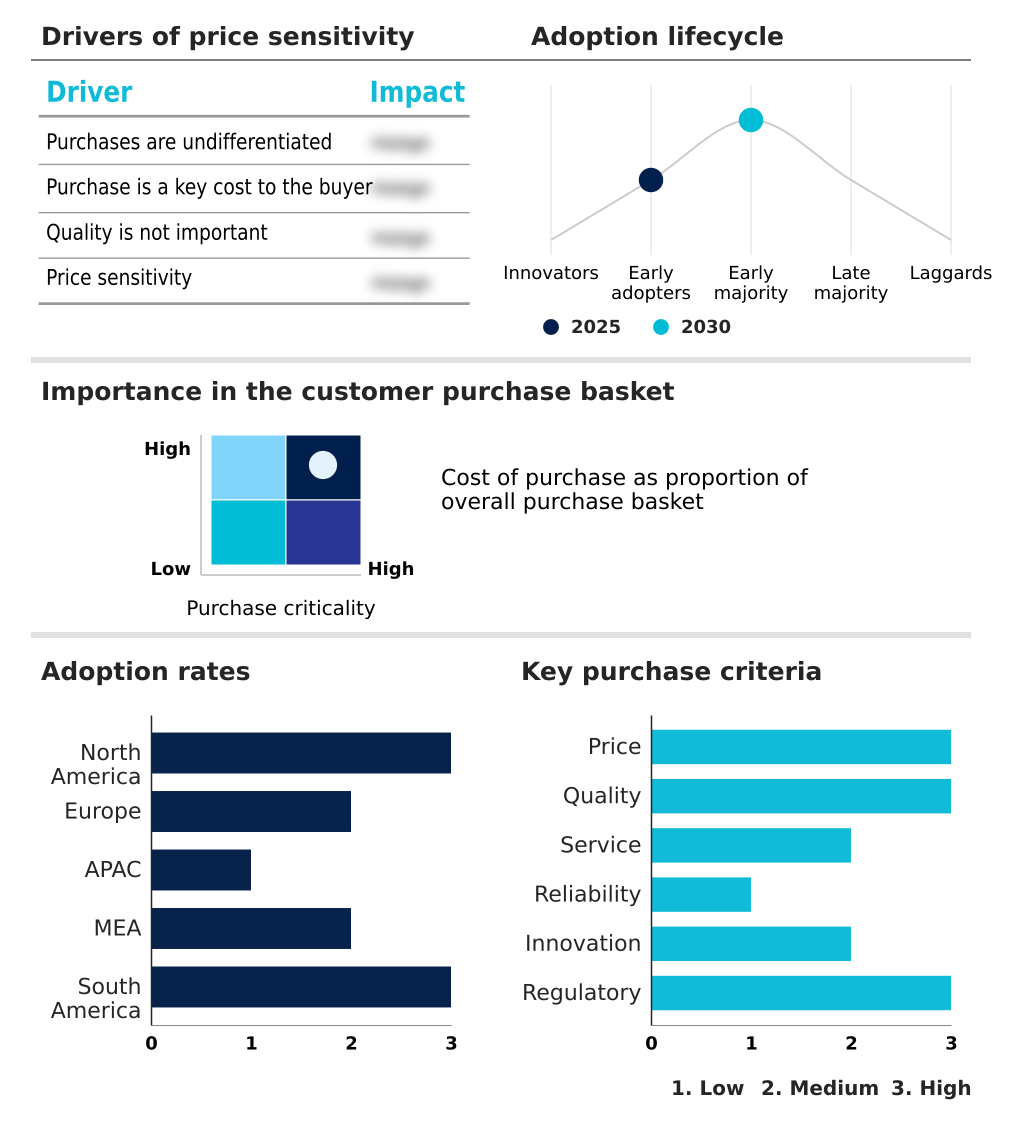
Customer Landscape of Sparkling Water Industry
Competitive Landscape
Companies are implementing various strategies, such as strategic alliances, sparkling water market forecast, partnerships, mergers and acquisitions, geographical expansion, and product/service launches, to enhance their presence in the industry.
Anheuser Busch InBev SA NV - Offers a range of sparkling water and seltzer products, targeting growing consumer demand for healthier, non-alcoholic beverage alternatives.
The industry research and growth report includes detailed analyses of the competitive landscape of the market and information about key companies, including:
- Anheuser Busch InBev SA NV
- Aqua Maestro Inc.
- Big Watt Beverage Co.
- Carpathian Springs SA
- Danone SA
- JAB Holding Co.
- Keurig Dr Pepper Inc.
- Klarbrunn Inc.
- Mountain Valley Spring Co.
- National Beverage Corp.
- Nestle SA
- PepsiCo Inc.
- Polar Beverages
- Primo Water Corp.
- Rhodius Mineralquellen Co. KG
- Talking Rain Beverage Co.
- The Coca Cola Co.
- Volay Water
- VOSS of Norway AS
- WakeWater Beverage Co.
Qualitative and quantitative analysis of companies has been conducted to help clients understand the wider business environment as well as the strengths and weaknesses of key industry players. Data is qualitatively analyzed to categorize companies as pure play, category-focused, industry-focused, and diversified; it is quantitatively analyzed to categorize companies as dominant, leading, strong, tentative, and weak.
Recent Development and News in Sparkling water market
- In April 2025, Klarbrunn Inc. announced a new partnership with regional distributors in the United States to expand the availability of its naturally flavored sparkling water line in major metropolitan areas.
- In February 2025, The Coca Cola Co. implemented a new high speed carbonation facility in Europe to enhance production efficiency and meet the rising demand for its sparkling water brands.
- In February 2025, PepsiCo Inc. launched a new line of functional sparkling waters in the United States that are enriched with electrolytes and natural caffeine to cater to the needs of the active urban population.
- In January 2025, Carpathian Springs SA introduced a new bottle design made from fifty percent recycled plastic to address environmental concerns while maintaining the functional benefits of the material.
Dive into Technavio’s robust research methodology, blending expert interviews, extensive data synthesis, and validated models for unparalleled Sparkling Water Market insights. See full methodology.
| Market Scope | |
|---|---|
| Page number | 293 |
| Base year | 2025 |
| Historic period | 2020-2024 |
| Forecast period | 2026-2030 |
| Growth momentum & CAGR | Accelerate at a CAGR of 11.8% |
| Market growth 2026-2030 | USD 35150.7 million |
| Market structure | Fragmented |
| YoY growth 2025-2026(%) | 10.7% |
| Key countries | US, Canada, Mexico, Germany, UK, France, Italy, Spain, The Netherlands, China, Japan, India, South Korea, Australia, Indonesia, UAE, Saudi Arabia, South Africa, Turkey, Israel, Brazil, Argentina and Chile |
| Competitive landscape | Leading Companies, Market Positioning of Companies, Competitive Strategies, and Industry Risks |
Research Analyst Overview
- The Global Sparkling Water Market 2026-2030 is characterized by intense innovation in both product and process. Strategic imperatives are driving firms toward functional beverage enrichment and clean label ingredient sourcing, utilizing technologies from natural fruit essence extraction to natural caffeine integration.
- A key boardroom decision revolves around capital investment in sustainable packaging solutions, balancing the costs of recycled PET bottling and recycled aluminum can manufacturing against consumer demand for environmental stewardship. Firms that have adopted smart bottling plant automation report up to a 20% improvement in operational efficiency and effervescence retention technology, ensuring consistent bubble size control and mixology-grade mixer quality.
- Success hinges on a holistic approach encompassing everything from artesian spring water sourcing and advanced water filtration technology to AI-driven inventory management and cold chain integrity monitoring. This requires mastering carbon dioxide infusion process, temperature-controlled logistics, and post-consumer resin integration to meet both regulatory and consumer expectations.
What are the Key Data Covered in this Sparkling Water Market Research and Growth Report?
-
What is the expected growth of the Sparkling Water Market between 2026 and 2030?
-
USD 35.15 billion, at a CAGR of 11.8%
-
-
What segmentation does the market report cover?
-
The report is segmented by Distribution Channel (Hypermarkets, On-trade and independent retailers, Convenience stores, and Online), Product (Unflavored sparkling water, and Flavored sparkling water), Packaging (Plastic bottles, Cans, and Glass bottles) and Geography (North America, Europe, APAC, Middle East and Africa, South America)
-
-
Which regions are analyzed in the report?
-
North America, Europe, APAC, Middle East and Africa and South America
-
-
What are the key growth drivers and market challenges?
-
Increasing consumer health consciousness levels, Supply chain and logistics constraints
-
-
Who are the major players in the Sparkling Water Market?
-
Anheuser Busch InBev SA NV, Aqua Maestro Inc., Big Watt Beverage Co., Carpathian Springs SA, Danone SA, JAB Holding Co., Keurig Dr Pepper Inc., Klarbrunn Inc., Mountain Valley Spring Co., National Beverage Corp., Nestle SA, PepsiCo Inc., Polar Beverages, Primo Water Corp., Rhodius Mineralquellen Co. KG, Talking Rain Beverage Co., The Coca Cola Co., Volay Water, VOSS of Norway AS and WakeWater Beverage Co.
-
Market Research Insights
- The market's dynamics are shaped by a pronounced consumer shift, with data showing a consistent 5% annual decline in traditional soda consumption in several key markets. This has prompted a strategic pivot towards wellness-focused drinks, where brands focusing on this segment are seeing portfolio growth outperform legacy products by up to 15%.
- The rise of e-commerce beverage sales has also been a transformative force, as direct-to-consumer models demonstrate a 20% higher customer retention rate compared to conventional retail channels. This digital transition is intensifying competition around sophisticated flavor profiles and the beverage premiumization trend, compelling companies to innovate beyond simple hydration.
We can help! Our analysts can customize this sparkling water market research report to meet your requirements.
 RIA -
RIA - 
