


Variable Air Volume Box Market Size 2026-2030
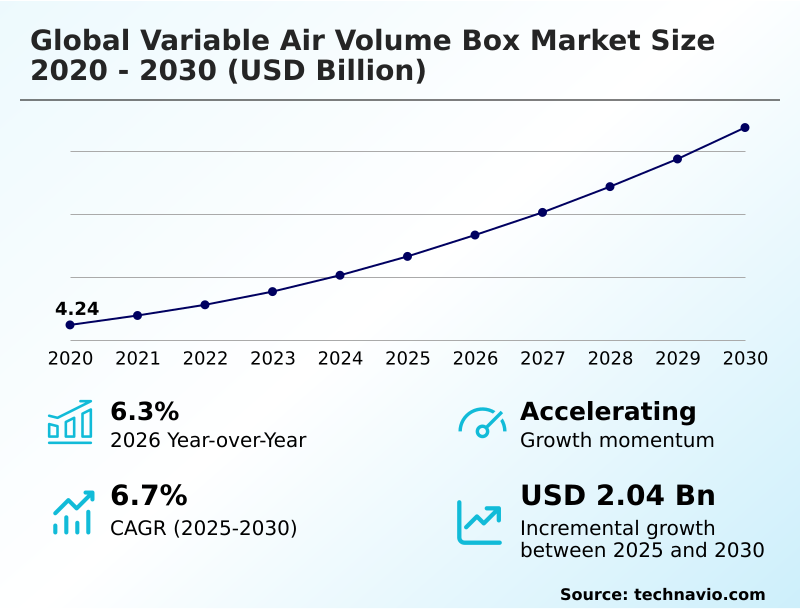
The variable air volume box market size is valued to increase by USD 2.04 billion, at a CAGR of 6.7% from 2025 to 2030. Escalating demand for energy efficiency and sustainability in building operations will drive the variable air volume box market.
Major Market Trends & Insights
- APAC dominated the market and accounted for a 42.1% growth during the forecast period.
- By Type - Single-duct VAV segment was valued at USD 2.07 billion in 2024
- By Application - Commercial buildings segment accounted for the largest market revenue share in 2024
Market Size & Forecast
- Market Opportunities: USD 3.14 billion
- Market Future Opportunities: USD 2.04 billion
- CAGR from 2025 to 2030 : 6.7%
Market Summary
- The variable air volume box market is experiencing sustained development, driven by the escalating global emphasis on energy efficiency in commercial and industrial buildings. This technology is fundamental to modern HVAC design, allowing for precise HVAC zoning and temperature regulation by modulating airflow to specific areas.
- The core driver is the significant energy savings achieved by reducing the workload on the central air handling unit and fans through variable frequency drives, directly supporting sustainable building practices and net-zero energy targets. A key trend is the digital transformation of these devices from simple mechanical dampers into intelligent nodes within a smart building ecosystem.
- The integration of direct digital controls and airflow sensors with building automation systems enables advanced strategies like demand-controlled ventilation and predictive HVAC maintenance.
- For instance, a facility management firm overseeing a portfolio of commercial properties can leverage this connectivity to analyze real-time performance data, identify units requiring calibration, and optimize energy consumption across all buildings from a central dashboard, improving operational efficiency significantly.
- However, challenges such as high initial capital costs, the complexity of VAV system commissioning, and the persistent threat from alternative technologies like variable refrigerant flow systems temper market expansion. The need for specialized labor for proper installation and maintenance also remains a considerable barrier for some projects.
What will be the Size of the Variable Air Volume Box Market during the forecast period?
Get Key Insights on Market Forecast (PDF) Get Free Sample
How is the Variable Air Volume Box Market Segmented?
The variable air volume box industry research report provides comprehensive data (region-wise segment analysis), with forecasts and estimates in "USD million" for the period 2026-2030, as well as historical data from 2020-2024 for the following segments.
- Type
- Single-duct VAV
- Fan-powered VAV
- Dual-duct VAV
- Induction VAV
- Application
- Commercial buildings
- Industrial buildings
- Residential buildings
- End-user
- New installation
- Replacement
- Geography
- APAC
- China
- Japan
- India
- North America
- US
- Canada
- Mexico
- Europe
- Germany
- UK
- France
- Middle East and Africa
- Saudi Arabia
- UAE
- South Africa
- South America
- Brazil
- Argentina
- Colombia
- Rest of World (ROW)
- APAC
By Type Insights
The single-duct vav segment is estimated to witness significant growth during the forecast period.
Single-duct VAV units are a cornerstone of modern energy-efficient HVAC design, representing the most widely deployed terminal unit for precise HVAC zoning.
These devices regulate conditioned airflow to a specific area using a damper actuator, which modulates based on signals from a local thermostat to achieve exact zone temperature control.
Their operational simplicity and cost-effectiveness make them ideal for interior zones with consistent cooling loads.
Advanced models now feature pressure-independent control, utilizing integrated airflow sensors to maintain a programmed VAV control sequence regardless of duct static pressure fluctuations, improving system stability by up to 35%.
When heating is required, these units are often paired with reheat coils. Proper VAV box sizing and VAV diffuser selection are critical for optimizing performance and occupant comfort.
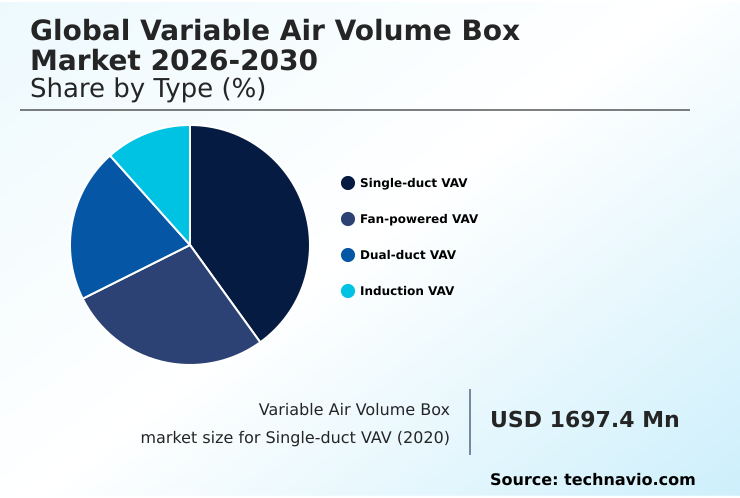
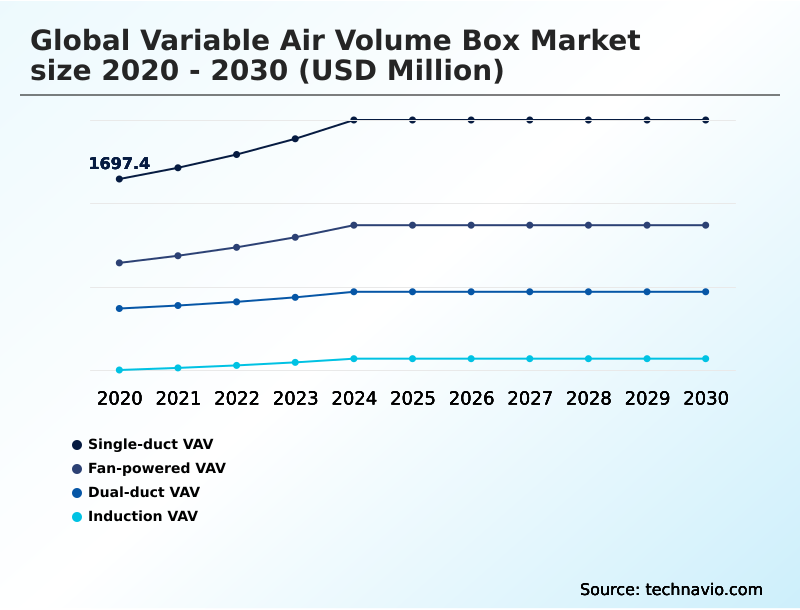
The Single-duct VAV segment was valued at USD 2.07 billion in 2024 and showed a gradual increase during the forecast period.
Regional Analysis
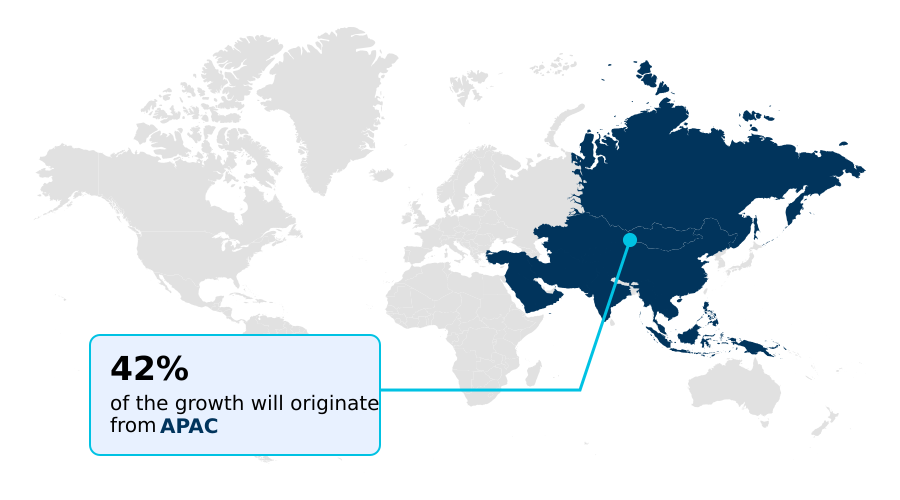
APAC is estimated to contribute 42.1% to the growth of the global market during the forecast period.Technavio’s analysts have elaborately explained the regional trends and drivers that shape the market during the forecast period.
See How Variable Air Volume Box Market Demand is Rising in APAC Get Free Sample
The geographic landscape is led by APAC, which accounts for 42.1% of the market's incremental growth, fueled by massive commercial construction in China and India. This region shows high demand for robust air handling unit configurations.
North America remains a mature market focused on retrofits and achieving higher efficiency, contributing 23.7% to growth. In this region, smart VAV controller integration is standard.
Europe, accounting for 22.1% of growth, prioritizes sustainability and specialized systems like induction VAV and dual-duct VAV for applications requiring precise environmental control. It leads in adopting demand response strategies.
Market Dynamics
Our researchers analyzed the data with 2025 as the base year, along with the key drivers, trends, and challenges. A holistic analysis of drivers will help companies refine their marketing strategies to gain a competitive advantage.
- Facility managers and engineers face complex decisions when specifying and managing modern HVAC systems. Key considerations include the single duct vs fan powered VAV efficiency trade-offs and the total cost of VAV system for commercial building projects. Once installed, VAV box troubleshooting for no airflow is a common maintenance task, often traced to failed VAV box actuators.
- Improving VAV system acoustic performance is another critical goal, especially for VAV box selection criteria for hospitals and open plan offices. A crucial step is integrating VAV with bacnet building controls for centralized management. Understanding the benefits of pressure independent VAV boxes, which ensure stable airflow, is essential for system stability.
- For operational planning, having a clear maintenance schedule for VAV terminal units is non-negotiable, just as calculating VAV box minimum CFM settings is vital during commissioning. The process of upgrading pneumatic VAV to digital controls is a major retrofit trend, directly impacting the role of VAV in LEED certification.
- Implementing an optimized VAV box control logic for energy savings can significantly reduce operational costs. The impact of static pressure on VAV performance cannot be overstated. Choices like a VAV terminal unit with electric reheat or a wireless thermostat for VAV systems depend on climate and infrastructure. Addressing common failures in VAV box actuators proactively can reduce system downtime.
- Ultimately, the VAV vs VRF systems comparison shows that VAV systems improve tenant comfort more effectively in large, multi-zone applications, with post-retrofit tenant satisfaction scores often improving by a greater margin than with alternative systems. For specialized areas like cleanrooms, a VAV box for laboratory ventilation control is indispensable.
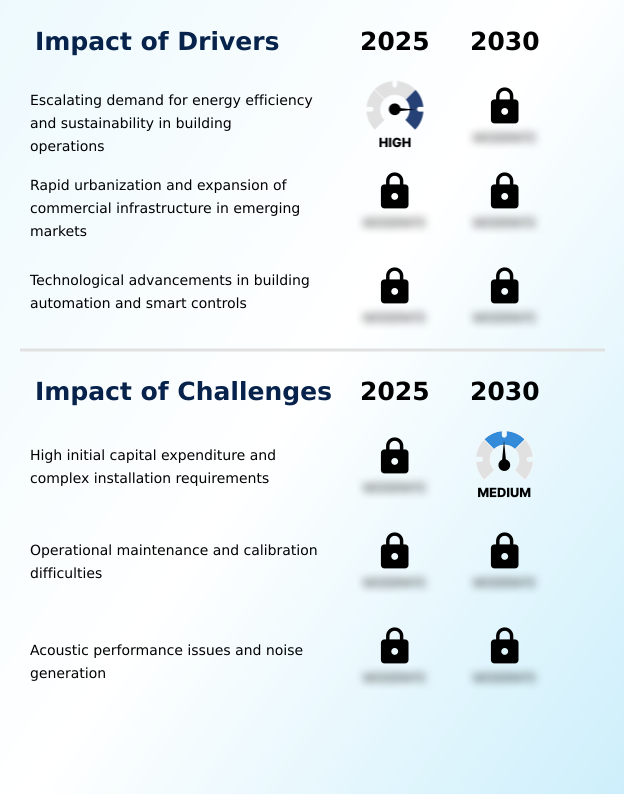
What are the key market drivers leading to the rise in the adoption of Variable Air Volume Box Industry?
- The escalating demand for greater energy efficiency and sustainability in building operations is a primary driver for the market.
- The drive toward achieving net-zero energy targets, underpinned by regulations like the energy performance of buildings directive, is a major market catalyst.
- Adoption of sustainable building practices is compelling a shift to systems that enable demand-controlled ventilation, which can reduce the energy consumption of an air handling unit by over 30%.
- The synergy between variable frequency drives on central fans and intelligent building automation systems creates a smart building ecosystem.
- This integration optimizes energy use, with the specification of electronically commutated motors in fan-powered units further reducing localized energy consumption by up to 50% compared to older motor types. These integrated building controls are fundamental to modern, high-performance building design.
What are the market trends shaping the Variable Air Volume Box Industry?
- The integration of IoT capabilities and advanced data analytics into variable air volume systems emerges as a transformative market trend. This evolution is reshaping building management for enhanced operational intelligence.
- A significant trend is the intensified focus on indoor environmental quality, pushing manufacturers to innovate beyond simple temperature control. Modern terminal unit designs prioritize superior terminal unit acoustics and acoustic attenuation to meet stringent noise criteria ratings, with some advanced models reducing perceptible noise by up to 25%.
- This shift addresses new indoor air quality standards and tenant expectations for healthier workspaces. The integration with building management systems enables predictive HVAC maintenance, reducing system downtime by 15%. VAV box retrofit solutions are increasingly incorporating sensors for occupancy-based airflow, optimizing ventilation and energy use in real time.
What challenges does the Variable Air Volume Box Industry face during its growth?
- The high initial capital expenditure and complex installation requirements associated with the technology present a key challenge to market growth.
- The complexity and cost of VAV system commissioning and balancing remain significant challenges. Improper static pressure control can lead to operational inefficiencies and acoustic issues, while inaccurate airflow sensors can degrade performance, with deviations of just 10% in airflow measurement accuracy impacting energy use.
- The threat from alternative technologies like variable refrigerant flow and chilled beam systems, which can offer simpler installation in certain scenarios, is persistent. Furthermore, the expense of a pneumatic to DDC upgrade, though beneficial long-term, presents a high initial financial barrier.
- The labor-intensive nature of VAV system balancing can increase project costs by 15-20% compared to less complex systems, deterring adoption in smaller-scale projects.
Exclusive Technavio Analysis on Customer Landscape
The variable air volume box market forecasting report includes the adoption lifecycle of the market, covering from the innovator’s stage to the laggard’s stage. It focuses on adoption rates in different regions based on penetration. Furthermore, the variable air volume box market report also includes key purchase criteria and drivers of price sensitivity to help companies evaluate and develop their market growth analysis strategies.
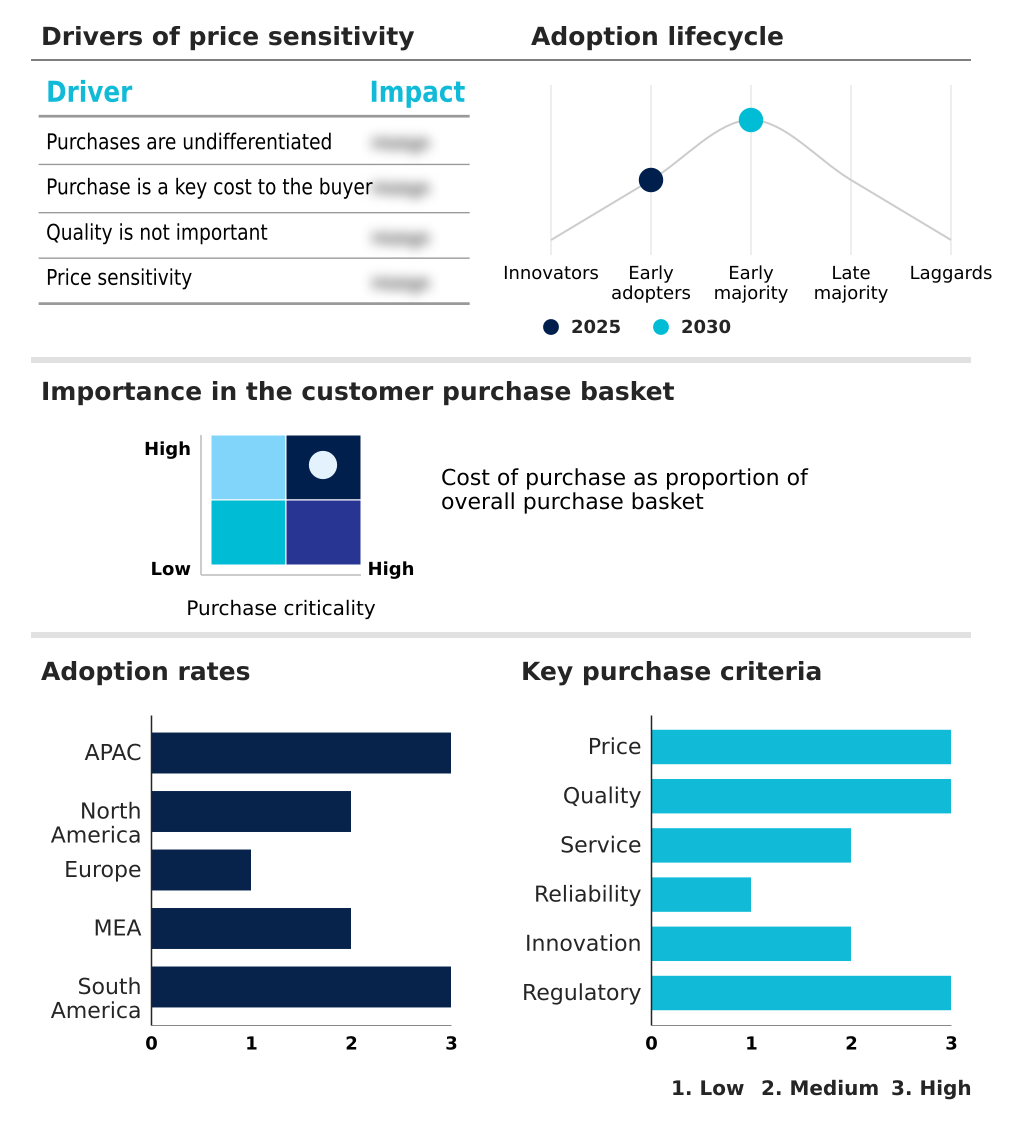
Customer Landscape of Variable Air Volume Box Industry
Competitive Landscape
Companies are implementing various strategies, such as strategic alliances, variable air volume box market forecast, partnerships, mergers and acquisitions, geographical expansion, and product/service launches, to enhance their presence in the industry.
Air Master - Core offerings center on advanced air terminal units and integrated controls, engineered to optimize building energy performance and enhance indoor environmental quality.
The industry research and growth report includes detailed analyses of the competitive landscape of the market and information about key companies, including:
- Air Master
- Aldes Group Export
- Anemostat, Inc.
- Barcol Air
- Carrier Global Corp.
- Daikin Industries Ltd.
- FlaktGroup Holding GmbH
- Johnson Controls International
- Lindab AB
- Metalaire
- Nailor Industries Inc.
- Pari Infrastructure Ltd.
- SRP Automation Pvt. Ltd.
- Swegon Group AB
- Titus
- Trane Technologies plc
- TROX SE
- Tuttle and Bailey
- Warren Technology Inc.
Qualitative and quantitative analysis of companies has been conducted to help clients understand the wider business environment as well as the strengths and weaknesses of key industry players. Data is qualitatively analyzed to categorize companies as pure play, category-focused, industry-focused, and diversified; it is quantitatively analyzed to categorize companies as dominant, leading, strong, tentative, and weak.
Recent Development and News in Variable air volume box market
- In February 2025, The International Energy Efficiency Bureau released updated guidelines mandating that all new commercial constructions in Tier 1 cities adopt adaptive airflow technologies, accelerating VAV unit deployment.
- In March 2025, Johnson Controls unveiled a new series of digital variable air volume controllers with advanced algorithms, designed specifically to enhance energy granularity and comfort in large-scale commercial towers.
- In April 2025, Johnson Controls International announced the acquisition of a specialized sensor technology firm to enhance the AI capabilities of their VAV box controllers, aiming to improve autonomous airflow regulation.
- In May 2025, Trane Technologies announced a strategic partnership with a major European real estate management firm to execute a comprehensive retrofit program, replacing outdated air distribution units with high-efficiency VAV boxes.
Dive into Technavio’s robust research methodology, blending expert interviews, extensive data synthesis, and validated models for unparalleled Variable Air Volume Box Market insights. See full methodology.
| Market Scope | |
|---|---|
| Page number | 293 |
| Base year | 2025 |
| Historic period | 2020-2024 |
| Forecast period | 2026-2030 |
| Growth momentum & CAGR | Accelerate at a CAGR of 6.7% |
| Market growth 2026-2030 | USD 2044.5 million |
| Market structure | Fragmented |
| YoY growth 2025-2026(%) | 6.3% |
| Key countries | China, Japan, India, South Korea, Australia, Indonesia, US, Canada, Mexico, Germany, UK, France, Italy, Spain, The Netherlands, Saudi Arabia, UAE, South Africa, Israel, Turkey, Brazil, Argentina and Colombia |
| Competitive landscape | Leading Companies, Market Positioning of Companies, Competitive Strategies, and Industry Risks |
Research Analyst Overview
- The variable air volume box market is defined by a technological shift toward smarter, more efficient air distribution. The core components, from the basic single-duct VAV to the more complex fan-powered VAV, dual-duct VAV, and induction VAV types, are now integral parts of cohesive building automation systems.
- Integration with the central air handling unit is managed through direct digital controls, which receive data from airflow sensors to modulate a damper actuator. This allows for precise pressure-independent control and dynamic HVAC zoning. A critical decision for facility managers is optimizing static pressure control for variable frequency drives, as improper setup can negate energy savings.
- The emphasis on indoor environmental quality has also elevated the importance of meeting stringent noise criteria ratings through advanced acoustic attenuation. In a recent analysis of building retrofits, projects that upgraded to terminal unit controllers with predictive algorithms achieved a 15% faster return on investment through optimized energy use compared to those with standard controls.
- This highlights the growing importance of software in hardware performance.
What are the Key Data Covered in this Variable Air Volume Box Market Research and Growth Report?
-
What is the expected growth of the Variable Air Volume Box Market between 2026 and 2030?
-
USD 2.04 billion, at a CAGR of 6.7%
-
-
What segmentation does the market report cover?
-
The report is segmented by Type (Single-duct VAV, Fan-powered VAV, Dual-duct VAV, and Induction VAV), Application (Commercial buildings, Industrial buildings, and Residential buildings), End-user (New installation, and Replacement) and Geography (APAC, North America, Europe, Middle East and Africa, South America)
-
-
Which regions are analyzed in the report?
-
APAC, North America, Europe, Middle East and Africa and South America
-
-
What are the key growth drivers and market challenges?
-
Escalating demand for energy efficiency and sustainability in building operations, High initial capital expenditure and complex installation requirements
-
-
Who are the major players in the Variable Air Volume Box Market?
-
Air Master, Aldes Group Export, Anemostat, Inc., Barcol Air, Carrier Global Corp., Daikin Industries Ltd., FlaktGroup Holding GmbH, Johnson Controls International, Lindab AB, Metalaire, Nailor Industries Inc., Pari Infrastructure Ltd., SRP Automation Pvt. Ltd., Swegon Group AB, Titus, Trane Technologies plc, TROX SE, Tuttle and Bailey and Warren Technology Inc.
-
Market Research Insights
- The market's dynamics are increasingly shaped by the push for intelligent and efficient building operations. A VAV box retrofit solution can yield operational energy savings of up to 40% compared to constant volume systems, driving a robust replacement market. The focus on energy-efficient HVAC design is intensified by corporate sustainability goals and stricter building codes.
- Smart VAV controller integration with occupancy sensors enables precise, demand-based airflow, reducing ventilation energy waste by over 50% in intermittently used spaces. As facility managers prioritize data-driven operations, systems offering seamless building management system compatibility and support for predictive HVAC maintenance are gaining a distinct competitive advantage, with such systems demonstrating a 15% reduction in unplanned service calls.
We can help! Our analysts can customize this variable air volume box market research report to meet your requirements.
 RIA -
RIA - 
