


Market Size and Growth 2024-2028
The vegetable seed market will flourish at a CAGR of 7.66% between 2023 and 2028 and reach USD 4.65 billion, driven by the growing demand for vegetables, rising food security concerns, and ongoing advancements in vegetable seed technology. The Indian seed market size in APAC will record strong growth supported by increasing adoption of hybrid seeds, government support initiatives, demand for high-quality agricultural inputs, as well as the rising demand for fresh vegetables and fruits.
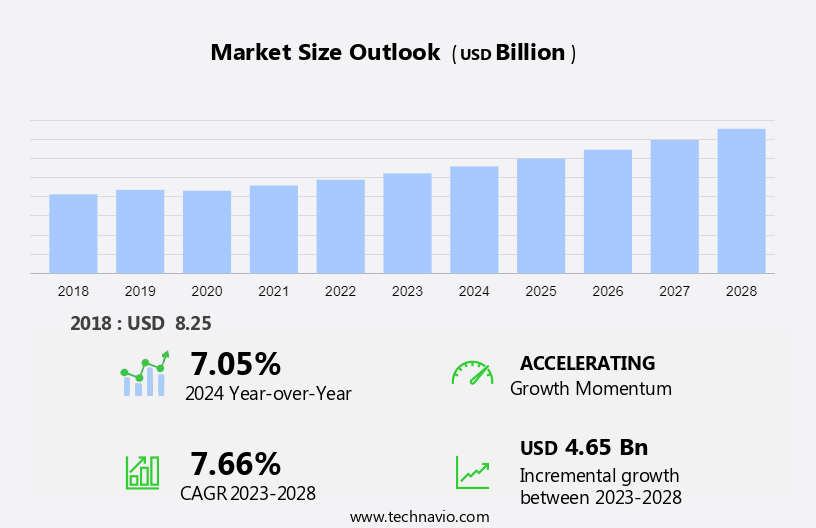
The market shows an accelerated CAGR during the forecast period.
To get additional information about the market report, Request Free Sample
Segment Overview
The market research and growth report forecasts market growth by revenue at global, regional & country levels and provides an analysis of the latest trends and growth opportunities from 2018 to 2028
- Type Outlook
- Inorganic
- Organic
- Product Outlook
- Conventional seeds
- GM seeds
- Region Outlook
- North America
- The U.S.
- Canada
- South America
- Chile
- Brazil
- Argentina
- Europe
- U.K.
- Germany
- France
- Rest of Europe
- APAC
- China
- India
- Middle East & Africa
- Saudi Arabia
- South Africa
- Rest of the Middle East & Africa
- North America
By Product:
Conventional Seeds: These are the most common type, obtained through traditional farming practices. They may involve synthetic pesticides, fertilizers, and even GMOs. They are generally more affordable but may not meet organic or non-GMO certification standards.
GM Seeds: Genetically modified seeds are engineered for specific traits like pest resistance, extended shelf life, and higher yields. While popular for their benefits, they face concerns about long-term environmental impact and consumer health.
By Type:
Organic Seeds: These seeds come from organic farming practices and are not treated with synthetic chemicals. They are preferred by consumers seeking healthy and sustainable food options.
Inorganic Seeds: These seeds are grown using conventional methods, often involving fertilizers, pesticides, and herbicides. They are generally more readily available and offer higher yields.
Key Regions
APAC is expected to contribute 37% to the market growth due to rising awareness about healthy eating and the importance of vegetables in a balanced diet.
Factors Contributing to APAC's Dominance:
- High Vegetable Consumption: Countries like China and India have a long tradition of vegetable consumption, leading to a high demand for diverse and high-quality seeds.
- Rising Disposable Income: Growing economies in the region are leading to an increase in disposable income, allowing consumers to spend more on fresh vegetables and premium seeds.
- Government Initiatives: Many APAC governments are promoting investments in agriculture and research & development of improved seed varieties, further propelling market growth.
- Focus on Food Security: With a large and growing population, ensuring food security is a major concern for APAC governments. High-yielding vegetable seeds play a crucial role in achieving this goal.
- Climate Diversity: The vastness of the APAC region offers diverse climates, requiring seed varieties adapted to specific conditions. This creates a demand for a wider range of vegetable seeds compared to other regions.
Market Drivers:
- Focus on High-Yielding Varieties: A major driver is the increasing demand for GM seeds that offer higher yields and improved resistance to pests and diseases. This is crucial as population growth puts pressure on limited arable land.
- Rising Investments in Agricultural Research: Public and private investments in agricultural research are leading to advancements in seed quality, disease resistance, and climate adaptability. This is fostering innovation in the vegetable seeds market.
- Shift Towards Healthy Eating: Growing consumer awareness about healthy eating habits is driving demand for premium vegetable seeds, including heirloom varieties, superfoods, and organic options.
- Urban Agriculture and Sustainability: Increasing urbanization is creating a demand for compact and high-yielding seeds suitable for urban gardens and vertical farming. Additionally, sustainable farming practices like crop rotation and agroecology are driving the demand for organic and open-pollinated seeds.
Market Challenges:
- Counterfeit Seeds: The presence of counterfeit seeds, especially in developing countries, is a major challenge. These low-quality seeds lead to crop failure and economic losses for farmers.
- Seed Patenting Issues: Concerns exist around intellectual property rights and seed patenting by large corporations. This can limit access to diverse seed varieties for farmers and hinder innovation.
- Balancing Efficiency with Tradition: Balancing the need for efficiency in large-scale farming with traditional practices that promote agricultural biodiversity is a key challenge. This includes preserving open-pollinated seeds and locally adapted vegetable varieties.
Market Trends:
- Advancements in Seed Technology: Developments in biotechnology, seed coating techniques, and precision breeding are leading to more resilient, disease-resistant, and climate-tolerant seeds.
- Focus on Locally Adapted Seeds: There's a growing interest in locally adapted vegetables and heirloom varieties, promoting seed diversity and fostering sustainable farming practices.
- Direct-to-consumer Seed Sales: Online platforms are enabling direct-to-consumer sales of specialty and organic seeds, catering to the growing demand for unique and healthy vegetable options.
Understanding these segmentation factors, drivers, challenges, and trends will help stakeholders in the vegetable seeds market make informed decisions. From seed developers to farmers and consumers, this knowledge can guide the development of innovative, sustainable, and accessible solutions for a thriving vegetable seeds market.
Company Overview
Companies are implementing various strategies, such as strategic alliances, partnerships, mergers and acquisitions, geographical expansion, and product/service launches, to enhance their presence in the market forecasting growth and analysis.
- Key Offering- Bejo Zaden B.V: The company offers vegetable grains under the brand Seminis that has a long-standing history of serving the unique needs of growers in open-field and greenhouse growing environments across diverse markets.
- Key Offering- DLF Seeds AS: The company offers vegetable seeds through its subsidiary Bejo Seeds, such as asparagus, broccoli, and brussels sprouts.
The market growth and forecasting report also includes detailed analyses of the competitive landscape of the market and information about 20 market companies, including: Akshay Seeds Pvt. Ltd., Bayer AG, Bejo Zaden B.V., DLF Seeds AS, East West Seed Group, Enza Zaden Beheer B.V., Gentex Seeds Pvt. Ltd., Kaveri Seeds, KWS SAAT SE and Co. KGaA, Limagrain, Mahyco Pvt. Ltd., Namdhari Seeds Pvt Ltd, Rijk Zwaan Zaadteelt en Zaadhandel BV, Sakata Seed Corp., Syngenta Crop Protection AG, Takii and Co. Ltd., UPL Ltd., VNR Seeds, W. Atlee Burpee and Co., and BASF SE
Market Analyst Overview
The global vegetable seeds market is experiencing a transformative shift driven by a growing emphasis on maintaining a balanced diet and incorporating essential nutrients to address health issues like obesity and eye-related problems. The market is witnessing an increasing demand for non-starchy vegetables such as lettuce and spinach, supporting weight management and promoting overall nutrition. Premium vegetable seeds play a crucial role in aligning with healthy eating trends, offering unique and specialty vegetables, including heirloom varieties and superfoods, catering to consumers' evolving preferences for organic produce and distinct flavor profiles. This shift towards healthier choices is evident not only among home gardeners but also in the practices of commercial farmers who are adopting organic and sustainable farming methods like agroecology, permaculture, and crop rotations.
Further, varied seed varieties designed for different climates and growing conditions, alongside advancements in agricultural technologies and modern seed varieties, address market accessibility challenges. However, seed patenting issues and the need for balancing efficiency in large-scale farming with traditional farming practices, including open-pollinated varieties and agricultural biodiversity, are considerations in the evolving market. Locally adapted vegetables, heirloom varieties like tomatoes, peppers, and eggplants, and cultivation methods such as protected and open field cultivation contribute to the market's sustainability and efficiency.
|
Market Scope |
|
|
Report Coverage |
Details |
|
Page number |
151 |
|
Base year |
2023 |
|
Historic period |
2018-2022 |
|
Forecast period |
2024-2028 |
|
Growth momentum & CAGR |
Accelerate at a CAGR of 7.66% |
|
Market Growth 2024-2028 |
USD 4.65 billion |
|
Market structure |
Fragmented |
|
YoY growth 2023-2024(%) |
7.05 |
|
Regional analysis |
APAC, North America, Europe, South America, and Middle East and Africa |
|
Performing market contribution |
APAC at 37% |
|
Key countries |
US, Canada, China, France, and Brazil |
|
Competitive landscape |
Leading Companies, Market Positioning of Companies, Competitive Strategies, and Industry Risks |
|
Key companies profiled |
Akshay Seeds Pvt. Ltd., Bayer AG, Bejo Zaden B.V., DLF Seeds AS, East West Seed Group, Enza Zaden Beheer B.V., Gentex Seeds Pvt. Ltd., Kaveri Seeds, KWS SAAT SE and Co. KGaA, Limagrain, Mahyco Pvt. Ltd., Namdhari Seeds Pvt Ltd, Rijk Zwaan Zaadteelt en Zaadhandel BV, Sakata Seed Corp., Syngenta Crop Protection AG, Takii and Co. Ltd., UPL Ltd., VNR Seeds, W. Atlee Burpee and Co., and BASF SE |
|
Market dynamics |
Parent market analysis, Market growth inducers and obstacles, Fast-growing and slow-growing segment analysis, COVID-19 impact and recovery analysis and future consumer dynamics, Market condition analysis for the forecast period. |
|
Customization purview |
If our market report has not included the data that you are looking for, you can reach out to our analysts and get segments customized. |
BUY NOW Full Report and Discover more
What are the Key Data Covered in this Market Research Report?
- CAGR of the market during the forecast period
- Detailed information on factors that will drive the growth of the market between 2024 and 2028
- Precise estimation of the market size and its contribution of the market in focus to the parent market
- Accurate predictions about upcoming trends and changes in consumer behavior
- Growth of the market across APAC, North America, Europe, South America, and Middle East and Africa
- A thorough analysis of the market’s competitive landscape and detailed information about companies
- Comprehensive analysis of factors that will challenge the growth of market companies
We can help! Our analysts can customize this market research report to meet your requirements. Get in touch
 RIA -
RIA - 
