


Voice Commerce Market Size 2026-2030
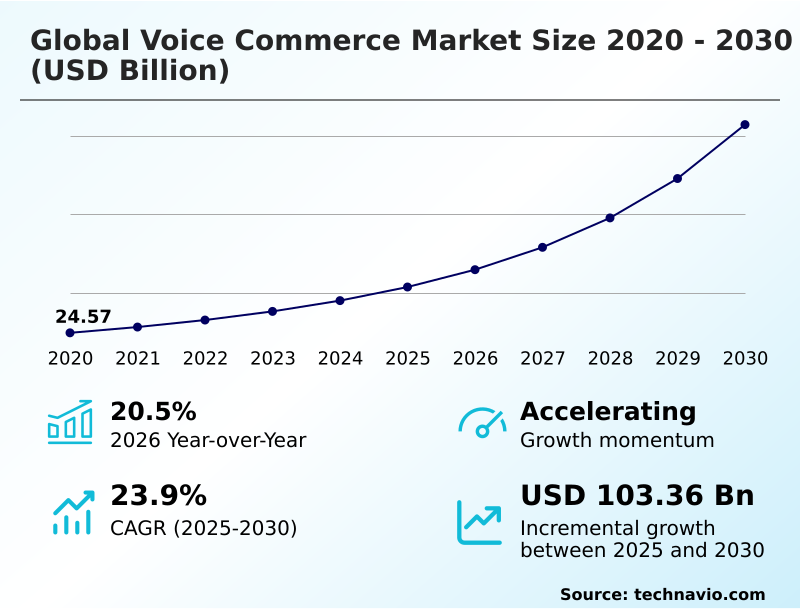
The voice commerce market size is valued to increase by USD 103.36 billion, at a CAGR of 23.9% from 2025 to 2030. Biometric voice payment authentication systems will drive the voice commerce market.
Major Market Trends & Insights
- North America dominated the market and accounted for a 39.1% growth during the forecast period.
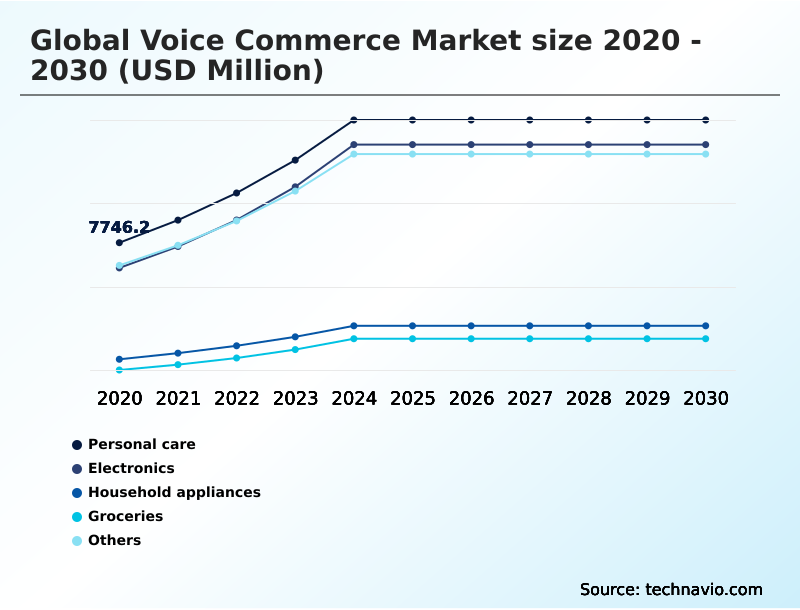
- By Application - Personal care segment was valued at USD 13.70 billion in 2024
- By Type - Smart speaker segment accounted for the largest market revenue share in 2024
Market Size & Forecast
- Market Opportunities: USD 132.50 billion
- Market Future Opportunities: USD 103.36 billion
- CAGR from 2025 to 2030 : 23.9%
Market Summary
- The voice commerce market is defined by its use of conversational artificial intelligence to enable a hands-free shopping experience across an ecosystem of connected devices. This technology leverages automatic speech recognition and natural language understanding to interpret user commands and execute transactions, moving beyond simple product discovery to full-scale payment authorization.
- A primary market driver is the demand for convenience, supported by innovations in biometric voice payment authentication that enhance security and create a frictionless checkout process. Key trends include the shift toward multimodal interface integration, where voice is augmented by screen-based visuals, and the rise of agentic commerce ecosystems that offer proactive assistance.
- For instance, a consumer packaged goods firm can automate subscription replenishments based on household consumption patterns predicted by AI, sending notifications and processing orders via voice commands. However, the industry faces challenges related to data privacy regulatory compliance and the need for high technical accuracy in understanding diverse dialects and accents.
What will be the Size of the Voice Commerce Market during the forecast period?
Get Key Insights on Market Forecast (PDF) Get Free Sample
How is the Voice Commerce Market Segmented?
The voice commerce industry research report provides comprehensive data (region-wise segment analysis), with forecasts and estimates in "USD million" for the period 2026-2030, as well as historical data from 2020-2024 for the following segments.
- Application
- Personal care
- Electronics
- Household appliances
- Groceries
- Others
- Type
- Smart speaker
- Voice assistant
- Virtual digital assistant
- End-user
- Consumer goods and retail
- Media and entertainment
- Healthcare
- Hospitality and travel
- Others
- Geography
- North America
- US
- Canada
- Mexico
- Europe
- UK
- Germany
- France
- APAC
- China
- Japan
- India
- South America
- Brazil
- Argentina
- Colombia
- Middle East and Africa
- Saudi Arabia
- UAE
- South Africa
- Rest of World (ROW)
- North America
By Application Insights
The personal care segment is estimated to witness significant growth during the forecast period.
The personal care segment is expanding as consumers use voice for replenishing beauty and hygiene products. High-frequency repeat purchases are streamlined through hands-free commands, integrating into daily grooming routines.
A key factor is the use of a voice driven diagnostic tool and conversational AI commerce to provide personalized recommendations based on purchase history, with some platforms featuring CRM integrated voice commerce.
This advisory experience, powered by an agentic ai search experience, reduces product return rate reduction by up to 15% by ensuring correct product selection.
Voice assistants like bixby voice assistant and siri voice assistant on smart device commerce ecosystems, including amazon echo ecosystem, facilitate reordering, while systems using azure voice services and einstein voice enable brands to build direct consumer relationships.
This is enhanced by ai powered catalog management and apple ecosystem transactions via devices like the dueros voice assistant.
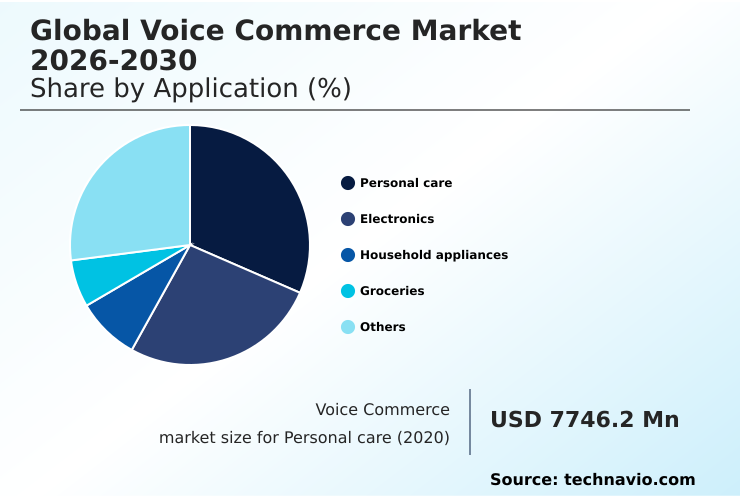
The Personal care segment was valued at USD 13.70 billion in 2024 and showed a gradual increase during the forecast period.
Regional Analysis
North America is estimated to contribute 39.1% to the growth of the global market during the forecast period.Technavio’s analysts have elaborately explained the regional trends and drivers that shape the market during the forecast period.
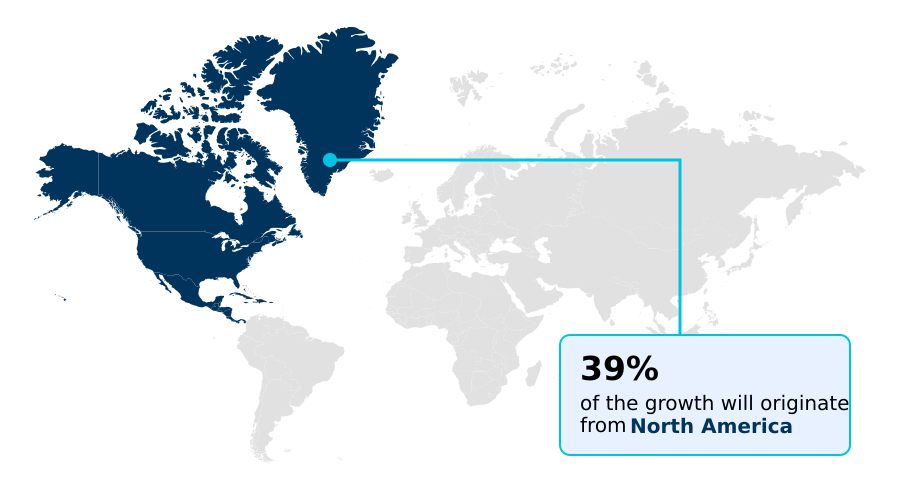
See How Voice Commerce Market Demand is Rising in North America Get Free Sample
The geographic landscape is led by North America, where a mature technological infrastructure and high consumer adoption create a fertile ground for a hands-free shopping experience.
This region serves as the primary hub for innovation in the conversational interface and far field microphone technology.
Growth in APAC is accelerating, driven by expanding internet access and a growing middle class, though it presents unique challenges for audio search optimization.
Across all regions, a key dynamic is the push for hyper personalization, with platforms leveraging a conversational shopping feature to improve engagement.
Advanced voice apis and conversational commerce solutions are being deployed globally, with systems like google assistant shopping and alexa voice shopping setting standards.
The integration of a voice ai platform and voice enabled search capabilities into smart audio commerce integration and other voice enabled speakers is critical for capturing market share, with some seeing a 20% uplift in user interaction following optimization for real time voice interaction.
Market Dynamics
Our researchers analyzed the data with 2025 as the base year, along with the key drivers, trends, and challenges. A holistic analysis of drivers will help companies refine their marketing strategies to gain a competitive advantage.
- The strategic implementation of voice commerce hinges on robust security and intuitive user experiences. The adoption of voice biometric payment authentication systems is foundational for establishing trust, creating a frictionless checkout with voice biometrics that is further secured through multi factor authentication for voice payments.
- On the user experience front, the development of a multimodal interface for consumer journey enhancement is a key trend, with some platforms reporting a 15% increase in task completion rates. This is especially true when a proactive service assistant for households anticipates needs, such as facilitating voice commands for grocery reordering.
- Success depends on the backend technology, including low latency communication for voice ai and the ability to scale globally through cloud scalability for global accessibility. Personalization is another critical pillar, with generative ai for conversion personalization and conversational shopping feature for negotiation driving engagement.
- As agentic commerce ecosystem adoption trends continue, overcoming challenges like data privacy in voice commerce and ensuring dialect accuracy in speech recognition will be paramount.
- The high integration costs for voice platforms are offset by the value derived from tools like voice driven skincare diagnostic tools and ai powered catalog management tools, all while optimizing audio search optimization for retail and leveraging real time synchronization across devices, including in-car systems with a heads up display for in car shopping.
- The scaling of passive voice biometric security scaling will be essential for widespread adoption.
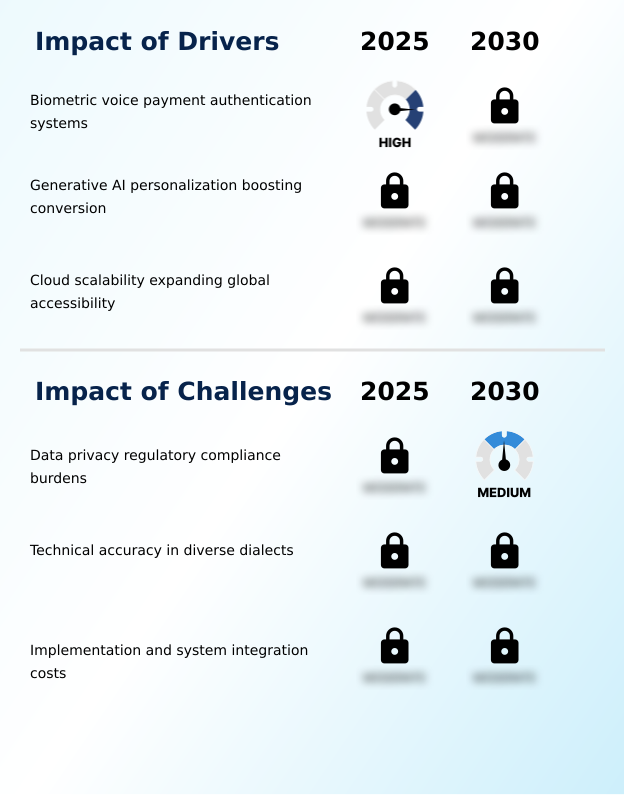
What are the key market drivers leading to the rise in the adoption of Voice Commerce Industry?
- Widespread adoption of biometric voice payment authentication systems is a key driver for market growth, enhancing transaction security and streamlining the consumer checkout process.
- Market growth is significantly driven by advancements in security and personalization. The adoption of biometric voice payment authentication, supported by a dedicated biometric processor, offers a frictionless checkout process and has been shown to reduce transaction fraud by over 25%.
- A sophisticated voice biometrics platform using conversational artificial intelligence can analyze vocal sentiment analysis to tailor interactions. This enables a proactive service assistant that anticipates user needs.
- Furthermore, generative ai personalization and the ability to conduct natural dialogue negotiation are increasing conversion rates by double digits in pilot programs.
- Security is bolstered by passive voice biometric security and multi factor authentication, while innovations like secure microphones and the underlying cloud scalability ensure reliable performance and a high degree of trust, which is essential for widespread adoption.
What are the market trends shaping the Voice Commerce Industry?
- The integration of multimodal interfaces that pair voice commands with visual and haptic feedback is becoming a standard market expectation. This approach enhances the consumer journey, particularly for complex or high-value purchases.
- Key market trends are centered on enhancing the consumer journey enhancement through sophisticated user interfaces. The move toward multimodal interface integration is critical, as combining voice with a high resolution image display and other visual and haptic feedback can reduce user cognitive load by up to 30%.
- This multi sensory experience is becoming standard, supported by technologies enabling real time synchronization across devices. The rise of agentic commerce ecosystems, powered by an omni modal foundation model, is reshaping interactions, particularly for in car shopping service via heads up displays.
- This requires advanced backend orchestration and low latency communication protocols to deliver a seamless, voice first visual always design. As a result, platforms providing tactile confirmation feedback see a 15% higher user satisfaction rate.
What challenges does the Voice Commerce Industry face during its growth?
- Navigating the complexities and burdens of data privacy regulatory compliance presents a significant challenge to sustained industry growth.
- The market faces significant hurdles related to data governance and technical performance. Navigating bulk data rule compliance and managing consent management platforms has become a major operational burden, with data subject requests increasing by over 246% in the last three years. This necessitates robust data sharing protocols and a focus on local processing privacy.
- Concurrently, achieving high dialect recognition accuracy remains a challenge for automatic speech recognition and natural language understanding systems, impacting the effectiveness of generative ai shopping assistants and other agentic ai solutions. The high system integration cost for implementing these ai driven commerce solutions also acts as a constraint.
- Furthermore, the deployment of a personalized shopping agent for household smart speaker usage requires careful management of personal data to maintain consumer trust.
Exclusive Technavio Analysis on Customer Landscape
The voice commerce market forecasting report includes the adoption lifecycle of the market, covering from the innovator’s stage to the laggard’s stage. It focuses on adoption rates in different regions based on penetration. Furthermore, the voice commerce market report also includes key purchase criteria and drivers of price sensitivity to help companies evaluate and develop their market growth analysis strategies.
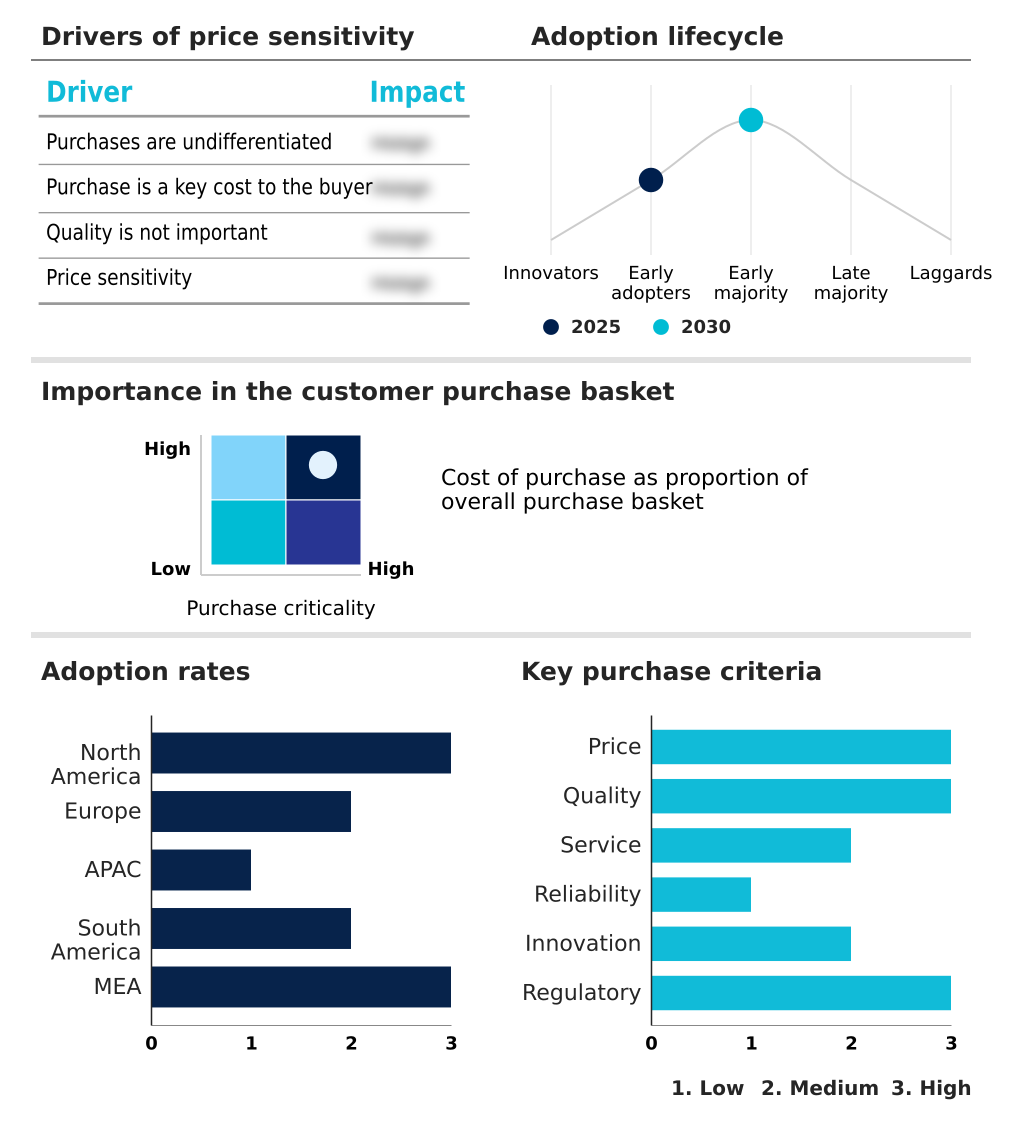
Customer Landscape of Voice Commerce Industry
Competitive Landscape
Companies are implementing various strategies, such as strategic alliances, voice commerce market forecast, partnerships, mergers and acquisitions, geographical expansion, and product/service launches, to enhance their presence in the industry.
Adobe Inc. - Key offerings include conversational AI platforms, multimodal commerce solutions, and voice-enabled CRM integrations designed to enhance customer engagement and enable frictionless transactions.
The industry research and growth report includes detailed analyses of the competitive landscape of the market and information about key companies, including:
- Adobe Inc.
- Agora Inc.
- Algolia Inc.
- Alibaba Cloud
- Amazon.com Inc.
- Apple Inc.
- Baidu Inc.
- BigCommerce Holdings Inc.
- CM.com NV
- Google LLC
- iAdvize SAS
- Microsoft Corp.
- Salesforce Inc.
- Samsung Electronics Co. Ltd.
- Sonos Inc.
- SoundHound AI Inc.
- Twilio Inc.
- Voiceflow Inc.
- Walmart Inc.
Qualitative and quantitative analysis of companies has been conducted to help clients understand the wider business environment as well as the strengths and weaknesses of key industry players. Data is qualitatively analyzed to categorize companies as pure play, category-focused, industry-focused, and diversified; it is quantitatively analyzed to categorize companies as dominant, leading, strong, tentative, and weak.
Recent Development and News in Voice commerce market
- In February 2025, Mastercard Inc. launched its advanced voice biometrics platform that utilizes deep learning to analyze distinct vocal traits, creating a secure digital voiceprint for financial transactions.
- In February 2025, Amazon.com Inc. introduced an updated multimodal shopping experience that synchronizes voice search with television screens and mobile devices in real time for a unified consumer journey.
- In January 2025, iAdvize SAS introduced generative AI shopping assistants designed to guide customers through the entire purchase journey from discovery to post-purchase support.
- In April 2025, The Federal Trade Commission published final amendments to COPPA, expanding requirements for online services that collect data from children, directly impacting household smart speaker usage.
Dive into Technavio’s robust research methodology, blending expert interviews, extensive data synthesis, and validated models for unparalleled Voice Commerce Market insights. See full methodology.
| Market Scope | |
|---|---|
| Page number | 315 |
| Base year | 2025 |
| Historic period | 2020-2024 |
| Forecast period | 2026-2030 |
| Growth momentum & CAGR | Accelerate at a CAGR of 23.9% |
| Market growth 2026-2030 | USD 103356.5 million |
| Market structure | Fragmented |
| YoY growth 2025-2026(%) | 20.5% |
| Key countries | US, Canada, Mexico, UK, Germany, France, Italy, Spain, The Netherlands, China, Japan, India, South Korea, Australia, Indonesia, Brazil, Argentina, Colombia, Saudi Arabia, UAE, South Africa, Turkey and Egypt |
| Competitive landscape | Leading Companies, Market Positioning of Companies, Competitive Strategies, and Industry Risks |
Research Analyst Overview
- The voice commerce market is evolving from simple command execution to sophisticated, context-aware interactions driven by conversational artificial intelligence. This shift is enabled by technologies like the voice biometrics platform, which supports passive voice biometric security and a frictionless checkout process through biometric voice payment authentication.
- The rise of agentic commerce ecosystems necessitates a strategic pivot in boardroom discussions toward integrating a voice ai platform capable of handling generative ai personalization and ai driven commerce solutions. Innovations such as the conversational shopping feature and voice driven diagnostic tool are becoming standard, powered by advanced natural language understanding and automatic speech recognition.
- For businesses, this means deploying ai powered catalog management and crm integrated voice commerce with systems like einstein voice. The user experience is enhanced by multimodal interface integration, combining voice with visual and haptic feedback on devices ranging from voice enabled speakers to those with heads up displays, all requiring backend orchestration and low latency communication protocols.
- As assistants like siri voice assistant, bixby voice assistant, and dueros voice assistant advance, and platforms like alexa voice shopping and google assistant shopping mature, the focus shifts to deploying secure microphones, biometric processors, and robust multi factor authentication. Agentic ai solutions and generative ai shopping assistants are redefining the amazon echo ecosystem and apple ecosystem transactions.
- Solutions leveraging azure voice services, smart audio commerce integration, and communication driven commerce solutions via voice apis are creating new avenues for smart device commerce and voice enabled search, with some achieving a 30% reduction in query processing time.
What are the Key Data Covered in this Voice Commerce Market Research and Growth Report?
-
What is the expected growth of the Voice Commerce Market between 2026 and 2030?
-
USD 103.36 billion, at a CAGR of 23.9%
-
-
What segmentation does the market report cover?
-
The report is segmented by Application (Personal care, Electronics, Household appliances, Groceries, and Others), Type (Smart speaker, Voice assistant, and Virtual digital assistant), End-user (Consumer goods and retail, Media and entertainment, Healthcare, Hospitality and travel, and Others) and Geography (North America, Europe, APAC, South America, Middle East and Africa)
-
-
Which regions are analyzed in the report?
-
North America, Europe, APAC, South America and Middle East and Africa
-
-
What are the key growth drivers and market challenges?
-
Biometric voice payment authentication systems, Data privacy regulatory compliance burdens
-
-
Who are the major players in the Voice Commerce Market?
-
Adobe Inc., Agora Inc., Algolia Inc., Alibaba Cloud, Amazon.com Inc., Apple Inc., Baidu Inc., BigCommerce Holdings Inc., CM.com NV, Google LLC, iAdvize SAS, Microsoft Corp., Salesforce Inc., Samsung Electronics Co. Ltd., Sonos Inc., SoundHound AI Inc., Twilio Inc., Voiceflow Inc. and Walmart Inc.
-
Market Research Insights
- The market's dynamics are shaped by the drive for a seamless hands-free shopping experience, which improves consumer journey enhancement and reduces cognitive load. This is balanced by the complexities of regulatory adherence, with data subject requests increasing by 246% in recent years, demanding robust consent management platforms.
- The adoption of a conversational interface, supported by far field microphone technology, is critical for household smart speaker usage. Technologies enabling hyper personalization and natural dialogue negotiation are boosting conversion rates by over 15% in certain segments.
- As enterprises focus on audio search optimization and real time voice interaction, they must also address the system integration cost and challenges of dialect recognition accuracy. Innovations like the personalized shopping agent and the use of a dedicated biometric processor for local processing privacy are key to building consumer trust and expanding the agentic ai search experience across platforms.
We can help! Our analysts can customize this voice commerce market research report to meet your requirements.
 RIA -
RIA - 
