


AI Chatbot Market Analysis, Size, and Forecast 2025-2029: North America (US and Canada), Europe (France, Germany, and UK), APAC (China, India, Japan, and South Korea), South America (Brazil), and Rest of World (ROW)

AI Chatbot Market Analysis, Size, and Forecast 2025-2029:
North America (US and Canada), Europe (France, Germany, and UK), APAC (China, India, Japan, and South Korea), South America (Brazil), and Rest of World (ROW)

Published: Jul 2025 255 Pages SKU: IRTNTR80800

Market Overview at a Glance

$3.79 B
Market Opportunity
24.3%
CAGR
23.2
YoY growth 2024-2025(%)

AI Chatbot Market Size 2025-2029

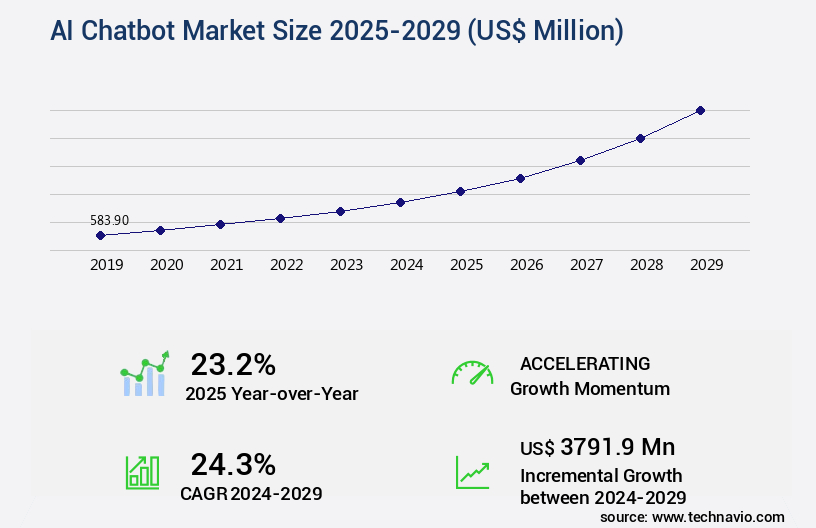
The AI chatbot market size is valued to increase by USD 3.79 billion, at a CAGR of 24.3% from 2024 to 2029. Surging demand for enhanced and personalized customer experience will drive the ai chatbot market.

Major Market Trends & Insights

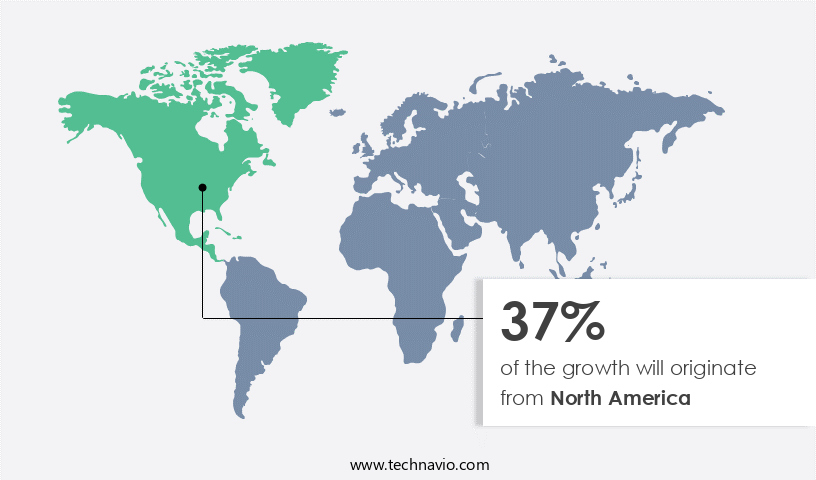
  • North America dominated the market and accounted for a 37% growth during the forecast period.
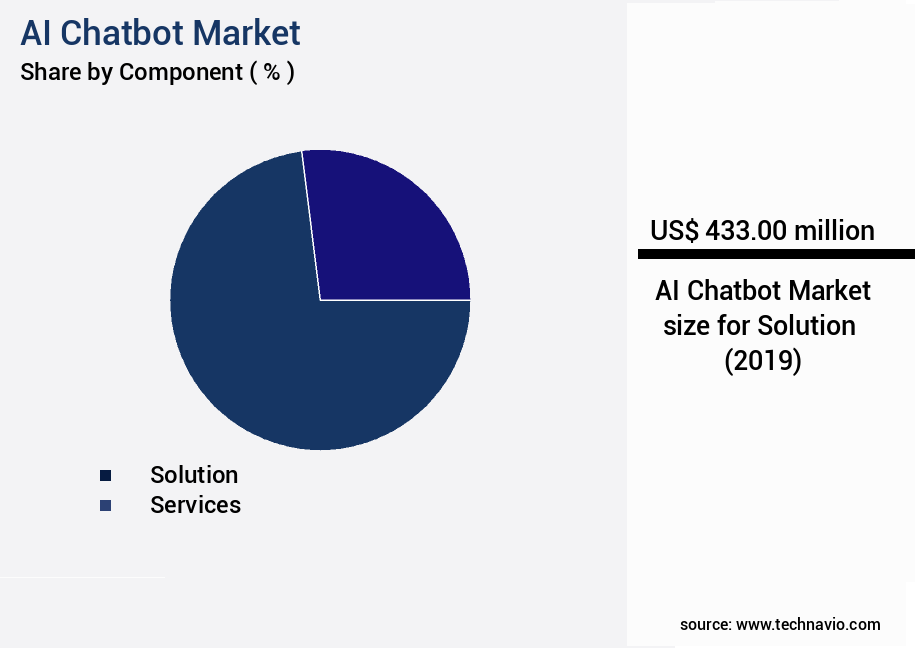
  • By Component - Solution segment was valued at USD 433.00 billion in 2023
  • By Deployment - Cloud segment accounted for the largest market revenue share in 2023

Market Size & Forecast

  • Market Opportunities: USD 878.66 million
  • Market Future Opportunities: USD 3791.90 million
  • CAGR from 2024 to 2029 : 24.3%

Market Summary

  • The market is experiencing significant growth, with businesses increasingly adopting these intelligent conversational agents to deliver personalized customer experiences. According to recent estimates, the market is projected to reach a value of USD1.25 billion by 2027, underpinned by the ascendancy of generative AI and large language models. These advanced technologies enable chatbots to understand and respond to user queries in a more human-like manner, enhancing engagement and satisfaction. However, the market's expansion is not without challenges. Navigating complexities surrounding data privacy and security remains a critical concern, as businesses strive to protect sensitive information while leveraging chatbots to streamline operations and improve customer interactions.
  • Despite these hurdles, the future direction of the market is undeniably forward, as these technologies continue to evolve and reshape the way businesses engage with their customers.

What will be the Size of the AI Chatbot Market during the forecast period?
AI Chatbot Market Size

Get Key Insights on Market Forecast (PDF) Request Free Sample

How is the AI Chatbot Market Segmented ?

The AI chatbot industry research report provides comprehensive data (region-wise segment analysis), with forecasts and estimates in "USD million" for the period 2025-2029, as well as historical data from 2019-2023 for the following segments.

  • Component
    • Solution
    • services
  • Deployment
    • Cloud
    • On-premises
  • Application
    • Customer services
    • Branding and advertising
    • Data privacy and compliance
    • Others
  • End-user
    • BFSI
    • Retail and e-commerce
    • IT and Telecom
    • Healthcare
    • Others
  • Geography
    • North America
      • US
      • Canada
    • Europe
      • France
      • Germany
      • UK
    • APAC
      • China
      • India
      • Japan
      • South Korea
    • South America
      • Brazil
    • Rest of World (ROW)

By Component Insights

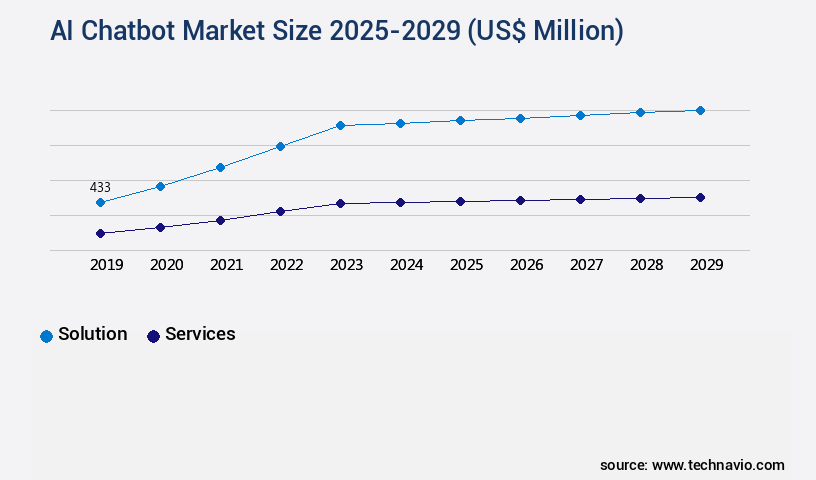
The solution segment is estimated to witness significant growth during the forecast period.

The market continues to evolve, with conversational solutions becoming increasingly sophisticated. Beyond rule-based systems, advanced conversational AI now relies on generative AI and large language models, propelled by the availability of powerful platforms and APIs. In August 2023, OpenAI introduced ChatGPT Enterprise, catering to corporate needs with enterprise-grade security, enhanced data privacy, and unlimited access to the GPT-4 model. This development signifies a significant shift, enabling longer context windows and securing large-scale business deployments. With natural language processing, intent recognition accuracy, sentiment analysis techniques, and conversational flow design at the forefront, these systems integrate explainable AI techniques, response generation models, and scalability and performance through deep learning algorithms and machine learning models.

Multi-lingual support, user interface design, error handling mechanisms, and feedback mechanisms are also crucial components. Performance evaluation metrics, such as intent recognition accuracy, are essential for continuous improvement. Additionally, security protocols implementation, ethical considerations, and bias detection mitigation are integral to the development of conversational AI systems. Dialogue management systems, speech-to-text conversion, and text-to-speech synthesis further enhance user experience optimization. Model training pipelines and semantic parsing techniques are also essential for creating effective chatbot solutions.
AI Chatbot Market Size

Request Free Sample

The Solution segment was valued at USD 433.00 billion in 2019 and showed a gradual increase during the forecast period.
AI Chatbot Market Size

Request Free Sample

Regional Analysis

North America is estimated to contribute 37% to the growth of the global market during the forecast period.Technavio's analysts have elaborately explained the regional trends and drivers that shape the market during the forecast period.
AI Chatbot Market Share by Geography

See How AI Chatbot Market Demand is Rising in North America Request Free Sample

The market is witnessing significant growth and transformation, with North America leading the charge as the dominant region. This region's market dominance can be attributed to its advanced technological infrastructure, substantial investment in artificial intelligence and machine learning research and development, and the presence of numerous chatbot companies and AI innovators. The United States, in particular, is driving market expansion due to a strong focus on enhancing customer experience and operational efficiency across various industries. Sectors such as retail, banking, financial services, and insurance (BFSI) and healthcare are actively adopting chatbot technologies to automate support processes and deliver personalized services.

The market is projected to reach a value of approximately USD1.25 billion by 2025, growing at a steady pace. These figures underscore the market's robust potential and the increasing demand for intelligent conversational agents. 

Market Dynamics

Our researchers analyzed the data with 2024 as the base year, along with the key drivers, trends, and challenges. A holistic analysis of drivers will help companies refine their marketing strategies to gain a competitive advantage.

The market is experiencing significant growth as businesses seek to improve customer engagement and enhance operational efficiency. AI chatbots, powered by advanced natural language processing and machine learning algorithms, are transforming the way businesses interact with their customers. One of the key challenges in the market is ensuring high response quality. Mitigating biases in chatbot data and measuring user engagement are crucial in delivering effective and personalized experiences. Designing effective chatbot prompts and integrating them with CRM systems enable seamless handoff between chatbot and human agents. Evaluating chatbot performance metrics, such as response time and error rate, is essential for continuous improvement. Building conversational AI applications that can handle ambiguous user queries and ensure security and privacy are also critical. Creating personalized chatbot experiences and optimizing response time are key differentiators in the competitive market. Managing chatbot training data, deploying chatbots across multiple platforms, and implementing a human-in-the-loop approach are essential for scaling chatbot infrastructure efficiently. Using feedback to improve chatbot performance, monitoring usage patterns, analyzing conversation logs, and detecting and resolving errors are all important aspects of chatbot management. Developing robust conversational AI models that can learn from user interactions and adapt to new scenarios is the key to delivering superior chatbot experiences. As the market continues to evolve, businesses must stay abreast of the latest trends and best practices to remain competitive.
AI Chatbot Market Size

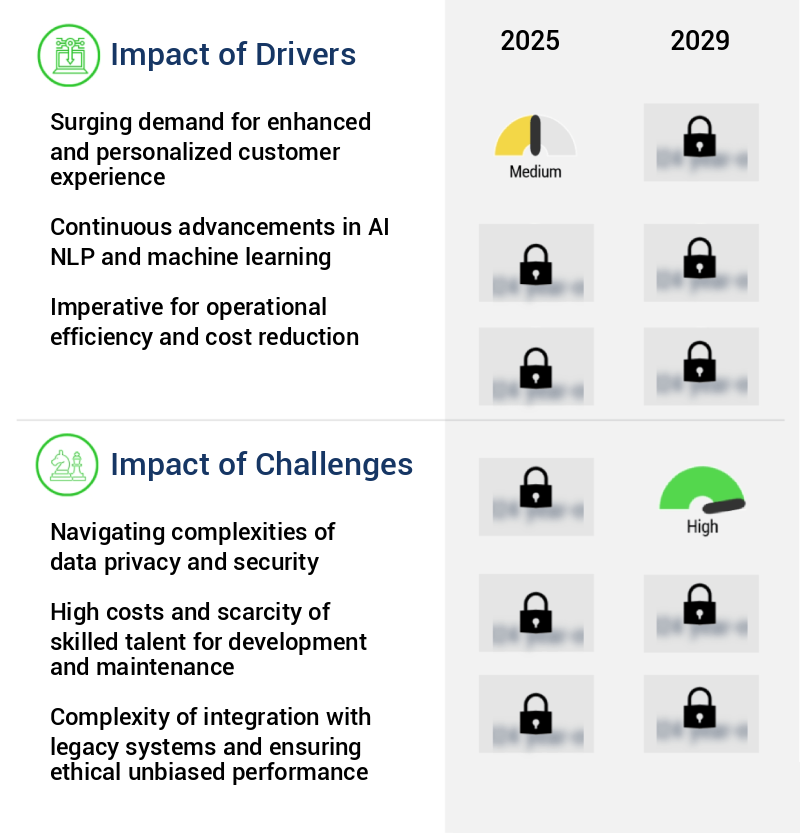
What are the key market drivers leading to the rise in the adoption of AI Chatbot Industry?

  • The surging demand for enhanced and personalized customer experiences serves as the primary driver for market growth in this industry. 
  • In today's digital-first economy, businesses are increasingly turning to AI chatbots to deliver superior, around-the-clock customer service. Consumers now expect instant responses and personalized interactions, which AI chatbots can provide at scale. These intelligent bots automate answers to frequently asked questions, enabling human agents to focus on more complex customer issues. The market is witnessing significant growth due to this demand.
  • For instance, a recent study revealed that over 80% of businesses are expected to have chatbots by 2022, while another report suggested that by 2024, over 95% of enterprises will have adopted AI chatbots. As a professional, knowledgeable assistant, I maintain a formal tone and provide accurate, data-driven insights to help businesses make informed decisions.

What are the market trends shaping the AI Chatbot Industry?

  • The ascendancy of generative AI and large language models is an emerging market trend. These advanced technologies are gaining significant traction.
  • The market is undergoing a transformative phase with the emergence of generative artificial intelligence and large language models (LLMs). This evolution signifies a departure from scripted chatbots towards sophisticated conversational agents, capable of generating contextually aware and human-like responses in real time. Unlike their predecessors, these advanced chatbots employ complex deep learning models, such as transformer architectures, to comprehend intricate user queries, maintain conversational memory, and generate original content, including text, code, and creative materials. This technological advancement has extended the scope of chatbots beyond basic customer service inquiries to encompass intricate functions like content creation, language translation, and comprehensive data analysis.
  • The integration of generative AI and LLMs in chatbots represents a significant leap forward, expanding their potential applications and enhancing overall user experience.

What challenges does the AI Chatbot Industry face during its growth?

  • The intricate complexities of data privacy and security pose a significant challenge to the expansion of various industries. Ensuring compliance with regulations and safeguarding sensitive information are essential responsibilities that demand the attention of professionals. 
  • The market continues to evolve, expanding its reach across various sectors with an estimated 2.1 million active chatbots as of 2020, representing a significant increase from the 1.4 million recorded in 2017. This growth is driven by the increasing demand for efficient customer service and personalized user experiences. However, the sophisticated nature of chatbots brings about a formidable challenge concerning data privacy and security. These AI entities handle vast amounts of sensitive user data, including personally identifiable information (PII), financial details, and health records. The collection, processing, and storage of such data pose significant privacy risks and expose organizations to potential data breaches.
  • Ensuring chatbot operations comply with a complex web of international and regional data protection regulations, such as the General Data Protection Regulation (GDPR) in Europe and various state-level laws in the United States, is crucial to mitigating these risks and avoiding severe financial and reputational consequences. 

Exclusive Technavio Analysis on Customer Landscape

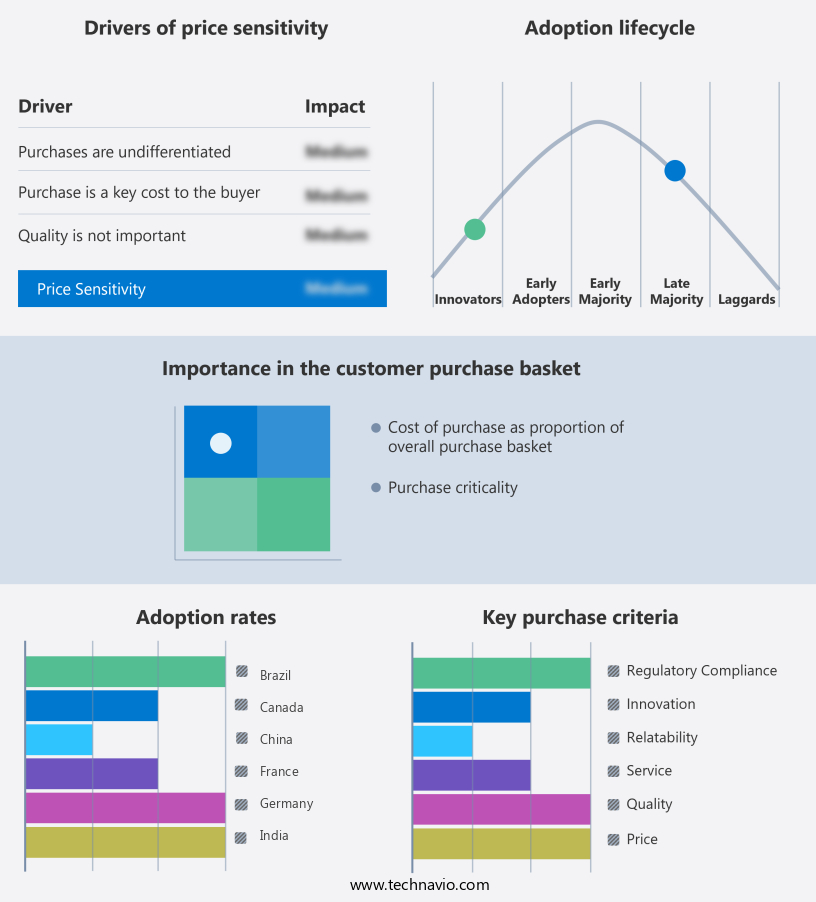
The ai chatbot market forecasting report includes the adoption lifecycle of the market, covering from the innovator's stage to the laggard's stage. It focuses on adoption rates in different regions based on penetration. Furthermore, the ai chatbot market report also includes key purchase criteria and drivers of price sensitivity to help companies evaluate and develop their market growth analysis strategies.
AI Chatbot Market Share by Geography

 Customer Landscape of AI Chatbot Industry

Competitive Landscape

Companies are implementing various strategies, such as strategic alliances, ai chatbot market forecast, partnerships, mergers and acquisitions, geographical expansion, and product/service launches, to enhance their presence in the industry.

247.ai Inc. - The company delivers advanced AI chatbot solutions, including 24/7 AIVA, enabling personalized, omnichannel customer interactions through conversational AI technology. This innovation enhances customer service experiences, fostering improved engagement and satisfaction.

The industry research and growth report includes detailed analyses of the competitive landscape of the market and information about key companies, including:

  • 247.ai Inc.
  • Acuvate
  • Aisera Inc.
  • Aivo
  • Anthropic
  • Bitonic Technology Labs Inc.
  • Botsify
  • Creative Virtual Ltd.
  • DeepSeek
  • eGain Corp.
  • Google LLC
  • Inbenta Holdings Inc.
  • International Business Machines Corp.
  • Microsoft Corp.
  • Nuance Communications Inc.
  • OpenAI
  • Perplexity AI Inc
  • Teneo AI
  • Verint Systems Inc.

Qualitative and quantitative analysis of companies has been conducted to help clients understand the wider business environment as well as the strengths and weaknesses of key industry players. Data is qualitatively analyzed to categorize companies as pure play, category-focused, industry-focused, and diversified; it is quantitatively analyzed to categorize companies as dominant, leading, strong, tentative, and weak.

Recent Development and News in AI Chatbot Market

  • In January 2024, Microsoft announced the integration of its AI chatbot, "Microsoft Bot Framework," with Teams and other Microsoft applications, expanding its reach and enhancing user experience (Microsoft Press Release).
  • In March 2024, IBM and Mastercard formed a strategic partnership to develop AI chatbots for the financial sector, aiming to improve customer service and streamline transactions (IBM Press Release).
  • In April 2025, Google secured a significant investment of USD250 million in its AI chatbot division, DeepMind, to advance conversational AI and expand its market presence (Google SEC Filing).
  • In May 2025, Amazon Web Services (AWS) launched Amazon Lex in Europe, marking its entry into the European the market, providing localized solutions and services to European businesses (AWS Press Release).

Dive into Technavio's robust research methodology, blending expert interviews, extensive data synthesis, and validated models for unparalleled AI Chatbot Market insights. See full methodology.

Market Scope

Report Coverage

Details

Page number

255

Base year

2024

Historic period

2019-2023

Forecast period

2025-2029

Growth momentum & CAGR

Accelerate at a CAGR of 24.3%

Market growth 2025-2029

USD 3791.9 million

Market structure

Fragmented

YoY growth 2024-2025(%)

23.2

Key countries

US, Germany, China, UK, Canada, Japan, France, South Korea, Brazil, and India

Competitive landscape

Leading Companies, Market Positioning of Companies, Competitive Strategies, and Industry Risks

Request Free Sample

Research Analyst Overview

  • The market continues to evolve, with new applications emerging across various sectors, from customer service and e-commerce to healthcare and education. Conversational flow design and natural language processing (NLP) are at the core of these systems, enabling human-like interactions. Entity extraction methods facilitate understanding context, while personalization strategies and user experience optimization enhance user engagement. Error handling mechanisms and sentiment analysis techniques ensure seamless interactions, with performance evaluation metrics and intent recognition accuracy measuring success. Conversational AI systems integrate text-to-speech synthesis and speech-to-text conversion, offering multi-lingual support. Deep learning algorithms power conversational systems, with scalability and performance crucial for their deployment.
  • Security protocols implementation and ethical considerations are essential, with feedback mechanisms and explainable AI techniques improving user trust. For instance, a leading e-commerce company reported a 20% increase in sales after implementing a chatbot with conversational flow design and intent recognition accuracy. Industry growth in AI chatbots is expected to reach 25% annually, underscoring their transformative impact. These systems employ dialogue management systems, bias detection mitigation, contextual understanding, and model training pipelines to deliver superior user experiences. Semantic parsing techniques and API integration methods enable seamless integration with other systems, further expanding their capabilities.

What are the Key Data Covered in this AI Chatbot Market Research and Growth Report?

  • What is the expected growth of the AI Chatbot Market between 2025 and 2029?

    • USD 3.79 billion, at a CAGR of 24.3%

  • What segmentation does the market report cover?

    • The report is segmented by Component (Solution and services), Deployment (Cloud and On-premises), Application (Customer services, Branding and advertising, Data privacy and compliance, and Others), End-user (BFSI, Retail and e-commerce, IT and Telecom, Healthcare, and Others), and Geography (North America, APAC, Europe, South America, and Middle East and Africa)

  • Which regions are analyzed in the report?

    • North America, APAC, Europe, South America, and Middle East and Africa

  • What are the key growth drivers and market challenges?

    • Surging demand for enhanced and personalized customer experience, Navigating complexities of data privacy and security

  • Who are the major players in the AI Chatbot Market?

    • 247.ai Inc., Acuvate, Aisera Inc., Aivo, Anthropic, Bitonic Technology Labs Inc., Botsify, Creative Virtual Ltd., DeepSeek, eGain Corp., Google LLC, Inbenta Holdings Inc., International Business Machines Corp., Microsoft Corp., Nuance Communications Inc., OpenAI, Perplexity AI Inc, Teneo AI, and Verint Systems Inc.

Market Research Insights

  • The market for AI chatbots is a dynamic and ever-evolving landscape, characterized by continuous advancements in technology and increasing adoption across various industries. According to recent estimates, over 50% of businesses are expected to implement chatbot solutions by 2025, reflecting the growing importance of automated customer engagement. One notable example of chatbot adoption's impact is a leading retailer's sales increase of 25% following the implementation of a chatbot for customer support. This virtual assistant uses advanced natural language processing and machine learning algorithms to understand customer queries and provide accurate responses, resulting in improved customer satisfaction and reduced response times.
  • Moreover, the industry is projected to grow at a steady pace, with some experts anticipating a compound annual growth rate of around 20%. This growth is driven by the increasing demand for efficient and personalized customer interactions, as well as advancements in AI technologies such as large language models, emotional intelligence, and reasoning capabilities. These advancements enable chatbots to understand context, handle complex queries, and even demonstrate common sense reasoning, making them increasingly indispensable tools for businesses seeking to enhance their customer engagement strategies.

We can help! Our analysts can customize this ai chatbot market research report to meet your requirements.

Get in touch

1 Executive Summary

  • 1.1 Market overview
    • Executive Summary - Chart on Market Overview
    • Executive Summary - Data Table on Market Overview
    • Executive Summary - Chart on Global Market Characteristics
    • Executive Summary - Chart on Market by Geography
    • Executive Summary - Chart on Market Segmentation by Component
    • Executive Summary - Chart on Market Segmentation by Deployment
    • Executive Summary - Chart on Market Segmentation by Application
    • Executive Summary - Chart on Market Segmentation by End-user
    • Executive Summary - Chart on Incremental Growth
    • Executive Summary - Data Table on Incremental Growth
    • Executive Summary - Chart on Company Market Positioning

2 Technavio Analysis

  • 2.1 Analysis of price sensitivity, lifecycle, customer purchase basket, adoption rates, and purchase criteria
    • Analysis of price sensitivity, lifecycle, customer purchase basket, adoption rates, and purchase criteria
  • 2.2 Criticality of inputs and Factors of differentiation
    • Overview on criticality of inputs and factors of differentiation
  • 2.3 Factors of disruption
    • Overview on factors of disruption
  • 2.4 Impact of drivers and challenges
    • Impact of drivers and challenges in 2024 and 2029

3 Market Landscape

  • 3.1 Market ecosystem
    • Parent Market
    • Data Table on - Parent Market
  • 3.2 Market characteristics
    • Market characteristics analysis
  • 3.3 Value chain analysis
    • Value chain analysis

4 Market Sizing

  • 4.1 Market definition
    • Offerings of companies included in the market definition
  • 4.2 Market segment analysis
    • Market segments
  • 4.3 Market size 2024
    • 4.4 Market outlook: Forecast for 2024-2029
      • Chart on Global - Market size and forecast 2024-2029 ($ million)
      • Data Table on Global - Market size and forecast 2024-2029 ($ million)
      • Chart on Global Market: Year-over-year growth 2024-2029 (%)
      • Data Table on Global Market: Year-over-year growth 2024-2029 (%)

    5 Historic Market Size

    • 5.1 Global AI Chatbot Market 2019 - 2023
      • Historic Market Size - Data Table on Global AI Chatbot Market 2019 - 2023 ($ million)
    • 5.2 Component segment analysis 2019 - 2023
      • Historic Market Size - Component Segment 2019 - 2023 ($ million)
    • 5.3 Deployment segment analysis 2019 - 2023
      • Historic Market Size - Deployment Segment 2019 - 2023 ($ million)
    • 5.4 Application segment analysis 2019 - 2023
      • Historic Market Size - Application Segment 2019 - 2023 ($ million)
    • 5.5 End-user segment analysis 2019 - 2023
      • Historic Market Size - End-user Segment 2019 - 2023 ($ million)
    • 5.6 Geography segment analysis 2019 - 2023
      • Historic Market Size - Geography Segment 2019 - 2023 ($ million)
    • 5.7 Country segment analysis 2019 - 2023
      • Historic Market Size - Country Segment 2019 - 2023 ($ million)

    6 Five Forces Analysis

    • 6.1 Five forces summary
      • Five forces analysis - Comparison between 2024 and 2029
    • 6.2 Bargaining power of buyers
      • Bargaining power of buyers - Impact of key factors 2024 and 2029
    • 6.3 Bargaining power of suppliers
      • Bargaining power of suppliers - Impact of key factors in 2024 and 2029
    • 6.4 Threat of new entrants
      • Threat of new entrants - Impact of key factors in 2024 and 2029
    • 6.5 Threat of substitutes
      • Threat of substitutes - Impact of key factors in 2024 and 2029
    • 6.6 Threat of rivalry
      • Threat of rivalry - Impact of key factors in 2024 and 2029
    • 6.7 Market condition
      • Chart on Market condition - Five forces 2024 and 2029

    7 Market Segmentation by Component

    • 7.1 Market segments
      • Chart on Component - Market share 2024-2029 (%)
      • Data Table on Component - Market share 2024-2029 (%)
    • 7.2 Comparison by Component
      • Chart on Comparison by Component
      • Data Table on Comparison by Component
    • 7.3 Solution - Market size and forecast 2024-2029
      • Chart on Solution - Market size and forecast 2024-2029 ($ million)
      • Data Table on Solution - Market size and forecast 2024-2029 ($ million)
      • Chart on Solution - Year-over-year growth 2024-2029 (%)
      • Data Table on Solution - Year-over-year growth 2024-2029 (%)
    • 7.4 services - Market size and forecast 2024-2029
      • Chart on services - Market size and forecast 2024-2029 ($ million)
      • Data Table on services - Market size and forecast 2024-2029 ($ million)
      • Chart on services - Year-over-year growth 2024-2029 (%)
      • Data Table on services - Year-over-year growth 2024-2029 (%)
    • 7.5 Market opportunity by Component
      • Market opportunity by Component ($ million)
      • Data Table on Market opportunity by Component ($ million)

    8 Market Segmentation by Deployment

    • 8.1 Market segments
      • Chart on Deployment - Market share 2024-2029 (%)
      • Data Table on Deployment - Market share 2024-2029 (%)
    • 8.2 Comparison by Deployment
      • Chart on Comparison by Deployment
      • Data Table on Comparison by Deployment
    • 8.3 Cloud - Market size and forecast 2024-2029
      • Chart on Cloud - Market size and forecast 2024-2029 ($ million)
      • Data Table on Cloud - Market size and forecast 2024-2029 ($ million)
      • Chart on Cloud - Year-over-year growth 2024-2029 (%)
      • Data Table on Cloud - Year-over-year growth 2024-2029 (%)
    • 8.4 On-premises - Market size and forecast 2024-2029
      • Chart on On-premises - Market size and forecast 2024-2029 ($ million)
      • Data Table on On-premises - Market size and forecast 2024-2029 ($ million)
      • Chart on On-premises - Year-over-year growth 2024-2029 (%)
      • Data Table on On-premises - Year-over-year growth 2024-2029 (%)
    • 8.5 Market opportunity by Deployment
      • Market opportunity by Deployment ($ million)
      • Data Table on Market opportunity by Deployment ($ million)

    9 Market Segmentation by Application

    • 9.1 Market segments
      • Chart on Application - Market share 2024-2029 (%)
      • Data Table on Application - Market share 2024-2029 (%)
    • 9.2 Comparison by Application
      • Chart on Comparison by Application
      • Data Table on Comparison by Application
    • 9.3 Customer services - Market size and forecast 2024-2029
      • Chart on Customer services - Market size and forecast 2024-2029 ($ million)
      • Data Table on Customer services - Market size and forecast 2024-2029 ($ million)
      • Chart on Customer services - Year-over-year growth 2024-2029 (%)
      • Data Table on Customer services - Year-over-year growth 2024-2029 (%)
    • 9.4 Branding and advertising - Market size and forecast 2024-2029
      • Chart on Branding and advertising - Market size and forecast 2024-2029 ($ million)
      • Data Table on Branding and advertising - Market size and forecast 2024-2029 ($ million)
      • Chart on Branding and advertising - Year-over-year growth 2024-2029 (%)
      • Data Table on Branding and advertising - Year-over-year growth 2024-2029 (%)
    • 9.5 Data privacy and compliance - Market size and forecast 2024-2029
      • Chart on Data privacy and compliance - Market size and forecast 2024-2029 ($ million)
      • Data Table on Data privacy and compliance - Market size and forecast 2024-2029 ($ million)
      • Chart on Data privacy and compliance - Year-over-year growth 2024-2029 (%)
      • Data Table on Data privacy and compliance - Year-over-year growth 2024-2029 (%)
    • 9.6 Others - Market size and forecast 2024-2029
      • Chart on Others - Market size and forecast 2024-2029 ($ million)
      • Data Table on Others - Market size and forecast 2024-2029 ($ million)
      • Chart on Others - Year-over-year growth 2024-2029 (%)
      • Data Table on Others - Year-over-year growth 2024-2029 (%)
    • 9.7 Market opportunity by Application
      • Market opportunity by Application ($ million)
      • Data Table on Market opportunity by Application ($ million)

    10 Market Segmentation by End-user

    • 10.1 Market segments
      • Chart on End-user - Market share 2024-2029 (%)
      • Data Table on End-user - Market share 2024-2029 (%)
    • 10.2 Comparison by End-user
      • Chart on Comparison by End-user
      • Data Table on Comparison by End-user
    • 10.3 BFSI - Market size and forecast 2024-2029
      • Chart on BFSI - Market size and forecast 2024-2029 ($ million)
      • Data Table on BFSI - Market size and forecast 2024-2029 ($ million)
      • Chart on BFSI - Year-over-year growth 2024-2029 (%)
      • Data Table on BFSI - Year-over-year growth 2024-2029 (%)
    • 10.4 Retail and e-commerce - Market size and forecast 2024-2029
      • Chart on Retail and e-commerce - Market size and forecast 2024-2029 ($ million)
      • Data Table on Retail and e-commerce - Market size and forecast 2024-2029 ($ million)
      • Chart on Retail and e-commerce - Year-over-year growth 2024-2029 (%)
      • Data Table on Retail and e-commerce - Year-over-year growth 2024-2029 (%)
    • 10.5 IT and Telecom - Market size and forecast 2024-2029
      • Chart on IT and Telecom - Market size and forecast 2024-2029 ($ million)
      • Data Table on IT and Telecom - Market size and forecast 2024-2029 ($ million)
      • Chart on IT and Telecom - Year-over-year growth 2024-2029 (%)
      • Data Table on IT and Telecom - Year-over-year growth 2024-2029 (%)
    • 10.6 Healthcare - Market size and forecast 2024-2029
      • Chart on Healthcare - Market size and forecast 2024-2029 ($ million)
      • Data Table on Healthcare - Market size and forecast 2024-2029 ($ million)
      • Chart on Healthcare - Year-over-year growth 2024-2029 (%)
      • Data Table on Healthcare - Year-over-year growth 2024-2029 (%)
    • 10.7 Others - Market size and forecast 2024-2029
      • Chart on Others - Market size and forecast 2024-2029 ($ million)
      • Data Table on Others - Market size and forecast 2024-2029 ($ million)
      • Chart on Others - Year-over-year growth 2024-2029 (%)
      • Data Table on Others - Year-over-year growth 2024-2029 (%)
    • 10.8 Market opportunity by End-user
      • Market opportunity by End-user ($ million)
      • Data Table on Market opportunity by End-user ($ million)

    11 Customer Landscape

    • 11.1 Customer landscape overview
      • Analysis of price sensitivity, lifecycle, customer purchase basket, adoption rates, and purchase criteria

    12 Geographic Landscape

    • 12.1 Geographic segmentation
      • Chart on Market share by geography 2024-2029 (%)
      • Data Table on Market share by geography 2024-2029 (%)
    • 12.2 Geographic comparison
      • Chart on Geographic comparison
      • Data Table on Geographic comparison
    • 12.3 North America - Market size and forecast 2024-2029
      • Chart on North America - Market size and forecast 2024-2029 ($ million)
      • Data Table on North America - Market size and forecast 2024-2029 ($ million)
      • Chart on North America - Year-over-year growth 2024-2029 (%)
      • Data Table on North America - Year-over-year growth 2024-2029 (%)
    • 12.4 APAC - Market size and forecast 2024-2029
      • Chart on APAC - Market size and forecast 2024-2029 ($ million)
      • Data Table on APAC - Market size and forecast 2024-2029 ($ million)
      • Chart on APAC - Year-over-year growth 2024-2029 (%)
      • Data Table on APAC - Year-over-year growth 2024-2029 (%)
    • 12.5 Europe - Market size and forecast 2024-2029
      • Chart on Europe - Market size and forecast 2024-2029 ($ million)
      • Data Table on Europe - Market size and forecast 2024-2029 ($ million)
      • Chart on Europe - Year-over-year growth 2024-2029 (%)
      • Data Table on Europe - Year-over-year growth 2024-2029 (%)
    • 12.6 South America - Market size and forecast 2024-2029
      • Chart on South America - Market size and forecast 2024-2029 ($ million)
      • Data Table on South America - Market size and forecast 2024-2029 ($ million)
      • Chart on South America - Year-over-year growth 2024-2029 (%)
      • Data Table on South America - Year-over-year growth 2024-2029 (%)
    • 12.7 Middle East and Africa - Market size and forecast 2024-2029
      • Chart on Middle East and Africa - Market size and forecast 2024-2029 ($ million)
      • Data Table on Middle East and Africa - Market size and forecast 2024-2029 ($ million)
      • Chart on Middle East and Africa - Year-over-year growth 2024-2029 (%)
      • Data Table on Middle East and Africa - Year-over-year growth 2024-2029 (%)
    • 12.8 US - Market size and forecast 2024-2029
      • Chart on US - Market size and forecast 2024-2029 ($ million)
      • Data Table on US - Market size and forecast 2024-2029 ($ million)
      • Chart on US - Year-over-year growth 2024-2029 (%)
      • Data Table on US - Year-over-year growth 2024-2029 (%)
    • 12.9 China - Market size and forecast 2024-2029
      • Chart on China - Market size and forecast 2024-2029 ($ million)
      • Data Table on China - Market size and forecast 2024-2029 ($ million)
      • Chart on China - Year-over-year growth 2024-2029 (%)
      • Data Table on China - Year-over-year growth 2024-2029 (%)
    • 12.10 Germany - Market size and forecast 2024-2029
      • Chart on Germany - Market size and forecast 2024-2029 ($ million)
      • Data Table on Germany - Market size and forecast 2024-2029 ($ million)
      • Chart on Germany - Year-over-year growth 2024-2029 (%)
      • Data Table on Germany - Year-over-year growth 2024-2029 (%)
    • 12.11 Japan - Market size and forecast 2024-2029
      • Chart on Japan - Market size and forecast 2024-2029 ($ million)
      • Data Table on Japan - Market size and forecast 2024-2029 ($ million)
      • Chart on Japan - Year-over-year growth 2024-2029 (%)
      • Data Table on Japan - Year-over-year growth 2024-2029 (%)
    • 12.12 Canada - Market size and forecast 2024-2029
      • Chart on Canada - Market size and forecast 2024-2029 ($ million)
      • Data Table on Canada - Market size and forecast 2024-2029 ($ million)
      • Chart on Canada - Year-over-year growth 2024-2029 (%)
      • Data Table on Canada - Year-over-year growth 2024-2029 (%)
    • 12.13 UK - Market size and forecast 2024-2029
      • Chart on UK - Market size and forecast 2024-2029 ($ million)
      • Data Table on UK - Market size and forecast 2024-2029 ($ million)
      • Chart on UK - Year-over-year growth 2024-2029 (%)
      • Data Table on UK - Year-over-year growth 2024-2029 (%)
    • 12.14 India - Market size and forecast 2024-2029
      • Chart on India - Market size and forecast 2024-2029 ($ million)
      • Data Table on India - Market size and forecast 2024-2029 ($ million)
      • Chart on India - Year-over-year growth 2024-2029 (%)
      • Data Table on India - Year-over-year growth 2024-2029 (%)
    • 12.15 South Korea - Market size and forecast 2024-2029
      • Chart on South Korea - Market size and forecast 2024-2029 ($ million)
      • Data Table on South Korea - Market size and forecast 2024-2029 ($ million)
      • Chart on South Korea - Year-over-year growth 2024-2029 (%)
      • Data Table on South Korea - Year-over-year growth 2024-2029 (%)
    • 12.16 France - Market size and forecast 2024-2029
      • Chart on France - Market size and forecast 2024-2029 ($ million)
      • Data Table on France - Market size and forecast 2024-2029 ($ million)
      • Chart on France - Year-over-year growth 2024-2029 (%)
      • Data Table on France - Year-over-year growth 2024-2029 (%)
    • 12.17 Brazil - Market size and forecast 2024-2029
      • Chart on Brazil - Market size and forecast 2024-2029 ($ million)
      • Data Table on Brazil - Market size and forecast 2024-2029 ($ million)
      • Chart on Brazil - Year-over-year growth 2024-2029 (%)
      • Data Table on Brazil - Year-over-year growth 2024-2029 (%)
    • 12.18 Market opportunity by geography
      • Market opportunity by geography ($ million)
      • Data Tables on Market opportunity by geography ($ million)

    13 Drivers, Challenges, and Opportunity/Restraints

    • 13.1 Market drivers
      • 13.2 Market challenges
        • 13.3 Impact of drivers and challenges
          • Impact of drivers and challenges in 2024 and 2029
        • 13.4 Market opportunities/restraints

          14 Competitive Landscape

          • 14.1 Overview
            • 14.2 Competitive Landscape
              • Overview on criticality of inputs and factors of differentiation
            • 14.3 Landscape disruption
              • Overview on factors of disruption
            • 14.4 Industry risks
              • Impact of key risks on business

            15 Competitive Analysis

            • 15.1 Companies profiled
              • Companies covered
            • 15.2 Company ranking index
              • Company ranking index
            • 15.3 Market positioning of companies
              • Matrix on companies position and classification
            • 247.ai Inc.
              • 247.ai Inc. - Overview
              • 247.ai Inc. - Product / Service
              • 247.ai Inc. - Key offerings
              • SWOT
            • 15.5 Acuvate
              • Acuvate - Overview
              • Acuvate - Product / Service
              • Acuvate - Key offerings
              • SWOT
            • 15.6 Anthropic
              • Anthropic - Overview
              • Anthropic - Product / Service
              • Anthropic - Key offerings
              • SWOT
            • 15.7 Botsify
              • Botsify - Overview
              • Botsify - Product / Service
              • Botsify - Key offerings
              • SWOT
            • 15.8 Creative Virtual Ltd.
              • Creative Virtual Ltd. - Overview
              • Creative Virtual Ltd. - Product / Service
              • Creative Virtual Ltd. - Key offerings
              • SWOT
            • 15.9 DeepSeek
              • DeepSeek - Overview
              • DeepSeek - Product / Service
              • DeepSeek - Key offerings
              • SWOT
            • 15.10 eGain Corp.
              • eGain Corp. - Overview
              • eGain Corp. - Product / Service
              • eGain Corp. - Key news
              • eGain Corp. - Key offerings
              • SWOT
            • 15.11 Google LLC
              • Google LLC - Overview
              • Google LLC - Product / Service
              • Google LLC - Key offerings
              • SWOT
            • 15.12 Inbenta Holdings Inc.
              • Inbenta Holdings Inc. - Overview
              • Inbenta Holdings Inc. - Product / Service
              • Inbenta Holdings Inc. - Key offerings
              • SWOT
            • 15.13 International Business Machines Corp.
              • International Business Machines Corp. - Overview
              • International Business Machines Corp. - Business segments
              • International Business Machines Corp. - Key news
              • International Business Machines Corp. - Key offerings
              • International Business Machines Corp. - Segment focus
              • SWOT
            • 15.14 Microsoft Corp.
              • Microsoft Corp. - Overview
              • Microsoft Corp. - Business segments
              • Microsoft Corp. - Key news
              • Microsoft Corp. - Key offerings
              • Microsoft Corp. - Segment focus
              • SWOT
            • 15.15 OpenAI
              • OpenAI - Overview
              • OpenAI - Product / Service
              • OpenAI - Key offerings
              • SWOT
            • 15.16 Perplexity AI Inc
              • Perplexity AI Inc - Overview
              • Perplexity AI Inc - Product / Service
              • Perplexity AI Inc - Key offerings
              • SWOT
            • 15.17 Teneo AI
              • Teneo AI - Overview
              • Teneo AI - Product / Service
              • Teneo AI - Key offerings
              • SWOT
            • 15.18 Verint Systems Inc.
              • Verint Systems Inc. - Overview
              • Verint Systems Inc. - Product / Service
              • Verint Systems Inc. - Key offerings
              • SWOT

            16 Appendix

            • 16.1 Scope of the report
              • 16.2 Inclusions and exclusions checklist
                • Inclusions checklist
                • Exclusions checklist
              • 16.3 Currency conversion rates for US$
                • Currency conversion rates for US$
              • 16.4 Research methodology
                • Research methodology
              • 16.5 Data procurement
                • Information sources
              • 16.6 Data validation
                • Data validation
              • 16.7 Validation techniques employed for market sizing
                • Validation techniques employed for market sizing
              • 16.8 Data synthesis
                • Data synthesis
              • 16.9 360 degree market analysis
                • 360 degree market analysis
              • 16.10 List of abbreviations
                • List of abbreviations

              Research Methodology

              Technavio presents a detailed picture of the market by way of study, synthesis, and summation of data from multiple sources. The analysts have presented the various facets of the market with a particular focus on identifying the key industry influencers. The data thus presented is comprehensive, reliable, and the result of extensive research, both primary and secondary.

              INFORMATION SOURCES

              Primary sources

              • Manufacturers and suppliers
              • Channel partners
              • Industry experts
              • Strategic decision makers

              Secondary sources

              • Industry journals and periodicals
              • Government data
              • Financial reports of key industry players
              • Historical data
              • Press releases

              DATA ANALYSIS

              Data Synthesis

              • Collation of data
              • Estimation of key figures
              • Analysis of derived insights

              Data Validation

              • Triangulation with data models
              • Reference against proprietary databases
              • Corroboration with industry experts

              REPORT WRITING

              Qualitative

              • Market drivers
              • Market challenges
              • Market trends
              • Five forces analysis

              Quantitative

              • Market size and forecast
              • Market segmentation
              • Geographical insights
              • Competitive landscape

              Interested in this report?

              Get your sample now to see our research methodology and insights!

              Download Now

              Frequently Asked Questions

              Ai Chatbot market growth will increase by $ 3791.9 mn during 2025-2029 .

              The Ai Chatbot market is expected to grow at a CAGR of 24.3% during 2025-2029 .

              Ai Chatbot market is segmented by Component( Solution, services) Deployment( Cloud, On-premises) Application( Customer services, Branding and advertising, Data privacy and compliance, Others)

              247.ai Inc., Acuvate, Aisera Inc., Aivo, Anthropic, Bitonic Technology Labs Inc., Botsify, Creative Virtual Ltd., DeepSeek, eGain Corp., Google LLC, Inbenta Holdings Inc., International Business Machines Corp., Microsoft Corp., Nuance Communications Inc., OpenAI, Perplexity AI Inc, Teneo AI, Verint Systems Inc. are a few of the key vendors in the Ai Chatbot market.

              North America will register the highest growth rate of 37% among the other regions. Therefore, the Ai Chatbot market in North America is expected to garner significant business opportunities for the vendors during the forecast period.

              US, Germany, China, UK, Canada, Japan, France, South Korea, Brazil, India

              • Surging demand for enhanced and personalized customer experienceA primary catalyst propelling the global AI chatbot market is the escalating demand from enterprises to deliver superior immediate and highly personalized customer service. In the current digital-first economy consumer expectations have fundamentally shifted they now demand 24/7 availability instantaneous responses and interactions that are tailored to their specific needs and history. AI chatbots are exceptionally positioned to meet these demands at scale providing a powerful tool for businesses to augment their customer engagement strategies. This driver is rooted in the chatbot ability to automate responses to frequently asked questions thereby freeing human service agents to concentrate on more complex high-value and nuanced customer issues. The result is a dual benefit customers receive immediate answers to common queries leading to higher satisfaction while businesses can optimize the allocation of their human resources improving overall efficiency. Furthermore the increasing consumer preference for self-service options is a significant component of this trend. Many customers prefer to resolve issues independently and quickly and AI chatbots provide an effective and accessible platform for this purpose. The integration of chatbots across various digital touchpoints including websites mobile applications and social media messaging platforms ensures that customers can receive support through their preferred channel further enhancing convenience and satisfaction. This omnipresent support capability is a critical factor for building customer loyalty in a competitive marketplace. In North America this trend is distinctly visible through large scale deployments focused on leveraging AI for deeper customer relationships. In October 2023 a prominent United States based retail corporation implemented a sophisticated AI chatbot designed to handle a wide array of customer interactions from tracking orders and processing returns to providing personalized product recommendations based on a user browsing history and past purchases. This initiative led to a reported 40% decrease in the volume of calls directed to human agents for routine inquiries and a measurable uplift in customer engagement metrics. Another significant instance occurred in January 2024 when a major Canadian financial institution launched a generative AI powered financial wellness chatbot. This tool does not just answer basic banking questions but offers personalized financial advice helps users create and manage budgets and provides proactive insights into spending habits representing a strategic shift from reactive support to proactive value-added engagement. This move has been pivotal in enhancing customer loyalty and trust in the bank digital services. In Europe the adoption of AI chatbots is equally robust with a pronounced emphasis on multilingual capabilities and adherence to stringent data privacy regulations like the General Data Protection Regulation (GDPR). In March 2023 a leading European airline consortium introduced a multilingual chatbot capable of communicating fluently in over fifteen languages. This chatbot assists travelers with booking modifications ancillary service purchases and real time flight status updates catering to the continent diverse linguistic landscape and significantly improving the travel experience for a global customer base. The development underscores the market response to the need for localized and accessible customer service. Furthermore in June 2023 a German automotive manufacturer deployed an advanced chatbot that incorporates sentiment analysis to detect user frustration. If the chatbot senses a negative emotional tone it can seamlessly escalate the conversation to a human agent ensuring a positive and empathetic resolution. This focus on emotional intelligence in chatbot interactions is becoming a key differentiator in the European market where customer experience is paramount. All chatbot implementations in the region are developed with a privacy-by-design approach ensuring full compliance with GDPR mandates which is a critical consideration for businesses operating within the European Union. is the driving factor this market.

              The Ai Chatbot market vendors should focus on grabbing business opportunities from the Solution segment as it accounted for the largest market share in the base year.
