



AI Enterprise Search Platforms Market Size 2026-2030
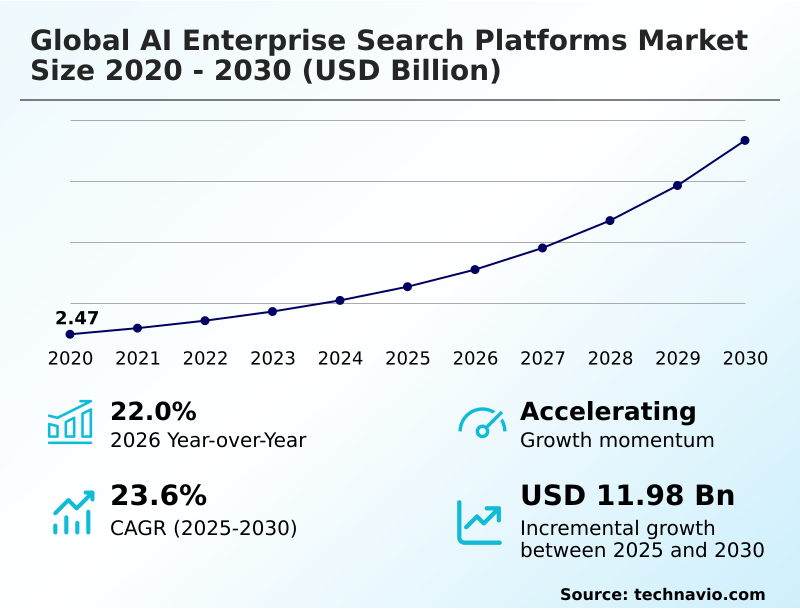
The ai enterprise search platforms market size is valued to increase by USD 11.98 billion, at a CAGR of 23.6% from 2025 to 2030. Exponential proliferation of unstructured data across corporate ecosystem will drive the ai enterprise search platforms market.
Major Market Trends & Insights
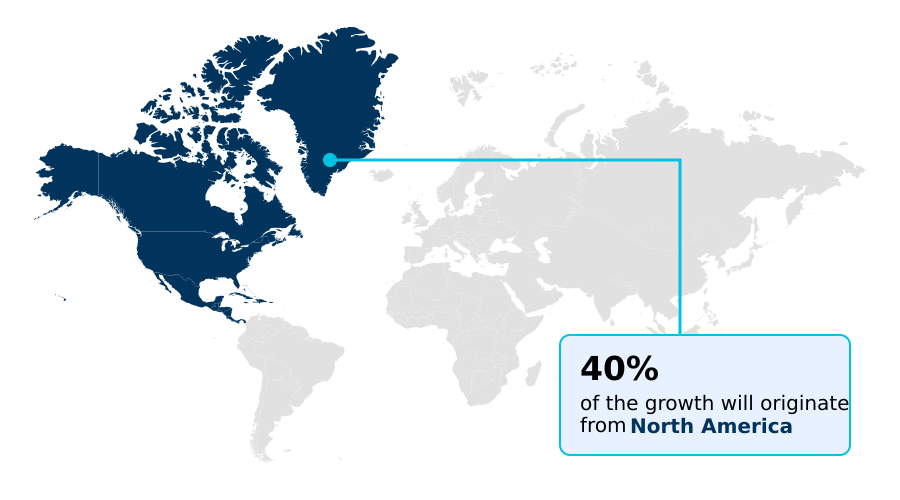
- North America dominated the market and accounted for a 39.6% growth during the forecast period.
- By Component - Software segment was valued at USD 3.66 billion in 2024
- By Deployment - Cloud segment accounted for the largest market revenue share in 2024
Market Size & Forecast
- Market Opportunities: USD 15.87 billion
- Market Future Opportunities: USD 11.98 billion
- CAGR from 2025 to 2030 : 23.6%
Market Summary
- The AI Enterprise Search Platforms market is being reshaped by the critical need for unified discovery layers that can navigate the vast expanse of corporate data. Organizations are moving beyond keyword-based tools toward solutions employing semantic understanding models and retrieval-augmented generation to interpret user intent and deliver contextually relevant answers.
- This shift is driven by the demand for enhanced employee productivity and seamless knowledge democratization in an increasingly digital workplace. For instance, a multinational firm can leverage an intelligent search platform to accelerate its R&D cycle by enabling engineers to instantly retrieve technical schematics and maintenance records from decades of siloed project data, significantly reducing manual research time.
- As hybrid work models become standard, these platforms serve as the connective tissue of an organization, making its collective intelligence accessible. However, progress is tempered by challenges such as the complexities of data governance, ensuring privacy compliance, and mitigating the risk of information hallucination, which require robust verification mechanisms and a focus on responsible AI deployment.
What will be the Size of the AI Enterprise Search Platforms Market during the forecast period?
Get Key Insights on Market Forecast (PDF) Get Free Sample
How is the AI Enterprise Search Platforms Market Segmented?
The ai enterprise search platforms industry research report provides comprehensive data (region-wise segment analysis), with forecasts and estimates in "USD million" for the period 2026-2030, as well as historical data from 2020-2024 for the following segments.
- Component
- Software
- Services
- Deployment
- Cloud
- On premises
- Hybrid
- End-user
- Information technology
- BFSI
- Healthcare and life sciences
- Manufacturing
- Others
- Geography
- North America
- US
- Canada
- Mexico
- Europe
- Germany
- UK
- France
- APAC
- China
- Japan
- India
- Middle East and Africa
- Saudi Arabia
- UAE
- South Africa
- South America
- Brazil
- Argentina
- Colombia
- Rest of World (ROW)
- North America
By Component Insights
The software segment is estimated to witness significant growth during the forecast period.
The software component is the core of AI Enterprise Search Platforms, evolving beyond simple retrieval to offer sophisticated intelligent document processing. These platforms leverage advanced semantic search and generative AI architectures to function as proactive intelligence systems.
By using query intent recognition and semantic understanding models, the software provides conversational search interfaces addressing unstructured data proliferation challenges. This evolution, incorporating retrieval-augmented generation, facilitates knowledge democratization and significantly reduces cognitive load.
Implementations have demonstrated decision-making acceleration and enhanced employee productivity, with some achieving over a 25% improvement in information discovery cycle times, showcasing clear operational efficiency gains.
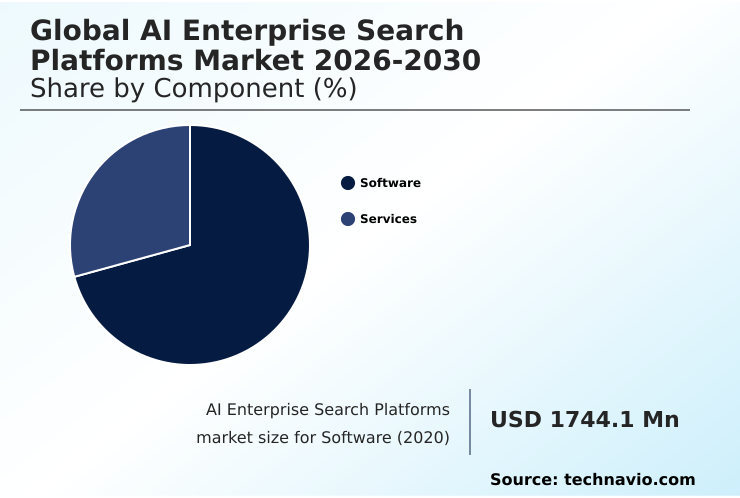
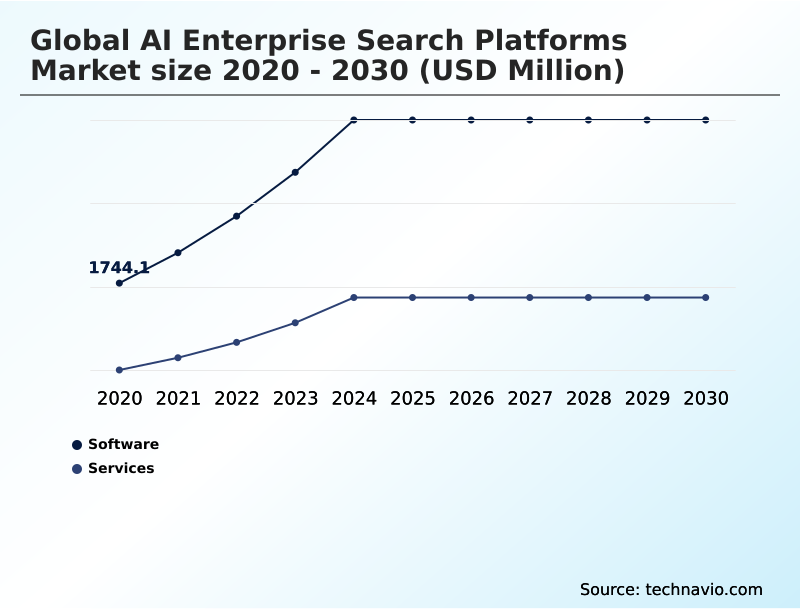
The Software segment was valued at USD 3.66 billion in 2024 and showed a gradual increase during the forecast period.
Regional Analysis
North America is estimated to contribute 39.6% to the growth of the global market during the forecast period.Technavio’s analysts have elaborately explained the regional trends and drivers that shape the market during the forecast period.
See How AI Enterprise Search Platforms Market Demand is Rising in North America Get Free Sample
Geographically, North America leads the market, projected to capture nearly 40% of incremental growth by addressing legacy system integration challenges with autonomous search agents and cross-platform data synthesis solutions.
APAC follows as the fastest-growing region with a 24.3% growth rate, focusing on serverless search capabilities for its expanding digital workplace connectivity. European markets prioritize data exfiltration prevention and information hallucination mitigation to build resilience against user trust erosion.
Across regions, the deployment of cross-lingual information retrieval and contextual relevance algorithms is crucial for managing global operations.
An enterprise knowledge assistant framework that leverages these technologies helps companies achieve a unified view of their data, with firms reporting a 15% increase in cross-departmental project efficiency.
Market Dynamics
Our researchers analyzed the data with 2025 as the base year, along with the key drivers, trends, and challenges. A holistic analysis of drivers will help companies refine their marketing strategies to gain a competitive advantage.
- The strategic implementation of AI Enterprise Search Platforms is becoming highly specialized, tailored to distinct industry needs. For instance, AI enterprise search for BFSI compliance is critical for navigating complex regulatory landscapes, while retrieval-augmented generation for legal discovery is transforming document review processes.
- In healthcare, AI enterprise search for healthcare records provides a unified patient view, and AI search for patent and research databases accelerates innovation. In the industrial sector, multimodal search for manufacturing data and AI-powered search for supply chain visibility are enhancing operational intelligence. E-commerce and retail are being reshaped by enterprise search platforms for e-commerce and retail.
- Companies are now measuring ROI of enterprise search platforms by evaluating improvements in knowledge worker productivity. The focus is on improving search relevance with vector databases and using knowledge graph-based semantic search to manage enterprise search for unstructured data. This allows for personalizing search results for different roles.
- Technology firms are adopting AI-powered search for software development, while integrating enterprise search with collaboration tools and creating platforms for IT support are becoming standard practice. Furthermore, securing sensitive data in enterprise search and enabling cross-lingual search in multinational corporations are top priorities for global organizations.
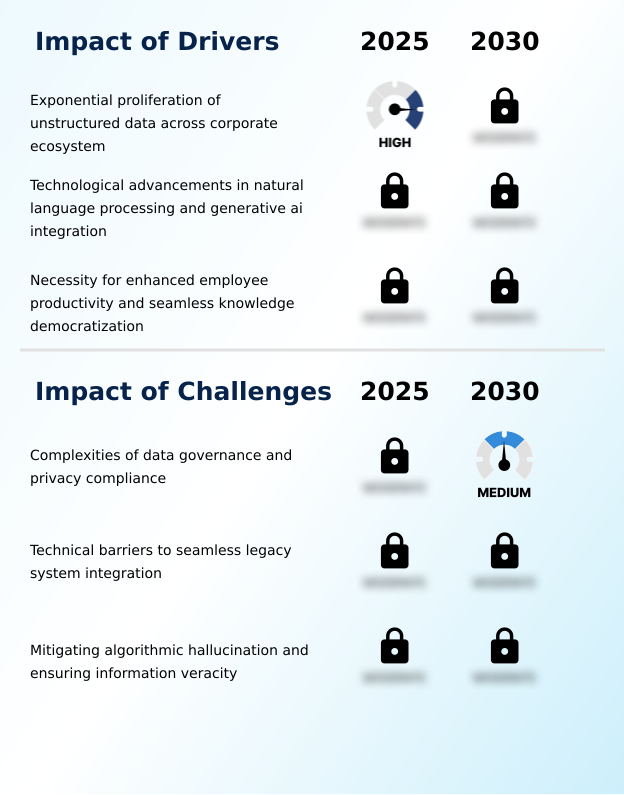
What are the key market drivers leading to the rise in the adoption of AI Enterprise Search Platforms Industry?
- The exponential proliferation of unstructured data across the corporate ecosystem is a key driver for market growth.
- Market growth is driven by the need to manage unstructured data proliferation, which now accounts for over 80% of enterprise information. AI platforms serve as a critical digital transformation enabler by creating a unified information architecture.
- This addresses information silo breakdown, a common issue that costs large companies millions in lost productivity. The demand for enhanced employee productivity is met by reducing search times by an average of 35%, freeing up resources for high-value tasks.
- Furthermore, these platforms support seamless knowledge democratization, ensuring all team members have access to relevant data. Continuous algorithm improvement ensures that the systems become more effective over time, adapting to new data types and user behaviors.
What are the market trends shaping the AI Enterprise Search Platforms Industry?
- A key market trend is the integration of retrieval-augmented generation. This approach combines large language models with generative AI architectures for enhanced performance.
- Key market trends are redefining information access, with a clear shift towards hybrid retrieval engines and knowledge graph integration. This enables a more profound contextual understanding, improving search relevance by up to 45% in complex data environments. The adoption of an intelligent work assistant that provides hands-free information access is becoming widespread, particularly in industrial settings.
- These platforms are also crucial for internal knowledge sharing and verifiable data synthesis, which builds confidence in the system's output. The use of high-dimensional vector embeddings is fundamental to this change, allowing for more nuanced and accurate results.
- This technological shift is pivotal for firms aiming to maintain a competitive edge through superior data utilization, with some reporting a 20% increase in project completion speed.
What challenges does the AI Enterprise Search Platforms Industry face during its growth?
- The complexities associated with data governance and privacy compliance present a key challenge to industry growth.
- Significant challenges persist, primarily around data sovereignty compliance and the technical hurdles of legacy system integration. Organizations face complexities in algorithmic bias prevention and ensuring user trust, as a single inaccurate result can erode confidence. The process of cross-platform metadata synchronization is resource-intensive, often requiring specialized expertise that increases project costs by up to 25%.
- Furthermore, mitigating the risk of data exfiltration prevention through sophisticated search queries remains a top concern for security teams. Successfully navigating these challenges requires a strategic approach that balances innovation with rigorous governance, as failure to do so can stall deployment and diminish the technology's overall business value by 30%.
Exclusive Technavio Analysis on Customer Landscape
The ai enterprise search platforms market forecasting report includes the adoption lifecycle of the market, covering from the innovator’s stage to the laggard’s stage. It focuses on adoption rates in different regions based on penetration. Furthermore, the ai enterprise search platforms market report also includes key purchase criteria and drivers of price sensitivity to help companies evaluate and develop their market growth analysis strategies.
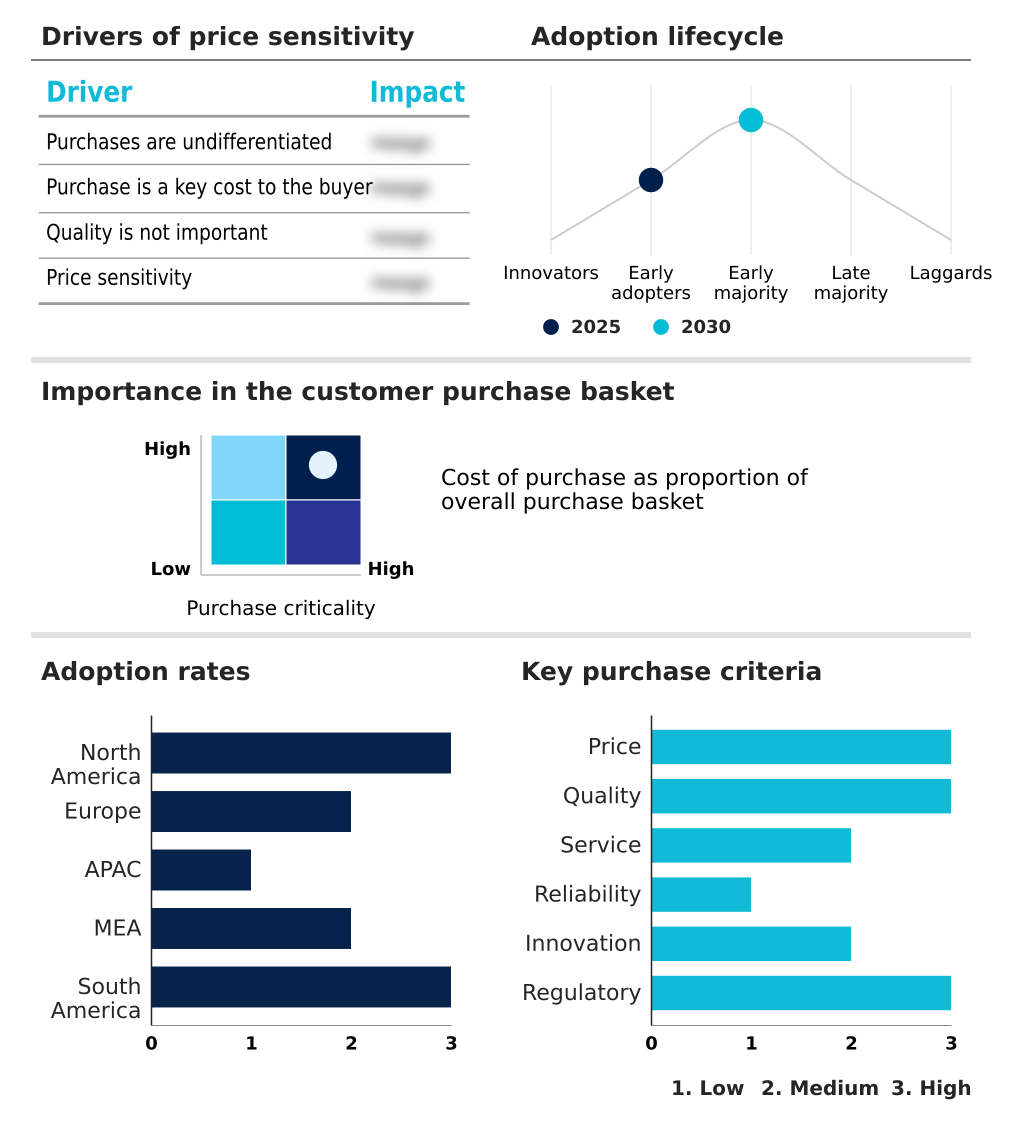
Customer Landscape of AI Enterprise Search Platforms Industry
Competitive Landscape
Companies are implementing various strategies, such as strategic alliances, ai enterprise search platforms market forecast, partnerships, mergers and acquisitions, geographical expansion, and product/service launches, to enhance their presence in the industry.
Algolia Inc. - Offerings provide advanced AI and neural search capabilities, delivering scalable, highly relevant information discovery across enterprise ecosystems.
The industry research and growth report includes detailed analyses of the competitive landscape of the market and information about key companies, including:
- Algolia Inc.
- Alphasense Ltd.
- Amazon Web Services Inc.
- Coveo Solutions Inc.
- Dashworks
- Elasticsearch B.V.
- Guru Technologies Inc.
- Glean Technologies Inc.
- Google LLC
- Hebbia Inc.
- IBM Corp.
- IntraFind Software AG
- Lucidworks Inc.
- Microsoft Corp.
- Mindbreeze GmbH
- Open Text Corp.
- Squirro AG
- Stardog Union Inc.
- Upland Software Inc.
- Vectara Inc.
Qualitative and quantitative analysis of companies has been conducted to help clients understand the wider business environment as well as the strengths and weaknesses of key industry players. Data is qualitatively analyzed to categorize companies as pure play, category-focused, industry-focused, and diversified; it is quantitatively analyzed to categorize companies as dominant, leading, strong, tentative, and weak.
Recent Development and News in Ai enterprise search platforms market
- In August 2025, Microsoft Corporation released a significant update to its enterprise discovery framework, featuring a new hybrid retrieval engine that combines traditional indexing with advanced semantic vector mapping to better understand industry-specific terminology.
- In February 2025, Microsoft Corporation announced a comprehensive update to its enterprise discovery suite, introducing a direct verification mechanism that allows generative models to provide real-time, clickable citations for synthesized information from internal documents.
- In May 2025, Amazon Web Services introduced a comprehensive set of automated connectors designed to ingest and vectorize massive datasets from disparate legacy storage systems into a centralized intelligent index.
- In November 2025, a major global cloud infrastructure provider updated its search service to include an automated citation verification layer, which flags inconsistent or unverified information in AI-generated summaries to enhance precision.
Dive into Technavio’s robust research methodology, blending expert interviews, extensive data synthesis, and validated models for unparalleled AI Enterprise Search Platforms Market insights. See full methodology.
| Market Scope | |
|---|---|
| Page number | 304 |
| Base year | 2025 |
| Historic period | 2020-2024 |
| Forecast period | 2026-2030 |
| Growth momentum & CAGR | Accelerate at a CAGR of 23.6% |
| Market growth 2026-2030 | USD 11976.6 million |
| Market structure | Fragmented |
| YoY growth 2025-2026(%) | 22.0% |
| Key countries | US, Canada, Mexico, Germany, UK, France, The Netherlands, Italy, Spain, China, Japan, India, South Korea, Australia, Indonesia, Saudi Arabia, UAE, South Africa, Israel, Turkey, Brazil, Argentina and Colombia |
| Competitive landscape | Leading Companies, Market Positioning of Companies, Competitive Strategies, and Industry Risks |
Research Analyst Overview
- The AI Enterprise Search Platforms market is defined by a rapid technological evolution centered on creating a unified discovery layer for corporate knowledge. The core technology stack now includes retrieval-augmented generation and generative AI architectures, which work with semantic understanding models and contextual relevance algorithms to deliver proactive intelligence systems.
- These systems use neural network indexing, high-dimensional vector embeddings, and hybrid retrieval engines to provide federated search capabilities across an organization. A key innovation is the intelligent work assistant, also known as an enterprise work assistant, AI-powered work assistant, or enterprise knowledge assistant, which uses cognitive search technology for intelligent knowledge discovery.
- Features like query intent recognition and personalized search results are standard. To ensure accuracy, platforms are integrating automated citation verification and information hallucination mitigation. Functionality is expanding to include multimodal data discovery, intelligent document processing, and cross-platform data synthesis, often managed through serverless search capabilities.
- The goal is to provide secure information retrieval via conversational search interfaces, supported by robust data governance frameworks and insight engine platforms that offer enterprise search analytics. Advanced semantic search and cross-lingual information retrieval are breaking down data silos, while autonomous search agents automate information gathering.
- A financial services firm leveraging these technologies reduced its compliance reporting time by over 40%.
What are the Key Data Covered in this AI Enterprise Search Platforms Market Research and Growth Report?
-
What is the expected growth of the AI Enterprise Search Platforms Market between 2026 and 2030?
-
USD 11.98 billion, at a CAGR of 23.6%
-
-
What segmentation does the market report cover?
-
The report is segmented by Component (Software, and Services), Deployment (Cloud, On premises, and Hybrid), End-user (Information technology, BFSI, Healthcare and life sciences, Manufacturing, and Others) and Geography (North America, Europe, APAC, Middle East and Africa, South America)
-
-
Which regions are analyzed in the report?
-
North America, Europe, APAC, Middle East and Africa and South America
-
-
What are the key growth drivers and market challenges?
-
Exponential proliferation of unstructured data across corporate ecosystem, Complexities of data governance and privacy compliance
-
-
Who are the major players in the AI Enterprise Search Platforms Market?
-
Algolia Inc., Alphasense Ltd., Amazon Web Services Inc., Coveo Solutions Inc., Dashworks, Elasticsearch B.V., Guru Technologies Inc., Glean Technologies Inc., Google LLC, Hebbia Inc., IBM Corp., IntraFind Software AG, Lucidworks Inc., Microsoft Corp., Mindbreeze GmbH, Open Text Corp., Squirro AG, Stardog Union Inc., Upland Software Inc. and Vectara Inc.
-
Market Research Insights
- The dynamics of the AI Enterprise Search Platforms market are shaped by the pursuit of enhanced employee productivity and seamless knowledge democratization. Organizations adopting these platforms report up to a 40% reduction in time spent searching for information, directly impacting operational efficiency gains. This is achieved by addressing information silo breakdown and enabling proactive risk management.
- For example, some systems improve the accuracy of internal compliance audits by over 60% compared to manual methods. The focus is on creating a unified information architecture that supports digital workplace connectivity and provides verifiable data synthesis, which are critical for talent retention tools and fostering a culture of data-driven decision-making.
- The ability to deliver context-aware information delivery is a key differentiator.
We can help! Our analysts can customize this ai enterprise search platforms market research report to meet your requirements.
 RIA -
RIA - 
