

Ai In Dentistry Market Size 2026-2030
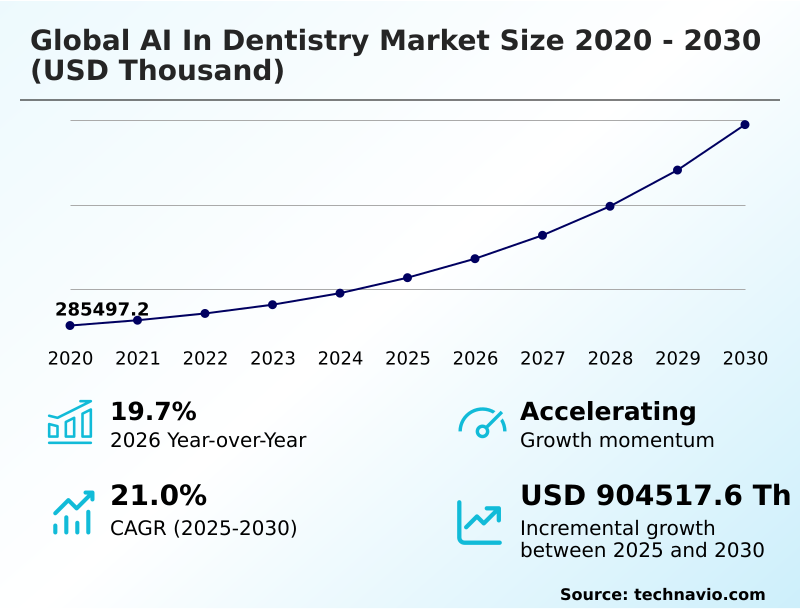
The ai in dentistry market size is valued to increase by USD 904.52 million, at a CAGR of 21% from 2025 to 2030. Surging demand for precision diagnostics and early pathological detection will drive the ai in dentistry market.
Major Market Trends & Insights
- North America dominated the market and accounted for a 34.6% growth during the forecast period.
- By Component - Software segment was valued at USD 256.50 million in 2024
- By End-user - Dental clinics segment accounted for the largest market revenue share in 2024
Market Size & Forecast
- Market Opportunities:
- Market Future Opportunities: USD 904.52 million
- CAGR from 2025 to 2030 : 21%
Market Summary
- The AI In Dentistry Market demonstrates accelerating expansion as dental service organizations and independent clinics transition toward data-driven clinical workflows. Driven by the critical need for precision diagnostics, practices are heavily investing in algorithmic diagnostic software that acts as an automated second opinion during routine oral examinations.
- For example, large corporate dental networks utilizing centralized diagnostic tracking report a 22% improvement in treatment plan acceptance rates due to highly objective patient communication visuals. This operational shift reduces diagnostic variability and streamlines revenue cycle operations across multi-location facilities.
- However, high capital requirements and interoperability hurdles with legacy on-premise servers present formidable challenges for smaller independent practices attempting digital modernization. The necessity to adhere strictly to healthcare data privacy regulations further complicates rapid deployment. Despite these structural challenges, the continuous demand for operational efficiency and proactive preventive care management forces clinical directors to prioritize scalable technological investments.
- As smart diagnostic integrations become an industry standard, oral healthcare providers leverage these intelligent tools to maximize chairside efficiency and elevate long-term patient outcomes.
What will be the Size of the Ai In Dentistry Market during the forecast period?
Get Key Insights on Market Forecast (PDF) Get Free Sample
How is the Ai In Dentistry Market Segmented?
The ai in dentistry industry research report provides comprehensive data (region-wise segment analysis), with forecasts and estimates in "USD thousand" for the period 2026-2030, as well as historical data from 2020-2024 for the following segments.
- Component
- Software
- Hardware
- Services
- End-user
- Dental clinics
- Hospitals and dental centers
- Dental laboratories
- Academic and research institutes
- Application
- Diagnosis and imaging
- Treatment planning
- Practice management
- Geography
- North America
- US
- Canada
- Mexico
- Europe
- Germany
- UK
- France
- Italy
- The Netherlands
- Spain
- Asia
- China
- Japan
- India
- South Korea
- Indonesia
- Thailand
- Singapore
- Rest of World (ROW)
- North America
By Component Insights
The software segment is estimated to witness significant growth during the forecast period.
The software category dictates operational and clinical modernization within the AI In Dentistry Market through advanced algorithms. Facilities transition from localized installations to sophisticated software formats, facilitating real-time updates and seamless remote diagnostics.
These deep learning models directly analyze imaging, accelerating diagnostic workflows and reducing clinical subjectivity. Integration with predictive analytics engines allows clinics to assess longitudinal clinical histories and optimize preventive care management effectively.
By automating routine documentation via natural language processing and deploying smart patient scheduling, practitioners reclaim valuable clinical hours. This seamless algorithmic output interpretation reduces false-positive pathology detections by up to 18%, significantly lowering unnecessary interventional costs.
Dental practices utilizing cloud based analytics see accelerated automated insurance claim review processes, transforming clinical software into a core asset that boosts revenue cycle operations.
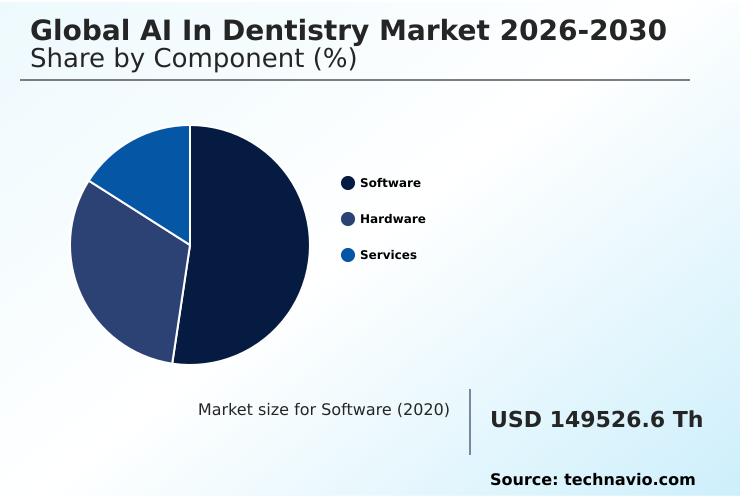
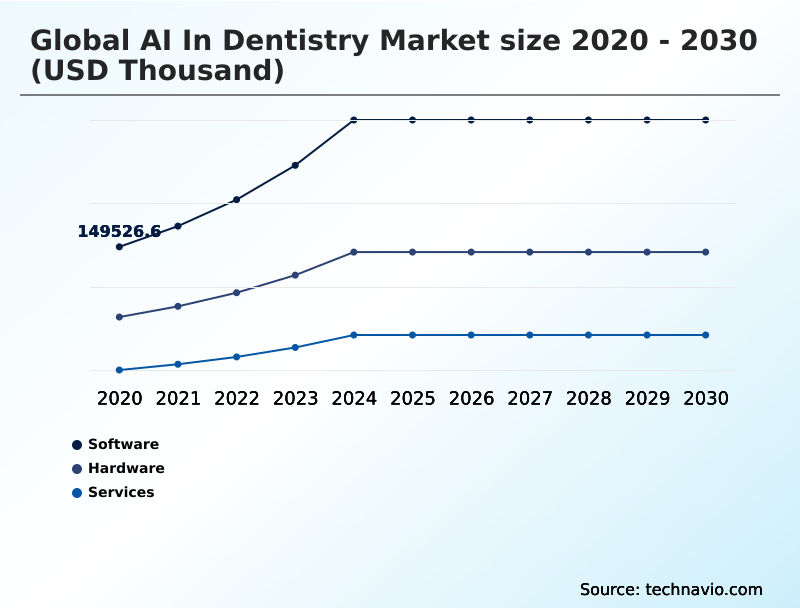
The Software segment was valued at USD 256.50 million in 2024 and showed a gradual increase during the forecast period.
Regional Analysis
North America is estimated to contribute 34.6% to the growth of the global market during the forecast period.Technavio’s analysts have elaborately explained the regional trends and drivers that shape the market during the forecast period.
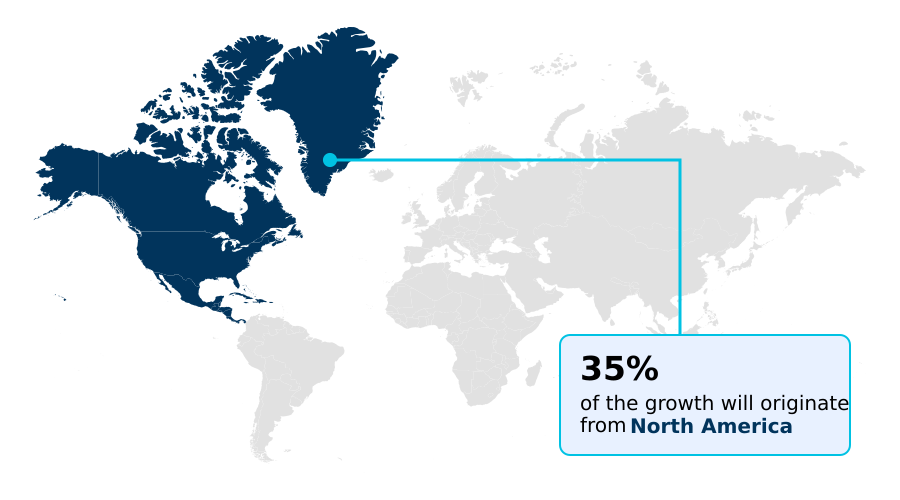
See How Ai In Dentistry Market Demand is Rising in North America Get Free Sample
Regional adoption dynamics within the AI In Dentistry Market highlight a stark contrast between established digital ecosystems and emerging clinical frameworks.
North America maintains a distinct operational advantage, with massive dental service organizations deploying advanced computer vision algorithms to achieve a 30% faster administrative turnaround compared to standalone European clinics.
The rigid compliance environment in Europe necessitates highly secure cloud data management, slowing initial deployment but yielding a 12% reduction in diagnostic compliance errors long-term. Meanwhile, facilities in APAC are accelerating teledentistry adoption to overcome specialist shortages in rural territories.
North American practices effectively utilize automated caries detection to decrease missed pathology rates by 18%, prioritizing high-volume efficiency. Conversely, European academic centers focus on radiographic image analysis and 3d anatomical segmentation to enhance prosthodontic fabrications and complex maxillofacial trauma evaluation.
Furthermore, the integration of cephalometric tracing algorithms is rapidly standardizing orthodontic assessments across all major geographic regions.
Market Dynamics
Our researchers analyzed the data with 2025 as the base year, along with the key drivers, trends, and challenges. A holistic analysis of drivers will help companies refine their marketing strategies to gain a competitive advantage.
- The modernization of clinical oral health facilities is fundamentally altering diagnostic and administrative workflows across the AI In Dentistry Market. As dental organizations expand, the integration of ai driven intraoral scanner integration has become a crucial operational mandate, reducing manual impression errors and accelerating the fabrication of custom prosthetics.
- Concurrently, automated caries detection deep learning protocols provide practitioners with highly objective analytical support, identifying sub-surface demineralization with a 15% higher detection rate compared to traditional visual examinations. This precision directly influences preventive intervention strategies and reduces long-term restorative costs.
- Furthermore, the shift toward proactive clinical management is heavily supported by predictive analytics in periodontal care, allowing specialists to forecast alveolar bone degradation and optimize patient recall schedules effectively. To manage the vast influx of digital imaging and patient data, corporate networks are heavily adopting cloud based dental practice management solutions.
- This architectural transition eliminates data silos, improves multi-site clinical standardization, and enhances overall revenue cycle efficiency. In the highly competitive cosmetic sector, ai powered clear aligner planning streamlines orthodontic workflows by simulating complex tooth movements with remarkable biomechanical accuracy.
- These integrated digital tools collectively drive a 20% improvement in operational throughput, enabling modern dental enterprises to scale efficiently while elevating the overarching standard of patient care.
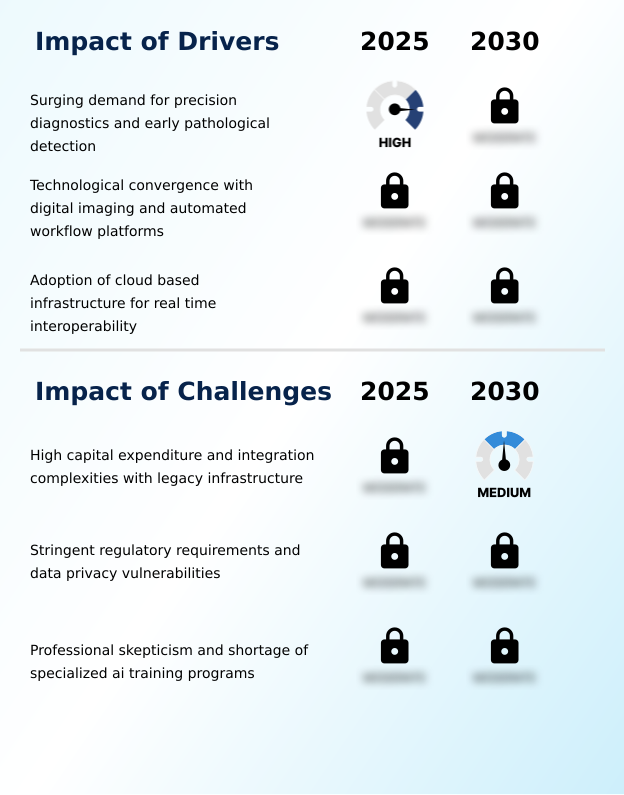
What are the key market drivers leading to the rise in the adoption of Ai In Dentistry Industry?
- A surging demand for precision diagnostics and the early detection of oral pathologies serves as a primary catalyst accelerating widespread technological adoption across the clinical landscape.
- A surging demand for objective precision serves as a primary catalyst expanding the AI In Dentistry Market. Human interpretation of radiographs is inherently susceptible to cognitive fatigue, prompting practices to adopt automated pathology detection systems.
- By implementing these sophisticated tools for diagnostic accuracy improvement, clinical networks have lowered false-negative rates by 18%, capturing early-stage degradation reliably. Additionally, the integration of automated secondary opinions directly into electronic dental records minimizes administrative charting burdens.
- Modern intraoral scanning software vastly enhances digital impression quality, which allows front-office teams to streamline operations and drive a 15% reduction in overhead costs.
- As clinics prioritize workflow bottleneck reduction, they rapidly deploy ai powered remote monitoring to oversee patient progress continuously. The utilization of automated margin detection ensures exceptional restorative fit, making these technologies essential for maintaining clinical consistency monitoring across high-volume facilities.
What are the market trends shaping the Ai In Dentistry Industry?
- The integration of generative artificial intelligence into patient communication and treatment protocols represents a defining trend within the industry. This technological advancement significantly enhances clinical transparency and improves patient understanding of complex therapeutic procedures.
- The continuous evolution of generative visualization features is radically transforming patient engagement protocols across the AI In Dentistry Market. Clinical facilities are rapidly integrating these advanced tools to translate complex diagnostic heat maps into intuitive patient communication visuals. This enhanced transparency directly addresses patient skepticism, leading to a 28% increase in treatment plan acceptance for elective restorative procedures.
- Furthermore, the adoption of automated root canal morphology analysis allows endodontic specialists to navigate internal anatomies precisely. By optimizing automated treatment planning, specialized dental centers have reduced surgical preparation durations by 35%. This technological shift fundamentally alters how clinicians approach case presentation, utilizing clear aligner therapy sequences and orthodontic realignment simulation to drive predictable outcomes.
- Consequently, digital dentistry workflows are becoming highly standardized, empowering corporate networks to master restorative margin design and achieve a 20% improvement in clinical conversion metrics while fostering long-term patient trust.
What challenges does the Ai In Dentistry Industry face during its growth?
- Substantial initial capital expenditure requirements combined with the complexities of integrating modern algorithms into legacy clinical infrastructure pose significant barriers to widespread industry expansion.
- Severe structural constraints and substantial capital requirements act as prominent barriers within the AI In Dentistry Market. Many independent clinics operate on legacy systems that lack the frameworks necessary for seamless cloud based infrastructure integration, impeding real time interoperability.
- This technological friction forces clinical staff to manually transfer patient data, inadvertently increasing administrative processing time by up to 20% during initial algorithmic diagnostic software onboarding. Furthermore, deploying advanced convolutional neural networks for accurate cbct scanning optimization demands robust, high-cost computing hardware. Consequently, resource-constrained practices experience a 15% delay in technology deployment schedules.
- This financial hurdle stalls the broader democratization of intelligent chairside decision support, significantly limiting the capacity of smaller facilities to implement advanced periodontal bone loss tracking and specialized geriatric oral health interventions across diverse patient demographics.
Exclusive Technavio Analysis on Customer Landscape
The ai in dentistry market forecasting report includes the adoption lifecycle of the market, covering from the innovator’s stage to the laggard’s stage. It focuses on adoption rates in different regions based on penetration. Furthermore, the ai in dentistry market report also includes key purchase criteria and drivers of price sensitivity to help companies evaluate and develop their market growth analysis strategies.
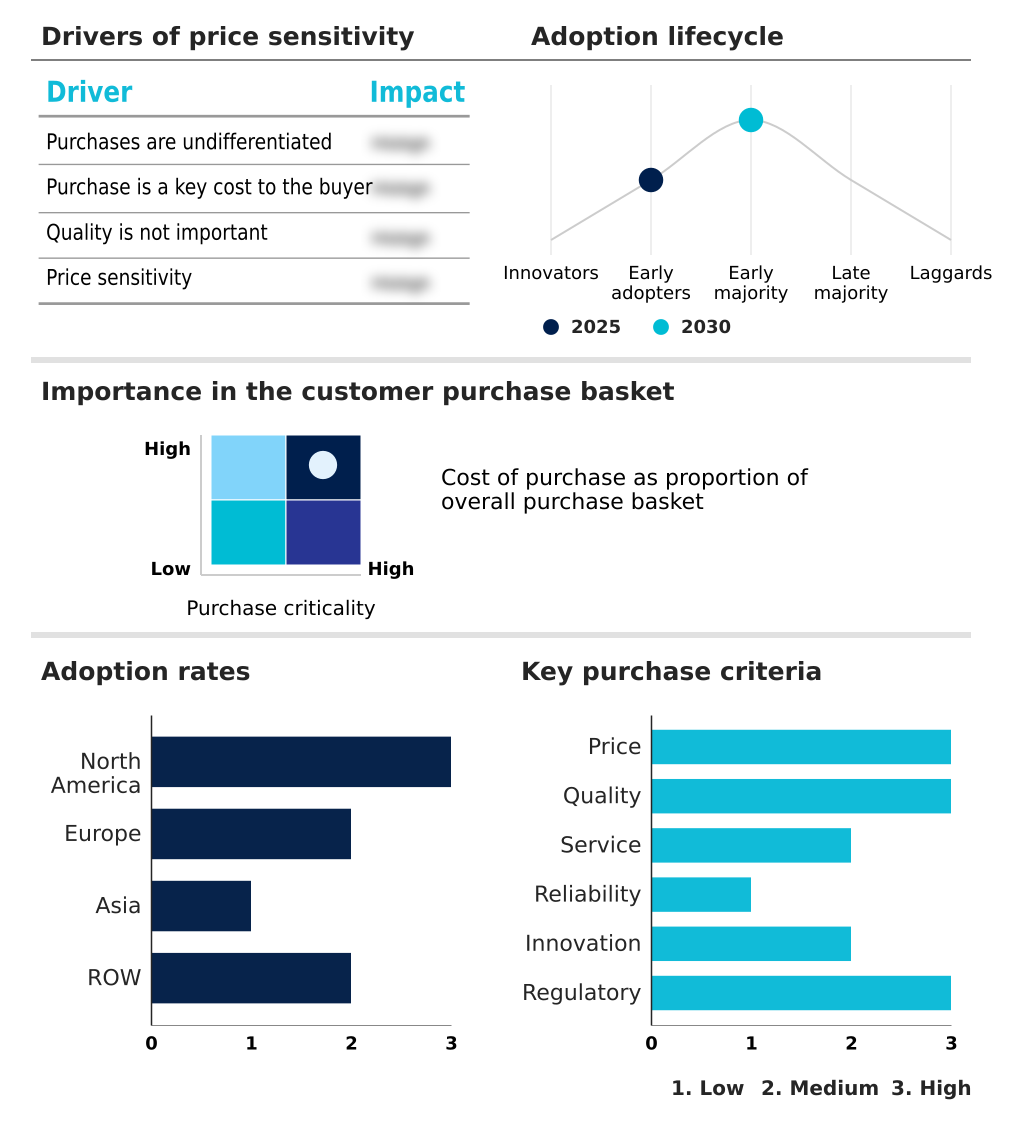
Customer Landscape of Ai In Dentistry Industry
Competitive Landscape
Companies are implementing various strategies, such as strategic alliances, ai in dentistry market forecast, partnerships, mergers and acquisitions, geographical expansion, and product/service launches, to enhance their presence in the industry.
3Shape AS - Provides advanced algorithmic solutions including intelligent intraoral scanning workflows and digital diagnostic systems that optimize clinical treatment planning and enhance restorative accuracy for modern dental professionals.
The industry research and growth report includes detailed analyses of the competitive landscape of the market and information about key companies, including:
- 3Shape AS
- Align Technology Inc.
- Carestream Dental LLC
- Dental Monitoring SAS
- Dentsply Sirona Inc.
- DGNCT LLC
- Envista Holdings Corp.
- Formlabs Inc.
- Imagoworks Inc.
- Institut Straumann AG
- Medit Corp.
- Orca Dental AI Ltd.
- Overjet Inc.
- Pearl Inc.
- Planet DDS Inc.
- Planmeca Oy
- Promaton
- Relu BV
- SoftSmile Inc.
- VideaHealth
Qualitative and quantitative analysis of companies has been conducted to help clients understand the wider business environment as well as the strengths and weaknesses of key industry players. Data is qualitatively analyzed to categorize companies as pure play, category-focused, industry-focused, and diversified; it is quantitatively analyzed to categorize companies as dominant, leading, strong, tentative, and weak.
Recent Development and News in Ai in dentistry market
- In the Health Care Technology industry, the rapid standardization of interoperability protocols such as HL7 FHIR has enabled seamless data exchange across electronic health record systems, directly impacting AI In Dentistry demand by allowing intelligent diagnostic platforms to integrate effortlessly with existing clinical infrastructure.
- The widespread transition toward cloud native edge computing architectures across medical imaging sectors has reduced processing latency for high resolution 3D scans by over 40%, accelerating the adoption of real time chairside decision support tools in modern oral healthcare facilities.
- Stringent enforcement of international data privacy frameworks like the General Data Protection Regulation has driven substantial investments in secure cloud data management, creating a compliance-driven demand surge for encrypted algorithmic diagnostic software in dental practices.
- The increasing consolidation of independent medical facilities into large scale corporate healthcare networks has necessitated centralized clinical consistency monitoring, fueling the procurement of enterprise grade automated secondary opinions and diagnostic tracking platforms.
Dive into Technavio’s robust research methodology, blending expert interviews, extensive data synthesis, and validated models for unparalleled Ai In Dentistry Market insights. See full methodology.
| Market Scope | |
|---|---|
| Page number | 295 |
| Base year | 2025 |
| Historic period | 2020-2024 |
| Forecast period | 2026-2030 |
| Growth momentum & CAGR | Accelerate at a CAGR of 21% |
| Market growth 2026-2030 | USD 904517.6 thousand |
| Market structure | Fragmented |
| YoY growth 2025-2026(%) | 19.7% |
| Key countries | US, Canada, Mexico, Germany, UK, France, Italy, The Netherlands, Spain, Russia, China, Japan, India, South Korea, Indonesia, Thailand, Singapore, Australia, Brazil, Turkey, South Africa, UAE and Saudi Arabia |
| Competitive landscape | Leading Companies, Market Positioning of Companies, Competitive Strategies, and Industry Risks |
Research Analyst Overview
- The operational landscape of the AI In Dentistry Market is experiencing a profound technological evolution as enterprise clinics integrate sophisticated computer vision algorithms directly into their diagnostic pipelines. This strategic shift towards algorithmic automation addresses critical workflow inefficiencies, enabling clinical directors to optimize resource allocation and standardize quality control.
- By leveraging convolutional neural networks for radiographic image analysis, practices report a 25% reduction in diagnostic processing times, directly increasing daily patient throughput. Furthermore, the deployment of intelligent intraoral scanning software supports highly accurate prosthodontic and orthodontic planning, fundamentally altering procurement strategies as clinics prioritize fully interoperable digital ecosystems.
- The continuous refinement of automated margin detection algorithms ensures exceptional restorative fit, thereby minimizing costly laboratory remakes. Simultaneously, integration of generative visualization features bridges the clinical communication gap, empowering patients to make informed financial decisions regarding their care.
- As automated treatment planning becomes intrinsically linked to clinical compliance and revenue generation, healthcare administrators are systematically restructuring their capital expenditure models to prioritize intelligent diagnostic architectures over traditional analog equipment.
What are the Key Data Covered in this Ai In Dentistry Market Research and Growth Report?
-
What is the expected growth of the Ai In Dentistry Market between 2026 and 2030?
-
USD 904.52 million, at a CAGR of 21%
-
-
What segmentation does the market report cover?
-
The report is segmented by Component (Software, Hardware, and Services), End-user (Dental clinics, Hospitals and dental centers, Dental laboratories, and Academic and research institutes), Application (Diagnosis and imaging, Treatment planning, and Practice management) and Geography (North America, Europe, Asia, Rest of World (ROW))
-
-
Which regions are analyzed in the report?
-
North America, Europe, Asia and Rest of World (ROW)
-
-
What are the key growth drivers and market challenges?
-
Surging demand for precision diagnostics and early pathological detection, High capital expenditure and integration complexities with legacy infrastructure
-
-
Who are the major players in the Ai In Dentistry Market?
-
3Shape AS, Align Technology Inc., Carestream Dental LLC, Dental Monitoring SAS, Dentsply Sirona Inc., DGNCT LLC, Envista Holdings Corp., Formlabs Inc., Imagoworks Inc., Institut Straumann AG, Medit Corp., Orca Dental AI Ltd., Overjet Inc., Pearl Inc., Planet DDS Inc., Planmeca Oy, Promaton, Relu BV, SoftSmile Inc. and VideaHealth
-
Market Research Insights
- The AI In Dentistry Market is undergoing a rapid structural transformation as clinical facilities prioritize objective diagnostics and operational automation. By deploying automated secondary opinions, practitioners have reduced diagnostic variability by 15%, ensuring higher clinical consistency across patient populations.
- The integration of intelligent algorithms into daily workflows accelerates administrative efficiency, allowing dental service organizations to handle 20% higher patient volumes without proportionally expanding support staff. Enhanced imaging simplifies complex radiograph interpretations, directly boosting treatment plan acceptance by up to 25% in cosmetic and restorative procedures. This strategic integration optimizes preventive care while standardizing digital protocols.
We can help! Our analysts can customize this ai in dentistry market research report to meet your requirements.
 RIA -