



Ai Model Monitoring And Drift Detection Market Size and Growth Forecast 2026-2030
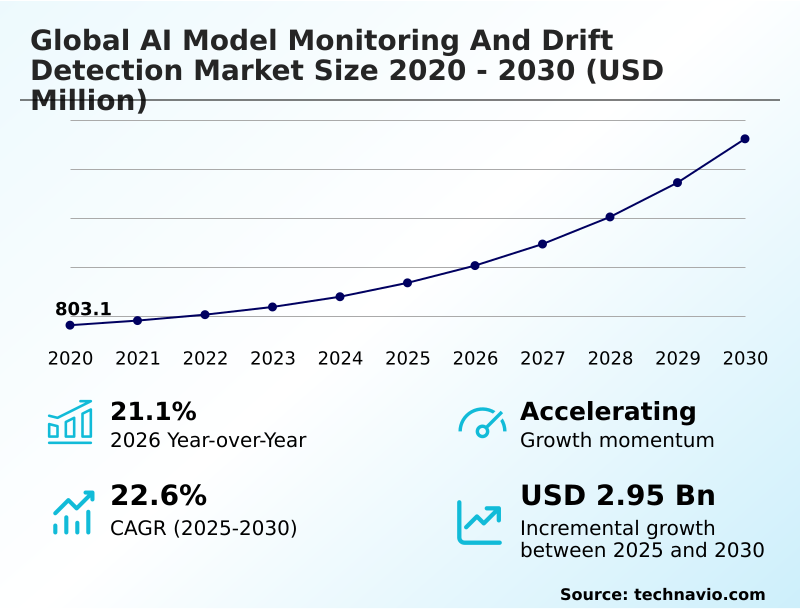
The Ai Model Monitoring And Drift Detection Market size was valued at USD 1.67 billion in 2025 growing at a CAGR of 22.6% during the forecast period 2026-2030.
North America accounts for 37.8% of incremental growth during the forecast period. The Cloud-based segment by Deployment was valued at USD 825.1 million in 2024, while the Model performance monitoring segment holds the largest revenue share by Type.
The market is projected to grow by USD 3.81 billion from 2020 to 2030, with USD 2.95 billion of the growth expected during the forecast period of 2025 to 2030.
Get Key Insights on Market Forecast (PDF) Request Free Sample
Ai Model Monitoring And Drift Detection Market Overview
The AI model monitoring and drift detection market is expanding as organizations shift focus from model development to ensuring long-term operational health, with the market showing a year-over-year growth of 21.1%. This strategic pivot is essential for maintaining algorithmic accountability and mitigating risks associated with model decay. A key application is in financial services, where a high-frequency trading firm deploys real-time model monitoring to detect subtle shifts in market data. By using lightweight statistical tests and automated mitigation triggers, the firm prevents significant losses that could result from a model failing to adapt to a sudden change in market volatility. This focus on AI reliability engineering and continuous validation is becoming standard practice. As North America continues to contribute over 37% of the market's incremental growth, the demand for sophisticated production ML models with integrated diagnostic reporting frameworks and MLOps lifecycle management will intensify.
Drivers, Trends, and Challenges in the Ai Model Monitoring And Drift Detection Market
The maturation of MLOps is forcing a strategic re-evaluation of the total cost of ownership for AI, moving beyond initial development to focus on the long-term operational expense of maintaining model accuracy. This shift is a direct response to the challenges of monitoring high-dimensional data and the need for ensuring generative AI reliability in production environments.
For instance, the cost-benefit analysis of ML model monitoring is becoming a standard part of project planning, with large enterprises showing adoption rates significantly higher than SMEs due to the scale of their deployments.
In a typical scenario, a global financial institution implements a new platform to address the impact of data drift on model accuracy for its credit scoring algorithms. To comply with the EU AI Act's transparency requirements, the platform must facilitate bias and fairness auditing in machine learning, integrating drift detection directly into MLOps pipelines.
This proactive approach to AI governance framework implementation is critical for measuring concept drift in non-stationary environments and performing automated root cause analysis for model failure, ultimately safeguarding against regulatory penalties and financial losses.
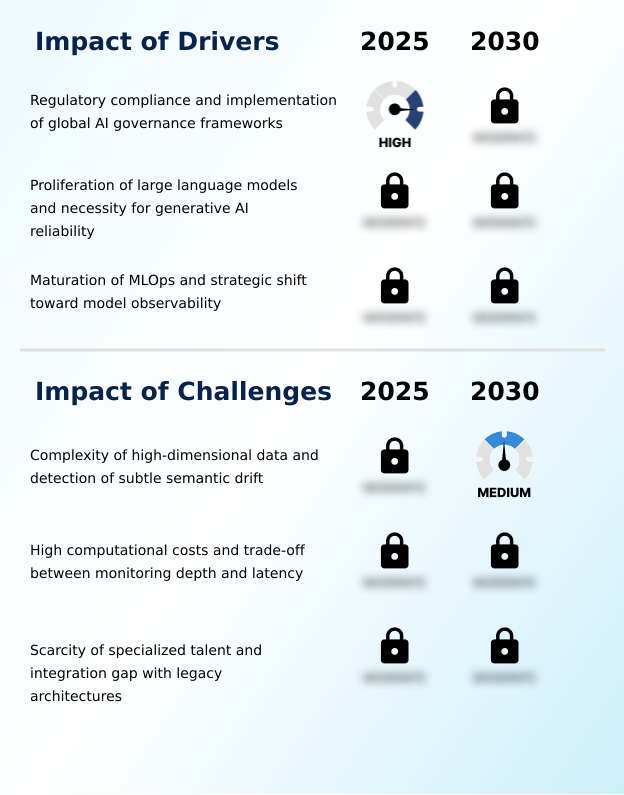
Primary Growth Driver: Regulatory compliance requirements and the implementation of global AI governance frameworks are key drivers for the market.
Market growth is primarily propelled by two forces: stringent regulatory mandates and the rapid operationalization of generative AI.
Global AI governance frameworks, such as the EU AI Act, mandate algorithmic accountability and transparency, making robust model performance monitoring a legal necessity, not just a best practice.
This is particularly true in North America, which is set to contribute over 37% of incremental growth. Simultaneously, the proliferation of large language models introduces risks like hallucinations and output variance, creating urgent demand for solutions ensuring generative AI reliability.
This requires advanced unstructured data monitoring and real-time quality evaluation, extending the scope of monitoring to include vector database monitoring and retrieval-augmented generation pipelines, thus solidifying the need for a comprehensive continuous validation platform.
Emerging Market Trend: An emerging market trend involves the adoption of federated learning monitoring. This shift is driven by the need for decentralized drift detection mechanisms that preserve data privacy.
Emerging trends are centered on extending monitoring capabilities to decentralized and specialized environments. The rise of federated learning monitoring addresses privacy concerns and data sovereignty mandates like GDPR, enabling decentralized drift detection without centralizing raw data. This is crucial for healthcare and finance.
Concurrently, the expansion of IoT ecosystems is driving demand for hardware-aware drift analysis and edge-native monitoring tools, especially in APAC's manufacturing sector. These systems use lightweight statistical tests for real-time model monitoring on-device.
Another significant advancement is the move toward deep semantic drift detection, which goes beyond statistical shifts to understand changes in data context, a vital capability for high-stakes verticals like legal technology and personalized medicine where model behavior analysis is critical.
Key Industry Challenge: The complexity of high-dimensional data, combined with the difficulty of detecting subtle semantic drift, presents a key challenge affecting industry growth.
A primary market challenge is the inherent complexity of identifying subtle performance decay within high-dimensional and unstructured data, a problem magnified by the growth of generative AI. Traditional statistical distribution shift methods often fail in the latent spaces of deep learning models, leading to a high rate of false positives or, more critically, undetected model failures.
This issue is compounded by significant computational overhead, forcing a difficult trade-off between the depth of root-cause analysis and system latency. Furthermore, a severe scarcity of specialized talent, specifically in AI reliability engineering, creates an integration gap. Many organizations struggle to manage modern monitoring systems within legacy architectures, hindering the effective implementation of data quality monitoring and model health tracking.
Explore Full Market Dynamics Analysis Request Free Sample
Ai Model Monitoring And Drift Detection Market Segmentation
The ai model monitoring and drift detection industry research report provides comprehensive data including region-wise segment analysis, with forecasts and analysis for the period 2026-2030, as well as historical data from 2020-2024 for the following segments.
Deployment Segment Analysis
The cloud-based segment is estimated to witness significant growth during the forecast period.
The market is segmented by deployment, type, and end-user, reflecting diverse operational requirements. The cloud-based deployment model is dominant, accounting for nearly 60% of the market, as organizations prioritize scalability and reduced hardware maintenance.
This approach facilitates production environment monitoring and simplifies MLOps observability for distributed teams. On-premises and hybrid solutions cater to sectors with stringent data residency and security needs, such as defense and banking, where complete control is non-negotiable.
Segmentation by type addresses the full spectrum of AI governance, including model performance monitoring, data drift detection, and increasingly, bias and fairness monitoring.
Large enterprises constitute the primary end-user segment, driven by the complexity of managing extensive model portfolios and the need for centralized, automated alert systems.
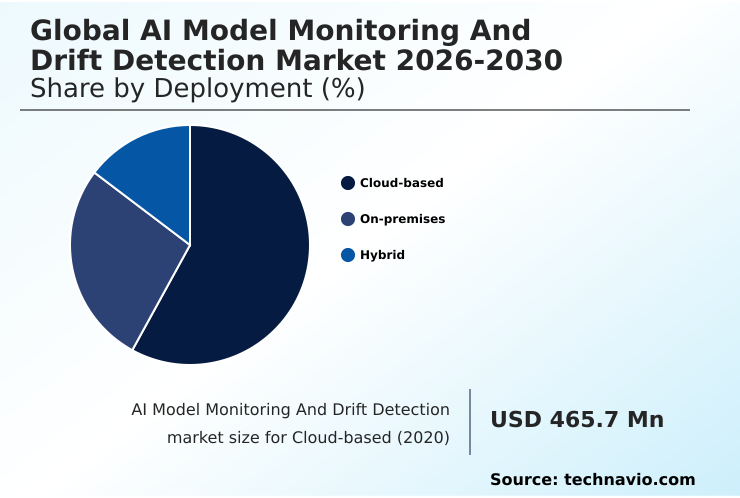
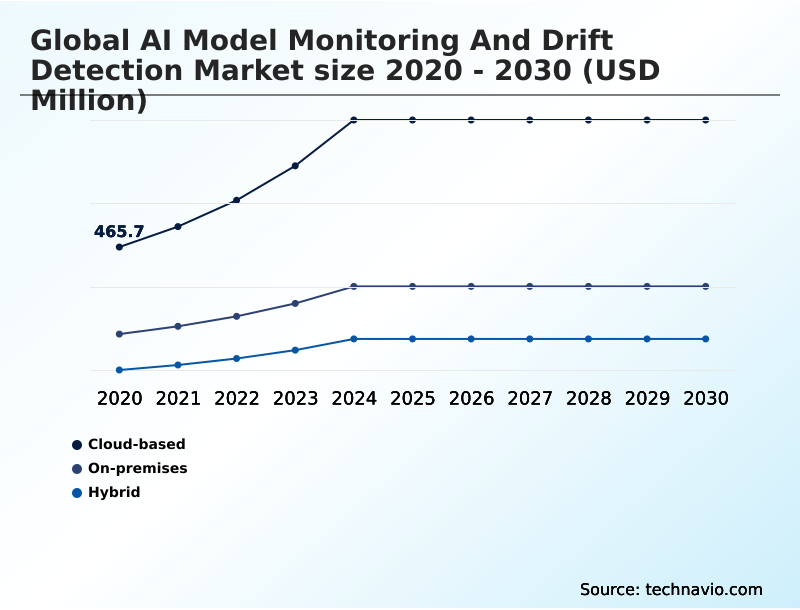
The Cloud-based segment was valued at USD 825.1 million in 2024 and showed a gradual increase during the forecast period.
Ai Model Monitoring And Drift Detection Market by Region: North America Leads with 37.8% Growth Share
North America is estimated to contribute 37.8% to the growth of the global market during the forecast period.
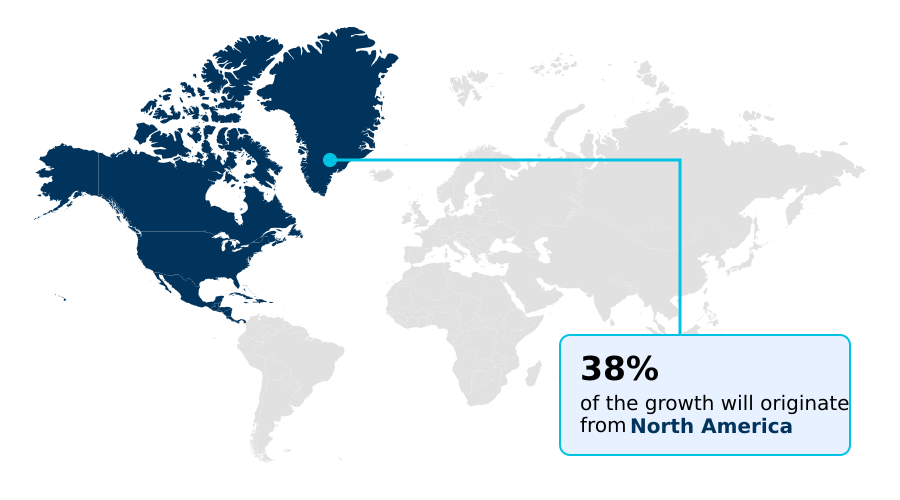
The geographic landscape is characterized by the established dominance of North America, which accounts for 37.8% of the market's incremental growth, driven by a high concentration of mature tech enterprises and early adopters in finance and healthcare.
This region leads in MLOps observability and the demand for platforms providing a centralized monitoring dashboard. In contrast, APAC is the fastest-growing region, with a projected CAGR of 23.8%, fueled by rapid digitalization in manufacturing and e-commerce.
The expansion of high-tech facilities in APAC creates strong demand for edge-native monitoring and hardware-aware drift analysis to support IoT ecosystems.
Europe's growth is shaped by stringent regulations, fostering innovation in federated learning monitoring and privacy-preserving diagnostic frameworks to comply with directives like GDPR.
Customer Landscape Analysis for the Ai Model Monitoring And Drift Detection Market
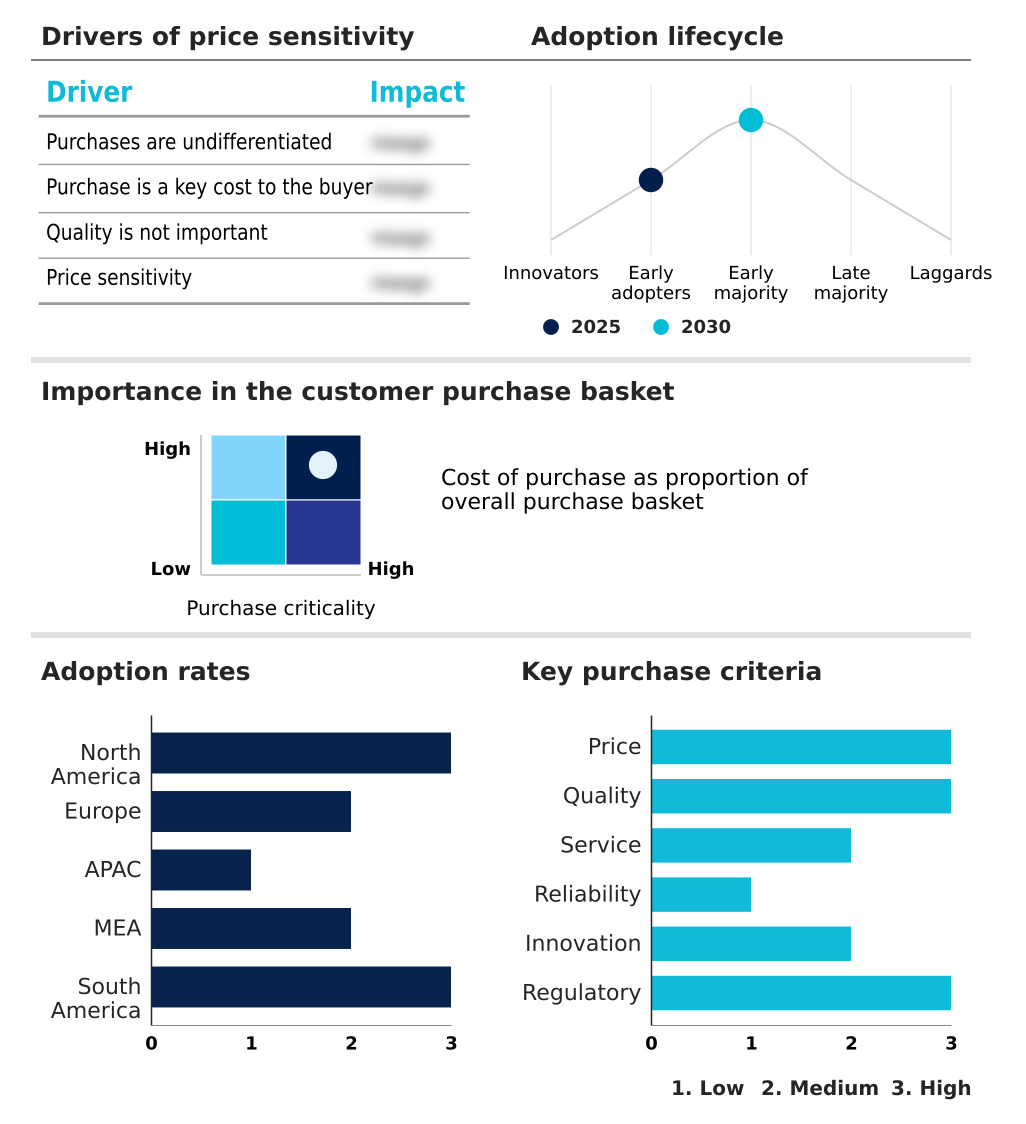
The ai model monitoring and drift detection market forecasting report includes the adoption lifecycle of the market, covering from the innovator’s stage to the laggard’s stage. It focuses on adoption rates in different regions based on penetration. Furthermore, the ai model monitoring and drift detection market report also includes key purchase criteria and drivers of price sensitivity to help companies evaluate and develop their market growth analysis strategies.
Competitive Landscape of the Ai Model Monitoring And Drift Detection Market
Companies are implementing various strategies, such as strategic alliances, partnerships, mergers and acquisitions, geographical expansion, and product/service launches, to enhance their presence in the ai model monitoring and drift detection market industry.
Amazon.com Inc. - Delivers customizable ML observability platforms for real-time monitoring of data health, performance degradation, and drift in production AI applications.
The industry research and growth report includes detailed analyses of the competitive landscape of the market and information about key companies, including:
- Amazon.com Inc.
- Aporia Technologies
- ArthurAI Inc.
- Censius
- Cisco Systems Inc.
- Comet ML Inc.
- Datadog Inc.
- DataRobot Inc.
- Deepchecks AI
- Domino Data Lab Inc.
- Dynatrace Inc.
- Evidently AI
- Fiddler AI
- Google LLC
- H2O.ai Inc.
- New Relic Inc.
- Seldon Technologies
- Snowflake Inc.
- Superwise
- WhyLabs, Inc.
Qualitative and quantitative analysis of companies has been conducted to help clients understand the wider business environment as well as the strengths and weaknesses of key industry players. Data is qualitatively analyzed to categorize companies as pure play, category-focused, industry-focused, and diversified; it is quantitatively analyzed to categorize companies as dominant, leading, strong, tentative, and weak.
Recent Developments in the Ai Model Monitoring And Drift Detection Market
- In February 2025, Snowflake Inc. expanded its platform to include automated drift detection for generative models, enabling organizations to maintain data integrity within its cloud data environment.
- In March 2025, Cisco Systems, Inc. integrated monitoring tools from its recent acquisitions into a unified observability framework, enhancing its support for networking and security operations.
- In March 2025, the United States Department of Commerce established the National AI Monitoring Bureau to oversee the safety and reliability of models used in critical infrastructure, increasing demand for compliant commercial platforms.
- In February 2025, the United States Department of Commerce formed a national task force focused on implementing drift detection standards for AI applications within the public sector.
Research Analyst Overview: Ai Model Monitoring And Drift Detection Market
An operational pivot from model development to long-term maintenance is defining the market, with a notable year-over-year growth of 21.1%. This reflects a growing recognition that AI systems are not static assets. The proliferation of generative AI necessitates advanced unstructured data monitoring and semantic drift detection to ensure reliability, a challenge that legacy tools cannot address.
For C-suite decision-makers, the key concern is balancing the high computational costs of real-time model monitoring against the legal and financial risks of non-compliance with AI governance frameworks like the EU AI Act.
As such, investment in platforms that offer explainable AI and automated retraining pipelines is no longer a technical decision but a core component of corporate model risk management. This involves a focus on concept drift detection and continuous validation platforms to manage model decay, making robust AI assurance platforms a critical infrastructure investment for any organization deploying production ML models.
Dive into Technavio’s robust research methodology, blending expert interviews, extensive data synthesis, and validated models for unparalleled Ai Model Monitoring And Drift Detection Market insights. See full methodology.
| Market Scope | |
|---|---|
| Page number | 290 |
| Base year | 2025 |
| Historic period | 2020-2024 |
| Forecast period | 2026-2030 |
| Growth momentum & CAGR | Accelerate at a CAGR of 22.6% |
| Market growth 2026-2030 | USD 2945.9 million |
| Market structure | Fragmented |
| YoY growth 2025-2026(%) | 21.1% |
| Key countries | US, Canada, Mexico, Germany, UK, France, The Netherlands, Italy, Spain, China, India, Japan, South Korea, Australia, Indonesia, Saudi Arabia, UAE, South Africa, Israel, Turkey, Brazil, Argentina and Colombia |
| Competitive landscape | Leading Companies, Market Positioning of Companies, Competitive Strategies, and Industry Risks |
Ai Model Monitoring And Drift Detection Market: Key Questions Answered in This Report
-
What is the expected growth of the Ai Model Monitoring And Drift Detection Market between 2026 and 2030?
-
The Ai Model Monitoring And Drift Detection Market is expected to grow by USD 2.95 billion during 2026-2030, registering a CAGR of 22.6%. Year-over-year growth in 2026 is estimated at 21.1%%. This acceleration is shaped by regulatory compliance and implementation of global ai governance frameworks, which is intensifying demand across multiple end-use verticals covered in the report.
-
-
What segmentation does the market report cover?
-
The report is segmented by Deployment (Cloud-based, On-premises, and Hybrid), Type (Model performance monitoring, Data drift detection, Concept drift detection, and Bias and fairness monitoring), End-user (Large enterprises, and SMEs) and Geography (North America, Europe, APAC, Middle East and Africa, South America). Among these, the Cloud-based segment is estimated to witness significant growth during the forecast period, driven by rising adoption across key application areas. Each segment includes detailed qualitative and quantitative analysis, along with historical data from 2020-2024 and forecasts through 2030 with year-over-year growth rates.
-
-
Which regions are analyzed in the report?
-
The report covers North America, Europe, APAC, Middle East and Africa and South America. North America is estimated to contribute 37.8% to market growth during the forecast period. Country-level analysis includes US, Canada, Mexico, Germany, UK, France, The Netherlands, Italy, Spain, China, India, Japan, South Korea, Australia, Indonesia, Saudi Arabia, UAE, South Africa, Israel, Turkey, Brazil, Argentina and Colombia, with dedicated market size tables and year-over-year growth for each.
-
-
What are the key growth drivers and market challenges?
-
The primary driver is regulatory compliance and implementation of global ai governance frameworks, which is accelerating investment and industry demand. The main challenge is complexity of high-dimensional data and detection of subtle semantic drift, creating operational barriers for key market participants. The report quantifies the impact of each driver and challenge across 2026 and 2030 with comparative analysis.
-
-
Who are the major players in the Ai Model Monitoring And Drift Detection Market?
-
Key vendors include Amazon.com Inc., Aporia Technologies, ArthurAI Inc., Censius, Cisco Systems Inc., Comet ML Inc., Datadog Inc., DataRobot Inc., Deepchecks AI, Domino Data Lab Inc., Dynatrace Inc., Evidently AI, Fiddler AI, Google LLC, H2O.ai Inc., New Relic Inc., Seldon Technologies, Snowflake Inc., Superwise and WhyLabs, Inc.. The report provides qualitative and quantitative analysis categorizing companies as dominant, leading, strong, tentative, and weak based on their market positioning. Company profiles include business segment analysis, SWOT assessment, key offerings, and recent strategic developments.
-
Ai Model Monitoring And Drift Detection Market Research Insights
Market dynamics are increasingly shaped by the need for algorithmic transparency and compliance with frameworks like the EU AI Act. This pressure compels organizations to adopt robust model health tracking and data integrity checks. While cloud-based deployment is the largest segment, the preference for on-premises solutions persists in sectors where data residency compliance is mandatory.
Procurement decisions often hinge on a platform's ability to provide not just performance degradation alerts but also comprehensive regulatory compliance reporting. In practice, a European bank might implement a hybrid monitoring solution that keeps sensitive customer data on-premises for initial model validation while using a scalable cloud service for a unified model portfolio view and resource-intensive, continuous improvement cycle analysis.
We can help! Our analysts can customize this ai model monitoring and drift detection market research report to meet your requirements.
 RIA -
RIA - 
