
AI Model Optimization Tools Market Analysis, Size, and Forecast 2026-2030: North America (US, Canada, and Mexico), Europe (Germany, UK, and France), APAC (China, Japan, and India), Middle East and Africa (Saudi Arabia, UAE, and Israel), South America (Brazil and Argentina), and Rest of World (ROW)

AI Model Optimization Tools Market Analysis, Size, and Forecast 2026-2030:
North America (US, Canada, and Mexico), Europe (Germany, UK, and France), APAC (China, Japan, and India), Middle East and Africa (Saudi Arabia, UAE, and Israel), South America (Brazil and Argentina), and Rest of World (ROW)

Published: Mar 2026 318 Pages SKU: IRTNTR81373

Market Overview at a Glance

$1.98 B
Market Opportunity
22.1%
CAGR 2025 - 2030
40.6%
North America Growth
$501.5 Mn
Cloud based segment 2024

AI Model Optimization Tools Market Size 2026-2030

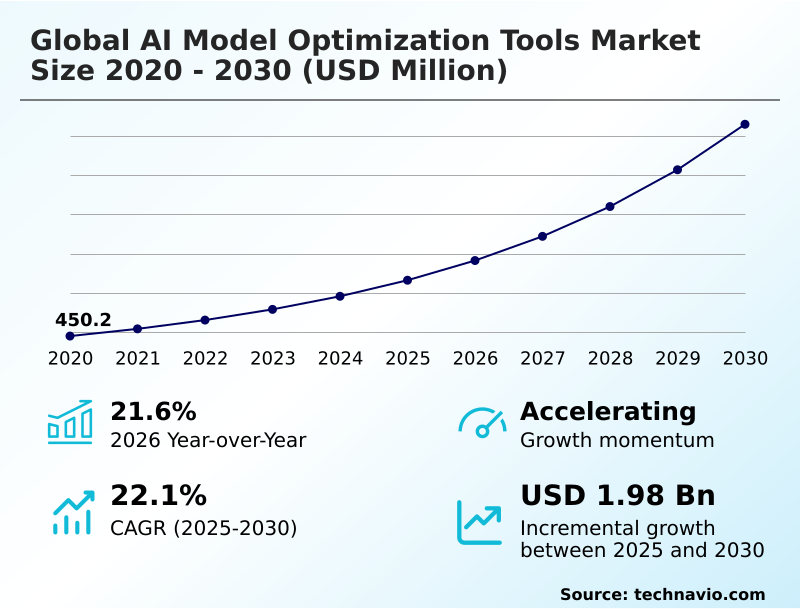
The ai model optimization tools market size is valued to increase by USD 1.98 billion, at a CAGR of 22.1% from 2025 to 2030. Proliferation of edge computing and internet of things hardware will drive the ai model optimization tools market.

Major Market Trends & Insights

  • North America dominated the market and accounted for a 40.6% growth during the forecast period.
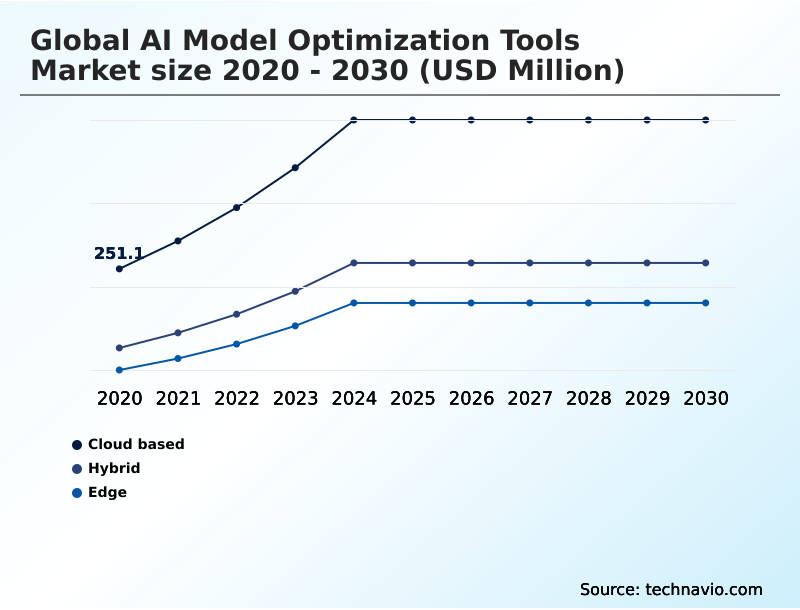
  • By Deployment - Cloud based segment was valued at USD 501.5 million in 2024
  • By Application - Generative AI segment accounted for the largest market revenue share in 2024

Market Size & Forecast

  • Market Opportunities: USD 2.70 billion
  • Market Future Opportunities: USD 1.98 billion
  • CAGR from 2025 to 2030 : 22.1%

Market Summary

  • The AI model optimization tools market is driven by the imperative to bridge the gap between complex neural networks and practical hardware limitations. As organizations scale AI from experimentation to enterprise-wide deployment, techniques such as weight pruning, quantization, and knowledge distillation become essential for commercial viability.
  • These methods reduce the computational footprint and memory requirements of deep learning architectures, enabling their use on resource-constrained devices like IoT sensors and edge nodes. This is particularly critical in applications requiring low latency, such as autonomous navigation systems, where real-time processing is paramount.
  • For instance, in a smart factory setting, optimized computer vision models can perform defect detection on a high-speed assembly line using only on-device processing, eliminating cloud dependency and enhancing data privacy. The growing demand for generative AI further accelerates this need, as enterprises seek to mitigate high operational expenses and power consumption associated with large language models.
  • The industry's focus is on developing automated, hardware-aware frameworks that maximize the utility of hardware investments, ensuring that AI applications are both powerful and efficient in a competitive environment.

What will be the Size of the AI Model Optimization Tools Market during the forecast period?

Get Key Insights on Market Forecast (PDF) Request Free Sample

How is the AI Model Optimization Tools Market Segmented?

The ai model optimization tools industry research report provides comprehensive data (region-wise segment analysis), with forecasts and estimates in "USD million" for the period 2026-2030, as well as historical data from 2020-2024 for the following segments.

  • Deployment
    • Cloud based
    • Hybrid
    • Edge
  • Application
    • Generative AI
    • Computer vision
    • NLP
    • Others
  • End-user
    • IT and telecom
    • Automotive
    • Healthcare
    • BFSI
    • Others
  • Geography
    • North America
      • US
      • Canada
      • Mexico
    • Europe
      • Germany
      • UK
      • France
    • APAC
      • China
      • Japan
      • India
    • Middle East and Africa
      • Saudi Arabia
      • UAE
      • Israel
    • South America
      • Brazil
      • Argentina
    • Rest of World (ROW)

By Deployment Insights

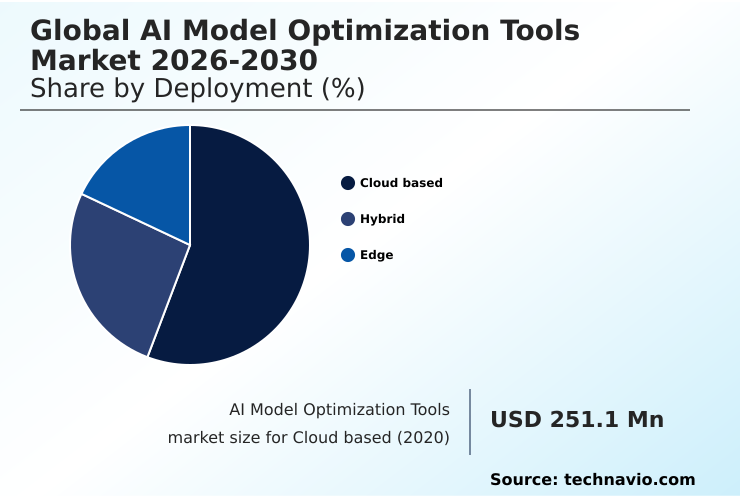
The cloud based segment is estimated to witness significant growth during the forecast period.

Cloud-based deployment is a cornerstone of the market, leveraging vast computational resources in centralized data centers to enhance AI model deployment efficiency.

Optimization within this segment concentrates on increasing the throughput of massive machine learning models and reducing the financial burden of high-end hardware utilization, such as tensor processing units.

Cloud providers offer specialized tools that automate model compression through techniques like weight pruning and quantization. This enables the serving of millions of requests with lower latency, which is critical for real-time AI processing.

Furthermore, complex methods like knowledge distillation, which require significant memory and power, are executed in the cloud. Such processes improve sustainable AI computing by creating smaller models, achieving a 70% reduction in inference energy consumption for certain workloads.

Request Free Sample

The Cloud based segment was valued at USD 501.5 million in 2024 and showed a gradual increase during the forecast period.
Request Free Sample

Regional Analysis

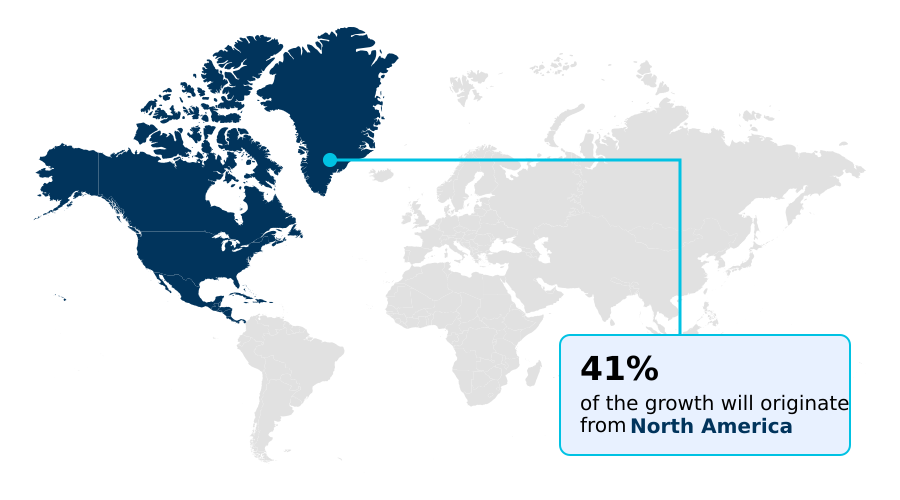
North America is estimated to contribute 40.6% to the growth of the global market during the forecast period.Technavio’s analysts have elaborately explained the regional trends and drivers that shape the market during the forecast period.

See How AI Model Optimization Tools Market Demand is Rising in North America Request Free Sample

The geographic landscape is led by North America, which accounts for 40.6% of the market's incremental growth and is projected to expand at a rate of 22.9%.

This region is the epicenter for developing foundational models, driving demand for inference acceleration and automated model compression to ensure cost-efficient AI inference at scale.

Europe, growing at a solid 21.7%, emphasizes sustainable and privacy-preserving AI, fueling advancements in structural pruning and low-rank adaptation for low-latency AI applications. The focus in this region is on hardware-agnostic AI deployment to comply with data sovereignty regulations.

The APAC region is a critical hub for hardware manufacturing, where hardware-aware optimization is paramount for embedding AI in consumer electronics and mobile devices, demanding effective AI model lifecycle management.

Market Dynamics

Our researchers analyzed the data with 2025 as the base year, along with the key drivers, trends, and challenges. A holistic analysis of drivers will help companies refine their marketing strategies to gain a competitive advantage.

  • Strategic deployment of AI hinges on addressing core efficiency challenges, from optimizing LLMs for mobile devices to reducing inference latency in computer vision. The debate over pruning versus quantization for model size is ongoing, with each method impacting the trade-off between AI model size and speed.
  • For generative models, knowledge distillation for generative AI models is a key technique, but the impact of optimization on generative AI quality requires careful validation. For specialized tasks, hardware-aware NAS for custom silicon offers bespoke solutions, while the four-bit quantization impact on model accuracy remains a critical research area for general-purpose applications.
  • Successfully integrating optimization into MLOps workflows is essential for managing the AI model lifecycle. However, the challenges in cross-platform AI deployment persist, demanding robust strategies for managing AI model fidelity post-compression. This is especially true when optimizing transformer models for NLP tasks, where nuance is critical.
  • The push for AI model optimization for autonomous vehicles highlights the need for safety and reliability. Meanwhile, reducing energy use of large language models addresses sustainability concerns, influencing the cost comparison of cloud versus edge AI. Techniques are also being refined for specific applications, such as quantization methods for recommender systems and the optimization of predictive maintenance models.
  • For instance, streamlining deep learning inference processes for AI model optimization for financial services can yield performance gains three times greater than unoptimized transactional systems. Ultimately, lowering computational needs of CNNs and other architectures is fundamental to scaling AI deployments effectively and economically.

What are the key market drivers leading to the rise in the adoption of AI Model Optimization Tools Industry?

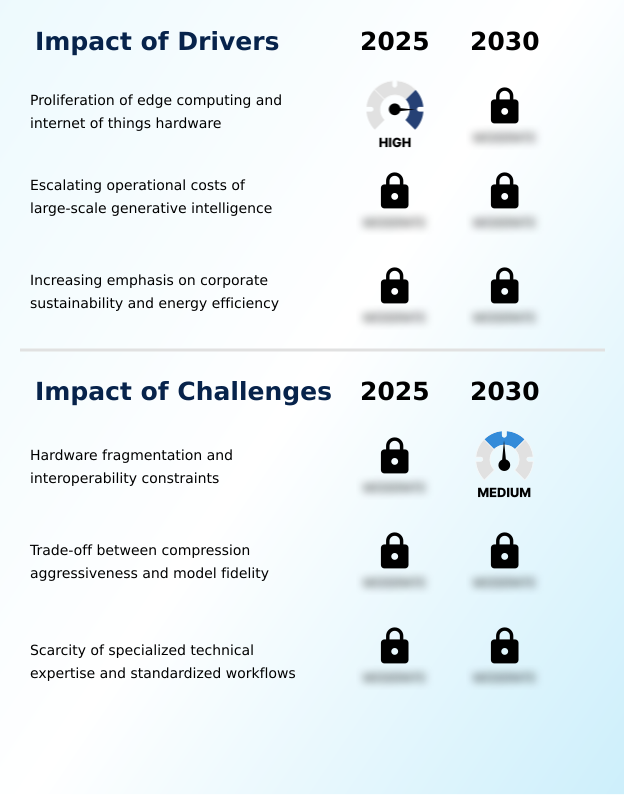
  • The proliferation of edge computing and Internet of Things (IoT) hardware is a key market driver, creating significant demand for optimized models on resource-constrained devices.

  • Market growth is primarily driven by economic and sustainability imperatives. The escalating operational costs of large language model deployment are compelling enterprises to prioritize inference cost reduction.
  • Techniques like four-bit quantization and eight-bit quantization are becoming standard for AI algorithm streamlining, enabling some firms to lower their deep learning inference expenses by over 50%.
  • Concurrently, the proliferation of edge computing and the demand for generative AI on-device capabilities necessitate efficient models like convolutional neural networks that can operate under strict power constraints.
  • ESG mandates are also a major factor, with optimization tools helping reduce the energy consumption of data centers.
  • Efficient models require up to 75% less power, directly contributing to corporate sustainability goals and making the AI model validation process more aligned with green initiatives.

What are the market trends shaping the AI Model Optimization Tools Industry?

  • A prominent market trend is the rising adoption of hardware-aware automated neural architecture search. This approach optimizes performance by tailoring model designs to specific hardware characteristics.

  • Key market trends are centered on enhancing efficiency and automating complex workflows. The rise of ultra-low precision methods, such as low-bit quantization, is critical for deploying large models on consumer devices, enabling up to a fourfold reduction in memory footprint with manageable accuracy trade-offs. This drive for energy-efficient AI is essential for both mobile applications and cloud AI cost reduction.
  • Another significant trend is the deep MLOps integration of optimization tools. This shift treats optimization not as a final step but as a continuous process, with automated pipelines applying techniques like embedding layer streamlining and speculative decoding during retraining cycles.
  • This continuous optimization approach improves AI model portability and has been shown to reduce model deployment failures by over 60% by maintaining consistent performance.

What challenges does the AI Model Optimization Tools Industry face during its growth?

  • Significant hardware fragmentation and persistent interoperability constraints present a key challenge affecting industry growth by complicating model deployment across diverse platforms.

  • Key challenges constrain the market, led by hardware fragmentation that complicates cross-platform AI deployment. Engineering teams often see development time increase by over 40% when creating optimized deep learning models for disparate hardware backends. Another critical hurdle is the trade-off between compression and model fidelity, particularly for complex transformer-based architectures.
  • Aggressive optimization can degrade accuracy by up to 5%, an unacceptable risk in high-stakes applications like medical diagnostics. This necessitates a rigorous AI model version control and validation process. Furthermore, a significant talent shortage of engineers with expertise in both deep learning and low-level systems engineering hinders adoption.
  • The lack of standardized workflows also makes AI model auditing for bias and security in compressed models a major operational barrier, slowing the transition to production-ready systems with a lower computational footprint.

Exclusive Technavio Analysis on Customer Landscape

The ai model optimization tools market forecasting report includes the adoption lifecycle of the market, covering from the innovator’s stage to the laggard’s stage. It focuses on adoption rates in different regions based on penetration. Furthermore, the ai model optimization tools market report also includes key purchase criteria and drivers of price sensitivity to help companies evaluate and develop their market growth analysis strategies.
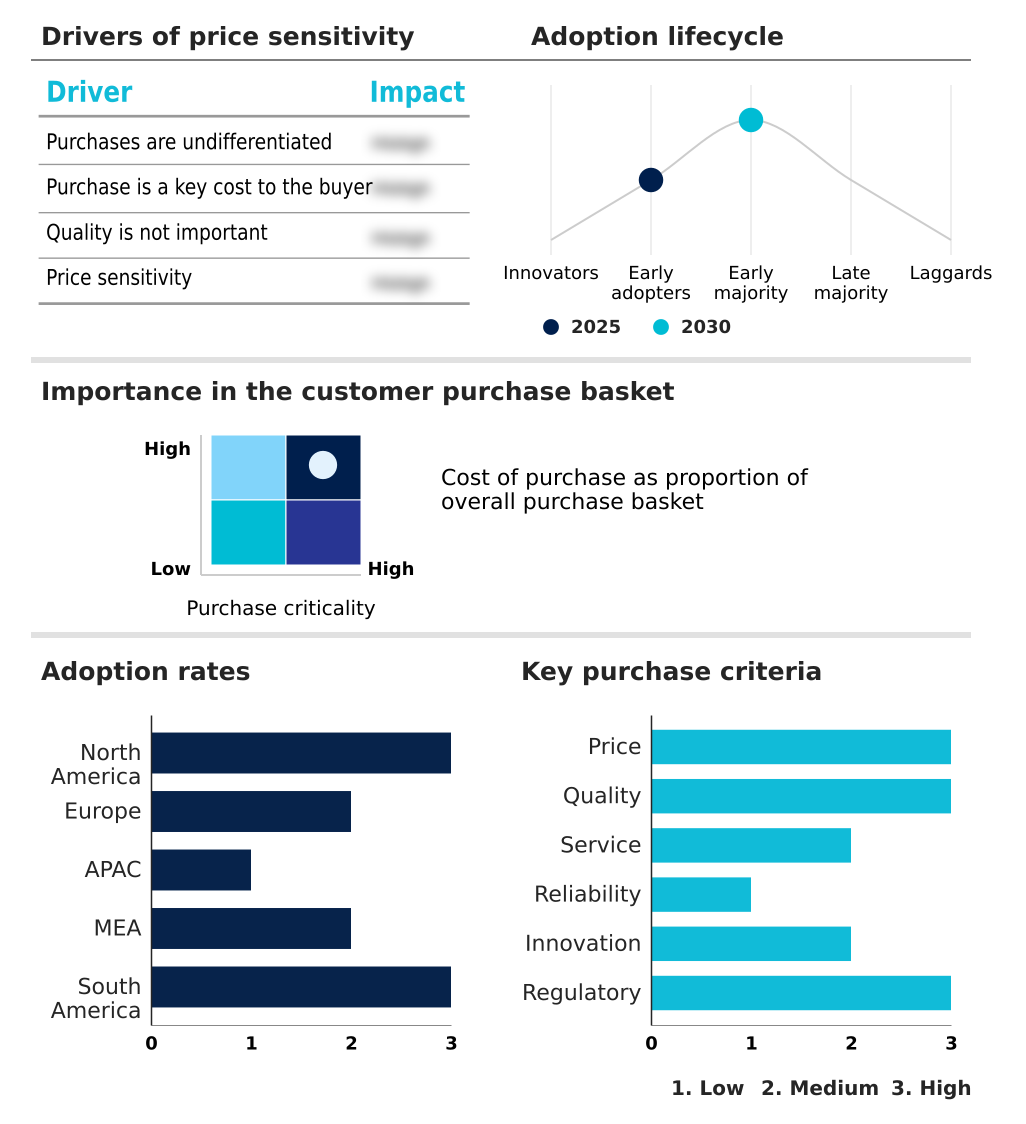
Customer Landscape of AI Model Optimization Tools Industry

Competitive Landscape

Companies are implementing various strategies, such as strategic alliances, ai model optimization tools market forecast, partnerships, mergers and acquisitions, geographical expansion, and product/service launches, to enhance their presence in the industry.

Advanced Micro Devices Inc. - Offerings enable accelerated deep learning inference and training performance, leveraging specialized software ecosystems to improve efficiency across complex computational tasks.

The industry research and growth report includes detailed analyses of the competitive landscape of the market and information about key companies, including:

  • Advanced Micro Devices Inc.
  • Amazon.com Inc.
  • Apple Inc.
  • Arm Ltd.
  • Baidu Inc.
  • Blaize
  • Cadence Design Systems Inc.
  • Google LLC
  • Hugging Face Inc.
  • IBM Corp.
  • Intel Corp.
  • Latent AI Inc.
  • Meta Platforms Inc.
  • Microsoft Corp.
  • NVIDIA Corp.
  • Oracle Corp.
  • Qualcomm Inc.
  • Red Hat Inc.
  • SAP SE
  • Synopsys Inc.

Qualitative and quantitative analysis of companies has been conducted to help clients understand the wider business environment as well as the strengths and weaknesses of key industry players. Data is qualitatively analyzed to categorize companies as pure play, category-focused, industry-focused, and diversified; it is quantitatively analyzed to categorize companies as dominant, leading, strong, tentative, and weak.

Recent Development and News in Ai model optimization tools market

  • In August 2025, Meta Platforms released an enhanced version of the ExecuTorch framework, which introduced streamlined support for four-bit quantization across a wider range of mobile and embedded chipsets.
  • In May 2025, Arm Holdings introduced an updated version of the Ethos-U85 neural processing unit software suite, featuring hardware-native weight compression and automated pruning capabilities to reduce memory bandwidth requirements.
  • In November 2025, Microsoft Corporation implemented a comprehensive energy-efficiency tracking system within its Azure AI model catalog to provide transparent metrics on wattage consumed per inference task.
  • In February 2025, the Linux Foundation launched the Open Accelerator Communications project to create a standard interface for connecting different types of artificial intelligence accelerators, aiming to reduce engineering overhead.

Dive into Technavio’s robust research methodology, blending expert interviews, extensive data synthesis, and validated models for unparalleled AI Model Optimization Tools Market insights. See full methodology.

Market Scope
Page number 318
Base year 2025
Historic period 2020-2024
Forecast period 2026-2030
Growth momentum & CAGR Accelerate at a CAGR of 22.1%
Market growth 2026-2030 USD 1984.9 million
Market structure Fragmented
YoY growth 2025-2026(%) 21.6%
Key countries US, Canada, Mexico, Germany, UK, France, Italy, Spain, The Netherlands, China, Japan, India, South Korea, Australia, Indonesia, Saudi Arabia, UAE, Israel, South Africa, Egypt, Brazil, Argentina and Chile
Competitive landscape Leading Companies, Market Positioning of Companies, Competitive Strategies, and Industry Risks

Request Free Sample

Research Analyst Overview

  • The market is defined by a suite of sophisticated techniques designed to shrink the computational footprint of AI. Core methods like weight pruning and quantization are fundamental, with advanced approaches such as knowledge distillation and low-rank adaptation enabling smaller, yet powerful models.
  • The pursuit of peak performance drives the use of hardware-aware optimization and automated neural architecture search, which tailor algorithms to specific hardware like tensor processing units for maximum inference acceleration. For generative AI, model compression strategies are paramount, with low-bit quantization, including four-bit quantization and eight-bit quantization, becoming standard practice.
  • Techniques like weight-only quantization and structural pruning are critical for deploying complex transformer-based architectures and convolutional neural networks on edge devices. This allows businesses to achieve over a 40% increase in inference throughput on existing hardware. Effective optimization also involves embedding layer streamlining and speculative decoding, supported by weight tying techniques, all while ensuring model fidelity.
  • This focus on efficiency is crucial for managing the cost of deep learning inference and enabling broader adoption.

What are the Key Data Covered in this AI Model Optimization Tools Market Research and Growth Report?

  • What is the expected growth of the AI Model Optimization Tools Market between 2026 and 2030?

    • USD 1.98 billion, at a CAGR of 22.1%

  • What segmentation does the market report cover?

    • The report is segmented by Deployment (Cloud based, Hybrid, and Edge), Application (Generative AI, Computer vision, NLP, and Others), End-user (IT and telecom, Automotive, Healthcare, BFSI, and Others) and Geography (North America, Europe, APAC, Middle East and Africa, South America)

  • Which regions are analyzed in the report?

    • North America, Europe, APAC, Middle East and Africa and South America

  • What are the key growth drivers and market challenges?

    • Proliferation of edge computing and internet of things hardware, Hardware fragmentation and interoperability constraints

  • Who are the major players in the AI Model Optimization Tools Market?

    • Advanced Micro Devices Inc., Amazon.com Inc., Apple Inc., Arm Ltd., Baidu Inc., Blaize, Cadence Design Systems Inc., Google LLC, Hugging Face Inc., IBM Corp., Intel Corp., Latent AI Inc., Meta Platforms Inc., Microsoft Corp., NVIDIA Corp., Oracle Corp., Qualcomm Inc., Red Hat Inc., SAP SE and Synopsys Inc.

Market Research Insights

  • Market dynamics are shaped by the drive for cost-efficient AI inference and improved AI model deployment efficiency across various platforms. The pursuit of on-device generative AI has led to aggressive compression techniques that can achieve a fourfold reduction in model size, making sophisticated features viable on consumer hardware.
  • This supports the trend toward hardware-agnostic AI deployment, which aims to reduce reliance on specific silicon. Geographically, market momentum is significant, with North America alone accounting for over 40% of the incremental growth, driven by its concentration of foundational model developers and hyperscale data centers.
  • This regional dominance underscores the importance of cloud AI cost reduction and AI model lifecycle management for maintaining competitive advantage in an accelerating market.

We can help! Our analysts can customize this ai model optimization tools market research report to meet your requirements.

Get in touch

1. Executive Summary

1.1 Market overview

Executive Summary - Chart on Market Overview
Executive Summary - Data Table on Market Overview
Executive Summary - Chart on Global Market Characteristics
Executive Summary - Chart on Market by Geography
Executive Summary - Chart on Market Segmentation by Deployment
Executive Summary - Chart on Market Segmentation by Application
Executive Summary - Chart on Market Segmentation by End-user
Executive Summary - Chart on Incremental Growth
Executive Summary - Data Table on Incremental Growth
Executive Summary - Chart on Company Market Positioning

2. Technavio Analysis

2.1 Analysis of price sensitivity, lifecycle, customer purchase basket, adoption rates, and purchase criteria

2.2 Criticality of inputs and Factors of differentiation

Chart on Overview on criticality of inputs and factors of differentiation

2.3 Factors of disruption

Chart on Overview on factors of disruption

2.4 Impact of drivers and challenges

Chart on Impact of drivers and challenges in 2025 and 2030

3. Market Landscape

3.1 Market ecosystem

Chart on Parent Market
Data Table on - Parent Market

3.2 Market characteristics

Chart on Market characteristics analysis

3.3 Value chain analysis

Chart on Value chain analysis

4. Market Sizing

4.1 Market definition

Data Table on Offerings of companies included in the market definition

4.2 Market segment analysis

Market segments

4.3 Market size 2025

4.4 Market outlook: Forecast for 2025-2030

Chart on Global - Market size and forecast 2025-2030 ($ million)
Data Table on Global - Market size and forecast 2025-2030 ($ million)
Chart on Global Market: Year-over-year growth 2025-2030 (%)
Data Table on Global Market: Year-over-year growth 2025-2030 (%)

5. Historic Market Size

5.1 Global AI Model Optimization Tools Market 2020 - 2024

Historic Market Size - Data Table on Global AI Model Optimization Tools Market 2020 - 2024 ($ million)

5.2 Deployment segment analysis 2020 - 2024

Historic Market Size - Deployment Segment 2020 - 2024 ($ million)

5.3 Application segment analysis 2020 - 2024

Historic Market Size - Application Segment 2020 - 2024 ($ million)

5.4 End-user segment analysis 2020 - 2024

Historic Market Size - End-user Segment 2020 - 2024 ($ million)

5.5 Geography segment analysis 2020 - 2024

Historic Market Size - Geography Segment 2020 - 2024 ($ million)

5.6 Country segment analysis 2020 - 2024

Historic Market Size - Country Segment 2020 - 2024 ($ million)

6. Qualitative Analysis

6.1 Impact of geopolitical conflicts on Global AI Model Optimization Tools Market

7. Five Forces Analysis

7.1 Five forces summary

Five forces analysis - Comparison between 2025 and 2030

7.2 Bargaining power of buyers

Bargaining power of buyers - Impact of key factors 2025 and 2030

7.3 Bargaining power of suppliers

Bargaining power of suppliers - Impact of key factors in 2025 and 2030

7.4 Threat of new entrants

Threat of new entrants - Impact of key factors in 2025 and 2030

7.5 Threat of substitutes

Threat of substitutes - Impact of key factors in 2025 and 2030

7.6 Threat of rivalry

Threat of rivalry - Impact of key factors in 2025 and 2030

7.7 Market condition

Chart on Market condition - Five forces 2025 and 2030

8. Market Segmentation by Deployment

8.1 Market segments

Chart on Deployment - Market share 2025-2030 (%)
Data Table on Deployment - Market share 2025-2030 (%)

8.2 Comparison by Deployment

Chart on Comparison by Deployment
Data Table on Comparison by Deployment

8.3 Cloud based - Market size and forecast 2025-2030

Chart on Cloud based - Market size and forecast 2025-2030 ($ million)
Data Table on Cloud based - Market size and forecast 2025-2030 ($ million)
Chart on Cloud based - Year-over-year growth 2025-2030 (%)
Data Table on Cloud based - Year-over-year growth 2025-2030 (%)

8.4 Hybrid - Market size and forecast 2025-2030

Chart on Hybrid - Market size and forecast 2025-2030 ($ million)
Data Table on Hybrid - Market size and forecast 2025-2030 ($ million)
Chart on Hybrid - Year-over-year growth 2025-2030 (%)
Data Table on Hybrid - Year-over-year growth 2025-2030 (%)

8.5 Edge - Market size and forecast 2025-2030

Chart on Edge - Market size and forecast 2025-2030 ($ million)
Data Table on Edge - Market size and forecast 2025-2030 ($ million)
Chart on Edge - Year-over-year growth 2025-2030 (%)
Data Table on Edge - Year-over-year growth 2025-2030 (%)

8.6 Market opportunity by Deployment

Market opportunity by Deployment ($ million)
Data Table on Market opportunity by Deployment ($ million)

9. Market Segmentation by Application

9.1 Market segments

Chart on Application - Market share 2025-2030 (%)
Data Table on Application - Market share 2025-2030 (%)

9.2 Comparison by Application

Chart on Comparison by Application
Data Table on Comparison by Application

9.3 Generative AI - Market size and forecast 2025-2030

Chart on Generative AI - Market size and forecast 2025-2030 ($ million)
Data Table on Generative AI - Market size and forecast 2025-2030 ($ million)
Chart on Generative AI - Year-over-year growth 2025-2030 (%)
Data Table on Generative AI - Year-over-year growth 2025-2030 (%)

9.4 Computer vision - Market size and forecast 2025-2030

Chart on Computer vision - Market size and forecast 2025-2030 ($ million)
Data Table on Computer vision - Market size and forecast 2025-2030 ($ million)
Chart on Computer vision - Year-over-year growth 2025-2030 (%)
Data Table on Computer vision - Year-over-year growth 2025-2030 (%)

9.5 NLP - Market size and forecast 2025-2030

Chart on NLP - Market size and forecast 2025-2030 ($ million)
Data Table on NLP - Market size and forecast 2025-2030 ($ million)
Chart on NLP - Year-over-year growth 2025-2030 (%)
Data Table on NLP - Year-over-year growth 2025-2030 (%)

9.6 Others - Market size and forecast 2025-2030

Chart on Others - Market size and forecast 2025-2030 ($ million)
Data Table on Others - Market size and forecast 2025-2030 ($ million)
Chart on Others - Year-over-year growth 2025-2030 (%)
Data Table on Others - Year-over-year growth 2025-2030 (%)

9.7 Market opportunity by Application

Market opportunity by Application ($ million)
Data Table on Market opportunity by Application ($ million)

10. Market Segmentation by End-user

10.1 Market segments

Chart on End-user - Market share 2025-2030 (%)
Data Table on End-user - Market share 2025-2030 (%)

10.2 Comparison by End-user

Chart on Comparison by End-user
Data Table on Comparison by End-user

10.3 IT and telecom - Market size and forecast 2025-2030

Chart on IT and telecom - Market size and forecast 2025-2030 ($ million)
Data Table on IT and telecom - Market size and forecast 2025-2030 ($ million)
Chart on IT and telecom - Year-over-year growth 2025-2030 (%)
Data Table on IT and telecom - Year-over-year growth 2025-2030 (%)

10.4 Automotive - Market size and forecast 2025-2030

Chart on Automotive - Market size and forecast 2025-2030 ($ million)
Data Table on Automotive - Market size and forecast 2025-2030 ($ million)
Chart on Automotive - Year-over-year growth 2025-2030 (%)
Data Table on Automotive - Year-over-year growth 2025-2030 (%)

10.5 Healthcare - Market size and forecast 2025-2030

Chart on Healthcare - Market size and forecast 2025-2030 ($ million)
Data Table on Healthcare - Market size and forecast 2025-2030 ($ million)
Chart on Healthcare - Year-over-year growth 2025-2030 (%)
Data Table on Healthcare - Year-over-year growth 2025-2030 (%)

10.6 BFSI - Market size and forecast 2025-2030

Chart on BFSI - Market size and forecast 2025-2030 ($ million)
Data Table on BFSI - Market size and forecast 2025-2030 ($ million)
Chart on BFSI - Year-over-year growth 2025-2030 (%)
Data Table on BFSI - Year-over-year growth 2025-2030 (%)

10.7 Others - Market size and forecast 2025-2030

Chart on Others - Market size and forecast 2025-2030 ($ million)
Data Table on Others - Market size and forecast 2025-2030 ($ million)
Chart on Others - Year-over-year growth 2025-2030 (%)
Data Table on Others - Year-over-year growth 2025-2030 (%)

10.8 Market opportunity by End-user

Market opportunity by End-user ($ million)
Data Table on Market opportunity by End-user ($ million)

11. Customer Landscape

11.1 Customer landscape overview

Analysis of price sensitivity, lifecycle, customer purchase basket, adoption rates, and purchase criteria

12. Geographic Landscape

12.1 Geographic segmentation

Chart on Market share by geography 2025-2030 (%)
Data Table on Market share by geography 2025-2030 (%)

12.2 Geographic comparison

Chart on Geographic comparison
Data Table on Geographic comparison

12.3 North America - Market size and forecast 2025-2030

Chart on North America - Market size and forecast 2025-2030 ($ million)
Data Table on North America - Market size and forecast 2025-2030 ($ million)
Chart on North America - Year-over-year growth 2025-2030 (%)
Data Table on North America - Year-over-year growth 2025-2030 (%)
Chart on Regional Comparison - North America
Data Table on Regional Comparison - North America

12.3.1 US - Market size and forecast 2025-2030

Chart on US - Market size and forecast 2025-2030 ($ million)
Data Table on US - Market size and forecast 2025-2030 ($ million)
Chart on US - Year-over-year growth 2025-2030 (%)
Data Table on US - Year-over-year growth 2025-2030 (%)

12.3.2 Canada - Market size and forecast 2025-2030

Chart on Canada - Market size and forecast 2025-2030 ($ million)
Data Table on Canada - Market size and forecast 2025-2030 ($ million)
Chart on Canada - Year-over-year growth 2025-2030 (%)
Data Table on Canada - Year-over-year growth 2025-2030 (%)

12.3.3 Mexico - Market size and forecast 2025-2030

Chart on Mexico - Market size and forecast 2025-2030 ($ million)
Data Table on Mexico - Market size and forecast 2025-2030 ($ million)
Chart on Mexico - Year-over-year growth 2025-2030 (%)
Data Table on Mexico - Year-over-year growth 2025-2030 (%)

12.4 Europe - Market size and forecast 2025-2030

Chart on Europe - Market size and forecast 2025-2030 ($ million)
Data Table on Europe - Market size and forecast 2025-2030 ($ million)
Chart on Europe - Year-over-year growth 2025-2030 (%)
Data Table on Europe - Year-over-year growth 2025-2030 (%)
Chart on Regional Comparison - Europe
Data Table on Regional Comparison - Europe

12.4.1 Germany - Market size and forecast 2025-2030

Chart on Germany - Market size and forecast 2025-2030 ($ million)
Data Table on Germany - Market size and forecast 2025-2030 ($ million)
Chart on Germany - Year-over-year growth 2025-2030 (%)
Data Table on Germany - Year-over-year growth 2025-2030 (%)

12.4.2 UK - Market size and forecast 2025-2030

Chart on UK - Market size and forecast 2025-2030 ($ million)
Data Table on UK - Market size and forecast 2025-2030 ($ million)
Chart on UK - Year-over-year growth 2025-2030 (%)
Data Table on UK - Year-over-year growth 2025-2030 (%)

12.4.3 France - Market size and forecast 2025-2030

Chart on France - Market size and forecast 2025-2030 ($ million)
Data Table on France - Market size and forecast 2025-2030 ($ million)
Chart on France - Year-over-year growth 2025-2030 (%)
Data Table on France - Year-over-year growth 2025-2030 (%)

12.4.4 Italy - Market size and forecast 2025-2030

Chart on Italy - Market size and forecast 2025-2030 ($ million)
Data Table on Italy - Market size and forecast 2025-2030 ($ million)
Chart on Italy - Year-over-year growth 2025-2030 (%)
Data Table on Italy - Year-over-year growth 2025-2030 (%)

12.4.5 Spain - Market size and forecast 2025-2030

Chart on Spain - Market size and forecast 2025-2030 ($ million)
Data Table on Spain - Market size and forecast 2025-2030 ($ million)
Chart on Spain - Year-over-year growth 2025-2030 (%)
Data Table on Spain - Year-over-year growth 2025-2030 (%)

12.4.6 The Netherlands - Market size and forecast 2025-2030

Chart on The Netherlands - Market size and forecast 2025-2030 ($ million)
Data Table on The Netherlands - Market size and forecast 2025-2030 ($ million)
Chart on The Netherlands - Year-over-year growth 2025-2030 (%)
Data Table on The Netherlands - Year-over-year growth 2025-2030 (%)

12.5 APAC - Market size and forecast 2025-2030

Chart on APAC - Market size and forecast 2025-2030 ($ million)
Data Table on APAC - Market size and forecast 2025-2030 ($ million)
Chart on APAC - Year-over-year growth 2025-2030 (%)
Data Table on APAC - Year-over-year growth 2025-2030 (%)
Chart on Regional Comparison - APAC
Data Table on Regional Comparison - APAC

12.5.1 China - Market size and forecast 2025-2030

Chart on China - Market size and forecast 2025-2030 ($ million)
Data Table on China - Market size and forecast 2025-2030 ($ million)
Chart on China - Year-over-year growth 2025-2030 (%)
Data Table on China - Year-over-year growth 2025-2030 (%)

12.5.2 Japan - Market size and forecast 2025-2030

Chart on Japan - Market size and forecast 2025-2030 ($ million)
Data Table on Japan - Market size and forecast 2025-2030 ($ million)
Chart on Japan - Year-over-year growth 2025-2030 (%)
Data Table on Japan - Year-over-year growth 2025-2030 (%)

12.5.3 India - Market size and forecast 2025-2030

Chart on India - Market size and forecast 2025-2030 ($ million)
Data Table on India - Market size and forecast 2025-2030 ($ million)
Chart on India - Year-over-year growth 2025-2030 (%)
Data Table on India - Year-over-year growth 2025-2030 (%)

12.5.4 South Korea - Market size and forecast 2025-2030

Chart on South Korea - Market size and forecast 2025-2030 ($ million)
Data Table on South Korea - Market size and forecast 2025-2030 ($ million)
Chart on South Korea - Year-over-year growth 2025-2030 (%)
Data Table on South Korea - Year-over-year growth 2025-2030 (%)

12.5.5 Australia - Market size and forecast 2025-2030

Chart on Australia - Market size and forecast 2025-2030 ($ million)
Data Table on Australia - Market size and forecast 2025-2030 ($ million)
Chart on Australia - Year-over-year growth 2025-2030 (%)
Data Table on Australia - Year-over-year growth 2025-2030 (%)

12.5.6 Indonesia - Market size and forecast 2025-2030

Chart on Indonesia - Market size and forecast 2025-2030 ($ million)
Data Table on Indonesia - Market size and forecast 2025-2030 ($ million)
Chart on Indonesia - Year-over-year growth 2025-2030 (%)
Data Table on Indonesia - Year-over-year growth 2025-2030 (%)

12.6 Middle East and Africa - Market size and forecast 2025-2030

Chart on Middle East and Africa - Market size and forecast 2025-2030 ($ million)
Data Table on Middle East and Africa - Market size and forecast 2025-2030 ($ million)
Chart on Middle East and Africa - Year-over-year growth 2025-2030 (%)
Data Table on Middle East and Africa - Year-over-year growth 2025-2030 (%)
Chart on Regional Comparison - Middle East and Africa
Data Table on Regional Comparison - Middle East and Africa

12.6.1 Saudi Arabia - Market size and forecast 2025-2030

Chart on Saudi Arabia - Market size and forecast 2025-2030 ($ million)
Data Table on Saudi Arabia - Market size and forecast 2025-2030 ($ million)
Chart on Saudi Arabia - Year-over-year growth 2025-2030 (%)
Data Table on Saudi Arabia - Year-over-year growth 2025-2030 (%)

12.6.2 UAE - Market size and forecast 2025-2030

Chart on UAE - Market size and forecast 2025-2030 ($ million)
Data Table on UAE - Market size and forecast 2025-2030 ($ million)
Chart on UAE - Year-over-year growth 2025-2030 (%)
Data Table on UAE - Year-over-year growth 2025-2030 (%)

12.6.3 Israel - Market size and forecast 2025-2030

Chart on Israel - Market size and forecast 2025-2030 ($ million)
Data Table on Israel - Market size and forecast 2025-2030 ($ million)
Chart on Israel - Year-over-year growth 2025-2030 (%)
Data Table on Israel - Year-over-year growth 2025-2030 (%)

12.6.4 South Africa - Market size and forecast 2025-2030

Chart on South Africa - Market size and forecast 2025-2030 ($ million)
Data Table on South Africa - Market size and forecast 2025-2030 ($ million)
Chart on South Africa - Year-over-year growth 2025-2030 (%)
Data Table on South Africa - Year-over-year growth 2025-2030 (%)

12.6.5 Egypt - Market size and forecast 2025-2030

Chart on Egypt - Market size and forecast 2025-2030 ($ million)
Data Table on Egypt - Market size and forecast 2025-2030 ($ million)
Chart on Egypt - Year-over-year growth 2025-2030 (%)
Data Table on Egypt - Year-over-year growth 2025-2030 (%)

12.7 South America - Market size and forecast 2025-2030

Chart on South America - Market size and forecast 2025-2030 ($ million)
Data Table on South America - Market size and forecast 2025-2030 ($ million)
Chart on South America - Year-over-year growth 2025-2030 (%)
Data Table on South America - Year-over-year growth 2025-2030 (%)
Chart on Regional Comparison - South America
Data Table on Regional Comparison - South America

12.7.1 Brazil - Market size and forecast 2025-2030

Chart on Brazil - Market size and forecast 2025-2030 ($ million)
Data Table on Brazil - Market size and forecast 2025-2030 ($ million)
Chart on Brazil - Year-over-year growth 2025-2030 (%)
Data Table on Brazil - Year-over-year growth 2025-2030 (%)

12.7.2 Argentina - Market size and forecast 2025-2030

Chart on Argentina - Market size and forecast 2025-2030 ($ million)
Data Table on Argentina - Market size and forecast 2025-2030 ($ million)
Chart on Argentina - Year-over-year growth 2025-2030 (%)
Data Table on Argentina - Year-over-year growth 2025-2030 (%)

12.7.3 Chile - Market size and forecast 2025-2030

Chart on Chile - Market size and forecast 2025-2030 ($ million)
Data Table on Chile - Market size and forecast 2025-2030 ($ million)
Chart on Chile - Year-over-year growth 2025-2030 (%)
Data Table on Chile - Year-over-year growth 2025-2030 (%)

12.8 Market opportunity by geography

Market opportunity by geography ($ million)
Data Tables on Market opportunity by geography ($ million)

13. Drivers, Challenges, and Opportunity

13.1 Market drivers

Proliferation of edge computing and internet of things hardware
Escalating operational costs of large-scale generative intelligence
Increasing emphasis on corporate sustainability and energy efficiency

13.2 Market challenges

Hardware fragmentation and interoperability constraints
Trade-off between compression aggressiveness and model fidelity
Scarcity of specialized technical expertise and standardized workflows

13.3 Impact of drivers and challenges

Impact of drivers and challenges in 2025 and 2030

13.4 Market opportunities

Adoption of hardware-aware automated neural architecture search
Rise of ultra-low precision quantization for generative intelligence
Integration of continuous optimization within enterprise MLOPS pipelines

14. Competitive Landscape

14.1 Overview

14.2

Overview on criticality of inputs and factors of differentiation

14.3 Landscape disruption

Overview on factors of disruption

14.4 Industry risks

Impact of key risks on business

15. Competitive Analysis

15.1 Companies profiled

Companies covered

15.2 Company ranking index

15.3 Market positioning of companies

Matrix on companies position and classification

15.4 Advanced Micro Devices Inc.

Advanced Micro Devices Inc. - Overview
Advanced Micro Devices Inc. - Business segments
Advanced Micro Devices Inc. - Key news
Advanced Micro Devices Inc. - Key offerings
Advanced Micro Devices Inc. - Segment focus
SWOT

15.5 Amazon.com Inc.

Amazon.com Inc. - Overview
Amazon.com Inc. - Business segments
Amazon.com Inc. - Key news
Amazon.com Inc. - Key offerings
Amazon.com Inc. - Segment focus
SWOT

15.6 Apple Inc.

Apple Inc. - Overview
Apple Inc. - Business segments
Apple Inc. - Key news
Apple Inc. - Key offerings
Apple Inc. - Segment focus
SWOT

15.7 Arm Ltd.

Arm Ltd. - Overview
Arm Ltd. - Product / Service
Arm Ltd. - Key offerings
SWOT

15.8 Baidu Inc.

Baidu Inc. - Overview
Baidu Inc. - Business segments
Baidu Inc. - Key offerings
Baidu Inc. - Segment focus
SWOT

15.9 Blaize

Blaize - Overview
Blaize - Product / Service
Blaize - Key offerings
SWOT

15.10 Cadence Design Systems Inc.

Cadence Design Systems Inc. - Overview
Cadence Design Systems Inc. - Business segments
Cadence Design Systems Inc. - Key news
Cadence Design Systems Inc. - Key offerings
Cadence Design Systems Inc. - Segment focus
SWOT

15.11 Google LLC

Google LLC - Overview
Google LLC - Product / Service
Google LLC - Key offerings
SWOT

15.12 Hugging Face Inc.

Hugging Face Inc. - Overview
Hugging Face Inc. - Product / Service
Hugging Face Inc. - Key offerings
SWOT

15.13 IBM Corp.

IBM Corp. - Overview
IBM Corp. - Business segments
IBM Corp. - Key news
IBM Corp. - Key offerings
IBM Corp. - Segment focus
SWOT

15.14 Intel Corp.

Intel Corp. - Overview
Intel Corp. - Business segments
Intel Corp. - Key offerings
Intel Corp. - Segment focus
SWOT

15.15 Latent AI Inc.

Latent AI Inc. - Overview
Latent AI Inc. - Product / Service
Latent AI Inc. - Key offerings
SWOT

15.16 Meta Platforms Inc.

Meta Platforms Inc. - Overview
Meta Platforms Inc. - Business segments
Meta Platforms Inc. - Key offerings
Meta Platforms Inc. - Segment focus
SWOT

15.17 Microsoft Corp.

Microsoft Corp. - Overview
Microsoft Corp. - Business segments
Microsoft Corp. - Key news
Microsoft Corp. - Key offerings
Microsoft Corp. - Segment focus
SWOT

15.18 NVIDIA Corp.

NVIDIA Corp. - Overview
NVIDIA Corp. - Business segments
NVIDIA Corp. - Key news
NVIDIA Corp. - Key offerings
NVIDIA Corp. - Segment focus
SWOT

16. Appendix

16.1 Scope of the report

Market definition
Objectives
Notes and caveats

16.2 Inclusions and exclusions checklist

Inclusions checklist
Exclusions checklist

16.3 Currency conversion rates for US$

16.4 Research methodology

16.5 Data procurement

Information sources

16.6 Data validation

16.7 Validation techniques employed for market sizing

16.8 Data synthesis

16.9 360 degree market analysis

16.10 List of abbreviations

Research Methodology

Technavio presents a detailed picture of the market by way of study, synthesis, and summation of data from multiple sources. The analysts have presented the various facets of the market with a particular focus on identifying the key industry influencers. The data thus presented is comprehensive, reliable, and the result of extensive research, both primary and secondary.

INFORMATION SOURCES

Primary sources

  • Manufacturers and suppliers
  • Channel partners
  • Industry experts
  • Strategic decision makers

Secondary sources

  • Industry journals and periodicals
  • Government data
  • Financial reports of key industry players
  • Historical data
  • Press releases

DATA ANALYSIS

Data Synthesis

  • Collation of data
  • Estimation of key figures
  • Analysis of derived insights

Data Validation

  • Triangulation with data models
  • Reference against proprietary databases
  • Corroboration with industry experts

REPORT WRITING

Qualitative

  • Market drivers
  • Market challenges
  • Market trends
  • Five forces analysis

Quantitative

  • Market size and forecast
  • Market segmentation
  • Geographical insights
  • Competitive landscape

Interested in this report?

Get your sample now to see our research methodology and insights!

Download Now

Frequently Asked Questions

AI Model Optimization Tools market growth will increase by USD 1984.9 million during 2026-2030.

The AI Model Optimization Tools market is expected to grow at a CAGR of 22.1% during 2026-2030.

AI Model Optimization Tools market is segmented by Deployment (Cloud based, Hybrid, Edge) Application (Generative AI, Computer vision, NLP, Others) End-user (IT and telecom, Automotive, Healthcare, BFSI, Others)

Advanced Micro Devices Inc., Amazon.com Inc., Apple Inc., Arm Ltd., Baidu Inc., Blaize, Cadence Design Systems Inc., Google LLC, Hugging Face Inc., IBM Corp., Intel Corp., Latent AI Inc., Meta Platforms Inc., Microsoft Corp., NVIDIA Corp., Oracle Corp., Qualcomm Inc., Red Hat Inc., SAP SE, Synopsys Inc. are a few of the key vendors in the AI Model Optimization Tools market.

North America will register the highest growth rate of 40.6% among the other regions. Therefore, the AI Model Optimization Tools market in North America is expected to garner significant business opportunities for the vendors during the forecast period.

US, Canada, Mexico, Germany, UK, France, Italy, Spain, The Netherlands, China, Japan, India, South Korea, Australia, Indonesia, Saudi Arabia, UAE, Israel, South Africa, Egypt, Brazil, Argentina, Chile

  • Proliferation of edge computing and internet of things hardware is the driving factor this market.

The AI Model Optimization Tools market vendors should focus on grabbing business opportunities from the Deployment segment as it accounted for the largest market share in the base year.
RIA - Research AI Assistant
Ask RIA