


Airport IT Spending Market Size 2026-2030
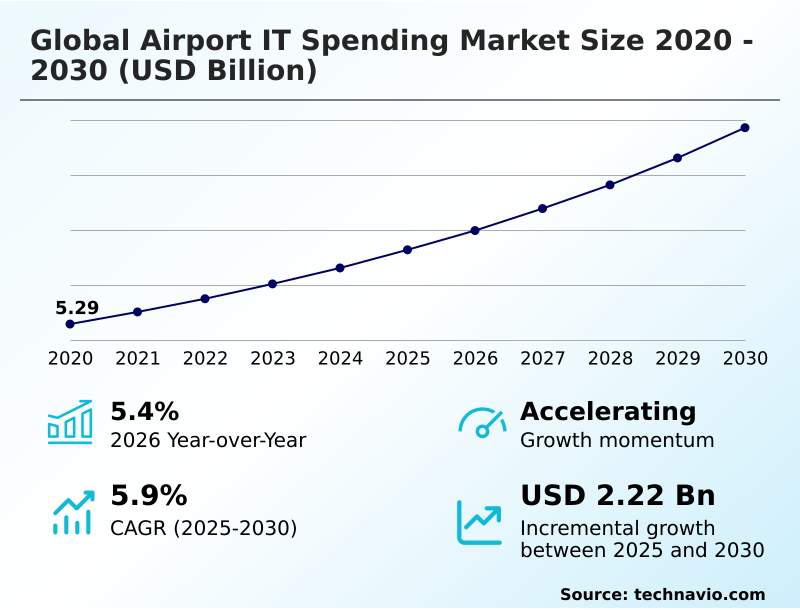
The Airport IT Spending Market size was valued at USD 6.64 billion in 2025, growing at a CAGR of 5.9% during the forecast period 2026-2030.
Major Market Trends & Insights
- APAC dominated the market and accounted for a 36.5% growth during the forecast period.
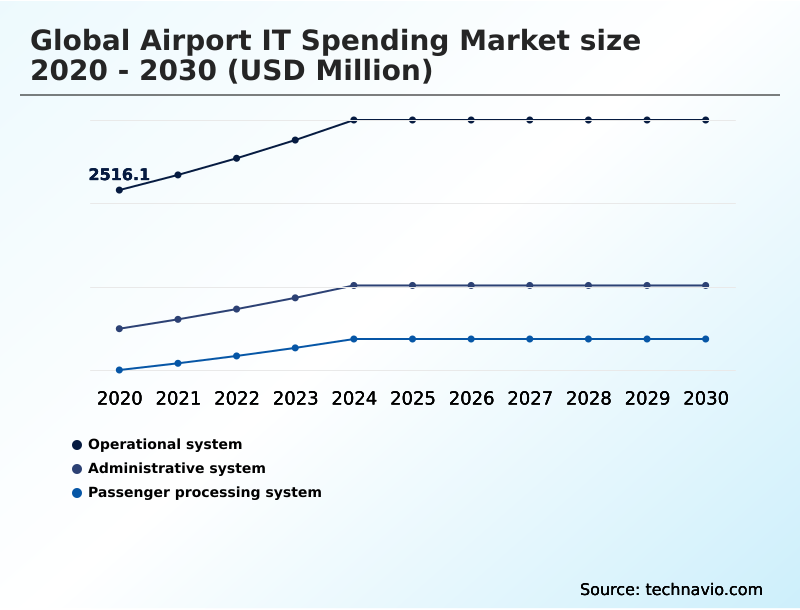
- By End-user - Operational system segment was valued at USD 3.01 billion in 2024
- By Component - Hardware segment accounted for the largest market revenue share in 2024
Market Size & Forecast
- Historic Market Opportunities 2020-2024: USD 3.57 billion
- Market Future Opportunities 2025-2030: USD 2.22 billion
- CAGR from 2025 to 2030 : 5.9%
Market Summary
- The airport IT spending market is defined by a strategic push toward operational efficiency, with technology adoption reducing passenger processing times by over 20% in modernized terminals. This investment is not optional; in one business scenario, an airport's inability to upgrade its baggage handling system led to a 15% increase in mishandled luggage, directly impacting airline partnerships and passenger satisfaction.
- A key driver is the effort to enhance the customer journey, as seamless, digitally-enabled experiences correlate directly with higher non-aeronautical revenue. However, progress is constrained by the significant challenge of high initial capital outlay and system complexity. Integrating new platforms with legacy infrastructure often requires extensive customization, delaying deployment and increasing costs.
- This dynamic forces airports to balance the immediate need for technological advancement against long-term financial and operational risks, making strategic IT investment a critical component of airport management.
What will be the Size of the Airport IT Spending Market during the forecast period?
Get Key Insights on Market Forecast (PDF) Request Free Sample
How is the Airport IT Spending Market Segmented?
The airport it spending industry research report provides comprehensive data (region-wise segment analysis), with forecasts and analysis for the period 2026-2030, as well as historical data from 2020-2024 for the following segments.
- End-user
- Operational system
- Administrative system
- Passenger processing system
- Component
- Hardware
- Software
- Services
- Application
- Security
- Finance and operations
- Maintenance
- Others
- Geography
- APAC
- China
- Japan
- India
- North America
- US
- Canada
- Mexico
- Europe
- Germany
- UK
- France
- Middle East and Africa
- Saudi Arabia
- UAE
- South Africa
- South America
- Brazil
- Argentina
- Colombia
- Rest of World (ROW)
- APAC
How is the Airport IT Spending Market Segmented by End-user?
The operational system segment is estimated to witness significant growth during the forecast period.
Operational systems constitute a critical segment in airport IT spending, with investments in this area reducing aircraft turnaround times by up to 15%.
This segment's growth is driven by the need for enhanced efficiency; for instance, the integration of an airport operational database with resource optimization software can improve on-time performance by over 10%.
These systems, which underpin functions from passenger flow management to airfield lighting, require a clear digital transformation roadmap. The adoption of biometric passenger processing and mobile app ecosystem integration is essential for managing passenger throughput.
As airports focus on sustainable aviation, operational IT is also being leveraged to monitor and reduce environmental impact, affecting everything from ground support to supply chain digitalization.
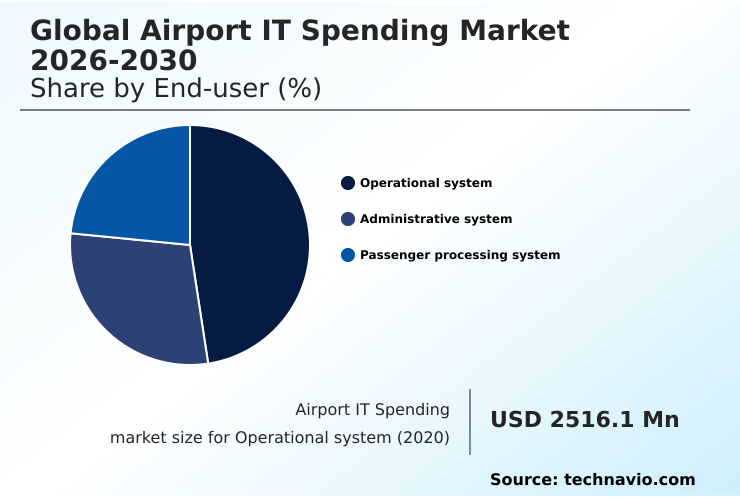
The Operational system segment was valued at USD 3.01 billion in 2024 and showed a gradual increase during the forecast period.
How demand for the Airport IT Spending market is rising in the leading region?
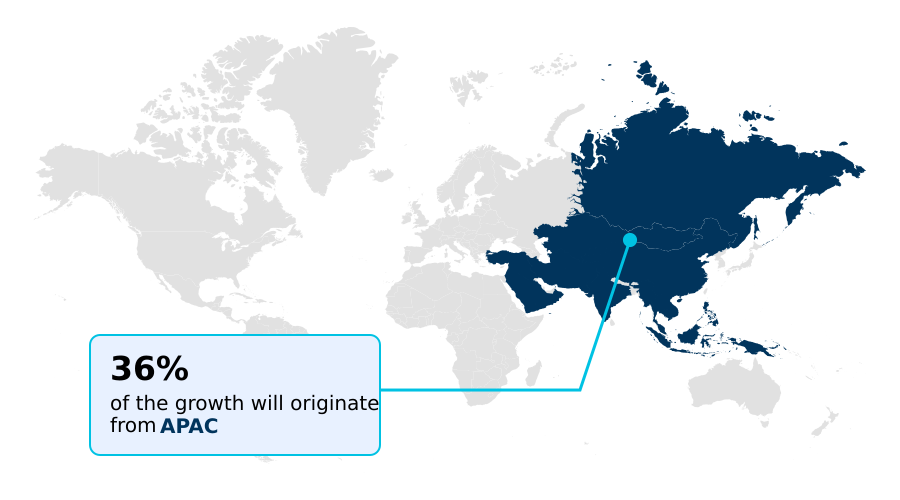
APAC is estimated to contribute 36.5% to the growth of the global market during the forecast period.Technavio’s analysts have elaborately explained the regional trends and drivers that shape the market during the forecast period.
See How Airport IT Spending Market demand is rising in APAC Request Free Sample
The geographic distribution of airport IT spending is led by APAC, which accounts for 36.5% of the market's incremental growth, significantly outpacing North America at 26.38%.
This growth is driven by countries like China, where IT spending in airports like Beijing Capital International is projected to be nearly double that of major European hubs.
Regional differences are pronounced; APAC's investment is heavily focused on new smart airport infrastructure and capacity planning for rapid passenger growth, while North America prioritizes infrastructure modernization of existing assets.
For example, the adoption of digital twin simulation for air traffic management is approximately 20% higher in new Asian airports compared to their North American counterparts.
This divergence impacts everything from workforce management strategies to backend IT infrastructure requirements, with APAC favoring scalable, greenfield deployments.
What are the key Drivers, Trends, and Challenges in the Airport IT Spending Market?
Our researchers analyzed the data with 2025 as the base year, along with the key drivers, trends, and challenges. A holistic analysis of drivers will help companies refine their marketing strategies to gain a competitive advantage.
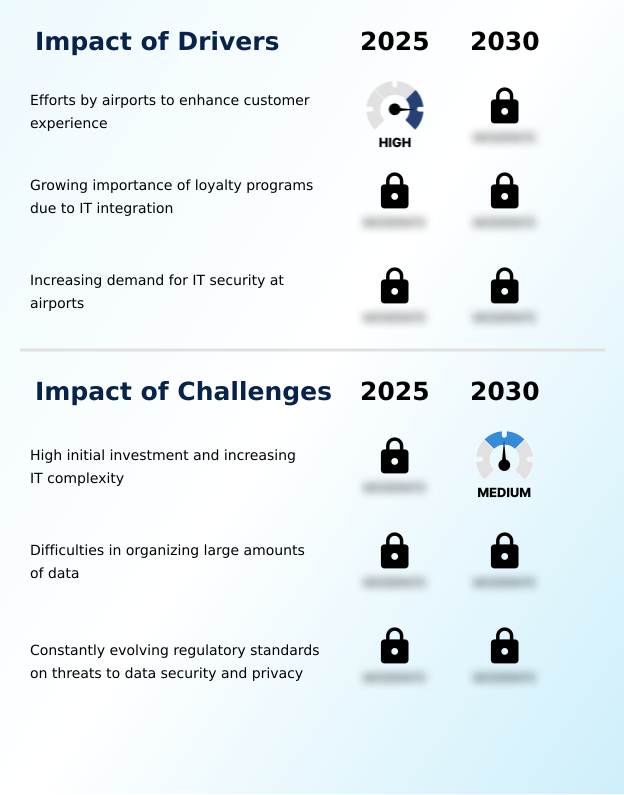
- Strategic decisions in airport IT spending are increasingly shaped by the goal of enhancing the overall customer experience, moving beyond purely operational metrics. Understanding the nuances of airport IT spending for customer experience is critical, as investments in seamless check-in and personalized communication can increase passenger satisfaction scores by over 15%.
- However, these initiatives are often weighed against the significant cybersecurity challenges in airport IT. The cost-benefit analysis of deploying new systems, such as exploring biometric passenger identification cost vs benefit, reveals complex trade-offs between security and convenience. Operators are also evaluating cloud CRM benefits for airports, which promise greater personalization and revenue generation but require robust data protection frameworks.
- The implementation of real-time passenger flow management systems addresses operational bottlenecks, a key factor as airports aim to handle more traffic without physical expansion. The effectiveness of these systems can be directly measured by a reduction in queue times, which in some cases exceeds 25% during peak hours.
- Ultimately, the market's trajectory is determined by how well airports can balance technological innovation with security imperatives and financial constraints, ensuring that every dollar spent contributes to a safer, more efficient, and more enjoyable passenger journey.
What are the key market drivers leading to the rise in the adoption of Airport IT Spending Industry?
- Efforts by airports to enhance the customer experience are a key driver for the market, necessitating investment in technologies that streamline the passenger journey.
- Efforts to enhance the passenger experience are a primary driver of the airport IT spending market, with airports using technology to increase non-aeronautical revenue by up to 20%.
- The growing importance of IT-integrated loyalty programs, powered by customer data platforms, allows for personalized marketing and deeper engagement.
- Simultaneously, the increasing demand for IT security, driven by the convergence of operational and information technologies, has made threat detection platforms a critical investment.
- Airports are implementing advanced solutions for digital identity management and predictive maintenance algorithms to ensure operational resilience.
- These investments in passenger service systems and baggage handling automation are not just about efficiency but are also a response to evolving regulatory compliance standards, making IT a strategic enabler of both revenue and security.
What are the market trends shaping the Airport IT Spending Industry?
- A primary market trend is the strategic focus on establishing high-end cybersecurity at airports to counter evolving digital threats. This involves deploying advanced threat detection and secure network architectures.
- A defining trend in airport IT spending is the shift toward holistic, high-end cybersecurity frameworks, which can reduce threat detection times by up to 40%. As airports evolve into digitized ecosystems, they are adopting cloud-based CRM and real-time wait time monitoring systems to enhance passenger journey mapping and elevate user experience design.
- The integration of biometric authentication and other contactless technologies is becoming standard, creating a seamless flow for travelers. This digital transformation is underpinned by a focus on robust IT governance to manage the vast amounts of data generated.
- The goal is to create a frictionless environment through sophisticated data-driven decision making and omnichannel engagement, where passenger satisfaction is directly linked to the quality of the digital interaction.
What challenges does the Airport IT Spending Industry face during its growth?
- The high initial investment required for modernization, coupled with increasing IT complexity, presents a key challenge affecting industry growth.
- The high initial investment and increasing complexity of IT systems present a significant challenge, with infrastructure modernization projects often exceeding initial budgets by 15-20%. Integrating modern solutions like smart airport infrastructure with legacy enterprise resource planning systems is a primary hurdle, frequently causing delays.
- The difficulty in organizing massive datasets from disparate sources hinders effective data harmonization and requires robust data governance frameworks that many airports lack. Furthermore, the need for seamless system integration and strict interoperability protocols between vendors adds another layer of complexity.
- This is particularly evident when deploying common-use terminal equipment or advanced ground handling management software, where a failure to adhere to a zero trust architecture can create significant security vulnerabilities.
Exclusive Technavio Analysis on Customer Landscape
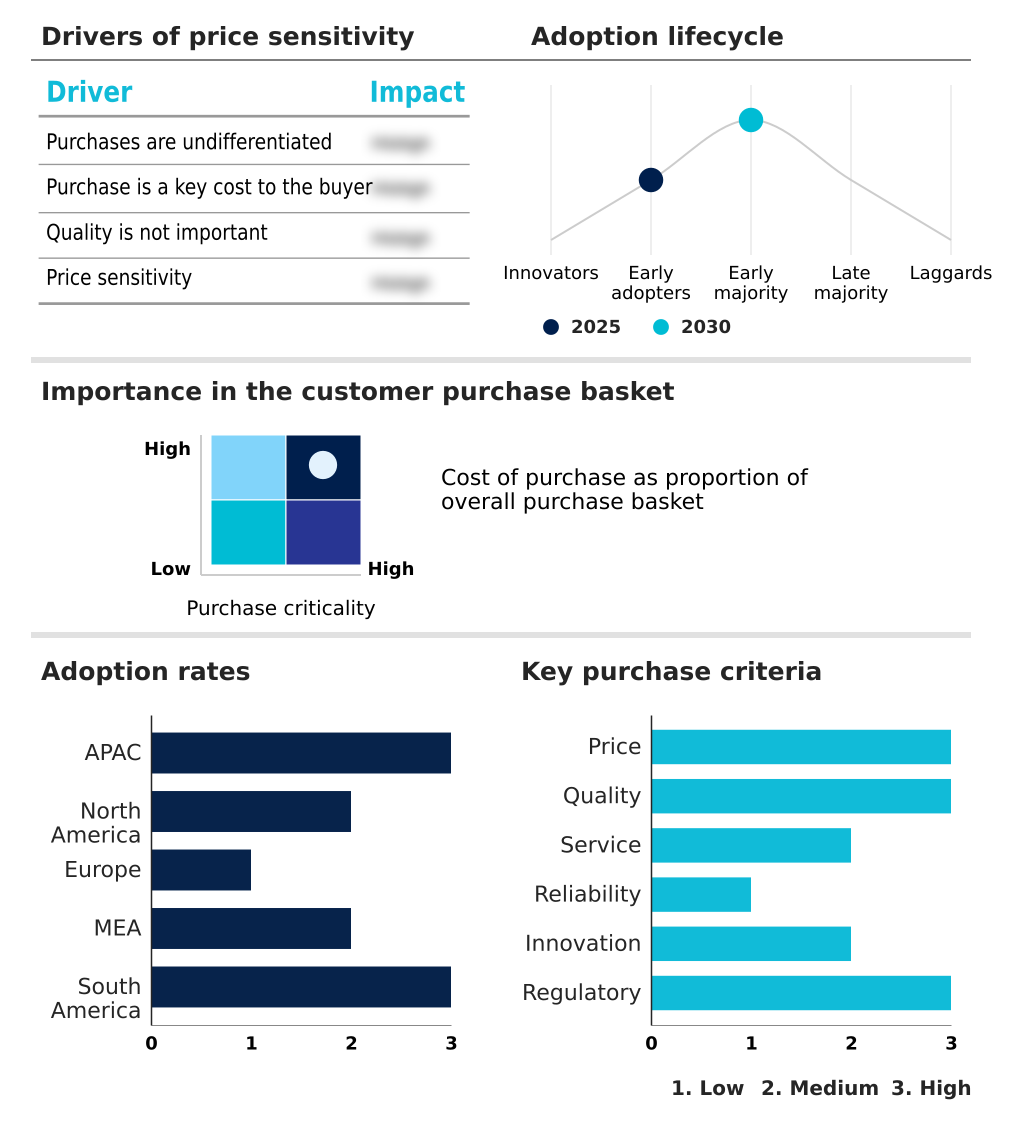
The airport it spending market forecasting report includes the adoption lifecycle of the market, covering from the innovator’s stage to the laggard’s stage. It focuses on adoption rates in different regions based on penetration. Furthermore, the airport it spending market report also includes key purchase criteria and drivers of price sensitivity to help companies evaluate and develop their market growth analysis strategies.
Customer Landscape of Airport IT Spending Industry
Competitive Landscape
Companies are implementing various strategies, such as strategic alliances, airport it spending market forecast, partnerships, mergers and acquisitions, geographical expansion, and product/service launches, to enhance their presence in the industry.
Amadeus IT Group SA - Offerings are centered on deploying integrated platforms for passenger service systems, airport operational databases, and biometric processing to enhance efficiency and security.
The industry research and growth report includes detailed analyses of the competitive landscape of the market and information about key companies, including:
- Amadeus IT Group SA
- Atos SE
- Capgemini SE
- China TravelSky Holding Co Ltd
- Cobham Ltd.
- Damarel Systems International
- IBM Corp.
- INFORM GmbH
- InterSystems Corp.
- Lockheed Martin Corp.
- NEC Corp.
- Northrop Grumman Corp.
- RESA SAS
- RTX Corp.
- Saab AB
- Siemens AG
- SITA
- Thales Group
- VELATIA S.L
Qualitative and quantitative analysis of companies has been conducted to help clients understand the wider business environment as well as the strengths and weaknesses of key industry players. Data is qualitatively analyzed to categorize companies as pure play, category-focused, industry-focused, and diversified; it is quantitatively analyzed to categorize companies as dominant, leading, strong, tentative, and weak.
Market Intelligence Radar: High-Impact Developments & Growth Signals
- In the IT Consulting and Other Services industry, increasing government investments to upgrade critical national IT infrastructure have directly accelerated spending on airport modernization, particularly in cybersecurity frameworks and passenger processing systems to meet new security mandates.
- The enterprise-wide push for digital transformation, including the adoption of advanced technologies like AI and cloud computing, is compelling airports to engage IT consulting firms for system integration and data harmonization, impacting their operational resilience.
- Heightened concerns over cybersecurity and the implementation of stringent data privacy regulations like GDPR have forced airports to allocate a larger portion of their IT budgets to compliance-driven security solutions and data governance frameworks, shaping service level agreements with vendors.
- The rising adoption of Agile and DevOps methodologies within IT services is influencing how airport IT projects are executed, enabling faster deployment of software for functions like passenger journey mapping and omnichannel engagement, thereby improving responsiveness to operational needs.
Dive into Technavio’s robust research methodology, blending expert interviews, extensive data synthesis, and validated models for unparalleled Airport IT Spending Market insights. See full methodology.
| Market Scope | |
|---|---|
| Page number | 306 |
| Base year | 2025 |
| Historic period | 2020-2024 |
| Forecast period | 2026-2030 |
| Growth momentum & CAGR | Accelerate at a CAGR of 5.9% |
| Market growth 2026-2030 | USD 2219.1 million |
| Market structure | Fragmented |
| YoY growth 2025-2026(%) | 5.4% |
| Key countries | China, Japan, India, South Korea, Australia, Indonesia, US, Canada, Mexico, Germany, UK, France, Italy, Spain, The Netherlands, Saudi Arabia, UAE, South Africa, Israel, Turkey, Brazil, Argentina and Colombia |
| Competitive landscape | Leading Companies, Market Positioning of Companies, Competitive Strategies, and Industry Risks |
Research Analyst Overview
- The airport IT spending ecosystem is a complex network of stakeholders, where technology providers and systems integrators account for over 60% of the value creation. The value chain begins with technology suppliers providing core components like biometric sensors and server hardware.
- These are then utilized by major solution providers, such as SITA and Amadeus IT Group SA, to build comprehensive platforms for passenger processing and airport operations. These platforms are segmented by end-user, with operational systems representing the largest share at 47.7% of the market.
- Regulatory bodies and aviation authorities impose strict standards for security and data privacy, influencing technology design and deployment. Finally, airports and airlines act as the end-users, procuring these IT solutions to enhance efficiency, security, and passenger experience, driving the entire ecosystem's innovation cycle.
What are the Key Data Covered in this Airport IT Spending Market Research and Growth Report?
-
What is the expected growth of the Airport IT Spending Market between 2026 and 2030?
-
The Airport IT Spending Market is expected to grow by USD 2.22 billion during 2026-2030, registering a CAGR of 5.9%. Year-over-year growth in 2026 is estimated at 5.4%%. This acceleration is shaped by efforts by airports to enhance customer experience, which is intensifying demand across multiple end-use verticals covered in the report.
-
-
What segmentation does the market report cover?
-
The report is segmented by End-user (Operational system, Administrative system, and Passenger processing system), Component (Hardware, Software, and Services), Application (Security, Finance and operations, Maintenance, and Others) and Geography (APAC, North America, Europe, Middle East and Africa, South America). Among these, the Operational system segment is estimated to witness significant growth during the forecast period, driven by rising adoption across key application areas. Each segment includes detailed qualitative and quantitative analysis, along with historical data from 2020-2024 and forecasts through 2030 with year-over-year growth rates.
-
-
Which regions are analyzed in the report?
-
The report covers APAC, North America, Europe, Middle East and Africa and South America. APAC is estimated to contribute 36.5% to market growth during the forecast period. Country-level analysis includes China, Japan, India, South Korea, Australia, Indonesia, US, Canada, Mexico, Germany, UK, France, Italy, Spain, The Netherlands, Saudi Arabia, UAE, South Africa, Israel, Turkey, Brazil, Argentina and Colombia, with dedicated market size tables and year-over-year growth for each.
-
-
What are the key growth drivers and market challenges?
-
The primary driver is efforts by airports to enhance customer experience, which is accelerating investment and industry demand. The main challenge is high initial investment and increasing it complexity, creating operational barriers for key market participants. The report quantifies the impact of each driver and challenge across 2026 and 2030 with comparative analysis.
-
-
Who are the major players in the Airport IT Spending Market?
-
Key vendors include Amadeus IT Group SA, Atos SE, Capgemini SE, China TravelSky Holding Co Ltd, Cobham Ltd., Damarel Systems International, IBM Corp., INFORM GmbH, InterSystems Corp., Lockheed Martin Corp., NEC Corp., Northrop Grumman Corp., RESA SAS, RTX Corp., Saab AB, Siemens AG, SITA, Thales Group and VELATIA S.L. The report provides qualitative and quantitative analysis categorizing companies as dominant, leading, strong, tentative, and weak based on their market positioning. Company profiles include business segment analysis, SWOT assessment, key offerings, and recent strategic developments.
-
Market Research Insights
- The competitive landscape in airport IT spending is marked by a high degree of technological specialization, with the top 10 vendors commanding over 45% of the market through integrated solution portfolios. Major players like Amadeus IT Group SA and SITA are advancing passenger service systems, while firms such as Thales Group and Siemens AG focus on security and operational infrastructure.
- Recent developments highlight a push toward automation and data analytics, exemplified by the integration of AI-driven tools to optimize gate assignments, which can improve asset utilization by up to 15%. This innovation directly addresses the industry's need for enhanced efficiency and security.
- However, vendors face the persistent challenge of ensuring interoperability between new and legacy systems, a factor that can slow down adoption cycles despite clear demand for modernization.
We can help! Our analysts can customize this airport it spending market research report to meet your requirements.
 RIA -
RIA - 
