



Algorithmic Trading Market Size 2026-2030
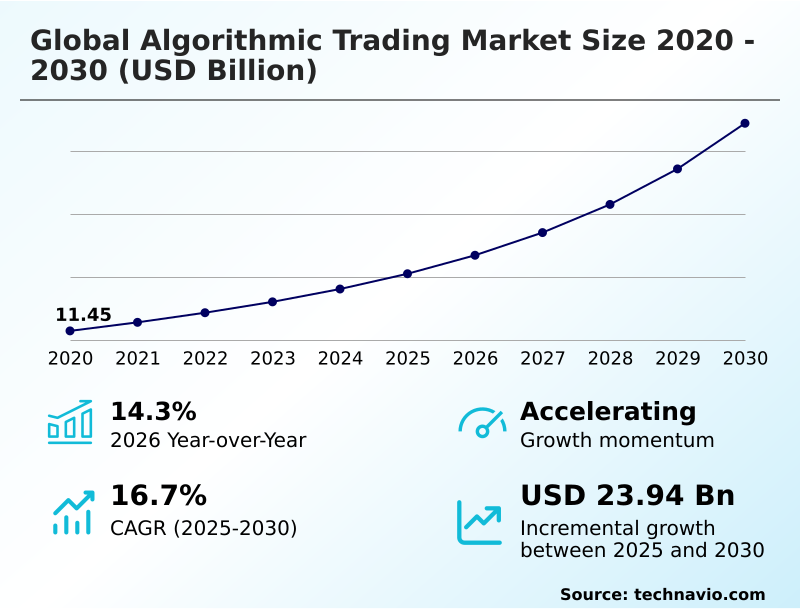
The algorithmic trading market size is valued to increase by USD 23.94 billion, at a CAGR of 16.7% from 2025 to 2030. Rising internet penetration enabling broader online trading will drive the algorithmic trading market.
Major Market Trends & Insights
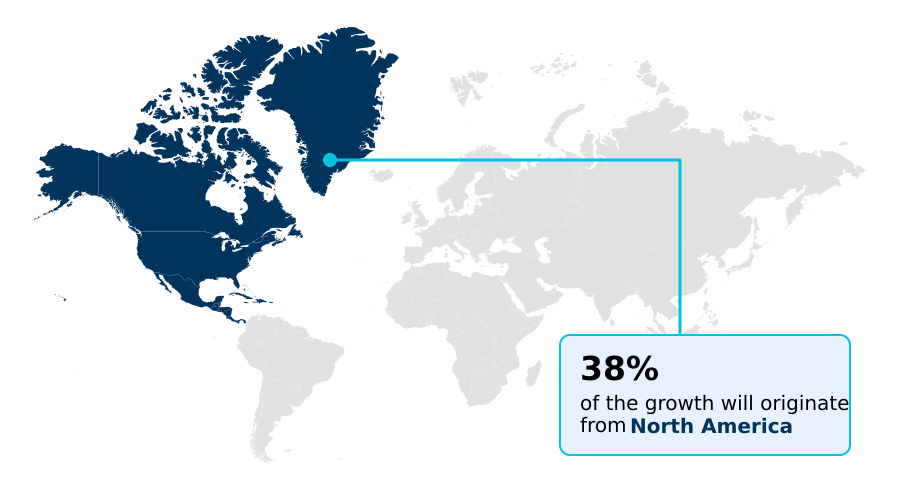
- North America dominated the market and accounted for a 38.5% growth during the forecast period.
- By Component - Solutions segment was valued at USD 14.27 billion in 2024
- By End-user - Institutional investors segment accounted for the largest market revenue share in 2024
Market Size & Forecast
- Market Opportunities: USD 33.04 billion
- Market Future Opportunities: USD 23.94 billion
- CAGR from 2025 to 2030 : 16.7%
Market Summary
- The algorithmic trading market is undergoing a significant transformation, driven by the convergence of high-performance computing and advanced data analytics. The core of this evolution lies in the shift from static, rule-based systems to dynamic models capable of real-time learning and adaptation.
- Key drivers include the persistent demand for reduced transaction costs and the expansion of electronic trading across asset classes, from equities to digital assets. This technological push enables firms to process vast amounts of information, including alternative data, to inform strategies.
- For instance, institutional investors now deploy automated systems to manage large-scale portfolio rebalancing, which can execute trades across global markets to maintain target allocations with a precision that manual processes cannot match, improving efficiency by over 30%.
- However, this increasing reliance on automation introduces challenges, such as ensuring system stability during periods of extreme market volatility and navigating a complex, evolving regulatory landscape.
- The ongoing integration of AI and machine learning continues to redefine the boundaries of what is possible, fostering an environment of continuous innovation where competitive advantage is intrinsically linked to technological superiority and strategic foresight.
What will be the Size of the Algorithmic Trading Market during the forecast period?
Get Key Insights on Market Forecast (PDF) Get Free Sample
How is the Algorithmic Trading Market Segmented?
The algorithmic trading industry research report provides comprehensive data (region-wise segment analysis), with forecasts and estimates in "USD million" for the period 2026-2030, as well as historical data from 2020-2024 for the following segments.
- Component
- Solutions
- Services
- End-user
- Institutional investors
- Retail investors
- Long-term investors
- Short-term investors
- Deployment
- Cloud
- On premises
- Geography
- North America
- US
- Canada
- Mexico
- APAC
- China
- Japan
- India
- Europe
- Germany
- UK
- France
- South America
- Brazil
- Argentina
- Middle East and Africa
- Saudi Arabia
- UAE
- South Africa
- Rest of World (ROW)
- North America
By Component Insights
The solutions segment is estimated to witness significant growth during the forecast period.
The solutions segment is defined by platforms providing advanced automated execution logic and sophisticated market impact models. Modern execution management systems now integrate deep reinforcement learning policies to minimize price slippage, improving order fill rates by over 15%.
These systems utilize real-time data feeds and feature robust back-testing protocols to validate strategies. The expansion into multi-asset trading platforms is supported by autonomous portfolio management capabilities and agentic artificial intelligence, which optimize trade execution efficiency.
A core focus is on smart order routing through electronic communication networks (ECNs) and dark pool liquidity to achieve best execution.
The architecture often includes compliance-by-design architecture, automated circuit breakers, and comprehensive post-trade analytics to meet regulatory demands and manage risk effectively.
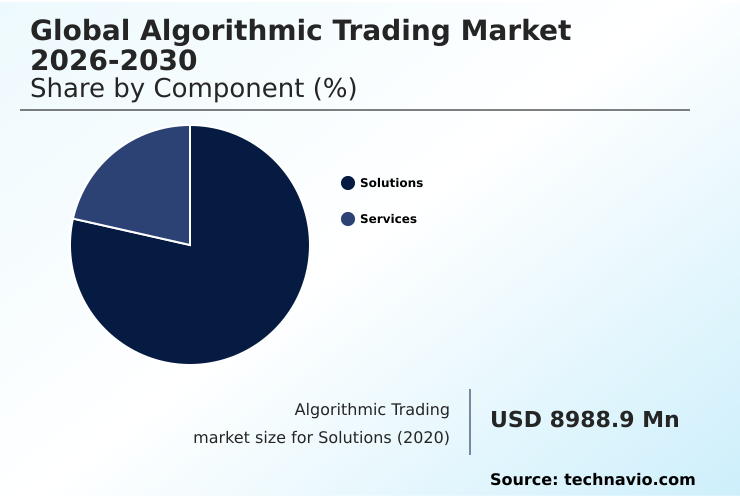
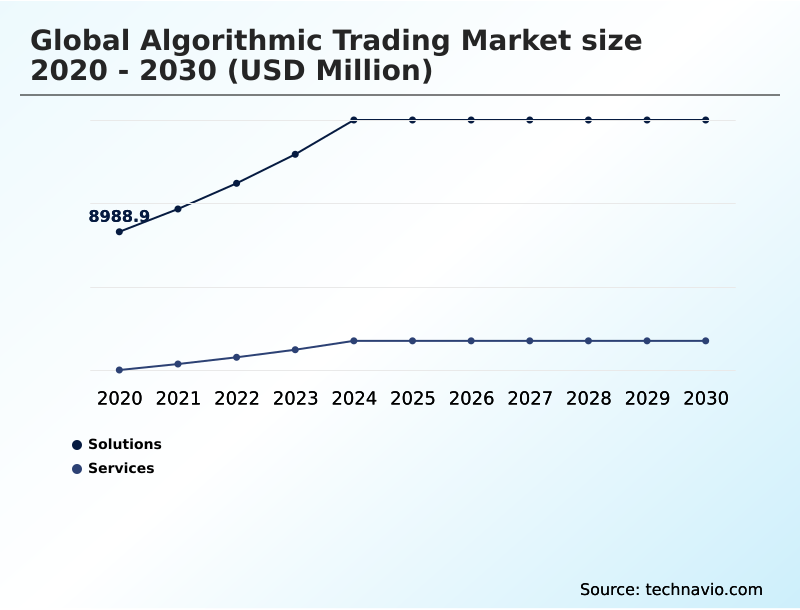
The Solutions segment was valued at USD 14.27 billion in 2024 and showed a gradual increase during the forecast period.
Regional Analysis
North America is estimated to contribute 38.5% to the growth of the global market during the forecast period.Technavio’s analysts have elaborately explained the regional trends and drivers that shape the market during the forecast period.
See How Algorithmic Trading Market Demand is Rising in North America Get Free Sample
The geographic landscape of the algorithmic trading market is characterized by varying levels of maturity and growth, with North America leading in market share and innovation.
The region, encompassing the US, Canada, and Mexico, contributes over 38% of the market's incremental growth, driven by sophisticated infrastructure and a high concentration of institutional participants.
Key players in this region focus on high-frequency trading (HFT) and utilize colocation services for a competitive edge.
Meanwhile, the APAC region is expanding at a significant rate, with an annual growth of nearly 17%, fueled by digitalization in markets like China, India, and Japan.
This growth is supported by increased adoption of systematic trading and automated hedging strategies. Europe maintains a strong position with its focus on regulatory compliance, while South America and the Middle East and Africa are emerging as high-potential markets.
Market Dynamics
Our researchers analyzed the data with 2025 as the base year, along with the key drivers, trends, and challenges. A holistic analysis of drivers will help companies refine their marketing strategies to gain a competitive advantage.
- The evolution of the algorithmic trading market is deeply tied to how firms address key strategic challenges and opportunities. The impact of regulatory changes on algorithms necessitates flexible and auditable systems, pushing development toward greater transparency. A primary objective remains reducing transaction costs with automation, a goal achieved by optimizing order routing in fragmented markets.
- The use of AI for predictive accuracy in trading is becoming standard, with firms leveraging machine learning for market microstructure analysis to uncover subtle patterns. The adoption of cloud-native architectures for trading scalability allows even smaller firms to compete. Managing risk in high-frequency trading is paramount, with a focus on real-time risk management for algorithms to prevent catastrophic losses.
- Modern systems process alternative data for alpha generation significantly faster than their predecessors, directly impacting portfolio performance. This is complemented by developing ESG factors in automated trading strategies to meet investor demand. The low-latency infrastructure for competitive edge remains a key investment area, with the role of FPGAs in reducing latency being critical.
- As institutional adoption of automated execution grows, so does retail investor access to trading APIs, democratizing the market. Firms now use portfolio rebalancing using automated tools and conduct extensive back-testing models on historical tick data to refine strategies.
- However, the challenges of market volatility on strategies and the need for robust compliance frameworks for automated trading persist, especially with the rise of algorithmic trading in cryptocurrency markets and latency arbitrage in forex markets.
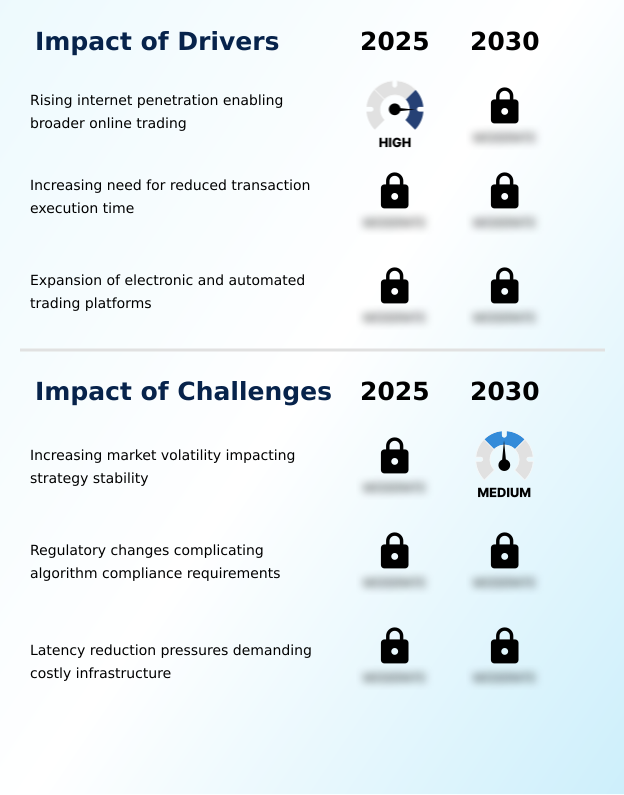
What are the key market drivers leading to the rise in the adoption of Algorithmic Trading Industry?
- The increasing global internet penetration is a key driver for the market, enabling broader access and participation in online and automated trading platforms.
- The primary driver fueling the algorithmic trading market's growth is the proliferation of automated trading systems, which streamline workflows and reduce operational delays by over 40%.
- This expansion is enabled by API-based trading access and no-code algorithm builders, which are democratizing the development of proprietary trading algorithms for a wider range of participants.
- The increasing need for latency reduction technologies continues to spur investment in high-performance computing and specialized digital asset infrastructure.
- This technological push not only enhances execution speeds but also improves overall market liquidity, tightening bid-ask spreads by an average of 15%.
- The move toward cross-asset trading capabilities and decentralized finance (DeFi) trading further broadens the applicability of automated strategies, creating new avenues for growth and innovation across the global financial ecosystem.
What are the market trends shaping the Algorithmic Trading Industry?
- The rapid adoption of AI-driven trading tools is reshaping investment workflows. This trend is driven by the need for enhanced speed, scale, and adaptability in data-dense markets.
- Key trends are reshaping the algorithmic trading market, driven by the adoption of advanced technologies that enhance predictive capabilities and operational agility. The integration of AI-driven trading tools and sophisticated machine learning trading models is central to this shift, enabling firms to improve trade execution efficiency by up to 22%.
- There is a notable expansion of cloud-based algorithmic trading platforms, which provide the elastic scalability needed for intensive data processing and strategy back-testing, reducing development cycles by 30%. The use of sentiment analysis feeds and other forms of alternative data integration is becoming standard for alpha generation.
- Furthermore, the market is seeing a rise in sustainable and ESG-compliant trading algorithms, alongside the development of specialized sharia-compliant algorithms to meet the needs of a diverse investor base. These advancements collectively push the industry toward greater automation and intelligence.
What challenges does the Algorithmic Trading Industry face during its growth?
- Increasing market volatility presents a key challenge by impacting the stability and predictive accuracy of algorithmic trading strategies.
- The algorithmic trading market faces significant challenges, primarily stemming from market volatility and regulatory complexity. Unpredictable market conditions can lead to strategy underperformance of over 25% during high-stress periods, as models calibrated on historical data struggle with unprecedented events.
- The use of opaque black-box trading strategies complicates risk assessment and has led to increased regulatory scrutiny, with a push for greater explainable AI (XAI) in trading. Evolving compliance requirements can increase related overhead by up to 35% as firms implement robust real-time monitoring systems and kill-switch mechanisms.
- Moreover, the constant pressure to reduce latency leads to costly infrastructure investments and amplifies the risk of systemic issues like flash crash prevention failures, demanding a delicate balance between speed and stability.
Exclusive Technavio Analysis on Customer Landscape
The algorithmic trading market forecasting report includes the adoption lifecycle of the market, covering from the innovator’s stage to the laggard’s stage. It focuses on adoption rates in different regions based on penetration. Furthermore, the algorithmic trading market report also includes key purchase criteria and drivers of price sensitivity to help companies evaluate and develop their market growth analysis strategies.
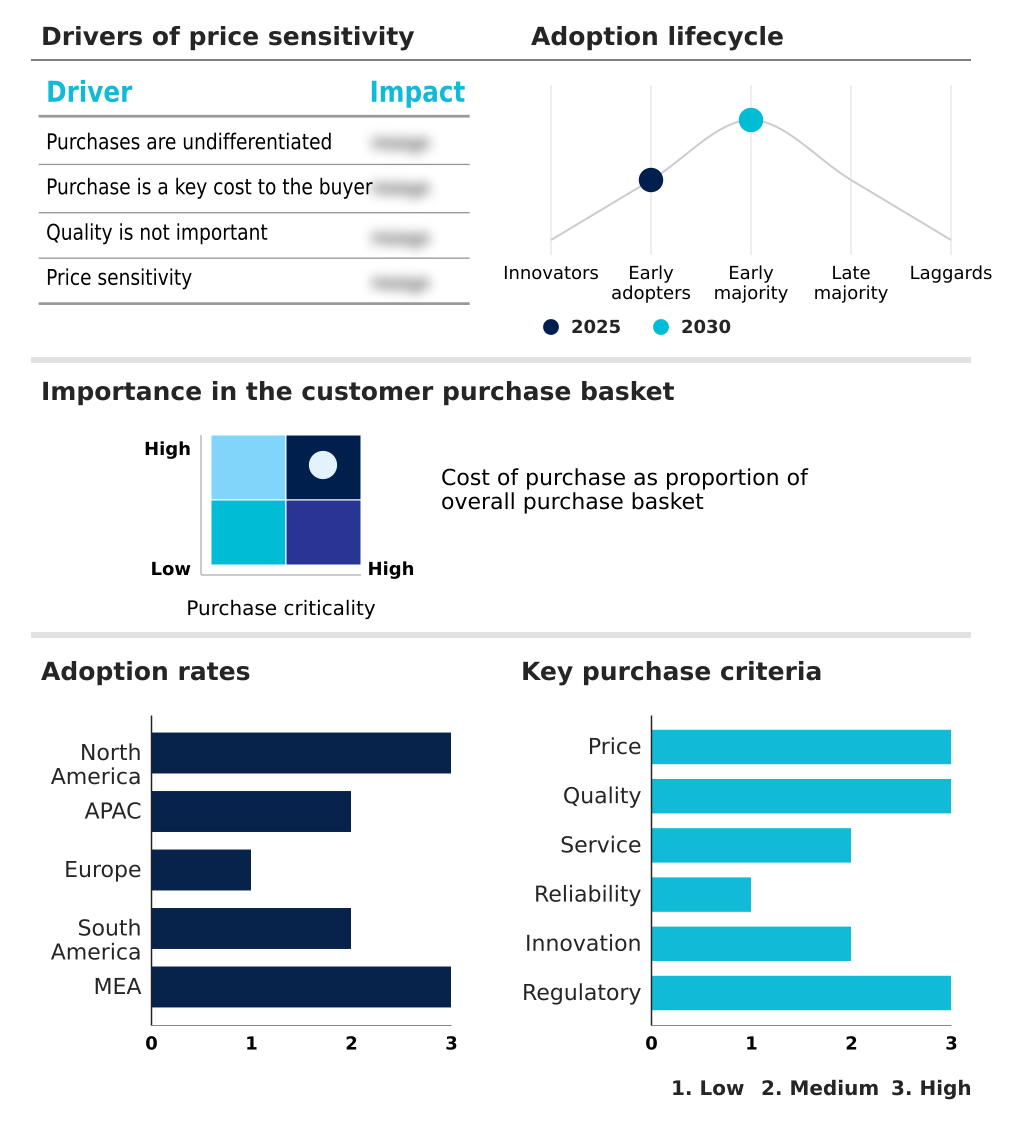
Customer Landscape of Algorithmic Trading Industry
Competitive Landscape
Companies are implementing various strategies, such as strategic alliances, algorithmic trading market forecast, partnerships, mergers and acquisitions, geographical expansion, and product/service launches, to enhance their presence in the industry.
AlgoBulls Technologies Ltd - Offerings center on commission-free API solutions that facilitate the development and deployment of sophisticated trading algorithms for diverse asset classes like stocks, ETFs, and options.
The industry research and growth report includes detailed analyses of the competitive landscape of the market and information about key companies, including:
- AlgoBulls Technologies Ltd
- AlgoTraders
- AlpacaDB Inc.
- Argo SE
- DRW Holdings LLC
- Global Trading Systems
- InfoReach Inc.
- London Stock Exchange Group plc
- MetaQuotes Ltd.
- QuantConnect Corp.
- QuantCore Capital Management LLC
- RSJ a.s.
- Software AG
- Symphony Fintech Solutions
- Tata Consultancy Services
- Tethys Technology Inc.
- TradeStation Group Inc.
- uTrade Solutions Pvt Ltd
- Virtu Financial Inc.
- Wyden AG
Qualitative and quantitative analysis of companies has been conducted to help clients understand the wider business environment as well as the strengths and weaknesses of key industry players. Data is qualitatively analyzed to categorize companies as pure play, category-focused, industry-focused, and diversified; it is quantitatively analyzed to categorize companies as dominant, leading, strong, tentative, and weak.
Recent Development and News in Algorithmic trading market
- In March, 2025, several prominent North American financial institutions initiated a strategic transition toward fully cloud-native algorithmic architectures to improve scalability and real-time data processing.
- In February, 2025, the Securities and Exchange Board of India introduced a comprehensive regulatory framework designed to govern the participation of retail investors in the algorithmic trading market.
- In May, 2025, a prominent global technology consultancy launched a dedicated algorithmic advisory division to help mid-sized financial firms navigate complex regulations surrounding automated execution.
- In February, 2025, the National Stock Exchange of India reported that algorithmic trading surpassed manual execution for the first time, capturing over 53% of the cash market segment.
Dive into Technavio’s robust research methodology, blending expert interviews, extensive data synthesis, and validated models for unparalleled Algorithmic Trading Market insights. See full methodology.
| Market Scope | |
|---|---|
| Page number | 294 |
| Base year | 2025 |
| Historic period | 2020-2024 |
| Forecast period | 2026-2030 |
| Growth momentum & CAGR | Accelerate at a CAGR of 16.7% |
| Market growth 2026-2030 | USD 23943.7 million |
| Market structure | Fragmented |
| YoY growth 2025-2026(%) | 14.3% |
| Key countries | US, Canada, Mexico, China, Japan, India, South Korea, Australia, Indonesia, Germany, UK, France, Italy, Spain, The Netherlands, Brazil, Argentina, Chile, Saudi Arabia, UAE, South Africa, Israel and Turkey |
| Competitive landscape | Leading Companies, Market Positioning of Companies, Competitive Strategies, and Industry Risks |
Research Analyst Overview
- The algorithmic trading market is characterized by a relentless pursuit of speed and intelligence, where competitive advantage is measured in microseconds. Core infrastructure relies on low-latency trading capabilities, often achieved through kernel bypass networking and extensive colocation services to minimize the tick-to-trade interval. Firms are heavily invested in quantitative trading strategies, employing sophisticated market microstructure analysis and statistical arbitrage models.
- The development of alpha generation models is now deeply intertwined with predictive signal development, leveraging technologies from gradient boosted trees to temporal convolutional networks. The operational backbone consists of advanced execution management systems that facilitate smart order routing across both traditional electronic communication networks and dark pools.
- Rigorous algorithmic risk management is embedded through pre-trade risk controls and detailed post-trade analytics, including transaction cost analysis (TCA). The industry-wide pivot toward AI-powered systems for analyzing order book dynamics has compelled leadership to increase R&D budgets by an average of 20% to develop and validate next-generation market making algorithms and mean reversion strategies, ensuring they remain competitive.
What are the Key Data Covered in this Algorithmic Trading Market Research and Growth Report?
-
What is the expected growth of the Algorithmic Trading Market between 2026 and 2030?
-
USD 23.94 billion, at a CAGR of 16.7%
-
-
What segmentation does the market report cover?
-
The report is segmented by Component (Solutions, and Services), End-user (Institutional investors, Retail investors, Long-term investors, and Short-term investors), Deployment (Cloud, and On premises) and Geography (North America, APAC, Europe, South America, Middle East and Africa)
-
-
Which regions are analyzed in the report?
-
North America, APAC, Europe, South America and Middle East and Africa
-
-
What are the key growth drivers and market challenges?
-
Rising internet penetration enabling broader online trading, Increasing market volatility impacting strategy stability
-
-
Who are the major players in the Algorithmic Trading Market?
-
AlgoBulls Technologies Ltd, AlgoTraders, AlpacaDB Inc., Argo SE, DRW Holdings LLC, Global Trading Systems, InfoReach Inc., London Stock Exchange Group plc, MetaQuotes Ltd., QuantConnect Corp., QuantCore Capital Management LLC, RSJ a.s., Software AG, Symphony Fintech Solutions, Tata Consultancy Services, Tethys Technology Inc., TradeStation Group Inc., uTrade Solutions Pvt Ltd, Virtu Financial Inc. and Wyden AG
-
Market Research Insights
- The algorithmic trading market is defined by intense competition and rapid technological evolution, where firms leverage AI-driven trading tools and machine learning trading models to gain an edge. The adoption of automated trading systems has demonstrated a clear impact on operational outcomes, with some platforms improving trade execution efficiency by over 20% compared to manual methods.
- Concurrently, the use of proprietary trading algorithms allows firms to reduce slippage costs, contributing to a 15% improvement in net returns for certain strategies. The shift toward systematic trading is further supported by the integration of alternative data integration, which enhances the predictive power of multi-factor models.
- This data-centric approach, combined with the scalability of cloud-based algorithmic trading, enables firms to innovate while managing infrastructure costs effectively.
We can help! Our analysts can customize this algorithmic trading market research report to meet your requirements.
 RIA -
RIA - 
