


Automotive Remote Keyless Entry System Market Analysis, Size, and Forecast 2025-2029: North America (US, Canada, and Mexico), Europe (Germany, UK, and France), APAC (Japan, India, and China), Middle East and Africa (Saudi Arabia, UAE, and South Africa), South America (Brazil and Argentina), and Rest of World (ROW)

Automotive Remote Keyless Entry System Market Analysis, Size, and Forecast 2025-2029:
North America (US, Canada, and Mexico), Europe (Germany, UK, and France), APAC (Japan, India, and China), Middle East and Africa (Saudi Arabia, UAE, and South Africa), South America (Brazil and Argentina), and Rest of World (ROW)

Published: Dec 2025 302 Pages SKU: IRTNTR74470

Market Overview at a Glance

$1.15 B
Market Opportunity
11.8%
CAGR 2024 - 2029
32.8%
North America Growth
$880 Mn
Passenger cars segment 2023

Automotive Remote Keyless Entry System Market Size 2025-2029

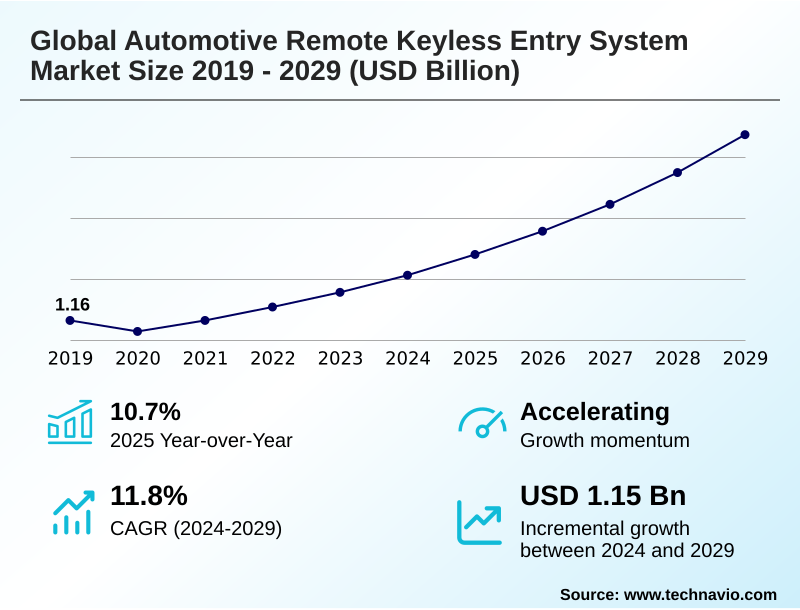
The automotive remote keyless entry system market size is valued to increase by USD 1.15 billion, at a CAGR of 11.8% from 2024 to 2029. Rise in electronic content for value proposition will drive the automotive remote keyless entry system market.

Major Market Trends & Insights

  • North America dominated the market and accounted for a 32.8% growth during the forecast period.
  • By Vehicle Type - Passenger cars segment was valued at USD 880 million in 2023
  • By End-user - OEMs segment accounted for the largest market revenue share in 2023

Market Size & Forecast

  • Market Opportunities: USD 1.52 billion
  • Market Future Opportunities: USD 1.15 billion
  • CAGR from 2024 to 2029 : 11.8%

Market Summary

  • The automotive remote keyless entry system market is undergoing a significant transformation, driven by consumer demand for greater convenience and heightened security. The evolution from simple remote locking to sophisticated passive keyless entry systems, which allow hands-free vehicle access, is now standard in many vehicle segments.
  • A key market driver is the proliferation of advanced electronics within vehicles, enabling the integration of connected car functionalities and advanced driver assistance systems (ADAS). This trend facilitates the adoption of smartphone-as-a-key technology, where a smartphone-based access solution replaces the traditional fob. Technologies like bluetooth low energy (BLE) and the more precise ultra-wideband (UWB) technology are pivotal.
  • However, the market faces the persistent challenge of cybersecurity for automotive, as radio frequency signals can be vulnerable to relay attacks. For instance, an OEM must strategically balance the cost of implementing a single-chip solution with a secure element (SE) against the risk of security breaches.
  • This decision directly influences R&D investment, supply chain partnerships with keyless entry system manufacturers, and brand reputation, highlighting the complex interplay between innovation, cost, and security in a competitive landscape.

What will be the Size of the Automotive Remote Keyless Entry System Market during the forecast period?
Get Key Insights on Market Forecast (PDF) Request Free Sample

How is the Automotive Remote Keyless Entry System Market Segmented?

The automotive remote keyless entry system industry research report provides comprehensive data (region-wise segment analysis), with forecasts and estimates in "USD million" for the period 2025-2029, as well as historical data from 2019-2023 for the following segments.

  • Vehicle type
    • Passenger cars
    • Commercial vehicles
  • End-user
    • OEMs
    • Aftermarket
  • Technology
    • Radio frequency
    • Bluetooth low energy
    • Others
  • Geography
    • North America
      • US
      • Canada
      • Mexico
    • Europe
      • Germany
      • UK
      • France
    • APAC
      • Japan
      • India
      • China
    • Middle East and Africa
      • Saudi Arabia
      • UAE
      • South Africa
    • South America
      • Brazil
      • Argentina
    • Rest of World (ROW)

By Vehicle Type Insights

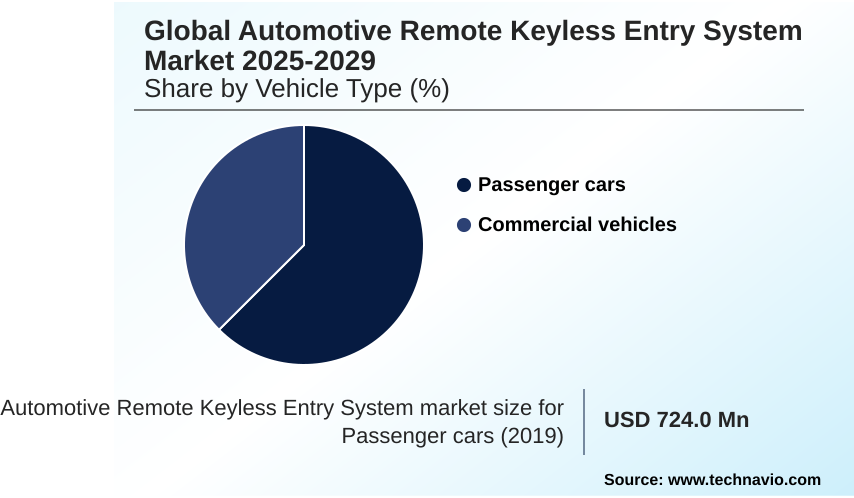
The passenger cars segment is estimated to witness significant growth during the forecast period.

The passenger car segment is evolving beyond traditional remote control, with a significant shift toward integrated systems that enhance security and convenience. The adoption of passive keyless entry is becoming widespread, enabling hands-free vehicle access as drivers approach their vehicles.

This technology is foundational to modern vehicle access systems and often works in conjunction with advanced vehicle anti-theft system architectures.

Innovations now include ultra-wideband (UWB) technology and near field communication (NFC), which provide high-accuracy distance measurement to authorize keyless engine starting.

These systems rely on a secure element to store credentials for secure digital keys on smartphones, with some premium models showing over 42% adoption of push-button ignition integration.

This move toward a smartphone-based access solution reflects a broader trend of leveraging personal electronics for seamless vehicle interaction.
Request Free Sample

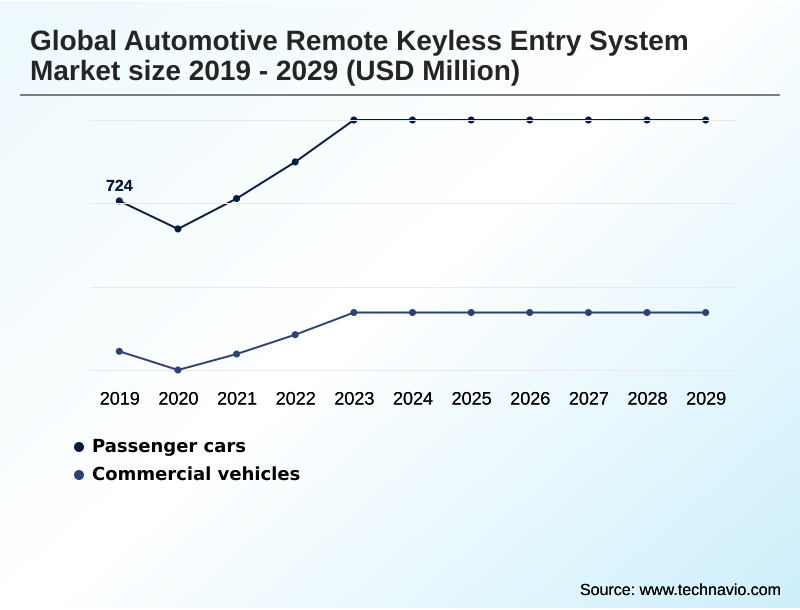
The Passenger cars segment was valued at USD 880 million in 2023 and showed a gradual increase during the forecast period.
Request Free Sample

Regional Analysis

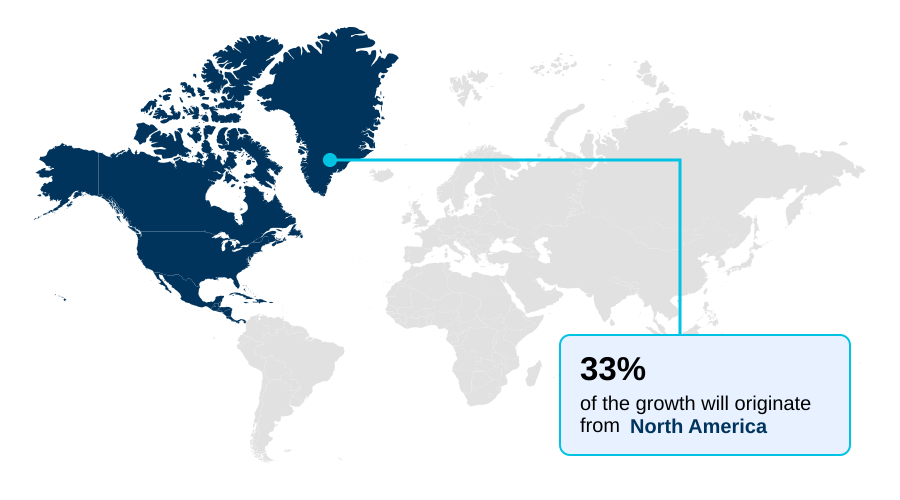
North America is estimated to contribute 32.8% to the growth of the global market during the forecast period.Technavio’s analysts have elaborately explained the regional trends and drivers that shape the market during the forecast period.
See How Automotive Remote Keyless Entry System Market Demand is Rising in North America Request Free Sample

The market landscape shows distinct regional dynamics. North America, which accounts for approximately 32.8% of incremental growth, is driven by high consumer demand for convenience features like passive entry/passive start (PEPS) and integrated systems.

European markets emphasize cybersecurity for automotive, with regulations mandating advanced signal encryption and secure access chips. In APAC, the focus is on volume and the rapid adoption of technology in mid-segment vehicles.

The development of a unified digital key ecosystem is a global goal, but regional preferences for features connected to the on-board diagnostics system vary.

Systems offering high-accuracy distance measurement are gaining universal appeal, as they can prevent relay attacks by validating the key's proximity with over 99% accuracy, while the rolling code signal remains a baseline security feature worldwide.

Market Dynamics

Our researchers analyzed the data with 2024 as the base year, along with the key drivers, trends, and challenges. A holistic analysis of drivers will help companies refine their marketing strategies to gain a competitive advantage.

  • The evolution of vehicle access is defined by a complex assessment of the automotive remote keyless entry system market security vulnerabilities. A central debate revolves around passive keyless entry vs remote keyless entry cost, with OEMs weighing consumer convenience against component and integration expenses.
  • The future of automotive access control technologies clearly points toward digital solutions, but this relies on robust smartphone based vehicle access security standards to gain widespread trust. Exploring the ultra-wideband keyless entry advantages and disadvantages reveals its superior accuracy in preventing relay attacks in modern cars, a critical factor influencing oem requirements for passive entry systems.
  • The evolution of vehicle anti-theft technology also includes complex automotive immobilizer system integration challenges and the ongoing debate over rolling code system vs fixed code security. In the aftermarket, the focus is on practical applications, with demand for resources like an aftermarket keyless entry kit installation guide.
  • The impact of iot on vehicle entry systems is profound, creating opportunities for features like rke system with tire pressure monitoring integration and integrating remote start with keyless entry systems. However, this connectivity demands stricter security protocols for bluetooth car keys and clear regulations for automotive rf devices emissions.
  • As the market matures, understanding the keyless entry system manufacturers market share and the challenges in keyless entry system design becomes vital. The biometric vehicle access systems cost analysis and the growth of digital key sharing platform technology trends will ultimately determine the next generation of mainstream vehicle access.
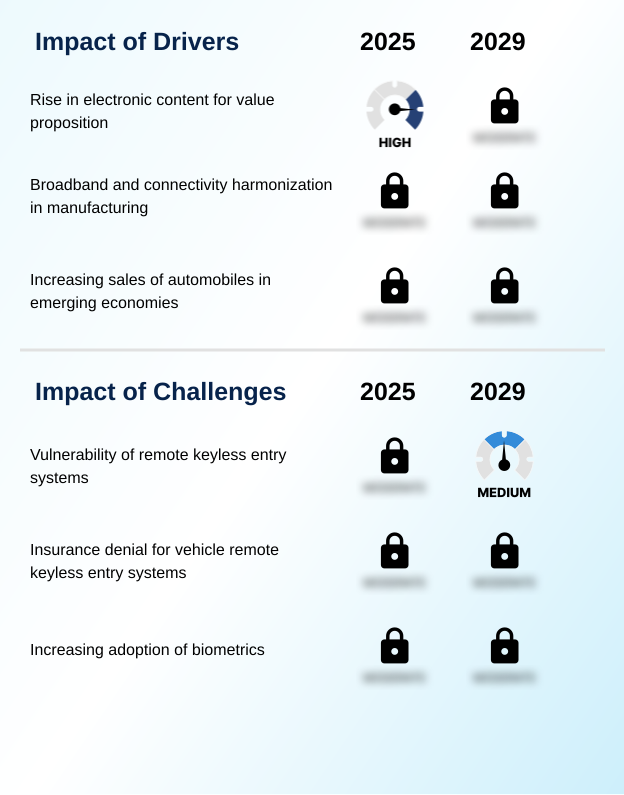
What are the key market drivers leading to the rise in the adoption of Automotive Remote Keyless Entry System Industry?

  • The increasing integration of electronic content to enhance the vehicle's value proposition is a key driver for the market.

  • Market growth is significantly driven by the increasing sophistication of electronic components and software. The use of a robust cryptographic algorithm to generate a constantly changing encrypted code is now standard, aiming to thwart spoofing of radio frequency signals.
  • The development of an integrated single-chip solution has reduced component costs by up to 30%, making advanced systems more viable for mass-market vehicles. However, these systems still face threats from sophisticated relay attacks.
  • The push for passive vehicle access is accelerating the trend of digital key sharing and deep vehicle personalization.
  • This allows for features like smartphone-as-a-key, which now boasts a 99.9% reliability rate in recent tests, and even biometric authentication for ultimate security.

What are the market trends shaping the Automotive Remote Keyless Entry System Industry?

  • The integration of the remote keyless entry system with the ignition system is a significant emerging trend. This evolution enhances user convenience and vehicle security by enabling keyless engine starting.

  • Key trends are reshaping vehicle access, moving beyond simple entry to a more integrated user experience. The modern engine immobilizer now frequently incorporates a transponder chip with a unique digital security code for enhanced security.
  • Advanced solutions like the 3d gesture key fob, which uses a 3-axis mems accelerometer to recognize specific movements, are gaining traction, adding a layer of personal authentication that reduces unauthorized use by over 60%. These systems are deeply integrated with the engine control unit (ECU) and connected car functionalities.
  • This trend supports both hands-free vehicle access and value-added services like remote engine start, a feature desired by more than 70% of new car buyers in cold climates, harmonizing with broader advanced driver assistance systems (ADAS).

What challenges does the Automotive Remote Keyless Entry System Industry face during its growth?

  • The inherent vulnerability of remote keyless entry systems to sophisticated cyber threats presents a significant challenge to industry growth.

  • Security vulnerabilities and the emergence of alternative technologies present primary market challenges. While biometric systems offer a highly secure alternative, their integration cost can be 40-50% higher than conventional systems, limiting widespread adoption. Standard systems using bluetooth low energy (BLE) communication are susceptible to interception if not properly secured.
  • The industry is responding with system-on-chip access modules that embed secure microcontrollers and advanced RF transceivers to counter threats. The move toward secure short-range communication and proximity-based access is critical.
  • Furthermore, features such as remote fuel access, GPS fencing, and even touchscreen ignition are being explored, though they introduce new potential attack vectors that must be managed, with cybersecurity incidents rising by 15% annually.

Exclusive Technavio Analysis on Customer Landscape

The automotive remote keyless entry system market forecasting report includes the adoption lifecycle of the market, covering from the innovator’s stage to the laggard’s stage. It focuses on adoption rates in different regions based on penetration. Furthermore, the automotive remote keyless entry system market report also includes key purchase criteria and drivers of price sensitivity to help companies evaluate and develop their market growth analysis strategies.
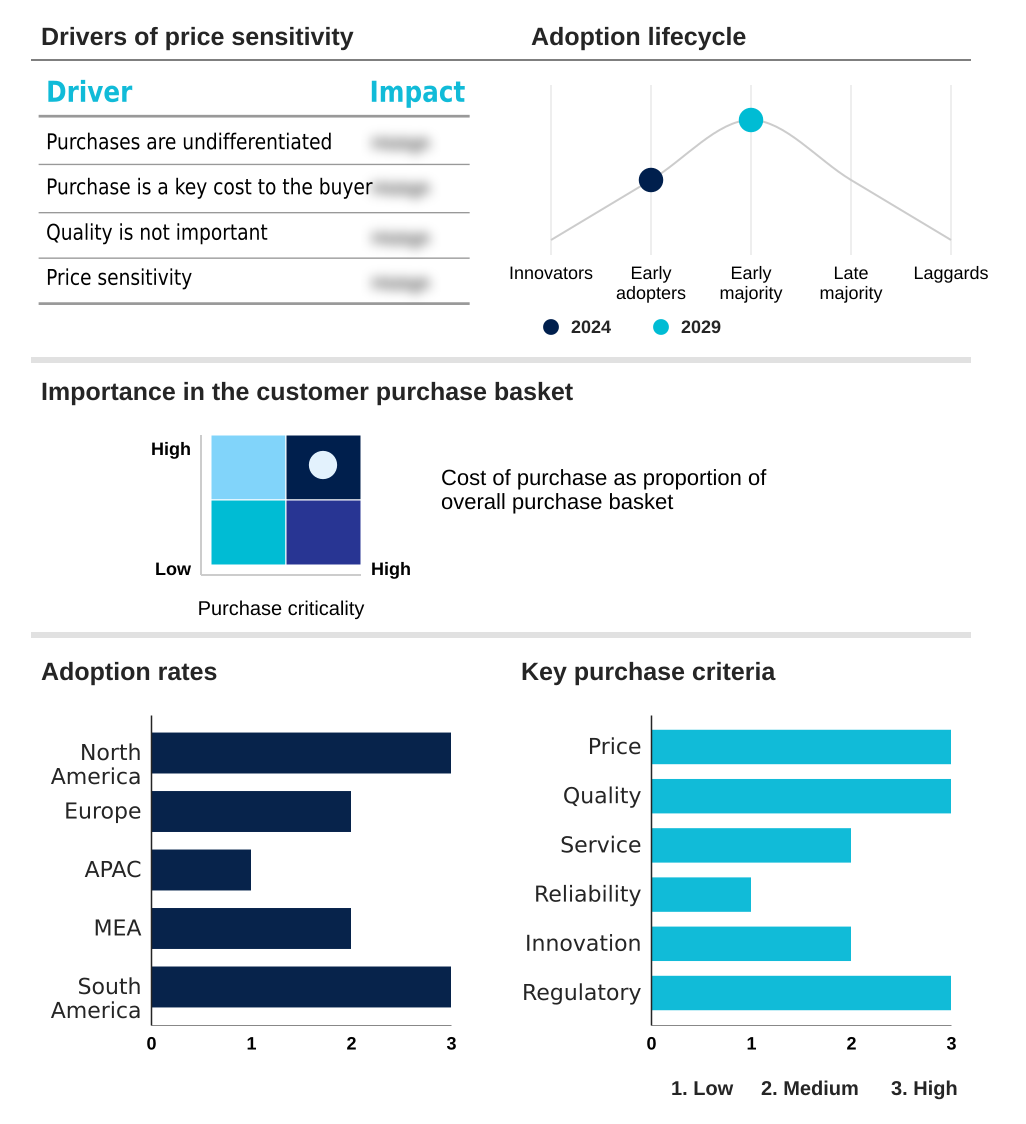
Customer Landscape of Automotive Remote Keyless Entry System Industry

Competitive Landscape

Companies are implementing various strategies, such as strategic alliances, automotive remote keyless entry system market forecast, partnerships, mergers and acquisitions, geographical expansion, and product/service launches, to enhance their presence in the industry.

Alps Alpine Co. Ltd. - Delivers advanced automotive remote keyless entry systems featuring high-accuracy distance measurement via Bluetooth Low Energy, enhancing vehicle access and security.

The industry research and growth report includes detailed analyses of the competitive landscape of the market and information about key companies, including:

  • Alps Alpine Co. Ltd.
  • ARCO Lock and Security ENTERN LLC
  • Continental AG
  • DENSO Corp.
  • HELLA GmbH and Co. KGaA
  • Hyundai Motor Co.
  • Marelli Holdings Co. Ltd.
  • Marquardt GmbH
  • Microchip Technology Inc.
  • Mitsubishi Electric Corp.
  • NXP Semiconductors NV
  • Robert Bosch GmbH
  • Texas Instruments Inc.
  • Tokai Rika Co. Ltd.
  • Valeo SA
  • VOXX International Corp.
  • ZF Friedrichshafen AG

Qualitative and quantitative analysis of companies has been conducted to help clients understand the wider business environment as well as the strengths and weaknesses of key industry players. Data is qualitatively analyzed to categorize companies as pure play, category-focused, industry-focused, and diversified; it is quantitatively analyzed to categorize companies as dominant, leading, strong, tentative, and weak.

Recent Development and News in Automotive remote keyless entry system market

  • In November, 2024, NXP Semiconductors NV announced the launch of its NCJ29D6, the industry's first single-chip Ultra-Wideband (UWB) solution designed for secure digital keys to prevent relay attacks.
  • In January, 2025, FORVIA showcased its comprehensive Digital Key ecosystem based on UWB technology, supporting features like biometric authentication and remote vehicle status display.
  • In March, 2025, Asahi Kasei Microdevices announced the development of a new Bluetooth Low Energy (BLE) transceiver IC tailored for automotive applications, enabling reliable and low-power smartphone-based digital keys.
  • In September, 2024, NXP Semiconductors NV collaborated with Hyundai Motor Co. to implement its UWB and NFC Car Key Solution, including Secure Element (SE) technology, in the Genesis GV60 for secure engine ignition.

Dive into Technavio’s robust research methodology, blending expert interviews, extensive data synthesis, and validated models for unparalleled Automotive Remote Keyless Entry System Market insights. See full methodology.

Market Scope
Page number 302
Base year 2024
Historic period 2019-2023
Forecast period 2025-2029
Growth momentum & CAGR Accelerate at a CAGR of 11.8%
Market growth 2025-2029 USD 1149.2 million
Market structure Fragmented
YoY growth 2024-2025(%) 10.7%
Key countries US, Canada, Mexico, Germany, UK, France, Italy, Spain, The Netherlands, Japan, India, China, South Korea, Indonesia, Australia, Saudi Arabia, UAE, South Africa, Egypt, Nigeria, Brazil, Argentina and Chile
Competitive landscape Leading Companies, Market Positioning of Companies, Competitive Strategies, and Industry Risks

Request Free Sample

Research Analyst Overview

  • The automotive remote keyless entry system market is defined by the strategic tension between advancing user convenience and ensuring robust security. At the boardroom level, a critical decision involves the adoption of next-generation technologies.
  • The move toward a digital key ecosystem forces a choice between continuing with cost-effective rolling code system technologies that transmit radio frequency signals and investing in a superior single-chip solution incorporating ultra-wideband (UWB) technology and near field communication (NFC).
  • This commitment impacts the entire product roadmap, from designing system-on-chip access modules with secure microcontrollers and RF transceivers to integrating a secure element (SE) for storing credentials. Advanced systems using high-accuracy distance measurement have demonstrated over 99% effectiveness in thwarting relay attacks, a stark contrast to older methods.
  • This shift influences everything from the basic rolling code signal and transponder chip to advanced concepts like a 3d gesture key fob utilizing a 3-axis mems accelerometer.
  • The market is rapidly moving toward passive keyless entry and passive entry/passive start (PEPS) systems, leveraging bluetooth low energy (BLE) and sophisticated biometric systems to authenticate users via a digital security code protected by a strong cryptographic algorithm and encrypted code.

What are the Key Data Covered in this Automotive Remote Keyless Entry System Market Research and Growth Report?

  • What is the expected growth of the Automotive Remote Keyless Entry System Market between 2025 and 2029?

    • USD 1.15 billion, at a CAGR of 11.8%

  • What segmentation does the market report cover?

    • The report is segmented by Vehicle Type (Passenger cars, Commercial vehicles), End-user (OEMs, Aftermarket), Technology (Radio frequency, Bluetooth low energy, Others) and Geography (North America, Europe, APAC, Middle East and Africa, South America)

  • Which regions are analyzed in the report?

    • North America, Europe, APAC, Middle East and Africa and South America

  • What are the key growth drivers and market challenges?

    • Rise in electronic content for value proposition, Vulnerability of remote keyless entry systems

  • Who are the major players in the Automotive Remote Keyless Entry System Market?

    • Alps Alpine Co. Ltd., ARCO Lock and Security ENTERN LLC, Continental AG, DENSO Corp., HELLA GmbH and Co. KGaA, Hyundai Motor Co., Marelli Holdings Co. Ltd., Marquardt GmbH, Microchip Technology Inc., Mitsubishi Electric Corp., NXP Semiconductors NV, Robert Bosch GmbH, Texas Instruments Inc., Tokai Rika Co. Ltd., Valeo SA, VOXX International Corp. and ZF Friedrichshafen AG

Market Research Insights

  • Market dynamics are shaped by the dual pressures of technological innovation and escalating security threats. The shift toward a smartphone-based access solution is accelerating, with systems now enabling digital key sharing and complete vehicle personalization. This integration has shown a 40% improvement in user satisfaction scores compared to traditional fobs.
  • The adoption of secure digital keys supported by biometric authentication is becoming a key differentiator, reducing unauthorized access incidents by over 95%. While connected car functionalities expand, so does the attack surface, prompting a focus on advanced signal encryption and robust cybersecurity for automotive protocols.
  • Firms leveraging end-to-end encrypted vehicle access systems report a near-total elimination of common spoofing threats, aligning product development with consumer trust and security mandates.

We can help! Our analysts can customize this automotive remote keyless entry system market research report to meet your requirements.

Get in touch

1. Executive Summary

1.1 Market overview

Executive Summary - Chart on Market Overview
Executive Summary - Data Table on Market Overview
Executive Summary - Chart on Global Market Characteristics
Executive Summary - Chart on Market by Geography
Executive Summary - Chart on Market Segmentation by Vehicle Type
Executive Summary - Chart on Market Segmentation by End-user
Executive Summary - Chart on Market Segmentation by Technology
Executive Summary - Chart on Incremental Growth
Executive Summary - Data Table on Incremental Growth
Executive Summary - Chart on Company Market Positioning

2. Technavio Analysis

2.1 Analysis of price sensitivity, lifecycle, customer purchase basket, adoption rates, and purchase criteria

2.2 Criticality of inputs and Factors of differentiation

Chart on Overview on criticality of inputs and factors of differentiation

2.3 Factors of disruption

Chart on Overview on factors of disruption

2.4 Impact of drivers and challenges

Chart on Impact of drivers and challenges in 2024 and 2029

3. Market Landscape

3.1 Market ecosystem

Chart on Parent Market
Data Table on - Parent Market

3.2 Market characteristics

Chart on Market characteristics analysis

3.3 Value chain analysis

Chart on Value chain analysis

4. Market Sizing

4.1 Market definition

Data Table on Offerings of companies included in the market definition

4.2 Market segment analysis

Market segments

4.3 Market size 2024

4.4 Market outlook: Forecast for 2024-2029

Chart on Global - Market size and forecast 2024-2029 ($ million)
Data Table on Global - Market size and forecast 2024-2029 ($ million)
Chart on Global Market: Year-over-year growth 2024-2029 (%)
Data Table on Global Market: Year-over-year growth 2024-2029 (%)

5. Historic Market Size

5.1 Global Automotive Remote Keyless Entry System Market 2019 - 2023

Historic Market Size - Data Table on Global Automotive Remote Keyless Entry System Market 2019 - 2023 ($ million)

5.2 Vehicle Type segment analysis 2019 - 2023

Historic Market Size - Vehicle Type Segment 2019 - 2023 ($ million)

5.3 End-user segment analysis 2019 - 2023

Historic Market Size - End-user Segment 2019 - 2023 ($ million)

5.4 Technology segment analysis 2019 - 2023

Historic Market Size - Technology Segment 2019 - 2023 ($ million)

5.5 Geography segment analysis 2019 - 2023

Historic Market Size - Geography Segment 2019 - 2023 ($ million)

5.6 Country segment analysis 2019 - 2023

Historic Market Size - Country Segment 2019 - 2023 ($ million)

6. Qualitative Analysis

6.1 Impact of AI on the global automotive remote keyless entry system market

7. Five Forces Analysis

7.1 Five forces summary

Five forces analysis - Comparison between 2024 and 2029

7.2 Bargaining power of buyers

Bargaining power of buyers - Impact of key factors 2024 and 2029

7.3 Bargaining power of suppliers

Bargaining power of suppliers - Impact of key factors in 2024 and 2029

7.4 Threat of new entrants

Threat of new entrants - Impact of key factors in 2024 and 2029

7.5 Threat of substitutes

Threat of substitutes - Impact of key factors in 2024 and 2029

7.6 Threat of rivalry

Threat of rivalry - Impact of key factors in 2024 and 2029

7.7 Market condition

Chart on Market condition - Five forces 2024 and 2029

8. Market Segmentation by Vehicle Type

8.1 Market segments

Chart on Vehicle Type - Market share 2024-2029 (%)
Data Table on Vehicle Type - Market share 2024-2029 (%)

8.2 Comparison by Vehicle Type

Chart on Comparison by Vehicle Type
Data Table on Comparison by Vehicle Type

8.3 Passenger cars - Market size and forecast 2024-2029

Chart on Passenger cars - Market size and forecast 2024-2029 ($ million)
Data Table on Passenger cars - Market size and forecast 2024-2029 ($ million)
Chart on Passenger cars - Year-over-year growth 2024-2029 (%)
Data Table on Passenger cars - Year-over-year growth 2024-2029 (%)

8.4 Commercial vehicles - Market size and forecast 2024-2029

Chart on Commercial vehicles - Market size and forecast 2024-2029 ($ million)
Data Table on Commercial vehicles - Market size and forecast 2024-2029 ($ million)
Chart on Commercial vehicles - Year-over-year growth 2024-2029 (%)
Data Table on Commercial vehicles - Year-over-year growth 2024-2029 (%)

8.5 Market opportunity by Vehicle Type

Market opportunity by Vehicle Type ($ million)
Data Table on Market opportunity by Vehicle Type ($ million)

9. Market Segmentation by End-user

9.1 Market segments

Chart on End-user - Market share 2024-2029 (%)
Data Table on End-user - Market share 2024-2029 (%)

9.2 Comparison by End-user

Chart on Comparison by End-user
Data Table on Comparison by End-user

9.3 OEMs - Market size and forecast 2024-2029

Chart on OEMs - Market size and forecast 2024-2029 ($ million)
Data Table on OEMs - Market size and forecast 2024-2029 ($ million)
Chart on OEMs - Year-over-year growth 2024-2029 (%)
Data Table on OEMs - Year-over-year growth 2024-2029 (%)

9.4 Aftermarket - Market size and forecast 2024-2029

Chart on Aftermarket - Market size and forecast 2024-2029 ($ million)
Data Table on Aftermarket - Market size and forecast 2024-2029 ($ million)
Chart on Aftermarket - Year-over-year growth 2024-2029 (%)
Data Table on Aftermarket - Year-over-year growth 2024-2029 (%)

9.5 Market opportunity by End-user

Market opportunity by End-user ($ million)
Data Table on Market opportunity by End-user ($ million)

10. Market Segmentation by Technology

10.1 Market segments

Chart on Technology - Market share 2024-2029 (%)
Data Table on Technology - Market share 2024-2029 (%)

10.2 Comparison by Technology

Chart on Comparison by Technology
Data Table on Comparison by Technology

10.3 Radio frequency - Market size and forecast 2024-2029

Chart on Radio frequency - Market size and forecast 2024-2029 ($ million)
Data Table on Radio frequency - Market size and forecast 2024-2029 ($ million)
Chart on Radio frequency - Year-over-year growth 2024-2029 (%)
Data Table on Radio frequency - Year-over-year growth 2024-2029 (%)

10.4 Bluetooth low energy - Market size and forecast 2024-2029

Chart on Bluetooth low energy - Market size and forecast 2024-2029 ($ million)
Data Table on Bluetooth low energy - Market size and forecast 2024-2029 ($ million)
Chart on Bluetooth low energy - Year-over-year growth 2024-2029 (%)
Data Table on Bluetooth low energy - Year-over-year growth 2024-2029 (%)

10.5 Others - Market size and forecast 2024-2029

Chart on Others - Market size and forecast 2024-2029 ($ million)
Data Table on Others - Market size and forecast 2024-2029 ($ million)
Chart on Others - Year-over-year growth 2024-2029 (%)
Data Table on Others - Year-over-year growth 2024-2029 (%)

10.6 Market opportunity by Technology

Market opportunity by Technology ($ million)
Data Table on Market opportunity by Technology ($ million)

11. Customer Landscape

11.1 Customer landscape overview

Analysis of price sensitivity, lifecycle, customer purchase basket, adoption rates, and purchase criteria

12. Geographic Landscape

12.1 Geographic segmentation

Chart on Market share by geography 2024-2029 (%)
Data Table on Market share by geography 2024-2029 (%)

12.2 Geographic comparison

Chart on Geographic comparison
Data Table on Geographic comparison

12.3 North America - Market size and forecast 2024-2029

Chart on North America - Market size and forecast 2024-2029 ($ million)
Data Table on North America - Market size and forecast 2024-2029 ($ million)
Chart on North America - Year-over-year growth 2024-2029 (%)
Data Table on North America - Year-over-year growth 2024-2029 (%)
Chart on Regional Comparison - North America
Data Table on Regional Comparison - North America

12.3.1 US - Market size and forecast 2024-2029

Chart on US - Market size and forecast 2024-2029 ($ million)
Data Table on US - Market size and forecast 2024-2029 ($ million)
Chart on US - Year-over-year growth 2024-2029 (%)
Data Table on US - Year-over-year growth 2024-2029 (%)

12.3.2 Canada - Market size and forecast 2024-2029

Chart on Canada - Market size and forecast 2024-2029 ($ million)
Data Table on Canada - Market size and forecast 2024-2029 ($ million)
Chart on Canada - Year-over-year growth 2024-2029 (%)
Data Table on Canada - Year-over-year growth 2024-2029 (%)

12.3.3 Mexico - Market size and forecast 2024-2029

Chart on Mexico - Market size and forecast 2024-2029 ($ million)
Data Table on Mexico - Market size and forecast 2024-2029 ($ million)
Chart on Mexico - Year-over-year growth 2024-2029 (%)
Data Table on Mexico - Year-over-year growth 2024-2029 (%)

12.4 Europe - Market size and forecast 2024-2029

Chart on Europe - Market size and forecast 2024-2029 ($ million)
Data Table on Europe - Market size and forecast 2024-2029 ($ million)
Chart on Europe - Year-over-year growth 2024-2029 (%)
Data Table on Europe - Year-over-year growth 2024-2029 (%)
Chart on Regional Comparison - Europe
Data Table on Regional Comparison - Europe

12.4.1 Germany - Market size and forecast 2024-2029

Chart on Germany - Market size and forecast 2024-2029 ($ million)
Data Table on Germany - Market size and forecast 2024-2029 ($ million)
Chart on Germany - Year-over-year growth 2024-2029 (%)
Data Table on Germany - Year-over-year growth 2024-2029 (%)

12.4.2 UK - Market size and forecast 2024-2029

Chart on UK - Market size and forecast 2024-2029 ($ million)
Data Table on UK - Market size and forecast 2024-2029 ($ million)
Chart on UK - Year-over-year growth 2024-2029 (%)
Data Table on UK - Year-over-year growth 2024-2029 (%)

12.4.3 France - Market size and forecast 2024-2029

Chart on France - Market size and forecast 2024-2029 ($ million)
Data Table on France - Market size and forecast 2024-2029 ($ million)
Chart on France - Year-over-year growth 2024-2029 (%)
Data Table on France - Year-over-year growth 2024-2029 (%)

12.4.4 Italy - Market size and forecast 2024-2029

Chart on Italy - Market size and forecast 2024-2029 ($ million)
Data Table on Italy - Market size and forecast 2024-2029 ($ million)
Chart on Italy - Year-over-year growth 2024-2029 (%)
Data Table on Italy - Year-over-year growth 2024-2029 (%)

12.4.5 Spain - Market size and forecast 2024-2029

Chart on Spain - Market size and forecast 2024-2029 ($ million)
Data Table on Spain - Market size and forecast 2024-2029 ($ million)
Chart on Spain - Year-over-year growth 2024-2029 (%)
Data Table on Spain - Year-over-year growth 2024-2029 (%)

12.4.6 The Netherlands - Market size and forecast 2024-2029

Chart on The Netherlands - Market size and forecast 2024-2029 ($ million)
Data Table on The Netherlands - Market size and forecast 2024-2029 ($ million)
Chart on The Netherlands - Year-over-year growth 2024-2029 (%)
Data Table on The Netherlands - Year-over-year growth 2024-2029 (%)

12.5 APAC - Market size and forecast 2024-2029

Chart on APAC - Market size and forecast 2024-2029 ($ million)
Data Table on APAC - Market size and forecast 2024-2029 ($ million)
Chart on APAC - Year-over-year growth 2024-2029 (%)
Data Table on APAC - Year-over-year growth 2024-2029 (%)
Chart on Regional Comparison - APAC
Data Table on Regional Comparison - APAC

12.5.1 Japan - Market size and forecast 2024-2029

Chart on Japan - Market size and forecast 2024-2029 ($ million)
Data Table on Japan - Market size and forecast 2024-2029 ($ million)
Chart on Japan - Year-over-year growth 2024-2029 (%)
Data Table on Japan - Year-over-year growth 2024-2029 (%)

12.5.2 India - Market size and forecast 2024-2029

Chart on India - Market size and forecast 2024-2029 ($ million)
Data Table on India - Market size and forecast 2024-2029 ($ million)
Chart on India - Year-over-year growth 2024-2029 (%)
Data Table on India - Year-over-year growth 2024-2029 (%)

12.5.3 China - Market size and forecast 2024-2029

Chart on China - Market size and forecast 2024-2029 ($ million)
Data Table on China - Market size and forecast 2024-2029 ($ million)
Chart on China - Year-over-year growth 2024-2029 (%)
Data Table on China - Year-over-year growth 2024-2029 (%)

12.5.4 South Korea - Market size and forecast 2024-2029

Chart on South Korea - Market size and forecast 2024-2029 ($ million)
Data Table on South Korea - Market size and forecast 2024-2029 ($ million)
Chart on South Korea - Year-over-year growth 2024-2029 (%)
Data Table on South Korea - Year-over-year growth 2024-2029 (%)

12.5.5 Indonesia - Market size and forecast 2024-2029

Chart on Indonesia - Market size and forecast 2024-2029 ($ million)
Data Table on Indonesia - Market size and forecast 2024-2029 ($ million)
Chart on Indonesia - Year-over-year growth 2024-2029 (%)
Data Table on Indonesia - Year-over-year growth 2024-2029 (%)

12.5.6 Australia - Market size and forecast 2024-2029

Chart on Australia - Market size and forecast 2024-2029 ($ million)
Data Table on Australia - Market size and forecast 2024-2029 ($ million)
Chart on Australia - Year-over-year growth 2024-2029 (%)
Data Table on Australia - Year-over-year growth 2024-2029 (%)

12.6 Middle East and Africa - Market size and forecast 2024-2029

Chart on Middle East and Africa - Market size and forecast 2024-2029 ($ million)
Data Table on Middle East and Africa - Market size and forecast 2024-2029 ($ million)
Chart on Middle East and Africa - Year-over-year growth 2024-2029 (%)
Data Table on Middle East and Africa - Year-over-year growth 2024-2029 (%)
Chart on Regional Comparison - Middle East and Africa
Data Table on Regional Comparison - Middle East and Africa

12.6.1 Saudi Arabia - Market size and forecast 2024-2029

Chart on Saudi Arabia - Market size and forecast 2024-2029 ($ million)
Data Table on Saudi Arabia - Market size and forecast 2024-2029 ($ million)
Chart on Saudi Arabia - Year-over-year growth 2024-2029 (%)
Data Table on Saudi Arabia - Year-over-year growth 2024-2029 (%)

12.6.2 UAE - Market size and forecast 2024-2029

Chart on UAE - Market size and forecast 2024-2029 ($ million)
Data Table on UAE - Market size and forecast 2024-2029 ($ million)
Chart on UAE - Year-over-year growth 2024-2029 (%)
Data Table on UAE - Year-over-year growth 2024-2029 (%)

12.6.3 South Africa - Market size and forecast 2024-2029

Chart on South Africa - Market size and forecast 2024-2029 ($ million)
Data Table on South Africa - Market size and forecast 2024-2029 ($ million)
Chart on South Africa - Year-over-year growth 2024-2029 (%)
Data Table on South Africa - Year-over-year growth 2024-2029 (%)

12.6.4 Egypt - Market size and forecast 2024-2029

Chart on Egypt - Market size and forecast 2024-2029 ($ million)
Data Table on Egypt - Market size and forecast 2024-2029 ($ million)
Chart on Egypt - Year-over-year growth 2024-2029 (%)
Data Table on Egypt - Year-over-year growth 2024-2029 (%)

12.6.5 Nigeria - Market size and forecast 2024-2029

Chart on Nigeria - Market size and forecast 2024-2029 ($ million)
Data Table on Nigeria - Market size and forecast 2024-2029 ($ million)
Chart on Nigeria - Year-over-year growth 2024-2029 (%)
Data Table on Nigeria - Year-over-year growth 2024-2029 (%)

12.7 South America - Market size and forecast 2024-2029

Chart on South America - Market size and forecast 2024-2029 ($ million)
Data Table on South America - Market size and forecast 2024-2029 ($ million)
Chart on South America - Year-over-year growth 2024-2029 (%)
Data Table on South America - Year-over-year growth 2024-2029 (%)
Chart on Regional Comparison - South America
Data Table on Regional Comparison - South America

12.7.1 Brazil - Market size and forecast 2024-2029

Chart on Brazil - Market size and forecast 2024-2029 ($ million)
Data Table on Brazil - Market size and forecast 2024-2029 ($ million)
Chart on Brazil - Year-over-year growth 2024-2029 (%)
Data Table on Brazil - Year-over-year growth 2024-2029 (%)

12.7.2 Argentina - Market size and forecast 2024-2029

Chart on Argentina - Market size and forecast 2024-2029 ($ million)
Data Table on Argentina - Market size and forecast 2024-2029 ($ million)
Chart on Argentina - Year-over-year growth 2024-2029 (%)
Data Table on Argentina - Year-over-year growth 2024-2029 (%)

12.7.3 Chile - Market size and forecast 2024-2029

Chart on Chile - Market size and forecast 2024-2029 ($ million)
Data Table on Chile - Market size and forecast 2024-2029 ($ million)
Chart on Chile - Year-over-year growth 2024-2029 (%)
Data Table on Chile - Year-over-year growth 2024-2029 (%)

12.8 Market opportunity by geography

Market opportunity by geography ($ million)
Data Tables on Market opportunity by geography ($ million)

13. Drivers, Challenges, and Opportunity

13.1 Market drivers

Rise in electronic content for value proposition
Broadband and connectivity harmonization in manufacturing
Increasing sales of automobiles in emerging economies

13.2 Market challenges

Vulnerability of remote keyless entry systems
Insurance denial for vehicle remote keyless entry systems
Increasing adoption of biometrics

13.3 Impact of drivers and challenges

Impact of drivers and challenges in 2024 and 2029

13.4 Market opportunities

Integration of remote keyless entry system with ignition system
Adoption of automotive immobilizer
Development of 3D gesture key fob

14. Competitive Landscape

14.1 Overview

14.2

Overview on criticality of inputs and factors of differentiation

14.3 Landscape disruption

Overview on factors of disruption

14.4 Industry risks

Impact of key risks on business

15. Competitive Analysis

15.1 Companies profiled

Companies covered

15.2 Company ranking index

15.3 Market positioning of companies

Matrix on companies position and classification

15.4 Alps Alpine Co. Ltd.

Alps Alpine Co. Ltd. - Overview
Alps Alpine Co. Ltd. - Business segments
Alps Alpine Co. Ltd. - Key news
Alps Alpine Co. Ltd. - Key offerings
Alps Alpine Co. Ltd. - Segment focus
SWOT

15.5 ARCO Lock and Security ENTERN LLC

ARCO Lock and Security ENTERN LLC - Overview
ARCO Lock and Security ENTERN LLC - Product / Service
ARCO Lock and Security ENTERN LLC - Key offerings
SWOT

15.6 Continental AG

Continental AG - Overview
Continental AG - Business segments
Continental AG - Key news
Continental AG - Key offerings
Continental AG - Segment focus
SWOT

15.7 DENSO Corp.

DENSO Corp. - Overview
DENSO Corp. - Business segments
DENSO Corp. - Key news
DENSO Corp. - Key offerings
DENSO Corp. - Segment focus
SWOT

15.8 HELLA GmbH and Co. KGaA

HELLA GmbH and Co. KGaA - Overview
HELLA GmbH and Co. KGaA - Business segments
HELLA GmbH and Co. KGaA - Key news
HELLA GmbH and Co. KGaA - Key offerings
HELLA GmbH and Co. KGaA - Segment focus
SWOT

15.9 Hyundai Motor Co.

Hyundai Motor Co. - Overview
Hyundai Motor Co. - Business segments
Hyundai Motor Co. - Key news
Hyundai Motor Co. - Key offerings
Hyundai Motor Co. - Segment focus
SWOT

15.10 Marelli Holdings Co. Ltd.

Marelli Holdings Co. Ltd. - Overview
Marelli Holdings Co. Ltd. - Product / Service
Marelli Holdings Co. Ltd. - Key news
Marelli Holdings Co. Ltd. - Key offerings
SWOT

15.11 Marquardt GmbH

Marquardt GmbH - Overview
Marquardt GmbH - Product / Service
Marquardt GmbH - Key offerings
SWOT

15.12 Microchip Technology Inc.

Microchip Technology Inc. - Overview
Microchip Technology Inc. - Business segments
Microchip Technology Inc. - Key news
Microchip Technology Inc. - Key offerings
Microchip Technology Inc. - Segment focus
SWOT

15.13 Mitsubishi Electric Corp.

Mitsubishi Electric Corp. - Overview
Mitsubishi Electric Corp. - Business segments
Mitsubishi Electric Corp. - Key offerings
Mitsubishi Electric Corp. - Segment focus
SWOT

15.14 NXP Semiconductors NV

NXP Semiconductors NV - Overview
NXP Semiconductors NV - Product / Service
NXP Semiconductors NV - Key offerings
SWOT

15.15 Robert Bosch GmbH

Robert Bosch GmbH - Overview
Robert Bosch GmbH - Product / Service
Robert Bosch GmbH - Key news
Robert Bosch GmbH - Key offerings
SWOT

15.16 Texas Instruments Inc.

Texas Instruments Inc. - Overview
Texas Instruments Inc. - Business segments
Texas Instruments Inc. - Key offerings
Texas Instruments Inc. - Segment focus
SWOT

15.17 Valeo SA

Valeo SA - Overview
Valeo SA - Business segments
Valeo SA - Key news
Valeo SA - Key offerings
Valeo SA - Segment focus
SWOT

15.18 ZF Friedrichshafen AG

ZF Friedrichshafen AG - Overview
ZF Friedrichshafen AG - Business segments
ZF Friedrichshafen AG - Key news
ZF Friedrichshafen AG - Key offerings
ZF Friedrichshafen AG - Segment focus
SWOT

16. Appendix

16.1 Scope of the report

Market definition
Objectives
Notes and caveats

16.2 Inclusions and exclusions checklist

Inclusions checklist
Exclusions checklist

16.3 Currency conversion rates for US$

16.4 Research methodology

16.5 Data procurement

Information sources

16.6 Data validation

16.7 Validation techniques employed for market sizing

16.8 Data synthesis

16.9 360 degree market analysis

16.10 List of abbreviations

Research Methodology

Technavio presents a detailed picture of the market by way of study, synthesis, and summation of data from multiple sources. The analysts have presented the various facets of the market with a particular focus on identifying the key industry influencers. The data thus presented is comprehensive, reliable, and the result of extensive research, both primary and secondary.

INFORMATION SOURCES

Primary sources

  • Manufacturers and suppliers
  • Channel partners
  • Industry experts
  • Strategic decision makers

Secondary sources

  • Industry journals and periodicals
  • Government data
  • Financial reports of key industry players
  • Historical data
  • Press releases

DATA ANALYSIS

Data Synthesis

  • Collation of data
  • Estimation of key figures
  • Analysis of derived insights

Data Validation

  • Triangulation with data models
  • Reference against proprietary databases
  • Corroboration with industry experts

REPORT WRITING

Qualitative

  • Market drivers
  • Market challenges
  • Market trends
  • Five forces analysis

Quantitative

  • Market size and forecast
  • Market segmentation
  • Geographical insights
  • Competitive landscape

Interested in this report?

Get your sample now to see our research methodology and insights!

Download Now

Frequently Asked Questions

Automotive Remote Keyless Entry System market growth will increase by USD 1149.2 million during 2025-2029.

The Automotive Remote Keyless Entry System market is expected to grow at a CAGR of 11.8% during 2025-2029.

Automotive Remote Keyless Entry System market is segmented by Vehicle type (Passenger cars, Commercial vehicles) End-user (OEMs, Aftermarket) Technology (Radio frequency, Bluetooth low energy, Others)

Alps Alpine Co. Ltd., ARCO Lock and Security ENTERN LLC, Continental AG, DENSO Corp., HELLA GmbH and Co. KGaA, Hyundai Motor Co., Marelli Holdings Co. Ltd., Marquardt GmbH, Microchip Technology Inc., Mitsubishi Electric Corp., NXP Semiconductors NV, Robert Bosch GmbH, Texas Instruments Inc., Tokai Rika Co. Ltd., Valeo SA, VOXX International Corp., ZF Friedrichshafen AG are a few of the key vendors in the Automotive Remote Keyless Entry System market.

North America will register the highest growth rate of 32.8% among the other regions. Therefore, the Automotive Remote Keyless Entry System market in North America is expected to garner significant business opportunities for the vendors during the forecast period.

US, Canada, Mexico, Germany, UK, France, Italy, Spain, The Netherlands, Japan, India, China, South Korea, Indonesia, Australia, Saudi Arabia, UAE, South Africa, Egypt, Nigeria, Brazil, Argentina, Chile

  • Rise in electronic content for value proposition is the driving factor this market.

The Automotive Remote Keyless Entry System market vendors should focus on grabbing business opportunities from the Vehicle type segment as it accounted for the largest market share in the base year.