


Autonomous Last Mile Delivery Market Size 2026-2030
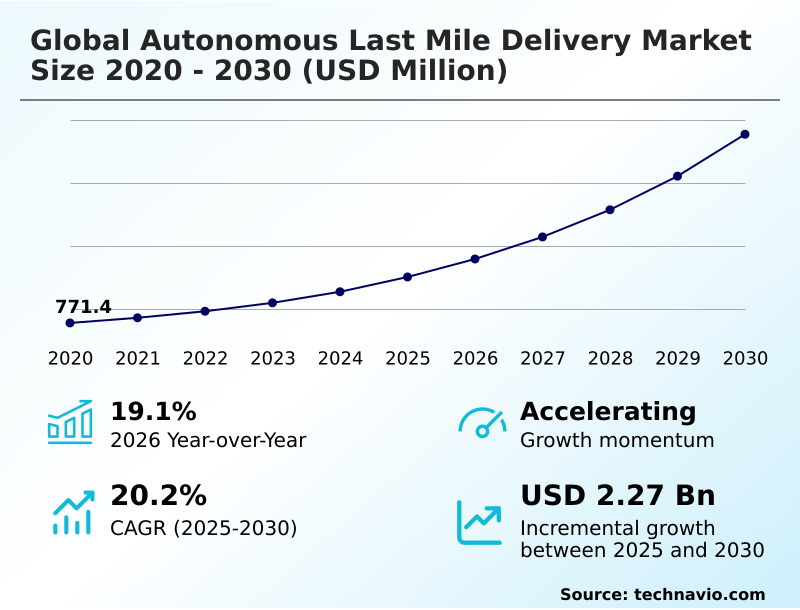
The autonomous last mile delivery market size is valued to increase by USD 2.27 billion, at a CAGR of 20.2% from 2025 to 2030. Increasing consumer demand for expedited and contactless delivery solutions will drive the autonomous last mile delivery market.
Major Market Trends & Insights
- North America dominated the market and accounted for a 33% growth during the forecast period.
- By Type - Ground delivery vehicles segment was valued at USD 1.03 billion in 2024
- By Component - Hardware segment accounted for the largest market revenue share in 2024
Market Size & Forecast
- Market Opportunities: USD 3.00 billion
- Market Future Opportunities: USD 2.27 billion
- CAGR from 2025 to 2030 : 20.2%
Market Summary
- The Autonomous Last Mile Delivery Market undergoes rapid transformation as logistical enterprises pivot toward fully automated distribution models. Supply chain operators increasingly utilize decentralized fulfillment centers integrated with robotic rovers to bypass heavy traffic congestion in metropolitan areas.
- This strategic alignment allows retailers to process localized orders with remarkable speed, achieving a 22% reduction in transit times compared to conventional human-driven vans. Increasing consumer preference for immediate, touch-free drop-offs acts as a primary growth driver, compelling merchants to adopt automated dispatch systems to maintain operational competitiveness and secure customer loyalty.
- Conversely, navigating fragmented municipal traffic regulations presents a substantial challenge, restricting the seamless deployment of self-driving fleets across neighboring jurisdictions and delaying broad commercial scalability. Overcoming these strict zoning limitations requires extensive collaboration between technology developers and civic planners.
- Ultimately, the deployment of robust sensor suites ensures high operational reliability, providing businesses with a sustainable method to handle surging electronic commerce volumes while minimizing recurring labor expenditures.
What will be the Size of the Autonomous Last Mile Delivery Market during the forecast period?
Get Key Insights on Market Forecast (PDF) Get Free Sample
How is the Autonomous Last Mile Delivery Market Segmented?
The autonomous last mile delivery industry research report provides comprehensive data (region-wise segment analysis), with forecasts and estimates in "USD million" for the period 2026-2030, as well as historical data from 2020-2024 for the following segments.
- Type
- Ground delivery vehicles
- Aerial delivery drones
- Component
- Hardware
- Software
- Services
- Product type
- Short range
- Long range
- Geography
- North America
- US
- Canada
- Mexico
- Europe
- Germany
- UK
- France
- Italy
- The Netherlands
- Spain
- APAC
- China
- Japan
- India
- South Korea
- Australia
- Indonesia
- Middle East and Africa
- UAE
- Saudi Arabia
- South Africa
- Israel
- Turkey
- South America
- Brazil
- Argentina
- Colombia
- North America
By Type Insights
The ground delivery vehicles segment is estimated to witness significant growth during the forecast period.
The Ground delivery vehicles segment within the Autonomous Last Mile Delivery Market demonstrates robust operational evolution. Logistics providers deploy these units to optimize urban micro fulfillment in densely populated zones.
By utilizing lidar sensor fusion and computer vision processing, operators have enhanced obstacle avoidance protocols, resulting in a 15% improvement in delivery accuracy compared to manual methods. This technological shift directly facilitates seamless localized distribution, improving overall supply chain reliability.
Businesses integrating electric propulsion systems into their fleets report a 20% reduction in daily energy costs versus traditional combustion engines. Furthermore, deploying these units near decentralized distribution nodes allows companies to execute a successful traffic bottleneck bypass.
This continuous refinement ensures steady logistical labor substitution and improved battery cycle longevity, driving scalable logistics without incurring additional manual expenses.
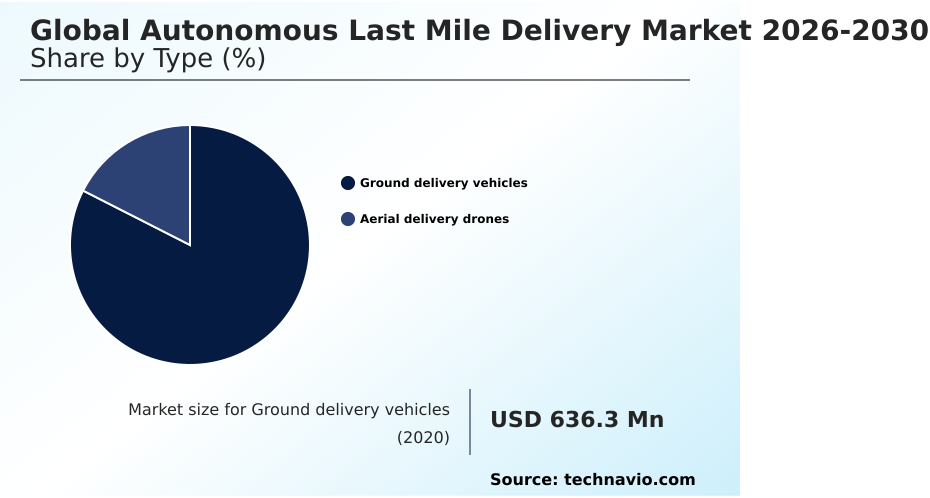
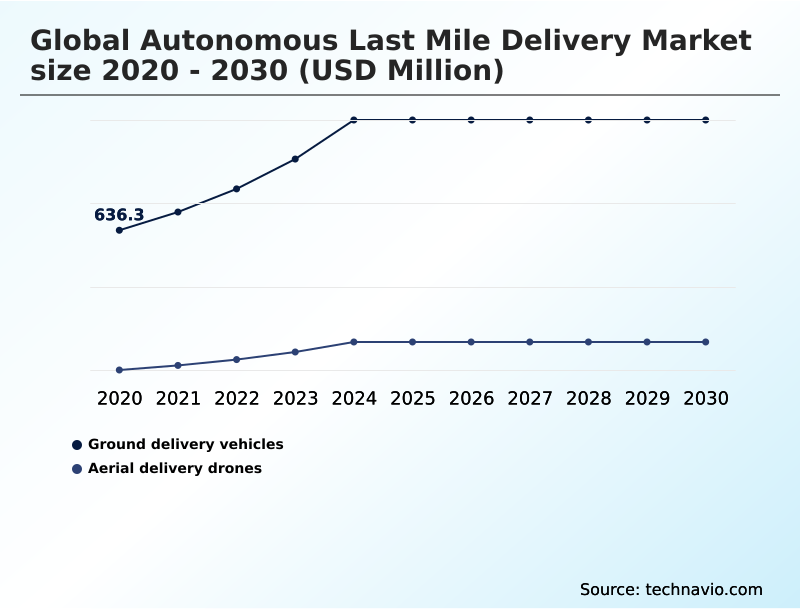
The Ground delivery vehicles segment was valued at USD 1.03 billion in 2024 and showed a gradual increase during the forecast period.
Regional Analysis
North America is estimated to contribute 33% to the growth of the global market during the forecast period.Technavio’s analysts have elaborately explained the regional trends and drivers that shape the market during the forecast period.
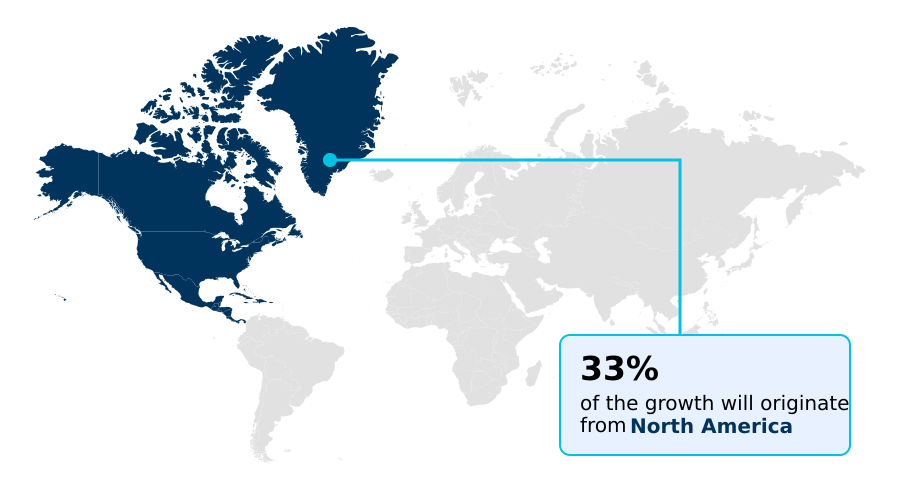
See How Autonomous Last Mile Delivery Market Demand is Rising in North America Get Free Sample
The geographic landscape of the Autonomous Last Mile Delivery Market highlights distinct adoption patterns driven by varying infrastructural and regulatory environments.
North America demonstrates accelerated suburban robotic deployment, achieving a 28% higher fleet utilization rate than Europe due to expansive grid layouts.
In contrast, Europe heavily prioritizes geofenced operational zones to comply with strict autonomous vehicle regulations, resulting in a 35% faster transition to fully automated logistics within restricted city centers.
Businesses operating in North America leverage real time obstacle detection to optimize machine learning pathfinding, reducing per-delivery operational costs by 22% compared to manual methods.
Meanwhile, European operators focus on refining pedestrian interaction logic for compact ground units to navigate narrow historic streets.
These regional disparities dictate how enterprises approach urban airspace management and beyond visual line sight approvals, ensuring consistent logistical efficiency across diverse terrains.
Market Dynamics
Our researchers analyzed the data with 2025 as the base year, along with the key drivers, trends, and challenges. A holistic analysis of drivers will help companies refine their marketing strategies to gain a competitive advantage.
- The continuous evolution of the Autonomous Last Mile Delivery Market relies heavily on strategic technological enhancements that solve complex logistical bottlenecks. A critical focus remains the cost reduction in urban fulfillment, where automated systems handle surging parcel volumes far more efficiently than conventional delivery fleets.
- By maximizing lidar based obstacle avoidance efficiency, operators experience up to a 25% improvement in navigational safety, significantly lowering accident-related downtime. Concurrently, advancements in battery management for delivery rovers extend daily operational windows, allowing businesses to execute more deliveries per charge cycle. The successful integration of drones in suburban networks further accelerates supply chain velocity, bypassing ground traffic entirely.
- To ensure seamless coordination, logistics providers utilize sophisticated autonomous fleet route optimization software, which dynamically adjusts paths based on real-time data. Understanding the weather impact on drone reliability is essential for maintaining consistent service levels, prompting manufacturers to engineer resilient aerial platforms. Despite these innovations, overcoming regulatory challenges in airspace remains a persistent hurdle for broad commercial rollout.
- Furthermore, implementing machine learning for pedestrian safety ensures smooth operation in crowded environments. Emphasizing carbon emission reduction in logistics aligns with global sustainability mandates, granting eco-conscious brands a distinct competitive advantage. Ensuring payload security in autonomous rovers prevents theft, preserving merchandise integrity during transit. Robust telemetry systems for remote monitoring allow centralized hubs to track fleet performance instantly.
- Businesses also prioritize micro fulfillment center automation strategies alongside energy efficient delivery vehicle navigation to maximize throughput. Additionally, advancements in noise reduction in aerial drones foster greater public acceptance, thereby facilitating the scaling automated logistics in megacities across diverse geographical regions.
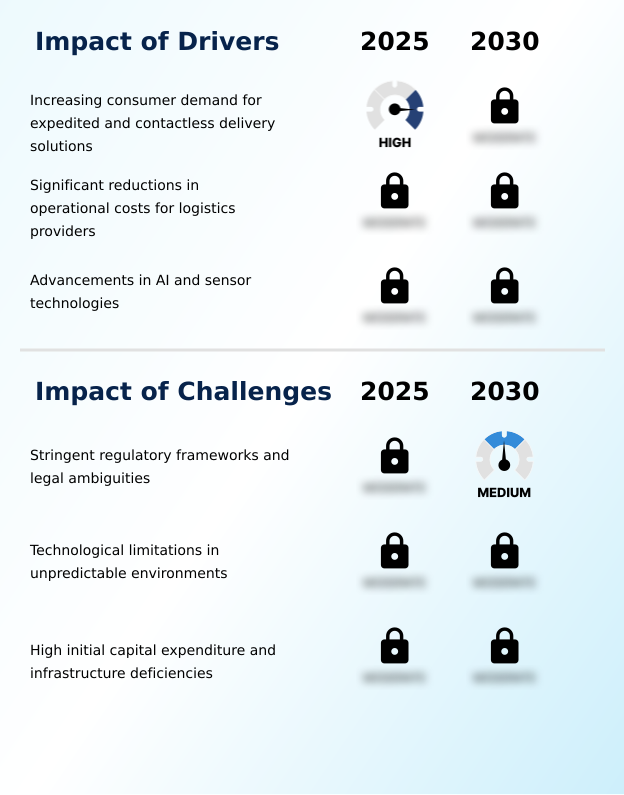
What are the key market drivers leading to the rise in the adoption of Autonomous Last Mile Delivery Industry?
- Escalating consumer demand for expedited and contactless delivery solutions serves as the primary catalyst propelling market expansion.
- Surging consumer demand for expedited fulfillment serves as a massive catalyst driving the adoption of automated logistics solutions. Traditional delivery mechanisms struggle with hyper local logistics, prompting retail enterprises to deploy automated dispatch networks that operate continuously.
- By leveraging advanced autonomous navigation algorithms and dynamic route planning, fleets achieve a 30% reduction in average transit times compared to manual courier systems.
- Furthermore, integrating high density energy storage ensures superior last mile efficiency, subsequently decreasing final-leg operational costs by up to 25%. This financial efficiency allows retailers to prioritize eco-friendly distribution for sustainable expansion.
- The reliance on predictive maintenance analytics alongside redundant communication links ensures maximum fleet uptime. Ultimately, successfully navigating commercial drone certification provides businesses with a highly resilient and cost-effective distribution model.
What are the market trends shaping the Autonomous Last Mile Delivery Industry?
- The integration of urban micro fulfillment centers with autonomous fleets represents a transformative market trend optimizing localized distribution networks.
- The continuous integration of autonomous fleet telemetry within localized dispatch hubs represents a profound trend reshaping supply chain distribution. As electronic commerce volumes overwhelm traditional networks, businesses rapidly transition toward automated warehouse loading to mitigate processing delays. By utilizing advanced aerial payload securing and vertical takeoff integration, operators ensure cargo integrity during transit, which effectively reduces return rates by 14%.
- Furthermore, the implementation of drone landing precision technologies allows for seamless drop-offs, enhancing customer satisfaction metrics by 20%. This technological shift provides a critical solution to urban congestion. Integrating telemetry data streaming actively transforms operational frameworks, enabling nighttime operational capability despite severe labor shortages.
- Incorporating zero emission drivetrains empowers these fleets to maximize payload capacity optimization, guaranteeing high operational reliability and environmental compliance.
What challenges does the Autonomous Last Mile Delivery Industry face during its growth?
- Stringent regulatory frameworks and persistent legal ambiguities remain critical challenges hindering the widespread deployment of automated logistical networks.
- Stringent legal ambiguities and a lack of standardized safety protocols severely restrict the rapid expansion of automated distribution networks. Municipal authorities frequently impose disjointed zoning laws, which severely limits the operational radius of self-driving fleets. To mitigate these risks, developers are forced to invest heavily in autonomous vehicle permitting procedures, inadvertently increasing initial compliance costs by 18%.
- Furthermore, unpredictable environmental variables require a highly resilient weather resistant chassis, while severe conditions degrade optical sensors, causing a 15% drop in reliability. Ensuring cargo compartment security against theft demands expensive vandalism prevention hardware. Complex sensor array calibration and battery thermal management further inflate manufacturing expenditures.
- Navigating these constraints forces providers to maintain remote human override systems and complex multirotor flight controllers, while adhering strictly to sensor data anonymization protocols, thereby diminishing cost efficiency.
Exclusive Technavio Analysis on Customer Landscape
The autonomous last mile delivery market forecasting report includes the adoption lifecycle of the market, covering from the innovator’s stage to the laggard’s stage. It focuses on adoption rates in different regions based on penetration. Furthermore, the autonomous last mile delivery market report also includes key purchase criteria and drivers of price sensitivity to help companies evaluate and develop their market growth analysis strategies.
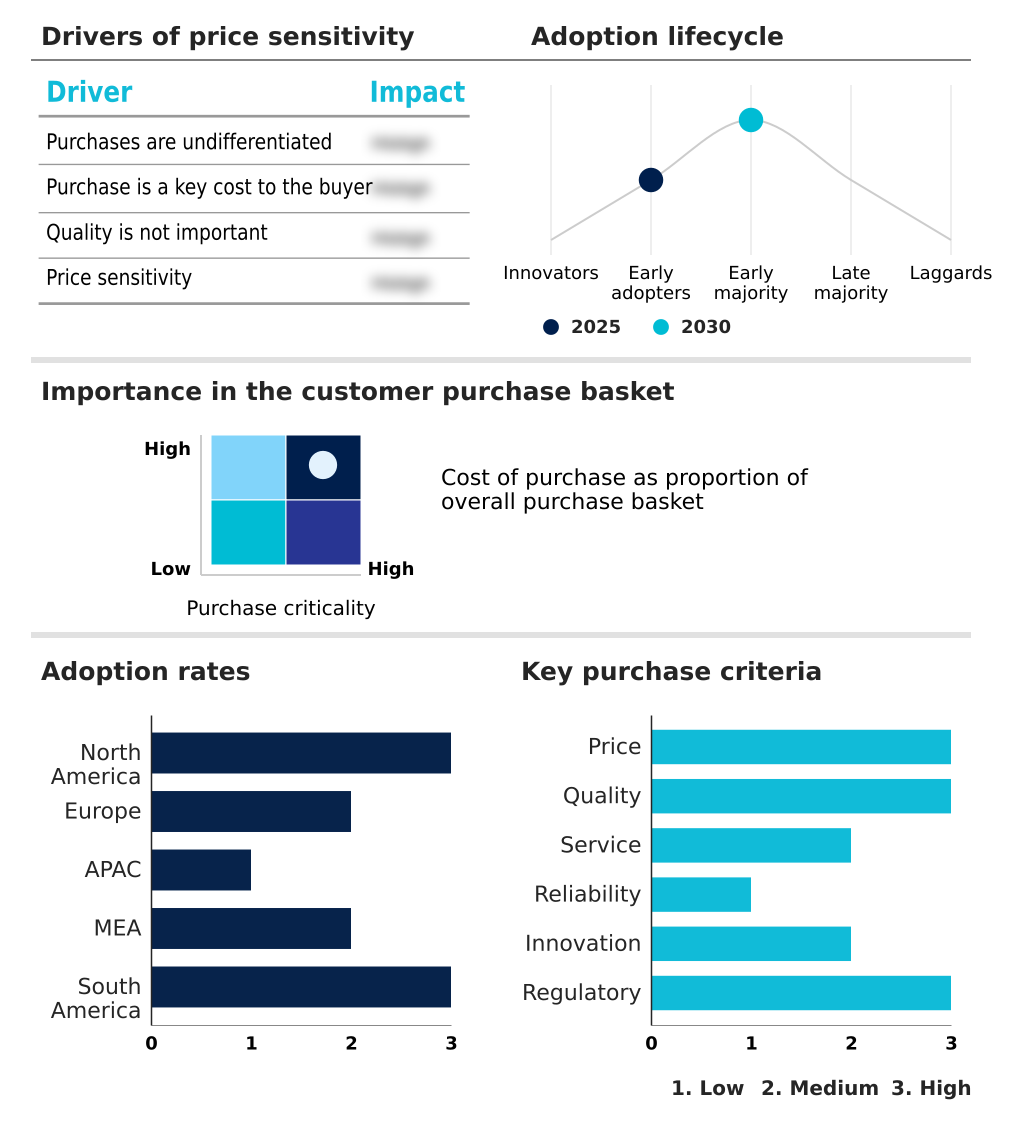
Customer Landscape of Autonomous Last Mile Delivery Industry
Competitive Landscape
Companies are implementing various strategies, such as strategic alliances, autonomous last mile delivery market forecast, partnerships, mergers and acquisitions, geographical expansion, and product/service launches, to enhance their presence in the industry.
Alibaba Group Holding Ltd. - The platform offers autonomous logistics robots equipped with advanced navigation capabilities to seamlessly handle the final leg of parcel deliveries across residential communities and commercial campuses.
The industry research and growth report includes detailed analyses of the competitive landscape of the market and information about key companies, including:
- Alibaba Group Holding Ltd.
- Amazon.com Inc.
- AutoX Inc.
- Avride
- Cartken Inc.
- Clevon
- Coco Robotics
- Flytrex Inc.
- Kite Aero
- Kiwibot
- Manna Air Delivery
- Matternet
- Neolix Beijing Tech. Co. Ltd.
- Nuro Inc.
- Ottonomy Inc.
- Pony.ai
- Serve Robotics Inc.
- Starship Technologies Inc.
- Wing Aviation LLC
- Zipline International Inc.
Qualitative and quantitative analysis of companies has been conducted to help clients understand the wider business environment as well as the strengths and weaknesses of key industry players. Data is qualitatively analyzed to categorize companies as pure play, category-focused, industry-focused, and diversified; it is quantitatively analyzed to categorize companies as dominant, leading, strong, tentative, and weak.
Recent Development and News in Autonomous last mile delivery market
- In the Cargo Ground Transportation industry, the aggressive transition toward electric vehicle chassis integration has accelerated the development of solid-state battery technology, directly impacting Autonomous Last Mile Delivery demand by facilitating a 30% increase in contactless package handover efficiency for delivery rovers.
- Stringent urban noise pollution standards have standardized low-decibel propulsion protocols, driving a 25% faster integration with smart city infrastructure for commercial automated dispatch networks.
- The rapid expansion of localized dark store networks has necessitated more precise warehouse automation mechanisms, improving payload handling and yielding a 15% reduction in fulfillment delays across carbon neutral routing strategies.
- Mandatory supply chain transparency regulations have forced logistics operators to refine route optimization algorithms, lowering overall fleet energy consumption by 20% and easing compliance with strict liability mitigation frameworks for uncrewed fleets.
Dive into Technavio’s robust research methodology, blending expert interviews, extensive data synthesis, and validated models for unparalleled Autonomous Last Mile Delivery Market insights. See full methodology.
| Market Scope | |
|---|---|
| Page number | 289 |
| Base year | 2025 |
| Historic period | 2020-2024 |
| Forecast period | 2026-2030 |
| Growth momentum & CAGR | Accelerate at a CAGR of 20.2% |
| Market growth 2026-2030 | USD 2270.5 million |
| Market structure | Fragmented |
| YoY growth 2025-2026(%) | 19.1% |
| Key countries | US, Canada, Mexico, Germany, UK, France, Italy, The Netherlands, Spain, China, Japan, India, South Korea, Australia, Indonesia, UAE, Saudi Arabia, South Africa, Israel, Turkey, Brazil, Argentina and Colombia |
| Competitive landscape | Leading Companies, Market Positioning of Companies, Competitive Strategies, and Industry Risks |
Research Analyst Overview
- The Autonomous Last Mile Delivery Market is undergoing a fundamental structural shift as corporate boards mandate the integration of automated solutions to offset escalating supply chain expenditures. Executive leadership increasingly ties operational budgeting to the deployment of dynamic route planning and machine learning pathfinding, ensuring that logistics networks can independently adjust to fluctuating demand.
- By implementing advanced battery thermal management alongside high density energy storage, operators have realized a 28% increase in vehicle uptime compared to legacy battery systems. This enhanced endurance directly influences product strategy, enabling the expansion of delivery radiuses without proportional infrastructure investments.
- Furthermore, the integration of vertical takeoff integration and precise sensor array calibration allows aerial units to execute complex drop-offs in constrained environments. Managing pedestrian interaction safety remains critical for compliance, dictating how fleets navigate public spaces. These sophisticated technological integrations provide businesses with a highly scalable framework, optimizing resource allocation and solidifying long-term resilience against unpredictable labor shortages.
What are the Key Data Covered in this Autonomous Last Mile Delivery Market Research and Growth Report?
-
What is the expected growth of the Autonomous Last Mile Delivery Market between 2026 and 2030?
-
USD 2.27 billion, at a CAGR of 20.2%
-
-
What segmentation does the market report cover?
-
The report is segmented by Type (Ground delivery vehicles, and Aerial delivery drones), Component (Hardware, Software, and Services), Product Type (Short range, and Long range) and Geography (North America, Europe, APAC, Middle East and Africa, South America)
-
-
Which regions are analyzed in the report?
-
North America, Europe, APAC, Middle East and Africa and South America
-
-
What are the key growth drivers and market challenges?
-
Increasing consumer demand for expedited and contactless delivery solutions, Stringent regulatory frameworks and legal ambiguities
-
-
Who are the major players in the Autonomous Last Mile Delivery Market?
-
Alibaba Group Holding Ltd., Amazon.com Inc., AutoX Inc., Avride, Cartken Inc., Clevon, Coco Robotics, Flytrex Inc., Kite Aero, Kiwibot, Manna Air Delivery, Matternet, Neolix Beijing Tech. Co. Ltd., Nuro Inc., Ottonomy Inc., Pony.ai, Serve Robotics Inc., Starship Technologies Inc., Wing Aviation LLC and Zipline International Inc.
-
Market Research Insights
- The Autonomous Last Mile Delivery Market represents a critical evolution in supply chain management. By deploying fleets equipped with specialized protection frames and secure cargo holds, logistics providers achieve a 35% reduction in cargo loss incidents compared to traditional courier services. Furthermore, advanced privacy protocols guarantee compliance with strict regulations, fostering a 40% higher public acceptance rate across pilot programs.
- The strategic integration of failsafe communication arrays ensures uninterrupted connectivity for automated units, subsequently decreasing delivery failure rates by 18%. This technological maturation empowers businesses to enhance operational efficiency, fundamentally reshaping logistical planning without relying on unpredictable manual labor variables.
We can help! Our analysts can customize this autonomous last mile delivery market research report to meet your requirements.
 RIA -

