



Black Mass Recycling Market Size 2026-2030
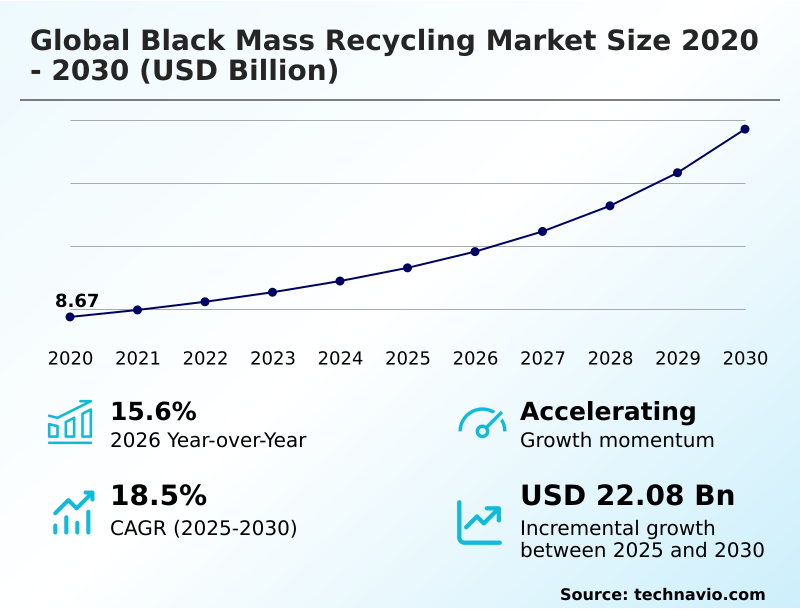
The black mass recycling market size is valued to increase by USD 22.08 billion, at a CAGR of 18.5% from 2025 to 2030. Localization of critical mineral supply chains to mitigate geopolitical risks will drive the black mass recycling market.
Major Market Trends & Insights
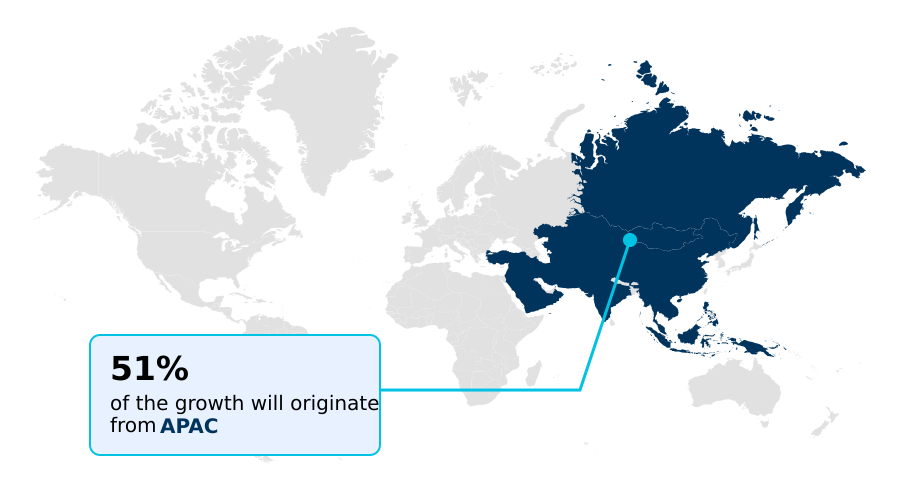
- APAC dominated the market and accounted for a 50.7% growth during the forecast period.
- By Technology - Hydrometallurgy segment was valued at USD 6.96 billion in 2024
- By Material Type - Nickel segment accounted for the largest market revenue share in 2024
Market Size & Forecast
- Market Opportunities: USD 29.88 billion
- Market Future Opportunities: USD 22.08 billion
- CAGR from 2025 to 2030 : 18.5%
Market Summary
- The black mass recycling market is rapidly transitioning from a niche waste management activity into a cornerstone of the global energy transition. Driven by the need for raw material security and stringent environmental mandates, this sector focuses on the waste stream valorization of end-of-life batteries and gigafactory manufacturing scrap.
- The industry is pivotal in creating a circular economy by recovering critical minerals and reintroducing them into the battery value chain.
- For instance, an automotive OEM might partner with a recycler to establish a closed-loop supply chain, ensuring that the battery-grade metals from its old vehicles are processed through advanced hydrometallurgical processes to create the precursor materials for its next generation of EVs.
- This not only mitigates supply chain volatility but also addresses challenges like feedstock heterogeneity and hazardous waste classification, turning a potential liability into a strategic asset for battery cell production. This evolution underscores the market's role in delivering sustainable metal sourcing and enhancing recycling efficiency.
What will be the Size of the Black Mass Recycling Market during the forecast period?
Get Key Insights on Market Forecast (PDF) Get Free Sample
How is the Black Mass Recycling Market Segmented?
The black mass recycling industry research report provides comprehensive data (region-wise segment analysis), with forecasts and estimates in "USD million" for the period 2026-2030, as well as historical data from 2020-2024 for the following segments.
- Technology
- Hydrometallurgy
- Pyrometallurgy
- Others
- Material type
- Nickel
- Cobalt
- Lithium
- Copper
- Others
- Source
- Automotive
- Consumer electronics
- Industrial and power
- Others
- Geography
- APAC
- China
- Japan
- India
- Europe
- Germany
- UK
- France
- North America
- US
- Canada
- Mexico
- Middle East and Africa
- Saudi Arabia
- UAE
- South Africa
- South America
- Brazil
- Argentina
- Colombia
- Rest of World (ROW)
- APAC
By Technology Insights
The hydrometallurgy segment is estimated to witness significant growth during the forecast period.
The market is increasingly adopting advanced hydrometallurgical processes for black mass refining, driven by the need for sustainable metal sourcing across the EV battery lifecycle.
This approach utilizes aqueous chemistry and specific chemical reagents in a controlled leaching process to achieve superior battery material recovery and recycling efficiency. Unlike smelting vs. leaching comparisons that highlight pyrometallurgy's energy use, hydrometallurgical refining operates at lower temperatures.
Through precise techniques like solvent extraction, it yields high-purity metals. This method's efficiency is notable, with metal recovery rates for critical minerals often exceeding 95%, making it pivotal for producing battery-grade metals and advancing e-waste management.
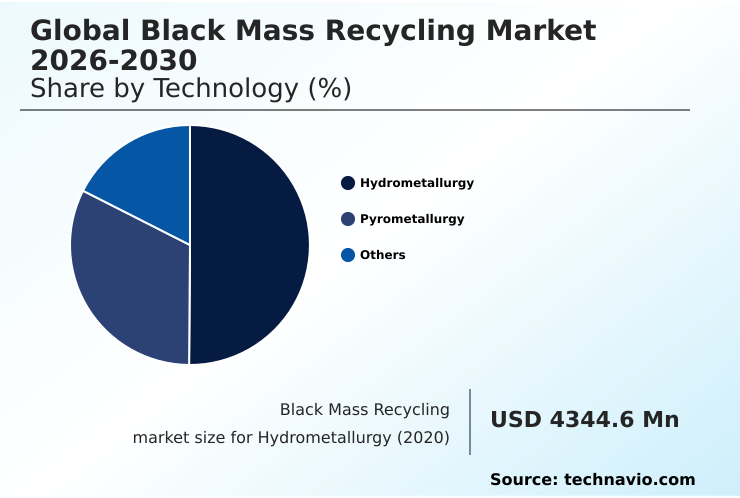
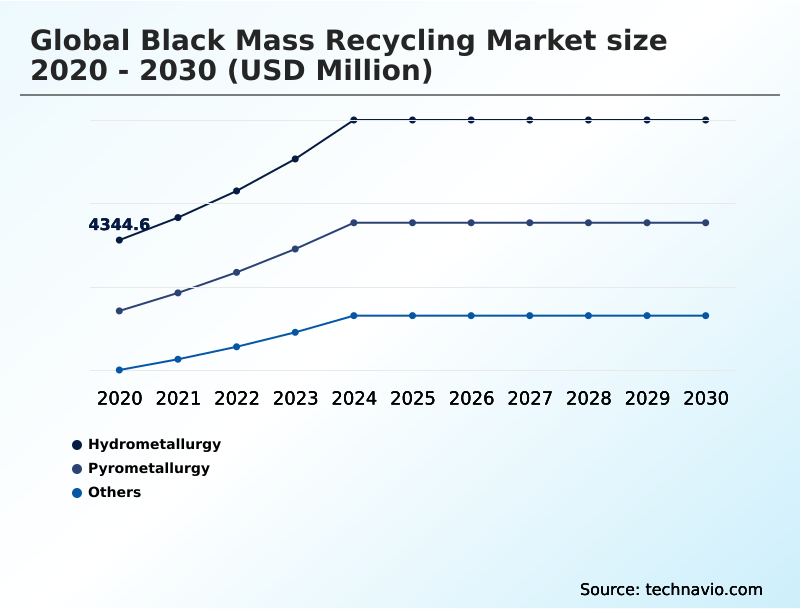
The Hydrometallurgy segment was valued at USD 6.96 billion in 2024 and showed a gradual increase during the forecast period.
Regional Analysis
APAC is estimated to contribute 50.7% to the growth of the global market during the forecast period.Technavio’s analysts have elaborately explained the regional trends and drivers that shape the market during the forecast period.
See How Black Mass Recycling Market Demand is Rising in APAC Get Free Sample
The geographic landscape is dominated by APAC, which commands over 50% of the market opportunity, driven by established infrastructure for processing gigafactory scrap and end-of-life batteries. This region excels at urban mining and waste stream valorization, achieving high recycling efficiency.
Europe's market is shaped by the Critical Raw Materials Act, which promotes closed-loop manufacturing to secure conflict-free minerals and address geopolitical risk mitigation pressures.
North America is rapidly building out its battery value chain with incentives for domestic mineral refining to produce cathode active materials.
The payables pricing mechanism remains a critical factor influencing trade flows for black mass refining between these dominant regions, which are all striving for a more circular supply chain.
Market Dynamics
Our researchers analyzed the data with 2025 as the base year, along with the key drivers, trends, and challenges. A holistic analysis of drivers will help companies refine their marketing strategies to gain a competitive advantage.
- The economic viability of the global black mass recycling market 2026-2030 is subject to complex variables, making hydrometallurgical plant investment decisions exceptionally challenging. The impact of LFP on recycling economics is profound, as these batteries lack the high-value metals of NMC chemistries, altering the entire black mass pricing formula analysis.
- A key industry focus is on improving lithium recovery from black mass, as traditional methods often resulted in losses. The sourcing strategies for black mass are complicated by the need for standardizing black mass quality metrics, as impurity removal techniques are costly.
- Furthermore, the role of black mass in the circular economy is conditional upon overcoming hurdles like the high cost of black mass transportation and navigating complex regulations for shipping battery waste. The debate comparing pyrometallurgy and hydrometallurgy continues, though advanced hydrometallurgical methods can achieve recovery rates over 25% higher than smelting for certain critical metals.
- Effective risk management in battery recycling is essential for achieving battery-grade metal purity and scaling capacity, confirming black mass as a strategic asset rather than mere waste.
What are the key market drivers leading to the rise in the adoption of Black Mass Recycling Industry?
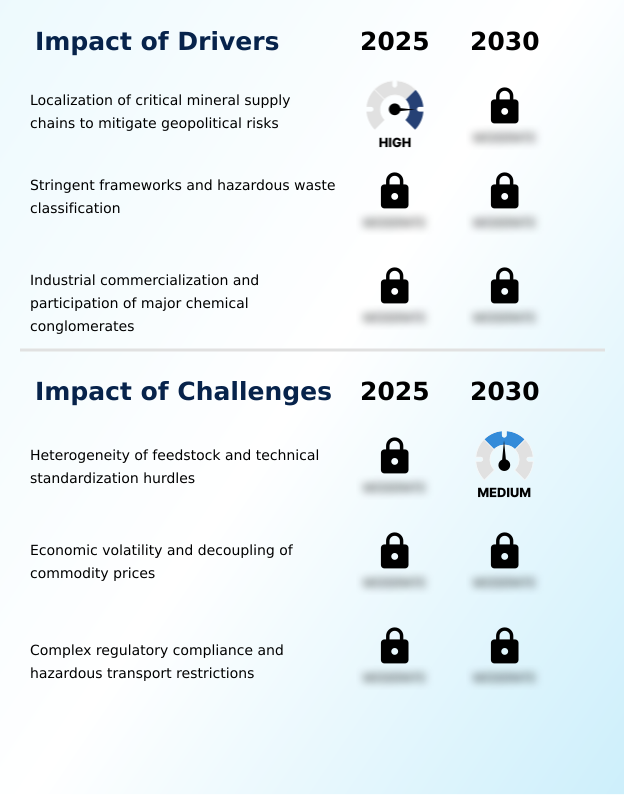
- The imperative to localize critical mineral supply chains and mitigate geopolitical risks serves as a primary driver for the market.
- Supply chain localization is a primary driver, as nations seek to secure domestic sources of critical minerals and reduce reliance on foreign entities.
- This push is reinforced by recycled content mandates, which compel manufacturers to use secondary raw material from sources like gigafactory manufacturing scrap, thereby driving Scope 3 emissions reduction.
- These regulations necessitate investment in industrial-scale refining infrastructure for both black mass refining and battery dismantling.
- Stringent hazardous waste classification rules are also forcing a shift from export models to domestic processing, stimulating the market even when there is no significant green premium on metals from buyers.
- Investment in domestic facilities has increased by over 200% in some regions.
What are the market trends shaping the Black Mass Recycling Industry?
- The market is characterized by an accelerating trend toward strategic vertical integration. This movement is fostering the development of closed-loop ecosystems to enhance supply chain security.
- A dominant trend is the formation of a closed-loop supply chain, where automakers and recyclers partner to enhance raw material security for future battery cell production. This move toward a circular economy is supported by logistical innovations like hub-and-spoke logistics, which can cut transport costs for shredded battery material by over 30%.
- Digital tools such as battery passport systems are being implemented to track materials, aligning with the end-of-life vehicle directive. While pyrometallurgical methods are still used, emerging direct recycling technology aims to rejuvenate cathode materials directly.
- This, combined with a focus on design for disassembly, is critical for building strategic mineral reserves from secondary sources and creating a truly circular supply chain.
What challenges does the Black Mass Recycling Industry face during its growth?
- Significant industry growth challenges include the inherent heterogeneity of feedstock and persistent hurdles in technical standardization.
- Feedstock heterogeneity is a major market challenge, as recyclers must handle a chaotic mix of battery types, from nickel-manganese-cobalt (NMC) to lithium iron phosphate (LFP). This variability in cathode chemistry complicates the production of consistent precursor materials. A shift in battery chemistry can alter the value of the ore-grade equivalent in black mass by over 50%.
- The thermal runaway risk during the processing of materials from energy storage recycling requires specialized, costly protocols. Furthermore, complex regulations on transboundary waste movement restrict the flow of feedstock to large, efficient facilities, with compliance costs adding 15-20% to overall expenses, creating logistical bottlenecks.
Exclusive Technavio Analysis on Customer Landscape
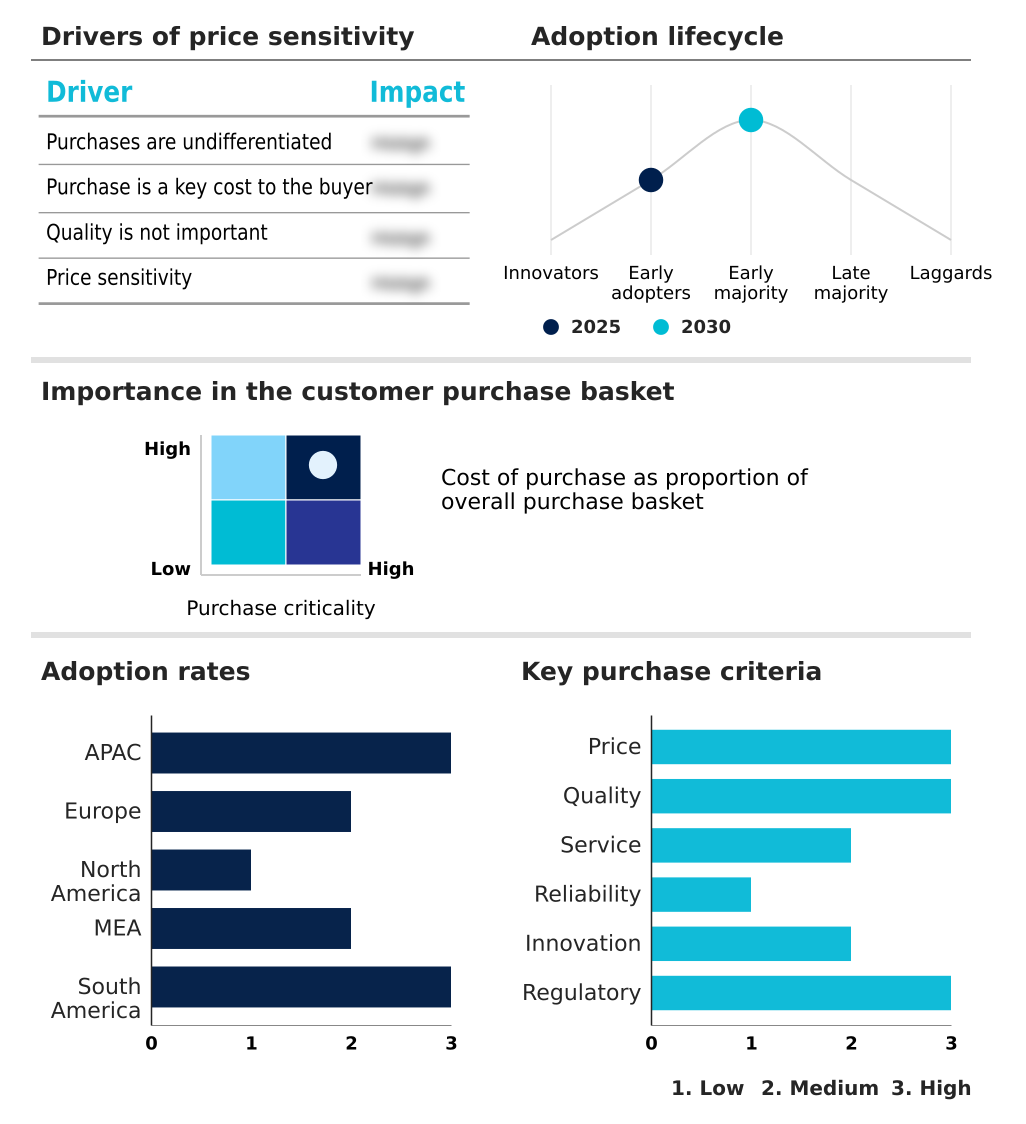
The black mass recycling market forecasting report includes the adoption lifecycle of the market, covering from the innovator’s stage to the laggard’s stage. It focuses on adoption rates in different regions based on penetration. Furthermore, the black mass recycling market report also includes key purchase criteria and drivers of price sensitivity to help companies evaluate and develop their market growth analysis strategies.
Customer Landscape of Black Mass Recycling Industry
Competitive Landscape
Companies are implementing various strategies, such as strategic alliances, black mass recycling market forecast, partnerships, mergers and acquisitions, geographical expansion, and product/service launches, to enhance their presence in the industry.
Akkuser Oy - Expertise centers on producing precursor and cathode active materials from recycled black mass, integrating circular economy principles into the battery value chain.
The industry research and growth report includes detailed analyses of the competitive landscape of the market and information about key companies, including:
- Akkuser Oy
- American Battery Technology Co.
- Aqua Metals Inc.
- BASF SE
- Duesenfeld GmbH
- Ecobat LLC
- Fortum Oyj
- GEM Co. Ltd.
- Glencore Plc
- Li Cycle Holdings Corp.
- Neometals Ltd.
- Primobius GmbH
- RecycLiCo Battery Materials
- Redwood Materials Inc.
- SungEel Hi Tech Co. Ltd.
- Tenova Spa
- Umicore SA
Qualitative and quantitative analysis of companies has been conducted to help clients understand the wider business environment as well as the strengths and weaknesses of key industry players. Data is qualitatively analyzed to categorize companies as pure play, category-focused, industry-focused, and diversified; it is quantitatively analyzed to categorize companies as dominant, leading, strong, tentative, and weak.
Recent Development and News in Black mass recycling market
- In May 2025, Northvolt announced a strategic recalibration of its Revolt recycling operations, temporarily reducing throughput rates at its hydrometallurgical facilities to retrofit filtration systems capable of handling higher-than-anticipated impurity profiles in incoming black mass.
- In April 2025, Redwood Materials Inc. officially commenced operations at the second phase of its Battery Materials Campus near Charleston, South Carolina, significantly increasing its capacity to process end-of-life electric vehicle batteries and manufacturing scrap.
- In March 2025, the European Commission updated the European List of Waste to formally classify black mass from lithium-ion batteries as hazardous waste, a measure intended to halt the leakage of critical raw materials to non-OECD nations.
- In February 2025, Umicore issued an investor update revising its guidance for its battery recycling business unit, citing the sustained depression of lithium carbonate spot prices as the primary factor for delaying a final investment decision on a planned large-scale battery recycling plant in North America.
Dive into Technavio’s robust research methodology, blending expert interviews, extensive data synthesis, and validated models for unparalleled Black Mass Recycling Market insights. See full methodology.
| Market Scope | |
|---|---|
| Page number | 303 |
| Base year | 2025 |
| Historic period | 2020-2024 |
| Forecast period | 2026-2030 |
| Growth momentum & CAGR | Accelerate at a CAGR of 18.5% |
| Market growth 2026-2030 | USD 22075.7 million |
| Market structure | Fragmented |
| YoY growth 2025-2026(%) | 15.6% |
| Key countries | China, Japan, India, South Korea, Australia, Indonesia, Germany, UK, France, Italy, The Netherlands, Spain, US, Canada, Mexico, Saudi Arabia, UAE, South Africa, Israel, Turkey, Brazil, Argentina and Colombia |
| Competitive landscape | Leading Companies, Market Positioning of Companies, Competitive Strategies, and Industry Risks |
Research Analyst Overview
- The black mass recycling market is undergoing a fundamental re-evaluation, shifting from a waste management function to a strategic pillar of raw material security. At the boardroom level, this pivot forces a critical decision: whether to secure long-term feedstock contracts or invest heavily in proprietary direct recycling technology.
- The sector's operational viability hinges on managing the extreme feedstock heterogeneity of shredded battery material from end-of-life batteries. For example, a mere 1% increase in certain impurities within the anode material can reduce the efficiency of the leaching process by up to 15%, disrupting the production of precursor materials. This sensitivity underscores the importance of advanced battery dismantling and sorting.
- As the industry matures, the focus is on optimizing chemical reagents, improving the smelting process, and enhancing recycling efficiency to ensure that the recovery of critical minerals like lithium iron phosphate (LFP) creates a truly resilient and circular economy.
What are the Key Data Covered in this Black Mass Recycling Market Research and Growth Report?
-
What is the expected growth of the Black Mass Recycling Market between 2026 and 2030?
-
USD 22.08 billion, at a CAGR of 18.5%
-
-
What segmentation does the market report cover?
-
The report is segmented by Technology (Hydrometallurgy, Pyrometallurgy, and Others), Material Type (Nickel, Cobalt, Lithium, Copper, and Others), Source (Automotive, Consumer electronics, Industrial and power, and Others) and Geography (APAC, Europe, North America, Middle East and Africa, South America)
-
-
Which regions are analyzed in the report?
-
APAC, Europe, North America, Middle East and Africa and South America
-
-
What are the key growth drivers and market challenges?
-
Localization of critical mineral supply chains to mitigate geopolitical risks, Heterogeneity of feedstock and technical standardization hurdles
-
-
Who are the major players in the Black Mass Recycling Market?
-
Akkuser Oy, American Battery Technology Co., Aqua Metals Inc., BASF SE, Duesenfeld GmbH, Ecobat LLC, Fortum Oyj, GEM Co. Ltd., Glencore Plc, Li Cycle Holdings Corp., Neometals Ltd., Primobius GmbH, RecycLiCo Battery Materials, Redwood Materials Inc., SungEel Hi Tech Co. Ltd., Tenova Spa and Umicore SA
-
Market Research Insights
- Market dynamics are shaped by a complex interplay of economic and regulatory factors. While advanced hydrometallurgical refining processes can achieve battery material recovery rates exceeding 95%, buyers often exhibit high price sensitivity, benchmarking recycled materials against volatile virgin-mined equivalents. This creates a challenging environment where the green premium on metals is not always realized.
- Recycled content mandates and the critical raw materials act are creating locked-in demand, forcing supply chain localization and investment in industrial-scale refining. However, the payables pricing mechanism for feedstock remains a key variable, influencing profitability. Firms are adopting hub-and-spoke logistics models to manage costs associated with transboundary waste movement and mitigate geopolitical risk, establishing a more resilient circular supply chain.
We can help! Our analysts can customize this black mass recycling market research report to meet your requirements.
 RIA -
RIA - 
