


Blueberry Market Size 2026-2030
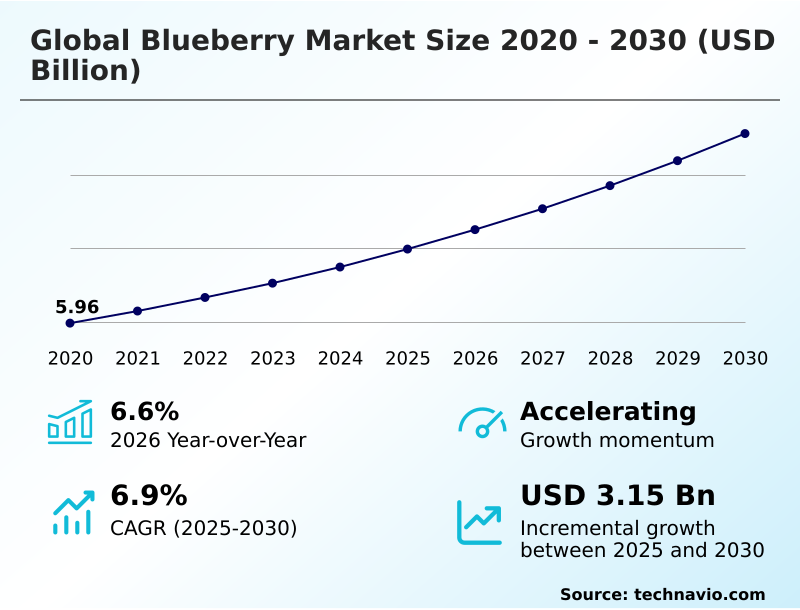
The blueberry market size is valued to increase by USD 3.15 billion, at a CAGR of 6.9% from 2025 to 2030. Rising health awareness and demand for antioxidant rich superfoods will drive the blueberry market.
Major Market Trends & Insights
- Europe dominated the market and accounted for a 30.6% growth during the forecast period.
- By Application - Food and beverages segment was valued at USD 5.42 billion in 2024
- By Type - Organic segment accounted for the largest market revenue share in 2024
Market Size & Forecast
- Market Opportunities: USD 5.17 billion
- Market Future Opportunities: USD 3.15 billion
- CAGR from 2025 to 2030 : 6.9%
Market Summary
- The blueberry market is undergoing a significant evolution, driven by a convergence of consumer health consciousness and agricultural innovation. Demand is shifting from a commodity focus to a preference for premium fruit with specific attributes like enhanced sweetness, size, and texture. This transition is compelling growers to invest in advanced genetics and varietal renewal programs.
- As a result, the supply chain is adapting to handle these higher-value products, with an emphasis on technologies that preserve freshness from farm to retail. For instance, a distributor may implement a dynamic cold chain management system that uses real-time data to adjust temperature and humidity, reducing spoilage by up to 15% on long-haul shipments.
- The industry is also expanding its geographic footprint to ensure year-round availability, with new cultivation projects in previously untapped climates. Concurrently, the use of blueberries as a functional ingredient in processed foods and beverages is growing, further diversifying revenue streams.
- Navigating challenges such as climate volatility and labor costs requires a commitment to technological adoption and sustainable practices, which are becoming standard operating principles for competitive players.
What will be the Size of the Blueberry Market during the forecast period?
Get Key Insights on Market Forecast (PDF) Get Free Sample
How is the Blueberry Market Segmented?
The blueberry industry research report provides comprehensive data (region-wise segment analysis), with forecasts and estimates in "USD million" for the period 2026-2030, as well as historical data from 2020-2024 for the following segments.
- Application
- Food and beverages
- Bakery and confectionary
- Others
- Type
- Organic
- Conventional
- Product
- Fresh
- Frozen
- Dried
- Geography
- North America
- US
- Canada
- Mexico
- Europe
- Germany
- UK
- Spain
- APAC
- China
- Japan
- South Korea
- South America
- Brazil
- Middle East and Africa
- UAE
- South Africa
- Saudi Arabia
- Rest of World (ROW)
- North America
By Application Insights
The food and beverages segment is estimated to witness significant growth during the forecast period.
The food and beverages segment is expanding as the demand for functional nutrition shapes consumer preferences. The use of blueberries as key food and beverage ingredients is rising, driven by the clean label movement.
Manufacturers are incorporating the fruit in various forms, including processed fruit products, valuing its sensory profile and nutritional benefits. Innovations in aseptic processing allow for shelf-stable liquid applications, while freeze-dried blueberry powders are used in health-focused snacks.
Advanced brix level measurement ensures consistent sweetness, and maintaining fruit firmness is critical for quality perception. This focus on premium inputs has led to a 15% increase in the adoption of specialized blueberry formats for gourmet beverage preparations.
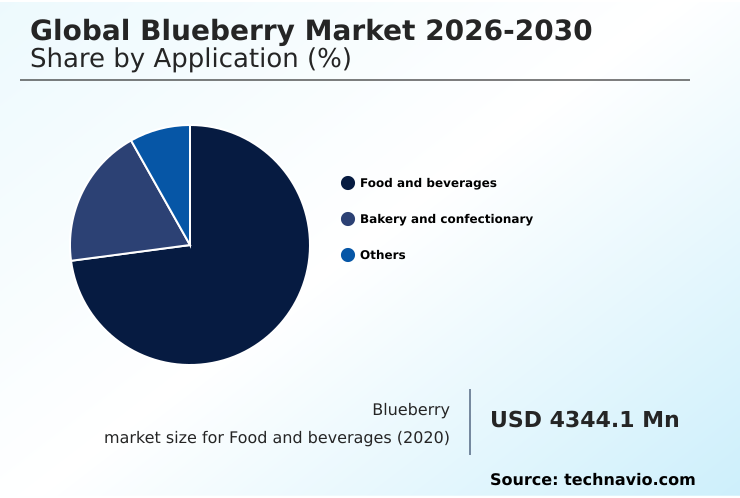
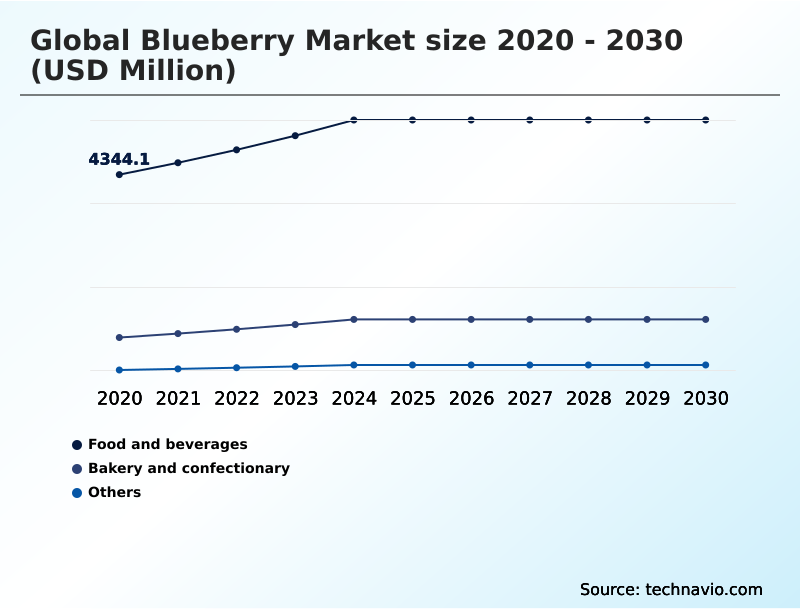
The Food and beverages segment was valued at USD 5.42 billion in 2024 and showed a gradual increase during the forecast period.
Regional Analysis
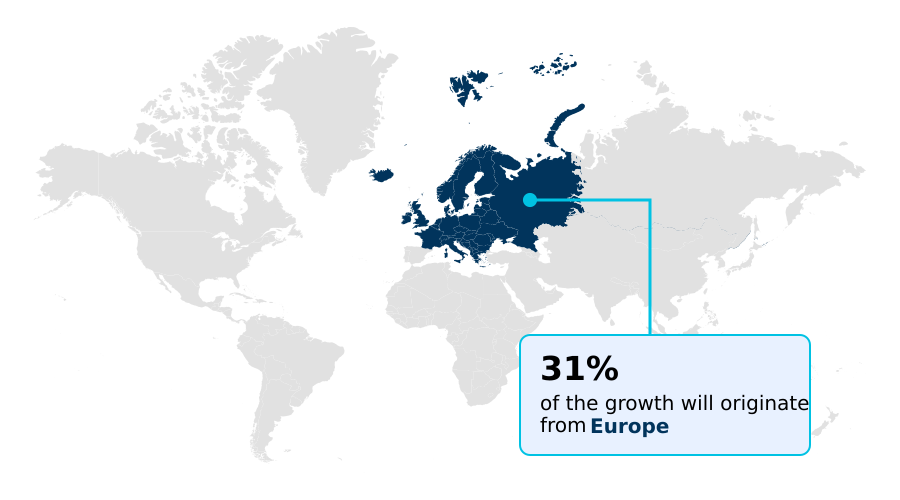
Europe is estimated to contribute 30.6% to the growth of the global market during the forecast period.Technavio’s analysts have elaborately explained the regional trends and drivers that shape the market during the forecast period.
See How Blueberry Market Demand is Rising in Europe Get Free Sample
The market's geographic landscape is diversifying to ensure supply chain optimization and meet global demand. North America remains a primary consumption hub, while South American countries are key suppliers, leveraging counter-seasonal harvests.
Europe represents the largest opportunity, projected to contribute over 30% of the market's incremental growth. Meanwhile, APAC is the fastest-growing region, with a projected growth rate of 8.3%, driven by rising incomes and health awareness.
Effective cold chain logistics are critical for maintaining post-harvest quality and enabling the export of fresh and IQF (Individually Quick Frozen) blueberries from key growing regions.
Innovations in cryogenic freezing technology are also helping producers in emerging markets meet stringent blueberry export standards, expanding their global reach.
Market Dynamics
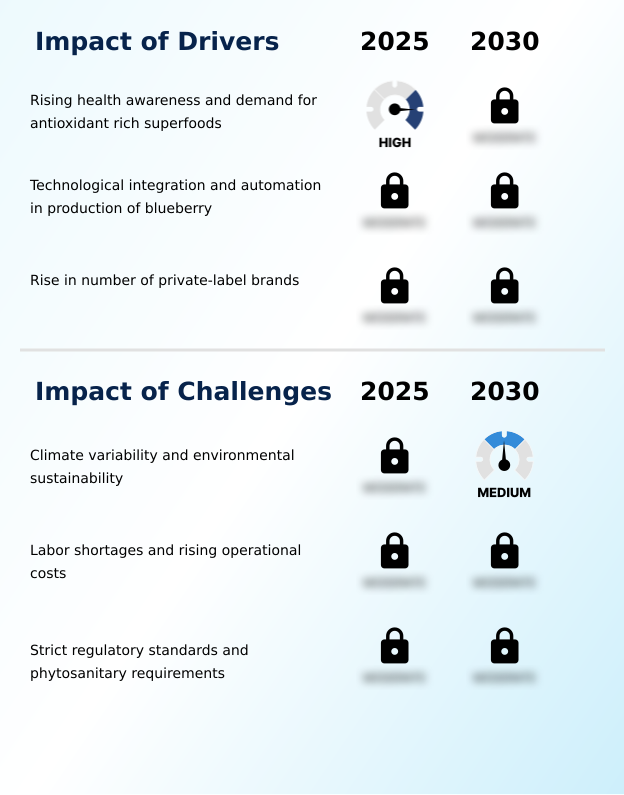
Our researchers analyzed the data with 2025 as the base year, along with the key drivers, trends, and challenges. A holistic analysis of drivers will help companies refine their marketing strategies to gain a competitive advantage.
- The industry is navigating a complex set of factors that influence production and profitability. A primary concern is the impact of climate change on blueberry yield, which is compelling growers to explore controlled-environment agriculture and climate-resilient cultivars. This directly connects to strategies for year-round blueberry supply, which rely on a global network of farms operating in different seasonal windows.
- The benefits of proprietary blueberry varieties are central to this strategy, as they offer improved firmness, flavor, and transportability, addressing key challenges in global blueberry logistics. These advanced genetics are crucial for increasing the shelf life of fresh blueberries.
- Concurrently, the adoption of technologies for mechanical blueberry harvesting is accelerating to counter labor shortages and rising operational costs, with some systems demonstrating a 40% improvement in picking efficiency over manual methods. The consumer preference for large size blueberries continues to shape cultivation priorities.
- On the processing side, the use of blueberries in functional beverages is a significant growth area, leveraging the role of antioxidants in blueberry health claims. Furthermore, growers are increasingly adopting organic blueberry farming best practices to meet demand from health-conscious consumers and gain access to premium market segments.
What are the key market drivers leading to the rise in the adoption of Blueberry Industry?
- The market is primarily driven by rising health awareness and strong consumer demand for blueberries, recognized as an antioxidant-rich superfood.
- Heightened consumer focus on blueberry health benefits and nutritional value is a primary market driver. As a key component of superfood trends, the fruit's high antioxidant content and rich concentration of phytonutrients are heavily marketed.
- The demand for products with verifiable health claims has pushed the functional food market forward. Scientific validation of bioactive compounds and high polyphenol concentration supports its status as a wellness ingredient.
- The expansion of organic blueberry production, which now accounts for over 25% of new plantings in some regions, directly addresses consumer demand for chemical-free options.
- Products fortified with blueberry extracts have demonstrated a 10% higher repeat purchase rate compared to conventional alternatives.
What are the market trends shaping the Blueberry Industry?
- A key market trend is the 'blue renaissance,' characterized by strategic varietal renewal programs. This industry-wide shift prioritizes fruit quality, consistency, and premium attributes over sheer production volume.
- The industry is undergoing a transformation driven by a focus on premium fruit attributes and varietal renewal. The development of new blueberry cultivar options is a central strategy, with a clear market preference for jumbo sized berries that command higher retail prices. This shift supports the goal of a year-round blueberry supply.
- Through genetic advancement, producers are achieving significant shelf life extension, reducing spoilage rates by up to 20%. This innovation is critical for retail fruit marketing and meeting evolving consumer dietary habits. For instance, new varieties offer a 15% improvement in resilience to transit-related damage, ensuring a consistent high-quality product reaches global consumers.
What challenges does the Blueberry Industry face during its growth?
- A primary challenge affecting industry growth is increasing climate variability, which intensifies the need for more advanced environmental sustainability practices across production.
- Producers face significant operational hurdles from climate variability and rising operational costs. The adoption of agritech solutions is crucial for developing climate-resilient crops and ensuring stable yields. Investments in controlled environment agriculture and precision agriculture technologies are increasing, with some farms reporting a 30% reduction in water usage.
- However, the high capital cost of mechanical harvesting equipment remains a barrier, despite its potential to reduce labor cost dependency by over 50%. Furthermore, adhering to stringent food safety regulations and phytosanitary measures adds complexity to global trade. Effective crop protection strategies that align with sustainable farming practices are essential for market access and long-term viability.
Exclusive Technavio Analysis on Customer Landscape
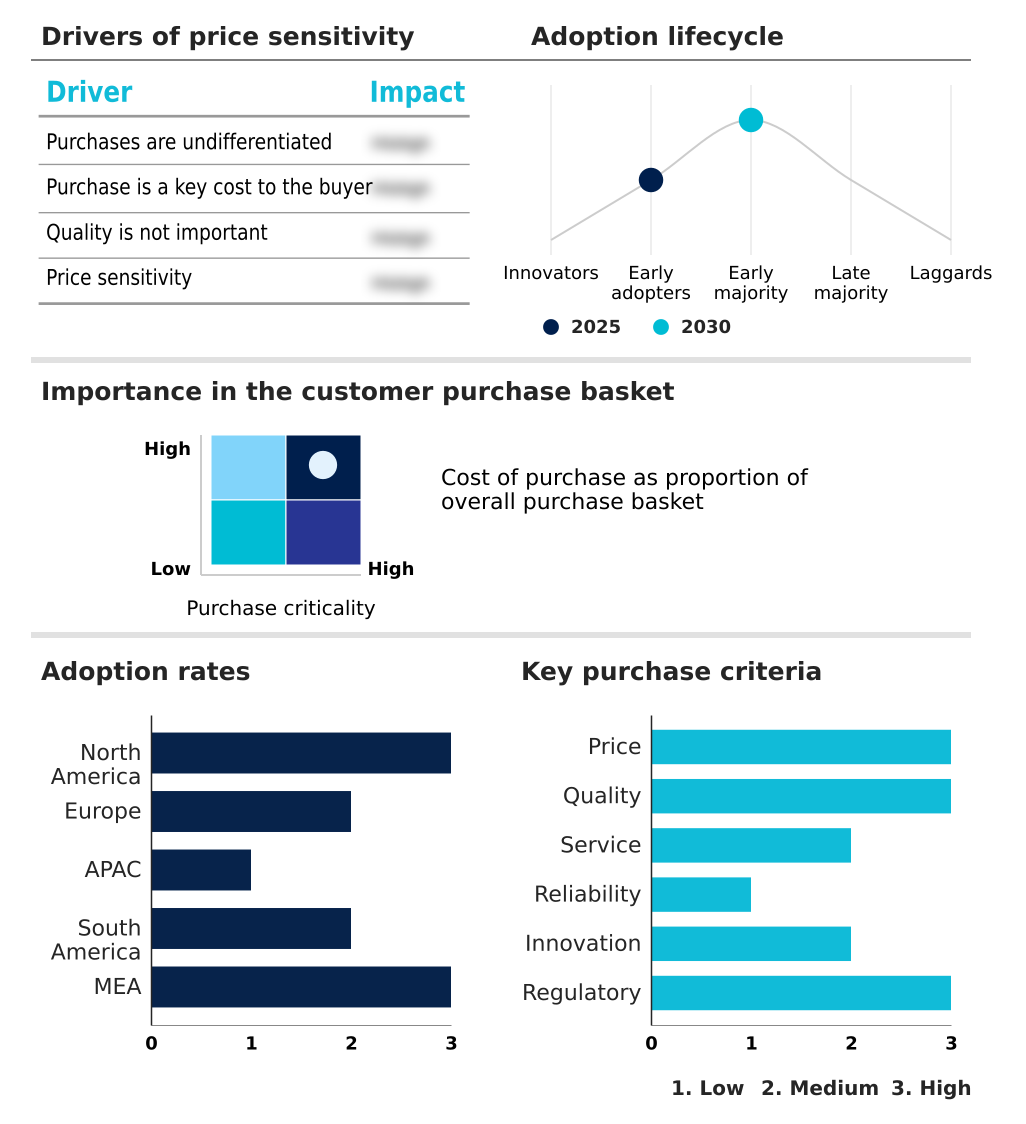
The blueberry market forecasting report includes the adoption lifecycle of the market, covering from the innovator’s stage to the laggard’s stage. It focuses on adoption rates in different regions based on penetration. Furthermore, the blueberry market report also includes key purchase criteria and drivers of price sensitivity to help companies evaluate and develop their market growth analysis strategies.
Customer Landscape of Blueberry Industry
Competitive Landscape
Companies are implementing various strategies, such as strategic alliances, blueberry market forecast, partnerships, mergers and acquisitions, geographical expansion, and product/service launches, to enhance their presence in the industry.
AGRANA Beteiligungs AG - Specializing in value-added fruit preparations and blueberry concentrates for industrial food applications, enhancing product formulation and quality.
The industry research and growth report includes detailed analyses of the competitive landscape of the market and information about key companies, including:
- AGRANA Beteiligungs AG
- Arctic Flavors
- Ardo NV
- BerryWorld Group
- Betec
- Dole plc
- Driscolls Inc.
- Earthbound Farm
- Hortifrut SA
- Jones Family Farms
- Joy Wing Mau Group
- JR Simplot Co.
- Kenburn Orchards
- MBG Marketing
- Naturipe Farms LLC
- Scenic Fruit Co.
- SunOpta Inc.
- Van Drunen Farms
- World Variety Produce Inc.
Qualitative and quantitative analysis of companies has been conducted to help clients understand the wider business environment as well as the strengths and weaknesses of key industry players. Data is qualitatively analyzed to categorize companies as pure play, category-focused, industry-focused, and diversified; it is quantitatively analyzed to categorize companies as dominant, leading, strong, tentative, and weak.
Recent Development and News in Blueberry market
- In May 2025, Naturipe Farms announced the launch of its exclusive proprietary varieties, including Envoy and Keepsake, tailored for the New Jersey and Michigan growing regions to enhance firmness, size, and flavor.
- In March 2025, Costa Group launched the first 17-hectare stage of its blueberry farm in Laos, aiming to extend the production season for the Asian market with plans to expand to 200 hectares.
- In February 2025, Driscoll's announced the launch of its premium Sweetest Batch blueberry range in Germany and the Middle East, introducing high-brix proprietary varieties to meet international demand for superior fresh fruit.
- In January 2025, Naturipe Farms reported a significant increase in organic blueberry volumes from its South American operations, achieving record yields to ensure a consistent year-round supply for retailers.
Dive into Technavio’s robust research methodology, blending expert interviews, extensive data synthesis, and validated models for unparalleled Blueberry Market insights. See full methodology.
| Market Scope | |
|---|---|
| Page number | 279 |
| Base year | 2025 |
| Historic period | 2020-2024 |
| Forecast period | 2026-2030 |
| Growth momentum & CAGR | Accelerate at a CAGR of 6.9% |
| Market growth 2026-2030 | USD 3152.7 million |
| Market structure | Fragmented |
| YoY growth 2025-2026(%) | 6.6% |
| Key countries | US, Canada, Mexico, Germany, UK, Poland, Spain, France, Italy, China, Japan, South Korea, India, Australia, Indonesia, Peru, Chile, Brazil, UAE, South Africa, Saudi Arabia, Egypt and Morocco |
| Competitive landscape | Leading Companies, Market Positioning of Companies, Competitive Strategies, and Industry Risks |
Research Analyst Overview
- The blueberry market is defined by a push for operational excellence through technological and genetic advancement. A central theme is varietal renewal, where producers are replacing older blueberry cultivar options with new ones that offer superior fruit firmness and an enhanced sensory profile. This focus on post-harvest quality is critical for boardroom decisions on brand positioning and pricing strategy.
- Investment in advanced cold chain logistics is non-negotiable for maintaining the integrity of fresh and IQF (Individually Quick Frozen) blueberries across global supply routes. To improve efficiency, the adoption of mechanical harvesting is increasing, while precision agriculture and controlled environment agriculture offer solutions to climate-related risks.
- For instance, implementing sustainable farming practices combined with targeted crop protection has been shown to improve marketable yield by over 12%. The industry's evolution is also visible in processing, with growth in freeze-dried blueberry formats and products highlighting high polyphenol concentration, antioxidant content, and other bioactive compounds and phytonutrients, all driven by consumer health trends.
What are the Key Data Covered in this Blueberry Market Research and Growth Report?
-
What is the expected growth of the Blueberry Market between 2026 and 2030?
-
USD 3.15 billion, at a CAGR of 6.9%
-
-
What segmentation does the market report cover?
-
The report is segmented by Application (Food and beverages, Bakery and confectionary, and Others), Type (Organic, and Conventional), Product (Fresh, Frozen, and Dried) and Geography (North America, Europe, APAC, South America, Middle East and Africa)
-
-
Which regions are analyzed in the report?
-
North America, Europe, APAC, South America and Middle East and Africa
-
-
What are the key growth drivers and market challenges?
-
Rising health awareness and demand for antioxidant rich superfoods, Climate variability and environmental sustainability
-
-
Who are the major players in the Blueberry Market?
-
AGRANA Beteiligungs AG, Arctic Flavors, Ardo NV, BerryWorld Group, Betec, Dole plc, Driscolls Inc., Earthbound Farm, Hortifrut SA, Jones Family Farms, Joy Wing Mau Group, JR Simplot Co., Kenburn Orchards, MBG Marketing, Naturipe Farms LLC, Scenic Fruit Co., SunOpta Inc., Van Drunen Farms and World Variety Produce Inc.
-
Market Research Insights
- Market dynamics are shaped by a strategic push toward supply chain optimization and delivering premium fruit attributes. The goal of a year-round blueberry supply is driving geographic diversification into new blueberry growing regions and investment in agritech solutions.
- This focus on quality is reflected in retail fruit marketing, where premium branding has led to a 15% price premium compared to standard offerings. Furthermore, alignment with consumer dietary habits, such as the clean label movement, has resulted in a 20% increase in the use of blueberries as natural food and beverage ingredients.
- Producers are leveraging these trends to differentiate their offerings, navigating complex food safety regulations while aiming for improved operational efficiencies.
We can help! Our analysts can customize this blueberry market research report to meet your requirements.
 RIA -
RIA - 
