
Europe Breakfast Cereals Market Size 2025-2029
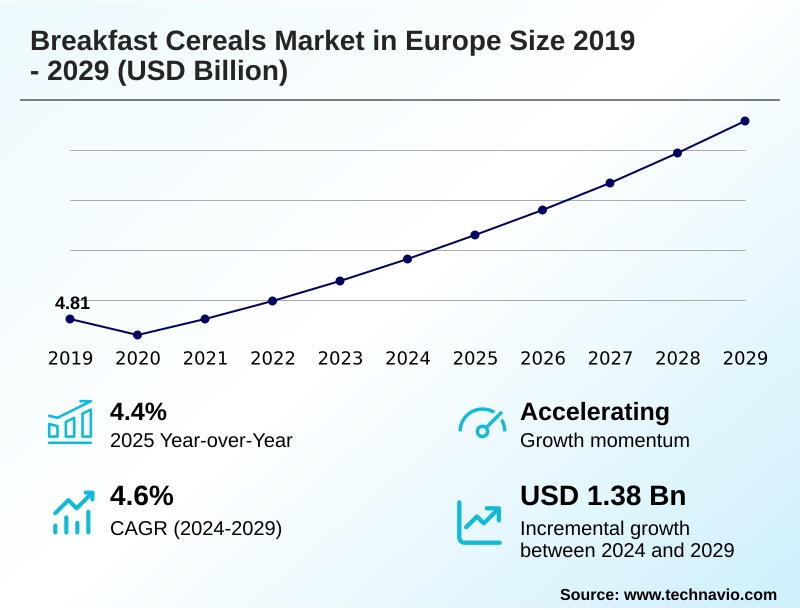
The Europe breakfast cereals market size is forecast to increase by USD 1.4 billion, at a CAGR of 4.6% between 2024 and 2029.
The breakfast cereals market in Europe is advancing, primarily driven by the increasing demand for breakfast cereals as consumers become more aware of the importance of a healthy first meal. This trend has spurred innovation, with a focus on developing products that are not only convenient but also nutritionally robust, containing essential carbohydrates, proteins, and fibers. Offerings like organic cereal are gaining traction as health benefits, such as high-fiber content and low cholesterol, become key purchasing criteria. Manufacturers are responding with new product launches that cater to this health-conscious demographic, including fruit-flavored and reduced-sugar varieties. The rising popularity of online retail is further amplifying this growth, as an increasing number of consumers turn to e-commerce for their grocery needs. This digital shift allows for greater accessibility and a wider selection of breakfast food, catering to diverse tastes and dietary requirements across the region.The expansion of online distribution channels, driven by increasing internet penetration and a growing base of e-commerce users, is a significant trend reshaping the market. New players are entering the online space, capitalizing on the demand for convenient purchasing options, which is further supported by the growth of food delivery services. Online platforms enable manufacturers of products like rte breakfast cereal to reach a broader audience, including those in remote areas, while subscription models encourage repeat business. However, the industry grapples with the challenge of food price fluctuations. The unpredictable costs of raw materials, influenced by adverse weather conditions and other external factors, create pricing instability. This volatility can affect profit margins and consumer affordability, presenting a persistent challenge to sustained market expansion.
What will be the size of the Europe Breakfast Cereals Market during the forecast period?
Explore in-depth regional segment analysis with market size data - historical 2019 - 2023 and forecasts 2025-2029 - in the full report.
Request Free Sample
The ongoing evolution of the breakfast cereals market in Europe is marked by a dynamic interplay between consumer health consciousness and digital transformation. The demand for convenient nutrition is reshaping product development, leading to a greater variety of fortified breakfast options and ready-to-eat cereals. Innovations in formulations, such as the use of plant-derived proteins and alternative grains, reflect a broader shift toward wellness-oriented consumption. Concurrently, the expansion of online distribution channels continues to alter the retail landscape, providing consumers with unprecedented access to niche products like organic cereal and customizable muesli blends. This digital integration is also enabling more direct engagement between brands and their customers.Strategic responses within the market are increasingly focused on navigating supply chain complexities and regulatory demands. The persistence of food price fluctuations requires agile sourcing and production cost management to maintain competitive pricing for both shelf-stable foods and frozen breakfast foods. Furthermore, the emphasis on supply chain transparency and ethical ingredient sourcing is becoming a critical differentiator. As the competitive landscape intensifies with the growth of private-label brands, companies are leveraging value-added packaging and clean labeling practices to communicate product quality and build consumer trust. The continuous adaptation to these evolving economic and consumer-driven pressures is essential for maintaining market position.
How is this market segmented?
The market research report provides comprehensive data (region-wise segment analysis), with forecasts and estimates in "USD million" for the period 2025-2029, as well as historical data from 2019 - 2023 for the following segments.
- Distribution channel
- Type of packaging
- Boxes
- Stand-up pouches
- Portable containers
- Others
- End-user
- Households
- Foodservice industry
- Institutional buyers
- Geography
By Distribution Channel Insights
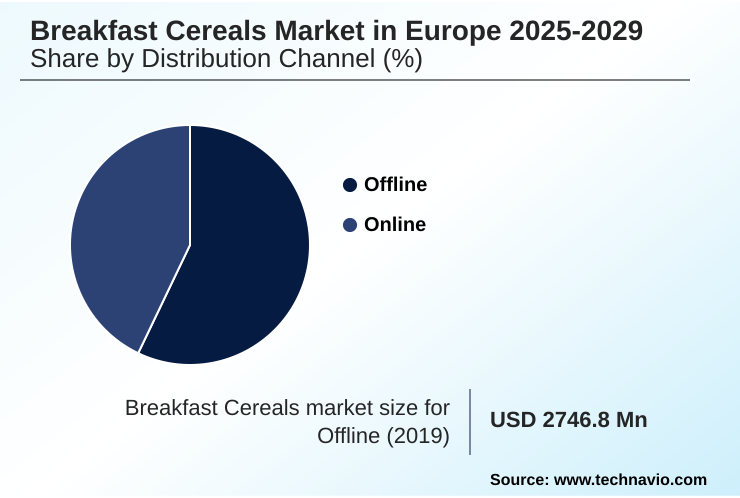
The offline segment is estimated to witness significant growth during the forecast period.
The offline distribution channel, which includes supermarkets, hypermarkets, and convenience stores, remains a cornerstone of the breakfast cereals market. These physical retail spaces offer significant advantages, such as large shelf areas that accommodate a wide variety of ready-to-eat cereals and other whole-grain food products, allowing for direct consumer comparison. In-store promotions and the ability to bundle purchases with other grocery items also drive sales. In many areas, this channel benefits from a high prevalence of organized retail, with private-label brands accounting for a significant retail value share.
Convenience stores and smaller discount retailers contribute to the offline channel's reach by providing accessibility in residential neighborhoods. These stores offer a curated selection of popular breakfast food options, catering to impulse buys and top-up shopping trips. The effectiveness of this segment is also enhanced by in-store marketing and attractive product displays, which raise brand awareness for new product launches and reinforce the visibility of established fortified breakfast options. These factors collectively ensure the continued relevance of the offline channel in the overall market structure.

Download Free Sample Report
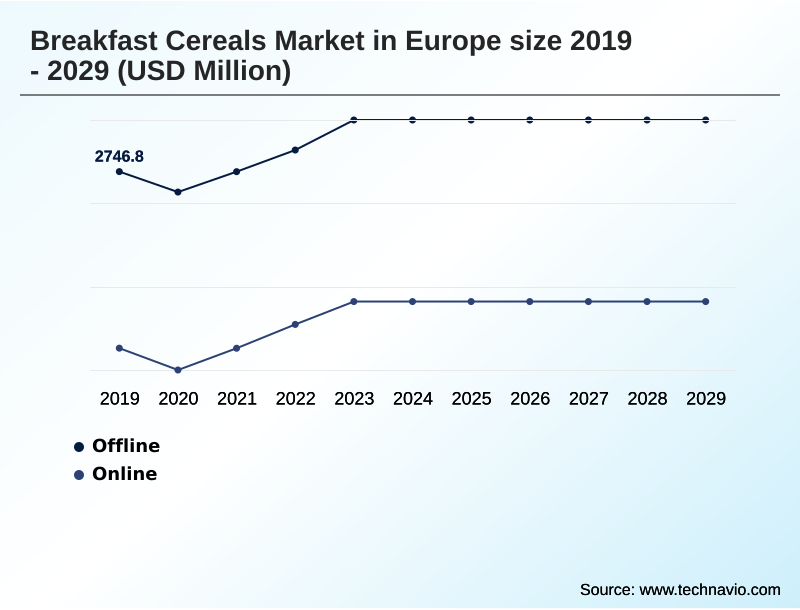
The Offline segment was valued at USD 2.7 billion in 2019 and showed a gradual increase during the forecast period.
Market Dynamics
Our researchers analyzed the data with 2024 as the base year, along with the key drivers, trends, and challenges. A holistic analysis of drivers will help companies refine their marketing strategies to gain a competitive advantage.
The European breakfast cereals market is experiencing significant transformation, driven by the increasing demand for healthy breakfast options and a rising consumer awareness of nutritional benefits. This shift is underscored by a growing preference for ready-to-eat meal solutions that align with the powerful influence of health and wellness trends. The consumer shift toward plant-based dietary habits has amplified the demand for cereals with high-fiber content and spurred the development of gluten-free and organic products. In response, manufacturers are focusing on strategic new product development and launches, showcasing a clear market response to reduced sugar formulations and highlighting the important role of micronutrient fortification in cereals to meet evolving consumer expectations.Operationally, the market dynamics are shaped by the significant impact of online retail on consumer access, further accelerated by the expansion of e-commerce food delivery services. However, companies face challenges from raw material price volatility, necessitating robust strategies for managing supply chain for agricultural commodities. Success hinges on leveraging technology for supply chain transparency and emphasizing the importance of sustainable and ethical sourcing. Furthermore, brands must contend with competitive pressure from private label offerings while navigating stringent food safety and labeling regulations. Adapting to fluctuating consumer spending patterns requires constant innovation, not just in product but also through innovation in packaging for shelf life extension, ensuring resilience in a competitive landscape.

What are the Europe Breakfast Cereals Market drivers leading to the rise in adoption of the Industry?
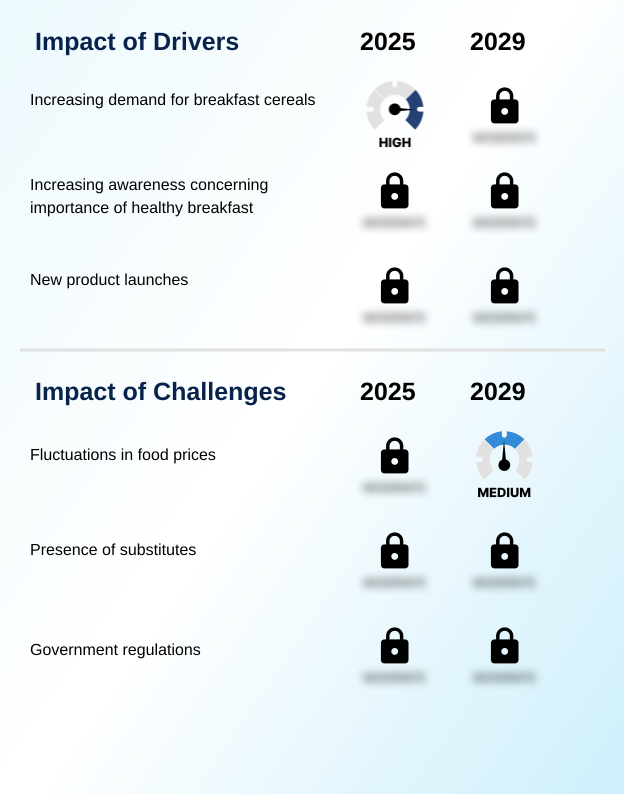
- The increasing demand for breakfast cereals is a key factor driving the market's growth.
The increasing demand for breakfast cereals is a primary dynamic shaping the market, as consumers grow more aware of the health benefits associated with a nutritious breakfast. These products, which include ready-to-eat cereals and hot cereal preparations, are recognized for their rich composition of carbohydrates, proteins, and fibers. Many offerings are also fortified breakfast options, containing key micronutrients such as vitamins and minerals. In response, companies are actively promoting the wellness advantages of their products, such as high-fiber content. This focus on health and nutrition is particularly resonant in developed economies, where breakfast cereals are significant contributors to daily nutrient intake for many consumers, with private label brands holding a retail value share that can exceed 40% in some markets.Growing awareness regarding the importance of a healthy breakfast is another key factor influencing market dynamics. Consumers are increasingly educated about the role of diet in overall well-being, leading them to seek out healthy breakfast alternatives. To meet this demand, companies are innovating with new product launches that feature desirable attributes like fruit-flavored products and reduced sugar formulations. There is a concerted effort to improve the nutritional profile of offerings, including reducing fat and oil content in items like cereal bars. This strategic pivot toward healthier, more functional foods, such as whole-grain food products, is positioning companies to capitalize on evolving consumer preferences and sustain market momentum.
What are the Europe Breakfast Cereals Market trends shaping the Industry?
- The market is witnessing an upcoming trend of increasing internet and e-commerce users for purchasing breakfast cereals.
The expansion of internet access and the corresponding rise in e-commerce adoption are creating new avenues for market growth. The convenience of online retail is attracting both established companies and new market entrants to enhance their digital presence. The growing demand for online purchasing, supported by expanding food delivery services and high internet penetration, allows for wider distribution of breakfast food options. Online channels provide manufacturers with the capability to connect with consumers in remote areas, while e-commerce subscription services facilitate customer retention through recurring purchases of items like organic cereal. The ease of online transactions and home delivery are key factors supporting this trend, as unorganized players can account for up to 40% of revenue in certain food processing sectors, highlighting the potential for structured online retail to capture share.A discernible shift in consumer preference toward ready-to-eat (RTE) cereals is significantly influencing product development and market positioning. Modern, fast-paced lifestyles leave many consumers with limited time for meal preparation, making the convenience of rte breakfast cereal highly appealing. This demand extends beyond just speed, as consumers are also seeking RTE options that do not compromise on nutritional value, such as whole-grain food products and those with high-fiber content. Manufacturers are responding by expanding their portfolios of convenient, healthy breakfast alternatives, including various fruit-flavored products and reduced sugar formulations. This trend is complemented by innovations in packaging, such as portable containers, that enhance the on-the-go consumption experience, catering directly to the needs of time-constrained individuals.
How does Europe Breakfast Cereals Market faces challenges face during its growth?
- Fluctuations in food prices pose a significant challenge to the growth of the industry.
Fluctuations in food prices present a persistent challenge for the market, as companies strive to manage the volatility of raw material costs. To mitigate this risk, some firms engage in purchase contracts with suppliers to fix prices in advance. However, the prices of essential commodities like grains are subject to significant year-over-year variation, which can impact profit margins and consumer pricing. These fluctuations are often driven by external factors such as adverse weather conditions, including droughts and floods, which affect crop yields and the availability of key ingredients like oats. With global economic growth contracting to 2.6% in a recent year, consumer price sensitivity has heightened, making it difficult to pass on increased production costs without risking a loss of market share.The presence of numerous substitutes poses a considerable challenge to market growth, as consumers have a wide array of alternative breakfast food options available. Products such as yogurt, smoothies, fruit, and breakfast bars compete directly for the morning meal occasion. These substitutes often appeal to consumers seeking variety, specific health benefits, or even greater convenience than traditional cereals. The rising popularity of plant-based diets further diversifies breakfast choices, with consumers exploring options beyond grain-based products. This competitive pressure requires cereal manufacturers to continuously innovate with offerings like gluten-free granola and sprouted grain cereals, and to reinforce the value proposition of their products through effective marketing that highlights their unique nutritional benefits and flavor profiles.
Exclusive Europe Breakfast Cereals Market Customer Landscape
The market forecasting report includes the adoption lifecycle of the market, covering from the innovator’s stage to the laggard’s stage. It focuses on adoption rates in different regions based on penetration. Furthermore, the report also includes key purchase criteria and drivers of price sensitivity to help companies evaluate and develop their market growth analysis strategies.
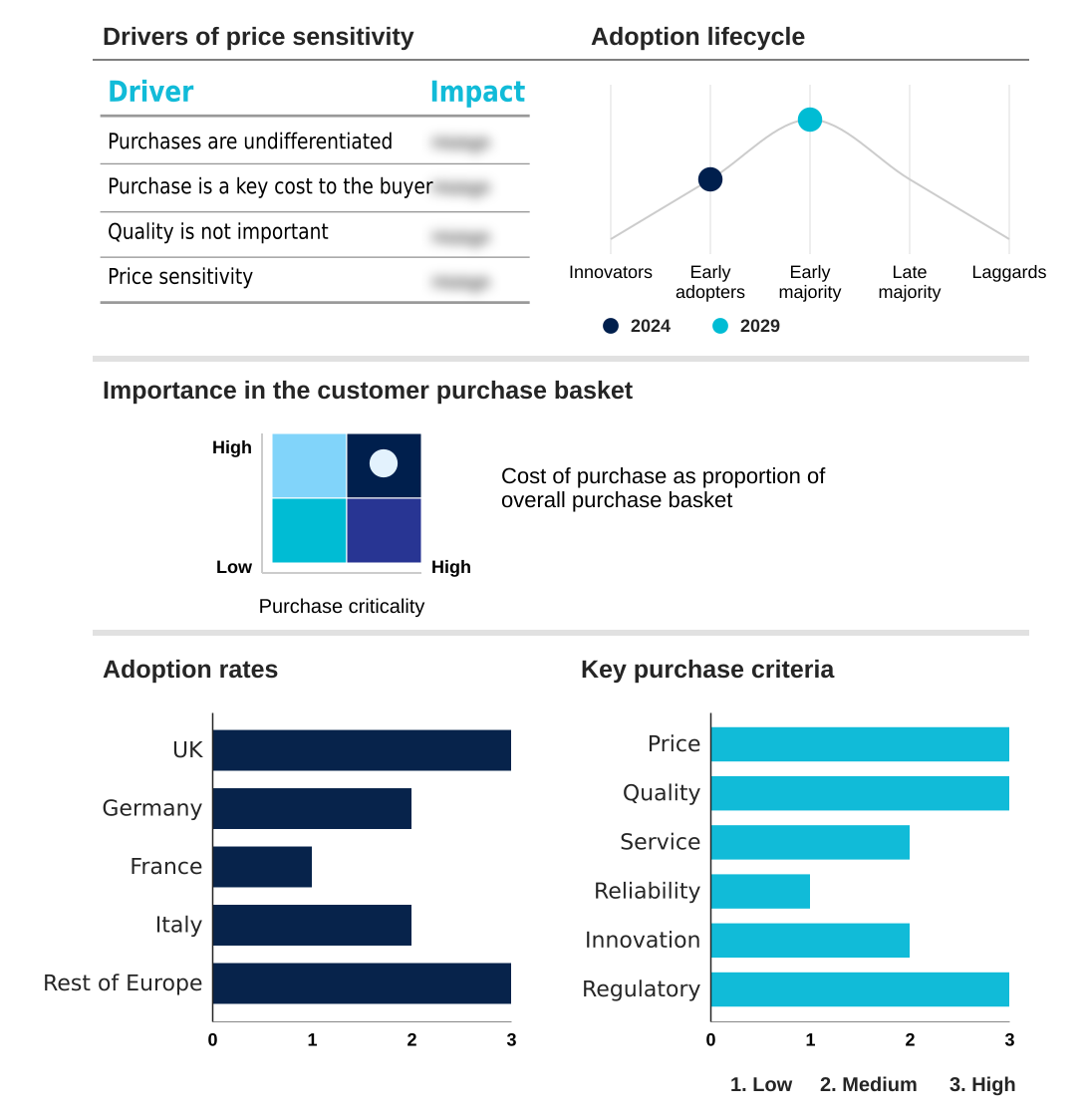
Customer Landscape
Key Companies & Market Insights
Companies are implementing various strategies, such as strategic alliances, market forecast partnerships, mergers and acquisitions, geographical expansion, and product/service launches, to enhance their presence in the market.
The market research and growth report includes detailed analyses of the competitive landscape of the market and information about key companies, including:
- Alara Wholefoods Ltd.
- Associated British Foods Plc
- B and G Foods Inc.
- Bobs Red Mill Natural Foods Inc.
- Cerealto Siro Foods S.L
- Food For Life Baking Co. Inc.
- General Mills Inc.
- Kellogg Co.
- Mornflake
- mymuesli AG
- Nestle SA
- Orkla ASA
- PepsiCo Inc.
- Peter Kolln GmbH and Co. KGaA
- Post Holdings Inc.
- The Hain Celestial Group Inc.
Qualitative and quantitative analysis of companies has been conducted to help clients understand the wider business environment as well as the strengths and weaknesses of key market players. Data is qualitatively analyzed to categorize companies as pure play, category-focused, industry-focused, and diversified; it is quantitatively analyzed to categorize companies as dominant, leading, strong, tentative, and weak.
Recent Development and News in Europe Breakfast Cereals Market
In February 2024, Kellanova reported its financial results for the fourth quarter and full year 2023, following the successful spin-off of its North American cereal business, highlighting growth in its snacks and emerging markets segments.In February 2024, General Mills announced a series of new product innovations across its portfolio, including new flavor extensions for its cereal brands, aimed at catering to evolving consumer tastes for both indulgent and health-conscious options.In May 2024, Nestle SA reaffirmed its commitment to its health and wellness strategy, outlining plans to further reformulate products to reduce sugar and sodium content while increasing nutritional value, including its range of breakfast cereals.In May 2024, PepsiCo Inc. announced a new multi-year initiative focused on advancing regenerative agriculture practices across its supply chain, impacting key ingredients for its Quaker Foods North America segment.
Research Analyst Overview
The breakfast cereals market in Europe reflects evolving preferences across a spectrum of breakfast food options. While ready-to-eat cereals remain prominent, there is expanding interest in hot cereal preparations, including porridge oats and customizable muesli blends. This transition is supported by a focus on healthy breakfast alternatives featuring whole-grain food products, high-fiber content, and reduced sugar formulations. The convenient nutrition category sees a rise in offerings like gluten-free granola and sprouted grain cereals. Consumers are drawn to organic food products with natural food ingredients, fortified breakfast options, and fruit-flavored products. The role of cereals also expands, with products positioned as meal replacements or for nutritional therapies, often consumed with plant-based beverages.Operational dynamics are shaped by food price fluctuations and commodity price volatility, directly impacting production cost management for both established names and private-label brands. Firms are utilizing sustainable ingredients and techniques like non-thermal processing alongside active packaging solutions for shelf-stable foods and even frozen foods. The importance of supply chain transparency and adherence to food safety regulations is intensifying. Concurrently, the expansion of online distribution channels and e-commerce subscriptions is altering how consumer spending habits are captured. This digital shift facilitates innovative product launches and influences retail value share, which could see a 4% adjustment, while the availability of raw material commodities remains a central planning factor.
Dive into Technavio’s robust research methodology, blending expert interviews, extensive data synthesis, and validated models for unparalleled Europe Breakfast Cereals Market insights. See full methodology.
|
Market Scope
|
|
Report Coverage
|
Details
|
|
Page number
|
206
|
|
Base year
|
2024
|
|
Historic period
|
2019 - 2023 |
|
Forecast period
|
2025-2029
|
|
Growth momentum & CAGR
|
Accelerating at a CAGR of 4.6%
|
|
Market growth 2024-2029
|
USD 1.4 billion
|
|
Market structure
|
Fragmented
|
|
YoY growth 2024-2029(%)
|
4.4%
|
|
Competitive landscape
|
Leading Companies, Market Positioning of Companies, Competitive Strategies, and Industry Risks
|
Request Free Sample
What are the Key Data Covered in this Market Research Report?
- CAGR of the market during the forecast period
- Detailed information on factors that will drive the market growth and forecasting between 2024 and 2029
- Precise estimation of the size of the market and its contribution of the market in focus to the parent market
- Accurate predictions about upcoming market growth and trends and changes in consumer behaviour
- Growth of the market across UK, Germany, France, Italy, Rest of Europe
- Thorough analysis of the market’s competitive landscape and detailed information about companies
- Comprehensive analysis of factors that will challenge the growth of market companies
We can help! Our analysts can customize this market research report to meet your requirements Get in touch
1 Executive Summary
- 1 Executive Summary
- 1.1 Market overview
- Executive Summary - Chart on Market Overview
- Executive Summary - Data Table on Market Overview
- Executive Summary - Chart on Country Market Characteristics
- Executive Summary - Chart on Market by Geography
- Executive Summary - Chart on Market Segmentation by Distribution Channel
- Executive Summary - Chart on Market Segmentation by Type of Packaging
- Executive Summary - Chart on Market Segmentation by End-user
- Executive Summary - Chart on Incremental Growth
- Executive Summary - Data Table on Incremental Growth
- Executive Summary - Chart on Company Market Positioning
2 Technavio Analysis
- 2 Technavio Analysis
- 2.1 Analysis of price sensitivity, lifecycle, customer purchase basket, adoption rates, and purchase criteria
- Analysis of price sensitivity, lifecycle, customer purchase basket, adoption rates, and purchase criteria
- 2.2 Criticality of inputs and Factors of differentiation
- Overview on criticality of inputs and factors of differentiation
- 2.3 Factors of disruption
- Overview on factors of disruption
- 2.4 Impact of drivers and challenges
- Impact of drivers and challenges in 2024 and 2029
3 Market Landscape
- 3 Market Landscape
- 3.1 Market ecosystem
- Chart on Parent Market
- Data Table on - Parent Market
- 3.2 Market characteristics
- Chart on Market characteristics analysis
- 3.3 Value chain analysis
- Chart on Value chain analysis
4 Market Sizing
- 4 Market Sizing
- 4.1 Market definition
- Data Table on Offerings of companies included in the market definition
- 4.2 Market segment analysis
- 4.3 Market size 2024
- 4.4 Market outlook: Forecast for 2024-2029
- Chart on Europe - Market size and forecast 2024-2029 ($ billion)
- Data Table on Regional - Market size and forecast 2024-2029 ($ billion)
- Chart on Europe: Year-over-year growth 2024-2029 (%)
- Data Table on Regional - Market size and forecast 2024-2029 ($ billion)
5 Historic Market Size
- 5 Historic Market Size
- 5.1 Breakfast Cereals Market in Europe 2019 - 2023
- Historic Market Size - Data Table on Breakfast Cereals Market in Europe 2019 - 2023 ($ billion)
- 5.2 Distribution Channel segment analysis 2019 - 2023
- Historic Market Size - Distribution Channel Segment 2019 - 2023 ($ billion)
- 5.3 Type of Packaging segment analysis 2019 - 2023
- Historic Market Size - Type of Packaging Segment 2019 - 2023 ($ billion)
- 5.4 End-user segment analysis 2019 - 2023
- Historic Market Size - End-user Segment 2019 - 2023 ($ billion)
- 5.5 Geography segment analysis 2019 - 2023
- Historic Market Size - Geography Segment 2019 - 2023 ($ billion)
6 Qualitative Analysis
- 6 Qualitative Analysis
- 6.1 The AI impact on Breakfast Cereals Market in Europe
7 Five Forces Analysis
- 7 Five Forces Analysis
- 7.1 Five forces summary
- Five forces analysis - Comparison between 2024 and 2029
- 7.2 Bargaining power of buyers
- Bargaining power of buyers - Impact of key factors 2024 and 2029
- 7.3 Bargaining power of suppliers
- Bargaining power of suppliers - Impact of key factors in 2024 and 2029
- 7.4 Threat of new entrants
- Threat of new entrants - Impact of key factors in 2024 and 2029
- 7.5 Threat of substitutes
- Threat of substitutes - Impact of key factors in 2024 and 2029
- 7.6 Threat of rivalry
- Threat of rivalry - Impact of key factors in 2024 and 2029
- 7.7 Market condition
- Chart on Market condition - Five forces 2024 and 2029
8 Market Segmentation by Distribution Channel
- 8 Market Segmentation by Distribution Channel
- 8.1 Market segments
- Chart on Distribution Channel - Market share 2024-2029 (%)
- Data Table on Distribution Channel - Market share 2024-2029 (%)
- 8.2 Comparison by Distribution Channel
- Chart on Comparison by Distribution Channel
- Data Table on Comparison by Distribution Channel
- 8.3 Offline - Market size and forecast 2024-2029
- Chart on Offline - Market size and forecast 2024-2029 ($ billion)
- Data Table on Offline - Market size and forecast 2024-2029 ($ billion)
- Chart on Offline - Year-over-year growth 2024-2029 (%)
- Data Table on Offline - Year-over-year growth 2024-2029 (%)
- 8.4 Online - Market size and forecast 2024-2029
- Chart on Online - Market size and forecast 2024-2029 ($ billion)
- Data Table on Online - Market size and forecast 2024-2029 ($ billion)
- Chart on Online - Year-over-year growth 2024-2029 (%)
- Data Table on Online - Year-over-year growth 2024-2029 (%)
- 8.5 Market opportunity by Distribution Channel
- Market opportunity by Distribution Channel ($ billion)
- Data Table on Market opportunity by Distribution Channel ($ billion)
9 Market Segmentation by Type of Packaging
- 9 Market Segmentation by Type of Packaging
- 9.1 Market segments
- Chart on Type of Packaging - Market share 2024-2029 (%)
- Data Table on Type of Packaging - Market share 2024-2029 (%)
- 9.2 Comparison by Type of Packaging
- Chart on Comparison by Type of Packaging
- Data Table on Comparison by Type of Packaging
- 9.3 Boxes - Market size and forecast 2024-2029
- Chart on Boxes - Market size and forecast 2024-2029 ($ billion)
- Data Table on Boxes - Market size and forecast 2024-2029 ($ billion)
- Chart on Boxes - Year-over-year growth 2024-2029 (%)
- Data Table on Boxes - Year-over-year growth 2024-2029 (%)
- 9.4 Stand-up pouches - Market size and forecast 2024-2029
- Chart on Stand-up pouches - Market size and forecast 2024-2029 ($ billion)
- Data Table on Stand-up pouches - Market size and forecast 2024-2029 ($ billion)
- Chart on Stand-up pouches - Year-over-year growth 2024-2029 (%)
- Data Table on Stand-up pouches - Year-over-year growth 2024-2029 (%)
- 9.5 Portable containers - Market size and forecast 2024-2029
- Chart on Portable containers - Market size and forecast 2024-2029 ($ billion)
- Data Table on Portable containers - Market size and forecast 2024-2029 ($ billion)
- Chart on Portable containers - Year-over-year growth 2024-2029 (%)
- Data Table on Portable containers - Year-over-year growth 2024-2029 (%)
- 9.6 Others - Market size and forecast 2024-2029
- Chart on Others - Market size and forecast 2024-2029 ($ billion)
- Data Table on Others - Market size and forecast 2024-2029 ($ billion)
- Chart on Others - Year-over-year growth 2024-2029 (%)
- Data Table on Others - Year-over-year growth 2024-2029 (%)
- 9.7 Market opportunity by Type of Packaging
- Market opportunity by Type of Packaging ($ billion)
- Data Table on Market opportunity by Type of Packaging ($ billion)
10 Market Segmentation by End-user
- 10 Market Segmentation by End-user
- 10.1 Market segments
- Chart on End-user - Market share 2024-2029 (%)
- Data Table on End-user - Market share 2024-2029 (%)
- 10.2 Comparison by End-user
- Chart on Comparison by End-user
- Data Table on Comparison by End-user
- 10.3 Households - Market size and forecast 2024-2029
- Chart on Households - Market size and forecast 2024-2029 ($ billion)
- Data Table on Households - Market size and forecast 2024-2029 ($ billion)
- Chart on Households - Year-over-year growth 2024-2029 (%)
- Data Table on Households - Year-over-year growth 2024-2029 (%)
- 10.4 Foodservice industry - Market size and forecast 2024-2029
- Chart on Foodservice industry - Market size and forecast 2024-2029 ($ billion)
- Data Table on Foodservice industry - Market size and forecast 2024-2029 ($ billion)
- Chart on Foodservice industry - Year-over-year growth 2024-2029 (%)
- Data Table on Foodservice industry - Year-over-year growth 2024-2029 (%)
- 10.5 Institutional buyers - Market size and forecast 2024-2029
- Chart on Institutional buyers - Market size and forecast 2024-2029 ($ billion)
- Data Table on Institutional buyers - Market size and forecast 2024-2029 ($ billion)
- Chart on Institutional buyers - Year-over-year growth 2024-2029 (%)
- Data Table on Institutional buyers - Year-over-year growth 2024-2029 (%)
- 10.6 Market opportunity by End-user
- Market opportunity by End-user ($ billion)
- Data Table on Market opportunity by End-user ($ billion)
11 Customer Landscape
- 11 Customer Landscape
- 11.1 Customer landscape overview
- Analysis of price sensitivity, lifecycle, customer purchase basket, adoption rates, and purchase criteria
12 Geographic Landscape
- 12 Geographic Landscape
- 12.1 Geographic segmentation
- Chart on Market share by geography - 2024-2029 (%)
- Data Table on Market share by geography - 2024-2029 (%)
- 12.2 Geographic comparison
- Chart on Geographic comparison
- Data Table on Geographic comparison
- 12.3 UK - Market size and forecast 2024-2029
- Chart on UK - Market size and forecast 2024-2029 ($ billion)
- Data Table on UK - Market size and forecast 2024-2029 ($ billion)
- Chart on UK - Year-over-year growth 2024-2029 (%)
- Data Table on UK - Year-over-year growth 2024-2029 (%)
- 12.4 Germany - Market size and forecast 2024-2029
- Chart on Germany - Market size and forecast 2024-2029 ($ billion)
- Data Table on Germany - Market size and forecast 2024-2029 ($ billion)
- Chart on Germany - Year-over-year growth 2024-2029 (%)
- Data Table on Germany - Year-over-year growth 2024-2029 (%)
- 12.5 France - Market size and forecast 2024-2029
- Chart on France - Market size and forecast 2024-2029 ($ billion)
- Data Table on France - Market size and forecast 2024-2029 ($ billion)
- Chart on France - Year-over-year growth 2024-2029 (%)
- Data Table on France - Year-over-year growth 2024-2029 (%)
- 12.6 Italy - Market size and forecast 2024-2029
- Chart on Italy - Market size and forecast 2024-2029 ($ billion)
- Data Table on Italy - Market size and forecast 2024-2029 ($ billion)
- Chart on Italy - Year-over-year growth 2024-2029 (%)
- Data Table on Italy - Year-over-year growth 2024-2029 (%)
- 12.7 Rest of Europe - Market size and forecast 2024-2029
- Chart on Rest of Europe - Market size and forecast 2024-2029 ($ billion)
- Data Table on Rest of Europe - Market size and forecast 2024-2029 ($ billion)
- Chart on Rest of Europe - Year-over-year growth 2024-2029 (%)
- Data Table on Rest of Europe - Year-over-year growth 2024-2029 (%)
- 12.8 Market opportunity by geography
- Market opportunity by geography ($ billion)
- Data Table on Market opportunity by geography ($ billion)
13 Drivers, Challenges, and Opportunity
- 13 Drivers, Challenges, and Opportunity
- 13.1 Market drivers
- Increasing demand for breakfast cereals
- Increasing awareness concerning importance of healthy breakfast
- New product launches
- 13.2 Market challenges
- Fluctuations in food prices
- Presence of substitutes
- Government regulations
- 13.3 Impact of drivers and challenges
- Impact of drivers and challenges in 2024 and 2029
- 13.4 Market opportunities
- Increasing internet and e-commerce users
- Rising demand for ready-to-eat (RTE) cereals
- Increase in mergers and acquisitions among companies
14 Competitive Landscape
- 14 Competitive Landscape
- 14.1 Overview
- 14.2 Competitive Landscape
- Overview on criticality of inputs and factors of differentiation
- 14.3 Landscape disruption
- Overview on factors of disruption
- 14.4 Industry risks
- Impact of key risks on business
15 Competitive Analysis
- 15 Competitive Analysis
- 15.1 Companies profiled
- 15.2 Company ranking index
- 15.3 Market positioning of companies
- Matrix on companies position and classification
- 15.4 Alara Wholefoods Ltd.
- Alara Wholefoods Ltd. - Overview
- Alara Wholefoods Ltd. - Product / Service
- Alara Wholefoods Ltd. - Key offerings
- SWOT
- 15.5 Associated British Foods Plc
- Associated British Foods Plc - Overview
- Associated British Foods Plc - Business segments
- Associated British Foods Plc - Key offerings
- Associated British Foods Plc - Segment focus
- SWOT
- 15.6 B and G Foods Inc.
- B and G Foods Inc. - Overview
- B and G Foods Inc. - Product / Service
- B and G Foods Inc. - Key offerings
- SWOT
- 15.7 Bobs Red Mill Natural Foods Inc.
- Bobs Red Mill Natural Foods Inc. - Overview
- Bobs Red Mill Natural Foods Inc. - Product / Service
- Bobs Red Mill Natural Foods Inc. - Key offerings
- SWOT
- 15.8 Cerealto Siro Foods S.L
- Cerealto Siro Foods S.L - Overview
- Cerealto Siro Foods S.L - Product / Service
- Cerealto Siro Foods S.L - Key offerings
- SWOT
- 15.9 Food For Life Baking Co. Inc.
- Food For Life Baking Co. Inc. - Overview
- Food For Life Baking Co. Inc. - Product / Service
- Food For Life Baking Co. Inc. - Key offerings
- SWOT
- 15.10 General Mills Inc.
- General Mills Inc. - Overview
- General Mills Inc. - Business segments
- General Mills Inc. - Key news
- General Mills Inc. - Key offerings
- General Mills Inc. - Segment focus
- SWOT
- 15.11 Kellogg Co.
- Kellogg Co. - Overview
- Kellogg Co. - Business segments
- Kellogg Co. - Key offerings
- Kellogg Co. - Segment focus
- SWOT
- 15.12 Mornflake
- Mornflake - Overview
- Mornflake - Product / Service
- Mornflake - Key offerings
- SWOT
- 15.13 mymuesli AG
- mymuesli AG - Overview
- mymuesli AG - Product / Service
- mymuesli AG - Key offerings
- SWOT
- 15.14 Nestle SA
- Nestle SA - Overview
- Nestle SA - Business segments
- Nestle SA - Key news
- Nestle SA - Key offerings
- Nestle SA - Segment focus
- SWOT
- 15.15 Orkla ASA
- Orkla ASA - Overview
- Orkla ASA - Business segments
- Orkla ASA - Key news
- Orkla ASA - Key offerings
- Orkla ASA - Segment focus
- SWOT
- 15.16 PepsiCo Inc.
- PepsiCo Inc. - Overview
- PepsiCo Inc. - Business segments
- PepsiCo Inc. - Key news
- PepsiCo Inc. - Key offerings
- PepsiCo Inc. - Segment focus
- SWOT
- 15.17 Post Holdings Inc.
- Post Holdings Inc. - Overview
- Post Holdings Inc. - Business segments
- Post Holdings Inc. - Key offerings
- Post Holdings Inc. - Segment focus
- SWOT
- 15.18 The Hain Celestial Group Inc.
- The Hain Celestial Group Inc. - Overview
- The Hain Celestial Group Inc. - Business segments
- The Hain Celestial Group Inc. - Key news
- The Hain Celestial Group Inc. - Key offerings
- The Hain Celestial Group Inc. - Segment focus
- SWOT
16 Appendix
- 16 Appendix
- 16.1 Scope of the report
- Market definition
- Objectives
- Notes and caveats
- 16.2 Inclusions and exclusions checklist
- Inclusions checklist
- Exclusions checklist
- 16.3 Currency conversion rates for US$
- Currency conversion rates for US$
- 16.4 Research methodology
- 16.5 Data procurement
- 16.6 Data validation
- 16.7 Validation techniques employed for market sizing
- Validation techniques employed for market sizing
- 16.8 Data synthesis
- 16.9 360 degree market analysis
- 360 degree market analysis
- 16.10 List of abbreviations
Research Framework
Technavio presents a detailed picture of the market by way of study, synthesis, and summation of data from multiple sources. The analysts have presented the various facets of the market with a particular focus on identifying the key industry influencers. The data thus presented is comprehensive, reliable, and the result of extensive research, both primary and secondary.
INFORMATION SOURCES
Primary sources
- Manufacturers and suppliers
- Channel partners
- Industry experts
- Strategic decision makers
Secondary sources
- Industry journals and periodicals
- Government data
- Financial reports of key industry players
- Historical data
- Press releases

DATA ANALYSIS
Data Synthesis
- Collation of data
- Estimation of key figures
- Analysis of derived insights
Data Validation
- Triangulation with data models
- Reference against proprietary databases
- Corroboration with industry experts

REPORT WRITING
Qualitative
- Market drivers
- Market challenges
- Market trends
- Five forces analysis
Quantitative
- Market size and forecast
- Market segmentation
- Geographical insights
- Competitive landscape