


Bridal Wear Market Analysis, Size, and Forecast 2026-2030: North America (US, Canada, and Mexico), Europe (Italy, France, and UK), APAC (China, Japan, and India), Middle East and Africa (Saudi Arabia, Turkey, and UAE), South America (Brazil and Argentina), and Rest of World (ROW)

Bridal Wear Market Analysis, Size, and Forecast 2026-2030:
North America (US, Canada, and Mexico), Europe (Italy, France, and UK), APAC (China, Japan, and India), Middle East and Africa (Saudi Arabia, Turkey, and UAE), South America (Brazil and Argentina), and Rest of World (ROW)

Published: Mar 2026 285 Pages SKU: IRTNTR72913

Market Overview at a Glance

$11 B
Market Opportunity
3.3%
CAGR 2025 - 2030
42.7%
North America Growth
$48.7 B
Offline segment 2024

Bridal Wear Market Size 2026-2030

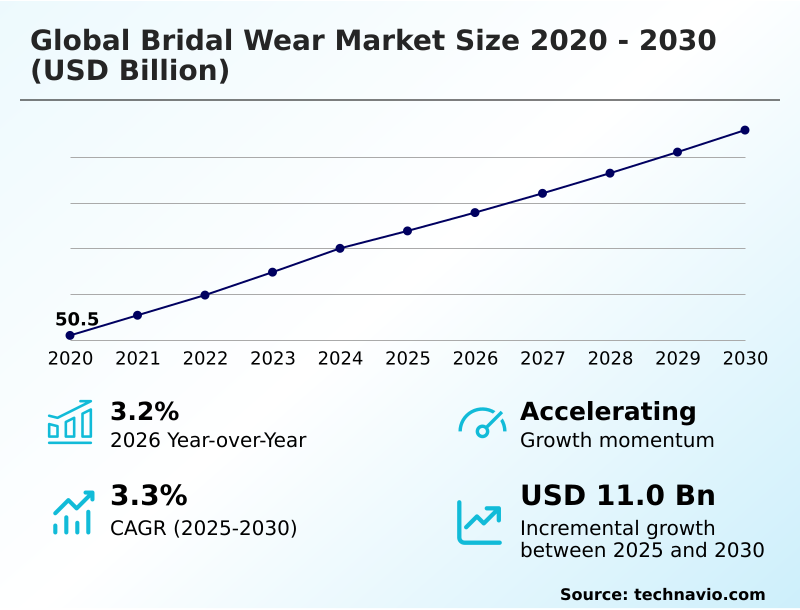
The bridal wear market size is valued to increase by USD 11 billion, at a CAGR of 3.3% from 2025 to 2030. Increase in product premiumization will drive the bridal wear market.

Major Market Trends & Insights

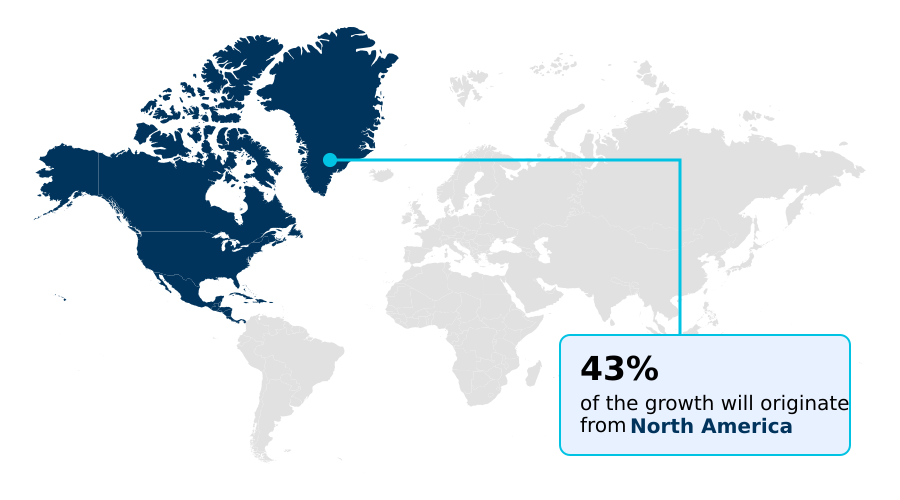
  • North America dominated the market and accounted for a 42.7% growth during the forecast period.
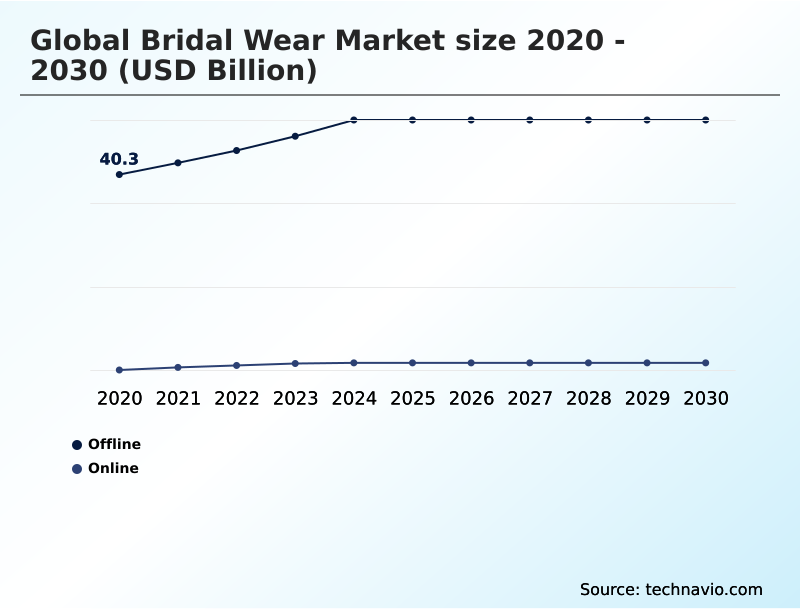
  • By Distribution Channel - Offline segment was valued at USD 48.7 billion in 2024
  • By Product - Gown segment accounted for the largest market revenue share in 2024

Market Size & Forecast

  • Market Opportunities: USD 22.4 billion
  • Market Future Opportunities: USD 11 billion
  • CAGR from 2025 to 2030 : 3.3%

Market Summary

  • The bridal wear market is a dynamic sector defined by high-value purchases and deep emotional significance. Growth is driven by product premiumization, where consumers increasingly seek bespoke craftsmanship and unique, personalized experiences. This trend is amplified by the pervasive influence of social media and celebrity culture, accelerating style cycles and creating demand for both haute couture and accessible luxury.
  • A key trend reshaping the industry is the adoption of sustainable fashion and slow fashion principles, with a growing number of consumers prioritizing eco-friendly fabrics and ethical production. Operationally, companies face the challenge of sophisticated inventory management to align with diverse consumer needs, from traditional gowns to non-traditional attire for micro-weddings.
  • For instance, optimizing the supply chain through demand sensing systems allows a business to reduce excess stock of high-cost artisanal craftsmanship gowns by over 15%, aligning made-to-order pipelines with actual consumer interest and minimizing financial risk. Concurrently, the rise of direct-to-consumer models and digital retail solutions, including virtual try-on platforms, is creating new avenues for customer engagement and market entry.

What will be the Size of the Bridal Wear Market during the forecast period?
Get Key Insights on Market Forecast (PDF) Request Free Sample

How is the Bridal Wear Market Segmented?

The bridal wear industry research report provides comprehensive data (region-wise segment analysis), with forecasts and estimates in "USD billion" for the period 2026-2030, as well as historical data from 2020-2024 for the following segments.

  • Distribution channel
    • Offline
    • Online
  • Product
    • Gown
    • Traditional wear
  • Price range
    • Premium
    • Medium
    • Economy
  • Geography
    • North America
      • US
      • Canada
      • Mexico
    • Europe
      • Italy
      • France
      • UK
    • APAC
      • China
      • Japan
      • India
    • Middle East and Africa
      • Saudi Arabia
      • Turkey
      • UAE
    • South America
      • Brazil
      • Argentina
    • Rest of World (ROW)

By Distribution Channel Insights

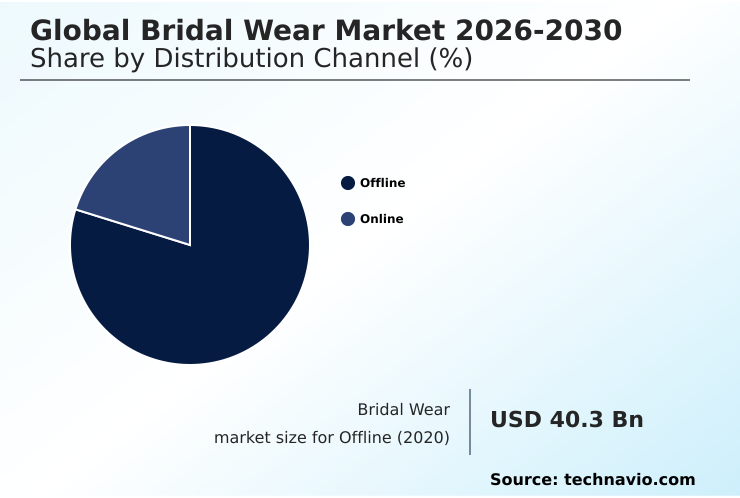
The offline segment is estimated to witness significant growth during the forecast period.

The offline channel remains dominant, commanding over 80% of sales, as the emotional significance of the purchase necessitates a tactile experience. This segment is where bespoke tailoring and assessments of hand-worked embroidery are best conducted.

The customer landscape values the expertise found in physical stores for creating differentiated products. Here, the heirloom-centric consumer can engage with made-to-order pipelines and select unique eco-friendly fabrics.

This is also where private-label brands can control the narrative through direct interaction.

A detailed five forces analysis shows that despite the growth of digital retail solutions, the need for in-person fittings for trans-seasonal collections preserves the strategic importance of brick-and-mortar establishments, demonstrating strong trend-responsiveness.
Request Free Sample

The Offline segment was valued at USD 48.7 billion in 2024 and showed a gradual increase during the forecast period.
Request Free Sample

Regional Analysis

North America is estimated to contribute 42.7% to the growth of the global market during the forecast period.Technavio’s analysts have elaborately explained the regional trends and drivers that shape the market during the forecast period.
See How Bridal Wear Market Demand is Rising in North America Request Free Sample

The geographic landscape is defined by diverse regional aesthetic preferences, with North America and Europe accounting for over 75% of high-end market activity. In these mature markets, sustainable fashion and inclusive sizing are becoming standard.

Meanwhile, APAC is a key growth region characterized by a fusion of cultural heritage and contemporary aesthetics, where bridal consulting services are professionalizing. This has given rise to avant-garde artistry and sculptural design in ready-to-wear collections.

Brands that effectively support local artisan communities and address social identity in their marketing see up to a 10% higher brand loyalty score. The adoption of ethereal draping and other modern styles highlights a global convergence of taste.

Market Dynamics

Our researchers analyzed the data with 2025 as the base year, along with the key drivers, trends, and challenges. A holistic analysis of drivers will help companies refine their marketing strategies to gain a competitive advantage.

  • Navigating the modern bridal market requires understanding the profound impact of social media on bridal trends and the corresponding rise of sustainable and ethical bridal wear. Key operational hurdles include the challenges of inventory management in bridal retail and the critical need for effective omnichannel retail strategies for bridal brands.
  • The influence of celebrity weddings on consumer choice cannot be overstated, pushing firms toward achieving accessible luxury in the bridal market through innovations in personalization and customization in bridal gowns. This digital transformation in bridal shopping experience is reshaping the entire value chain.
  • A core tension exists between traditional versus contemporary bridal attire, which complicates managing the supply chain in luxury bridal fashion. Meanwhile, the growth of private-label bridal collections offers retailers a competitive edge. The role of virtual try-on in online bridal sales is expanding, meeting the demand for modular and versatile wedding dresses.
  • Firms must also address the threat of counterfeit bridal gowns and brand protection. The enduring cultural significance in traditional bridal wear, especially the fusion aesthetics in the asia-pacific bridal market, contrasts with the growing use of eco-friendly materials in modern wedding dresses.
  • These dynamics exist alongside the structural impact of falling marriage rates on the bridal industry, ongoing premiumization trends in bridal couture, and the continuous challenge of navigating price sensitivity in bridal purchases. In this complex environment, offline channels still command over four times the market share of online platforms, underscoring the importance of a balanced strategy.
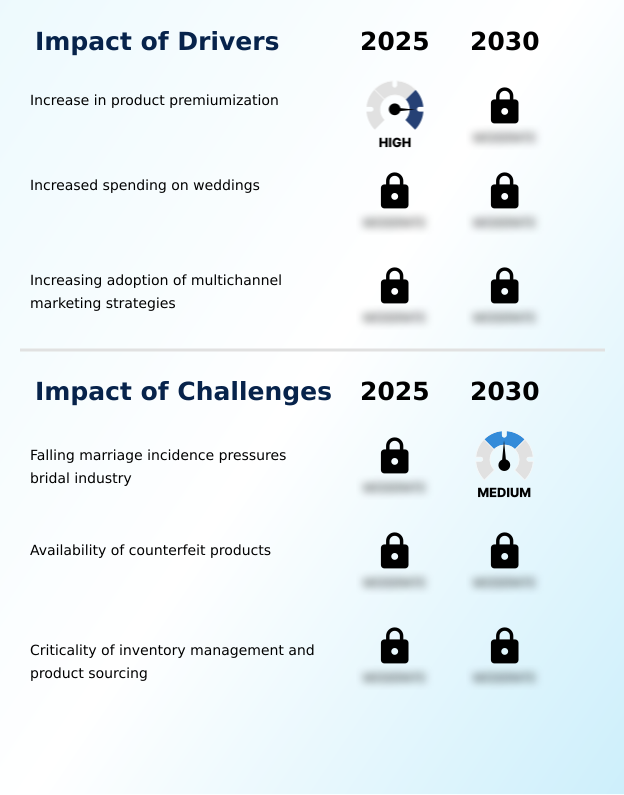
What are the key market drivers leading to the rise in the adoption of Bridal Wear Industry?

  • The increase in product premiumization is a key market driver, fueled by a growing consumer emphasis on superior quality, exclusivity, and craftsmanship.

  • Key drivers are centered on product premiumization and the execution of effective multichannel marketing strategies. Consumers are increasingly seeking personalized experiences, driving demand for bespoke craftsmanship and artisanal craftsmanship in haute couture.
  • This has propelled direct-to-consumer models that offer modular designs and accessible luxury, bypassing traditional retail channels. The emotional appeal of destination weddings further fuels spending.
  • High-touch consultations, whether in-person or digital, enhance brand equity and support the sale of high-value garments. Brands leveraging these strategies see an up to 30% improvement in lead conversion, as they successfully blend traditional craftsmanship with modern consumer engagement tactics.

What are the market trends shaping the Bridal Wear Industry?

  • The increased adoption of omnichannel strategies is a significant upcoming market trend, reflecting a shift toward integrating physical and digital touchpoints to create a seamless customer journey.

  • The market is pivoting toward a sophisticated omnichannel strategy, where experiential retail in boutique studios is enhanced by digital tools. The celebrity influence on couture-inspired silhouettes is undeniable, but a counter-movement toward non-traditional attire and slow fashion principles is strengthening the rental and resale sectors.
  • Advanced virtual try-on platforms and augmented reality fitting tools are becoming integral, with some platforms reducing fit-related returns by over 25%. This trend-responsiveness, supported by virtual consultations, allows brands to protect their brand heritage while engaging a modern consumer, leading to a 15% higher engagement rate for brands that fully integrate physical and digital channels.

What challenges does the Bridal Wear Industry face during its growth?

  • The declining incidence of marriage in many developed regions presents a structural challenge to the industry, directly impacting the traditional consumer base for bridal wear.

  • Operational resilience is a primary challenge, with complex supply chain dynamics and the need for resilient sourcing strategies. Effective inventory management is critical to combat the risks of fast-fashion cycles, while robust product sourcing and demand sensing systems are required to navigate market volatility.
  • The proliferation of counterfeit products continues to threaten margins, with some brands experiencing a profit erosion of nearly 40% on key lines. Furthermore, the rise of micro-weddings and civil ceremonies shifts demand toward budget-friendly attire, altering the traditional value chain analysis.
  • To mitigate these issues, firms are exploring localized manufacturing and improving sample management, which can reduce waste by 20% and improve forecast accuracy.

Exclusive Technavio Analysis on Customer Landscape

The bridal wear market forecasting report includes the adoption lifecycle of the market, covering from the innovator’s stage to the laggard’s stage. It focuses on adoption rates in different regions based on penetration. Furthermore, the bridal wear market report also includes key purchase criteria and drivers of price sensitivity to help companies evaluate and develop their market growth analysis strategies.
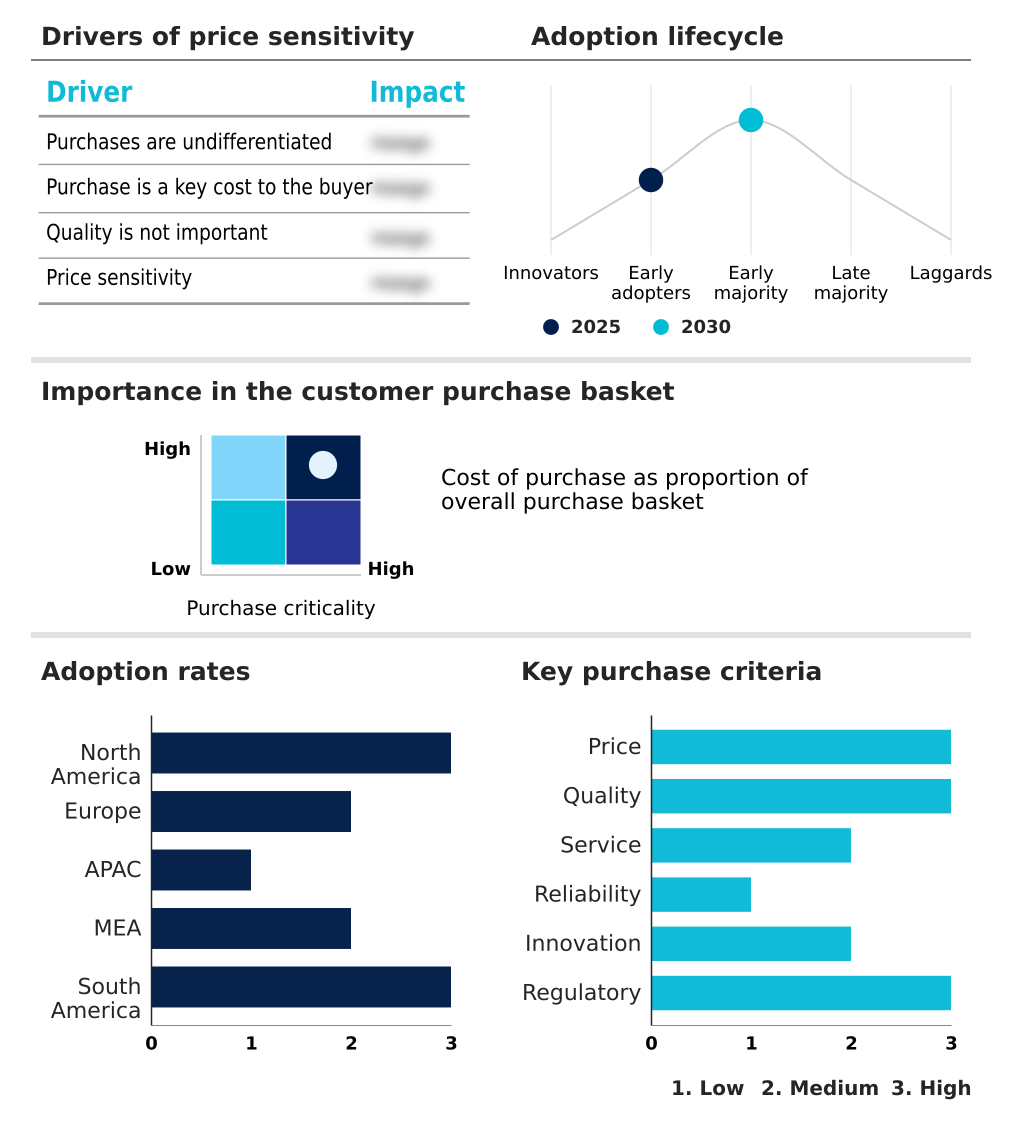
Customer Landscape of Bridal Wear Industry

Competitive Landscape

Companies are implementing various strategies, such as strategic alliances, bridal wear market forecast, partnerships, mergers and acquisitions, geographical expansion, and product/service launches, to enhance their presence in the industry.

Allure Bridals - An extensive portfolio of bridal gowns and formalwear is offered across multiple brand labels, encompassing diverse styles from classic romance to modern couture.

The industry research and growth report includes detailed analyses of the competitive landscape of the market and information about key companies, including:

  • Allure Bridals
  • ASOS Plc
  • Betsy and Adam
  • Davids Bridal LLC
  • Elie Saab
  • H and M Hennes and Mauritz GBC
  • House of Anita Dongre Ltd.
  • Justin Alexander Inc.
  • Klienfeld Bridal Corp.
  • Manish Malhotra
  • Monique Lhuillier Inc.
  • Morilee LLC
  • Naeem Khan Ltd.
  • Peter Langner
  • Pronovias Group
  • Rosa Clara
  • SAU LEE
  • Temperley London
  • Winnie Couture Inc.

Qualitative and quantitative analysis of companies has been conducted to help clients understand the wider business environment as well as the strengths and weaknesses of key industry players. Data is qualitatively analyzed to categorize companies as pure play, category-focused, industry-focused, and diversified; it is quantitatively analyzed to categorize companies as dominant, leading, strong, tentative, and weak.

Recent Development and News in Bridal wear market

  • In January, 2025, Justin Alexander Group announced the launch of its customizable e-commerce platform, Justin Alexander Studio, offering made-to-order gowns produced in the United States with a two-week delivery time.
  • In February, 2025, the Australian fashion brand MESHKI expanded its portfolio by launching a dedicated bridal wear collection, targeting millennial and Gen Z demographics with modern silhouettes.
  • In March, 2025, Allure Bridals India introduced a specialized line of high-end bridal gowns crafted from eco-friendly fabrics, targeting environmentally conscious luxury consumers.
  • In March, 2025, Morilee premiered its Goddess Collection at the National Chicago Bridal Market, showcasing architectural fabrics and ethereal silhouettes influenced by classical mythology.

Dive into Technavio’s robust research methodology, blending expert interviews, extensive data synthesis, and validated models for unparalleled Bridal Wear Market insights. See full methodology.

Market Scope
Page number 285
Base year 2025
Historic period 2020-2024
Forecast period 2026-2030
Growth momentum & CAGR Accelerate at a CAGR of 3.3%
Market growth 2026-2030 USD 11.0 billion
Market structure Fragmented
YoY growth 2025-2026(%) 3.2%
Key countries US, Canada, Mexico, Italy, France, UK, Germany, Spain, The Netherlands, China, Japan, India, South Korea, Australia, Indonesia, Saudi Arabia, Turkey, UAE, South Africa, Israel, Brazil, Argentina and Chile
Competitive landscape Leading Companies, Market Positioning of Companies, Competitive Strategies, and Industry Risks

Request Free Sample

Research Analyst Overview

  • The market's boardroom strategy is shifting toward a comprehensive omnichannel strategy that integrates digital retail solutions with experiential retail. This addresses the rise of private-label brands and the powerful celebrity influence driving product premiumization. Effective multichannel marketing strategies are essential for brand survival, combating counterfeit products through superior product sourcing and inventory management.
  • The demand for bespoke craftsmanship, including bespoke tailoring and hand-worked embroidery, defines the haute couture segment, where artisanal craftsmanship is paramount. Sustainable fashion is now a core consideration, influencing supply chain dynamics through the adoption of eco-friendly fabrics and slow fashion principles.
  • The market is diversifying with modular designs, avant-garde artistry, and sculptural design, while augmented reality fitting and virtual try-on platforms support direct-to-consumer models and made-to-order pipelines. These technologies are crucial as tastes fragment to include fusion aesthetics, ethereal draping, and ready-to-wear collections that prioritize inclusive sizing.
  • The rise of micro-weddings and civil ceremonies, influenced by fast-fashion cycles, also strengthens the rental and resale sectors, creating a market where investment in brand is rated with high criticality over R&D.

What are the Key Data Covered in this Bridal Wear Market Research and Growth Report?

  • What is the expected growth of the Bridal Wear Market between 2026 and 2030?

    • USD 11 billion, at a CAGR of 3.3%

  • What segmentation does the market report cover?

    • The report is segmented by Distribution Channel (Offline, and Online), Product (Gown, and Traditional wear), Price Range (Premium, Medium, and Economy) and Geography (North America, Europe, APAC, Middle East and Africa, South America)

  • Which regions are analyzed in the report?

    • North America, Europe, APAC, Middle East and Africa and South America

  • What are the key growth drivers and market challenges?

    • Increase in product premiumization, Falling marriage incidence pressures bridal industry

  • Who are the major players in the Bridal Wear Market?

    • Allure Bridals, ASOS Plc, Betsy and Adam, Davids Bridal LLC, Elie Saab, H and M Hennes and Mauritz GBC, House of Anita Dongre Ltd., Justin Alexander Inc., Klienfeld Bridal Corp., Manish Malhotra, Monique Lhuillier Inc., Morilee LLC, Naeem Khan Ltd., Peter Langner, Pronovias Group, Rosa Clara, SAU LEE, Temperley London and Winnie Couture Inc.

Market Research Insights

  • Market dynamics are increasingly shaped by a focus on personalized experiences and enhanced brand equity, which is considered significantly more critical than R&D investment. The customer landscape is evolving, with a growing interest in destination weddings and non-traditional attire that reflects a blend of cultural heritage and contemporary aesthetics.
  • While price sensitivity remains a neutral factor for a core segment, the demand for high-touch consultations and curated boutique studios highlights a preference for value over low cost. The adoption of multichannel strategies improves trend-responsiveness, with integrated digital platforms boosting customer engagement rates by up to 20% compared to single-channel approaches.
  • This allows brands to showcase their brand heritage and differentiated products effectively, catering to a consumer base seeking both emotional significance and unique social identity in their purchases.

We can help! Our analysts can customize this bridal wear market research report to meet your requirements.

Get in touch

1. Executive Summary

1.1 Market overview

Executive Summary - Chart on Market Overview
Executive Summary - Data Table on Market Overview
Executive Summary - Chart on Global Market Characteristics
Executive Summary - Chart on Market by Geography
Executive Summary - Chart on Market Segmentation by Distribution Channel
Executive Summary - Chart on Market Segmentation by Product
Executive Summary - Chart on Market Segmentation by Price Range
Executive Summary - Chart on Incremental Growth
Executive Summary - Data Table on Incremental Growth
Executive Summary - Chart on Company Market Positioning

2. Technavio Analysis

2.1 Analysis of price sensitivity, lifecycle, customer purchase basket, adoption rates, and purchase criteria

2.2 Criticality of inputs and Factors of differentiation

Chart on Overview on criticality of inputs and factors of differentiation

2.3 Factors of disruption

Chart on Overview on factors of disruption

2.4 Impact of drivers and challenges

Chart on Impact of drivers and challenges in 2025 and 2030

3. Market Landscape

3.1 Market ecosystem

Chart on Parent Market
Data Table on - Parent Market

3.2 Market characteristics

Chart on Market characteristics analysis

3.3 Value chain analysis

Chart on Value chain analysis

4. Market Sizing

4.1 Market definition

Data Table on Offerings of companies included in the market definition

4.2 Market segment analysis

Market segments

4.3 Market size 2025

4.4 Market outlook: Forecast for 2025-2030

Chart on Global - Market size and forecast 2025-2030 ($ billion)
Data Table on Global - Market size and forecast 2025-2030 ($ billion)
Chart on Global Market: Year-over-year growth 2025-2030 (%)
Data Table on Global Market: Year-over-year growth 2025-2030 (%)

5. Historic Market Size

5.1 Global Bridal Wear Market 2020 - 2024

Historic Market Size - Data Table on Global Bridal Wear Market 2020 - 2024 ($ billion)

5.2 Distribution Channel segment analysis 2020 - 2024

Historic Market Size - Distribution Channel Segment 2020 - 2024 ($ billion)

5.3 Product segment analysis 2020 - 2024

Historic Market Size - Product Segment 2020 - 2024 ($ billion)

5.4 Price Range segment analysis 2020 - 2024

Historic Market Size - Price Range Segment 2020 - 2024 ($ billion)

5.5 Geography segment analysis 2020 - 2024

Historic Market Size - Geography Segment 2020 - 2024 ($ billion)

5.6 Country segment analysis 2020 - 2024

Historic Market Size - Country Segment 2020 - 2024 ($ billion)

6. Qualitative Analysis

6.1 The AI impact on Global Bridal Wear Market

7. Five Forces Analysis

7.1 Five forces summary

Five forces analysis - Comparison between 2025 and 2030

7.2 Bargaining power of buyers

Bargaining power of buyers - Impact of key factors 2025 and 2030

7.3 Bargaining power of suppliers

Bargaining power of suppliers - Impact of key factors in 2025 and 2030

7.4 Threat of new entrants

Threat of new entrants - Impact of key factors in 2025 and 2030

7.5 Threat of substitutes

Threat of substitutes - Impact of key factors in 2025 and 2030

7.6 Threat of rivalry

Threat of rivalry - Impact of key factors in 2025 and 2030

7.7 Market condition

Chart on Market condition - Five forces 2025 and 2030

8. Market Segmentation by Distribution Channel

8.1 Market segments

Chart on Distribution Channel - Market share 2025-2030 (%)
Data Table on Distribution Channel - Market share 2025-2030 (%)

8.2 Comparison by Distribution Channel

Chart on Comparison by Distribution Channel
Data Table on Comparison by Distribution Channel

8.3 Offline - Market size and forecast 2025-2030

Chart on Offline - Market size and forecast 2025-2030 ($ billion)
Data Table on Offline - Market size and forecast 2025-2030 ($ billion)
Chart on Offline - Year-over-year growth 2025-2030 (%)
Data Table on Offline - Year-over-year growth 2025-2030 (%)

8.4 Online - Market size and forecast 2025-2030

Chart on Online - Market size and forecast 2025-2030 ($ billion)
Data Table on Online - Market size and forecast 2025-2030 ($ billion)
Chart on Online - Year-over-year growth 2025-2030 (%)
Data Table on Online - Year-over-year growth 2025-2030 (%)

8.5 Market opportunity by Distribution Channel

Market opportunity by Distribution Channel ($ billion)
Data Table on Market opportunity by Distribution Channel ($ billion)

9. Market Segmentation by Product

9.1 Market segments

Chart on Product - Market share 2025-2030 (%)
Data Table on Product - Market share 2025-2030 (%)

9.2 Comparison by Product

Chart on Comparison by Product
Data Table on Comparison by Product

9.3 Gown - Market size and forecast 2025-2030

Chart on Gown - Market size and forecast 2025-2030 ($ billion)
Data Table on Gown - Market size and forecast 2025-2030 ($ billion)
Chart on Gown - Year-over-year growth 2025-2030 (%)
Data Table on Gown - Year-over-year growth 2025-2030 (%)

9.4 Traditional wear - Market size and forecast 2025-2030

Chart on Traditional wear - Market size and forecast 2025-2030 ($ billion)
Data Table on Traditional wear - Market size and forecast 2025-2030 ($ billion)
Chart on Traditional wear - Year-over-year growth 2025-2030 (%)
Data Table on Traditional wear - Year-over-year growth 2025-2030 (%)

9.5 Market opportunity by Product

Market opportunity by Product ($ billion)
Data Table on Market opportunity by Product ($ billion)

10. Market Segmentation by Price Range

10.1 Market segments

Chart on Price Range - Market share 2025-2030 (%)
Data Table on Price Range - Market share 2025-2030 (%)

10.2 Comparison by Price Range

Chart on Comparison by Price Range
Data Table on Comparison by Price Range

10.3 Premium - Market size and forecast 2025-2030

Chart on Premium - Market size and forecast 2025-2030 ($ billion)
Data Table on Premium - Market size and forecast 2025-2030 ($ billion)
Chart on Premium - Year-over-year growth 2025-2030 (%)
Data Table on Premium - Year-over-year growth 2025-2030 (%)

10.4 Medium - Market size and forecast 2025-2030

Chart on Medium - Market size and forecast 2025-2030 ($ billion)
Data Table on Medium - Market size and forecast 2025-2030 ($ billion)
Chart on Medium - Year-over-year growth 2025-2030 (%)
Data Table on Medium - Year-over-year growth 2025-2030 (%)

10.5 Economy - Market size and forecast 2025-2030

Chart on Economy - Market size and forecast 2025-2030 ($ billion)
Data Table on Economy - Market size and forecast 2025-2030 ($ billion)
Chart on Economy - Year-over-year growth 2025-2030 (%)
Data Table on Economy - Year-over-year growth 2025-2030 (%)

10.6 Market opportunity by Price Range

Market opportunity by Price Range ($ billion)
Data Table on Market opportunity by Price Range ($ billion)

11. Customer Landscape

11.1 Customer landscape overview

Analysis of price sensitivity, lifecycle, customer purchase basket, adoption rates, and purchase criteria

12. Geographic Landscape

12.1 Geographic segmentation

Chart on Market share by geography 2025-2030 (%)
Data Table on Market share by geography 2025-2030 (%)

12.2 Geographic comparison

Chart on Geographic comparison
Data Table on Geographic comparison

12.3 North America - Market size and forecast 2025-2030

Chart on North America - Market size and forecast 2025-2030 ($ billion)
Data Table on North America - Market size and forecast 2025-2030 ($ billion)
Chart on North America - Year-over-year growth 2025-2030 (%)
Data Table on North America - Year-over-year growth 2025-2030 (%)
Chart on Regional Comparison - North America
Data Table on Regional Comparison - North America

12.3.1 US - Market size and forecast 2025-2030

Chart on US - Market size and forecast 2025-2030 ($ billion)
Data Table on US - Market size and forecast 2025-2030 ($ billion)
Chart on US - Year-over-year growth 2025-2030 (%)
Data Table on US - Year-over-year growth 2025-2030 (%)

12.3.2 Canada - Market size and forecast 2025-2030

Chart on Canada - Market size and forecast 2025-2030 ($ billion)
Data Table on Canada - Market size and forecast 2025-2030 ($ billion)
Chart on Canada - Year-over-year growth 2025-2030 (%)
Data Table on Canada - Year-over-year growth 2025-2030 (%)

12.3.3 Mexico - Market size and forecast 2025-2030

Chart on Mexico - Market size and forecast 2025-2030 ($ billion)
Data Table on Mexico - Market size and forecast 2025-2030 ($ billion)
Chart on Mexico - Year-over-year growth 2025-2030 (%)
Data Table on Mexico - Year-over-year growth 2025-2030 (%)

12.4 Europe - Market size and forecast 2025-2030

Chart on Europe - Market size and forecast 2025-2030 ($ billion)
Data Table on Europe - Market size and forecast 2025-2030 ($ billion)
Chart on Europe - Year-over-year growth 2025-2030 (%)
Data Table on Europe - Year-over-year growth 2025-2030 (%)
Chart on Regional Comparison - Europe
Data Table on Regional Comparison - Europe

12.4.1 Italy - Market size and forecast 2025-2030

Chart on Italy - Market size and forecast 2025-2030 ($ billion)
Data Table on Italy - Market size and forecast 2025-2030 ($ billion)
Chart on Italy - Year-over-year growth 2025-2030 (%)
Data Table on Italy - Year-over-year growth 2025-2030 (%)

12.4.2 France - Market size and forecast 2025-2030

Chart on France - Market size and forecast 2025-2030 ($ billion)
Data Table on France - Market size and forecast 2025-2030 ($ billion)
Chart on France - Year-over-year growth 2025-2030 (%)
Data Table on France - Year-over-year growth 2025-2030 (%)

12.4.3 UK - Market size and forecast 2025-2030

Chart on UK - Market size and forecast 2025-2030 ($ billion)
Data Table on UK - Market size and forecast 2025-2030 ($ billion)
Chart on UK - Year-over-year growth 2025-2030 (%)
Data Table on UK - Year-over-year growth 2025-2030 (%)

12.4.4 Germany - Market size and forecast 2025-2030

Chart on Germany - Market size and forecast 2025-2030 ($ billion)
Data Table on Germany - Market size and forecast 2025-2030 ($ billion)
Chart on Germany - Year-over-year growth 2025-2030 (%)
Data Table on Germany - Year-over-year growth 2025-2030 (%)

12.4.5 Spain - Market size and forecast 2025-2030

Chart on Spain - Market size and forecast 2025-2030 ($ billion)
Data Table on Spain - Market size and forecast 2025-2030 ($ billion)
Chart on Spain - Year-over-year growth 2025-2030 (%)
Data Table on Spain - Year-over-year growth 2025-2030 (%)

12.4.6 The Netherlands - Market size and forecast 2025-2030

Chart on The Netherlands - Market size and forecast 2025-2030 ($ billion)
Data Table on The Netherlands - Market size and forecast 2025-2030 ($ billion)
Chart on The Netherlands - Year-over-year growth 2025-2030 (%)
Data Table on The Netherlands - Year-over-year growth 2025-2030 (%)

12.5 APAC - Market size and forecast 2025-2030

Chart on APAC - Market size and forecast 2025-2030 ($ billion)
Data Table on APAC - Market size and forecast 2025-2030 ($ billion)
Chart on APAC - Year-over-year growth 2025-2030 (%)
Data Table on APAC - Year-over-year growth 2025-2030 (%)
Chart on Regional Comparison - APAC
Data Table on Regional Comparison - APAC

12.5.1 China - Market size and forecast 2025-2030

Chart on China - Market size and forecast 2025-2030 ($ billion)
Data Table on China - Market size and forecast 2025-2030 ($ billion)
Chart on China - Year-over-year growth 2025-2030 (%)
Data Table on China - Year-over-year growth 2025-2030 (%)

12.5.2 Japan - Market size and forecast 2025-2030

Chart on Japan - Market size and forecast 2025-2030 ($ billion)
Data Table on Japan - Market size and forecast 2025-2030 ($ billion)
Chart on Japan - Year-over-year growth 2025-2030 (%)
Data Table on Japan - Year-over-year growth 2025-2030 (%)

12.5.3 India - Market size and forecast 2025-2030

Chart on India - Market size and forecast 2025-2030 ($ billion)
Data Table on India - Market size and forecast 2025-2030 ($ billion)
Chart on India - Year-over-year growth 2025-2030 (%)
Data Table on India - Year-over-year growth 2025-2030 (%)

12.5.4 South Korea - Market size and forecast 2025-2030

Chart on South Korea - Market size and forecast 2025-2030 ($ billion)
Data Table on South Korea - Market size and forecast 2025-2030 ($ billion)
Chart on South Korea - Year-over-year growth 2025-2030 (%)
Data Table on South Korea - Year-over-year growth 2025-2030 (%)

12.5.5 Australia - Market size and forecast 2025-2030

Chart on Australia - Market size and forecast 2025-2030 ($ billion)
Data Table on Australia - Market size and forecast 2025-2030 ($ billion)
Chart on Australia - Year-over-year growth 2025-2030 (%)
Data Table on Australia - Year-over-year growth 2025-2030 (%)

12.5.6 Indonesia - Market size and forecast 2025-2030

Chart on Indonesia - Market size and forecast 2025-2030 ($ billion)
Data Table on Indonesia - Market size and forecast 2025-2030 ($ billion)
Chart on Indonesia - Year-over-year growth 2025-2030 (%)
Data Table on Indonesia - Year-over-year growth 2025-2030 (%)

12.6 Middle East and Africa - Market size and forecast 2025-2030

Chart on Middle East and Africa - Market size and forecast 2025-2030 ($ billion)
Data Table on Middle East and Africa - Market size and forecast 2025-2030 ($ billion)
Chart on Middle East and Africa - Year-over-year growth 2025-2030 (%)
Data Table on Middle East and Africa - Year-over-year growth 2025-2030 (%)
Chart on Regional Comparison - Middle East and Africa
Data Table on Regional Comparison - Middle East and Africa

12.6.1 Saudi Arabia - Market size and forecast 2025-2030

Chart on Saudi Arabia - Market size and forecast 2025-2030 ($ billion)
Data Table on Saudi Arabia - Market size and forecast 2025-2030 ($ billion)
Chart on Saudi Arabia - Year-over-year growth 2025-2030 (%)
Data Table on Saudi Arabia - Year-over-year growth 2025-2030 (%)

12.6.2 Turkey - Market size and forecast 2025-2030

Chart on Turkey - Market size and forecast 2025-2030 ($ billion)
Data Table on Turkey - Market size and forecast 2025-2030 ($ billion)
Chart on Turkey - Year-over-year growth 2025-2030 (%)
Data Table on Turkey - Year-over-year growth 2025-2030 (%)

12.6.3 UAE - Market size and forecast 2025-2030

Chart on UAE - Market size and forecast 2025-2030 ($ billion)
Data Table on UAE - Market size and forecast 2025-2030 ($ billion)
Chart on UAE - Year-over-year growth 2025-2030 (%)
Data Table on UAE - Year-over-year growth 2025-2030 (%)

12.6.4 South Africa - Market size and forecast 2025-2030

Chart on South Africa - Market size and forecast 2025-2030 ($ billion)
Data Table on South Africa - Market size and forecast 2025-2030 ($ billion)
Chart on South Africa - Year-over-year growth 2025-2030 (%)
Data Table on South Africa - Year-over-year growth 2025-2030 (%)

12.6.5 Israel - Market size and forecast 2025-2030

Chart on Israel - Market size and forecast 2025-2030 ($ billion)
Data Table on Israel - Market size and forecast 2025-2030 ($ billion)
Chart on Israel - Year-over-year growth 2025-2030 (%)
Data Table on Israel - Year-over-year growth 2025-2030 (%)

12.7 South America - Market size and forecast 2025-2030

Chart on South America - Market size and forecast 2025-2030 ($ billion)
Data Table on South America - Market size and forecast 2025-2030 ($ billion)
Chart on South America - Year-over-year growth 2025-2030 (%)
Data Table on South America - Year-over-year growth 2025-2030 (%)
Chart on Regional Comparison - South America
Data Table on Regional Comparison - South America

12.7.1 Brazil - Market size and forecast 2025-2030

Chart on Brazil - Market size and forecast 2025-2030 ($ billion)
Data Table on Brazil - Market size and forecast 2025-2030 ($ billion)
Chart on Brazil - Year-over-year growth 2025-2030 (%)
Data Table on Brazil - Year-over-year growth 2025-2030 (%)

12.7.2 Argentina - Market size and forecast 2025-2030

Chart on Argentina - Market size and forecast 2025-2030 ($ billion)
Data Table on Argentina - Market size and forecast 2025-2030 ($ billion)
Chart on Argentina - Year-over-year growth 2025-2030 (%)
Data Table on Argentina - Year-over-year growth 2025-2030 (%)

12.7.3 Chile - Market size and forecast 2025-2030

Chart on Chile - Market size and forecast 2025-2030 ($ billion)
Data Table on Chile - Market size and forecast 2025-2030 ($ billion)
Chart on Chile - Year-over-year growth 2025-2030 (%)
Data Table on Chile - Year-over-year growth 2025-2030 (%)

12.8 Market opportunity by geography

Market opportunity by geography ($ billion)
Data Tables on Market opportunity by geography ($ billion)

13. Drivers, Challenges, and Opportunity

13.1 Market drivers

Increase in product premiumization
Increased spending on weddings
Increasing adoption of multichannel marketing strategies

13.2 Market challenges

Falling marriage incidence pressures bridal industry
Availability of counterfeit products
Criticality of inventory management and product sourcing

13.3 Impact of drivers and challenges

Impact of drivers and challenges in 2025 and 2030

13.4 Market opportunities

Increased adoption of omnichannel strategy
Rising number of private-label brands and smaller manufacturers
Increasing influence of celebrities bridal wear

14. Competitive Landscape

14.1 Overview

14.2

Overview on criticality of inputs and factors of differentiation

14.3 Landscape disruption

Overview on factors of disruption

14.4 Industry risks

Impact of key risks on business

15. Competitive Analysis

15.1 Companies profiled

Companies covered

15.2 Company ranking index

15.3 Market positioning of companies

Matrix on companies position and classification

15.4 Allure Bridals

Allure Bridals - Overview
Allure Bridals - Product / Service
Allure Bridals - Key offerings
SWOT

15.5 ASOS Plc

ASOS Plc - Overview
ASOS Plc - Business segments
ASOS Plc - Key news
ASOS Plc - Key offerings
ASOS Plc - Segment focus
SWOT

15.6 Betsy and Adam

Betsy and Adam - Overview
Betsy and Adam - Product / Service
Betsy and Adam - Key offerings
SWOT

15.7 Davids Bridal LLC

Davids Bridal LLC - Overview
Davids Bridal LLC - Product / Service
Davids Bridal LLC - Key offerings
SWOT

15.8 Elie Saab

Elie Saab - Overview
Elie Saab - Product / Service
Elie Saab - Key offerings
SWOT

15.9 H and M Hennes and Mauritz GBC

H and M Hennes and Mauritz GBC - Overview
H and M Hennes and Mauritz GBC - Business segments
H and M Hennes and Mauritz GBC - Key news
H and M Hennes and Mauritz GBC - Key offerings
H and M Hennes and Mauritz GBC - Segment focus
SWOT

15.10 House of Anita Dongre Ltd.

House of Anita Dongre Ltd. - Overview
House of Anita Dongre Ltd. - Product / Service
House of Anita Dongre Ltd. - Key offerings
SWOT

15.11 Justin Alexander Inc.

Justin Alexander Inc. - Overview
Justin Alexander Inc. - Product / Service
Justin Alexander Inc. - Key offerings
SWOT

15.12 Klienfeld Bridal Corp.

Klienfeld Bridal Corp. - Overview
Klienfeld Bridal Corp. - Product / Service
Klienfeld Bridal Corp. - Key offerings
SWOT

15.13 Manish Malhotra

Manish Malhotra - Overview
Manish Malhotra - Product / Service
Manish Malhotra - Key offerings
SWOT

15.14 Monique Lhuillier Inc.

Monique Lhuillier Inc. - Overview
Monique Lhuillier Inc. - Product / Service
Monique Lhuillier Inc. - Key offerings
SWOT

15.15 Pronovias Group

Pronovias Group - Overview
Pronovias Group - Product / Service
Pronovias Group - Key offerings
SWOT

15.16 SAU LEE

SAU LEE - Overview
SAU LEE - Product / Service
SAU LEE - Key offerings
SWOT

15.17 Temperley London

Temperley London - Overview
Temperley London - Product / Service
Temperley London - Key offerings
SWOT

15.18 Winnie Couture Inc.

Winnie Couture Inc. - Overview
Winnie Couture Inc. - Product / Service
Winnie Couture Inc. - Key offerings
SWOT

16. Appendix

16.1 Scope of the report

Market definition
Objectives
Notes and caveats

16.2 Inclusions and exclusions checklist

Inclusions checklist
Exclusions checklist

16.3 Currency conversion rates for US$

16.4 Research methodology

16.5 Data procurement

Information sources

16.6 Data validation

16.7 Validation techniques employed for market sizing

16.8 Data synthesis

16.9 360 degree market analysis

16.10 List of abbreviations

Research Methodology

Technavio presents a detailed picture of the market by way of study, synthesis, and summation of data from multiple sources. The analysts have presented the various facets of the market with a particular focus on identifying the key industry influencers. The data thus presented is comprehensive, reliable, and the result of extensive research, both primary and secondary.

INFORMATION SOURCES

Primary sources

  • Manufacturers and suppliers
  • Channel partners
  • Industry experts
  • Strategic decision makers

Secondary sources

  • Industry journals and periodicals
  • Government data
  • Financial reports of key industry players
  • Historical data
  • Press releases

DATA ANALYSIS

Data Synthesis

  • Collation of data
  • Estimation of key figures
  • Analysis of derived insights

Data Validation

  • Triangulation with data models
  • Reference against proprietary databases
  • Corroboration with industry experts

REPORT WRITING

Qualitative

  • Market drivers
  • Market challenges
  • Market trends
  • Five forces analysis

Quantitative

  • Market size and forecast
  • Market segmentation
  • Geographical insights
  • Competitive landscape

Interested in this report?

Get your sample now to see our research methodology and insights!

Download Now

Frequently Asked Questions

Bridal Wear market growth will increase by USD 11.0 billion during 2026-2030.

The Bridal Wear market is expected to grow at a CAGR of 3.3% during 2026-2030.

Bridal Wear market is segmented by Distribution channel (Offline, Online) Product (Gown, Traditional wear) Price range (Premium, Medium, Economy)

Allure Bridals, ASOS Plc, Betsy and Adam, Davids Bridal LLC, Elie Saab, H and M Hennes and Mauritz GBC, House of Anita Dongre Ltd., Justin Alexander Inc., Klienfeld Bridal Corp., Manish Malhotra, Monique Lhuillier Inc., Morilee LLC, Naeem Khan Ltd., Peter Langner, Pronovias Group, Rosa Clara, SAU LEE, Temperley London, Winnie Couture Inc. are a few of the key vendors in the Bridal Wear market.

North America will register the highest growth rate of 42.7% among the other regions. Therefore, the Bridal Wear market in North America is expected to garner significant business opportunities for the vendors during the forecast period.

US, Canada, Mexico, Italy, France, UK, Germany, Spain, The Netherlands, China, Japan, India, South Korea, Australia, Indonesia, Saudi Arabia, Turkey, UAE, South Africa, Israel, Brazil, Argentina, Chile

  • Increase in product premiumization is the driving factor this market.

The Bridal Wear market vendors should focus on grabbing business opportunities from the Distribution channel segment as it accounted for the largest market share in the base year.
RIA - Research AI Assistant
Ask RIA
