


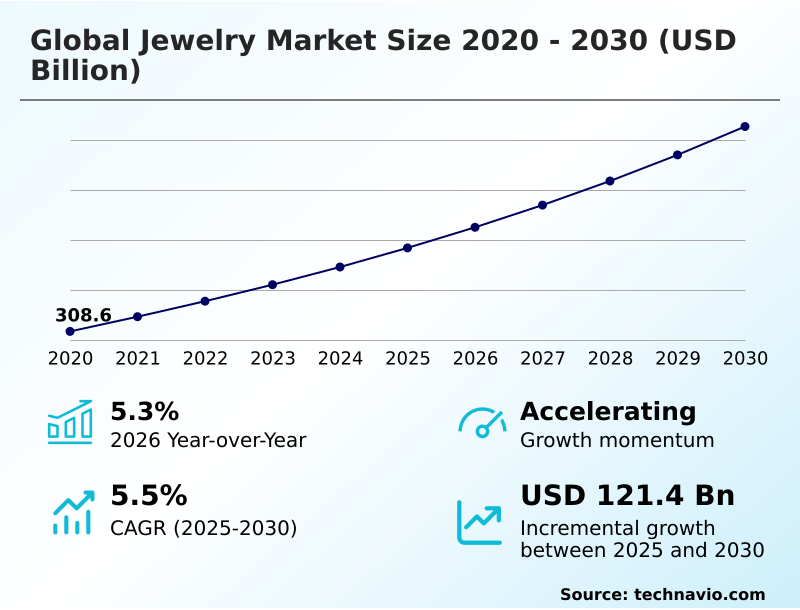
Jewelry Market Size 2026-2030
The jewelry market size is valued to increase by USD 121.4 billion, at a CAGR of 5.5% from 2025 to 2030. Increasing demand for jewelry as gifts will drive the jewelry market.
Major Market Trends & Insights
- APAC dominated the market and accounted for a 58.5% growth during the forecast period.
- By Distribution Channel - Specialist retailers segment was valued at USD 329 billion in 2024
- By Type - Gold segment accounted for the largest market revenue share in 2024
Market Size & Forecast
- Market Opportunities: USD 204.9 billion
- Market Future Opportunities: USD 121.4 billion
- CAGR from 2025 to 2030 : 5.5%
Market Summary
- The jewelry market is undergoing a significant transformation, evolving from its traditional role as a repository of wealth to a dynamic expression of personal style and ethical values. This shift is propelled by technological advancements in custom jewelry manufacturing, where computer-aided design (CAD) and 3D printing enable the creation of intricate, bespoke jewelry that caters to individual tastes.
- Concurrently, consumer consciousness is reshaping material sourcing, with a growing preference for recycled precious metals and laboratory-grown diamonds over conventionally mined stones, compelling brands to adopt stringent conflict-free sourcing protocols and transparent supply chain transparency.
- As a business scenario, a mid-sized brand might implement blockchain traceability to provide verifiable provenance tracking for its gemstones, thereby enhancing brand storytelling and building trust.
- This commitment to transparency and innovation, alongside adherence to hallmark certification and principles of a circular economy, is becoming crucial for competing in a market where demi-fine jewelry and sustainable luxury are gaining significant traction, particularly among younger, digitally-native consumers who prioritize authenticity and responsible consumption.
What will be the Size of the Jewelry Market during the forecast period?
Get Key Insights on Market Forecast (PDF) Get Free Sample
How is the Jewelry Market Segmented?
The jewelry industry research report provides comprehensive data (region-wise segment analysis), with forecasts and estimates in "USD billion" for the period 2026-2030, as well as historical data from 2020-2024 for the following segments.
- Distribution channel
- Specialist retailers
- Online
- Type
- Gold
- Diamond
- Others
- End-user
- Women
- Men
- Children
- Geography
- APAC
- China
- Japan
- India
- North America
- US
- Canada
- Mexico
- Europe
- Germany
- UK
- France
- Middle East and Africa
- Saudi Arabia
- UAE
- South Africa
- South America
- Brazil
- Argentina
- Rest of World (ROW)
- APAC
By Distribution Channel Insights
The specialist retailers segment is estimated to witness significant growth during the forecast period.
The specialist retailers segment functions as a critical channel, defined by its capacity to offer personalized service and tactile product evaluation. This channel's strength lies in delivering high-touch experiential retail environments where artisanal craftsmanship can be closely examined.
In-store consultants provide expert guidance on diamond grading and the specifics of unique pieces like tanzanite jewelry. These retailers are evolving into brand embassies that leverage brand storytelling and VIP clienteling to cultivate loyalty within the luxury retail sphere.
The focus on personalization services, including the creation of bespoke jewelry and custom gemstone setting, enhances customer engagement, with some retailers reporting a 15% increase in repeat business from clients who utilize these custom services.
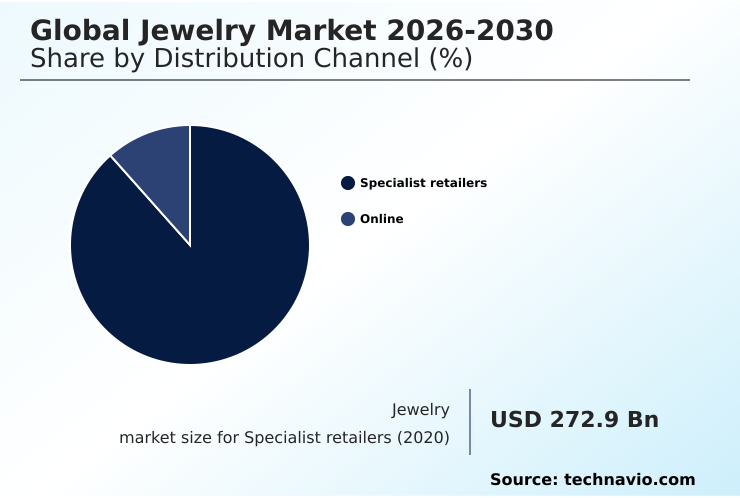
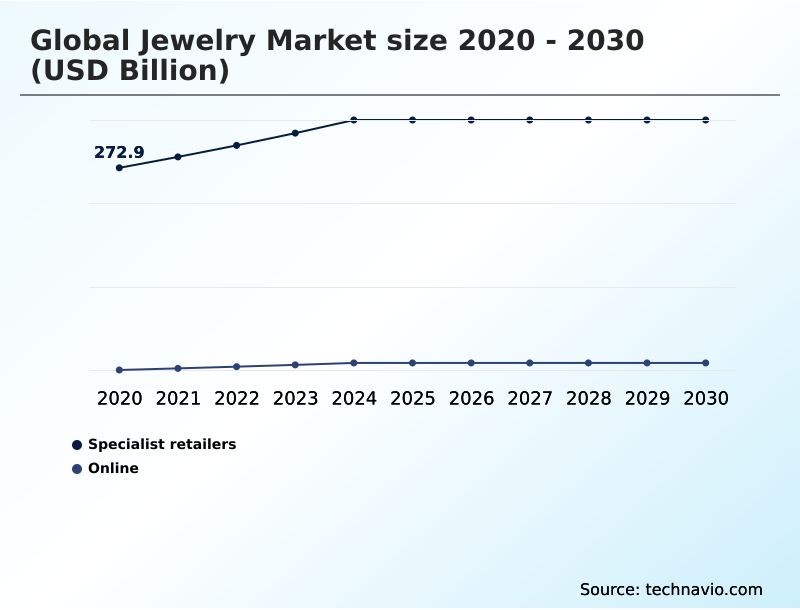
The Specialist retailers segment was valued at USD 329 billion in 2024 and showed a gradual increase during the forecast period.
Regional Analysis
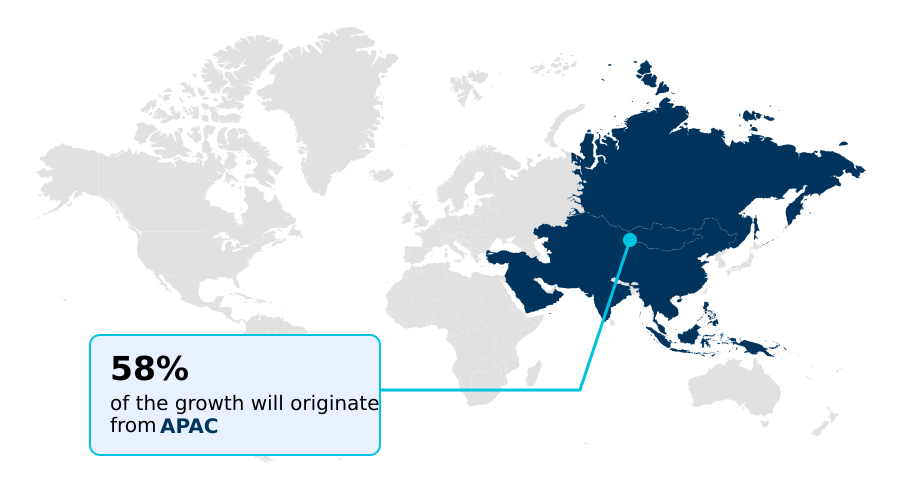
APAC is estimated to contribute 58.5% to the growth of the global market during the forecast period.Technavio’s analysts have elaborately explained the regional trends and drivers that shape the market during the forecast period.
See How Jewelry Market Demand is Rising in APAC Get Free Sample
The geographic landscape of the market is characterized by distinct regional dynamics.
APAC's growth, contributing to 58% of the market's incremental expansion, is driven by a deep-rooted goldsmithing tradition and a structural shift toward organized retail, underscored by the rising adoption of hallmark certification.
This region leverages social commerce and influencer marketing to promote heritage collections. In contrast, North America and Europe focus on design innovation and ethical standards.
South America showcases unique offerings like lapis lazuli and mapuche silverware, while Japan's market is refined by principles of sustainable aquaculture for pearls.
The integration of omnichannel retail and efficient e-commerce logistics is a unifying factor, enabling brands to cater to diverse global tastes.
Market Dynamics
Our researchers analyzed the data with 2025 as the base year, along with the key drivers, trends, and challenges. A holistic analysis of drivers will help companies refine their marketing strategies to gain a competitive advantage.
- The global jewelry market 2026-2030 is shaped by intersecting forces of innovation, consumer behavior, and ethical considerations. Key technology advancements in jewelry manufacturing are democratizing customization, where the role of CAD CAM in custom jewelry design allows for unprecedented precision and personalization. This directly fuels consumer demand for personalized name necklaces and other bespoke items.
- Simultaneously, there is a notable growth of demi fine jewelry for men, contributing to the overall men's urban jewelry market growth as the growing acceptance of jewelry among men becomes mainstream. Stylistically, trends in antique inspired jewelry designs coexist with modern aesthetics.
- However, the industry faces hurdles, including the persistent counterfeit jewelry impact on brand image and complex challenges in import export of jewelry. These issues, coupled with rising barriers to entry in jewelry market, create a competitive landscape where brand trust is paramount.
- The impact of lab grown diamonds on global jewelry market 2026-2030 continues to be a central theme, influencing marketing strategies for natural diamond jewelry. To succeed, companies are adopting sophisticated omnichannel strategies for luxury jewelry brands and ensuring robust ethical sourcing in high jewelry collections.
- Firms leveraging such omnichannel strategies report customer lifetime values nearly 30% higher than those relying on single-channel retail.
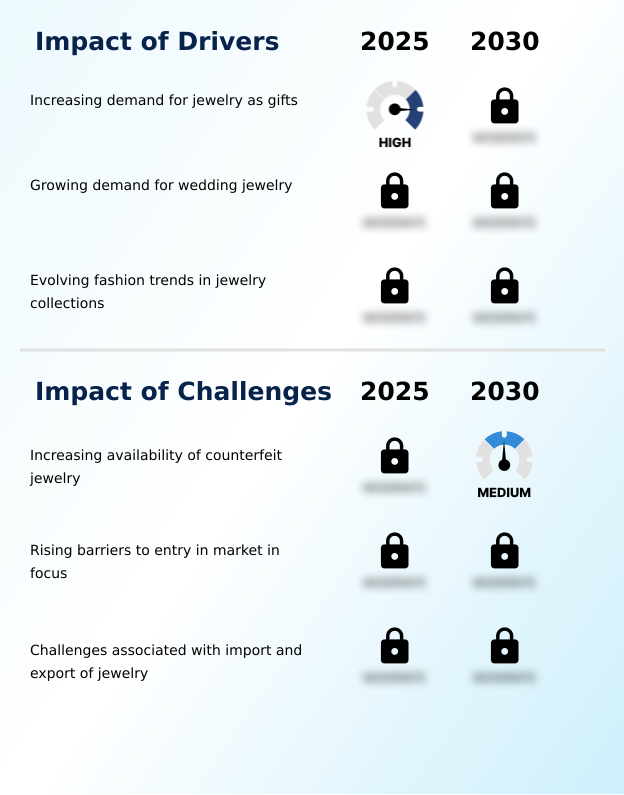
What are the key market drivers leading to the rise in the adoption of Jewelry Industry?
- The increasing demand for jewelry as a preferred choice for gifting across various cultural and personal milestones is a key driver propelling market growth.
- Key market drivers are centered on expanding consumer access and evolving cultural practices. The tradition of gifting jewelry, often defined by specific karat purity standards, is a consistent demand generator.
- The growth of digital gold investment platforms is also a significant factor, with studies indicating a conversion rate of nearly 20% from digital savers to physical jewelry buyers.
- Financial tools such as buy now pay later (BNPL) services are making higher-value items more attainable, boosting average order values by up to 25%.
- Modern manufacturing techniques, including computer-aided design (CAD) and lost wax casting of precious metal alloys, improve production efficiency.
- Meanwhile, livestreaming commerce and tax-free shopping opportunities in travel hubs further fuel sales, with some brands seeking halal certification to tap into new consumer segments.
What are the market trends shaping the Jewelry Industry?
- A significant trend shaping the market is the growing acceptance of jewelry among men, which moves beyond traditional accessories. This cultural shift expands the consumer base and drives demand for new product categories.
- Market trends are increasingly shaped by technological innovation and evolving consumer identities. The rise of gender-fluid fashion and the mini-me trend are expanding product categories beyond traditional demographics, creating new demand for versatile designs. Technologies such as 3D printing and laser engraving facilitate rapid prototyping and custom jewelry manufacturing at scale.
- Digital engagement is enhanced through augmented reality (AR) and virtual try-on (VTO) tools, which have been shown to increase user session times by over 40%. These trends support the growth of accessible categories like demi-fine jewelry and niche segments such as bio-jewelry, while the market for investment-grade watches continues to mature, showing a 10% faster resale velocity online.
What challenges does the Jewelry Industry face during its growth?
- The increasing availability of counterfeit products presents a significant challenge to the market, threatening brand integrity and consumer trust.
- The market confronts significant challenges related to material integrity and operational transparency. Ensuring conflict-free sourcing remains a primary concern, necessitating robust supply chain transparency and provenance tracking systems. The rise of laboratory-grown diamonds has introduced competitive pressure, compelling legacy brands to reinforce the value of natural stones.
- Consumers are demanding adherence to stringent ethical sourcing standards and the use of recycled precious metals as part of a broader shift toward a circular economy. Technologies like blockchain traceability are being deployed to validate claims, as over 60% of consumers report they would switch brands over authenticity concerns.
- Additionally, production complexities in techniques like intricate hand engraving and durable rhodium plating add to cost pressures.
Exclusive Technavio Analysis on Customer Landscape
The jewelry market forecasting report includes the adoption lifecycle of the market, covering from the innovator’s stage to the laggard’s stage. It focuses on adoption rates in different regions based on penetration. Furthermore, the jewelry market report also includes key purchase criteria and drivers of price sensitivity to help companies evaluate and develop their market growth analysis strategies.
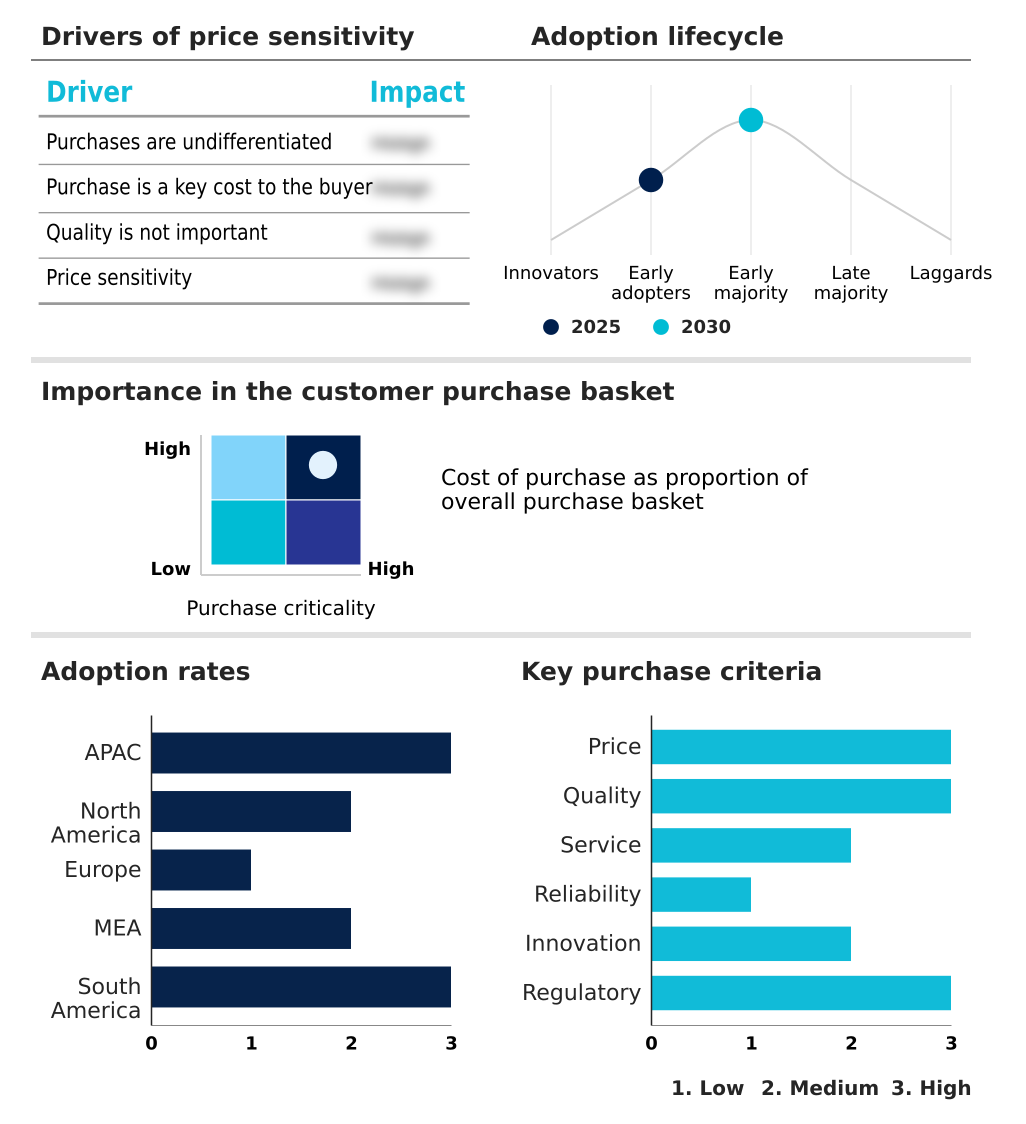
Customer Landscape of Jewelry Industry
Competitive Landscape
Companies are implementing various strategies, such as strategic alliances, jewelry market forecast, partnerships, mergers and acquisitions, geographical expansion, and product/service launches, to enhance their presence in the industry.
Asian Star Co. Ltd. - Portfolio spans fine jewelry, high-jewelry collections, and luxury timepieces, strategically targeting diverse consumer segments through multiple prestigious brands.
The industry research and growth report includes detailed analyses of the competitive landscape of the market and information about key companies, including:
- Asian Star Co. Ltd.
- AU Enterprises Inc.
- Boma Jewelry Inc.
- Cartier SA
- Casting House Inc.
- Chic Pistachio LLC
- DeBebians Inc.
- Gildform Inc.
- H. Stern Com. and Ind. SA
- Kapit Mas Pty Ltd.
- KGS Jewels Inc.
- LVMH Moet Hennessy
- Malabar Gold and Diamonds
- Mangla International
- MKM Jewelry Inc.
- Parad Jewelry LLC
- Rajesh Exports Ltd.
- Royi Sal Co. Ltd.
- Swarovski AG
- Wayfair Inc.
- Yiwu Nihao Jewelry Co. Ltd.
Qualitative and quantitative analysis of companies has been conducted to help clients understand the wider business environment as well as the strengths and weaknesses of key industry players. Data is qualitatively analyzed to categorize companies as pure play, category-focused, industry-focused, and diversified; it is quantitatively analyzed to categorize companies as dominant, leading, strong, tentative, and weak.
Recent Development and News in Jewelry market
- In May, 2025, Pandora A/S announced its entry into key Southeast Asian markets, launching its lab-grown diamond collections in Singapore and Malaysia to capture growing consumer demand for sustainable luxury.
- In March, 2025, Perfect Corp. unveiled an upgraded virtual try-on platform with hyper-realistic metal and gemstone rendering, which was immediately adopted by three major luxury brands to reduce online return rates.
- In December, 2024, Titan Company Ltd. acquired a significant minority stake in a US-based sustainable jewelry startup, marking its strategic entry into the North American demi-fine jewelry market.
- In September, 2024, De Beers Group announced a partnership with a leading technology firm to pilot a new blockchain-based traceability platform, providing consumers with verifiable, end-to-end provenance for its natural diamonds.
Dive into Technavio’s robust research methodology, blending expert interviews, extensive data synthesis, and validated models for unparalleled Jewelry Market insights. See full methodology.
| Market Scope | |
|---|---|
| Page number | 286 |
| Base year | 2025 |
| Historic period | 2020-2024 |
| Forecast period | 2026-2030 |
| Growth momentum & CAGR | Accelerate at a CAGR of 5.5% |
| Market growth 2026-2030 | USD 121.4 billion |
| Market structure | Fragmented |
| YoY growth 2025-2026(%) | 5.3% |
| Key countries | China, Japan, India, South Korea, Australia, Indonesia, US, Canada, Mexico, Germany, UK, France, Italy, Spain, The Netherlands, Saudi Arabia, UAE, South Africa, Israel, Turkey, Brazil, Argentina and Chile |
| Competitive landscape | Leading Companies, Market Positioning of Companies, Competitive Strategies, and Industry Risks |
Research Analyst Overview
- The jewelry market's operational landscape is increasingly sophisticated, built upon a foundation of advanced manufacturing and material science. Core production relies on techniques such as lost wax casting and computer-aided design (CAD), which allow for the precise fabrication of precious metal alloys with specific karat purity.
- Boardroom decisions now pivot on material strategy, weighing the market appeal of laboratory-grown diamonds against natural stones certified through conflict-free sourcing and rigorous diamond grading. The integration of recycled precious metals is no longer a niche consideration but a key differentiator, with companies adopting this practice reporting a 10% improvement in brand perception scores among key demographics.
- Final product value is enhanced through artisanal craftsmanship, including detailed hand engraving and finishing touches like rhodium plating. The demand for unique offerings, from tanzanite jewelry to bespoke jewelry, compels continuous innovation, while the market for investment-grade watches and the heritage of goldsmithing tradition provide stable, high-value segments.
What are the Key Data Covered in this Jewelry Market Research and Growth Report?
-
What is the expected growth of the Jewelry Market between 2026 and 2030?
-
USD 121.4 billion, at a CAGR of 5.5%
-
-
What segmentation does the market report cover?
-
The report is segmented by Distribution Channel (Specialist retailers, and Online), Type (Gold, Diamond, and Others), End-user (Women, Men, and Children) and Geography (APAC, North America, Europe, Middle East and Africa, South America)
-
-
Which regions are analyzed in the report?
-
APAC, North America, Europe, Middle East and Africa and South America
-
-
What are the key growth drivers and market challenges?
-
Increasing demand for jewelry as gifts, Increasing availability of counterfeit jewelry
-
-
Who are the major players in the Jewelry Market?
-
Asian Star Co. Ltd., AU Enterprises Inc., Boma Jewelry Inc., Cartier SA, Casting House Inc., Chic Pistachio LLC, DeBebians Inc., Gildform Inc., H. Stern Com. and Ind. SA, Kapit Mas Pty Ltd., KGS Jewels Inc., LVMH Moet Hennessy, Malabar Gold and Diamonds, Mangla International, MKM Jewelry Inc., Parad Jewelry LLC, Rajesh Exports Ltd., Royi Sal Co. Ltd., Swarovski AG, Wayfair Inc. and Yiwu Nihao Jewelry Co. Ltd.
-
Market Research Insights
- The market is defined by a dynamic interplay of digital innovation and evolving consumer expectations. The integration of omnichannel retail models has become standard, with brands leveraging social commerce and influencer marketing to drive engagement. Platforms adopting augmented reality (AR) and virtual try-on (VTO) features report up to a 40% increase in user session times compared to static image galleries.
- Furthermore, the strategic use of brand storytelling and VIP clienteling in luxury retail helps cultivate loyalty, with personalized outreach programs showing a 15% higher conversion rate than mass marketing campaigns. The logistical backbone of e-commerce logistics has also matured, supporting seamless global distribution for both established houses and direct-to-consumer startups specializing in custom jewelry manufacturing.
We can help! Our analysts can customize this jewelry market research report to meet your requirements.
 RIA -
RIA - 
