


Carbon Black In Lead-acid Battery Market Size 2026-2030
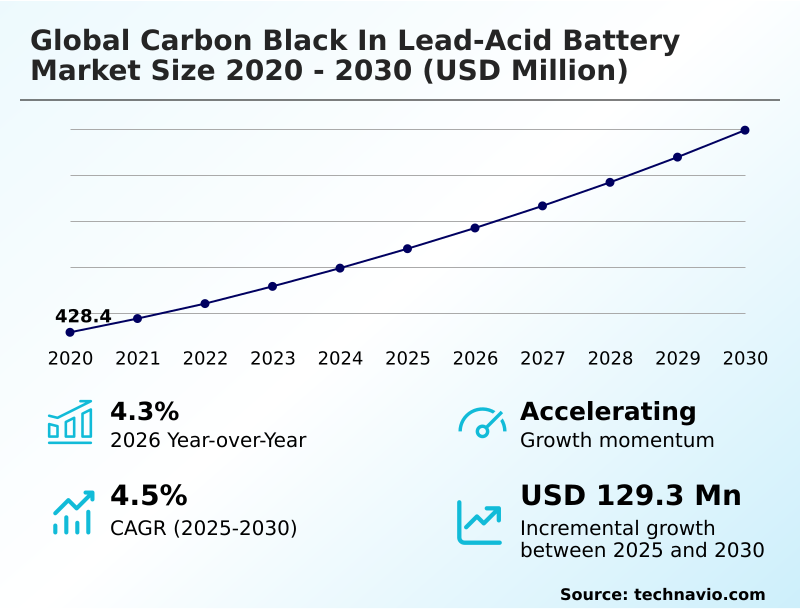
The carbon black in lead-acid battery market size is valued to increase by USD 129.3 million, at a CAGR of 4.5% from 2025 to 2030. Increasing demand from automotive industry will drive the carbon black in lead-acid battery market.
Major Market Trends & Insights
- APAC dominated the market and accounted for a 46.9% growth during the forecast period.
- By Battery Type - Flooded lead-acid battery segment was valued at USD 340 million in 2024
- By Application - Automotive batteries segment accounted for the largest market revenue share in 2024
Market Size & Forecast
- Market Opportunities: USD 220.5 million
- Market Future Opportunities: USD 129.3 million
- CAGR from 2025 to 2030 : 4.5%
Market Summary
- The carbon black in lead-acid battery market is defined by the material's critical role in enhancing battery performance and longevity. Carbon black additives are integral to the negative active mass, where they improve electrode paste conductivity and mitigate sulfation, a common failure mode.
- This is particularly vital for applications demanding high-rate partial-state-of-charge operation, such as automotive start-stop vehicle systems and industrial uninterruptible power supplies (UPS). For instance, an automotive OEM developing vehicles with regenerative braking requires batteries capable of rapid recharge pulse acceptance, a characteristic directly improved by specialty carbon blacks.
- The market is shaped by a continuous effort to balance cost with performance, as advanced lead-acid battery chemistry competes with emerging technologies. This involves optimizing carbon black dispersion in battery paste to create a stable conductive network, thereby extending battery cycle life and ensuring reliability.
- The development of next-generation lead-acid technology hinges on these material science advancements, making it a key focus for battery manufacturers aiming to meet evolving energy storage demands.
What will be the Size of the Carbon Black In Lead-acid Battery Market during the forecast period?
Get Key Insights on Market Forecast (PDF) Get Free Sample
How is the Carbon Black In Lead-acid Battery Market Segmented?
The carbon black in lead-acid battery industry research report provides comprehensive data (region-wise segment analysis), with forecasts and estimates in "USD million" for the period 2026-2030, as well as historical data from 2020-2024 for the following segments.
- Battery type
- Flooded lead-acid battery
- Valve regulated lead-acid battery
- Application
- Automotive batteries
- Industrial batteries
- Energy storage systems
- Grade type
- Standard grade
- High purity grade
- Customized grade
- Geography
- APAC
- China
- India
- Japan
- North America
- US
- Canada
- Mexico
- Europe
- Germany
- UK
- France
- South America
- Brazil
- Argentina
- Colombia
- Middle East and Africa
- South Africa
- Saudi Arabia
- Turkey
- Rest of World (ROW)
- APAC
By Battery Type Insights
The flooded lead-acid battery segment is estimated to witness significant growth during the forecast period.
The flooded lead-acid battery segment is foundational to the market, driven by its widespread use in automotive SLI batteries and industrial traction batteries.
Within this segment, the inclusion of specific carbon black additives in the negative active mass is a technical necessity for improving lead-acid battery performance and battery cycle life extension.
This conductive carbon material creates a conductive network in battery plates, enhancing electrode paste conductivity and mitigating the formation of lead sulfate crystals, a primary cause of lead-acid battery failure modes.
As manufacturers work on optimizing battery paste formulation to compete with alternative technologies, the use of these additives to improve dynamic charge acceptance by up to 15% has become standard, ensuring reliable operation in demanding applications and improving PSoC performance.
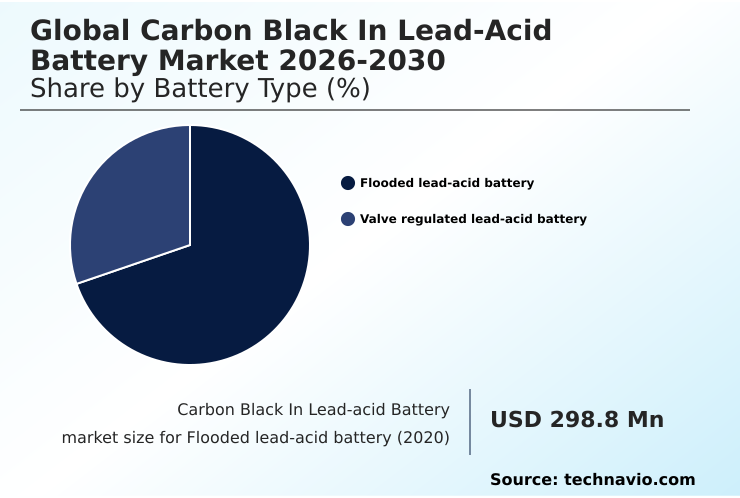
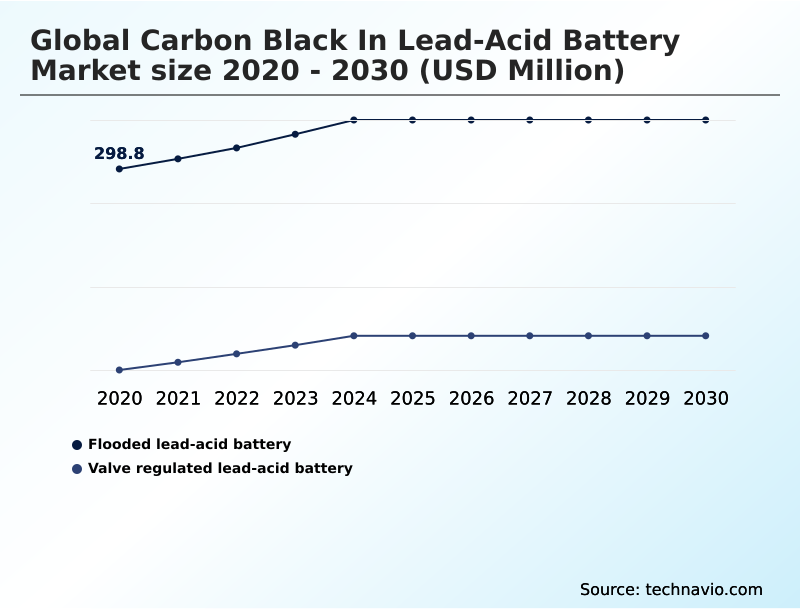
The Flooded lead-acid battery segment was valued at USD 340 million in 2024 and showed a gradual increase during the forecast period.
Regional Analysis
APAC is estimated to contribute 46.9% to the growth of the global market during the forecast period.Technavio’s analysts have elaborately explained the regional trends and drivers that shape the market during the forecast period.
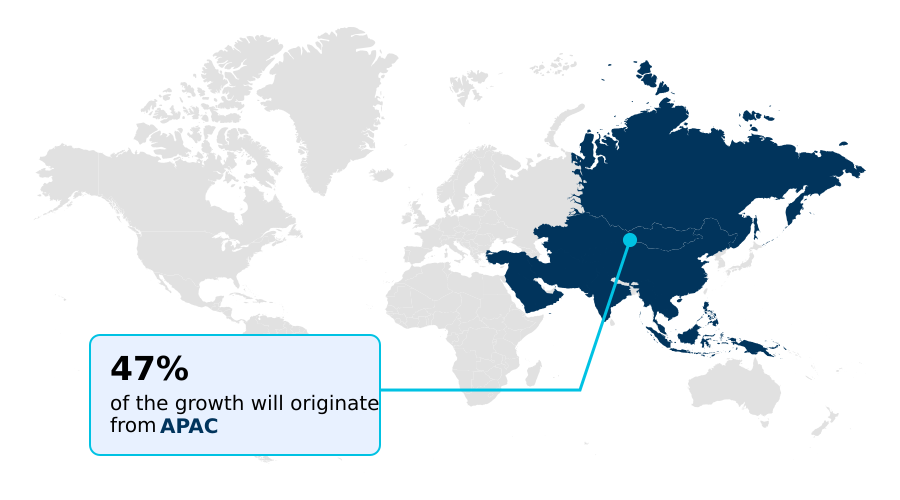
See How Carbon Black In Lead-acid Battery Market Demand is Rising in APAC Get Free Sample
Geographically, the market is dominated by the APAC region, which accounts for 46.87% of the global opportunity, significantly outpacing North America at 16.78%.
This leadership is driven by the vast automotive manufacturing sectors in China and India, where carbon black additives are essential for both conventional internal combustion engine vehicles and the 12-volt auxiliary batteries in electric vehicles.
In this region, porous structure enhancement is a key area of R&D. The rapid expansion of telecommunications infrastructure and data centers across APAC also fuels demand for reliable industrial batteries. Improving energy density with carbon is a crucial factor.
In North America and Europe, stringent emissions regulations drive the adoption of start-stop vehicle systems, necessitating batteries with high recharge pulse acceptance and robust battery performance optimization, thereby sustaining demand for high-performance carbon black for automotive batteries.
Market Dynamics
Our researchers analyzed the data with 2025 as the base year, along with the key drivers, trends, and challenges. A holistic analysis of drivers will help companies refine their marketing strategies to gain a competitive advantage.
- Understanding the global carbon black in lead-acid battery market requires an analysis of the specific benefits of using carbon black additives. A key technical advantage is the material's impact on mitigating irreversible sulfation, which addresses how carbon black impact on battery cycle life. This is particularly relevant when using carbon black in deep-cycle batteries for stationary storage applications.
- For automotive battery technology material advancements, the focus is on how to enhance charge acceptance in batteries to support start-stop systems. This involves using conductive additives for SLI batteries that reduce internal resistance, with some advanced materials demonstrating a two-fold improvement over standard grades, a crucial factor in automotive supply chain planning.
- While carbon nanotubes vs carbon black performance is a topic of research, carbon black remains the cost-effective choice. Similarly, while graphene additives in lead-acid battery plates show promise, their commercial-scale use is limited. Therefore, current R&D focuses on specific formulations for lead-carbon batteries and analyzing the cost of carbon black additives to deliver ways to optimize lead-acid battery efficiency.
- This extends to industrial battery performance material enhancement, where improving PSoC performance in industrial batteries and understanding the environmental impact of lead battery additives are key considerations for manufacturers.
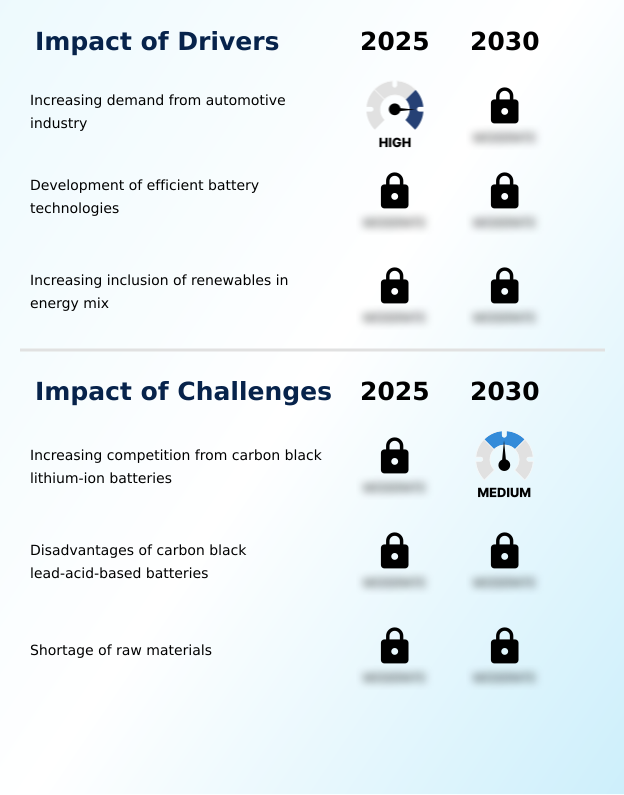
What are the key market drivers leading to the rise in the adoption of Carbon Black In Lead-acid Battery Industry?
- Increasing demand from the automotive industry, particularly for vehicles with advanced start-stop systems that require enhanced battery performance, serves as a key driver for the market.
- The primary driver for the market is the escalating demand from the automotive industry, where carbon black's role in PSoC performance is crucial.
- Modern vehicles equipped with start-stop systems, now present in over 60% of new vehicles in regions like Europe, require batteries capable of high dynamic charge acceptance.
- The addition of high surface area carbon improves battery performance under these conditions by more than 20%. This has reinvigorated the utility of flooded lead-acid battery technology, enabling it to meet stringent OEM requirements.
- Battery additive manufacturing techniques allow for the precise integration of negative plate expanders, ensuring consistent quality and performance.
- This focus on improving charge acceptance in SLI batteries has solidified the role of carbon additives as indispensable components in advanced lead-acid battery chemistry for automotive applications.
What are the market trends shaping the Carbon Black In Lead-acid Battery Industry?
- The increasing adoption of hybrid power systems in telecom towers represents a significant market trend, driven by the need for reliable and cost-effective energy in remote locations with poor grid connectivity.
- A key trend shaping the market is the rising adoption of hybrid power systems, particularly for telecom towers and industrial UPS applications, where cost-effective battery enhancers are critical. This shift is driven by the need for reliable, off-grid power solutions and the lower environmental impact of next-generation lead-acid technology.
- Hybrid systems incorporating advanced lead-acid batteries can reduce carbon emissions by up to 40% compared to traditional diesel generators. Furthermore, lead-acid batteries utilizing VRLA battery technology and enhanced flooded battery additives offer a 25% lower cost per kilowatt-hour cycle than some alternatives, making them a financially viable option for large-scale energy storage.
- The role of carbon in battery electrodes is pivotal in achieving the extended cycle life required for such applications, promoting their use in carbon black for energy storage.
What challenges does the Carbon Black In Lead-acid Battery Industry face during its growth?
- Intensifying competition from alternative energy storage solutions, notably lithium-ion batteries that are experiencing rapid cost reduction and technological advancement, presents a significant challenge to market growth.
- A significant challenge confronting the market is the intensifying competition from lithium-ion batteries, which are increasingly seen as a direct substitute. Technological advancements are driving lithium-ion battery pack costs toward the sub-$100 per kWh threshold, a stark contrast to lead-acid technologies that typically range from $180-220 per kWh. This price differential creates a formidable performance-to-cost challenge.
- The market for lead-acid vs lithium-ion additives is thus under pressure, as the rapid decline in lithium-ion prices—over 85% in the last decade—fuels their adoption in data centers and electric vehicles.
- Consequently, manufacturers of carbon black for traction batteries face the need for continuous innovation in areas like porous structure enhancement to maintain the relevance and cost-effectiveness of lead-carbon batteries in an increasingly competitive landscape.
Exclusive Technavio Analysis on Customer Landscape
The carbon black in lead-acid battery market forecasting report includes the adoption lifecycle of the market, covering from the innovator’s stage to the laggard’s stage. It focuses on adoption rates in different regions based on penetration. Furthermore, the carbon black in lead-acid battery market report also includes key purchase criteria and drivers of price sensitivity to help companies evaluate and develop their market growth analysis strategies.
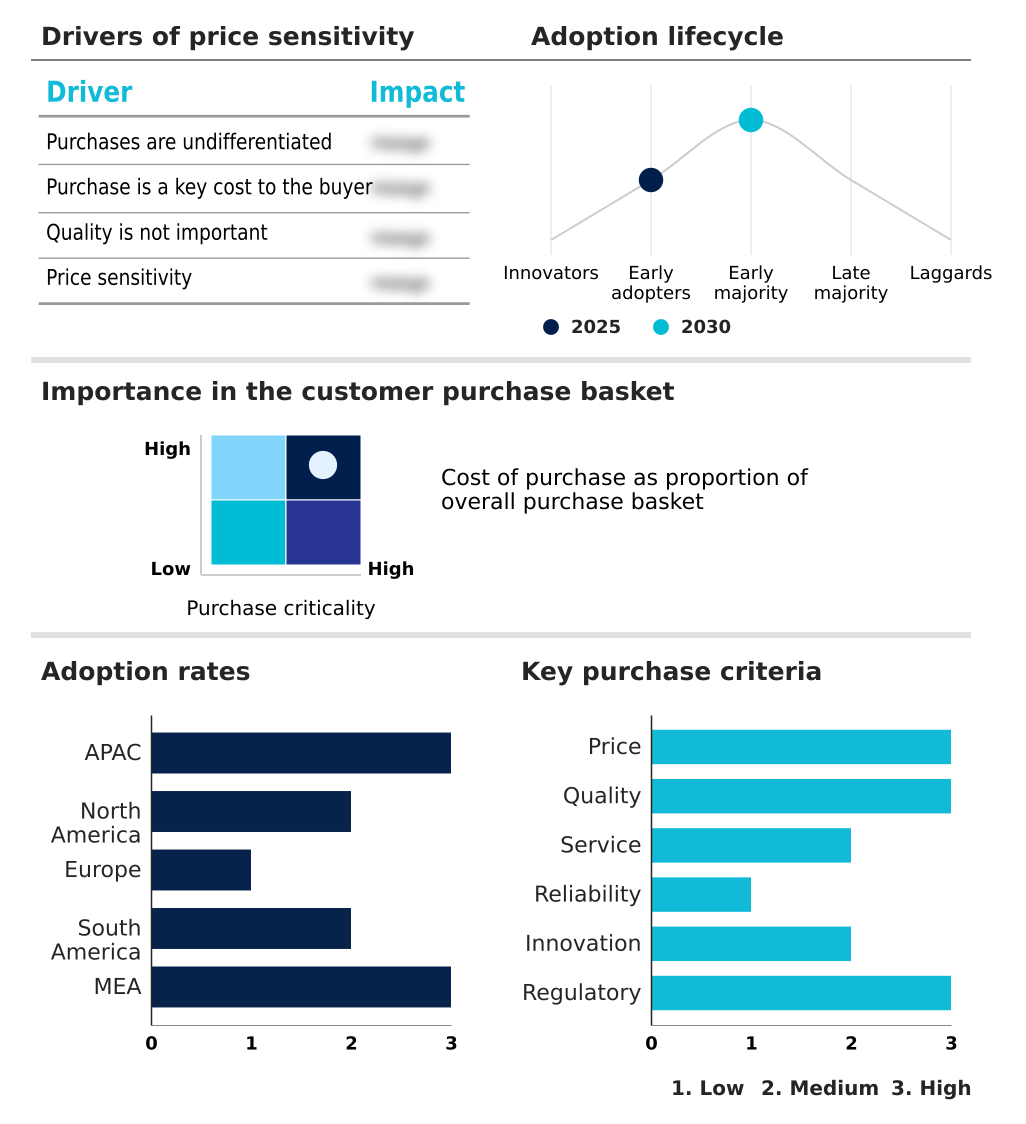
Customer Landscape of Carbon Black In Lead-acid Battery Industry
Competitive Landscape
Companies are implementing various strategies, such as strategic alliances, carbon black in lead-acid battery market forecast, partnerships, mergers and acquisitions, geographical expansion, and product/service launches, to enhance their presence in the industry.
Birla Carbon USA Inc - Specialized conductive carbon materials are engineered to enhance lead-acid battery performance, focusing on improved conductivity and charge acceptance for modern applications.
The industry research and growth report includes detailed analyses of the competitive landscape of the market and information about key companies, including:
- Birla Carbon USA Inc
- Cabot Corp.
- Denka Co. Ltd.
- Imerys S.A.
- Orion Engineered Carbons SA
- SGL Carbon SE
- Shandong Jinkeli Power Ltd.
- Superior graphite co
Qualitative and quantitative analysis of companies has been conducted to help clients understand the wider business environment as well as the strengths and weaknesses of key industry players. Data is qualitatively analyzed to categorize companies as pure play, category-focused, industry-focused, and diversified; it is quantitatively analyzed to categorize companies as dominant, leading, strong, tentative, and weak.
Recent Development and News in Carbon black in lead-acid battery market
- In May 2025, Cabot Corp. launched a new line of specialty carbon blacks engineered to improve the dynamic charge acceptance and cycle life of valve-regulated lead-acid batteries used in energy storage systems.
- In April 2025, Amara Raja Energy and Mobility commissioned a new manufacturing plant in Telangana, India, dedicated to producing advanced lead-carbon batteries that integrate specialized carbon black formulations for industrial and telecom applications.
- In January 2025, Orion Engineered Carbons SA announced a strategic partnership with a major European automotive manufacturer to co-develop next-generation conductive additives for 12-volt auxiliary batteries in electric vehicles, aiming to enhance reliability and performance.
- In October 2024, Birla Carbon completed a capacity expansion at its facility in North America to meet the growing demand for high-purity conductive carbon additives used in automotive start-stop vehicle systems.
Dive into Technavio’s robust research methodology, blending expert interviews, extensive data synthesis, and validated models for unparalleled Carbon Black In Lead-acid Battery Market insights. See full methodology.
| Market Scope | |
|---|---|
| Page number | 265 |
| Base year | 2025 |
| Historic period | 2020-2024 |
| Forecast period | 2026-2030 |
| Growth momentum & CAGR | Accelerate at a CAGR of 4.5% |
| Market growth 2026-2030 | USD 129.3 million |
| Market structure | Concentrated |
| YoY growth 2025-2026(%) | 4.3% |
| Key countries | China, India, Japan, South Korea, Australia, Indonesia, US, Canada, Mexico, Germany, UK, France, Italy, Spain, The Netherlands, Brazil, Argentina, Colombia, South Africa, Nigeria, Saudi Arabia, Egypt and Turkey |
| Competitive landscape | Leading Companies, Market Positioning of Companies, Competitive Strategies, and Industry Risks |
Research Analyst Overview
- The carbon black in lead-acid battery market is evolving beyond a commodity-driven space into one defined by material science and application-specific engineering. The integration of specialty carbon blacks into the negative active mass is now a standard practice to achieve significant battery performance optimization.
- These conductive additives are critical for creating a stable conductive network within the electrode paste, which is essential for sulfation mitigation and achieving superior battery cycle life extension in demanding high-rate partial-state-of-charge conditions.
- In the automotive sector, the proliferation of start-stop vehicle systems has made dynamic charge acceptance a primary metric, with advanced conductive carbon material enabling improvements of over 30% in recharge pulse acceptance. This trend has elevated the conversation in boardrooms, compelling battery manufacturers to shift product strategy toward high-performance lead-carbon batteries to remain competitive.
- This focus on porous structure enhancement is vital for both automotive SLI batteries and large-scale energy storage systems, where reliability and efficiency are paramount.
What are the Key Data Covered in this Carbon Black In Lead-acid Battery Market Research and Growth Report?
-
What is the expected growth of the Carbon Black In Lead-acid Battery Market between 2026 and 2030?
-
USD 129.3 million, at a CAGR of 4.5%
-
-
What segmentation does the market report cover?
-
The report is segmented by Battery Type (Flooded lead-acid battery, and Valve regulated lead-acid battery), Application (Automotive batteries, Industrial batteries, and Energy storage systems), Grade Type (Standard grade, High purity grade, and Customized grade) and Geography (APAC, North America, Europe, South America, Middle East and Africa)
-
-
Which regions are analyzed in the report?
-
APAC, North America, Europe, South America and Middle East and Africa
-
-
What are the key growth drivers and market challenges?
-
Increasing demand from automotive industry, Increasing competition from carbon black lithium-ion batteries
-
-
Who are the major players in the Carbon Black In Lead-acid Battery Market?
-
Birla Carbon USA Inc, Cabot Corp., Denka Co. Ltd., Imerys S.A., Orion Engineered Carbons SA, SGL Carbon SE, Shandong Jinkeli Power Ltd. and Superior graphite co
-
Market Research Insights
- The market's trajectory is influenced by the persistent need for improving lead-acid battery performance through advanced material science. The integration of high-conductivity carbon black grades enhances dynamic charge acceptance in automotive SLI batteries by over 20%, a critical metric for OEM partners.
- Furthermore, optimizing battery paste formulation with specific conductive additives can reduce early failure modes by 15%, significantly lowering warranty-related costs for manufacturers. This focus on advanced lead-acid battery chemistry is essential for applications ranging from industrial UPS systems to the auxiliary power units in electric vehicles.
- The role of carbon in battery electrodes is central to these improvements, defining the competitive positioning of lead-acid technology against alternatives. The market is expanding as cost-effective battery enhancers enable broader deployment in energy storage systems, especially in regions prioritizing grid stability and renewable energy integration.
We can help! Our analysts can customize this carbon black in lead-acid battery market research report to meet your requirements.
 RIA -
RIA - 
