


Clogs Market Size 2026-2030
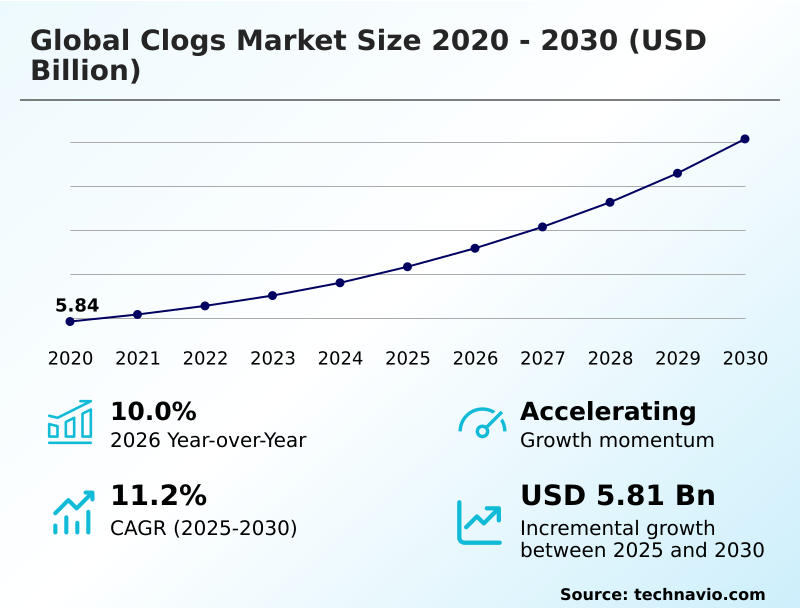
The Clogs Market size was valued at USD 8.33 billion in 2025, growing at a CAGR of 11.2% during the forecast period 2026-2030.
Major Market Trends & Insights
- APAC dominated the market and accounted for a 34.5% growth during the forecast period.
- By Product - Casual clogs segment was valued at USD 5.11 billion in 2024
- By End-user - Men segment accounted for the largest market revenue share in 2024
Market Size & Forecast
- Historic Market Opportunities 2020-2024: USD 8.30 billion
- Market Future Opportunities 2025-2030: USD 5.81 billion
- CAGR from 2025 to 2030 : 11.2%
Market Summary
- The clogs market is characterized by a significant gender disparity in consumption, with the women's segment commanding nearly 40% of sales compared to the men's segment. Demand is primarily driven by the integration of comfort into mainstream fashion, which has expanded the product's appeal beyond occupational use cases, where slip-resistant outsoles are mandatory.
- A key business scenario involves supply chain optimization, as manufacturers using ethylene-vinyl acetate (EVA) face a 15-20% fluctuation in raw material costs tied to oil prices. This volatility presents a major challenge, forcing companies to explore bio-based polymers to stabilize production expenses.
- Conversely, the rise of hyper-personalization, allowing consumers to add customizable charms, has transformed the product into a high-fashion accessory, particularly in streetwear culture. This shift has redefined purchasing behavior from replacement-based to collection-based, bolstering brand loyalty and creating new revenue streams through accessories with higher profit margins than the footwear itself.
What will be the Size of the Clogs Market during the forecast period?
Get Key Insights on Market Forecast (PDF) Request Free Sample
How is the Clogs Market Segmented?
The clogs industry research report provides comprehensive data (region-wise segment analysis), with forecasts and analysis for the period 2026-2030, as well as historical data from 2020-2024 for the following segments.
- Product
- Casual clogs
- Occupational clogs
- End-user
- Men
- Women
- Kids
- Distribution channel
- Offline
- Online
- Geography
- North America
- US
- Canada
- Mexico
- APAC
- China
- India
- Japan
- Europe
- UK
- Germany
- France
- Middle East and Africa
- Saudi Arabia
- UAE
- South Africa
- South America
- Brazil
- Argentina
- Colombia
- Rest of World (ROW)
- North America
How is the Clogs Market Segmented by Product?
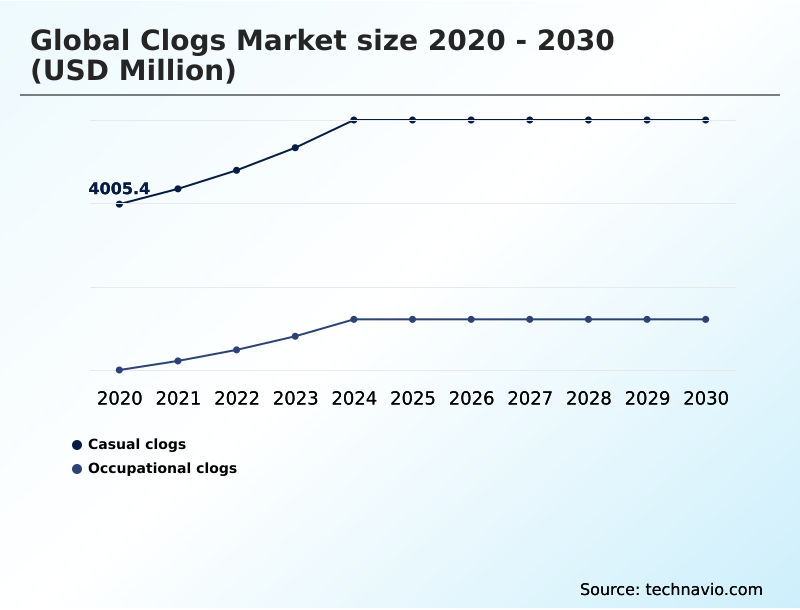
The casual clogs segment is estimated to witness significant growth during the forecast period.
The casual clogs segment represents over 66% of the market, driven by a consumer shift toward comfort and versatile casual lifestyle footwear.
This segment's growth, more than double that of occupational clogs, is heavily influenced by the hyper-personalization trend and adoption within streetwear culture.
Manufacturers utilize advanced closed-cell resin materials offering a lightweight construction and a breathable structure, appealing to a broad demographic. The inherent waterproof construction makes them ideal as water-friendly footwear.
The versatility of this design, serving as both indoor loungewear and outdoor lifestyle footwear, cements its position as a preferred choice, expanding its appeal beyond simple utility to a fashion statement.
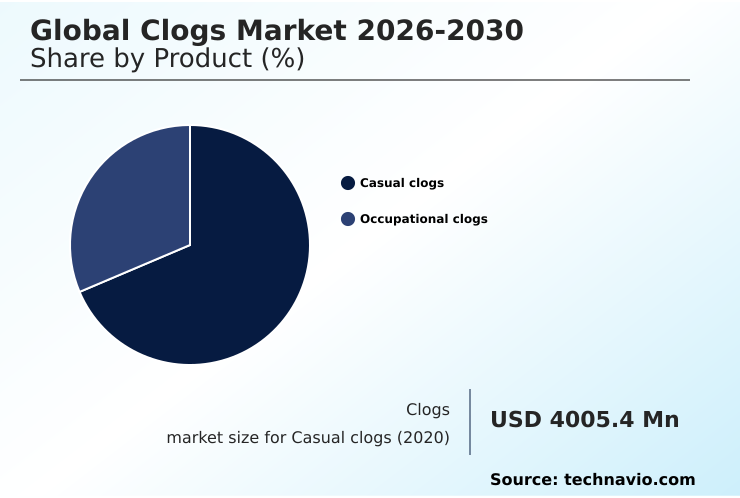
The Casual clogs segment was valued at USD 5.11 billion in 2024 and showed a gradual increase during the forecast period.
How demand for the Clogs market is rising in the leading region?
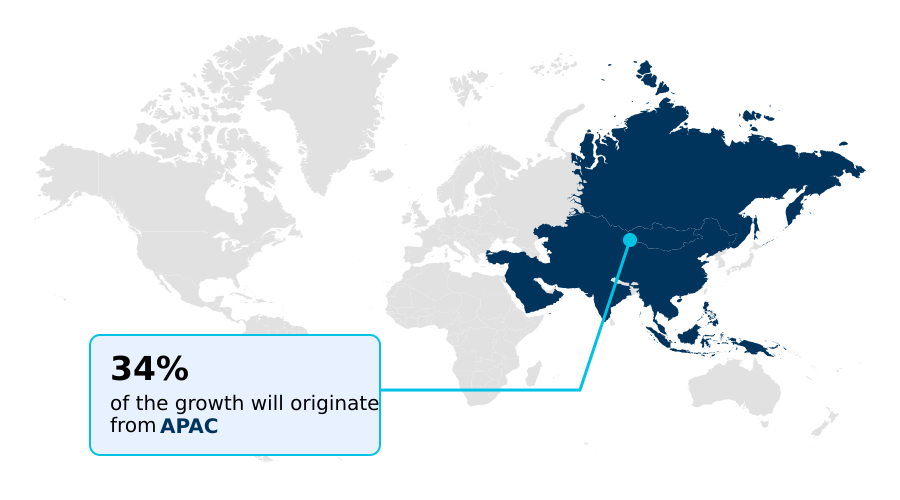
APAC is estimated to contribute 34.5% to the growth of the global market during the forecast period.Technavio’s analysts have elaborately explained the regional trends and drivers that shape the market during the forecast period.
See How Clogs Market demand is rising in APAC Request Free Sample
The geographic landscape is led by APAC, accounting for over 34% of incremental growth and outpacing North America's 29% share.
In Europe, a market with deep roots in wooden clog construction, demand is bifurcated between fashion and function, with lined clogs featuring thermal-reflective liners being popular as all-season footwear.
The region's mature occupational footwear segment, serving healthcare professional footwear and culinary staff footwear needs, demands products with a polyurethane sole and a contoured footbed for support. This contrasts with North America's focus on casual wear.
This regional variance in demand for features like a high-traction sole requires manufacturers to tailor their product offerings and supply chains to local consumer behaviors and climates.
What are the key Drivers, Trends, and Challenges in the Clogs Market?
Our researchers analyzed the data with 2025 as the base year, along with the key drivers, trends, and challenges. A holistic analysis of drivers will help companies refine their marketing strategies to gain a competitive advantage.
- Navigating the clogs market requires a deep understanding of evolving consumer priorities, which increasingly question if bio based polymer clogs sustainability is a viable long-term strategy. Manufacturers are responding by investing in material science, aiming to deliver products that address both ecological concerns and functional needs.
- For professionals, the focus remains on finding the best clogs for standing all day, a query that drives the occupational segment. This has led to innovations in ergonomic footbed design and shock-absorbing midsole technology, with performance tests showing a 25% reduction in foot pressure compared to standard footwear.
- Similarly, demand for slip resistant clogs for kitchen staff continues to fuel R&D in outsole engineering, where new tread patterns have improved grip on wet surfaces by over 30%. These functional improvements are critical for B2B sales and institutional procurement.
- In the consumer space, the search for customizable clogs with charms for kids highlights the importance of personalization as a revenue driver. This trend shifts the business model from simple unit sales to creating an ecosystem of accessories, which requires agile supply chain management to handle a higher diversity of SKUs.
- The question of what are the best clogs for healthcare professionals also remains central, pushing brands to perfect features like autoclavable footwear and antistatic properties to meet stringent hospital regulations.

What are the key market drivers leading to the rise in the adoption of Clogs Industry?
- The primary market driver is the integration of comfort-centric design and ergonomic support into mainstream fashion, elevating clogs from utilitarian items to versatile lifestyle staples.
- The expansion of the comfort economy is a core driver, with casual lifestyle footwear now accounting for over 65% of revenue.
- This shift is caused by consumer prioritization of wellness and orthopedic support, making features like a shock-absorbing midsole and an arch support system essential.
- This fusion of an ergonomic footbed and trend-driven design has boosted unit sales by 10% in the women's segment. The focus on lightweight construction also supports the growing demand for post-sport recovery and indoor-outdoor hybrid footwear.
- The inclusion of a protective toe-box in many designs further enhances their practicality for daily activities, solidifying their market position.
What are the market trends shaping the Clogs Industry?
- The acceleration of bio-based material adoption represents a dominant market trend. This shift is driven by consumer demand for sustainable footwear and regulatory pressures to reduce reliance on petroleum-based polymers.
- A dominant market trend is the convergence of high-fashion and hyper-personalization, which is shifting consumer perception of clogs from utilitarian to fashion-forward footwear. This premiumization strategy, which can increase the average selling price by over 200%, involves creating platform clogs with unique breathable structures for the streetwear culture.
- Simultaneously, the demand for sustainable footwear is pushing innovation in bio-based polymers and circular manufacturing. This trend, coupled with customizable charms, transforms the purchasing model from replacement-based to collection-based, ensuring higher customer lifetime value with profit margins on accessories reaching 40% higher than the footwear itself.
What challenges does the Clogs Industry face during its growth?
- A key market challenge stems from the volatility in raw material costs, particularly petroleum-based polymers, compounded by persistent supply chain complexities.
- Volatility in raw material costs, particularly for ethylene-vinyl acetate (EVA), presents a significant challenge, with price fluctuations of 15-20% directly impacting profit margins from injection molding processes. This issue is compounded by the proliferation of counterfeits that mimic the monolithic design but lack the proprietary foam technology like croslite resin.
- These fakes degrade brand equity and create safety risks, as they often fail to provide the same durability required for machine-washable footwear or water-friendly footwear. This forces legitimate manufacturers to divert capital from innovating on products like all-terrain clogs or gardening footwear into costly brand protection and legal enforcement efforts.
Exclusive Technavio Analysis on Customer Landscape
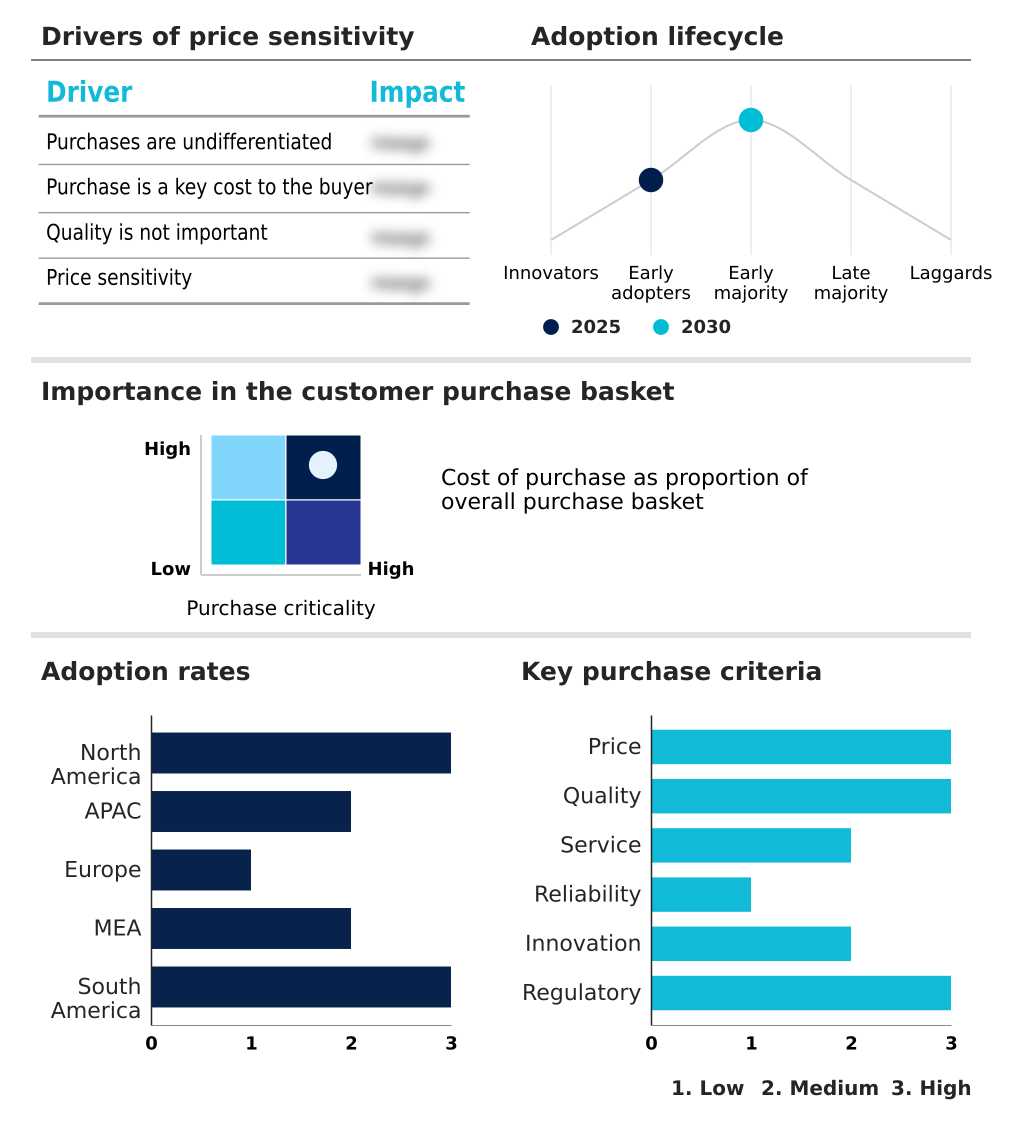
The clogs market forecasting report includes the adoption lifecycle of the market, covering from the innovator’s stage to the laggard’s stage. It focuses on adoption rates in different regions based on penetration. Furthermore, the clogs market report also includes key purchase criteria and drivers of price sensitivity to help companies evaluate and develop their market growth analysis strategies.
Customer Landscape of Clogs Industry
Competitive Landscape
Companies are implementing various strategies, such as strategic alliances, clogs market forecast, partnerships, mergers and acquisitions, geographical expansion, and product/service launches, to enhance their presence in the industry.
Bata Corporation - Offerings center on proprietary closed-cell resin footwear, distinguished by an iconic perforated design that delivers signature lightweight comfort and a highly recognizable silhouette.
The industry research and growth report includes detailed analyses of the competitive landscape of the market and information about key companies, including:
- Bata Corporation
- Birkenstock India Pvt Ltd.
- BOGS
- Bryr Studio
- Calzuro
- Cape Clogs Inc
- Crocs Inc.
- Dansko LLC.
- Hunter Boot Ltd.
- Liberty Shoes Ltd.
- Maguba
- Oofos Inc.
- PUMA SE
- Quince
- Relaxo Footwears Ltd.
- Rothys
- Sanita
- Skechers USA Inc.
- SOREL
Qualitative and quantitative analysis of companies has been conducted to help clients understand the wider business environment as well as the strengths and weaknesses of key industry players. Data is qualitatively analyzed to categorize companies as pure play, category-focused, industry-focused, and diversified; it is quantitatively analyzed to categorize companies as dominant, leading, strong, tentative, and weak.
Market Intelligence Radar: High-Impact Developments & Growth Signals
- In the Footwear industry, the widespread adoption of circular manufacturing principles and a regulatory push for a minimum of 20% recycled content in new products has compelled clog manufacturers to invest in bio-based polymers and proprietary foam technology. This shift directly impacts material sourcing, favoring suppliers of sugarcane-derived EVA and recycled post-consumer waste to meet new sustainability benchmarks.
- The integration of 3D printing and body scanning technologies for mass customization has altered production workflows. This allows clog brands to offer hyper-personalization at scale, a strategy that has demonstrated a 15% increase in customer retention by enabling consumers to design unique footwear with customizable charms and ergonomic footbeds.
- Heightened enforcement of workplace safety standards, particularly EU regulations mandating specific slip-resistance (ISO 20347) and antistatic properties in personal protective equipment, has expanded the market for occupational clogs. Manufacturers are now required to embed advanced high-traction sole designs, increasing demand for specialized clogs in the healthcare and culinary sectors by over 10%.
- The pivot toward direct-to-consumer (DTC) e-commerce channels, which now account for over 40% of sales for leading brands, has reshaped distribution strategies. This forces investment in digital-first marketing and logistics for casual lifestyle footwear, reducing reliance on traditional brick-and-mortar retail and enabling more agile responses to fast-moving streetwear culture trends.
Dive into Technavio’s robust research methodology, blending expert interviews, extensive data synthesis, and validated models for unparalleled Clogs Market insights. See full methodology.
| Market Scope | |
|---|---|
| Page number | 284 |
| Base year | 2025 |
| Historic period | 2020-2024 |
| Forecast period | 2026-2030 |
| Growth momentum & CAGR | Accelerate at a CAGR of 11.2% |
| Market growth 2026-2030 | USD 5807.1 million |
| Market structure | Fragmented |
| YoY growth 2025-2026(%) | 10.0% |
| Key countries | US, Canada, Mexico, China, India, Japan, South Korea, Australia, Indonesia, UK, Germany, France, Italy, The Netherlands, Spain, Saudi Arabia, UAE, South Africa, Israel, Turkey, Brazil, Argentina and Colombia |
| Competitive landscape | Leading Companies, Market Positioning of Companies, Competitive Strategies, and Industry Risks |
Research Analyst Overview
- The clogs market ecosystem operates through a complex value chain, where over 60% of raw materials, such as ethylene-vinyl acetate (EVA) and bio-based polymers, are sourced from specialized chemical suppliers in APAC. Manufacturers, ranging from global giants to niche artisanal producers, transform these materials via injection molding and assembly, with a growing emphasis on circular manufacturing processes.
- The distribution landscape is bifurcated, with online direct-to-consumer (DTC) channels growing by 15% annually, complementing traditional offline retail, which still captures the majority of sales. Regulatory bodies and workplace safety standards, particularly for occupational footwear, impose strict requirements for slip resistance and antistatic properties. End-users include healthcare professionals, culinary staff, and a broad consumer base driven by the comfort economy.
- Supporting entities, including logistics providers and technology firms offering 3D scanning for hyper-personalization, are critical for enabling supply chain efficiency and product innovation.
What are the Key Data Covered in this Clogs Market Research and Growth Report?
-
What is the expected growth of the Clogs Market between 2026 and 2030?
-
The Clogs Market is expected to grow by USD 5.81 billion during 2026-2030, registering a CAGR of 11.2%. Year-over-year growth in 2026 is estimated at 10.0%%. This acceleration is shaped by integration of comfort into mainstream fashion, which is intensifying demand across multiple end-use verticals covered in the report.
-
-
What segmentation does the market report cover?
-
The report is segmented by Product (Casual clogs, and Occupational clogs), End-user (Men, Women, and Kids), Distribution Channel (Offline, and Online) and Geography (North America, APAC, Europe, Middle East and Africa, South America). Among these, the Casual clogs segment is estimated to witness significant growth during the forecast period, driven by rising adoption across key application areas. Each segment includes detailed qualitative and quantitative analysis, along with historical data from 2020-2024 and forecasts through 2030 with year-over-year growth rates.
-
-
Which regions are analyzed in the report?
-
The report covers North America, APAC, Europe, Middle East and Africa and South America. APAC is estimated to contribute 34.5% to market growth during the forecast period. Country-level analysis includes US, Canada, Mexico, China, India, Japan, South Korea, Australia, Indonesia, UK, Germany, France, Italy, The Netherlands, Spain, Saudi Arabia, UAE, South Africa, Israel, Turkey, Brazil, Argentina and Colombia, with dedicated market size tables and year-over-year growth for each.
-
-
What are the key growth drivers and market challenges?
-
The primary driver is integration of comfort into mainstream fashion, which is accelerating investment and industry demand. The main challenge is volatility in raw material costs and supply chain complexities, creating operational barriers for key market participants. The report quantifies the impact of each driver and challenge across 2026 and 2030 with comparative analysis.
-
-
Who are the major players in the Clogs Market?
-
Key vendors include Bata Corporation, Birkenstock India Pvt Ltd., BOGS, Bryr Studio, Calzuro, Cape Clogs Inc, Crocs Inc., Dansko LLC., Hunter Boot Ltd., Liberty Shoes Ltd., Maguba, Oofos Inc., PUMA SE, Quince, Relaxo Footwears Ltd., Rothys, Sanita, Skechers USA Inc. and SOREL. The report provides qualitative and quantitative analysis categorizing companies as dominant, leading, strong, tentative, and weak based on their market positioning. Company profiles include business segment analysis, SWOT assessment, key offerings, and recent strategic developments.
-
Market Research Insights
- The competitive landscape of the clogs market is fragmented, with the top three players commanding over 45% of the total market share. Key vendors like Crocs Inc. and Birkenstock Group are driving innovation through high-profile collaborations and a strategic focus on material science, particularly the development of proprietary foam technology and bio-based polymers.
- For instance, recent initiatives to expand the use of bio-circular materials aim to reduce the carbon footprint by up to 50% per pair. These actions directly address consumer demand for sustainable footwear and ergonomic support. However, the industry grapples with the proliferation of counterfeit products, which dilute brand equity and pose safety risks due to inferior materials lacking orthopedic support.
- This forces leading companies to allocate significant resources toward intellectual property enforcement and monitoring online marketplaces to protect their market position and consumer trust.
We can help! Our analysts can customize this clogs market research report to meet your requirements.
 RIA -
RIA - 
