


Commercial Aircraft Auxiliary Power Unit (APU) Market Size 2024-2028
The commercial aircraft auxiliary power unit (apu) market size is forecast to increase by USD 990.65 million at a CAGR of 8.11% between 2023 and 2028.
- The market is experiencing significant growth, driven by the increasing focus on passenger comfort and experience in the aviation industry. Advanced APUs enable aircraft to provide conditioned air to the cabin before takeoff and during ground holding, enhancing passenger comfort and reducing the need for de-icing. Furthermore, APUs play a crucial role in providing power for various aircraft systems during ground operations and in the event of engine failure. Technological advancements in APUs are another key driver for market growth. Innovations such as fuel-efficient designs, lightweight materials, and improved reliability are making APUs more attractive to aircraft manufacturers and operators.
- However, the market also faces challenges, including the negative impacts of using batteries as an alternative power source in aircraft. While batteries offer potential benefits in terms of weight reduction and fuel savings, they present safety concerns and limitations in terms of power output and duration. Companies seeking to capitalize on market opportunities and navigate challenges effectively should focus on developing advanced, fuel-efficient APUs that address the need for both passenger comfort and environmental sustainability.
What will be the Size of the Commercial Aircraft Auxiliary Power Unit (APU) Market during the forecast period?

- The market encompasses the production and sale of electrical power sources for passenger comfort and aircraft systems in the commercial aviation segment. APUs play a crucial role in enhancing the passenger experience by providing electrical power during ground operations and reducing reliance on airport ground power. The market is driven by the growing demand for improved fuel efficiency, reduced emissions, and quieter operations in the commercial aviation industry. Technological advancements, such as all-electric APUs and electric architecture, are gaining traction to meet these demands.
- The market size is significant, with a substantial backlog of orders from major airlines for APUs on Airbus A320s and other commercial aircraft models. APUs are also essential for military aircrafts, and the market is expected to continue growing as the global fleet expands. Safety remains a top priority, with ongoing research and development in APU technologies ensuring reliable and efficient performance.
How is this Commercial Aircraft Auxiliary Power Unit (APU) Industry segmented?
The commercial aircraft auxiliary power unit (apu) industry research report provides comprehensive data (region-wise segment analysis), with forecasts and estimates in "USD million" for the period 2024-2028, as well as historical data from 2018-2022 for the following segments.
- Aircraft Type
- Narrow-body aircraft
- Wide-body aircraft
- Regional aircraft
- Type
- Battery power
- Electric ground power
- Geography
- North America
- US
- Canada
- Europe
- Germany
- UK
- APAC
- China
- South America
- Middle East and Africa
- North America
By Aircraft Type Insights
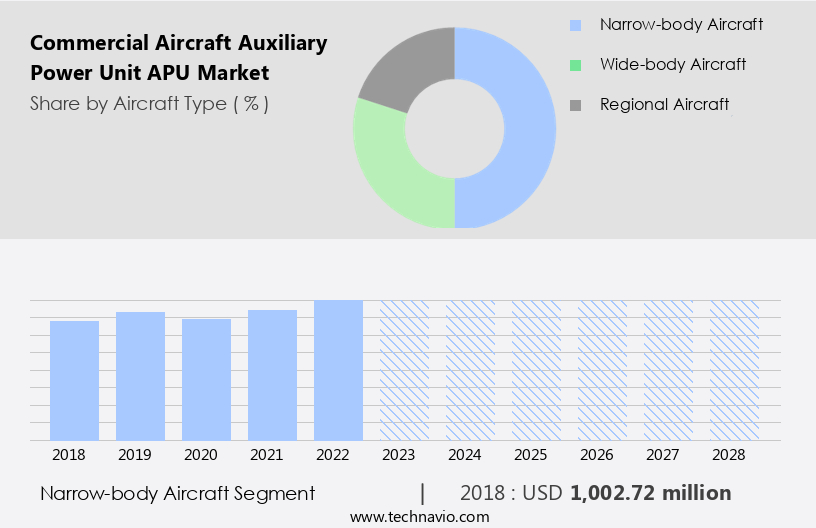
The narrow-body aircraft segment is estimated to witness significant growth during the forecast period.
The global commercial aircraft APU market is experiencing substantial growth, particularly in the context of narrow-body aircraft. Companies like Technodinamika, Rolls-Royce plc, Kinetics Ltd, Whitney & Pratt Canada, and Safran Power Units are leading this innovation. Narrow-body aircraft, such as the Boeing 737 and Airbus A320 families, require compact, lightweight, and efficient power generation solutions. These APUs are designed to meet the specific power demands and space constraints of these aircraft. One trend in this segment is the integration of advanced, fuel-efficient APUs. For instance, Microturbo's improved fuel efficiency and low noise APUs offer a competitive edge. Moreover, electric architecture and all-electric APUs are gaining popularity for their safety, reduced emissions, and quieter operations.
UAVs and military rotary-wing aircraft are also adopting APUs for their electrical power source. The commercial aviation segment is prioritizing fuel efficiency and reducing carbon emissions, making APUs an essential component of aircraft systems. Hamilton Sundstrand Corp's electrical power solutions and Airbus A320s' performance are notable examples. The development of electric aircraft and military aircrafts further underscores the importance of APUs in propulsion and aircraft systems.
Get a glance at the market report of share of various segments Request Free Sample
The Narrow-body aircraft segment was valued at USD 1002.72 million in 2018 and showed a gradual increase during the forecast period.
Regional Analysis
North America is estimated to contribute 31% to the growth of the global market during the forecast period.Technavio’s analysts have elaborately explained the regional trends and drivers that shape the market during the forecast period.

For more insights on the market size of various regions, Request Free Sample
The Commercial Aircraft APU market is witnessing significant growth, driven by the demand for improved fuel efficiency, reduced emissions, and quieter operations in the Commercial Aviation Segment. Technodinamika, a Russian technology company, and Kinetics Ltd, a Malaysian startup, are among the players contributing to this development through their innovative APUs. Rolls-Royce plc and Whitney & Pratt Canada also lead the market with their advanced APUs, offering a competitive edge in terms of fuel consumption and noise reduction. Moreover, the trend towards electric architecture in commercial and military aircraft, including fixed-wing and rotary-wing, is driving the demand for all-electric APUs from companies like Safran Power Units and Hamilton Sundstrand Corp.
UAVs are also adopting APUs for extended flight times and performance enhancement. The focus on passenger comfort and safety, as well as reduced emissions, is a key market driver. Microturbo, a Safran subsidiary, offers Low noise APUs for the economy class, enhancing the passenger experience. The increasing backlog of airlines and the growing demand for new aircraft systems further boost the market growth. In , the Commercial Aircraft APU market is experiencing dynamic growth, fueled by technological advancements, industry collaborations, and evolving aviation sector needs. Companies are investing in research and development to offer more efficient, quieter, and safer APUs for both commercial and military aircraft.
The market is expected to continue its expansion, driven by the increasing demand for advanced APUs in the global aviation industry.
Market Dynamics
Our researchers analyzed the data with 2023 as the base year, along with the key drivers, trends, and challenges. A holistic analysis of drivers will help companies refine their marketing strategies to gain a competitive advantage.
What are the key market drivers leading to the rise in the adoption of Commercial Aircraft Auxiliary Power Unit (APU) Industry?
- Rising focus on passenger comfort and experience is the key driver of the market.
- The commercial aircraft APU market is experiencing a notable focus on enhancing passenger comfort and experience in the aviation industry. This trend reflects the growing dedication of commercial airlines and aircraft manufacturers to improve in-flight ambiance and convenience for travelers. Honeywell International Inc. (Honeywell) is among the leading companies in this market, offering advanced APUs designed to cater to this industry shift.
- Honeywell's latest aircraft APU solutions are meticulously engineered to align with the industry's increasing emphasis on passenger comfort. This emphasis on comfort and convenience is a significant market dynamic shaping the commercial aircraft APU market.
What are the market trends shaping the Commercial Aircraft Auxiliary Power Unit (APU) Industry?
- Technological advancements in commercial aircraft APUs is the upcoming market trend.
- The commercial aircraft APU market has experienced substantial technological progressions, leading to enhanced efficiency, dependability, and sustainability in the commercial aviation sector. One significant innovation is the creation of more fuel-efficient and eco-friendly aircraft APUs to cater to the escalating demands of the global aviation industry. A prime instance of such technological advancements is the incorporation of advanced materials and design methodologies in the fabrication of aircraft APUs.
- Companies like Honeywell International Inc. And RTX Corp have introduced lightweight, high-strength materials, such as carbon composites and titanium alloys, to manufacture aircraft APU components. This innovation reduces the overall weight of aircraft APUs, thereby improving fuel efficiency.
What challenges does the Commercial Aircraft Auxiliary Power Unit (APU) Industry face during its growth?
- Negative impacts of using batteries in aircraft APUs is a key challenge affecting the industry growth.
- The integration of batteries in the commercial aircraft APU market presents both advantages and challenges for aviation industry stakeholders. One major concern is the added weight of battery-based APUs, which can negatively impact the overall weight and balance of an aircraft. Unlike traditional fuel-based APUs, battery-based units are inherently heavy, leading to increased fuel consumption and reduced payload capacity. For instance, the installation of large battery packs for aircraft APU applications may result in decreased fuel efficiency and higher operational costs for commercial airlines.
- It is crucial for industry players to carefully weigh the benefits and drawbacks of utilizing batteries in aircraft APUs to maintain operational efficiency and profitability.
Exclusive Customer Landscape
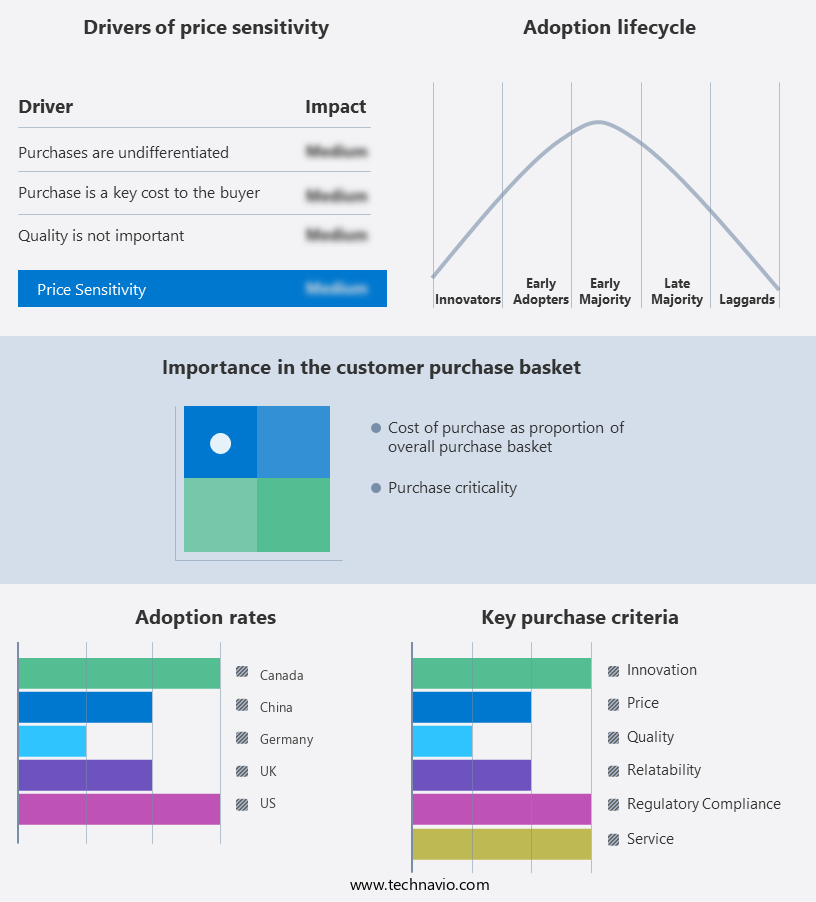
The commercial aircraft auxiliary power unit (apu) market forecasting report includes the adoption lifecycle of the market, covering from the innovator’s stage to the laggard’s stage. It focuses on adoption rates in different regions based on penetration. Furthermore, the commercial aircraft auxiliary power unit (apu) market report also includes key purchase criteria and drivers of price sensitivity to help companies evaluate and develop their market growth analysis strategies.
Customer Landscape
Key Companies & Market Insights
Companies are implementing various strategies, such as strategic alliances, commercial aircraft auxiliary power unit (apu) market forecast, partnerships, mergers and acquisitions, geographical expansion, and product/service launches, to enhance their presence in the industry.
Honeywell International Inc. - The company specializes in providing high-performance aircraft auxiliary power units, capable of generating power up to 350 kW. These units are essential for transport and passenger aircraft accommodating up to 250 individuals, ensuring optimal functionality during ground operations and in-flight emergencies. Our cutting-edge technology guarantees enhanced efficiency, reliability, and safety, setting us apart from competitors in the aviation industry.
The industry research and growth report includes detailed analyses of the competitive landscape of the market and information about key companies, including:
- Honeywell International Inc.
- Motor Sich JSC
- PBS Group AS
- Raytheon Technologies Corp.
- Rolls Royce Holdings Plc
- Safran SA
- Aerosila
Qualitative and quantitative analysis of companies has been conducted to help clients understand the wider business environment as well as the strengths and weaknesses of key industry players. Data is qualitatively analyzed to categorize companies as pure play, category-focused, industry-focused, and diversified; it is quantitatively analyzed to categorize companies as dominant, leading, strong, tentative, and weak.
Research Analyst Overview
The market encompasses a vital segment of the aviation industry, supplying power solutions for various aircraft types during ground operations and in-flight situations. These units play a crucial role in ensuring the efficient and reliable operation of aircraft systems, particularly in areas such as passenger comfort, safety, and reduced emissions. APUs provide electrical power for starting the main engines, providing air conditioning during ground operations, and supplying power for various aircraft systems during flight when the main engines are not in use. The commercial aviation segment is the primary consumer of APUs, with a significant number of units installed in fixed-wing and rotary-wing aircraft.
The market for APUs is driven by several factors, including the increasing demand for improved fuel efficiency, reduced noise pollution, and the need for quieter operations. The competitive edge of APU manufacturers lies in their ability to provide advanced technologies that cater to these demands. One such technology is electric architecture, which is gaining popularity due to its potential to reduce fuel consumption and carbon emissions. Several companies are investing in the development of electric APUs, with some even exploring the use of all-electric APUs in UAVs. Safety is another critical factor driving the market for APUs. These units are essential for providing power during emergency situations, ensuring the safety and comfort of passengers.
APUs also contribute to reduced emissions by allowing aircraft to use ground power instead of idling engines during ground operations. APU technologies have undergone significant advancements in recent years, with a focus on improving fuel efficiency, reducing noise, and enhancing the passenger experience. For instance, some APUs are designed to operate at lower noise levels, making them ideal for use in densely populated areas. Moreover, the increasing use of microturbo engines in APUs has led to improved fuel efficiency and reduced emissions. These engines operate on jet fuel and provide high power output with minimal fuel consumption. The market for APUs is highly competitive, with several established players and new entrants vying for a share.
Some of the key players in the market include Rolls-Royce plc, Kinetics Ltd, Whitney & Pratt Canada, Hamilton Sundstrand Corp, and Safran Power Units. These companies are investing in research and development to stay ahead of the competition and meet the evolving demands of the market. The APU market is expected to grow steadily in the coming years, driven by the increasing demand for more efficient and environmentally friendly power solutions for commercial and military aircraft. The backlog of orders for new aircraft is also expected to contribute to the growth of the market, as a significant number of these aircraft will require APUs for operation.
In , the commercial aircraft APU market is a dynamic and evolving industry, driven by the need for efficient, reliable, and environmentally friendly power solutions for aircraft. The market is highly competitive, with several players investing in research and development to meet the evolving demands of the market. The focus on improving fuel efficiency, reducing noise pollution, and enhancing the passenger experience is expected to drive the growth of the market in the coming years.
|
Market Scope |
|
|
Report Coverage |
Details |
|
Page number |
144 |
|
Base year |
2023 |
|
Historic period |
2018-2022 |
|
Forecast period |
2024-2028 |
|
Growth momentum & CAGR |
Accelerate at a CAGR of 8.11% |
|
Market growth 2024-2028 |
USD 990.65 million |
|
Market structure |
Concentrated |
|
YoY growth 2023-2024(%) |
7.57 |
|
Key countries |
US, Canada, China, Germany, and UK |
|
Competitive landscape |
Leading Companies, Market Positioning of Companies, Competitive Strategies, and Industry Risks |
What are the Key Data Covered in this Commercial Aircraft Auxiliary Power Unit (APU) Market Research and Growth Report?
- CAGR of the Commercial Aircraft Auxiliary Power Unit (APU) industry during the forecast period
- Detailed information on factors that will drive the growth and forecasting between 2024 and 2028
- Precise estimation of the size of the market and its contribution of the industry in focus to the parent market
- Accurate predictions about upcoming growth and trends and changes in consumer behaviour
- Growth of the market across North America, Europe, APAC, South America, and Middle East and Africa
- Thorough analysis of the market’s competitive landscape and detailed information about companies
- Comprehensive analysis of factors that will challenge the commercial aircraft auxiliary power unit (apu) market growth of industry companies
We can help! Our analysts can customize this commercial aircraft auxiliary power unit (apu) market research report to meet your requirements.
 RIA -
RIA - 
