


Crystal Market Size 2026-2030
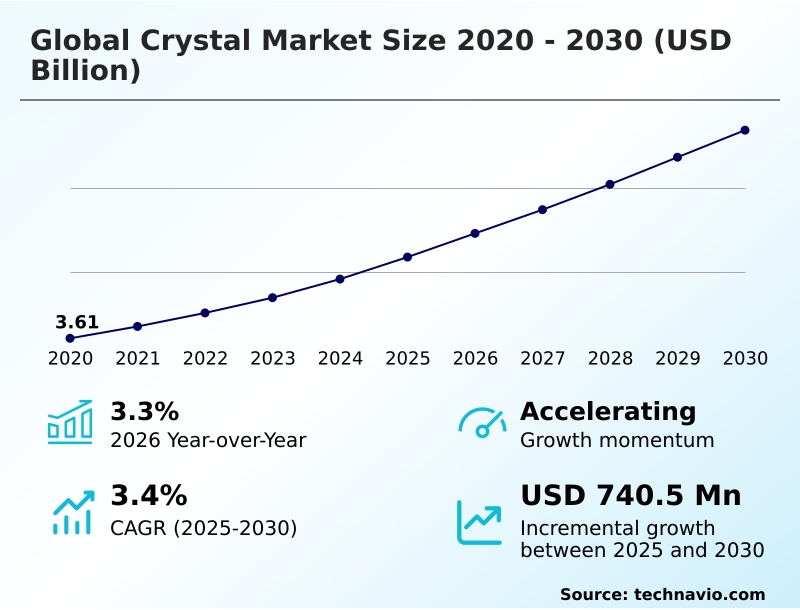
The crystal market size is valued to increase by USD 740.5 million, at a CAGR of 3.4% from 2025 to 2030. Proliferation of advanced semiconductor and 5g technology will drive the crystal market.
Major Market Trends & Insights
- APAC dominated the market and accounted for a 46.8% growth during the forecast period.
- By Frequency Range - MHz segment was valued at USD 2.58 billion in 2024
- By Application - Oscillators segment accounted for the largest market revenue share in 2024
Market Size & Forecast
- Market Opportunities: USD 1.23 billion
- Market Future Opportunities: USD 740.5 million
- CAGR from 2025 to 2030 : 3.4%
Market Summary
- The crystal market is experiencing a significant transformation, driven by the dual demands of technological advancement and evolving consumer preferences. At its core, the industry provides foundational components like piezoelectric crystal resonators and quartz crystal oscillators, which are indispensable for timing and frequency control in virtually all modern electronics.
- Key drivers include the global rollout of 5G networks and the increasing electronic complexity in electric vehicles, which demand high-performance temperature-compensated crystal oscillators (TCXOs) and oven-controlled crystal oscillators (OCXOs) for system stability. Simultaneously, the market is navigating the growing adoption of wide-bandgap semiconductors such as silicon carbide (SiC) and gallium nitride (GaN).
- A critical business scenario involves electronics manufacturers mitigating supply chain volatility. For instance, an automotive supplier facing disruptions in the high-purity quartz supply chain might diversify its sourcing strategy by qualifying multiple vendors across different geographies. This proactive measure, while increasing initial qualification costs, ensures production continuity for critical ADAS modules, safeguarding against potential shutdowns and revenue loss.
- The industry also faces challenges from the high energy costs of manufacturing processes and increasing competition from alternative technologies like microelectromechanical systems (MEMS).
What will be the Size of the Crystal Market during the forecast period?
Get Key Insights on Market Forecast (PDF) Get Free Sample
How is the Crystal Market Segmented?
The crystal industry research report provides comprehensive data (region-wise segment analysis), with forecasts and estimates in "USD million" for the period 2026-2030, as well as historical data from 2020-2024 for the following segments.
- Frequency range
- MHz
- KHz
- Application
- Oscillators
- Resonators
- Filters
- End-user
- Consumer electronics
- IT and telecommunication
- Automotive
- Military and aerospace
- Others
- Geography
- APAC
- China
- Japan
- India
- North America
- US
- Canada
- Mexico
- Europe
- Germany
- France
- UK
- Middle East and Africa
- UAE
- South Africa
- Israel
- South America
- Brazil
- Argentina
- Colombia
- Rest of World (ROW)
- APAC
By Frequency Range Insights
The mhz segment is estimated to witness significant growth during the forecast period.
The megahertz (MHz) frequency segment is pivotal to the crystal market, underpinning high-speed data processing and communication systems.
These components, including quartz crystal oscillators and ceramic resonators, serve as the primary clock source for microprocessors and high-speed networking hardware, where precise timing is non-negotiable.
The demand for these MHz crystals is driven by advancements in telecommunications and enterprise networking, which require lower jitter and improved phase noise to handle escalating data traffic.
The transition to advanced protocols like PCIe 5.0 in hyperscale data centers has increased the need for high-performance timing references, with some implementations achieving up to a 20% reduction in data transmission errors.
This segment's trajectory is closely tied to the innovation cycle in high-performance computing, automotive electronics, particularly ADAS, and industrial automation, where reliable, high-frequency timing from components like TCXOs is critical for system integrity.
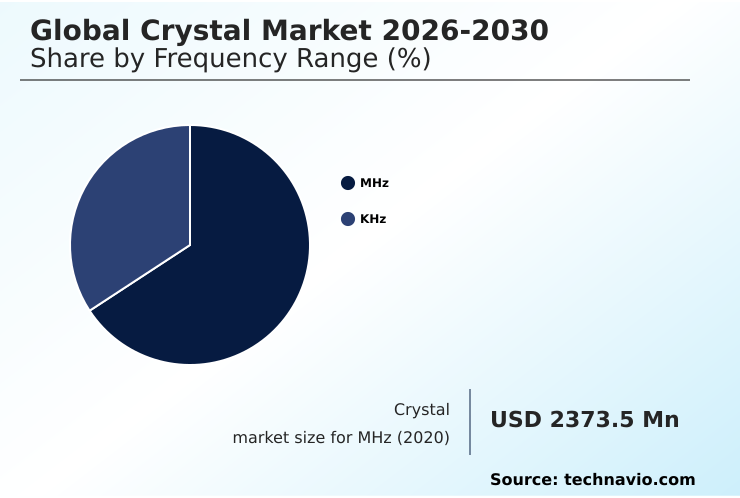
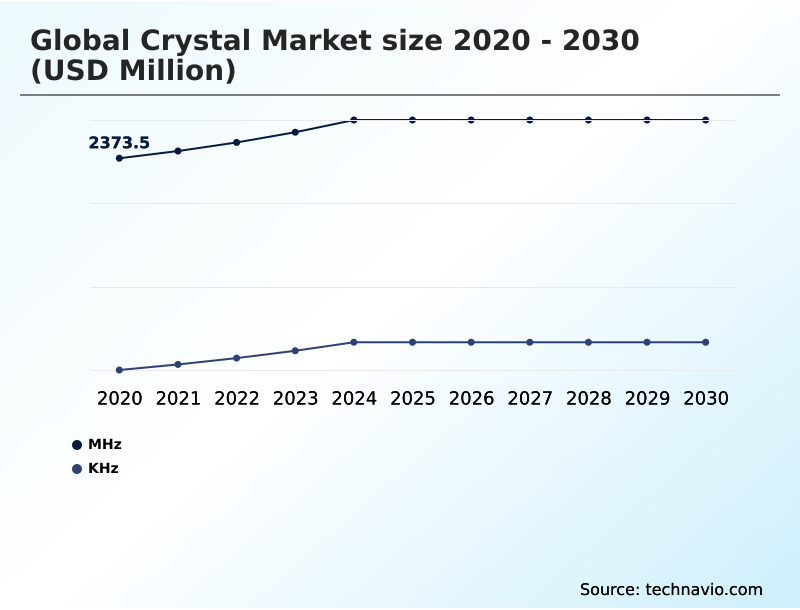
The MHz segment was valued at USD 2.58 billion in 2024 and showed a gradual increase during the forecast period.
Regional Analysis
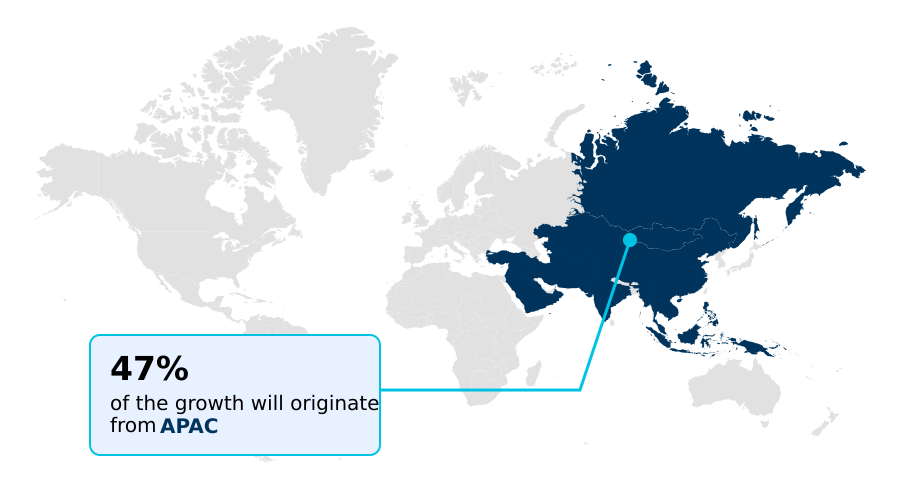
APAC is estimated to contribute 46.8% to the growth of the global market during the forecast period.Technavio’s analysts have elaborately explained the regional trends and drivers that shape the market during the forecast period.
See How Crystal Market Demand is Rising in APAC Get Free Sample
The geographic landscape of the global crystal market is characterized by distinct regional specializations. APAC, accounting for over 45% of global production, serves as the manufacturing powerhouse, driven by its dominance in consumer electronics, semiconductors, and solar panel production.
This region leverages massive economies of scale in producing monocrystalline silicon wafers and a wide array of timing components.
North America leads in high-value applications and R&D, particularly in the aerospace, defense, and electric vehicle sectors, where advanced synthetic crystals like silicon carbide and gallium nitride are critical.
Strategic initiatives in the region have helped some firms reduce R&D-to-production timelines by nearly 20% for next-generation materials. Europe excels in the automotive and luxury goods segments, combining industrial might with a rich heritage in craftsmanship.
The market's future will be shaped by how these regions navigate geopolitical tensions and supply chain risks.
Market Dynamics
Our researchers analyzed the data with 2025 as the base year, along with the key drivers, trends, and challenges. A holistic analysis of drivers will help companies refine their marketing strategies to gain a competitive advantage.
- Strategic decision-making in the global crystal market 2026-2030 is increasingly complex, requiring a nuanced understanding of competing technologies and their specific use cases. The debate over SiC vs GaN in EV inverters continues, with silicon carbide often favored for high-voltage powertrains while gallium nitride shows promise in on-board chargers.
- Similarly, the choice of MEMS oscillators for automotive applications is gaining traction due to their robustness, though high-stability OCXOs for 5G base stations remain the gold standard for network synchronization. For designers, quartz crystal selection for low-power IoT devices is a critical decision, balancing cost, size, and power consumption to maximize battery life.
- The market is also bifurcated by the lab-grown vs natural crystals jewelry market, where consumer perceptions of value and ethics play a significant role. Operationally, the impact of geopolitical tension on quartz supply is a primary concern.
- Firms that proactively diversify their sourcing have maintained up to 98% of their target inventory levels, in stark contrast to competitors facing significant shortfalls. This dynamic extends to the use of crystal filters for military radio communication, where secure, domestic supply chains are paramount.
- The foundational role of silicon wafers in semiconductor manufacturing, challenges in high-purity silicon production, and the emergence of advanced crystals for micro-LED displays further highlight the market's intricate and interconnected nature.
What are the key market drivers leading to the rise in the adoption of Crystal Industry?
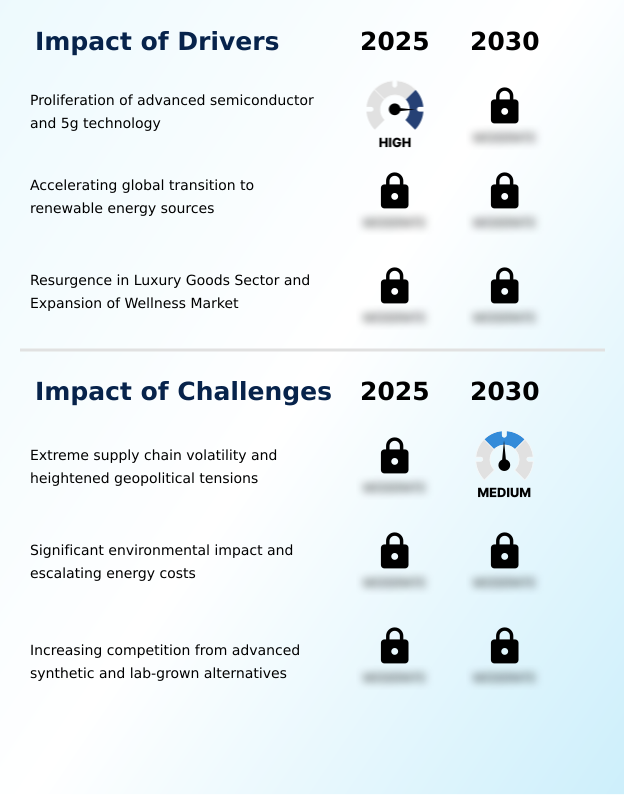
- The proliferation of advanced semiconductor and 5G technology is a key driver for the market.
- The global digital transformation is a primary driver for the crystal market, creating sustained demand for precision timing components.
- The rollout of 5G infrastructure necessitates high-performance temperature-compensated crystal oscillators (TCXOs) to ensure network synchronization, with advanced versions improving timing accuracy by over 50% compared to previous generations.
- In the automotive sector, the transition to electric vehicles (EVs) and advanced driver-assistance systems (ADAS) relies heavily on crystalline materials; the use of silicon carbide (SiC) in EV inverters can increase vehicle range by 5–10% by enhancing power conversion efficiency.
- This demand for sophisticated components is complemented by the burgeoning wellness industry, where consumers are increasingly purchasing natural crystals, expanding the market beyond its traditional industrial base.
- The industry is responding with innovations in both industrial-grade piezoelectric crystal resonators and consumer-focused aesthetic products.
What are the market trends shaping the Crystal Industry?
- The proliferation of advanced synthetic crystals is a defining market trend, driven by escalating performance demands in high-frequency electronics and next-generation photonic systems.
- The crystal market is evolving rapidly, driven by the adoption of advanced synthetic materials to meet escalating performance demands. The use of wide-bandgap semiconductors such as gallium nitride (GaN) in data center power supplies has improved energy efficiency by over 5%, a critical factor in reducing operational costs.
- In the renewable energy sector, advancements in monocrystalline silicon growth methods have pushed solar panel conversion efficiencies beyond 23% in commercial products, accelerating the transition to sustainable power. Concurrently, a powerful consumer-facing trend sees a convergence of wellness and luxury, where the aesthetic and perceived metaphysical properties of natural crystals are fueling robust demand in home decor and fashion.
- This dual evolution—from high-purity industrial materials like sapphire substrates to consumer-centric natural stones—creates a dynamic and diversified market landscape for frequency control devices.
What challenges does the Crystal Industry face during its growth?
- Extreme supply chain volatility and heightened geopolitical tensions present a key challenge affecting industry growth.
- The crystal market faces significant operational and competitive challenges that temper its growth prospects. Extreme supply chain volatility, stemming from the geographic concentration of high-purity quartz mining and processing, remains a primary concern. Recent disruptions have led to lead time increases of over 40% for certain quartz components, impacting manufacturing schedules globally.
- Another major hurdle is the industry's high energy consumption; manufacturing methods like the Czochralski process for silicon growth can account for more than 50% of the total energy used in producing a wafer, creating both cost pressures and environmental scrutiny. Furthermore, the market is encountering intensifying competition from alternative technologies.
- The rise of lab-grown diamonds and other synthetic crystals is altering market dynamics in the jewelry sector, while MEMS-based timing solutions present a growing challenge to traditional quartz devices in various electronic applications.
Exclusive Technavio Analysis on Customer Landscape
The crystal market forecasting report includes the adoption lifecycle of the market, covering from the innovator’s stage to the laggard’s stage. It focuses on adoption rates in different regions based on penetration. Furthermore, the crystal market report also includes key purchase criteria and drivers of price sensitivity to help companies evaluate and develop their market growth analysis strategies.

Customer Landscape of Crystal Industry
Competitive Landscape
Companies are implementing various strategies, such as strategic alliances, crystal market forecast, partnerships, mergers and acquisitions, geographical expansion, and product/service launches, to enhance their presence in the industry.
Abracon LLC - The portfolio features a broad range of frequency control products, including precision quartz crystals, advanced oscillators, and integrated timing modules designed for diverse electronic applications.
The industry research and growth report includes detailed analyses of the competitive landscape of the market and information about key companies, including:
- Abracon LLC
- CTS Corp.
- Daishinku Corp.
- ECS Inc.
- Hongxing Technology Co. Ltd.
- Jauch Quartz GmbH
- Kyocera Corp.
- Microchip Technology Inc.
- Murata Manufacturing Co. Ltd.
- Nihon Dempa Kogyo Ltd.
- Rakon Ltd.
- RALTRON
- Renesas Electronics Corp.
- River Eletec Corp.
- Epson Corp.
- SiTime Corp.
- SIWARD Crystal Tech. Ltd.
- TXC Corp.
- Wurth Elektronik GmbH and Co. KG
Qualitative and quantitative analysis of companies has been conducted to help clients understand the wider business environment as well as the strengths and weaknesses of key industry players. Data is qualitatively analyzed to categorize companies as pure play, category-focused, industry-focused, and diversified; it is quantitatively analyzed to categorize companies as dominant, leading, strong, tentative, and weak.
Recent Development and News in Crystal market
- In September 2024, SiTime Corp. announced a strategic partnership with a leading automotive Tier-1 supplier to integrate its latest generation of AEC-Q200 qualified MEMS oscillators into next-generation ADAS platforms, aiming to enhance system resilience against shock and vibration.
- In November 2024, Kyocera Corp. launched a new series of high-stability oven-controlled crystal oscillators (OCXOs) specifically designed to meet the stringent synchronization requirements of 5G-Advanced and early-stage 6G network infrastructure.
- In February 2025, Microchip Technology Inc. completed its acquisition of a specialized European manufacturer of high-reliability crystal filters, a move intended to strengthen its product offerings for the aerospace and defense markets.
- In April 2025, the US Department of Commerce, under the CHIPS and Science Act, awarded a significant grant to a domestic materials science company to build a new facility for processing high-purity quartz, aiming to reduce reliance on foreign supply chains.
Dive into Technavio’s robust research methodology, blending expert interviews, extensive data synthesis, and validated models for unparalleled Crystal Market insights. See full methodology.
| Market Scope | |
|---|---|
| Page number | 298 |
| Base year | 2025 |
| Historic period | 2020-2024 |
| Forecast period | 2026-2030 |
| Growth momentum & CAGR | Accelerate at a CAGR of 3.4% |
| Market growth 2026-2030 | USD 740.5 million |
| Market structure | Fragmented |
| YoY growth 2025-2026(%) | 3.3% |
| Key countries | China, Japan, India, South Korea, Australia, Indonesia, US, Canada, Mexico, Germany, France, UK, Italy, Spain, The Netherlands, UAE, South Africa, Israel, Saudi Arabia, Turkey, Brazil, Argentina and Colombia |
| Competitive landscape | Leading Companies, Market Positioning of Companies, Competitive Strategies, and Industry Risks |
Research Analyst Overview
- The crystal market is fundamentally shaped by the relentless pursuit of precision and efficiency in electronic systems. Core components such as piezoelectric crystal resonators, quartz crystal oscillators, and increasingly, microelectromechanical systems (MEMS) serve as the essential timing references for industries ranging from telecommunications to automotive.
- The ongoing shift toward wide-bandgap semiconductors, including silicon carbide (SiC) and gallium nitride (GaN), is a key trend, driven by their superior performance in high-power and high-frequency applications. For instance, the adoption of new synthetic crystals has enabled a 30% reduction in power loss in next-generation power supplies.
- This technological pivot presents a critical boardroom-level decision regarding capital expenditure: whether to invest in scaling up production of advanced materials like SiC or to optimize existing manufacturing lines for traditional quartz-based frequency control devices such as TCXOs and OCXOs. The decision impacts long-term competitiveness in high-growth sectors.
- The market's complexity is further heightened by the reliance on specialized materials like yttrium aluminum garnet (YAG) for lasers and scintillator crystals for medical imaging, each with unique supply chain considerations.
What are the Key Data Covered in this Crystal Market Research and Growth Report?
-
What is the expected growth of the Crystal Market between 2026 and 2030?
-
USD 740.5 million, at a CAGR of 3.4%
-
-
What segmentation does the market report cover?
-
The report is segmented by Frequency Range (MHz, and KHz), Application (Oscillators, Resonators, and Filters), End-user (Consumer electronics, IT and telecommunication, Automotive, Military and aerospace, and Others) and Geography (APAC, North America, Europe, Middle East and Africa, South America)
-
-
Which regions are analyzed in the report?
-
APAC, North America, Europe, Middle East and Africa and South America
-
-
What are the key growth drivers and market challenges?
-
Proliferation of advanced semiconductor and 5g technology, Extreme supply chain volatility and heightened geopolitical tensions
-
-
Who are the major players in the Crystal Market?
-
Abracon LLC, CTS Corp., Daishinku Corp., ECS Inc., Hongxing Technology Co. Ltd., Jauch Quartz GmbH, Kyocera Corp., Microchip Technology Inc., Murata Manufacturing Co. Ltd., Nihon Dempa Kogyo Ltd., Rakon Ltd., RALTRON, Renesas Electronics Corp., River Eletec Corp., Epson Corp., SiTime Corp., SIWARD Crystal Tech. Ltd., TXC Corp. and Wurth Elektronik GmbH and Co. KG
-
Market Research Insights
- The crystal market's dynamics are shaped by a convergence of high-tech industrial requirements and shifting consumer behaviors. In the industrial sphere, the adoption of silicon carbide in electric vehicle power electronics has improved power conversion efficiency by over 8%, directly impacting vehicle range.
- This push for performance in applications like advanced driver-assistance systems (ADAS) and 5G network synchronization fuels demand for specialized components. Concurrently, the wellness and luxury goods sectors are creating robust demand for natural crystals based on perceived metaphysical properties and aesthetic appeal. This diversification provides a counterbalance to the cyclical nature of industrial demand.
- However, the industry grapples with significant supply chain volatility; strategic sourcing of high-purity quartz and other raw materials has enabled some manufacturers to reduce production delays by up to 15%, highlighting the operational importance of supply chain resilience amid ongoing geopolitical friction.
We can help! Our analysts can customize this crystal market research report to meet your requirements.
 RIA -
RIA - 
