



Digital Thread Market Size 2026-2030
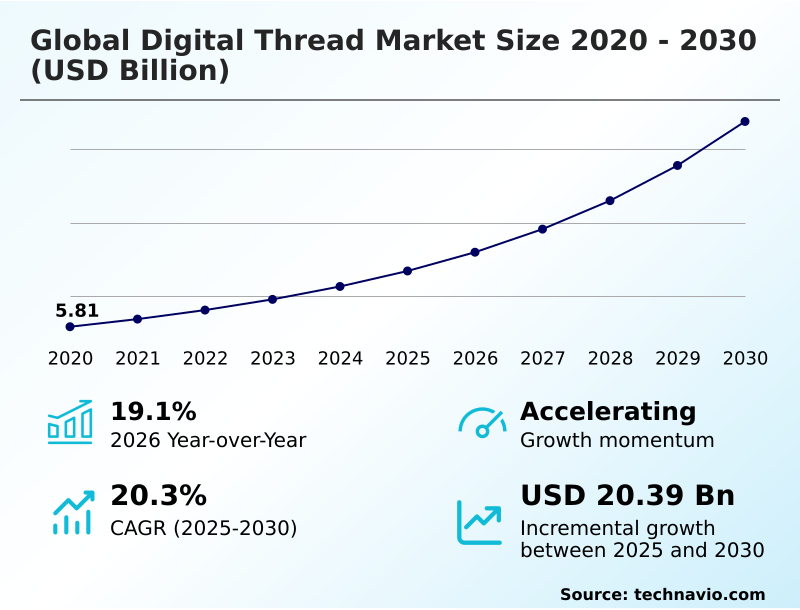
The digital thread market size is valued to increase by USD 20.39 billion, at a CAGR of 20.3% from 2025 to 2030. Accelerating industrial digitalization and adoption of industry 4.0 standards will drive the digital thread market.
Major Market Trends & Insights
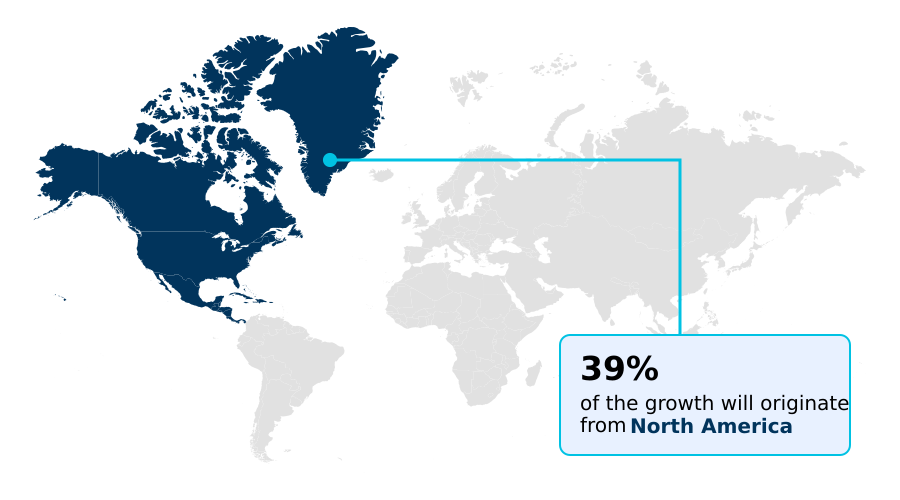
- North America dominated the market and accounted for a 39.2% growth during the forecast period.
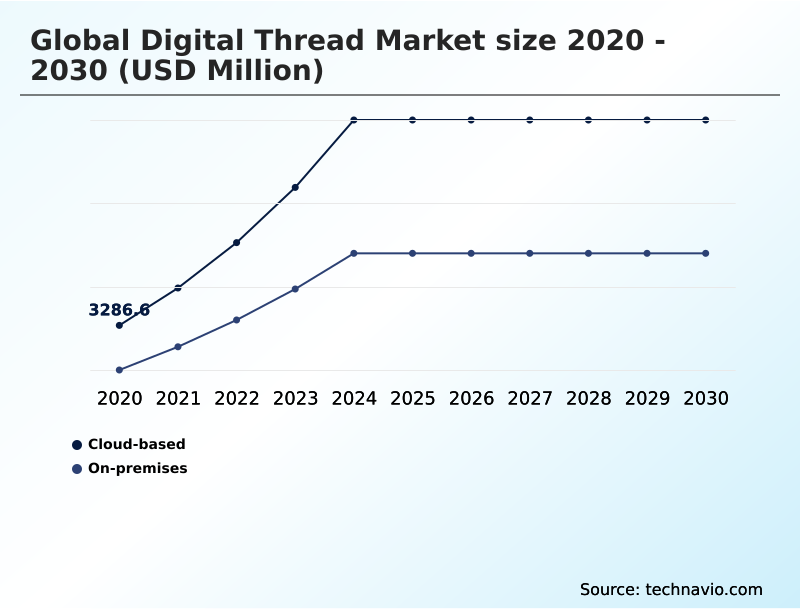
- By Deployment - Cloud-based segment was valued at USD 6.79 billion in 2024
- By Technology - Product lifecycle management segment accounted for the largest market revenue share in 2024
Market Size & Forecast
- Market Opportunities: USD 27.98 billion
- Market Future Opportunities: USD 20.39 billion
- CAGR from 2025 to 2030 : 20.3%
Market Summary
- The digital thread market establishes an authoritative, integrated communication framework for the entire product lifecycle, from design to service. This digital backbone is crucial for industrial digitalization, connecting disparate systems like product lifecycle management (PLM), enterprise resource planning (ERP), and manufacturing execution systems (MES) to create a single source of truth.
- Key drivers include the need for end-to-end traceability in complex industries and the push for sustainability reporting through digital product passports. A dominant trend is the integration of industrial AI and generative models for automated lifecycle data intelligence.
- For instance, an aerospace manufacturer can use the digital thread to link a component's material history tracking from its supplier with its in-service performance data, enabling predictive maintenance that reduces downtime and improves fleet reliability. However, challenges such as high initial capital expenditure, data governance complexities, and the need for robust industrial cybersecurity for cyber-physical systems persist.
- Addressing systemic interoperability hurdles is essential for realizing the full potential of a connected enterprise and achieving significant operational efficiency improvements.
What will be the Size of the Digital Thread Market during the forecast period?
Get Key Insights on Market Forecast (PDF) Get Free Sample
How is the Digital Thread Market Segmented?
The digital thread industry research report provides comprehensive data (region-wise segment analysis), with forecasts and estimates in "USD million" for the period 2026-2030, as well as historical data from 2020-2024 for the following segments.
- Deployment
- Cloud-based
- On-premises
- Technology
- Product lifecycle management
- Computer-aided design
- Digital twin and simulation
- Manufacturing execution systems
- Others
- End-user
- Automotive
- Industrial manufacturing
- Aerospace and defense
- Energy and utilities
- Others
- Geography
- North America
- US
- Canada
- Mexico
- APAC
- China
- Japan
- India
- Europe
- Germany
- UK
- France
- Middle East and Africa
- Saudi Arabia
- UAE
- South Africa
- South America
- Brazil
- Argentina
- Rest of World (ROW)
- North America
By Deployment Insights
The cloud-based segment is estimated to witness significant growth during the forecast period.
The cloud-based segment is defined by its use of cloud-native architecture to deliver a scalable industrial data platform. This model enables enterprise data integration and real-time collaboration, fostering a connected worker environment that dissolves geographical barriers.
Organizations are adopting this approach to achieve a single source of truth for asset performance management and industrial automation, leading to significant operational efficiency improvement.
By leveraging the cloud, firms facilitate remote diagnostics and provide augmented reality (AR) tools to field technicians, improving first-time fix rates by over 15%.
This deployment ensures data continuity, creating a dynamic and accessible foundation for virtual reality (VR) training and simulations.
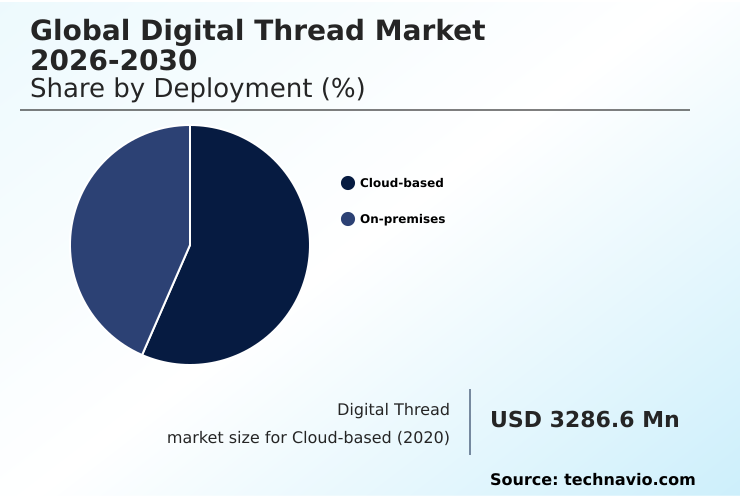
The Cloud-based segment was valued at USD 6.79 billion in 2024 and showed a gradual increase during the forecast period.
Regional Analysis
North America is estimated to contribute 39.2% to the growth of the global market during the forecast period.Technavio’s analysts have elaborately explained the regional trends and drivers that shape the market during the forecast period.
See How Digital Thread Market Demand is Rising in North America Get Free Sample
The geographic landscape is shaped by regional manufacturing priorities, with a focus on achieving a connected enterprise. In developed economies, predictive maintenance initiatives leveraging a closed-loop feedback system have reduced equipment downtime by over 25%.
These regions utilize model-based definition and semantic search capabilities for multi-disciplinary data management, enhancing quality assurance. The adoption of a compliance audit trail, supported by material history tracking, is critical for regulatory adherence.
Real-time data streaming enables agile manufacturing process optimization and asset lifecycle management.
Emerging markets are also adopting these frameworks, with a focus on creating a decentralized autonomous organization (DAO) structure to improve supply chain transparency, leading to a 15% decrease in logistical errors.
Market Dynamics
Our researchers analyzed the data with 2025 as the base year, along with the key drivers, trends, and challenges. A holistic analysis of drivers will help companies refine their marketing strategies to gain a competitive advantage.
- Strategic inquiries into the digital thread market often focus on specific applications and comparative analyses. Key topics include the implementation of digital thread for additive manufacturing and its role in the digital thread in aerospace and defense, where precision is paramount.
- The concept of the digital product passport for circular economy frameworks is gaining significant traction, forcing companies to address the challenge of integrating PLM MES and ERP systems. A common point of confusion is the digital twin and digital thread difference, where the former is a model and the latter is the data connection.
- Businesses must evaluate the cost of implementing digital thread and its corresponding ROI of digital thread implementation, which can be significant. Security is another major concern, centering on securing the industrial digital thread and establishing robust data governance for digital thread.
- Practical use cases like digital thread for predictive maintenance and digital thread for supply chain visibility offer clear value propositions, with organizations that implement a model-based enterprise reporting efficiency gains that are double those with siloed systems. The debate over cloud vs on-premise digital thread deployment continues, while the digital thread impact on quality control is universally acknowledged.
- Future-looking discussions involve generative AI in digital thread, the digital thread for regulated industries, and the development of open standards for digital thread. Ultimately, the digital thread role in smart factory environments, its connection to the digital thread and industrial metaverse, and its application in the digital thread for automotive industry define its transformative potential.
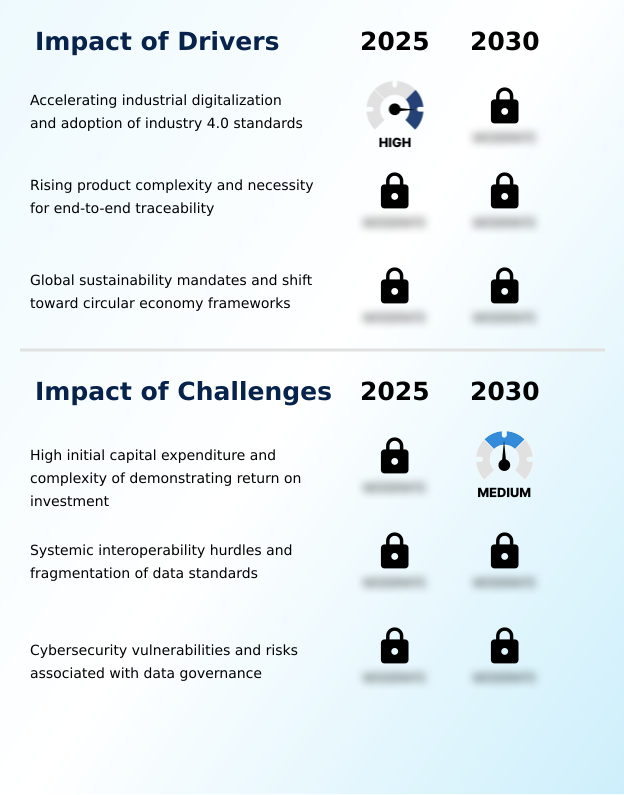
What are the key market drivers leading to the rise in the adoption of Digital Thread Industry?
- Accelerating industrial digitalization and the widespread adoption of Industry 4.0 standards are primary drivers for the market.
- Market expansion is driven by the mandate for end-to-end traceability and sustainability reporting, compelling the adoption of the digital product passport.
- This requires a robust digital backbone that ensures product data interoperability across product lifecycle management (PLM), enterprise resource planning (ERP), and manufacturing execution system (MES) platforms.
- The integration of computer-aided design (CAD) files with operational technology (OT) data streamlines production, leading to a time-to-market reduction of over 20% in complex industries.
- This level of connectivity is essential for regulatory compliance automation and enhances supply chain visibility, allowing organizations to meet consumer and investor demands for transparency. Enterprises that successfully link these systems report a 15% decrease in compliance-related penalties.
What are the market trends shaping the Digital Thread Industry?
- The strategic integration of industrial AI and generative models is emerging as a significant trend, enabling automated lifecycle intelligence across enterprise systems.
- A dominant trend is the strategic digital transformation through generative AI integration, which automates lifecycle data intelligence and supports digital twin synchronization. This shift toward smart manufacturing is enabling a more collaborative engineering environment, where data-driven decision-making is standard.
- The convergence with the industrial metaverse, powered by physics-based simulation, allows for immersive design and testing, reducing physical prototyping costs by up to 40%. The focus on lifecycle data management within a smart factory context is enhancing service lifecycle management, with some firms seeing a 25% improvement in maintenance scheduling accuracy.
- This evolution underscores the move toward an intelligent, responsive digital backbone that enhances supply chain transparency and operational agility across the entire product lifecycle.
What challenges does the Digital Thread Industry face during its growth?
- The high initial capital expenditure and the complexity of demonstrating a clear return on investment present a key challenge to market growth.
- A primary challenge is ensuring industrial cybersecurity across interconnected cyber-physical systems, especially as the industrial internet of things (IIoT) expands the attack surface. Establishing effective data governance for a decentralized digital thread that spans both information technology (IT) and operational technology presents significant complexity, with data breaches costing firms 4% of their annual revenue on average.
- The lack of interoperability and the difficulty in reconciling as-built vs as-designed data hinder the creation of a self-healing data architecture. This forces a reliance on complex system of systems engineering and application lifecycle management.
- Furthermore, the high computational demands often require edge computing solutions to process data locally, adding another layer of management and increasing the risk of information silo elimination failure.
Exclusive Technavio Analysis on Customer Landscape
The digital thread market forecasting report includes the adoption lifecycle of the market, covering from the innovator’s stage to the laggard’s stage. It focuses on adoption rates in different regions based on penetration. Furthermore, the digital thread market report also includes key purchase criteria and drivers of price sensitivity to help companies evaluate and develop their market growth analysis strategies.
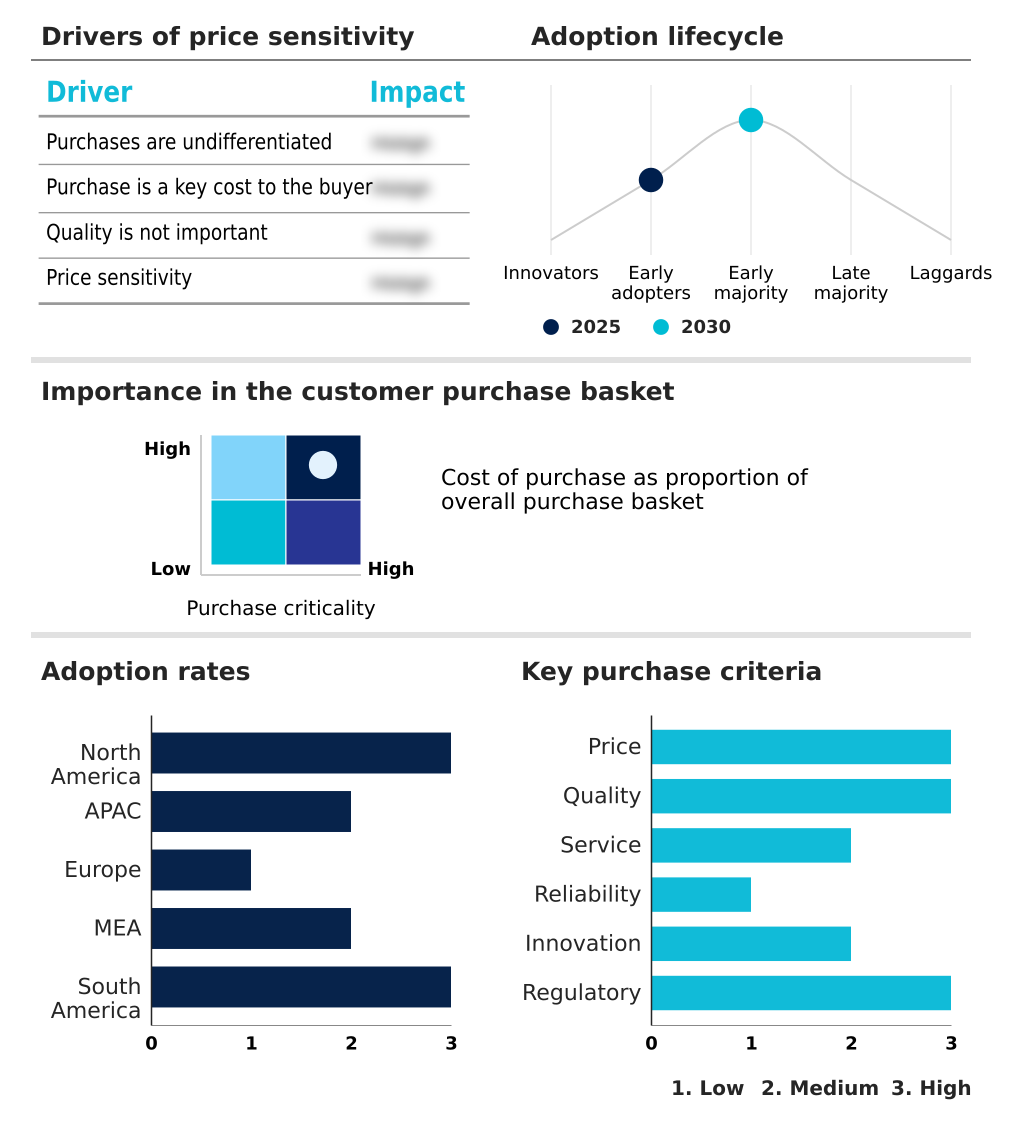
Customer Landscape of Digital Thread Industry
Competitive Landscape
Companies are implementing various strategies, such as strategic alliances, digital thread market forecast, partnerships, mergers and acquisitions, geographical expansion, and product/service launches, to enhance their presence in the industry.
Altair Engineering Inc. - Offerings provide an integrated communication framework, enabling a seamless data flow and a unified data record across the entire product lifecycle for enhanced industrial productivity.
The industry research and growth report includes detailed analyses of the competitive landscape of the market and information about key companies, including:
- Altair Engineering Inc.
- Amazon Web Services Inc.
- ANSYS Inc.
- Aras Corp.
- Autodesk Inc.
- AVEVA Group Ltd.
- Bentley Systems Inc.
- Dassault Systemes SE
- Epicor Software Corp.
- General Electric Co.
- Hexagon AB
- Honeywell International Inc.
- IBM Corp.
- IFS
- Microsoft Corp.
- Oracle Corp.
- PTC Inc.
- Rockwell Automation Inc.
- SAP SE
- Schneider Electric SE
- Siemens AG
Qualitative and quantitative analysis of companies has been conducted to help clients understand the wider business environment as well as the strengths and weaknesses of key industry players. Data is qualitatively analyzed to categorize companies as pure play, category-focused, industry-focused, and diversified; it is quantitatively analyzed to categorize companies as dominant, leading, strong, tentative, and weak.
Recent Development and News in Digital thread market
- In October 2025, Toyota Motor Corporation initiated a major overhaul of its digital architecture, integrating a decentralized digital thread model to accelerate its solid-state battery development programs and enhance real-time data accessibility for global research teams.
- In October 2025, the US Department of Defense established more stringent encryption and data governance requirements for defense contractors using digital thread frameworks to counter rising cyber espionage threats against interconnected design and manufacturing data.
- In January 2025, Siemens launched the Teamcenter Digital Reality Viewer, leveraging the NVIDIA Omniverse platform to enable immersive, real-time collaboration on large-scale digital twins within its product lifecycle management ecosystem.
- In April 2025, the European Commission adopted the first official working plan for Digital Product Passports under the Ecodesign for Sustainable Products Regulation, setting clear timelines for mandatory sustainability data reporting across various product categories.
Dive into Technavio’s robust research methodology, blending expert interviews, extensive data synthesis, and validated models for unparalleled Digital Thread Market insights. See full methodology.
| Market Scope | |
|---|---|
| Page number | 320 |
| Base year | 2025 |
| Historic period | 2020-2024 |
| Forecast period | 2026-2030 |
| Growth momentum & CAGR | Accelerate at a CAGR of 20.3% |
| Market growth 2026-2030 | USD 20389.9 million |
| Market structure | Fragmented |
| YoY growth 2025-2026(%) | 19.1% |
| Key countries | US, Canada, Mexico, China, Japan, India, South Korea, Australia, Singapore, Germany, UK, France, Italy, Spain, The Netherlands, Saudi Arabia, UAE, South Africa, Israel, Turkey, Brazil, Argentina and Chile |
| Competitive landscape | Leading Companies, Market Positioning of Companies, Competitive Strategies, and Industry Risks |
Research Analyst Overview
- The digital thread market is foundational to the modern smart factory, providing a cloud-native architecture for complete enterprise data integration. It establishes a digital product passport through model-based definition and enables physics-based simulation within the industrial metaverse. The framework supports generative AI integration for advanced lifecycle data intelligence and features a self-healing data architecture.
- By creating a closed-loop feedback system, often through a decentralized digital thread, it revolutionizes configuration management and ensures end-to-end traceability for a clear compliance audit trail. This facilitates predictive maintenance based on material history tracking and digital twin synchronization across all cyber-physical systems.
- The technology enables real-time collaboration and leverages the industrial internet of things (IIoT) with semantic search capabilities for multi-disciplinary data management. It allows for virtual commissioning of industrial automation, improving asset performance management. Integrating operational technology (OT) and information technology (IT) with product lifecycle management (PLM), computer-aided design (CAD), and manufacturing execution system (MES) platforms is crucial.
- This approach has proven to increase supply chain transparency, with early adopters reporting a 40% reduction in data reconciliation errors, and supports augmented reality (AR) and virtual reality (VR) applications with robust data governance.
What are the Key Data Covered in this Digital Thread Market Research and Growth Report?
-
What is the expected growth of the Digital Thread Market between 2026 and 2030?
-
USD 20.39 billion, at a CAGR of 20.3%
-
-
What segmentation does the market report cover?
-
The report is segmented by Deployment (Cloud-based, and On-premises), Technology (Product lifecycle management, Computer-aided design, Digital twin and simulation, Manufacturing execution systems, and Others), End-user (Automotive, Industrial manufacturing, Aerospace and defense, Energy and utilities, and Others) and Geography (North America, APAC, Europe, Middle East and Africa, South America)
-
-
Which regions are analyzed in the report?
-
North America, APAC, Europe, Middle East and Africa and South America
-
-
What are the key growth drivers and market challenges?
-
Accelerating industrial digitalization and adoption of industry 4.0 standards, High initial capital expenditure and complexity of demonstrating return on investment
-
-
Who are the major players in the Digital Thread Market?
-
Altair Engineering Inc., Amazon Web Services Inc., ANSYS Inc., Aras Corp., Autodesk Inc., AVEVA Group Ltd., Bentley Systems Inc., Dassault Systemes SE, Epicor Software Corp., General Electric Co., Hexagon AB, Honeywell International Inc., IBM Corp., IFS, Microsoft Corp., Oracle Corp., PTC Inc., Rockwell Automation Inc., SAP SE, Schneider Electric SE and Siemens AG
-
Market Research Insights
- Market dynamics are shaped by the pursuit of a connected enterprise, where data continuity and information silo elimination are paramount. Organizations leveraging a digital backbone report up to a 30% improvement in time-to-market reduction. The emphasis on lifecycle data management and real-time data streaming supports data-driven decision-making, which has been shown to enhance quality assurance by over 20%.
- Furthermore, establishing a collaborative engineering environment through industrial data platforms improves manufacturing process optimization and boosts operational efficiency. Firms adopting these strategies see a tangible ROI, with some achieving a 15% reduction in compliance-related costs through regulatory compliance automation.
We can help! Our analysts can customize this digital thread market research report to meet your requirements.
 RIA -
RIA - 
