



Metaverse Market Size 2026-2030
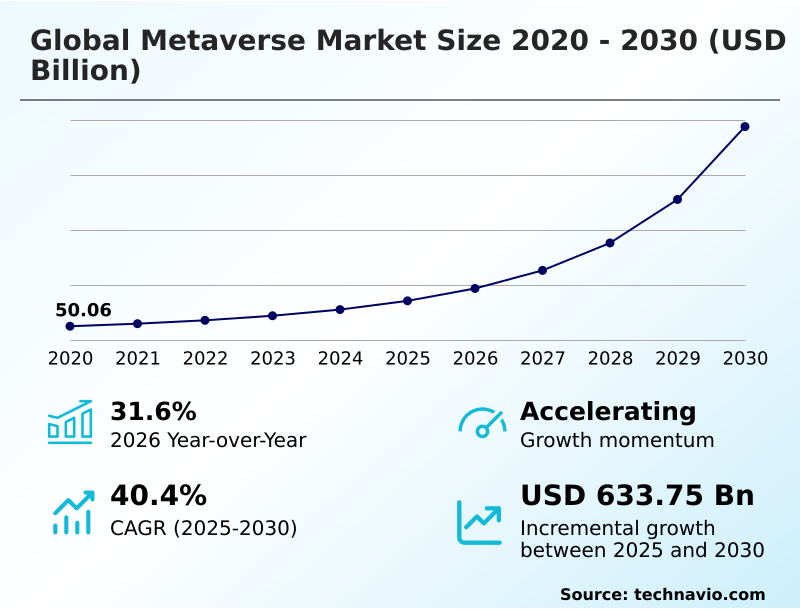
The metaverse market size is valued to increase by USD 633.75 billion, at a CAGR of 40.4% from 2025 to 2030. Acceleration of industrial digital twins and operational simulation will drive the metaverse market.
Major Market Trends & Insights
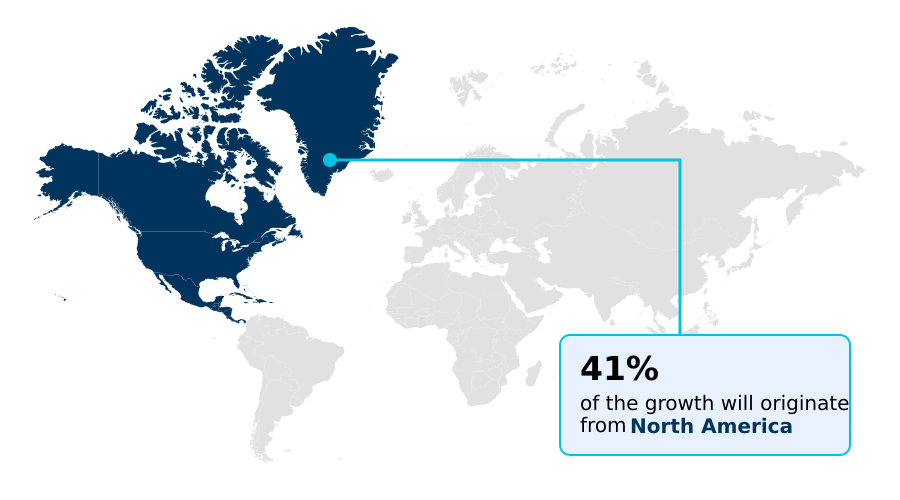
- North America dominated the market and accounted for a 41% growth during the forecast period.
- By Device - VR and AR devices segment was valued at USD 63.84 billion in 2024
- By Component - Hardware segment accounted for the largest market revenue share in 2024
Market Size & Forecast
- Market Opportunities: USD 726.07 billion
- Market Future Opportunities: USD 633.75 billion
- CAGR from 2025 to 2030 : 40.4%
Market Summary
- The metaverse market is undergoing a significant transformation, moving beyond consumer-centric entertainment to establish robust, utility-driven ecosystems for enterprise and industrial sectors. This evolution is defined by the convergence of advanced technologies, including spatial computing, generative AI, and decentralized frameworks, which collectively enable the creation of persistent, interconnected virtual environments.
- The focus has shifted toward developing high-value applications that deliver measurable returns, such as the use of digital twins in manufacturing. For instance, a firm can simulate its entire supply chain in a high-fidelity virtual replica, using predictive analytics to identify potential disruptions and optimize logistics, thereby reducing downtime and improving operational resilience.
- While the industrial metaverse gains traction, challenges surrounding interoperability between proprietary platforms and the need for robust data governance and privacy protocols remain. The development of interoperable digital identities and cross-platform compatibility is critical for fostering a unified digital economy.
- As hardware like mixed reality headsets becomes more accessible and powerful, and AI automates complex content creation, the market is positioned for broader adoption across diverse industries, solidifying its role as the next iteration of the internet.
What will be the Size of the Metaverse Market during the forecast period?
Get Key Insights on Market Forecast (PDF) Get Free Sample
How is the Metaverse Market Segmented?
The metaverse industry research report provides comprehensive data (region-wise segment analysis), with forecasts and estimates in "USD million" for the period 2026-2030, as well as historical data from 2020-2024 for the following segments.
- Device
- VR and AR devices
- Computing devices
- Component
- Hardware
- Software
- Services
- Platform
- Desktop
- Mobile
- Console
- Geography
- North America
- US
- Canada
- Mexico
- Europe
- Germany
- UK
- France
- APAC
- China
- Japan
- South Korea
- South America
- Brazil
- Argentina
- Middle East and Africa
- UAE
- Saudi Arabia
- South Africa
- Rest of World (ROW)
- North America
By Device Insights
The vr and ar devices segment is estimated to witness significant growth during the forecast period.
The virtual reality (VR) and augmented reality (AR) devices segment is the primary hardware gateway for the metaverse market, shifting from tethered systems to standalone, high-performance headsets with advanced spatial computing.
These devices are now distinct computing platforms facilitating immersive interaction through high-resolution displays, foveated rendering, and sophisticated sensor arrays for eye and hand tracking.
The proliferation is driven by declining micro-OLED component costs and AI integration at the silicon level, optimizing battery life.
A key trend is the institutionalization of the industrial metaverse, where high-fidelity digital twins allow organizations to simulate and optimize physical assets in a risk-free virtual environment.
By integrating real-time sensor data with physics-based rendering engines, enterprises can conduct complex engineering tests and logistical simulations.
The synergy between industrial automation and spatial computing ensures the metaverse serves as a foundational layer for the next stage of global manufacturing and urban planning, reducing research and development costs.
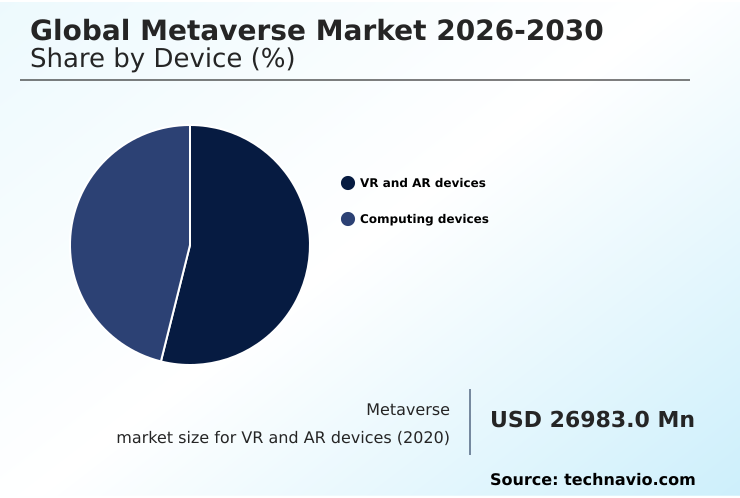
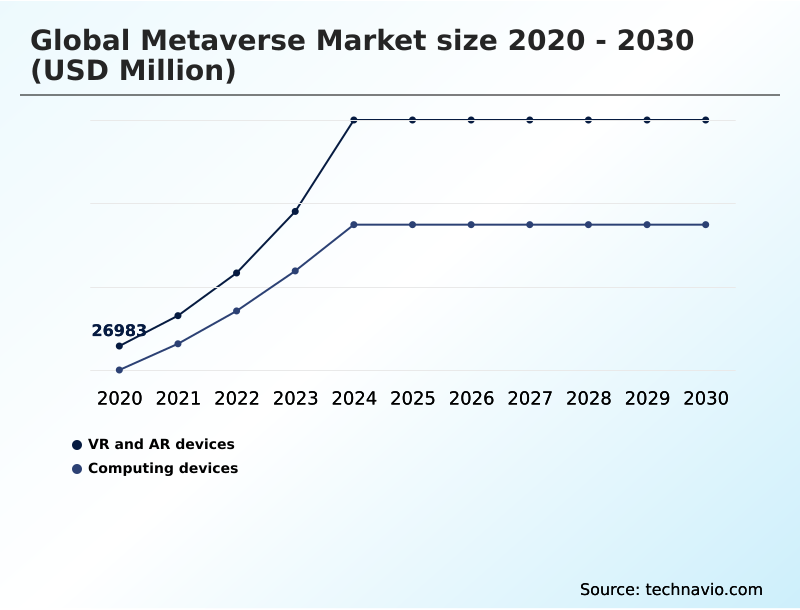
The VR and AR devices segment was valued at USD 63.84 billion in 2024 and showed a gradual increase during the forecast period.
Regional Analysis
North America is estimated to contribute 41% to the growth of the global market during the forecast period.Technavio’s analysts have elaborately explained the regional trends and drivers that shape the market during the forecast period.
See How Metaverse Market Demand is Rising in North America Get Free Sample
The geographic landscape of the metaverse market is diverse, with distinct regional specializations.
North America, contributing over 41% of the market opportunity, leads in enterprise adoption and venture capital investment, with a strong focus on the industrial metaverse and professional collaboration tools.
Europe is distinguished by its emphasis on regulatory governance, such as GDPR, and its leadership in industrial applications, particularly in Germany's automotive and manufacturing sectors. The region's commitment to data sovereignty and digital privacy shapes platform development.
Meanwhile, APAC is the fastest-growing region, driven by its massive, mobile-first user base and government support for digital infrastructure in countries like South Korea and China.
With a regional CAGR in the Middle East and Africa projected at 41.7%, nations like the UAE are making substantial investments in smart cities and virtual government services.
These regional dynamics highlight a global market that is simultaneously converging on core technologies and diverging in its application and regulatory priorities.
Market Dynamics
Our researchers analyzed the data with 2025 as the base year, along with the key drivers, trends, and challenges. A holistic analysis of drivers will help companies refine their marketing strategies to gain a competitive advantage.
- The evolution of the metaverse is contingent on solving complex technical and governance challenges. Establishing decentralized governance in virtual worlds is a primary focus, ensuring that platforms are not controlled by single entities. This is closely tied to the role of DAOs in platform governance, which empowers users with decision-making authority.
- The creator economy in decentralized platforms thrives on this model, but it also necessitates robust security protocols for virtual economies to prevent digital asset fraud. A key enabler for creators is the use of generative AI for 3D content creation, which automates the development of complex assets.
- Concurrently, industrial metaverse digital twin simulation is revolutionizing manufacturing, allowing for real-time simulation with digital twins for predictive maintenance and operational planning.These simulations rely on high-fidelity rendering for VR and advancements in haptic feedback for immersive experiences, delivering a tangible sense of presence.
- The success of these interconnected systems depends on spatial computing hardware advancements and the establishment of interoperability standards for metaverse platforms. Standardizing 3D asset formats and ensuring blockchain for digital asset verification are critical for a seamless user experience.
- Virtual collaboration in enterprise settings is becoming more common, powered by enterprise applications for mixed reality and AI-driven avatars for social interaction. However, this raises concerns about user data privacy in immersive environments. The challenges of building persistent worlds are significant, particularly concerning the impact of edge computing on latency, as high-speed, responsive interaction is non-negotiable for all applications.
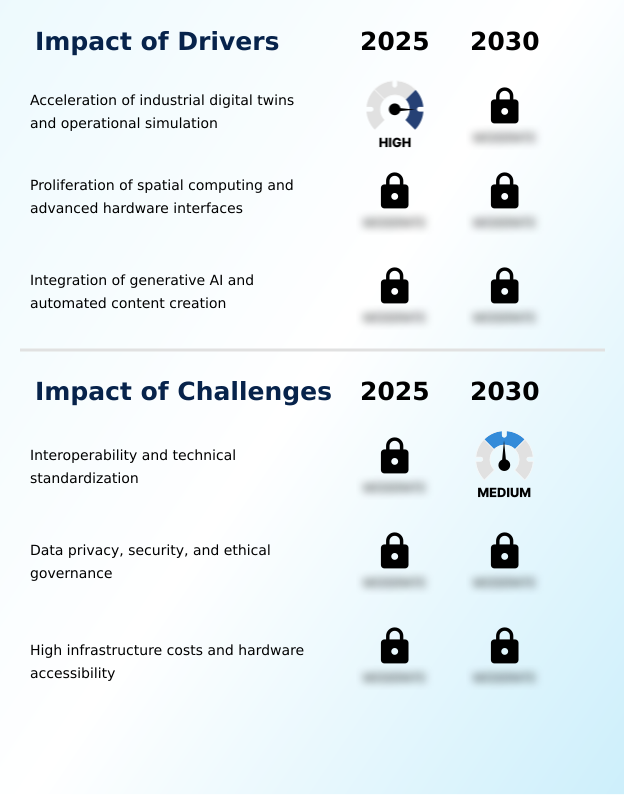
What are the key market drivers leading to the rise in the adoption of Metaverse Industry?
- The acceleration of industrial digital twins and operational simulation capabilities is a key driver for market growth.
- A primary driver for the global metaverse market is the rapid advancement and commercial availability of spatial computing hardware.
- This includes a new generation of mixed reality headsets and augmented reality glasses with significantly improved ergonomics, higher display resolutions, and more intuitive user interfaces.
- These devices are the main gateway for users to engage with 3D digital content, bridging the gap between flat-screen interactions and fully immersive experiences.
- The integration of advanced eye-tracking, hand gesture recognition, and spatial audio creates a more natural user experience. This technological leap has expanded the market from gaming enthusiasts to a broad spectrum of professional users.
- In regions like North America and APAC, high-performance devices have catalyzed the development of specialized software for architecture, healthcare, and remote collaboration.
- As hardware becomes more capable of blending digital layers with the physical environment, the utility of the metaverse increases beyond entertainment into daily productivity.
What are the market trends shaping the Metaverse Industry?
- The rise of the industrial metaverse, characterized by the adoption of high-fidelity digital twins, is a significant market trend. This development signals a shift toward practical, data-driven applications in virtual environments.
- A defining trend in the global metaverse market is the deep integration of generative artificial intelligence into the foundational architecture of virtual worlds. This technology revolutionizes how virtual spaces are built, moving away from static scenes toward dynamic, responsive environments.
- Generative AI tools empower both developers and users to create complex 3D assets, high-resolution textures, and interactive non-player characters using simple language prompts. This automation drastically reduces the time and capital required to expand the digital frontier, making it feasible for smaller enterprises to establish a robust virtual presence.
- In the consumer segment, this trend manifests as hyper-personalized experiences where the virtual environment adapts in real-time to user behaviors, fostering a higher level of immersion. This trend is particularly strong in the APAC region, where a vibrant developer ecosystem is leveraging AI to create massive, scalable social metaverses.
What challenges does the Metaverse Industry face during its growth?
- A lack of interoperability and technical standardization presents a key challenge affecting the industry's growth trajectory.
- The absence of universal technical standards is a significant structural challenge hindering the seamless expansion of the global metaverse market. The market is currently fragmented into numerous proprietary ecosystems, often called 'walled gardens,' where digital assets, avatars, and identity credentials cannot be easily transferred between platforms.
- This lack of interoperability stifles the network effects necessary for a unified digital economy, as users are forced to manage multiple accounts and repurchase assets across different virtual environments. For developers, creating content compatible with varying hardware requirements and software engines increases development costs and time-to-market.
- Furthermore, the high computational demands for real-time, low-latency rendering in decentralized environments put immense pressure on existing network infrastructures, especially in regions with developing digital connectivity. Without a consensus on open standards, the metaverse risks becoming a collection of isolated islands rather than a cohesive digital frontier.
Exclusive Technavio Analysis on Customer Landscape
The metaverse market forecasting report includes the adoption lifecycle of the market, covering from the innovator’s stage to the laggard’s stage. It focuses on adoption rates in different regions based on penetration. Furthermore, the metaverse market report also includes key purchase criteria and drivers of price sensitivity to help companies evaluate and develop their market growth analysis strategies.
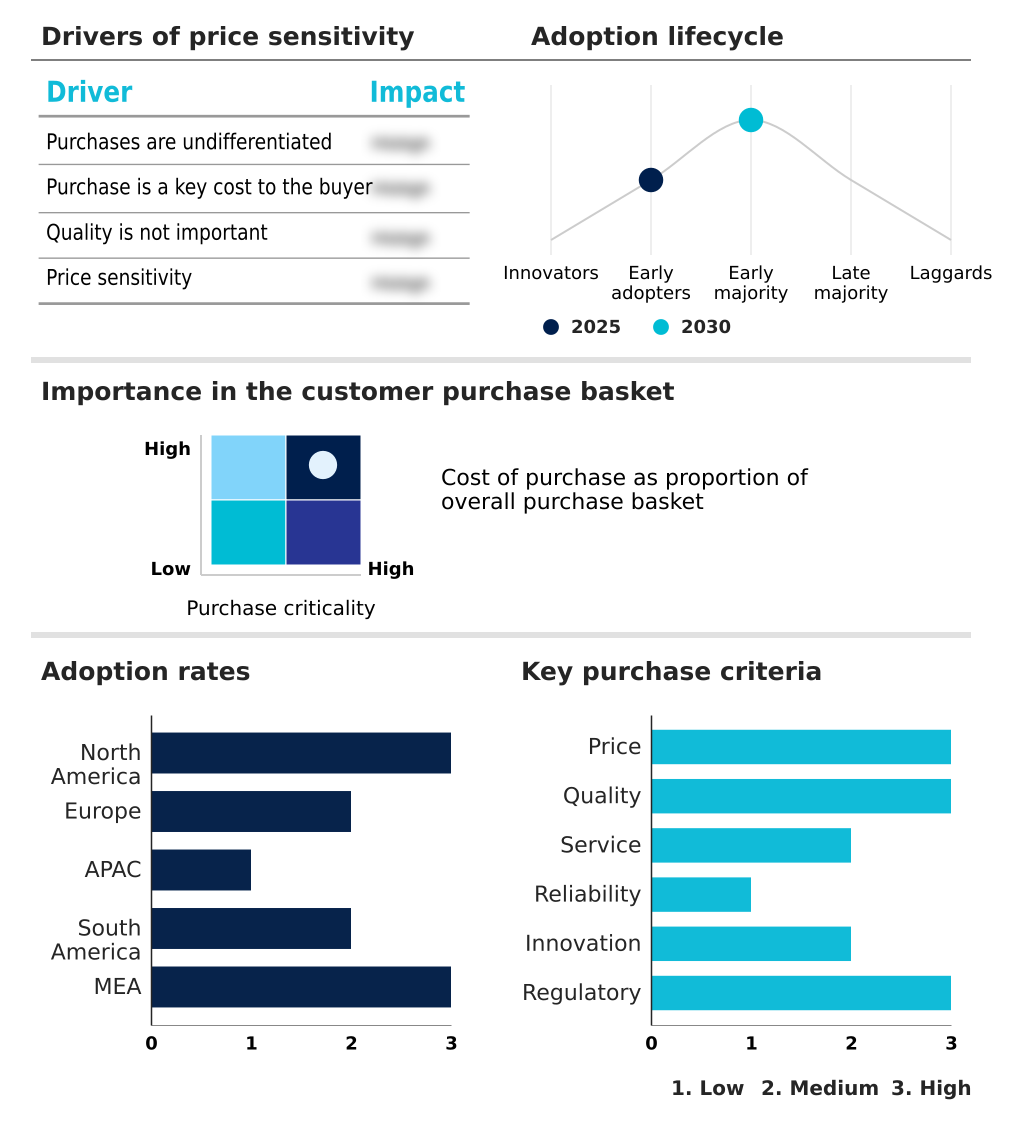
Customer Landscape of Metaverse Industry
Competitive Landscape
Companies are implementing various strategies, such as strategic alliances, metaverse market forecast, partnerships, mergers and acquisitions, geographical expansion, and product/service launches, to enhance their presence in the industry.
Accenture Plc - Delivers immersive enterprise services, facilitating virtual collaboration and comprehensive digital transformation for organizational growth.
The industry research and growth report includes detailed analyses of the competitive landscape of the market and information about key companies, including:
- Accenture Plc
- Animoca Brands Corp. Ltd.
- Apple Inc.
- ByteDance Ltd.
- Decentraland Foundation
- Electronic Arts Inc.
- Epic Games Inc.
- HTC Corp.
- Magic Leap Inc.
- Meta Platforms Inc.
- Microsoft Corp.
- NetEase Inc.
- NVIDIA Corp.
- Qualcomm Inc.
- Roblox Corp.
- Samsung Electronics Co. Ltd.
- Sony Group Corp.
- Tencent Holdings Ltd.
- Unity Technologies Inc.
- Verizon Communications Inc.
Qualitative and quantitative analysis of companies has been conducted to help clients understand the wider business environment as well as the strengths and weaknesses of key industry players. Data is qualitatively analyzed to categorize companies as pure play, category-focused, industry-focused, and diversified; it is quantitatively analyzed to categorize companies as dominant, leading, strong, tentative, and weak.
Recent Development and News in Metaverse market
- In September, 2024, The Metaverse Standards Forum released the Interoperability Protocol 2.0 framework, a critical step toward establishing common ground for 3D asset formats and identity management across major platforms, aiming to lower barriers for cross-platform commerce.
- In November, 2024, Meta Platforms strategically pivoted to a mixed-reality-first approach for its Horizon OS, launching the Meta Horizon Studio and Engine to empower a broader community of third-party developers for mobile and headset-based virtual experiences.
- In January, 2025, Siemens and NVIDIA expanded their strategic partnership to develop an Industrial AI Operating System, integrating the Siemens Xcelerator platform with NVIDIA Omniverse to create a unified environment for autonomous digital twins and revolutionize the industrial value chain.
- In March, 2025, The European Parliament reached a political agreement on amendments to the EU Artificial Intelligence Act, introducing strict prohibitions on non-consensual digital replicas and mandating higher transparency for AI-driven avatars that interact with human users in immersive environments.
Dive into Technavio’s robust research methodology, blending expert interviews, extensive data synthesis, and validated models for unparalleled Metaverse Market insights. See full methodology.
| Market Scope | |
|---|---|
| Page number | 295 |
| Base year | 2025 |
| Historic period | 2020-2024 |
| Forecast period | 2026-2030 |
| Growth momentum & CAGR | Accelerate at a CAGR of 40.4% |
| Market growth 2026-2030 | USD 633754.4 million |
| Market structure | Fragmented |
| YoY growth 2025-2026(%) | 31.6% |
| Key countries | US, Canada, Mexico, Germany, UK, France, Italy, Spain, The Netherlands, China, Japan, South Korea, India, Australia, Indonesia, Brazil, Argentina, Chile, UAE, Saudi Arabia, South Africa, Israel and Turkey |
| Competitive landscape | Leading Companies, Market Positioning of Companies, Competitive Strategies, and Industry Risks |
Research Analyst Overview
- The metaverse market is transitioning from a speculative concept to a tangible layer of the digital economy, driven by the convergence of foundational technologies. The integration of spatial computing, generative AI, and haptic feedback is enabling the creation of persistent virtual spaces that offer both immersive social experiences and high-utility enterprise solutions.
- These platforms are powered by sophisticated physics-based rendering and real-time 3D creation tools, supported by an infrastructure that includes edge computing and neural processing units to ensure low-latency rendering. A critical boardroom-level consideration is the development of interoperable digital identities, as this strategy is essential for mitigating the risks of vendor lock-in within proprietary ecosystems.
- The market is also addressing the need for decentralized applications and blockchain technology to secure transactions and verify ownership of digital assets. In industrial settings, the use of photorealistic environments for digital twins has demonstrated a 40% reduction in error rates for complex manual tasks, highlighting the technology's capacity to deliver measurable operational improvements.
- As mixed reality headsets and augmented reality glasses become more advanced and accessible, the market is poised to move beyond niche applications toward widespread adoption.
What are the Key Data Covered in this Metaverse Market Research and Growth Report?
-
What is the expected growth of the Metaverse Market between 2026 and 2030?
-
USD 633.75 billion, at a CAGR of 40.4%
-
-
What segmentation does the market report cover?
-
The report is segmented by Device (VR and AR devices, and Computing devices), Component (Hardware, Software, and Services), Platform (Desktop, Mobile, and Console) and Geography (North America, Europe, APAC, South America, Middle East and Africa)
-
-
Which regions are analyzed in the report?
-
North America, Europe, APAC, South America and Middle East and Africa
-
-
What are the key growth drivers and market challenges?
-
Acceleration of industrial digital twins and operational simulation, Interoperability and technical standardization
-
-
Who are the major players in the Metaverse Market?
-
Accenture Plc, Animoca Brands Corp. Ltd., Apple Inc., ByteDance Ltd., Decentraland Foundation, Electronic Arts Inc., Epic Games Inc., HTC Corp., Magic Leap Inc., Meta Platforms Inc., Microsoft Corp., NetEase Inc., NVIDIA Corp., Qualcomm Inc., Roblox Corp., Samsung Electronics Co. Ltd., Sony Group Corp., Tencent Holdings Ltd., Unity Technologies Inc. and Verizon Communications Inc.
-
Market Research Insights
- The metaverse market's dynamics are shaped by the interplay between rapid technological advancement and significant adoption hurdles. The integration of generative AI is a key driver, enabling the creation of dynamic virtual environments and automated content generation, which significantly reduces development costs.
- Proliferation of spatial computing and advanced hardware interfaces, including mixed reality headsets and augmented reality glasses, is expanding the user base beyond gaming into professional applications. However, challenges such as the lack of interoperability and technical standardization create fragmented ecosystems, or 'walled gardens,' limiting the seamless transfer of digital assets and identities.
- The high cost of hardware and the requirement for intensive cloud infrastructure create a digital divide, particularly in emerging economies. This balance of innovation and constraint defines the strategic landscape for companies navigating the transition to immersive digital economies.
We can help! Our analysts can customize this metaverse market research report to meet your requirements.
 RIA -
RIA - 
