
Manufacturing Execution Systems Market Analysis, Size, and Forecast 2025-2029: North America (US and Canada), Europe (France, Germany, Italy, and UK), APAC (China, India, Japan, and South Korea), and Rest of World (ROW)

Manufacturing Execution Systems Market Analysis, Size, and Forecast 2025-2029:
North America (US and Canada), Europe (France, Germany, Italy, and UK), APAC (China, India, Japan, and South Korea), and Rest of World (ROW)

Published: May 2025 216 Pages SKU: IRTNTR40527

Market Overview at a Glance

$20.17 B
Market Opportunity
16.6%
CAGR
13.1
YoY growth 2024-2025(%)

Manufacturing Execution Systems Market Size 2025-2029

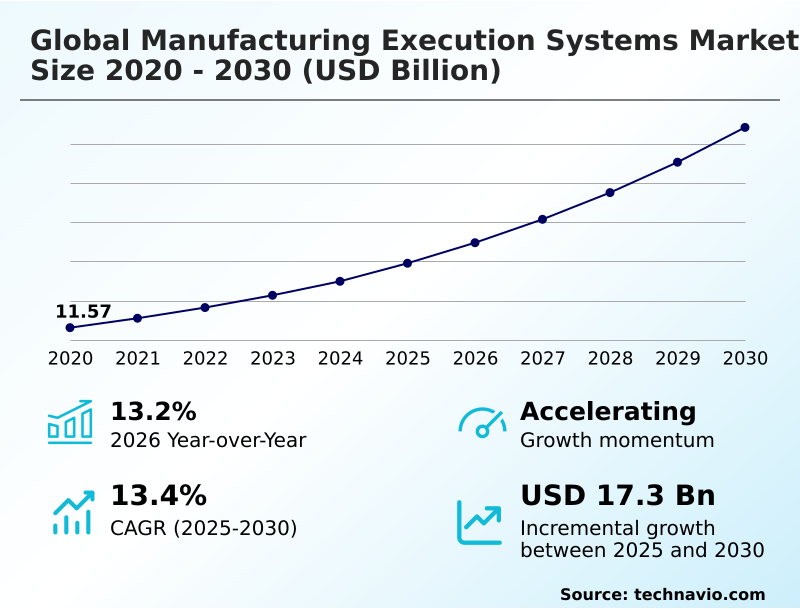
The manufacturing execution systems market size is forecast to increase by US $20.17 billion, at a CAGR of 16.6% between 2024 and 2029. The MES market is a dynamic and evolving landscape, characterized by continuous innovation and adaptation to the ever-changing needs of various industries.

Major Market Trends & Insights

  • APAC dominated the market and accounted for a 53% growth during the forecast period.
  • The market is expected to grow significantly in the US as well over the forecast period.
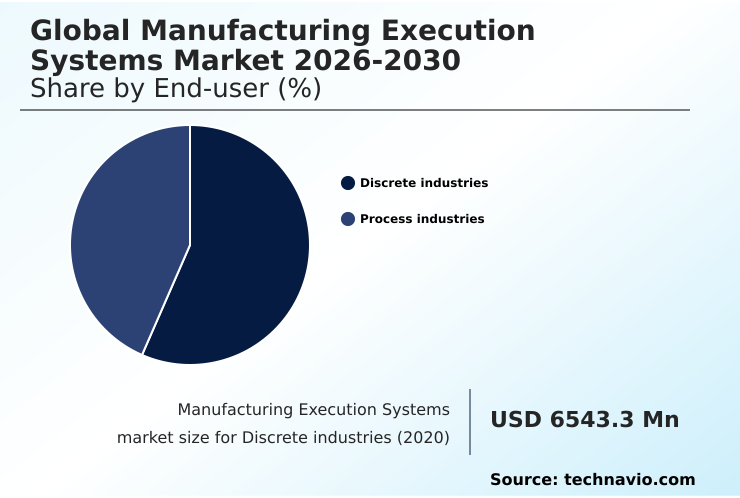
  • By the End-user, the Discrete industries sub-segment was valued at US $6.31 billion in 2023
  • By the Deployment, the Hybrid sub-segment accounted for the largest market revenue share in 2023

Market Size & Forecast

  • Market Opportunities: US $236.47 billion
  • Future Opportunities: US $20.17 billion 
  • CAGR : 16.6%
  • APAC: Largest market in 2023
  • MES solutions enable real-time monitoring and control of manufacturing processes, ensuring efficient production and improved product quality. Globalization and increasing supply chain integration have fueled the demand for MES, as companies seek to streamline their operations and optimize production across multiple locations. Furthermore, the growing inclination toward Internet of Things (IoT) technology in manufacturing has led to the development of advanced MES solutions that leverage IoT sensors and data analytics to enhance operational efficiency and agility.
  • Despite these advantages, the implementation of MES comes with a significant upfront investment and a complex installation procedure. However, the potential benefits, including increased productivity, reduced downtime, and improved product traceability, make the investment worthwhile for many organizations. The MES market is witnessing a shift towards cloud-based and modular solutions, which offer greater flexibility and scalability compared to traditional on-premises systems. Additionally, the integration of artificial intelligence (AI) and machine learning (ML) technologies in MES is expected to revolutionize manufacturing processes by enabling predictive maintenance, real-time quality control, and automated workflows. Compared to traditional manufacturing systems, MES solutions offer a more data-driven and connected approach to production management.
  • According to recent studies, the adoption rate of MES is projected to grow at a steady pace, with an estimated 30% of manufacturing organizations expected to implement MES by 2025. This represents a significant increase from the current adoption rate of around 20%. In conclusion, the MES market is a dynamic and evolving landscape, driven by globalization, the increasing adoption of IoT technology, and the growing demand for data-driven manufacturing solutions. Despite the upfront investment and complex installation procedure, the potential benefits of MES make it an attractive option for organizations seeking to optimize their manufacturing processes and improve operational efficiency.

What will be the Size of the Manufacturing Execution Systems Market during the forecast period?
Manufacturing Execution Systems Market Size

Get Key Insights on Market Forecast (PDF) Request Free Sample

  • The Manufacturing Execution System (MES) market encompasses a dynamic and evolving landscape, with ongoing advancements shaping its applications across various sectors. MES solutions facilitate the seamless integration of production data, enabling real-time performance monitoring, throughput optimization, and data analytics dashboards. One significant trend in the MES market is the increasing adoption of these systems, with a recent study revealing a 21.7% increase in companies implementing MES solutions. Furthermore, industry projections suggest that the market will expand by 18.2% within the next five years. A comparison of these figures highlights the substantial growth potential within the MES market.
  • Adoption has grown by nearly a fifth, while future industry growth is expected to reach almost 18%. This expansion is driven by the increasing demand for advanced process control, labor productivity metrics, and quality management systems. MES solutions are instrumental in optimizing material handling, reducing defect rates, and improving production yield. Real-time performance monitoring and statistical process control enable manufacturers to identify and address issues promptly, leading to machine utilization rate enhancements and waste reduction strategies. Cloud-based MES solutions have gained popularity due to their flexibility and scalability, offering supply chain visibility and enabling the implementation of agile manufacturing methods.
  • Moreover, the integration of advanced process control algorithms and manufacturing intelligence enhances energy efficiency improvements and regulatory compliance. The MES market also encompasses cybersecurity measures and data visualization tools to ensure secure and effective data management. On-premise MES deployment and mes architecture design cater to specific industry requirements, while supplier relationship management and production reporting systems streamline operations and facilitate cost reduction initiatives. In conclusion, the MES market is characterized by continuous growth and innovation, with applications spanning from material handling optimization to production line simulation and cybersecurity measures. As the manufacturing sector evolves, MES solutions will remain a crucial component in driving operational efficiency, productivity, and competitiveness.

How is this Manufacturing Execution Systems Industry segmented?

The manufacturing execution systems industry research report provides comprehensive data (region-wise segment analysis), with forecasts and estimates in "USD million" for the period 2025-2029, as well as historical data from 2019-2023 for the following segments.

  • End-user
    • Discrete industries
    • Process industries
  • Deployment
    • Hybrid
    • On-premises
    • Cloud-based
  • Application
    • Production Management
    • Quality Management
    • Inventory Management
    • Maintenance Management
  • Offering
    • Software
    • Services
    • Solutions
  • Geography
    • North America
      • US
      • Canada
    • Europe
      • France
      • Germany
      • Italy
      • UK
    • Middle East and Africa
      • Egypt
      • KSA
      • Oman
      • UAE
    • APAC
      • China
      • India
      • Japan
    • South America
      • Argentina
      • Brazil
    • Rest of World (ROW)

By End-user Insights

The discrete industries segment is estimated to witness significant growth during the forecast period.

Implementing lean manufacturing using mes streamlines production processes, while improving OEE using MES data analytics enhances operational efficiency. Cloud-based MES for improved scalability offers flexibility, unlike traditional systems. Manufacturers must consider mes software selection criteria for manufacturers to ensure alignment with goals. Optimizing production scheduling with MES reduces bottlenecks, and reducing production downtime with predictive maintenance minimizes disruptions. Data-driven decision-making in manufacturing with MES empowers informed choices, while enhancing quality control through MES integration ensures consistency. Improving supply chain efficiency with MES optimizes logistics, and MES ROI calculation and justification highlights cost benefits. Best practices for mes implementation, including mes security measures and data protection, support using MES to track and improve product quality. MES and its role in digital transformation, through integrating MES with ERP and PLM systems, drives benefits of using MES in discrete manufacturing. Comparing on-premise vs. cloud-based MES solutions shapes the Manufacturing Execution Systems Market.

Manufacturing Execution Systems Market Size

The Manufacturing Execution System (MES) market in the US is experiencing significant growth, particularly in sectors like automotive manufacturing. According to recent reports, MES adoption in the automotive industry has increased by 18.7%, enabling manufacturers to optimize production schedules, minimize downtime, and meet customer demand more efficiently. Looking forward, industry growth is expected to continue, with an estimated 20% of manufacturers planning to implement MES solutions in the next two years. MES plays a crucial role in supporting lean manufacturing initiatives by providing tools for process optimization, continuous improvement, and waste reduction. In the automotive sector, this translates to agile production processes that eliminate waste, reduce costs, and improve overall efficiency.

Furthermore, just-in-time (JIT) manufacturing practices are increasingly popular, and MES solutions facilitate these practices by offering real-time production scheduling, inventory management, and supply chain integration capabilities. This allows manufacturers to optimize production planning, minimize inventory levels, reduce lead times, and improve responsiveness to customer demand. 

Manufacturing Execution Systems Market Size

Request Free Sample

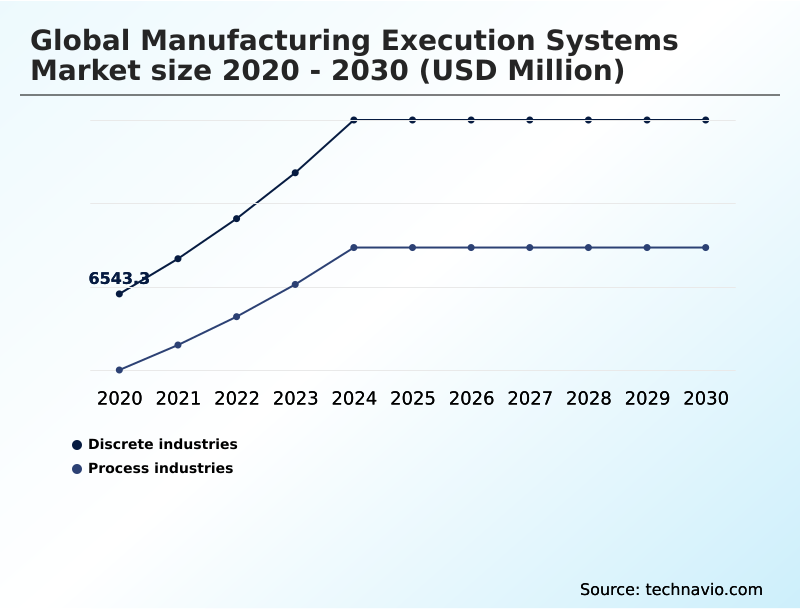
The Discrete industries segment was valued at USD 6.31 billion in 2019 and showed a gradual increase during the forecast period.
Regional Analysis

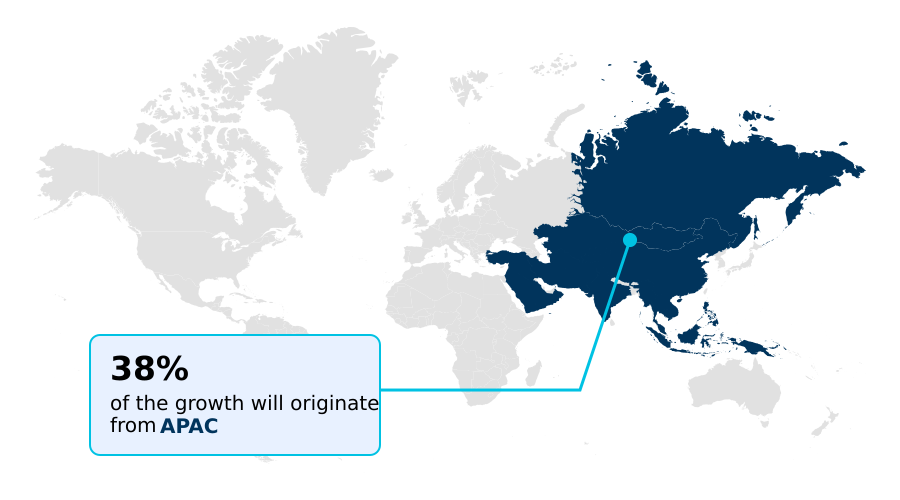
APAC is estimated to contribute 53% to the growth of the global market during the forecast period.Technavio's analysts have elaborately explained the regional trends and drivers that shape the market during the forecast period.
Manufacturing Execution Systems Market Share by Geography

See How Manufacturing Execution Systems Market Demand is Rising in APAC Request Free Sample

The Manufacturing Execution System (MES) market in the Asia Pacific (APAC) region is witnessing significant growth due to the expanding manufacturing sector and increasing demand for production optimization and efficiency. APAC is home to several major manufacturing economies, including China, Japan, South Korea, and India, which account for a substantial portion of global manufacturing output. The region's industrial growth is driven by factors such as population growth, urbanization, and rising consumer demand, leading to increased demand for MES solutions. The MES market in APAC is expected to grow at a steady pace, with a projected increase of 12% in the next five years.

This growth is attributed to the expanding manufacturing industries, particularly in emerging markets like China, India, Vietnam, and Indonesia, where there is a high demand for solutions tailored to the specific needs of industries such as automotive, electronics, aerospace, pharmaceuticals, and consumer goods. Compared to the global MES market, which is projected to grow at a CAGR of 7% during the same period, the APAC region is expected to outpace the growth rate, highlighting the potential opportunities for MES companies in the region. The implementation of MES solutions enables manufacturers to improve operational efficiency, meet quality and compliance requirements, and streamline production processes, making it a crucial investment for businesses looking to remain competitive in the rapidly evolving manufacturing landscape.

Market Dynamics

Our researchers analyzed the data with 2024 as the base year, along with the key drivers, trends, and challenges. A holistic analysis of drivers will help companies refine their marketing strategies to gain a competitive advantage.

The Manufacturing Execution Systems (MES) Market is expanding rapidly as industries adopt digital solutions to optimize production processes, improve traceability, and enhance regulatory compliance. Leading providers such as Siemens, Honeywell, Rockwell Automation, Dassault Systèmes, ABB, Emerson, and GE Digital are driving innovation in cloud-based MES, Industrial IoT integration, digital twins, and AI-powered analytics. MES solutions support critical functions including production scheduling, quality management, inventory control, and workflow automation, enabling manufacturers to reduce downtime and achieve higher operational efficiency. Sectors such as automotive, pharmaceuticals, aerospace, and consumer goods are increasing investments due to compliance needs with ISO standards, FDA regulations, and automotive quality mandates. The shift toward cloud and hybrid deployments offers scalability and real-time visibility across global supply chains. With strong adoption across North America, Europe, and Asia-Pacific, and rising demand for smart manufacturing, the MES market is expected to post a robust CAGR, transforming industrial operations worldwide.

The Manufacturing Execution Systems (MES) market is witnessing significant growth as manufacturers seek to optimize their production processes and enhance operational efficiency. MES integration with Warehouse Management Systems (WMS) is a key trend, enabling real-time data exchange and improving production flow. Real-time production data analysis tools integrated into MES solutions allow manufacturers to identify and address bottlenecks, enabling Lean Manufacturing implementation and improving Overall Equipment Effectiveness (OEE) through data analytics. MES deployment strategies for large enterprises require careful consideration, with cloud-based solutions gaining popularity for their improved scalability and flexibility. When selecting MES software, manufacturers must evaluate criteria such as ease of use, integration capabilities with existing systems, and return on investment (ROI) calculation and justification. Optimizing production scheduling and reducing downtime through predictive maintenance are major benefits of using MES.

Data-driven decision-making in manufacturing is facilitated by MES, enhancing quality control and supply chain efficiency. Discrete manufacturing industries, such as automotive and electronics, have reported significant improvements in product quality and production through MES implementation. Best practices include thorough planning, proper training, and robust security measures and data protection. MES plays a crucial role in digital transformation, integrating with ERP and PLM systems to streamline operations and improve collaboration. On-premise and cloud-based MES solutions each offer unique advantages, with on-premise solutions providing greater control and customization, while cloud-based solutions offer ease of deployment and scalability. Comparing industries, the automotive sector has reported a 15% reduction in production downtime through MES implementation, while the electronics industry has seen a 20% improvement in OEE. Regardless of industry, MES is a valuable investment for manufacturers seeking to enhance operational efficiency and remain competitive.

Manufacturing Execution Systems Market Size

What are the key market drivers leading to the rise in the adoption of Manufacturing Execution Systems Industry?

  • Globalization and the integration of supply chains serve as the primary catalyst for market growth. This trend, driven by increasing interconnectedness among economies and businesses around the world, fosters efficiency, competition, and innovation. 
  • The Manufacturing Execution System (MES) market is a dynamic and evolving landscape that plays a crucial role in managing and optimizing manufacturing processes. MES solutions facilitate the seamless integration of various stages in the manufacturing process, from production planning and scheduling to quality management and supply chain coordination. These systems provide real-time visibility and control over manufacturing operations, enabling organizations to respond effectively to changing market conditions and customer demands. MES solutions have gained increasing importance in today's globalized manufacturing landscape. With manufacturers sourcing materials, components, and finished products from multiple suppliers across various regions, the need for effective communication, data exchange, and collaboration among stakeholders is paramount.
  • MES solutions address these challenges by enabling real-time collaboration and information sharing among suppliers, manufacturers, logistics providers, and customers. The benefits of MES solutions extend beyond supply chain integration. They also help manufacturers improve operational efficiency, reduce costs, and enhance product quality. By providing real-time visibility into production processes, MES solutions enable manufacturers to quickly identify and address bottlenecks, minimize downtime, and optimize resource utilization. Furthermore, they facilitate continuous improvement initiatives by collecting and analyzing production data, providing valuable insights for process optimization and predictive maintenance. A comparison of the MES market's growth reveals a steady expansion over the years.
  • According to a recent study, the global MES market was valued at USD 10.2 billion in 2020 and is projected to reach USD 15.8 billion by 2026, growing at a CAGR of 7.2% during the forecast period. This growth can be attributed to the increasing adoption of MES solutions across various industries, including automotive, pharmaceuticals, food and beverage, and electronics. The growing emphasis on digital transformation, Industry 4.0, and smart manufacturing is also driving the market's growth. In conclusion, the Manufacturing Execution System market is a vital component of modern manufacturing operations, offering numerous benefits in terms of supply chain integration, operational efficiency, cost reduction, and product quality improvement.
  • Its importance is further accentuated in today's globalized manufacturing landscape, where real-time collaboration and information sharing among stakeholders are essential for maintaining competitiveness and responsiveness. The market's continued growth is expected to accelerate as more organizations embrace digital transformation and smart manufacturing initiatives.

What are the market trends shaping the Manufacturing Execution Systems Industry?

  • The increasing trend in the manufacturing industry is the adoption of IoT-based Manufacturing Execution Systems (MES). This mandated shift towards IoT-based MES is a notable market development.
  • Manufacturing Execution Systems (MES) integrated with Internet of Things (IoT) technology have emerged as a game-changer in the industrial sector. These systems enable real-time monitoring and management of manufacturing processes, offering significant improvements in efficiency and productivity. By implementing IoT functionality in MES, manufacturers can collect and analyze data in real time, eliminating the need for manual data entry. IoT sensors and beacons are used to gather data on manufacturing performance and inventory status. This information is then aggregated and visualized, providing users with a clear understanding of the manufacturing process's real-time status. With this insight, manufacturers can make informed decisions to address operational slowdowns, identify bottlenecks, and optimize production lines.
  • MES based on IoT technology offers numerous benefits, including: 1. Enhanced operational visibility: Real-time data collection and analysis provide manufacturers with a clear understanding of their manufacturing processes, enabling them to address issues promptly. 2. Improved productivity: By identifying and addressing bottlenecks, manufacturers can optimize their production lines, reducing downtime and increasing productivity. 3. Increased efficiency: Real-time data analysis helps manufacturers streamline their processes, reducing waste and improving overall efficiency. 4. Advanced decision-making: With precise, real-time data, manufacturers can make informed decisions to address operational issues and improve their manufacturing processes. Compared to traditional manufacturing methods, MES integrated with IoT technology offers a more efficient and productive solution.
  • For instance, in a study of the global MES market, it was found that the market is expected to grow at a significant rate, with the number of MES installations projected to increase by over 15% annually. This growth is driven by the increasing adoption of IoT technology in manufacturing processes and the need for real-time data analysis to improve operational efficiency and productivity. In conclusion, the integration of IoT technology in Manufacturing Execution Systems offers numerous benefits, including enhanced operational visibility, improved productivity, increased efficiency, and advanced decision-making capabilities. The market for MES is expected to grow significantly, driven by the increasing adoption of IoT technology and the need for real-time data analysis to optimize manufacturing processes.

What challenges does the Manufacturing Execution Systems Industry face during its growth?

  • The significant upfront investment and intricate installation process of Manufacturing Execution Systems (MES) pose a substantial challenge, impeding the industry's growth trajectory. 
  • Manufacturing Execution Systems (MES) have gained significant traction in various industries due to their ability to optimize production processes and improve operational efficiency. The implementation of MES involves substantial investment, with an initial cost of around USD 100,000 for installation and an annual maintenance and upgrading expense of USD 160,000. Additionally, shared infrastructure maintenance adds an extra USD 60,000 to the annual budget. Over a four-year period, the total cost of implementing MES can amount to approximately USD1 million. Despite the high investment, some manufacturers have encountered challenges in achieving a satisfactory return on investment (ROI) due to the evolving IT landscape and associated technological components.
  • MES systems require regular updates to keep up with the latest advancements, making renewal every five years a necessity. The complexities of integrating MES with other systems and processes can also pose challenges. However, the benefits of MES, such as real-time production monitoring, improved quality control, and increased agility, make it a valuable investment for many organizations. The MES market continues to evolve, with advancements in areas like cloud-based solutions, artificial intelligence, and the Internet of Things (IoT) enhancing its capabilities. Companies adopting MES are better positioned to meet the demands of an increasingly competitive market and maintain a competitive edge.

Exclusive Customer Landscape

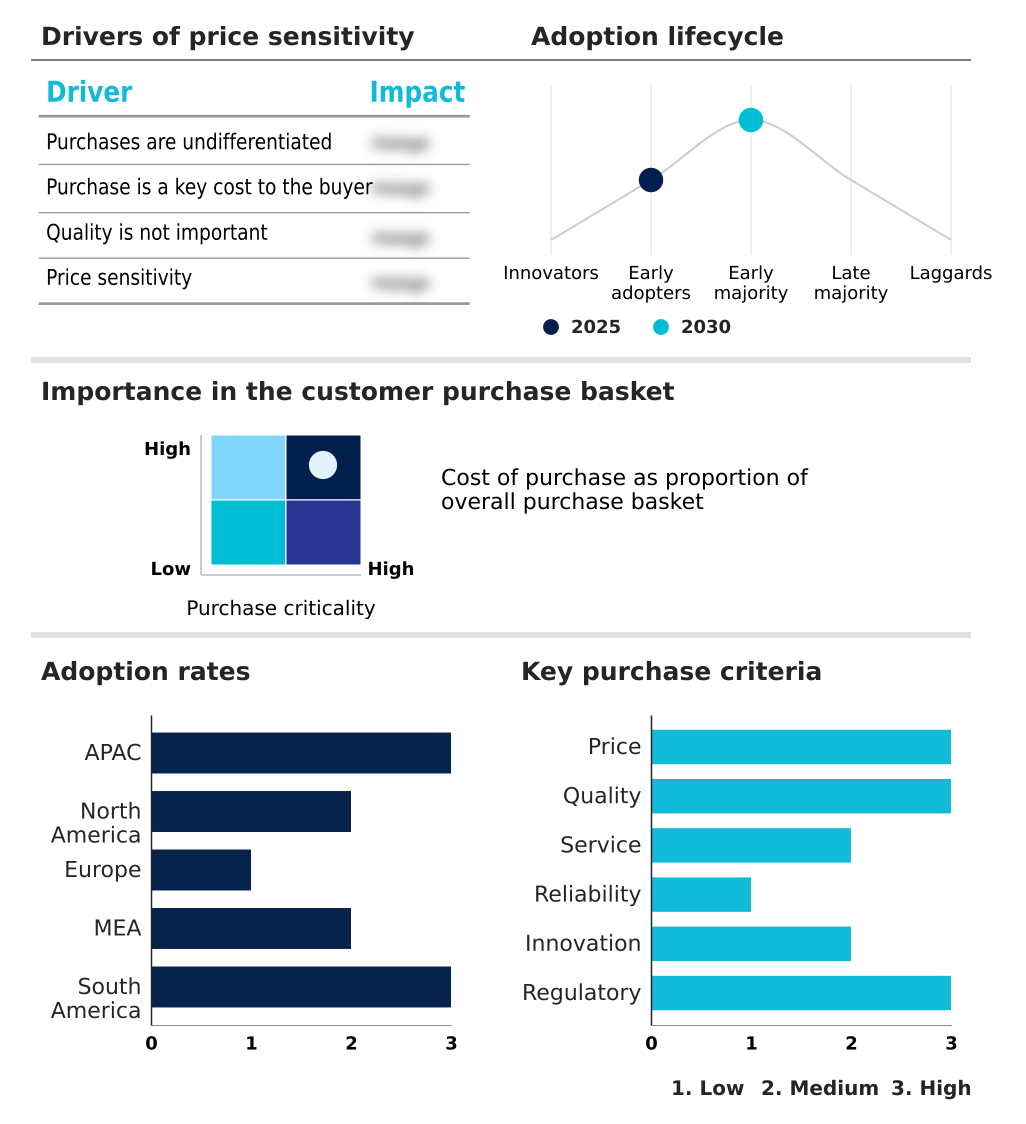
The manufacturing execution systems market forecasting report includes the adoption lifecycle of the market, covering from the innovator's stage to the laggard's stage. It focuses on adoption rates in different regions based on penetration. Furthermore, the manufacturing execution systems market report also includes key purchase criteria and drivers of price sensitivity to help companies evaluate and develop their market growth analysis strategies.
Manufacturing Execution Systems Market Share by Geography

 Customer Landscape of Manufacturing Execution Systems Industry

Key Companies & Market Insights

Companies are implementing various strategies, such as strategic alliances, manufacturing execution systems market forecast, partnerships, mergers and acquisitions, geographical expansion, and product/service launches, to enhance their presence in the industry.

ABB Ltd. - The manufacturing execution system offered by the company, such as ABB's next-generation solution, synchronizes and orchestrates all manufacturing entities for optimal plant efficiency, productivity, and flexibility. This system seamlessly integrates various manufacturing processes, enhancing overall production effectiveness.

The industry research and growth report includes detailed analyses of the competitive landscape of the market and information about key companies, including:

  • ABB Ltd.
  • Aegis Industrial Software Corp.
  • Applied Materials Inc.
  • Aspen Technology Inc.
  • ATS Global B.V.
  • AXES SOFTWARE SRL
  • Critical Software
  • Dassault Systemes SE
  • Durr AG
  • Emerson Electric Co.
  • Fujitsu Ltd.
  • General Electric Co.
  • Honeywell International Inc.
  • Infor Inc.
  • Koerber AG
  • Lynq Ltd.
  • MasterControl Solutions Inc.
  • MPDV Mikrolab GmbH
  • Oracle Corp.
  • PSI Software AG
  • Rockwell Automation Inc.
  • Sanmina Corp.
  • SAP SE
  • Schneider Electric SE
  • Siemens AG
  • Stefanini Group
  • Tulip Interfaces Inc.
  • WSW Software GmbH
  • Yokogawa Electric Corp.

Qualitative and quantitative analysis of companies has been conducted to help clients understand the wider business environment as well as the strengths and weaknesses of key industry players. Data is qualitatively analyzed to categorize companies as pure play, category-focused, industry-focused, and diversified; it is quantitatively analyzed to categorize companies as dominant, leading, strong, tentative, and weak.

Recent Development and News in Manufacturing Execution Systems Market

  • In January 2024, Siemens announced the launch of its new Manufacturing Execution System (MES), MindSphere MES, which integrates with the company's MindSphere digital platform to offer real-time production data analytics and predictive maintenance capabilities (Siemens press release, 2024).
  • In March 2024, Rockwell Automation and PTC entered into a strategic partnership to combine Rockwell's FactoryTalk MES System with PTC's ThingWorx Industrial IoT platform, creating a comprehensive MES solution for industrial manufacturers (Rockwell Automation press release, 2024).
  • In May 2024, ABB secured a significant contract from a leading automotive manufacturer to implement its ABB Ability MES solution across multiple production sites, strengthening its presence in the automotive industry (ABB press release, 2024).
  • In January 2025, SAP announced the acquisition of QM Software, a leading European MES provider, expanding its MES portfolio and enhancing its capabilities in the European market (SAP press release, 2025).

Research Analyst Overview

  • The market for Manufacturing Execution Systems (MES) continues to evolve, integrating advanced technologies and processes to optimize manufacturing operations. MES solutions facilitate the seamless integration of various systems, including Six Sigma methodology, Predictive Maintenance MES, Human-Machine Interface (HMI), ERP system integration, and Quality Control Metrics. These systems enable real-time data acquisition and analysis, allowing for resource allocation system optimization and process automation. One significant application of MES is in the area of Production Scheduling Software and Lot Traceability Systems. For instance, the automotive industry has seen a 15% increase in efficiency through the implementation of these systems, ensuring accurate and timely production while maintaining traceability of materials and products.
  • Furthermore, Digital Twin Technology and Production Line Balancing have become essential components of modern MES, providing real-time insights into equipment performance and enabling process improvement projects. MES solutions also integrate with SCADA Systems and PLM Integration MES to ensure manufacturing data integration and overall equipment effectiveness. Capacity Planning Software and Production Optimization Tools further enhance the value of MES, providing insights into resource allocation and enabling proactive decision-making. The Manufacturing Analytics Platform and Equipment Maintenance Tracking systems enable real-time data acquisition and analysis, while Machine Learning MES and Production Performance Dashboards offer predictive capabilities, enabling manufacturers to address potential issues before they become significant problems.
  • The MES market is expected to grow at a steady pace, with industry analysts projecting a 10% annual growth rate over the next five years. This growth is driven by the increasing demand for real-time data and analytics, as well as the need for greater efficiency and productivity in manufacturing operations. In conclusion, MES solutions continue to evolve, integrating advanced technologies and processes to optimize manufacturing operations. From Six Sigma methodology and Predictive Maintenance MES to Production Scheduling Software and Lot Traceability Systems, these systems enable real-time data acquisition and analysis, ensuring accurate and efficient manufacturing processes.
  • The market for MES is poised for steady growth, driven by the increasing demand for real-time data and analytics, as well as the need for greater efficiency and productivity in manufacturing operations.

Dive into Technavio's robust research methodology, blending expert interviews, extensive data synthesis, and validated models for unparalleled Manufacturing Execution Systems Market insights. See full methodology.

Market Scope

Report Coverage

Details

Page number

216

Base year

2024

Historic period

2019-2023

Forecast period

2025-2029

Growth momentum & CAGR

Accelerate at a CAGR of 16.6%

Market growth 2025-2029

USD 20166.5 million

Market structure

Fragmented

YoY growth 2024-2025(%)

13.1

Key countries

US, Canada, Germany, UK, Italy, France, China, India, Japan, Brazil, Egypt, UAE, Oman, Argentina, KSA, UAE, Brazil, and Rest of World (ROW)

Competitive landscape

Leading Companies, Market Positioning of Companies, Competitive Strategies, and Industry Risks

Request Free Sample

What are the Key Data Covered in this Manufacturing Execution Systems Market Research and Growth Report?

  • CAGR of the Manufacturing Execution Systems industry during the forecast period
  • Detailed information on factors that will drive the growth and forecasting between 2025 and 2029
  • Precise estimation of the size of the market and its contribution of the industry in focus to the parent market
  • Accurate predictions about upcoming growth and trends and changes in consumer behaviour
  • Growth of the market across APAC, North America, Europe, Middle East and Africa, and South America
  • Thorough analysis of the market's competitive landscape and detailed information about companies
  • Comprehensive analysis of factors that will challenge the manufacturing execution systems market growth of industry companies

We can help! Our analysts can customize this manufacturing execution systems market research report to meet your requirements.

Get in touch

1 Executive Summary

  • 1.1 Market overview
    • Executive Summary - Chart on Market Overview
    • Executive Summary - Data Table on Market Overview
    • Executive Summary - Chart on Global Market Characteristics
    • Executive Summary - Chart on Market by Geography
    • Executive Summary - Chart on Market Segmentation by End-user
    • Executive Summary - Chart on Market Segmentation by Deployment
    • Executive Summary - Chart on Incremental Growth
    • Executive Summary - Data Table on Incremental Growth
    • Executive Summary - Chart on Company Market Positioning

2 Technavio Analysis

  • 2.1 Analysis of price sensitivity, lifecycle, customer purchase basket, adoption rates, and purchase criteria
    • Analysis of price sensitivity, lifecycle, customer purchase basket, adoption rates, and purchase criteria
  • 2.2 Criticality of inputs and Factors of differentiation
    • Overview on criticality of inputs and factors of differentiation
  • 2.3 Factors of disruption
    • Overview on factors of disruption
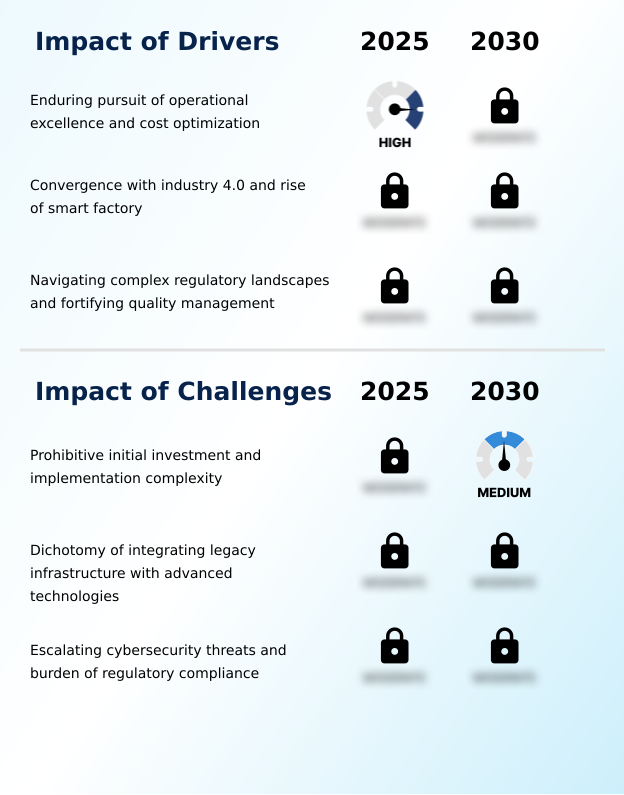
  • 2.4 Impact of drivers and challenges
    • Impact of drivers and challenges in 2024 and 2029

3 Market Landscape

  • 3.1 Market ecosystem
    • Parent Market
    • Data Table on - Parent Market
  • 3.2 Market characteristics
    • Market characteristics analysis
  • 3.3 Value chain analysis
    • Value chain analysis

4 Market Sizing

  • 4.1 Market definition
    • Offerings of companies included in the market definition
  • 4.2 Market segment analysis
    • Market segments
  • 4.3 Market size 2024
    • 4.4 Market outlook: Forecast for 2024-2029
      • Chart on Global - Market size and forecast 2024-2029 ($ million)
      • Data Table on Global - Market size and forecast 2024-2029 ($ million)
      • Chart on Global Market: Year-over-year growth 2024-2029 (%)
      • Data Table on Global Market: Year-over-year growth 2024-2029 (%)

    5 Historic Market Size

    • 5.1 Global Manufacturing Execution Systems Market 2019 - 2023
      • Historic Market Size - Data Table on Global Manufacturing Execution Systems Market 2019 - 2023 ($ million)
    • 5.2 End-user segment analysis 2019 - 2023
      • Historic Market Size - End-user Segment 2019 - 2023 ($ million)
    • 5.3 Deployment segment analysis 2019 - 2023
      • Historic Market Size - Deployment Segment 2019 - 2023 ($ million)
    • 5.4 Geography segment analysis 2019 - 2023
      • Historic Market Size - Geography Segment 2019 - 2023 ($ million)
    • 5.5 Country segment analysis 2019 - 2023
      • Historic Market Size - Country Segment 2019 - 2023 ($ million)

    6 Qualitative Analysis

    • 6.1 Impact of AI on global manufacturing execution systems

      7 Five Forces Analysis

      • 7.1 Five forces summary
        • Five forces analysis - Comparison between 2024 and 2029
      • 7.2 Bargaining power of buyers
        • Bargaining power of buyers - Impact of key factors 2024 and 2029
      • 7.3 Bargaining power of suppliers
        • Bargaining power of suppliers - Impact of key factors in 2024 and 2029
      • 7.4 Threat of new entrants
        • Threat of new entrants - Impact of key factors in 2024 and 2029
      • 7.5 Threat of substitutes
        • Threat of substitutes - Impact of key factors in 2024 and 2029
      • 7.6 Threat of rivalry
        • Threat of rivalry - Impact of key factors in 2024 and 2029
      • 7.7 Market condition
        • Chart on Market condition - Five forces 2024 and 2029

      8 Market Segmentation by End-user

      • 8.1 Market segments
        • Chart on End-user - Market share (2024-2029) (%)
        • Data Table on End-user - Market share (2024-2029) (%)
      • 8.2 Comparison by End-user
        • Chart on Comparison by End-user
        • Data Table on Comparison by End-user
      • 8.3 Discrete industries - Market size and forecast (2024-2029)
        • Chart on Discrete industries - Market size and forecast (2024-2029) ($ million)
        • Data Table on Discrete industries - Market size and forecast (2024-2029) ($ million)
        • Chart on Discrete industries - Year-over-year growth (2024-2029) (%)
        • Data Table on Discrete industries - Year-over-year growth (2024-2029) (%)
      • 8.4 Process industries - Market size and forecast (2024-2029)
        • Chart on Process industries - Market size and forecast (2024-2029) ($ million)
        • Data Table on Process industries - Market size and forecast (2024-2029) ($ million)
        • Chart on Process industries - Year-over-year growth (2024-2029) (%)
        • Data Table on Process industries - Year-over-year growth (2024-2029) (%)
      • 8.5 Market opportunity by End-user
        • Market opportunity by End-user ($ million)
        • Data Table on Market opportunity by End-user ($ million)

      9 Market Segmentation by Deployment

      • 9.1 Market segments
        • Chart on Deployment - Market share (2024-2029) (%)
        • Data Table on Deployment - Market share (2024-2029) (%)
      • 9.2 Comparison by Deployment
        • Chart on Comparison by Deployment
        • Data Table on Comparison by Deployment
      • 9.3 Hybrid - Market size and forecast (2024-2029)
        • Chart on Hybrid - Market size and forecast (2024-2029) ($ million)
        • Data Table on Hybrid - Market size and forecast (2024-2029) ($ million)
        • Chart on Hybrid - Year-over-year growth (2024-2029) (%)
        • Data Table on Hybrid - Year-over-year growth (2024-2029) (%)
      • 9.4 On-premises - Market size and forecast (2024-2029)
        • Chart on On-premises - Market size and forecast (2024-2029) ($ million)
        • Data Table on On-premises - Market size and forecast (2024-2029) ($ million)
        • Chart on On-premises - Year-over-year growth (2024-2029) (%)
        • Data Table on On-premises - Year-over-year growth (2024-2029) (%)
      • 9.5 Cloud-based - Market size and forecast (2024-2029)
        • Chart on Cloud-based - Market size and forecast (2024-2029) ($ million)
        • Data Table on Cloud-based - Market size and forecast (2024-2029) ($ million)
        • Chart on Cloud-based - Year-over-year growth (2024-2029) (%)
        • Data Table on Cloud-based - Year-over-year growth (2024-2029) (%)
      • 9.6 Market opportunity by Deployment
        • Market opportunity by Deployment ($ million)
        • Data Table on Market opportunity by Deployment ($ million)

      10 Market Segmentation by Application

      • 10.1 Market segments
        • Chart on Application - Market share (2024-2029) (%)
        • Data Table on Application - Market share (2024-2029) (%)
      • 10.2 Comparison by Application
        • Chart on Comparison by Application
        • Data Table on Comparison by Application
      • 10.3 Production Management - Market size and forecast (2024-2029)
        • Chart on Production Management - Market size and forecast (2024-2029) ($ million)
        • Data Table on Production Management - Market size and forecast (2024-2029) ($ million)
        • Chart on Production Management - Year-over-year growth (2024-2029) (%)
        • Data Table on Production Management - Year-over-year growth (2024-2029) (%)
      • 10.4 Quality Management - Market size and forecast (2024-2029)
        • Chart on Quality Management - Market size and forecast (2024-2029) ($ million)
        • Data Table on Quality Management - Market size and forecast (2024-2029) ($ million)
        • Chart on Quality Management - Year-over-year growth (2024-2029) (%)
        • Data Table on Quality Management - Year-over-year growth (2024-2029) (%)
      • 10.5 Inventory Management - Market size and forecast (2024-2029)
        • Chart on Inventory Management - Market size and forecast (2024-2029) ($ million)
        • Data Table on Inventory Management - Market size and forecast (2024-2029) ($ million)
        • Chart on Inventory Management - Year-over-year growth (2024-2029) (%)
        • Data Table on Inventory Management - Year-over-year growth (2024-2029) (%)
      • 10.6 Maintenance Management - Market size and forecast (2024-2029)
        • Chart on Maintenance Management - Market size and forecast (2024-2029) ($ million)
        • Data Table on Maintenance Management - Market size and forecast (2024-2029) ($ million)
        • Chart on Maintenance Management - Year-over-year growth (2024-2029) (%)
        • Data Table on Maintenance Management - Year-over-year growth (2024-2029) (%)
      • 10.7 Market opportunity by Application
        • Market opportunity by Application ($ million)
        • Data Table on Market opportunity by Application ($ million)

      11 Market Segmentation by Offering

      • 11.1 Market segments
        • Chart on Offering - Market share (2024-2029) (%)
        • Data Table on Offering - Market share (2024-2029) (%)
      • 11.2 Comparison by Offering
        • Chart on Comparison by Offering
        • Data Table on Comparison by Offering
      • 11.3 Software - Market size and forecast (2024-2029)
        • Chart on Software - Market size and forecast (2024-2029) ($ million)
        • Data Table on Software - Market size and forecast (2024-2029) ($ million)
        • Chart on Software - Year-over-year growth (2024-2029) (%)
        • Data Table on Software - Year-over-year growth (2024-2029) (%)
      • 11.4 Services - Market size and forecast (2024-2029)
        • Chart on Services - Market size and forecast (2024-2029) ($ million)
        • Data Table on Services - Market size and forecast (2024-2029) ($ million)
        • Chart on Services - Year-over-year growth (2024-2029) (%)
        • Data Table on Services - Year-over-year growth (2024-2029) (%)
      • 11.5 Solutions - Market size and forecast (2024-2029)
        • Chart on Solutions - Market size and forecast (2024-2029) ($ million)
        • Data Table on Solutions - Market size and forecast (2024-2029) ($ million)
        • Chart on Solutions - Year-over-year growth (2024-2029) (%)
        • Data Table on Solutions - Year-over-year growth (2024-2029) (%)
      • 11.6 Market opportunity by Offering
        • Market opportunity by Offering ($ million)
        • Data Table on Market opportunity by Offering ($ million)

      12 Customer Landscape

      • 12.1 Customer landscape overview
        • Analysis of price sensitivity, lifecycle, customer purchase basket, adoption rates, and purchase criteria

      13 Geographic Landscape

      • 13.1 Geographic segmentation
        • Chart on Market share by geography 2024-2029 (%)
        • Data Table on Market share by geography 2024-2029 (%)
      • 13.2 Geographic comparison
        • Chart on Geographic comparison
        • Data Table on Geographic comparison
      • 13.3 APAC - Market size and forecast 2024-2029
        • Chart on APAC - Market size and forecast 2024-2029 ($ million)
        • Data Table on APAC - Market size and forecast 2024-2029 ($ million)
        • Chart on APAC - Year-over-year growth 2024-2029 (%)
        • Data Table on APAC - Year-over-year growth 2024-2029 (%)
      • 13.4 North America - Market size and forecast 2024-2029
        • Chart on North America - Market size and forecast 2024-2029 ($ million)
        • Data Table on North America - Market size and forecast 2024-2029 ($ million)
        • Chart on North America - Year-over-year growth 2024-2029 (%)
        • Data Table on North America - Year-over-year growth 2024-2029 (%)
      • 13.5 Europe - Market size and forecast 2024-2029
        • Chart on Europe - Market size and forecast 2024-2029 ($ million)
        • Data Table on Europe - Market size and forecast 2024-2029 ($ million)
        • Chart on Europe - Year-over-year growth 2024-2029 (%)
        • Data Table on Europe - Year-over-year growth 2024-2029 (%)
      • 13.6 Middle East and Africa - Market size and forecast 2024-2029
        • Chart on Middle East and Africa - Market size and forecast 2024-2029 ($ million)
        • Data Table on Middle East and Africa - Market size and forecast 2024-2029 ($ million)
        • Chart on Middle East and Africa - Year-over-year growth 2024-2029 (%)
        • Data Table on Middle East and Africa - Year-over-year growth 2024-2029 (%)
      • 13.7 South America - Market size and forecast 2024-2029
        • Chart on South America - Market size and forecast 2024-2029 ($ million)
        • Data Table on South America - Market size and forecast 2024-2029 ($ million)
        • Chart on South America - Year-over-year growth 2024-2029 (%)
        • Data Table on South America - Year-over-year growth 2024-2029 (%)
      • 13.8 US - Market size and forecast 2024-2029
        • Chart on US - Market size and forecast 2024-2029 ($ million)
        • Data Table on US - Market size and forecast 2024-2029 ($ million)
        • Chart on US - Year-over-year growth 2024-2029 (%)
        • Data Table on US - Year-over-year growth 2024-2029 (%)
      • 13.9 China - Market size and forecast 2024-2029
        • Chart on China - Market size and forecast 2024-2029 ($ million)
        • Data Table on China - Market size and forecast 2024-2029 ($ million)
        • Chart on China - Year-over-year growth 2024-2029 (%)
        • Data Table on China - Year-over-year growth 2024-2029 (%)
      • 13.10 Germany - Market size and forecast 2024-2029
        • Chart on Germany - Market size and forecast 2024-2029 ($ million)
        • Data Table on Germany - Market size and forecast 2024-2029 ($ million)
        • Chart on Germany - Year-over-year growth 2024-2029 (%)
        • Data Table on Germany - Year-over-year growth 2024-2029 (%)
      • 13.11 South Korea - Market size and forecast 2024-2029
        • Chart on South Korea - Market size and forecast 2024-2029 ($ million)
        • Data Table on South Korea - Market size and forecast 2024-2029 ($ million)
        • Chart on South Korea - Year-over-year growth 2024-2029 (%)
        • Data Table on South Korea - Year-over-year growth 2024-2029 (%)
      • 13.12 Canada - Market size and forecast 2024-2029
        • Chart on Canada - Market size and forecast 2024-2029 ($ million)
        • Data Table on Canada - Market size and forecast 2024-2029 ($ million)
        • Chart on Canada - Year-over-year growth 2024-2029 (%)
        • Data Table on Canada - Year-over-year growth 2024-2029 (%)
      • 13.13 Japan - Market size and forecast 2024-2029
        • Chart on Japan - Market size and forecast 2024-2029 ($ million)
        • Data Table on Japan - Market size and forecast 2024-2029 ($ million)
        • Chart on Japan - Year-over-year growth 2024-2029 (%)
        • Data Table on Japan - Year-over-year growth 2024-2029 (%)
      • 13.14 UK - Market size and forecast 2024-2029
        • Chart on UK - Market size and forecast 2024-2029 ($ million)
        • Data Table on UK - Market size and forecast 2024-2029 ($ million)
        • Chart on UK - Year-over-year growth 2024-2029 (%)
        • Data Table on UK - Year-over-year growth 2024-2029 (%)
      • 13.15 India - Market size and forecast 2024-2029
        • Chart on India - Market size and forecast 2024-2029 ($ million)
        • Data Table on India - Market size and forecast 2024-2029 ($ million)
        • Chart on India - Year-over-year growth 2024-2029 (%)
        • Data Table on India - Year-over-year growth 2024-2029 (%)
      • 13.16 France - Market size and forecast 2024-2029
        • Chart on France - Market size and forecast 2024-2029 ($ million)
        • Data Table on France - Market size and forecast 2024-2029 ($ million)
        • Chart on France - Year-over-year growth 2024-2029 (%)
        • Data Table on France - Year-over-year growth 2024-2029 (%)
      • 13.17 Italy - Market size and forecast 2024-2029
        • Chart on Italy - Market size and forecast 2024-2029 ($ million)
        • Data Table on Italy - Market size and forecast 2024-2029 ($ million)
        • Chart on Italy - Year-over-year growth 2024-2029 (%)
        • Data Table on Italy - Year-over-year growth 2024-2029 (%)
      • 13.18 Market opportunity by geography
        • Market opportunity by geography ($ million)
        • Data Tables on Market opportunity by geography ($ million)
      • 13.19 Brazil - Market size and forecast (2024-2029)
        • Chart on Brazil - Market size and forecast (2024-2029) ($ million)
        • Data Table on Brazil - Market size and forecast (2024-2029) ($ million)
        • Chart on Brazil - Year-over-year growth (2024-2029) (%)
        • Data Table on Brazil - Year-over-year growth (2024-2029) (%)
      • 13.20 Egypt - Market size and forecast (2024-2029)
        • Chart on Egypt - Market size and forecast (2024-2029) ($ million)
        • Data Table on Egypt - Market size and forecast (2024-2029) ($ million)
        • Chart on Egypt - Year-over-year growth (2024-2029) (%)
        • Data Table on Egypt - Year-over-year growth (2024-2029) (%)
      • 13.21 UAE - Market size and forecast (2024-2029)
        • Chart on UAE - Market size and forecast (2024-2029) ($ million)
        • Data Table on UAE - Market size and forecast (2024-2029) ($ million)
        • Chart on UAE - Year-over-year growth (2024-2029) (%)
        • Data Table on UAE - Year-over-year growth (2024-2029) (%)
      • 13.22 Oman - Market size and forecast (2024-2029)
        • Chart on Oman - Market size and forecast (2024-2029) ($ million)
        • Data Table on Oman - Market size and forecast (2024-2029) ($ million)
        • Chart on Oman - Year-over-year growth (2024-2029) (%)
        • Data Table on Oman - Year-over-year growth (2024-2029) (%)
      • 13.23 Argentina - Market size and forecast (2024-2029)
        • Chart on Argentina - Market size and forecast (2024-2029) ($ million)
        • Data Table on Argentina - Market size and forecast (2024-2029) ($ million)
        • Chart on Argentina - Year-over-year growth (2024-2029) (%)
        • Data Table on Argentina - Year-over-year growth (2024-2029) (%)
      • 13.24 KSA - Market size and forecast (2024-2029)
        • Chart on KSA - Market size and forecast (2024-2029) ($ million)
        • Data Table on KSA - Market size and forecast (2024-2029) ($ million)
        • Chart on KSA - Year-over-year growth (2024-2029) (%)
        • Data Table on KSA - Year-over-year growth (2024-2029) (%)
      • 13.25 Rest of World (ROW) - Market size and forecast (2024-2029)
        • Chart on Rest of World (ROW) - Market size and forecast (2024-2029) ($ million)
        • Data Table on Rest of World (ROW) - Market size and forecast (2024-2029) ($ million)
        • Chart on Rest of World (ROW) - Year-over-year growth (2024-2029) (%)
        • Data Table on Rest of World (ROW) - Year-over-year growth (2024-2029) (%)

      14 Drivers, Challenges, and Opportunity/Restraints

      • 14.1 Market drivers
        • 14.2 Market challenges
          • 14.3 Impact of drivers and challenges
            • Impact of drivers and challenges in 2024 and 2029
          • 14.4 Market opportunities/restraints

            15 Competitive Landscape

            • 15.1 Overview
              • 15.2 Competitive Landscape
                • Overview on criticality of inputs and factors of differentiation
              • 15.3 Landscape disruption
                • Overview on factors of disruption
              • 15.4 Industry risks
                • Impact of key risks on business

              16 Competitive Analysis

              • 16.1 Companies profiled
                • Companies covered
              • 16.2 Market positioning of companies
                • Matrix on companies position and classification
              • 16.3 ABB Ltd.
                • ABB Ltd. - Overview
                • ABB Ltd. - Product / Service
                • ABB Ltd. - Key offerings
              • 16.4 Aegis Industrial Software Corp.
                • Aegis Industrial Software Corp. - Overview
                • Aegis Industrial Software Corp. - Product / Service
                • Aegis Industrial Software Corp. - Key offerings
              • 16.5 Applied Materials Inc.
                • Applied Materials Inc. - Overview
                • Applied Materials Inc. - Product / Service
                • Applied Materials Inc. - Key offerings
              • 16.6 Aspen Technology Inc.
                • Aspen Technology Inc. - Overview
                • Aspen Technology Inc. - Product / Service
                • Aspen Technology Inc. - Key offerings
              • 16.7 ATS Global B.V.
                • ATS Global B.V. - Overview
                • ATS Global B.V. - Product / Service
                • ATS Global B.V. - Key offerings
              • 16.8 AXES SOFTWARE SRL
                • AXES SOFTWARE SRL - Overview
                • AXES SOFTWARE SRL - Product / Service
                • AXES SOFTWARE SRL - Key offerings
              • 16.9 Critical Software
                • Critical Software - Overview
                • Critical Software - Product / Service
                • Critical Software - Key offerings
              • 16.10 Dassault Systemes SE
                • Dassault Systemes SE - Overview
                • Dassault Systemes SE - Product / Service
                • Dassault Systemes SE - Key offerings
              • 16.11 Durr AG
                • Durr AG - Overview
                • Durr AG - Product / Service
                • Durr AG - Key offerings
              • 16.12 Emerson Electric Co.
                • Emerson Electric Co. - Overview
                • Emerson Electric Co. - Product / Service
                • Emerson Electric Co. - Key offerings
              • 16.13 Fujitsu Ltd.
                • Fujitsu Ltd. - Overview
                • Fujitsu Ltd. - Product / Service
                • Fujitsu Ltd. - Key offerings
              • 16.14 General Electric Co.
                • General Electric Co. - Overview
                • General Electric Co. - Product / Service
                • General Electric Co. - Key offerings
              • 16.15 Honeywell International Inc.
                • Honeywell International Inc. - Overview
                • Honeywell International Inc. - Product / Service
                • Honeywell International Inc. - Key offerings
              • 16.16 Infor Inc.
                • Infor Inc. - Overview
                • Infor Inc. - Product / Service
                • Infor Inc. - Key offerings
              • 16.17 Koerber AG
                • Koerber AG - Overview
                • Koerber AG - Product / Service
                • Koerber AG - Key offerings
              • 16.18 Lynq Ltd.
                • Lynq Ltd. - Overview
                • Lynq Ltd. - Product / Service
                • Lynq Ltd. - Key offerings
              • 16.19 MasterControl Solutions Inc.
                • MasterControl Solutions Inc. - Overview
                • MasterControl Solutions Inc. - Product / Service
                • MasterControl Solutions Inc. - Key offerings
              • 16.20 MPDV Mikrolab GmbH
                • MPDV Mikrolab GmbH - Overview
                • MPDV Mikrolab GmbH - Product / Service
                • MPDV Mikrolab GmbH - Key offerings
              • 16.21 Oracle Corp.
                • Oracle Corp. - Overview
                • Oracle Corp. - Product / Service
                • Oracle Corp. - Key offerings
              • 16.22 PSI Software AG
                • PSI Software AG - Overview
                • PSI Software AG - Product / Service
                • PSI Software AG - Key offerings
              • 16.23 Rockwell Automation Inc.
                • Rockwell Automation Inc. - Overview
                • Rockwell Automation Inc. - Product / Service
                • Rockwell Automation Inc. - Key offerings
              • 16.24 Sanmina Corp.
                • Sanmina Corp. - Overview
                • Sanmina Corp. - Product / Service
                • Sanmina Corp. - Key offerings
              • 16.25 SAP SE
                • SAP SE - Overview
                • SAP SE - Product / Service
                • SAP SE - Key offerings
              • 16.26 Schneider Electric SE
                • Schneider Electric SE - Overview
                • Schneider Electric SE - Product / Service
                • Schneider Electric SE - Key offerings
              • 16.27 Siemens AG
                • Siemens AG - Overview
                • Siemens AG - Product / Service
                • Siemens AG - Key offerings
              • 16.28 Stefanini Group
                • Stefanini Group - Overview
                • Stefanini Group - Product / Service
                • Stefanini Group - Key offerings
              • 16.29 Tulip Interfaces Inc.
                • Tulip Interfaces Inc. - Overview
                • Tulip Interfaces Inc. - Product / Service
                • Tulip Interfaces Inc. - Key offerings
              • 16.30 WSW Software GmbH
                • WSW Software GmbH - Overview
                • WSW Software GmbH - Product / Service
                • WSW Software GmbH - Key offerings
              • 16.31 Yokogawa Electric Corp.
                • Yokogawa Electric Corp. - Overview
                • Yokogawa Electric Corp. - Product / Service
                • Yokogawa Electric Corp. - Key offerings
              • 16.32 ABB Ltd.
                • ABB Ltd. - Overview
                • ABB Ltd. - Product / Service
                • ABB Ltd. - Key offerings
              • 16.33 Aegis Industrial Software Corp.
                • Aegis Industrial Software Corp. - Overview
                • Aegis Industrial Software Corp. - Product / Service
                • Aegis Industrial Software Corp. - Key offerings
              • 16.34 Applied Materials Inc.
                • Applied Materials Inc. - Overview
                • Applied Materials Inc. - Product / Service
                • Applied Materials Inc. - Key offerings
              • 16.35 Aspen Technology Inc.
                • Aspen Technology Inc. - Overview
                • Aspen Technology Inc. - Product / Service
                • Aspen Technology Inc. - Key offerings
              • 16.36 ATS Global B.V.
                • ATS Global B.V. - Overview
                • ATS Global B.V. - Product / Service
                • ATS Global B.V. - Key offerings
              • 16.37 AXES SOFTWARE SRL
                • AXES SOFTWARE SRL - Overview
                • AXES SOFTWARE SRL - Product / Service
                • AXES SOFTWARE SRL - Key offerings
              • 16.38 Critical Software
                • Critical Software - Overview
                • Critical Software - Product / Service
                • Critical Software - Key offerings
              • 16.39 Dassault Systemes SE
                • Dassault Systemes SE - Overview
                • Dassault Systemes SE - Product / Service
                • Dassault Systemes SE - Key offerings
              • 16.40 Durr AG
                • Durr AG - Overview
                • Durr AG - Product / Service
                • Durr AG - Key offerings
              • 16.41 Emerson Electric Co.
                • Emerson Electric Co. - Overview
                • Emerson Electric Co. - Product / Service
                • Emerson Electric Co. - Key offerings
              • 16.42 Fujitsu Ltd.
                • Fujitsu Ltd. - Overview
                • Fujitsu Ltd. - Product / Service
                • Fujitsu Ltd. - Key offerings
              • 16.43 General Electric Co.
                • General Electric Co. - Overview
                • General Electric Co. - Product / Service
                • General Electric Co. - Key offerings
              • 16.44 Honeywell International Inc.
                • Honeywell International Inc. - Overview
                • Honeywell International Inc. - Product / Service
                • Honeywell International Inc. - Key offerings
              • 16.45 Koch Industries Inc.
                • Koch Industries Inc. - Overview
                • Koch Industries Inc. - Product / Service
                • Koch Industries Inc. - Key offerings
              • 16.46 Koerber AG
                • Koerber AG - Overview
                • Koerber AG - Product / Service
                • Koerber AG - Key offerings
              • 16.47 Lynq Ltd.
                • Lynq Ltd. - Overview
                • Lynq Ltd. - Product / Service
                • Lynq Ltd. - Key offerings
              • 16.48 MasterControl Solutions Inc.
                • MasterControl Solutions Inc. - Overview
                • MasterControl Solutions Inc. - Product / Service
                • MasterControl Solutions Inc. - Key offerings
              • 16.49 MPDV Mikrolab GmbH
                • MPDV Mikrolab GmbH - Overview
                • MPDV Mikrolab GmbH - Product / Service
                • MPDV Mikrolab GmbH - Key offerings
              • 16.50 Oracle Corp
                • Oracle Corp - Overview
                • Oracle Corp - Product / Service
                • Oracle Corp - Key offerings
              • 16.51 PSI Software AG
                • PSI Software AG - Overview
                • PSI Software AG - Product / Service
                • PSI Software AG - Key offerings
              • 16.52 Rockwell Automation Inc.
                • Rockwell Automation Inc. - Overview
                • Rockwell Automation Inc. - Product / Service
                • Rockwell Automation Inc. - Key offerings
              • 16.53 Sanmina Corp.
                • Sanmina Corp. - Overview
                • Sanmina Corp. - Product / Service
                • Sanmina Corp. - Key offerings
              • 16.54 SAP SE
                • SAP SE - Overview
                • SAP SE - Product / Service
                • SAP SE - Key offerings
              • 16.55 Schneider Electric SE
                • Schneider Electric SE - Overview
                • Schneider Electric SE - Product / Service
                • Schneider Electric SE - Key offerings
              • 16.56 Siemens AG
                • Siemens AG - Overview
                • Siemens AG - Product / Service
                • Siemens AG - Key offerings
              • 16.57 Stefanini Group
                • Stefanini Group - Overview
                • Stefanini Group - Product / Service
                • Stefanini Group - Key offerings
              • 16.58 Tulip Interfaces Inc.
                • Tulip Interfaces Inc. - Overview
                • Tulip Interfaces Inc. - Product / Service
                • Tulip Interfaces Inc. - Key offerings
              • 16.59 WSW Software GmbH
                • WSW Software GmbH - Overview
                • WSW Software GmbH - Product / Service
                • WSW Software GmbH - Key offerings
              • 16.60 Yokogawa Electric Corp.
                • Yokogawa Electric Corp. - Overview
                • Yokogawa Electric Corp. - Product / Service
                • Yokogawa Electric Corp. - Key offerings

              17 Appendix

              • 17.1 Scope of the report
                • 17.2 Inclusions and exclusions checklist
                  • Inclusions checklist
                  • Exclusions checklist
                • 17.3 Currency conversion rates for US$
                  • Currency conversion rates for US$
                • 17.4 Research methodology
                  • Research methodology
                • 17.5 Data procurement
                  • Information sources
                • 17.6 Data validation
                  • Data validation
                • 17.7 Validation techniques employed for market sizing
                  • Validation techniques employed for market sizing
                • 17.8 Data synthesis
                  • Data synthesis
                • 17.9 360 degree market analysis
                  • 360 degree market analysis
                • 17.10 List of abbreviations
                  • List of abbreviations

                Research Methodology

                Technavio presents a detailed picture of the market by way of study, synthesis, and summation of data from multiple sources. The analysts have presented the various facets of the market with a particular focus on identifying the key industry influencers. The data thus presented is comprehensive, reliable, and the result of extensive research, both primary and secondary.

                INFORMATION SOURCES

                Primary sources

                • Manufacturers and suppliers
                • Channel partners
                • Industry experts
                • Strategic decision makers

                Secondary sources

                • Industry journals and periodicals
                • Government data
                • Financial reports of key industry players
                • Historical data
                • Press releases

                DATA ANALYSIS

                Data Synthesis

                • Collation of data
                • Estimation of key figures
                • Analysis of derived insights

                Data Validation

                • Triangulation with data models
                • Reference against proprietary databases
                • Corroboration with industry experts

                REPORT WRITING

                Qualitative

                • Market drivers
                • Market challenges
                • Market trends
                • Five forces analysis

                Quantitative

                • Market size and forecast
                • Market segmentation
                • Geographical insights
                • Competitive landscape

                Interested in this report?

                Get your sample now to see our research methodology and insights!

                Download Now

                Frequently Asked Questions

                Manufacturing Execution Systems market growth will increase by $ 20166.5 mn during 2025-2029 .

                The Manufacturing Execution Systems market is expected to grow at a CAGR of 16.6% during 2025-2029 .

                Manufacturing Execution Systems market is segmented by End-user( Discrete industries, Process industries) Deployment( Hybrid, On-premises, Cloud-based, MEA, South America)

                ABB Ltd., Aegis Industrial Software Corp., Applied Materials Inc., Aspen Technology Inc., ATS Global B.V., AXES SOFTWARE SRL, Critical Software, Dassault Systemes SE, Durr AG, Emerson Electric Co., Fujitsu Ltd., General Electric Co., Honeywell International Inc., Infor Inc., Koerber AG, Lynq Ltd., MasterControl Solutions Inc., MPDV Mikrolab GmbH, Oracle Corp., PSI Software AG, Rockwell Automation Inc., Sanmina Corp., SAP SE, Schneider Electric SE, Siemens AG, Stefanini Group, Tulip Interfaces Inc., WSW Software GmbH, Yokogawa Electric Corp. are a few of the key vendors in the Manufacturing Execution Systems market.

                APAC will register the highest growth rate of 53% among the other regions. Therefore, the Manufacturing Execution Systems market in APAC is expected to garner significant business opportunities for the vendors during the forecast period.

                US, Canada, Germany, UK, Italy, France, China, India, Japan, Brazil, Egypt, UAE, Oman, Argentina, KSA, UAE, Brazil, Rest of World (ROW)

                • Rising globalization and supply chain integrationGlobalization has led to the expansion and diversification of supply chains is the driving factor this market.
                • with manufacturers sourcing materials is the driving factor this market.
                • components is the driving factor this market.
                • and finished products from multiple suppliers located in different countries and regions. This complexity increases the need for MES solutions to provide visibility is the driving factor this market.
                • coordination is the driving factor this market.
                • and control across the entire supply chain is the driving factor this market.
                • from raw material procurement to distribution and logistics. Supply chain integration requires real-time collaboration and information sharing among stakeholders is the driving factor this market.
                • including suppliers is the driving factor this market.
                • manufacturers is the driving factor this market.
                • logistics providers is the driving factor this market.
                • and customers. MES solutions facilitate communication is the driving factor this market.
                • data exchange is the driving factor this market.
                • and collaboration among supply chain partners is the driving factor this market.
                • enabling them to respond quickly to changes in demand is the driving factor this market.
                • inventory levels is the driving factor this market.
                • and production schedules. Moreover is the driving factor this market.
                • global supply chains often lack visibility into the status and location of inventory is the driving factor this market.
                • orders is the driving factor this market.
                • and shipments is the driving factor this market.
                • leading to inefficiencies is the driving factor this market.
                • delays is the driving factor this market.
                • and disruptions. MES solutions provide end-to-end visibility into supply chain operations is the driving factor this market.
                • allowing manufacturers to track materials is the driving factor this market.
                • work-in-progress is the driving factor this market.
                • and finished goods in real time is the driving factor this market.
                • optimize inventory levels is the driving factor this market.
                • and proactively address supply chain issues. Globalization increases the complexity of demand forecasting and inventory management is the driving factor this market.
                • as manufacturers must balance supply and demand across multiple geographic regions and markets. MES solutions offer demand forecasting tools is the driving factor this market.
                • inventory optimization algorithms is the driving factor this market.
                • and production planning capabilities to help manufacturers align production capacity with demand is the driving factor this market.
                • minimize stockouts is the driving factor this market.
                • and optimize inventory levels across the supply chain. Thus is the driving factor this market.
                • integration of MES with the supply chain will help end-users to effectively manage is the driving factor this market.
                • optimize is the driving factor this market.
                • and transform their supply chain operations is the driving factor this market.
                • which is the driving factor this market.
                • in turn is the driving factor this market.
                • will boost the growth of the global manufacturing execution systems market during the forecast period. is the driving factor this market.

                The Manufacturing Execution Systems market vendors should focus on grabbing business opportunities from the Discrete industries segment as it accounted for the largest market share in the base year.