


Drone Identification Systems Market Size 2024-2028
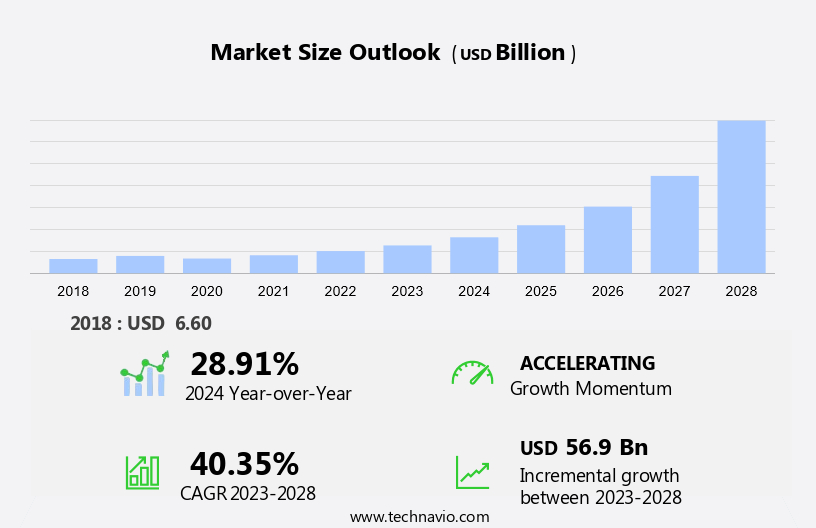
The drone identification systems market size is forecast to increase by USD 56.9 billion at a CAGR of 40.35% between 2023 and 2028.
- The market is experiencing significant growth due to the increasing threats posed by drones. Unauthorized drone usage can lead to security breaches, privacy invasions, and potential harm to people and infrastructure. To mitigate these risks, technological advances in drone identification systems are being developed. These systems use various techniques such as radio frequency identification (RFID), Global Navigation Satellite System (GNSS), and computer vision to identify and track drones. However, there are technical limitations to these technologies, including false positives and the inability to identify small or slow-moving drones. Unauthorized drones pose a threat to public safety and national security, leading to the need for identification and classification systems.Addressing these challenges will be crucial for the market's continued growth. In summary, the market is driven by the need to mitigate security risks posed by drones, with technological advances providing potential solutions, but also presenting challenges related to false positives and the identification of small or slow-moving drones.
What will be the Size of the Drone Identification Systems Market During the Forecast Period?
- The market is experiencing significant growth due to the increasing adoption of drones in various sectors, including advanced technologies, military applications, homeland security, and airspace safety. Market drivers include surveillance, delivery, data collection, and public safety applications. However, privacy concerns and potential misuse of drones for malicious purposes, such as jamming or hacking, present challenges. The market is fragmented, with defense forces, law enforcement agencies, and commercial agencies seeking a competitive edge through drone identification and mitigation solutions. Market accumulation and amalgamation traits are expected to shape the industry, with continued innovation and collaboration crucial for market dominance.
How is this Drone Identification Systems Industry segmented and which is the largest segment?
The drone identification systems industry research report provides comprehensive data (region-wise segment analysis), with forecasts and estimates in "USD billion" for the period 2024-2028, as well as historical data from 2018-2022 for the following segments.
- End-user
- Military
- Commercial
- Geography
- North America
- US
- Europe
- Germany
- APAC
- China
- Middle East and Africa
- South America
- North America
By End-user Insights
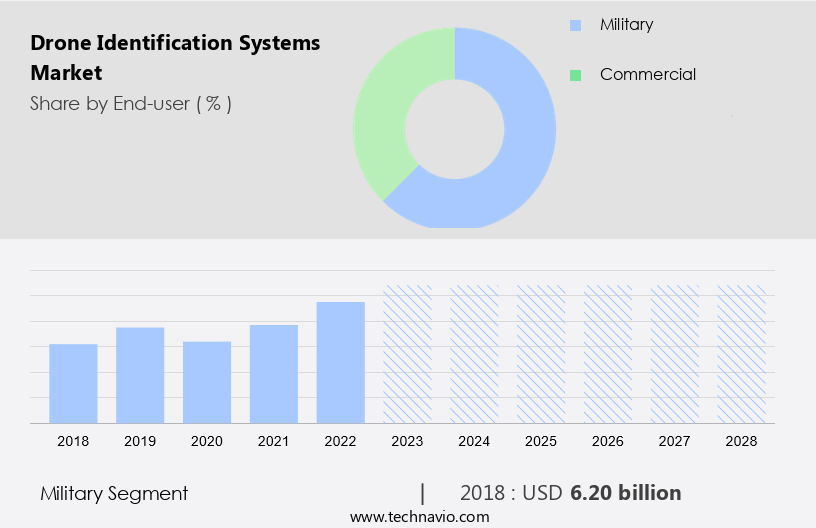
- The military segment is estimated to witness significant growth during the forecast period.
Drone identification systems have gained significant importance in ensuring airspace safety and security. These systems enable real-time tracking, identification, and detection of drones, addressing concerns around unauthorized drones and potential threats. The military segment is a significant market for drone identification systems, with applications in securing military facilities, borders, and coastlines. With the increasing use of drones by terrorist groups for surveillance and strategic communications, military organizations worldwide are investing in advanced technologies such as drone detection systems and jamming capabilities. The homeland security sector also relies on drone identification systems to maintain public safety and prevent security breaches. The market growth is driven by the need for surveillance, delivery, data collection, and infrastructure inspection.
However, privacy concerns and malicious activities, including jamming and hacking, pose challenges to the market. The forecast period is expected to witness increased demand for drone identification systems due to their role in mitigating threats to civil society and defending against terrorist attacks. Drone monitoring systems, electronic registration identifiers, and remote identification systems are key technologies driving market growth. Law enforcement agencies, commercial agencies, and defense forces are major consumers of drone identification systems.
Get a glance at the Drone Identification Systems Industry report of share of various segments Request Free Sample
The military segment was valued at USD 6.20 billion in 2018 and showed a gradual increase during the forecast period.
Regional Analysis
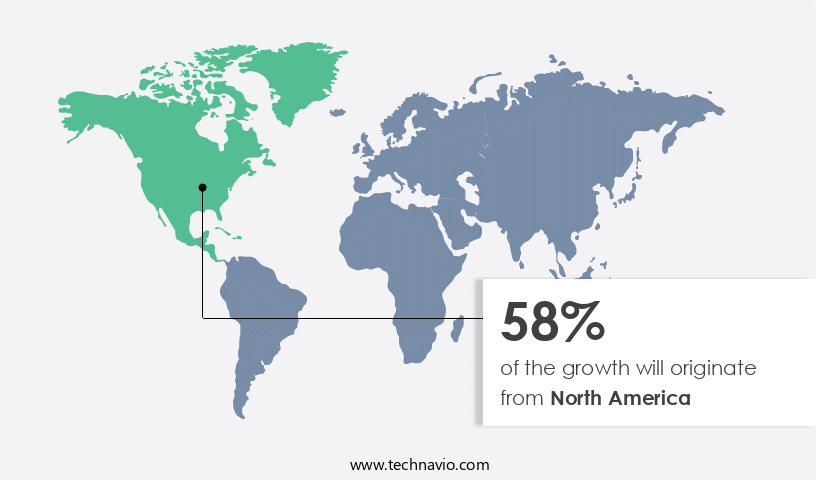
- North America is estimated to contribute 58% to the growth of the global market during the forecast period.
Technavio's analysts have elaborately explained the regional trends and drivers that shape the market during the forecast period.
For more insights on the market share of various regions, Request Free Sample
The North American market is expected to lead the market due to the growing adoption of drones in military and commercial applications. Legal restrictions on testing domestic technologies pose a challenge to the market's expansion In the US. However, recent regulatory changes are anticipated to accelerate market growth. Advanced technologies, such as remote identification systems, electronic registration identifiers, and real-time tracking, are integral to ensuring airspace safety and mitigating unauthorized drone usage. Market growth drivers include surveillance, delivery, data collection, public safety, medical supplies delivery, social distancing enforcement, infrastructure inspection, search and rescue operations, and drone traffic management.
However, privacy concerns and malicious activities, including jamming, hacking, accumulation, fragmentation, and mitigation, pose significant challenges. Market growth is further fueled by the increasing demand for law enforcement, defense forces, and commercial agency applications. Drone monitoring systems, obstacle detection systems, aerial surveillance, and security monitoring are key areas of impact analysis, including terrorism, security breaches, and infrastructure projects. The market's growth is also driven by investment opportunities in wireless communication and emerging technologies.
Market Dynamics
Our researchers analyzed the data with 2023 as the base year, along with the key drivers, trends, and challenges. A holistic analysis of drivers will help companies refine their marketing strategies to gain a competitive advantage.
What are the key market drivers leading to the rise In the adoption of Drone Identification Systems Industry?
Evidence of threats posed by drones is the key driver of the market.
- Advanced technologies have become essential in addressing the growing concern of unauthorized drone usage, particularly in military applications and homeland security. The increasing number of drone incidents, such as weaponized drones used by terrorist groups like ISIS and the DJI Phantom drone case involving explosives dropping, underscores the need for effective drone identification systems. These systems play a crucial role in ensuring airspace safety by detecting and deterring potential threats. The market growth drivers include surveillance, delivery, data collection, public safety, medical supplies delivery, social distancing enforcement, infrastructure inspection, search, rescue operations, and real-time tracking. However, privacy concerns remain a significant challenge.
- Drone monitoring systems employ various identification and detection methods, including electronic registration identifiers, remote identification systems, and obstacle detection systems. Mitigation technologies, such as jammers and hacking countermeasures, are also crucial to prevent malicious activities like jamming and hacking. The fragmented the market exhibits amalgamation traits, with defense forces, law enforcement agencies, and commercial agencies adopting these systems for diverse applications. Drone traffic management, flight permissions, and safety are key considerations In the market. Investment opportunities lie in wireless communication, impact analysis, and terrorism prevention, among others. Despite the challenges, the market's potential for growth is significant, driven by the increasing demand for security monitoring and the need for effective drone management.
What are the market trends shaping the Drone Identification Systems Industry?
Technological advances in drone identification systems is the upcoming market trend.
- The market is experiencing significant growth due to various market drivers. Advanced technologies, such as remote identification systems, electronic registration identifiers, and real-time tracking, are being adopted for military applications, homeland security, airspace safety, and unauthorized drone detection and mitigation. These systems enable identification and detection of drones, providing law enforcement agencies, defense forces, and commercial agencies with valuable data for surveillance, delivery, data collection, public safety, medical supplies delivery, social distancing enforcement, infrastructure inspection, search, rescue operations, and emergency response. However, privacy concerns remain a challenge for market growth. Mitigation technologies, such as jammers, hacking, and accumulation, pose threats to drone operations.
- Fragmentation dominance and amalgamation traits are shaping the market landscape. Detection, classification, mitigation, and defense forces are investing in drone monitoring systems, obstacle detection systems, and vision sensors for aerial surveillance and security monitoring. Impact analysis includes terrorism, security breaches, and federal aviation administration regulations. E-commerce delivery, environmental monitoring, agricultural drones, and infrastructure projects are driving the demand for drone traffic management and flight permissions. Investment opportunities exist in wireless communication and drone traffic management systems. Market players must address privacy concerns, malicious activities, and regulatory compliance to succeed in this dynamic market.
What challenges does the Drone Identification Systems Industry face during its growth?
Technical limitations of technologies used is a key challenge affecting the industry growth.
- The market faces technical challenges In the implementation of various sensors for drone detection and identification. RF sensors, which require RF signals for functioning, are not effective in urban environments. Radar sensors, which rely on line-of-sight, have limitations in detecting drones in complex environments. Optical systems, which use vision sensors, cannot function optimally in extreme weather conditions and have a limited range. Acoustic sensors, which detect drone sounds, also have a short range and are ineffective in noisy urban environments. To overcome these limitations and gain a competitive edge In the market, companies must focus on developing advanced identification and detection technologies, such as remote identification systems, electronic registration identifiers, and real-time tracking.
- These technologies can help mitigate malicious activities, including unauthorized drones, terrorism, and security breaches. Additionally, the integration of mitigation technologies, such as jammers and hacking countermeasures, can enhance the overall security of drone identification systems. The market growth is driven by various applications, including military, homeland security, airspace safety, surveillance, delivery, data collection, public safety, medical supplies delivery, social distancing enforcement, infrastructure inspection, search and rescue operations, and emergency response. The market also presents significant investment opportunities in infrastructure projects, drone traffic management, and flight permissions. Wireless communication technologies play a crucial role in ensuring effective and efficient drone monitoring systems.
- The integration of advanced technologies, such as vision sensors, autopilot detection, and obstacle detection systems, can further enhance the functionality and versatility of drone identification systems. The market is witnessing fragmentation dominance, with defense forces, law enforcement agencies, and commercial agencies adopting these systems for diverse applications. Impact analysis of drone identification systems on privacy concerns is a critical consideration for stakeholders. The Federal Aviation Administration (FAA) and other regulatory bodies are implementing regulations to ensure the safe and secure operation of drones In the airspace. The market is expected to continue growing due to the increasing demand for drone applications in various industries, including agriculture, e-commerce, and environmental monitoring.
Exclusive Customer Landscape
The drone identification systems market forecasting report includes the adoption lifecycle of the market, market growth and forecasting, covering from the innovator's stage to the laggard's stage. It focuses on adoption rates in different regions based on penetration. Furthermore, the drone identification systems market report also includes key purchase criteria and drivers of price sensitivity to help companies evaluate and develop their market growth analysis strategies.
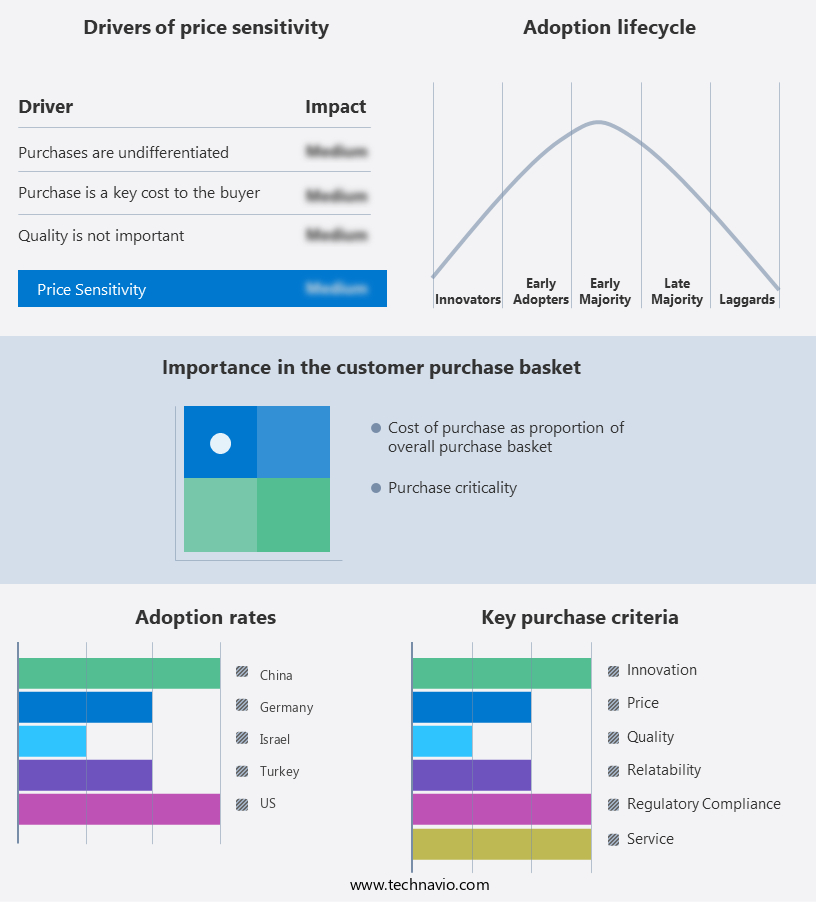
Customer Landscape
Key Companies & Market Insights
Companies are implementing various strategies, such as strategic alliances, drone identification systems market forecast, partnerships, mergers and acquisitions, geographical expansion, and product/service launches, to enhance their presence In the industry. The industry research and growth report includes detailed analyses of the competitive landscape of the market and information about key companies, including:
- Aaronia AG
- Advanced Protection Systems
- Blighter Surveillance Systems Ltd.
- CACI International Inc.
- Dedrone Holdings Inc.
- Department 13 International Ltd.
- Drone Defence Services Ltd.
- DroneShield Ltd.
- ELTA North America
- HENSOLDT AG
- Israel Aerospace Industries Ltd.
- Leonardo Spa
- Liteye Systems Inc.
- Lockheed Martin Corp.
- Mistral Solutions Pvt. Ltd.
- Northrop Grumman Corp.
- OPENWORKS Engineering Ltd.
- RTX Corp.
- Thales Group
- The Boeing Co.
Qualitative and quantitative analysis of companies has been conducted to help clients understand the wider business environment as well as the strengths and weaknesses of key industry players. Data is qualitatively analyzed to categorize companies as pure play, category-focused, industry-focused, and diversified; it is quantitatively analyzed to categorize companies as dominant, leading, strong, tentative, and weak.
Research Analyst Overview
The market encompasses a range of advanced technologies designed to enhance airspace safety and security. These systems play a crucial role in identifying and mitigating potential risks associated with unauthorized drones, particularly in military applications and homeland security. The market for drone identification systems is driven by several factors, including the growing demand for surveillance, delivery, and data collection applications. In the realm of public safety, drones are increasingly used for search and rescue operations, social distancing enforcement, and infrastructure inspection. However, the proliferation of drones also raises concerns around privacy and potential malicious activities, such as jamming or hacking. Remote identification systems have emerged as a key solution to address these challenges. These systems utilize electronic registration identifiers and real-time tracking capabilities to enable the identification and detection of drones in real-time. Mitigation technologies, such as jammers and obstacle detection systems, are also essential components of drone identification systems, helping to prevent potential collisions and unauthorized intrusions.
The market for drone identification systems is characterized by a high degree of fragmentation, with various defense forces, law enforcement agencies, commercial agencies, and drone monitoring systems adopting these technologies. The dominance of this market is shaped by the amalgamation of detection, classification, and mitigation capabilities. In the military sector, drone identification systems are used extensively for aerial surveillance and security monitoring. These systems help defense forces to maintain situational awareness and respond effectively to potential security breaches or terrorist activities. In the realm of law enforcement, drones are used for search and rescue operations, emergency response, and infrastructure projects. Commercial applications of drone identification systems are also on the rise, with e-commerce delivery services and infrastructure traffic management being key areas of growth. In the agricultural sector, drones are used for environmental monitoring and crop inspection. The impact analysis of drone identification systems is far-reaching, with potential applications in various industries and sectors.
For instance, these systems can help prevent accidents and collisions, enhance security and surveillance, and improve efficiency and productivity. However, the market for drone identification systems also presents significant investment opportunities. As the demand for drone technologies continues to grow, the need for effective identification and mitigation solutions is becoming increasingly critical. Companies specializing in drone identification systems are well-positioned to capitalize on this trend and contribute to the development of a safer and more secure drone ecosystem.
|
Market Scope |
|
|
Report Coverage |
Details |
|
Page number |
146 |
|
Base year |
2023 |
|
Historic period |
2018-2022 |
|
Forecast period |
2024-2028 |
|
Growth momentum & CAGR |
Accelerate at a CAGR of 40.35% |
|
Market growth 2024-2028 |
USD 56.9 billion |
|
Market structure |
Fragmented |
|
YoY growth 2023-2024(%) |
28.91 |
|
Key countries |
China, Germany, US, Israel, and Turkey |
|
Competitive landscape |
Leading Companies, Market Positioning of Companies, Competitive Strategies, and Industry Risks |
What are the Key Data Covered in this Drone Identification Systems Market Research and Growth Report?
- CAGR of the Drone Identification Systems industry during the forecast period
- Detailed information on factors that will drive the growth and forecasting between 2024 and 2028
- Precise estimation of the size of the market and its contribution of the industry in focus to the parent market
- Accurate predictions about upcoming growth and trends and changes in consumer behaviour
- Growth of the market across North America, Europe, APAC, Middle East and Africa, and South America
- Thorough analysis of the market's competitive landscape and detailed information about companies
- Comprehensive analysis of factors that will challenge the drone identification systems market growth of industry companies
We can help! Our analysts can customize this drone identification systems market research report to meet your requirements.
 RIA -
RIA - 
