
Factory Energy Optimization Platform Market Analysis, Size, and Forecast 2026-2030: North America (US, Canada, and Mexico), Europe (Germany, UK, and France), APAC (China, India, and Japan), South America (Brazil, Argentina, and Colombia), Middle East and Africa (Saudi Arabia, UAE, and South Africa), and Rest of World (ROW)

Factory Energy Optimization Platform Market Analysis, Size, and Forecast 2026-2030:
North America (US, Canada, and Mexico), Europe (Germany, UK, and France), APAC (China, India, and Japan), South America (Brazil, Argentina, and Colombia), Middle East and Africa (Saudi Arabia, UAE, and South Africa), and Rest of World (ROW)

Published: Mar 2026 303 Pages SKU: IRTNTR81264

Market Overview at a Glance

$14.25 B
Market Opportunity
13.8%
CAGR 2025 - 2030
32.6%
North America Growth
$6.21 B
Software segment 2024

Factory Energy Optimization Platform Market Size 2026-2030

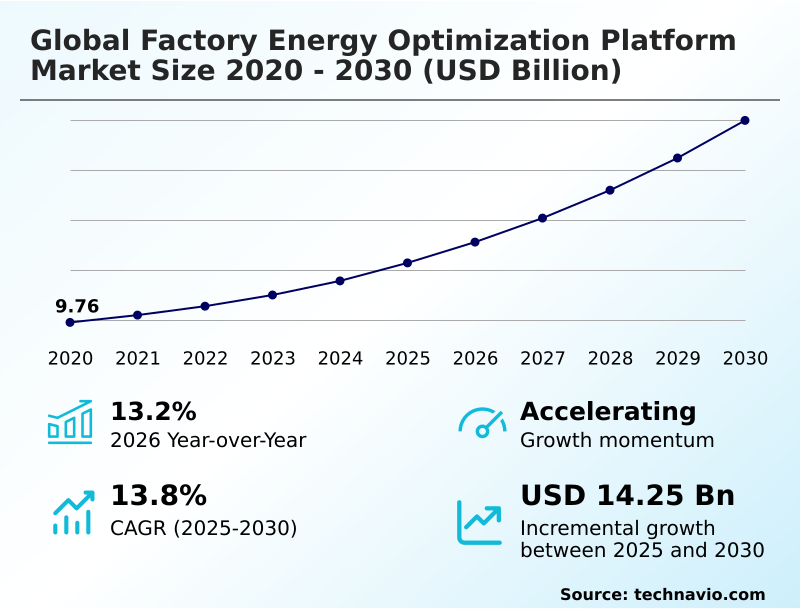
The factory energy optimization platform market size is valued to increase by USD 14.25 billion, at a CAGR of 13.8% from 2025 to 2030. Increasing stringency of global carbon regulations and decarbonization mandates will drive the factory energy optimization platform market.

Major Market Trends & Insights

  • North America dominated the market and accounted for a 32.6% growth during the forecast period.
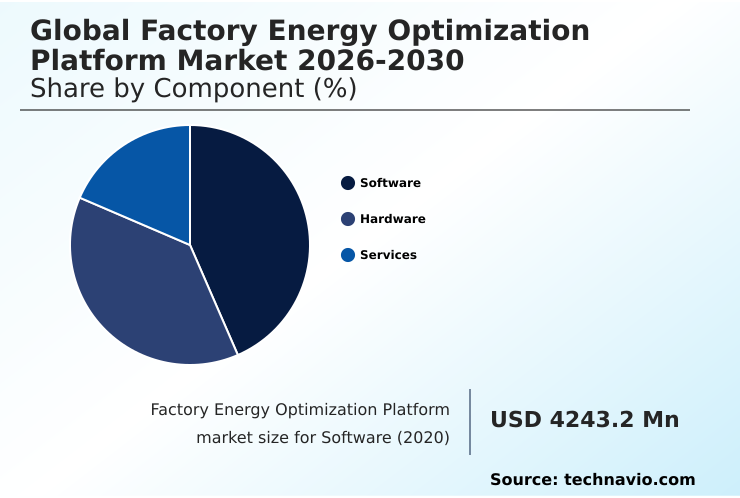
  • By Component - Software segment was valued at USD 6.21 billion in 2024
  • By Deployment - Cloud-based segment accounted for the largest market revenue share in 2024

Market Size & Forecast

  • Market Opportunities: USD 20.20 billion
  • Market Future Opportunities: USD 14.25 billion
  • CAGR from 2025 to 2030 : 13.8%

Market Summary

  • The factory energy optimization platform market is undergoing a significant transformation, driven by the convergence of industrial digitalization and stringent sustainability mandates. These platforms are crucial for manufacturers aiming to enhance operational efficiency while meeting rigorous environmental targets.
  • By leveraging technologies such as the industrial internet of things (IIoT), edge computing, and advanced analytics, these systems provide real-time visibility into power consumption across diverse assets. A key application involves synchronizing production schedules with fluctuating energy prices to minimize costs, a strategy that is becoming essential in volatile utility markets.
  • For example, an automotive plant can use an optimization platform to schedule the high-energy processes of its paint shop during off-peak hours, directly reducing operational expenditures without impacting output. Furthermore, these platforms are instrumental in carbon tracking and reporting, automating data collection for regulatory compliance.
  • The market's evolution is marked by a shift from simple monitoring to predictive and autonomous control, enabling factories to self-optimize for maximum energy efficiency and resilience. This transition is fundamental for any industrial enterprise seeking to maintain a competitive edge in an increasingly eco-conscious global economy.

What will be the Size of the Factory Energy Optimization Platform Market during the forecast period?

Get Key Insights on Market Forecast (PDF) Request Free Sample

How is the Factory Energy Optimization Platform Market Segmented?

The factory energy optimization platform industry research report provides comprehensive data (region-wise segment analysis), with forecasts and estimates in "USD million" for the period 2026-2030, as well as historical data from 2020-2024 for the following segments.

  • Component
    • Software
    • Hardware
    • Services
  • Deployment
    • Cloud-based
    • On-premises
    • Hybrid
  • End-user
    • Process industry
    • Discrete industry
  • Geography
    • North America
      • US
      • Canada
      • Mexico
    • Europe
      • Germany
      • UK
      • France
    • APAC
      • China
      • India
      • Japan
    • South America
      • Brazil
      • Argentina
      • Colombia
    • Middle East and Africa
      • Saudi Arabia
      • UAE
      • South Africa
    • Rest of World (ROW)

By Component Insights

The software segment is estimated to witness significant growth during the forecast period.

The software segment represents the core intelligence layer, evolving from basic monitoring to proactive optimization essential for industrial decarbonization.

Modern software, often delivered via a cloud-native platform, employs generative artificial intelligence (AI) and machine learning algorithms to deliver predictive sustainability insights.

These systems enable strategies like peak demand charge mitigation and automate sustainability reporting automation, driving significant utility cost reduction. By integrating energy consumption analytics into the broader smart factory ecosystem, organizations achieve substantial operational expenditure (opex) optimization.

For instance, advanced platforms have demonstrated the ability to identify subtle motor inefficiencies, improving equipment performance by over 15% and directly enhancing overall manufacturing efficiency.

Request Free Sample

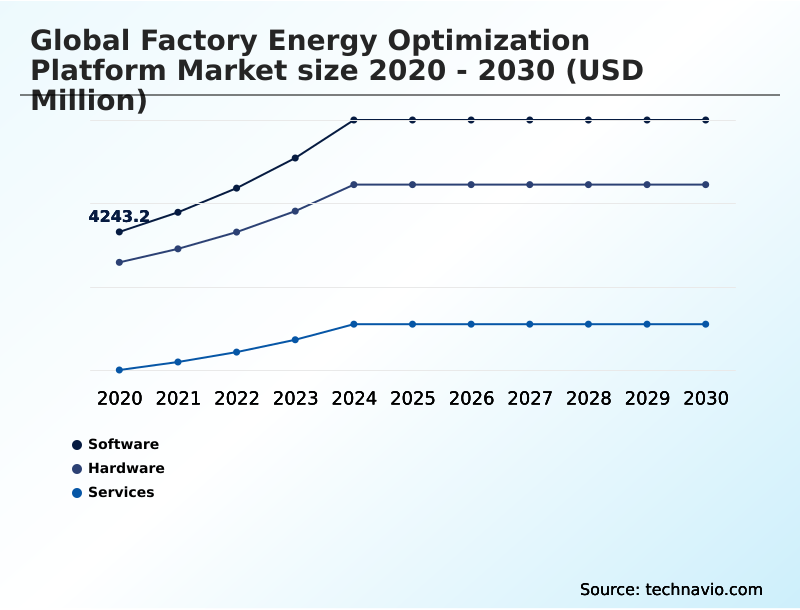
The Software segment was valued at USD 6.21 billion in 2024 and showed a gradual increase during the forecast period.
Request Free Sample

Regional Analysis

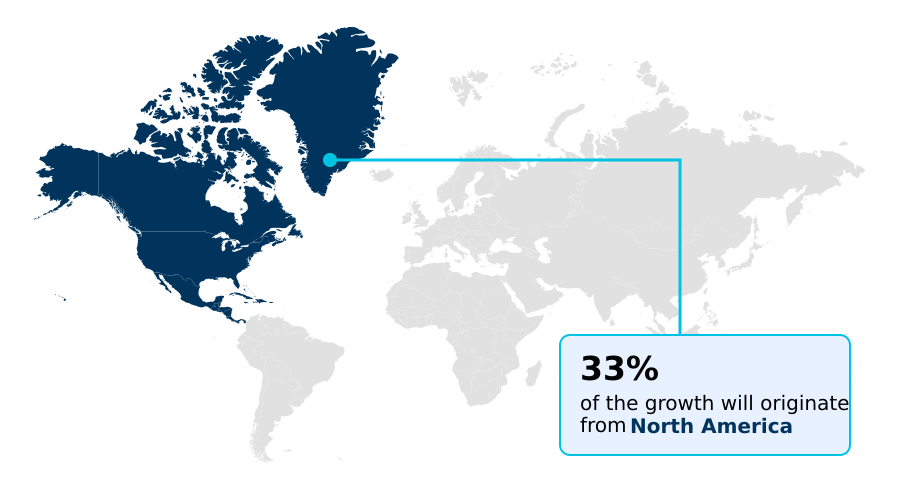
North America is estimated to contribute 32.6% to the growth of the global market during the forecast period.Technavio’s analysts have elaborately explained the regional trends and drivers that shape the market during the forecast period.

See How Factory Energy Optimization Platform Market Demand is Rising in North America Request Free Sample

The market's geographic landscape is led by APAC, which is forecast to exhibit the highest growth at a 14.9% CAGR, driven by its massive manufacturing scale and government-led digital transformation initiatives for carbon footprint tracking.

North America follows, poised to contribute over 32% of the market's incremental growth, with a strong focus on industrial internet of things (iiot) innovation and automated load balancing to enhance manufacturing efficiency.

Europe's market is defined by stringent environmental, social, and governance (esg) compliance, pushing adoption of platforms for power quality monitoring.

The focus on discrete manufacturing efficiency in regions like Germany and the UK underpins steady demand for these advanced industrial process optimization solutions.

Market Dynamics

Our researchers analyzed the data with 2025 as the base year, along with the key drivers, trends, and challenges. A holistic analysis of drivers will help companies refine their marketing strategies to gain a competitive advantage.

  • Industrial leaders are increasingly asking how does generative ai optimize factory energy, as they seek to move beyond simple monitoring. The benefits of digital twins for sustainability are becoming clear, enabling companies to model and refine operations in a virtual environment, thereby preventing energy leakage with digital twins before it occurs.
  • The deployment of iiot sensors for industrial power monitoring provides the granular data needed for these advanced systems to function effectively. Exploring the roi of factory energy optimization platforms reveals that initial costs are often offset by significant long-term savings, particularly by reducing peak demand charges in manufacturing.
  • Business models are also evolving, with eaas models for manufacturing plants lowering the barrier to entry for mid-sized companies. However, the challenges of integrating legacy ot systems persist, and addressing cybersecurity risks in smart factories remains a top priority. Companies are now comparing on-premises vs cloud energy platforms to find the best fit for their security and scalability needs.
  • Specific applications, such as real-time load balancing in automotive plants and ai for thermal energy optimization in chemical plants, demonstrate the technology's versatility. Using predictive analytics for energy forecasting is now standard for proactive management, while the role of edge computing in energy management grows in importance for low-latency control.
  • Furthermore, automating esg reporting with iiot data is streamlining compliance, a critical factor given the impact of carbon regulations on industrial energy.

What are the key market drivers leading to the rise in the adoption of Factory Energy Optimization Platform Industry?

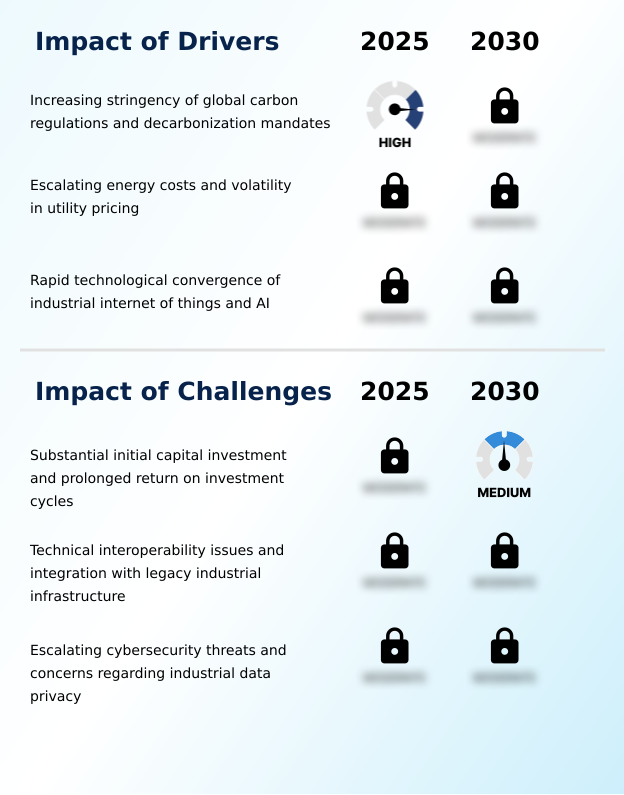
  • The increasing stringency of global carbon regulations and widespread decarbonization mandates serves as a key driver for market growth.

  • Stringent regulatory compliance frameworks and the need for esg compliance are primary market drivers. The persistent utility price volatility further compels manufacturers to adopt real-time energy management to protect profit margins.
  • Technological convergence, including standardized iiot communication protocols, enables better smart grid integration and management of decentralized energy resources (der). This evolution supports the growth of on-site energy generation and sophisticated renewable energy orchestration.
  • Innovative business models like energy-as-a-service (eaas) are also gaining traction, with adoption rates in some mid-market segments growing over 25% year-over-year as they lower the financial barrier to entry and accelerate industrial decarbonization efforts.

What are the market trends shaping the Factory Energy Optimization Platform Industry?

  • The market is witnessing a significant trend toward the integration of generative AI. This advancement enables autonomous energy steering and proactive industrial optimization.

  • A key market trend is the shift from passive monitoring to autonomous energy steering systems, with a strong focus on data-driven decision making. Digital twin technology is central to this, as high-fidelity digital twin models enable risk-free simulations for industrial process optimization.
  • The application of reinforcement learning models allows systems to learn and adapt, with some achieving up to a 20% improvement in carbon intensity forecasting. These advancements facilitate a better balance between production throughput balancing and energy use.
  • This trend is particularly impactful for achieving process industry energy savings, though challenges with legacy system integration remain a key consideration for widespread adoption across all manufacturing environments.

What challenges does the Factory Energy Optimization Platform Industry face during its growth?

  • Substantial initial capital investment requirements and prolonged return on investment cycles present a key challenge affecting industry growth.

  • Significant challenges inhibit widespread adoption, led by interoperability issues with legacy supervisory control and data acquisition (scada) systems and programmable logic controllers (plc). A lack of standardized industrial data exchange protocols creates data silos, with reports indicating nearly 60% of facilities use incompatible systems, hindering effective asset performance management (apm).
  • Furthermore, escalating cyber-physical security threats and the need for robust operational technology (ot) security increase complexity and cost. These hurdles impact industrial energy resilience and make it difficult to achieve full supply chain energy visibility, even with tools for high-resolution power monitoring and predictive maintenance for energy.

Exclusive Technavio Analysis on Customer Landscape

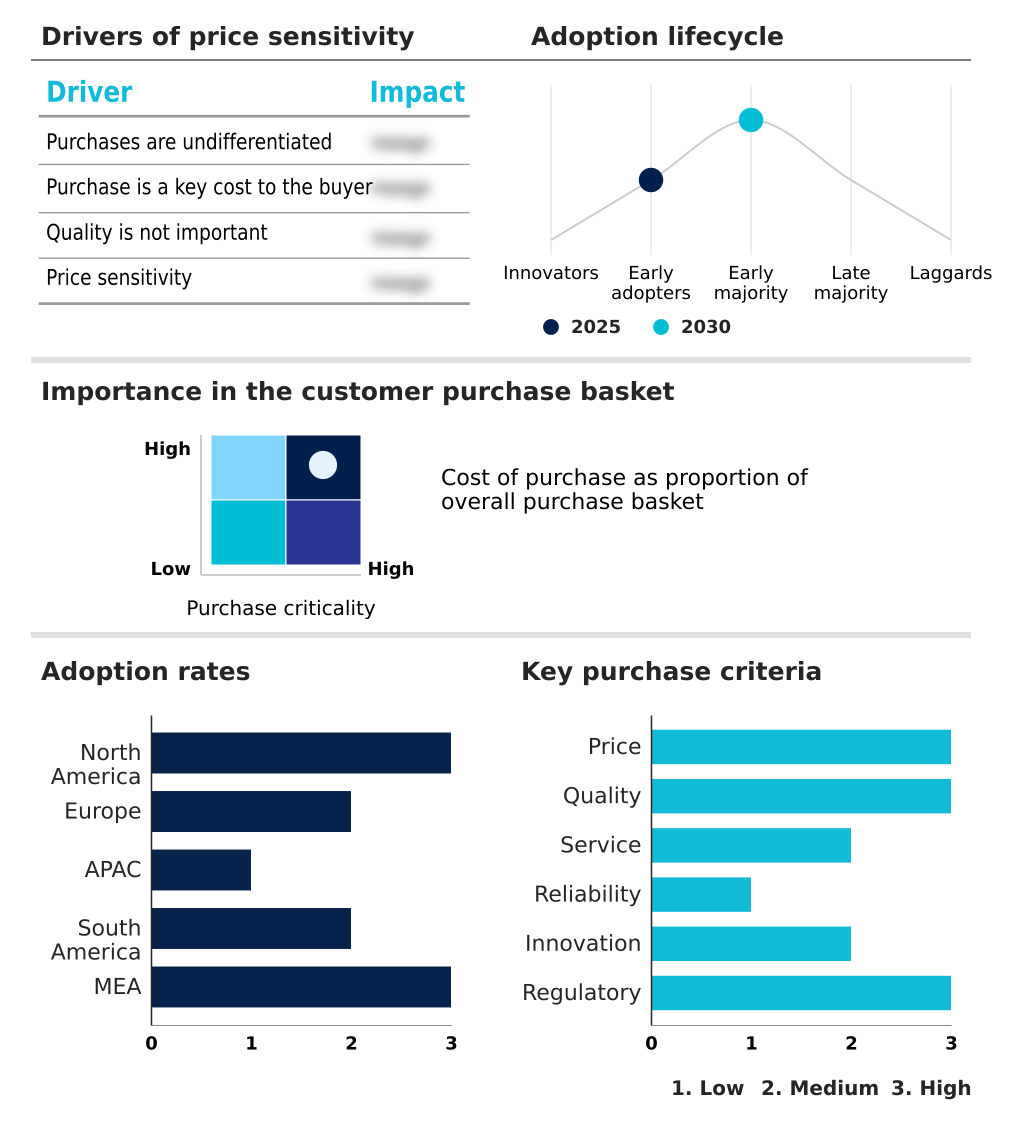
The factory energy optimization platform market forecasting report includes the adoption lifecycle of the market, covering from the innovator’s stage to the laggard’s stage. It focuses on adoption rates in different regions based on penetration. Furthermore, the factory energy optimization platform market report also includes key purchase criteria and drivers of price sensitivity to help companies evaluate and develop their market growth analysis strategies.
Customer Landscape of Factory Energy Optimization Platform Industry

Competitive Landscape

Companies are implementing various strategies, such as strategic alliances, factory energy optimization platform market forecast, partnerships, mergers and acquisitions, geographical expansion, and product/service launches, to enhance their presence in the industry.

ABB Ltd. - Delivers industrial energy management solutions that integrate monitoring, analytics, and optimization to reduce costs and enhance sustainability across factory operations.

The industry research and growth report includes detailed analyses of the competitive landscape of the market and information about key companies, including:

  • ABB Ltd.
  • Advantech Co. Ltd.
  • Autodesk Inc.
  • Eaton Corp. Plc
  • Emerson Electric Co.
  • GE Vernova Inc.
  • Hitachi Ltd.
  • Honeywell International Inc.
  • Johnson Controls International
  • Microsoft Corp.
  • Mitsubishi Electric Corp.
  • OMRON Corp.
  • Oracle Corp.
  • PTC Inc.
  • Rockwell Automation Inc.
  • SAP SE
  • Schneider Electric SE
  • Siemens AG
  • Yokogawa Electric Corp.
  • Zerynth S.p.A

Qualitative and quantitative analysis of companies has been conducted to help clients understand the wider business environment as well as the strengths and weaknesses of key industry players. Data is qualitatively analyzed to categorize companies as pure play, category-focused, industry-focused, and diversified; it is quantitatively analyzed to categorize companies as dominant, leading, strong, tentative, and weak.

Recent Development and News in Factory energy optimization platform market

  • In August 2025, Emerson introduced a high-fidelity digital twin solution engineered for the thermal energy optimization needs of the chemical and pharmaceutical industries.
  • In May 2025, Rockwell Automation released an autonomous energy steering module that applies reinforcement learning to balance a factory's power demand with its production throughput requirements.
  • In March 2025, Rockwell Automation introduced a new series of intelligent power monitors that utilize high-frequency sampling to detect power quality issues that contribute to equipment degradation and energy waste.
  • In February 2025, Siemens launched a specialized pilot program that utilizes a generative AI agent to create real-time energy-saving scripts for programmable logic controllers.

Dive into Technavio’s robust research methodology, blending expert interviews, extensive data synthesis, and validated models for unparalleled Factory Energy Optimization Platform Market insights. See full methodology.

Market Scope
Page number 303
Base year 2025
Historic period 2020-2024
Forecast period 2026-2030
Growth momentum & CAGR Accelerate at a CAGR of 13.8%
Market growth 2026-2030 USD 14249.9 million
Market structure Fragmented
YoY growth 2025-2026(%) 13.2%
Key countries US, Canada, Mexico, Germany, UK, France, Italy, Spain, The Netherlands, China, India, Japan, South Korea, Australia, Indonesia, Brazil, Argentina, Colombia, Saudi Arabia, UAE, South Africa, Israel and Turkey
Competitive landscape Leading Companies, Market Positioning of Companies, Competitive Strategies, and Industry Risks

Request Free Sample

Research Analyst Overview

  • The factory energy optimization platform market is defined by a rapid technological convergence where the industrial internet of things (iiot) and generative artificial intelligence (ai) are becoming standard. Key functionalities include autonomous energy steering and real-time energy management, which are critical for peak demand charge mitigation.
  • The integration of digital twin technology allows for predictive sustainability and precise carbon intensity forecasting. Platforms are increasingly built on cloud-native architectures, leveraging machine learning algorithms and reinforcement learning models to drive automated load balancing.
  • At the hardware level, connectivity relies on robust iiot communication protocols to link programmable logic controllers (plc) and supervisory control and data acquisition (scada) systems with edge computing nodes. This facilitates high-quality industrial data exchange. However, this connectivity heightens the need for advanced cyber-physical security and operational technology (ot) security.
  • On-site energy generation, enabled by smart grid integration, is another key focus, with energy-as-a-service (eaas) models making adoption more accessible. For instance, the deployment of high-resolution power quality monitoring has been shown to reduce equipment-related energy waste by more than 10% in certain industrial settings.

What are the Key Data Covered in this Factory Energy Optimization Platform Market Research and Growth Report?

  • What is the expected growth of the Factory Energy Optimization Platform Market between 2026 and 2030?

    • USD 14.25 billion, at a CAGR of 13.8%

  • What segmentation does the market report cover?

    • The report is segmented by Component (Software, Hardware, and Services), Deployment (Cloud-based, On-premises, and Hybrid), End-user (Process industry, and Discrete industry) and Geography (North America, Europe, APAC, South America, Middle East and Africa)

  • Which regions are analyzed in the report?

    • North America, Europe, APAC, South America and Middle East and Africa

  • What are the key growth drivers and market challenges?

    • Increasing stringency of global carbon regulations and decarbonization mandates, Substantial initial capital investment and prolonged return on investment cycles

  • Who are the major players in the Factory Energy Optimization Platform Market?

    • ABB Ltd., Advantech Co. Ltd., Autodesk Inc., Eaton Corp. Plc, Emerson Electric Co., GE Vernova Inc., Hitachi Ltd., Honeywell International Inc., Johnson Controls International, Microsoft Corp., Mitsubishi Electric Corp., OMRON Corp., Oracle Corp., PTC Inc., Rockwell Automation Inc., SAP SE, Schneider Electric SE, Siemens AG, Yokogawa Electric Corp. and Zerynth S.p.A

Market Research Insights

  • Market dynamics are shaped by the dual pressures of cost reduction and regulatory adherence, compelling manufacturers to adopt advanced energy management strategies. The need for industrial energy resilience and enhanced asset performance management (apm) is driving investment in platforms that support data-driven decision making.
  • While adoption grows, significant hurdles remain; reports indicate that nearly 60% of industrial facilities use legacy systems with protocols incompatible with modern cloud-native software, complicating integration. Despite this, the market is expanding, with North America alone accounting for over 32% of incremental growth.
  • This is fueled by a focus on operational expenditure (opex) optimization and the need for greater supply chain energy visibility, pushing organizations toward solutions that promise both manufacturing efficiency and environmental, social, and governance (esg) compliance.

We can help! Our analysts can customize this factory energy optimization platform market research report to meet your requirements.

Get in touch

1. Executive Summary

1.1 Market overview

Executive Summary - Chart on Market Overview
Executive Summary - Data Table on Market Overview
Executive Summary - Chart on Global Market Characteristics
Executive Summary - Chart on Market by Geography
Executive Summary - Chart on Market Segmentation by Component
Executive Summary - Chart on Market Segmentation by Deployment
Executive Summary - Chart on Market Segmentation by End-user
Executive Summary - Chart on Incremental Growth
Executive Summary - Data Table on Incremental Growth
Executive Summary - Chart on Company Market Positioning

2. Technavio Analysis

2.1 Analysis of price sensitivity, lifecycle, customer purchase basket, adoption rates, and purchase criteria

2.2 Criticality of inputs and Factors of differentiation

Chart on Overview on criticality of inputs and factors of differentiation

2.3 Factors of disruption

Chart on Overview on factors of disruption

2.4 Impact of drivers and challenges

Chart on Impact of drivers and challenges in 2025 and 2030

3. Market Landscape

3.1 Market ecosystem

Chart on Parent Market
Data Table on - Parent Market

3.2 Market characteristics

Chart on Market characteristics analysis

3.3 Value chain analysis

Chart on Value chain analysis

4. Market Sizing

4.1 Market definition

Data Table on Offerings of companies included in the market definition

4.2 Market segment analysis

Market segments

4.3 Market size 2025

4.4 Market outlook: Forecast for 2025-2030

Chart on Global - Market size and forecast 2025-2030 ($ million)
Data Table on Global - Market size and forecast 2025-2030 ($ million)
Chart on Global Market: Year-over-year growth 2025-2030 (%)
Data Table on Global Market: Year-over-year growth 2025-2030 (%)

5. Historic Market Size

5.1 Global Factory Energy Optimization Platform Market 2020 - 2024

Historic Market Size - Data Table on Global Factory Energy Optimization Platform Market 2020 - 2024 ($ million)

5.2 Component segment analysis 2020 - 2024

Historic Market Size - Component Segment 2020 - 2024 ($ million)

5.3 Deployment segment analysis 2020 - 2024

Historic Market Size - Deployment Segment 2020 - 2024 ($ million)

5.4 End-user segment analysis 2020 - 2024

Historic Market Size - End-user Segment 2020 - 2024 ($ million)

5.5 Geography segment analysis 2020 - 2024

Historic Market Size - Geography Segment 2020 - 2024 ($ million)

5.6 Country segment analysis 2020 - 2024

Historic Market Size - Country Segment 2020 - 2024 ($ million)

6. Qualitative Analysis

6.1 The AI impact on global factory energy optimization platform market

7. Five Forces Analysis

7.1 Five forces summary

Five forces analysis - Comparison between 2025 and 2030

7.2 Bargaining power of buyers

Bargaining power of buyers - Impact of key factors 2025 and 2030

7.3 Bargaining power of suppliers

Bargaining power of suppliers - Impact of key factors in 2025 and 2030

7.4 Threat of new entrants

Threat of new entrants - Impact of key factors in 2025 and 2030

7.5 Threat of substitutes

Threat of substitutes - Impact of key factors in 2025 and 2030

7.6 Threat of rivalry

Threat of rivalry - Impact of key factors in 2025 and 2030

7.7 Market condition

Chart on Market condition - Five forces 2025 and 2030

8. Market Segmentation by Component

8.1 Market segments

Chart on Component - Market share 2025-2030 (%)
Data Table on Component - Market share 2025-2030 (%)

8.2 Comparison by Component

Chart on Comparison by Component
Data Table on Comparison by Component

8.3 Software - Market size and forecast 2025-2030

Chart on Software - Market size and forecast 2025-2030 ($ million)
Data Table on Software - Market size and forecast 2025-2030 ($ million)
Chart on Software - Year-over-year growth 2025-2030 (%)
Data Table on Software - Year-over-year growth 2025-2030 (%)

8.4 Hardware - Market size and forecast 2025-2030

Chart on Hardware - Market size and forecast 2025-2030 ($ million)
Data Table on Hardware - Market size and forecast 2025-2030 ($ million)
Chart on Hardware - Year-over-year growth 2025-2030 (%)
Data Table on Hardware - Year-over-year growth 2025-2030 (%)

8.5 Services - Market size and forecast 2025-2030

Chart on Services - Market size and forecast 2025-2030 ($ million)
Data Table on Services - Market size and forecast 2025-2030 ($ million)
Chart on Services - Year-over-year growth 2025-2030 (%)
Data Table on Services - Year-over-year growth 2025-2030 (%)

8.6 Market opportunity by Component

Market opportunity by Component ($ million)
Data Table on Market opportunity by Component ($ million)

9. Market Segmentation by Deployment

9.1 Market segments

Chart on Deployment - Market share 2025-2030 (%)
Data Table on Deployment - Market share 2025-2030 (%)

9.2 Comparison by Deployment

Chart on Comparison by Deployment
Data Table on Comparison by Deployment

9.3 Cloud-based - Market size and forecast 2025-2030

Chart on Cloud-based - Market size and forecast 2025-2030 ($ million)
Data Table on Cloud-based - Market size and forecast 2025-2030 ($ million)
Chart on Cloud-based - Year-over-year growth 2025-2030 (%)
Data Table on Cloud-based - Year-over-year growth 2025-2030 (%)

9.4 On-premises - Market size and forecast 2025-2030

Chart on On-premises - Market size and forecast 2025-2030 ($ million)
Data Table on On-premises - Market size and forecast 2025-2030 ($ million)
Chart on On-premises - Year-over-year growth 2025-2030 (%)
Data Table on On-premises - Year-over-year growth 2025-2030 (%)

9.5 Hybrid - Market size and forecast 2025-2030

Chart on Hybrid - Market size and forecast 2025-2030 ($ million)
Data Table on Hybrid - Market size and forecast 2025-2030 ($ million)
Chart on Hybrid - Year-over-year growth 2025-2030 (%)
Data Table on Hybrid - Year-over-year growth 2025-2030 (%)

9.6 Market opportunity by Deployment

Market opportunity by Deployment ($ million)
Data Table on Market opportunity by Deployment ($ million)

10. Market Segmentation by End-user

10.1 Market segments

Chart on End-user - Market share 2025-2030 (%)
Data Table on End-user - Market share 2025-2030 (%)

10.2 Comparison by End-user

Chart on Comparison by End-user
Data Table on Comparison by End-user

10.3 Process industry - Market size and forecast 2025-2030

Chart on Process industry - Market size and forecast 2025-2030 ($ million)
Data Table on Process industry - Market size and forecast 2025-2030 ($ million)
Chart on Process industry - Year-over-year growth 2025-2030 (%)
Data Table on Process industry - Year-over-year growth 2025-2030 (%)

10.4 Discrete industry - Market size and forecast 2025-2030

Chart on Discrete industry - Market size and forecast 2025-2030 ($ million)
Data Table on Discrete industry - Market size and forecast 2025-2030 ($ million)
Chart on Discrete industry - Year-over-year growth 2025-2030 (%)
Data Table on Discrete industry - Year-over-year growth 2025-2030 (%)

10.5 Market opportunity by End-user

Market opportunity by End-user ($ million)
Data Table on Market opportunity by End-user ($ million)

11. Customer Landscape

11.1 Customer landscape overview

Analysis of price sensitivity, lifecycle, customer purchase basket, adoption rates, and purchase criteria

12. Geographic Landscape

12.1 Geographic segmentation

Chart on Market share by geography 2025-2030 (%)
Data Table on Market share by geography 2025-2030 (%)

12.2 Geographic comparison

Chart on Geographic comparison
Data Table on Geographic comparison

12.3 North America - Market size and forecast 2025-2030

Chart on North America - Market size and forecast 2025-2030 ($ million)
Data Table on North America - Market size and forecast 2025-2030 ($ million)
Chart on North America - Year-over-year growth 2025-2030 (%)
Data Table on North America - Year-over-year growth 2025-2030 (%)
Chart on Regional Comparison - North America
Data Table on Regional Comparison - North America

12.3.1 US - Market size and forecast 2025-2030

Chart on US - Market size and forecast 2025-2030 ($ million)
Data Table on US - Market size and forecast 2025-2030 ($ million)
Chart on US - Year-over-year growth 2025-2030 (%)
Data Table on US - Year-over-year growth 2025-2030 (%)

12.3.2 Canada - Market size and forecast 2025-2030

Chart on Canada - Market size and forecast 2025-2030 ($ million)
Data Table on Canada - Market size and forecast 2025-2030 ($ million)
Chart on Canada - Year-over-year growth 2025-2030 (%)
Data Table on Canada - Year-over-year growth 2025-2030 (%)

12.3.3 Mexico - Market size and forecast 2025-2030

Chart on Mexico - Market size and forecast 2025-2030 ($ million)
Data Table on Mexico - Market size and forecast 2025-2030 ($ million)
Chart on Mexico - Year-over-year growth 2025-2030 (%)
Data Table on Mexico - Year-over-year growth 2025-2030 (%)

12.4 Europe - Market size and forecast 2025-2030

Chart on Europe - Market size and forecast 2025-2030 ($ million)
Data Table on Europe - Market size and forecast 2025-2030 ($ million)
Chart on Europe - Year-over-year growth 2025-2030 (%)
Data Table on Europe - Year-over-year growth 2025-2030 (%)
Chart on Regional Comparison - Europe
Data Table on Regional Comparison - Europe

12.4.1 Germany - Market size and forecast 2025-2030

Chart on Germany - Market size and forecast 2025-2030 ($ million)
Data Table on Germany - Market size and forecast 2025-2030 ($ million)
Chart on Germany - Year-over-year growth 2025-2030 (%)
Data Table on Germany - Year-over-year growth 2025-2030 (%)

12.4.2 UK - Market size and forecast 2025-2030

Chart on UK - Market size and forecast 2025-2030 ($ million)
Data Table on UK - Market size and forecast 2025-2030 ($ million)
Chart on UK - Year-over-year growth 2025-2030 (%)
Data Table on UK - Year-over-year growth 2025-2030 (%)

12.4.3 France - Market size and forecast 2025-2030

Chart on France - Market size and forecast 2025-2030 ($ million)
Data Table on France - Market size and forecast 2025-2030 ($ million)
Chart on France - Year-over-year growth 2025-2030 (%)
Data Table on France - Year-over-year growth 2025-2030 (%)

12.4.4 Italy - Market size and forecast 2025-2030

Chart on Italy - Market size and forecast 2025-2030 ($ million)
Data Table on Italy - Market size and forecast 2025-2030 ($ million)
Chart on Italy - Year-over-year growth 2025-2030 (%)
Data Table on Italy - Year-over-year growth 2025-2030 (%)

12.4.5 Spain - Market size and forecast 2025-2030

Chart on Spain - Market size and forecast 2025-2030 ($ million)
Data Table on Spain - Market size and forecast 2025-2030 ($ million)
Chart on Spain - Year-over-year growth 2025-2030 (%)
Data Table on Spain - Year-over-year growth 2025-2030 (%)

12.4.6 The Netherlands - Market size and forecast 2025-2030

Chart on The Netherlands - Market size and forecast 2025-2030 ($ million)
Data Table on The Netherlands - Market size and forecast 2025-2030 ($ million)
Chart on The Netherlands - Year-over-year growth 2025-2030 (%)
Data Table on The Netherlands - Year-over-year growth 2025-2030 (%)

12.5 APAC - Market size and forecast 2025-2030

Chart on APAC - Market size and forecast 2025-2030 ($ million)
Data Table on APAC - Market size and forecast 2025-2030 ($ million)
Chart on APAC - Year-over-year growth 2025-2030 (%)
Data Table on APAC - Year-over-year growth 2025-2030 (%)
Chart on Regional Comparison - APAC
Data Table on Regional Comparison - APAC

12.5.1 China - Market size and forecast 2025-2030

Chart on China - Market size and forecast 2025-2030 ($ million)
Data Table on China - Market size and forecast 2025-2030 ($ million)
Chart on China - Year-over-year growth 2025-2030 (%)
Data Table on China - Year-over-year growth 2025-2030 (%)

12.5.2 India - Market size and forecast 2025-2030

Chart on India - Market size and forecast 2025-2030 ($ million)
Data Table on India - Market size and forecast 2025-2030 ($ million)
Chart on India - Year-over-year growth 2025-2030 (%)
Data Table on India - Year-over-year growth 2025-2030 (%)

12.5.3 Japan - Market size and forecast 2025-2030

Chart on Japan - Market size and forecast 2025-2030 ($ million)
Data Table on Japan - Market size and forecast 2025-2030 ($ million)
Chart on Japan - Year-over-year growth 2025-2030 (%)
Data Table on Japan - Year-over-year growth 2025-2030 (%)

12.5.4 South Korea - Market size and forecast 2025-2030

Chart on South Korea - Market size and forecast 2025-2030 ($ million)
Data Table on South Korea - Market size and forecast 2025-2030 ($ million)
Chart on South Korea - Year-over-year growth 2025-2030 (%)
Data Table on South Korea - Year-over-year growth 2025-2030 (%)

12.5.5 Australia - Market size and forecast 2025-2030

Chart on Australia - Market size and forecast 2025-2030 ($ million)
Data Table on Australia - Market size and forecast 2025-2030 ($ million)
Chart on Australia - Year-over-year growth 2025-2030 (%)
Data Table on Australia - Year-over-year growth 2025-2030 (%)

12.5.6 Indonesia - Market size and forecast 2025-2030

Chart on Indonesia - Market size and forecast 2025-2030 ($ million)
Data Table on Indonesia - Market size and forecast 2025-2030 ($ million)
Chart on Indonesia - Year-over-year growth 2025-2030 (%)
Data Table on Indonesia - Year-over-year growth 2025-2030 (%)

12.6 South America - Market size and forecast 2025-2030

Chart on South America - Market size and forecast 2025-2030 ($ million)
Data Table on South America - Market size and forecast 2025-2030 ($ million)
Chart on South America - Year-over-year growth 2025-2030 (%)
Data Table on South America - Year-over-year growth 2025-2030 (%)
Chart on Regional Comparison - South America
Data Table on Regional Comparison - South America

12.6.1 Brazil - Market size and forecast 2025-2030

Chart on Brazil - Market size and forecast 2025-2030 ($ million)
Data Table on Brazil - Market size and forecast 2025-2030 ($ million)
Chart on Brazil - Year-over-year growth 2025-2030 (%)
Data Table on Brazil - Year-over-year growth 2025-2030 (%)

12.6.2 Argentina - Market size and forecast 2025-2030

Chart on Argentina - Market size and forecast 2025-2030 ($ million)
Data Table on Argentina - Market size and forecast 2025-2030 ($ million)
Chart on Argentina - Year-over-year growth 2025-2030 (%)
Data Table on Argentina - Year-over-year growth 2025-2030 (%)

12.6.3 Colombia - Market size and forecast 2025-2030

Chart on Colombia - Market size and forecast 2025-2030 ($ million)
Data Table on Colombia - Market size and forecast 2025-2030 ($ million)
Chart on Colombia - Year-over-year growth 2025-2030 (%)
Data Table on Colombia - Year-over-year growth 2025-2030 (%)

12.7 Middle East and Africa - Market size and forecast 2025-2030

Chart on Middle East and Africa - Market size and forecast 2025-2030 ($ million)
Data Table on Middle East and Africa - Market size and forecast 2025-2030 ($ million)
Chart on Middle East and Africa - Year-over-year growth 2025-2030 (%)
Data Table on Middle East and Africa - Year-over-year growth 2025-2030 (%)
Chart on Regional Comparison - Middle East and Africa
Data Table on Regional Comparison - Middle East and Africa

12.7.1 Saudi Arabia - Market size and forecast 2025-2030

Chart on Saudi Arabia - Market size and forecast 2025-2030 ($ million)
Data Table on Saudi Arabia - Market size and forecast 2025-2030 ($ million)
Chart on Saudi Arabia - Year-over-year growth 2025-2030 (%)
Data Table on Saudi Arabia - Year-over-year growth 2025-2030 (%)

12.7.2 UAE - Market size and forecast 2025-2030

Chart on UAE - Market size and forecast 2025-2030 ($ million)
Data Table on UAE - Market size and forecast 2025-2030 ($ million)
Chart on UAE - Year-over-year growth 2025-2030 (%)
Data Table on UAE - Year-over-year growth 2025-2030 (%)

12.7.3 South Africa - Market size and forecast 2025-2030

Chart on South Africa - Market size and forecast 2025-2030 ($ million)
Data Table on South Africa - Market size and forecast 2025-2030 ($ million)
Chart on South Africa - Year-over-year growth 2025-2030 (%)
Data Table on South Africa - Year-over-year growth 2025-2030 (%)

12.7.4 Israel - Market size and forecast 2025-2030

Chart on Israel - Market size and forecast 2025-2030 ($ million)
Data Table on Israel - Market size and forecast 2025-2030 ($ million)
Chart on Israel - Year-over-year growth 2025-2030 (%)
Data Table on Israel - Year-over-year growth 2025-2030 (%)

12.7.5 Turkey - Market size and forecast 2025-2030

Chart on Turkey - Market size and forecast 2025-2030 ($ million)
Data Table on Turkey - Market size and forecast 2025-2030 ($ million)
Chart on Turkey - Year-over-year growth 2025-2030 (%)
Data Table on Turkey - Year-over-year growth 2025-2030 (%)

12.8 Market opportunity by geography

Market opportunity by geography ($ million)
Data Tables on Market opportunity by geography ($ million)

13. Drivers, Challenges, and Opportunity

13.1 Market drivers

Increasing stringency of global carbon regulations and decarbonization mandates
Escalating energy costs and volatility in utility pricing
Rapid technological convergence of industrial internet of things and AI

13.2 Market challenges

Substantial initial capital investment and prolonged return on investment cycles
Technical interoperability issues and integration with legacy industrial infrastructure
Escalating cybersecurity threats and concerns regarding industrial data privacy

13.3 Impact of drivers and challenges

Impact of drivers and challenges in 2025 and 2030

13.4 Market opportunities

Integration of generative AI and autonomous energy steering
Convergence of high-fidelity digital twin technology and predictive sustainability
Proliferation of energy-as-a-service and performance-based subscription models

14. Competitive Landscape

14.1 Overview

14.2

Overview on criticality of inputs and factors of differentiation

14.3 Landscape disruption

Overview on factors of disruption

14.4 Industry risks

Impact of key risks on business

15. Competitive Analysis

15.1 Companies profiled

Companies covered

15.2 Company ranking index

15.3 Market positioning of companies

Matrix on companies position and classification

15.4 ABB Ltd.

ABB Ltd. - Overview
ABB Ltd. - Business segments
ABB Ltd. - Key news
ABB Ltd. - Key offerings
ABB Ltd. - Segment focus
SWOT

15.5 Eaton Corp. Plc

Eaton Corp. Plc - Overview
Eaton Corp. Plc - Business segments
Eaton Corp. Plc - Key news
Eaton Corp. Plc - Key offerings
Eaton Corp. Plc - Segment focus
SWOT

15.6 Emerson Electric Co.

Emerson Electric Co. - Overview
Emerson Electric Co. - Business segments
Emerson Electric Co. - Key news
Emerson Electric Co. - Key offerings
Emerson Electric Co. - Segment focus
SWOT

15.7 GE Vernova Inc.

GE Vernova Inc. - Overview
GE Vernova Inc. - Business segments
GE Vernova Inc. - Key offerings
GE Vernova Inc. - Segment focus
SWOT

15.8 Hitachi Ltd.

Hitachi Ltd. - Overview
Hitachi Ltd. - Business segments
Hitachi Ltd. - Key news
Hitachi Ltd. - Key offerings
Hitachi Ltd. - Segment focus
SWOT

15.9 Honeywell International Inc.

Honeywell International Inc. - Overview
Honeywell International Inc. - Business segments
Honeywell International Inc. - Key news
Honeywell International Inc. - Key offerings
Honeywell International Inc. - Segment focus
SWOT

15.10 Johnson Controls International

Johnson Controls International - Overview
Johnson Controls International - Business segments
Johnson Controls International - Key news
Johnson Controls International - Key offerings
Johnson Controls International - Segment focus
SWOT

15.11 Microsoft Corp.

Microsoft Corp. - Overview
Microsoft Corp. - Business segments
Microsoft Corp. - Key news
Microsoft Corp. - Key offerings
Microsoft Corp. - Segment focus
SWOT

15.12 Mitsubishi Electric Corp.

Mitsubishi Electric Corp. - Overview
Mitsubishi Electric Corp. - Business segments
Mitsubishi Electric Corp. - Key offerings
Mitsubishi Electric Corp. - Segment focus
SWOT

15.13 PTC Inc.

PTC Inc. - Overview
PTC Inc. - Business segments
PTC Inc. - Key offerings
PTC Inc. - Segment focus
SWOT

15.14 Rockwell Automation Inc.

Rockwell Automation Inc. - Overview
Rockwell Automation Inc. - Business segments
Rockwell Automation Inc. - Key news
Rockwell Automation Inc. - Key offerings
Rockwell Automation Inc. - Segment focus
SWOT

15.15 SAP SE

SAP SE - Overview
SAP SE - Business segments
SAP SE - Key news
SAP SE - Key offerings
SAP SE - Segment focus
SWOT

15.16 Schneider Electric SE

Schneider Electric SE - Overview
Schneider Electric SE - Business segments
Schneider Electric SE - Key news
Schneider Electric SE - Key offerings
Schneider Electric SE - Segment focus
SWOT

15.17 Siemens AG

Siemens AG - Overview
Siemens AG - Business segments
Siemens AG - Key news
Siemens AG - Key offerings
Siemens AG - Segment focus
SWOT

15.18 Yokogawa Electric Corp.

Yokogawa Electric Corp. - Overview
Yokogawa Electric Corp. - Business segments
Yokogawa Electric Corp. - Key news
Yokogawa Electric Corp. - Key offerings
Yokogawa Electric Corp. - Segment focus
SWOT

16. Appendix

16.1 Scope of the report

Market definition
Objectives
Notes and caveats

16.2 Inclusions and exclusions checklist

Inclusions checklist
Exclusions checklist

16.3 Currency conversion rates for US$

16.4 Research methodology

16.5 Data procurement

Information sources

16.6 Data validation

16.7 Validation techniques employed for market sizing

16.8 Data synthesis

16.9 360 degree market analysis

16.10 List of abbreviations

Research Methodology

Technavio presents a detailed picture of the market by way of study, synthesis, and summation of data from multiple sources. The analysts have presented the various facets of the market with a particular focus on identifying the key industry influencers. The data thus presented is comprehensive, reliable, and the result of extensive research, both primary and secondary.

INFORMATION SOURCES

Primary sources

  • Manufacturers and suppliers
  • Channel partners
  • Industry experts
  • Strategic decision makers

Secondary sources

  • Industry journals and periodicals
  • Government data
  • Financial reports of key industry players
  • Historical data
  • Press releases

DATA ANALYSIS

Data Synthesis

  • Collation of data
  • Estimation of key figures
  • Analysis of derived insights

Data Validation

  • Triangulation with data models
  • Reference against proprietary databases
  • Corroboration with industry experts

REPORT WRITING

Qualitative

  • Market drivers
  • Market challenges
  • Market trends
  • Five forces analysis

Quantitative

  • Market size and forecast
  • Market segmentation
  • Geographical insights
  • Competitive landscape

Interested in this report?

Get your sample now to see our research methodology and insights!

Download Now

Frequently Asked Questions

Factory Energy Optimization Platform market growth will increase by USD 14249.9 million during 2026-2030.

The Factory Energy Optimization Platform market is expected to grow at a CAGR of 13.8% during 2026-2030.

Factory Energy Optimization Platform market is segmented by Component (Software, Hardware, Services) Deployment (Cloud-based, On-premises, Hybrid) End-user (Process industry, Discrete industry)

ABB Ltd., Advantech Co. Ltd., Autodesk Inc., Eaton Corp. Plc, Emerson Electric Co., GE Vernova Inc., Hitachi Ltd., Honeywell International Inc., Johnson Controls International, Microsoft Corp., Mitsubishi Electric Corp., OMRON Corp., Oracle Corp., PTC Inc., Rockwell Automation Inc., SAP SE, Schneider Electric SE, Siemens AG, Yokogawa Electric Corp., Zerynth S.p.A are a few of the key vendors in the Factory Energy Optimization Platform market.

North America will register the highest growth rate of 32.6% among the other regions. Therefore, the Factory Energy Optimization Platform market in North America is expected to garner significant business opportunities for the vendors during the forecast period.

US, Canada, Mexico, Germany, UK, France, Italy, Spain, The Netherlands, China, India, Japan, South Korea, Australia, Indonesia, Brazil, Argentina, Colombia, Saudi Arabia, UAE, South Africa, Israel, Turkey

  • Increasing stringency of global carbon regulations and decarbonization mandates is the driving factor this market.

The Factory Energy Optimization Platform market vendors should focus on grabbing business opportunities from the Component segment as it accounted for the largest market share in the base year.
RIA - Research AI Assistant
Ask RIA