


Fiber Optic Test Equipment Market Size 2026-2030
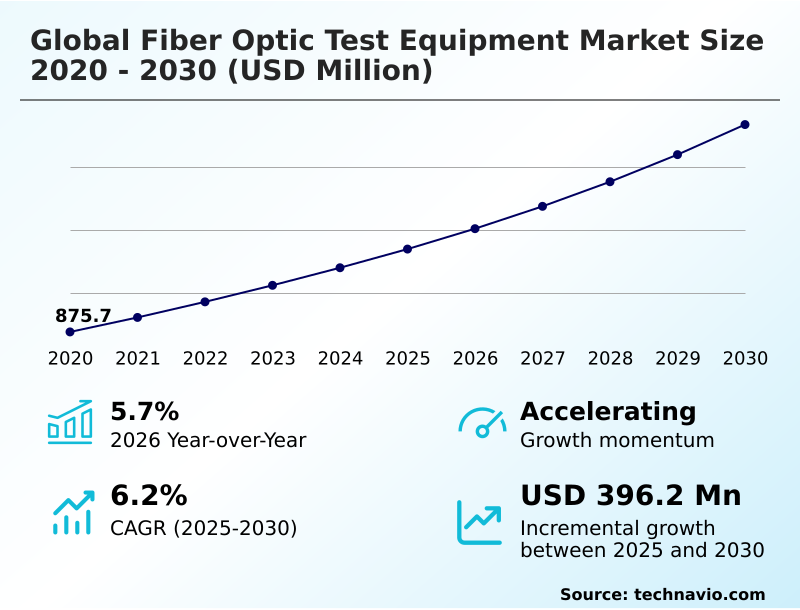
The fiber optic test equipment market size is valued to increase by USD 396.2 million, at a CAGR of 6.2% from 2025 to 2030. Escalation of 5G network deployments will drive the fiber optic test equipment market.
Major Market Trends & Insights
- APAC dominated the market and accounted for a 45.2% growth during the forecast period.
- By Product - Portable test equipment segment was valued at USD 923.4 million in 2024
- By Type - OTDR segment accounted for the largest market revenue share in 2024
Market Size & Forecast
- Market Opportunities: USD 659.8 million
- Market Future Opportunities: USD 396.2 million
- CAGR from 2025 to 2030 : 6.2%
Market Summary
- The Fiber Optic Test Equipment Market is undergoing a significant transformation, driven by the relentless expansion of digital infrastructure. Escalating deployments of 5G, the proliferation of hyperscale data centers for AI, and government-led broadband initiatives are creating an insatiable demand for higher bandwidth and lower latency.
- This necessitates a shift from basic connectivity verification to sophisticated network certification and performance monitoring. For instance, a telecommunications provider deploying a new metropolitan 400G ethernet network must utilize advanced tools to measure parameters like chromatic dispersion and polarization mode dispersion to guarantee service level agreements. This ensures network reliability and prevents costly outages.
- However, the increasing complexity of these networks, characterized by technologies such as dense wavelength division multiplexing (DWDM) and passive optical network (PON), presents significant challenges. Compounding this issue is a persistent shortage of skilled technicians capable of operating advanced test equipment, alongside the high capital investment required for these sophisticated tools.
- Consequently, the industry is moving towards more automated, AI-driven solutions to improve efficiency and mitigate human error.
What will be the Size of the Fiber Optic Test Equipment Market during the forecast period?
Get Key Insights on Market Forecast (PDF) Get Free Sample
How is the Fiber Optic Test Equipment Market Segmented?
The fiber optic test equipment industry research report provides comprehensive data (region-wise segment analysis), with forecasts and estimates in "USD million" for the period 2026-2030, as well as historical data from 2020-2024 for the following segments.
- Product
- Portable test equipment
- Benchtop systems
- Type
- OTDR
- Optical light source
- Optical power meter
- Optical loss test set
- Others
- End-user
- Telecommunications
- Data centers
- Industrial
- Others
- Geography
- APAC
- China
- India
- Japan
- North America
- US
- Canada
- Mexico
- Europe
- Germany
- UK
- France
- Middle East and Africa
- Saudi Arabia
- UAE
- South Africa
- South America
- Brazil
- Argentina
- Colombia
- Rest of World (ROW)
- APAC
By Product Insights
The portable test equipment segment is estimated to witness significant growth during the forecast period.
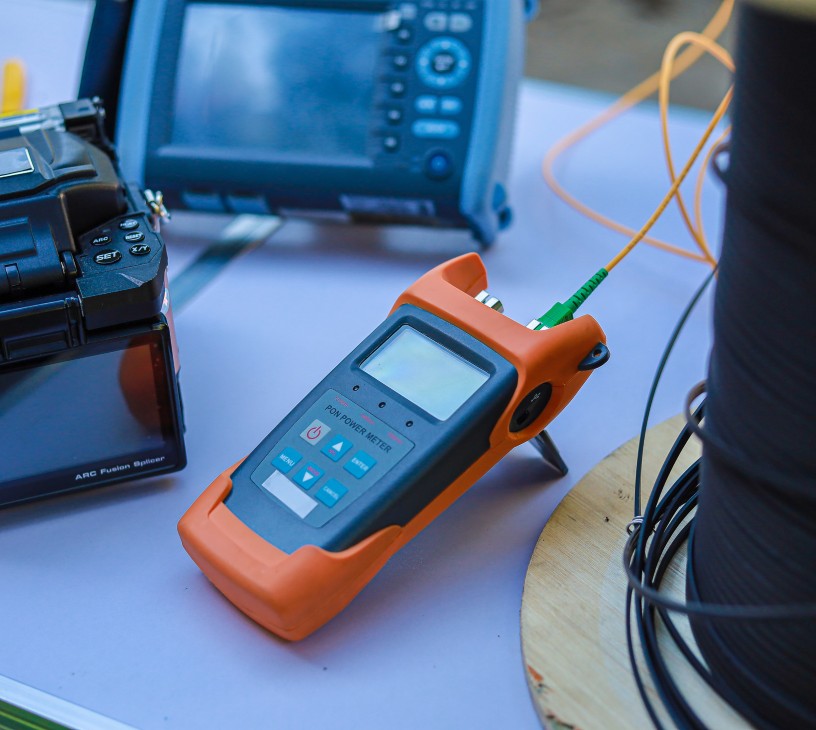
The portable test equipment segment is shaped by extensive fieldwork for network installation, maintenance, and troubleshooting. Field service test equipment is essential for on-the-spot verification of network integrity and performance optimization.
Demand is driven by the need for rugged, multifunctional, and user-friendly devices, with portable optical testing holding a notable 56% share of deployments. Recent developments focus on integrating cloud connectivity for real-time data sharing and remote analysis.
Advanced capabilities like optical channel monitoring, traditionally found in a benchtop system, are now being integrated into handheld tester models to meet the demands of next-generation passive optical network (PON) deployments.
This evolution is critical as simplifying field testing and managing network complexity become top priorities for operators.
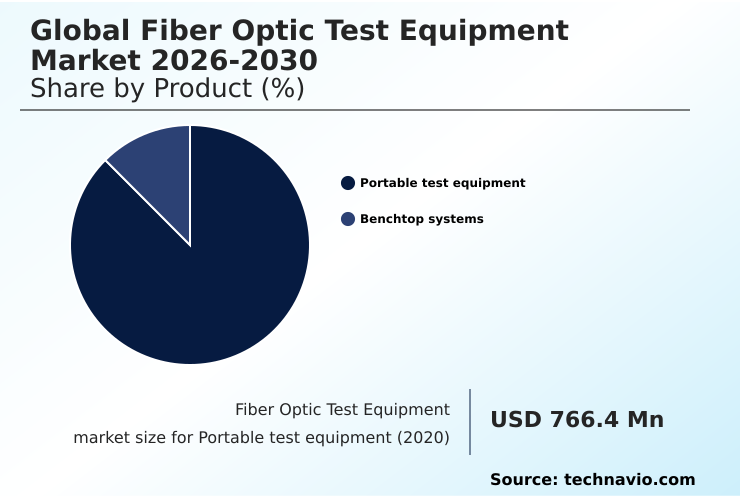
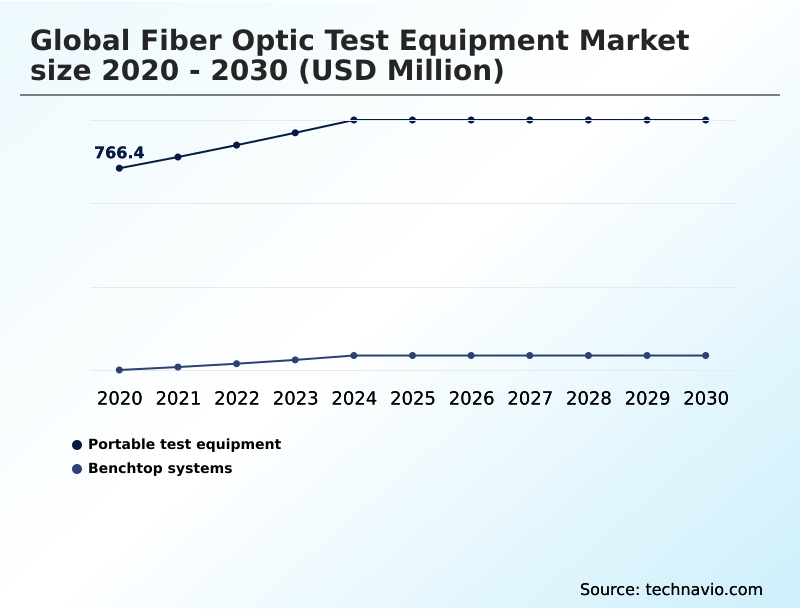
The Portable test equipment segment was valued at USD 923.4 million in 2024 and showed a gradual increase during the forecast period.
Regional Analysis
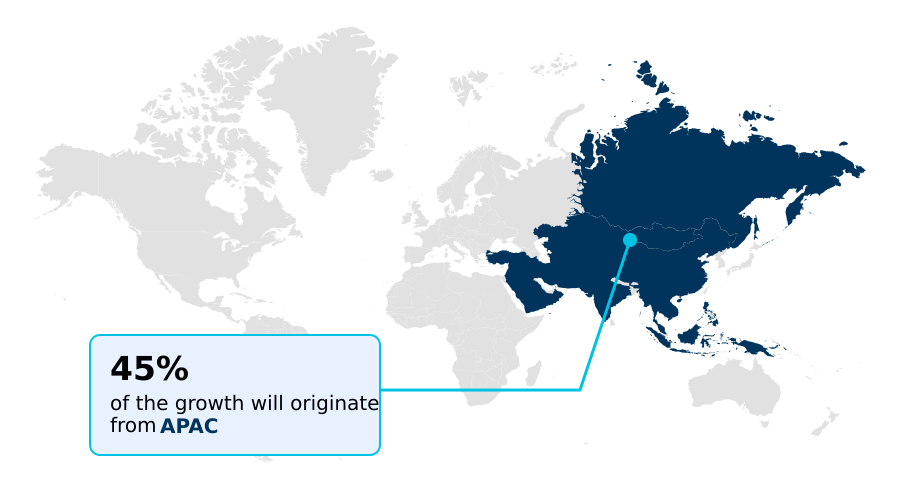
APAC is estimated to contribute 45.2% to the growth of the global market during the forecast period.Technavio’s analysts have elaborately explained the regional trends and drivers that shape the market during the forecast period.
See How Fiber Optic Test Equipment Market Demand is Rising in APAC Get Free Sample
The geographic landscape is led by APAC, which exhibits the market's highest growth at 6.9%, driven by massive infrastructure projects in China and India.
This region's focus on widespread 5G and FTTH rollouts creates substantial demand for tools supporting backhaul and fronthaul installations.
North America follows with a solid 5.9% growth, propelled by government-funded broadband initiatives and the continuous expansion of data center interconnect infrastructure. In this region, validating service level agreements and ensuring network uptime are primary concerns.
Europe, growing at 5.3%, is concentrating on upgrading existing networks and ensuring compliance with stringent performance standards, requiring sophisticated fiber optic network audit tools. Manufacturing test solutions are also crucial as the continent builds out its domestic supply chain.
These regional dynamics underscore a global need for effective troubleshooting fiber links and advanced network performance monitoring capabilities.
Market Dynamics
Our researchers analyzed the data with 2025 as the base year, along with the key drivers, trends, and challenges. A holistic analysis of drivers will help companies refine their marketing strategies to gain a competitive advantage.
- Strategic network management is evolving beyond basic fault detection to encompass a holistic approach to asset performance and longevity. Operators are now leveraging advanced dwdm channel analysis techniques to maximize the capacity of existing fiber, a critical step for deferring costly new builds.
- The process of certifying data center fiber links for 800g ethernet compliance testing has become a mission-critical task, as minor physical-layer impairments can cause significant performance degradation in AI workloads.
- Although the initial cost of fiber optic test equipment can be a barrier, the return on investment is realized through reduced opex with automated testing, which minimizes truck rolls and shortens repair times. For instance, a proactive approach using remote fiber monitoring for security and integrity can reduce service-disrupting incidents by a significant margin compared to reactive maintenance.
- Key challenges in hollow core fiber testing and the complexities of automating pic wafer-level testing are driving innovation. Best practices for fiber connector cleaning are being standardized to prevent common failure points, especially for mpo connectors. As networks grow, comparing otdr and olts for certification becomes crucial for balancing speed and accuracy.
- This shift requires training technicians for advanced testing to effectively troubleshoot passive optical network issues and validate latency for 5g fronthaul, ensuring reliability in industrial ethernet and readiness for test solutions for co-packaged optics.
- Moreover, the demand for portable otdr for ftth installation continues to grow, while otdr testing for long-haul networks and measuring polarization mode dispersion in 400g remain specialized, high-value activities for handheld testers for network maintenance.
What are the key market drivers leading to the rise in the adoption of Fiber Optic Test Equipment Industry?
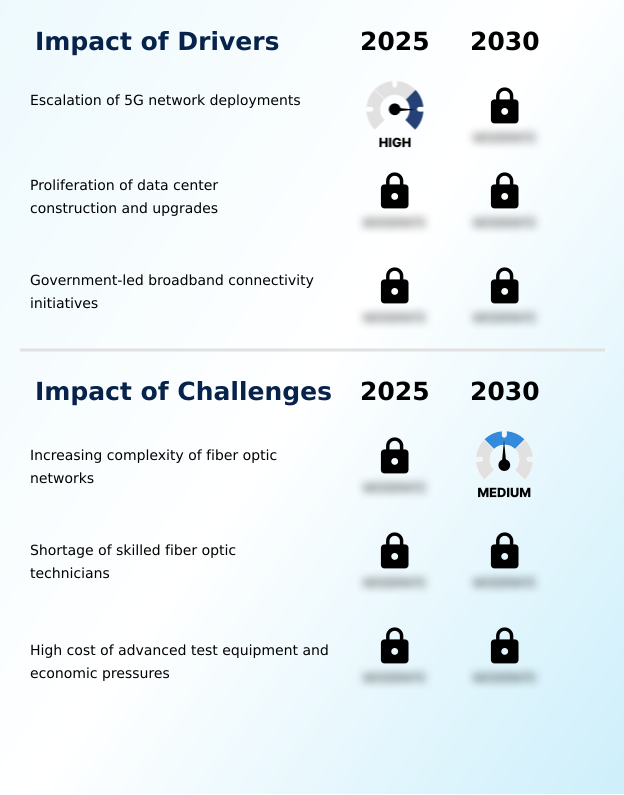
- The escalating deployment of 5G networks serves as a primary driver for market growth.
- Market growth is propelled by foundational investments in next-generation infrastructure. The escalation of 5G network deployments globally is a primary driver, as the technology relies on a dense fiber optic backhaul and fronthaul to deliver its low-latency, high-bandwidth promise.
- This expansion mandates rigorous end-to-end link testing. Another key driver is the unprecedented boom in data center construction, where the fiber density for AI-centric facilities is up to ten times greater than in traditional data centers.
- Government-led broadband initiatives, which aim to extend high-speed connectivity to underserved areas, also provide significant momentum, often increasing network access by over 40% in targeted regions.
- These drivers create sustained demand for advanced R&D lab instrumentation and installation and commissioning tools, ensuring network performance monitoring meets high standards.
What are the market trends shaping the Fiber Optic Test Equipment Industry?
- The proliferation of 5G networks and expansive Internet of Things ecosystems is a significant trend. This development is fundamentally reshaping connectivity demands and infrastructure requirements.
- Key market trends are centered on enabling higher speeds and greater automation. The surge in hyperscale data center construction, driven by AI workloads, necessitates advanced test solutions that can validate thousands of high-density fiber links with extreme precision.
- The integration of artificial intelligence into test equipment is a transformational shift, with AI-driven test automation capable of improving diagnostic accuracy by over 25% compared to manual methods. This allows operators to move from reactive troubleshooting to proactive network maintenance. The proliferation of 5G and IoT ecosystems continues to fuel demand for robust FTTH and backhaul networks.
- This expansion requires efficient field service test equipment and portable optical testing solutions that can accelerate network rollouts; automated fiber inspection tools reduce connector-related failures by up to 60%, significantly improving network uptime.
What challenges does the Fiber Optic Test Equipment Industry face during its growth?
- The increasing complexity of fiber optic network architectures presents a significant challenge to industry growth.
- The market faces significant operational and economic challenges. The increasing complexity of fiber optic networks, incorporating technologies like DWDM and high-speed Ethernet, demands highly sophisticated and expensive manufacturing test solutions. This high cost of advanced equipment presents a considerable hurdle for smaller contractors.
- Furthermore, a persistent shortage of skilled technicians capable of performing advanced fiber characterization services leads to project delays, with some reports indicating an increase in deployment timelines of up to 25% in fast-growing markets.
- This skills gap makes it difficult to effectively utilize advanced equipment for tasks like troubleshooting fiber links, creating a strong impetus for developing more intuitive and automated testing platforms. The meticulous nature of high-density fiber testing also means that failure to adhere to best practices can increase fault rates by over 50%.
Exclusive Technavio Analysis on Customer Landscape
The fiber optic test equipment market forecasting report includes the adoption lifecycle of the market, covering from the innovator’s stage to the laggard’s stage. It focuses on adoption rates in different regions based on penetration. Furthermore, the fiber optic test equipment market report also includes key purchase criteria and drivers of price sensitivity to help companies evaluate and develop their market growth analysis strategies.

Customer Landscape of Fiber Optic Test Equipment Industry
Competitive Landscape
Companies are implementing various strategies, such as strategic alliances, fiber optic test equipment market forecast, partnerships, mergers and acquisitions, geographical expansion, and product/service launches, to enhance their presence in the industry.
Advantest Corp. - Providers offer advanced test, measurement, and analytics solutions for certifying and managing next-generation communication network infrastructures.
The industry research and growth report includes detailed analyses of the competitive landscape of the market and information about key companies, including:
- Advantest Corp.
- AFL
- Anritsu Corp.
- AP Sensing GmbH
- Kingfisher International Pty Ltd.
- Corning Inc.
- EXFO Inc.
- Fluke Corp.
- Keysight Technologies Inc.
- Santec Corp.
- OZ Optics Ltd.
- Photon Kinetics
- Thorlabs Inc.
- VeEX Inc.
- Viavi Solutions Inc.
- Landa Pharmacy
- Yokogawa Electric Corp.
Qualitative and quantitative analysis of companies has been conducted to help clients understand the wider business environment as well as the strengths and weaknesses of key industry players. Data is qualitatively analyzed to categorize companies as pure play, category-focused, industry-focused, and diversified; it is quantitatively analyzed to categorize companies as dominant, leading, strong, tentative, and weak.
Recent Development and News in Fiber optic test equipment market
- In October, 2024, Vodafone Germany inaugurated its nationwide 5G Standalone network, covering over 92% of the population, a move that requires extensive fiber backhaul testing and validation.
- In January, 2025, Microsoft announced an investment of approximately $80 billion in AI-enabled data centers for its fiscal year, driving massive demand for high-speed fiber interconnect testing solutions.
- In February, 2025, a major UK telecom provider launched a large-scale apprenticeship program to cultivate a new generation of fiber technicians, directly addressing the industry-wide shortage of skilled personnel.
- In March, 2025, VIAVI Solutions showcased a new suite of test solutions specifically designed for AI infrastructure, including advanced connector microscopes and an 800G transport module for field testing platforms.
Dive into Technavio’s robust research methodology, blending expert interviews, extensive data synthesis, and validated models for unparalleled Fiber Optic Test Equipment Market insights. See full methodology.
| Market Scope | |
|---|---|
| Page number | 300 |
| Base year | 2025 |
| Historic period | 2020-2024 |
| Forecast period | 2026-2030 |
| Growth momentum & CAGR | Accelerate at a CAGR of 6.2% |
| Market growth 2026-2030 | USD 396.2 million |
| Market structure | Fragmented |
| YoY growth 2025-2026(%) | 5.7% |
| Key countries | China, India, Japan, South Korea, Australia, Indonesia, US, Canada, Mexico, Germany, UK, France, Italy, Spain, The Netherlands, Saudi Arabia, UAE, South Africa, Israel, Turkey, Brazil, Argentina and Colombia |
| Competitive landscape | Leading Companies, Market Positioning of Companies, Competitive Strategies, and Industry Risks |
Research Analyst Overview
- The Fiber Optic Test Equipment Market is fundamentally shaped by the need to validate increasingly complex network infrastructures. Boardroom decisions on capital expenditure are now directly influenced by the technical requirements of deploying 400g ethernet and 800g ethernet, where improper network certification can lead to catastrophic service failures.
- The transition to coherent optics and dense wavelength division multiplexing (dwdm) demands a higher level of signal integrity, making tools like an optical spectrum analyzer and bit error rate tester (bert) indispensable.
- The shortage of skilled technicians, which increases project deployment times by an estimated 20% in some high-growth areas, is forcing a strategic shift towards automated solutions for fault detection and analysis. Key measurement parameters such as chromatic dispersion, polarization mode dispersion, insertion loss, return loss, and latency measurement are critical for ensuring network reliability.
- Equipment ranging from a handheld tester to a full benchtop system is essential. The focus extends to components like the multi-fiber push on connector and emerging technologies like hollow core fiber and the photonic integrated circuit (pic).
- Tools such as the otdr module, optical power meter, optical light source, optical loss test set, visual fault locator, and fiber inspection probe are vital for ftth, data center interconnect, fronthaul, and backhaul applications.
- The ultimate goal is to maintain a low optical signal-to-noise ratio and minimal signal attenuation, with remote fiber test system (rfts) platforms enabling proactive optical channel monitoring.
What are the Key Data Covered in this Fiber Optic Test Equipment Market Research and Growth Report?
-
What is the expected growth of the Fiber Optic Test Equipment Market between 2026 and 2030?
-
USD 396.2 million, at a CAGR of 6.2%
-
-
What segmentation does the market report cover?
-
The report is segmented by Product (Portable test equipment, and Benchtop systems), Type (OTDR, Optical light source, Optical power meter, Optical loss test set, and Others), End-user (Telecommunications, Data centers, Industrial, and Others) and Geography (APAC, North America, Europe, Middle East and Africa, South America)
-
-
Which regions are analyzed in the report?
-
APAC, North America, Europe, Middle East and Africa and South America
-
-
What are the key growth drivers and market challenges?
-
Escalation of 5G network deployments, Increasing complexity of fiber optic networks
-
-
Who are the major players in the Fiber Optic Test Equipment Market?
-
Advantest Corp., AFL, Anritsu Corp., AP Sensing GmbH, Kingfisher International Pty Ltd., Corning Inc., EXFO Inc., Fluke Corp., Keysight Technologies Inc., Santec Corp., OZ Optics Ltd., Photon Kinetics, Thorlabs Inc., VeEX Inc., Viavi Solutions Inc., Landa Pharmacy and Yokogawa Electric Corp.
-
Market Research Insights
- The market is defined by a strategic push toward improving operational efficiencies and ensuring network uptime. Advanced test process automation delivers tangible benefits, with some deployments achieving a 40% reduction in certification time. This is critical for managing network complexity and validating service level agreements in high-stakes environments.
- Furthermore, AI-driven test automation enhances diagnostic precision, with proactive network maintenance capabilities reducing fault-related operational expenditure by up to 30%. End-to-end link testing and real-time network visibility are now standard requirements. Operators are adopting comprehensive fiber characterization services and remote network troubleshooting to maintain performance. Key activities include PON network activation, submarine cable testing, and certifying structured cabling.
- The focus is on simplifying field testing through advanced installation and commissioning tools while performing thorough fiber optic network audits. This ensures that next-generation network testing meets stringent fiber optic testing standards for optical transport network testing, optical component testing, and high-density fiber testing, ultimately supporting a transition to automated fiber inspection and R&D lab instrumentation.
We can help! Our analysts can customize this fiber optic test equipment market research report to meet your requirements.
 RIA -
RIA - 
