


Geothermal Drilling For Power Generation Market Size 2026-2030
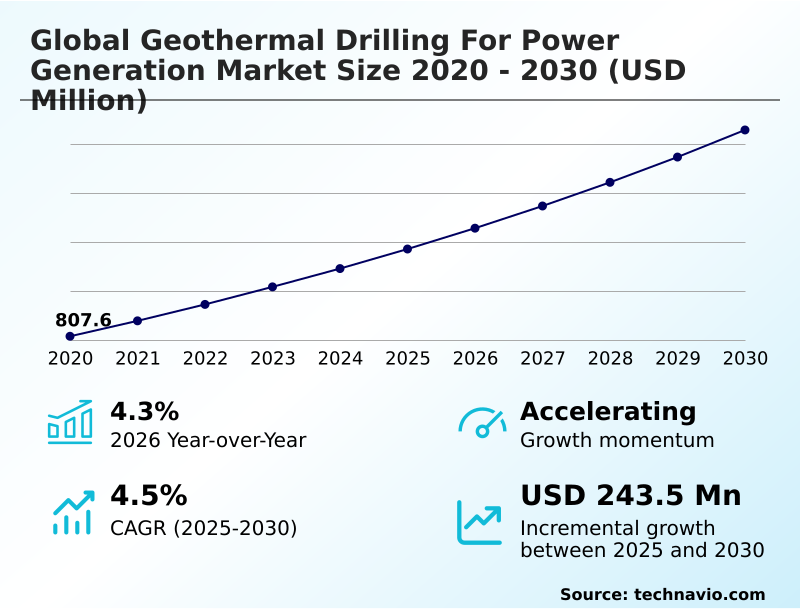
The geothermal drilling for power generation market size is valued to increase by USD 243.5 million, at a CAGR of 4.5% from 2025 to 2030. Global decarbonization mandates and necessity for baseload power will drive the geothermal drilling for power generation market.
Major Market Trends & Insights
- APAC dominated the market and accounted for a 45.2% growth during the forecast period.
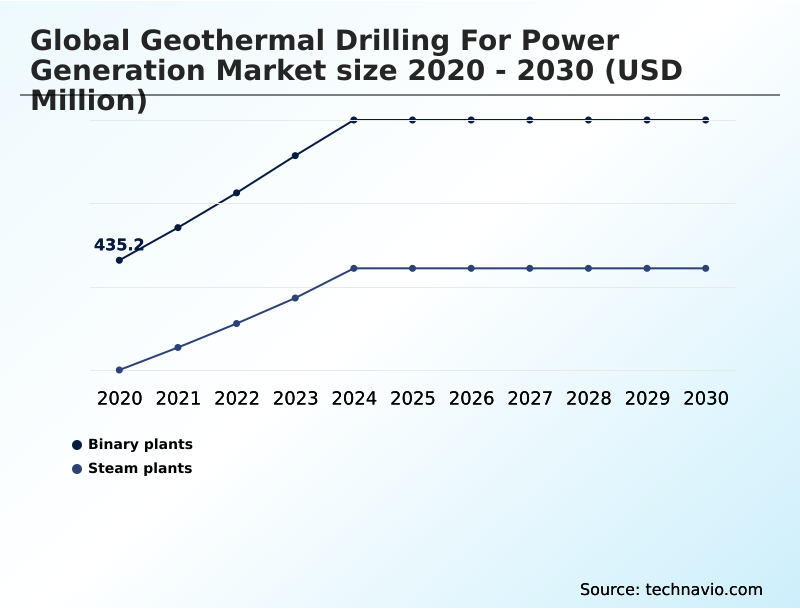
- By Application - Binary plants segment was valued at USD 515.5 million in 2024
- By Area - Below 1000m segment accounted for the largest market revenue share in 2024
Market Size & Forecast
- Market Opportunities: USD 422 million
- Market Future Opportunities: USD 243.5 million
- CAGR from 2025 to 2030 : 4.5%
Market Summary
- The geothermal drilling for power generation market is undergoing a significant transformation, driven by the urgent need for baseload renewable energy. This industry, which focuses on specialized engineering to access the Earth's thermal energy, is moving beyond conventional hydrothermal reservoirs.
- A key development is the strategic integration of oil and gas expertise, where technologies like advanced directional drilling and subsurface modeling are adapted for geothermal energy extraction. This convergence allows for the development of enhanced geothermal systems, unlocking vast unconventional geothermal resources in previously unviable hot dry rock locations.
- For instance, a utility provider can leverage these advancements to develop a local geothermal asset, achieving a stable power supply with a capacity factor over 90%, thereby enhancing grid stability and reducing reliance on volatile fossil fuel markets.
- However, the high initial capital investment and subsurface exploration risk remain considerable barriers, necessitating innovative geothermal project financing and risk-mitigation strategies to sustain momentum.
What will be the Size of the Geothermal Drilling For Power Generation Market during the forecast period?
Get Key Insights on Market Forecast (PDF) Request Free Sample
How is the Geothermal Drilling For Power Generation Market Segmented?
The geothermal drilling for power generation industry research report provides comprehensive data (region-wise segment analysis), with forecasts and estimates in "USD million" for the period 2026-2030, as well as historical data from 2020-2024 for the following segments.
- Application
- Binary plants
- Steam plants
- Area
- Below 1000m
- 1000-2000m
- Type
- Production wells
- Injection wells
- Slim wells
- Geography
- APAC
- Indonesia
- Japan
- China
- North America
- US
- Canada
- Mexico
- Europe
- Italy
- Germany
- France
- South America
- Argentina
- Brazil
- Middle East and Africa
- Turkey
- Saudi Arabia
- Rest of World (ROW)
- APAC
By Application Insights
The binary plants segment is estimated to witness significant growth during the forecast period.
The binary plants segment is pivotal for expanding the geothermal value chain, enabling power generation from moderate-enthalpy resources previously considered unviable. This approach utilizes secondary fluids and advanced geothermal heat exchangers, requiring specific subsurface engineering and drilling strategies.
Unlike steam plants, binary systems operate in a closed loop, making them integral to a resilient energy portfolio in regions with stringent environmental standards.
The focus is on optimizing drilling operational costs for larger-diameter wells and advanced casing design to accommodate high-volume pumps. Effective geothermal reservoir engineering is crucial to manage fluid flow and prevent thermal breakthrough.
Innovations in high-temperature resilient materials and well stimulation techniques are enhancing system efficiency, with some designs improving heat extraction rates by over 15% and supporting large-scale geothermal district heating networks.
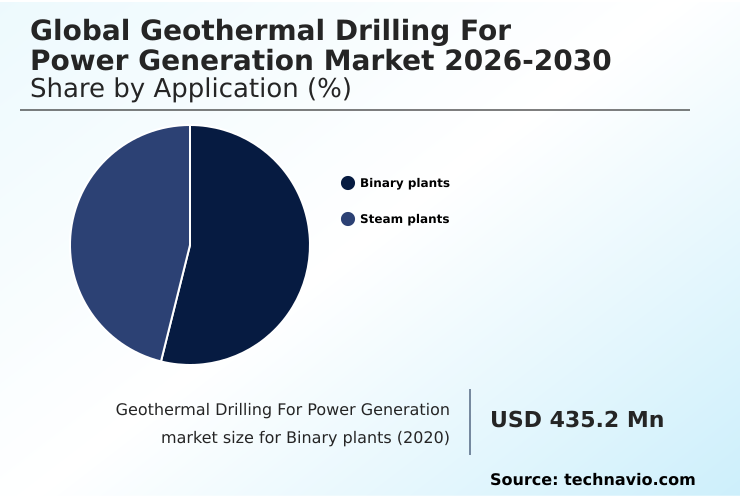
The Binary plants segment was valued at USD 515.5 million in 2024 and showed a gradual increase during the forecast period.
Regional Analysis
APAC is estimated to contribute 45.2% to the growth of the global market during the forecast period.Technavio’s analysts have elaborately explained the regional trends and drivers that shape the market during the forecast period.

See How Geothermal Drilling For Power Generation Market Demand is Rising in APAC Request Free Sample
The regions covered in the Global Geothermal Drilling For Power Generation Market 2026-2030 are APAC, North America, Europe, South America, and Middle East and Africa. APAC is the key region, contributing over 45% of incremental growth.
This expansion is driven by vast resources along the Pacific Ring of Fire, particularly in Indonesia and The Philippines, focusing on high-pressure steam for geothermal well construction.
In North America, the focus is on Enhanced Geothermal Systems (EGS) in hot dry rock formations, leveraging drilling rig automation to improve efficiency.
Meanwhile, the Middle East and Africa, especially along the East African Rift in Kenya, is a major growth frontier.
This diverse geopolitical landscape dictates varied approaches to drilling and geothermal asset management, from optimizing production well and injection well systems in mature fields to using advanced polycrystalline diamond compact bits to increase the drilling rate of penetration in new explorations.
Market Dynamics
Our researchers analyzed the data with 2025 as the base year, along with the key drivers, trends, and challenges. A holistic analysis of drivers will help companies refine their marketing strategies to gain a competitive advantage.
- Strategic decision-making in the geothermal sector increasingly revolves around complex technical and financial trade-offs. The debate over enhanced geothermal systems vs hydrothermal projects highlights this, with the former offering broader geographic potential but facing challenges in hot dry rock drilling.
- Stakeholders are intensely focused on the cost of deep geothermal drilling per foot and finding ways to improve the rate of penetration in hard rock. A critical operational concern is minimizing induced seismicity in geothermal projects, which requires sophisticated real-time data analytics in geothermal drilling and advanced monitoring.
- Material science plays a crucial role, with ongoing R&D for materials for corrosive geothermal environments and casing design for thermal expansion. The efficiency of drilling automation for geothermal wells is now a key performance indicator, with automated systems reducing certain operational risks by over 50% compared to manual methods.
- Optimizing geothermal wellbore placement through better subsurface data is directly linked to mitigating investment risks in geothermal exploration. Furthermore, the effectiveness of different geothermal well stimulation methods is central to managing thermal breakthrough in reservoirs and ensuring the long-term viability of geothermal power for baseload electricity demand, whether from a binary plant vs steam plant geothermal configuration.
- The industry's evolution hinges on innovations that address these long-tail challenges.
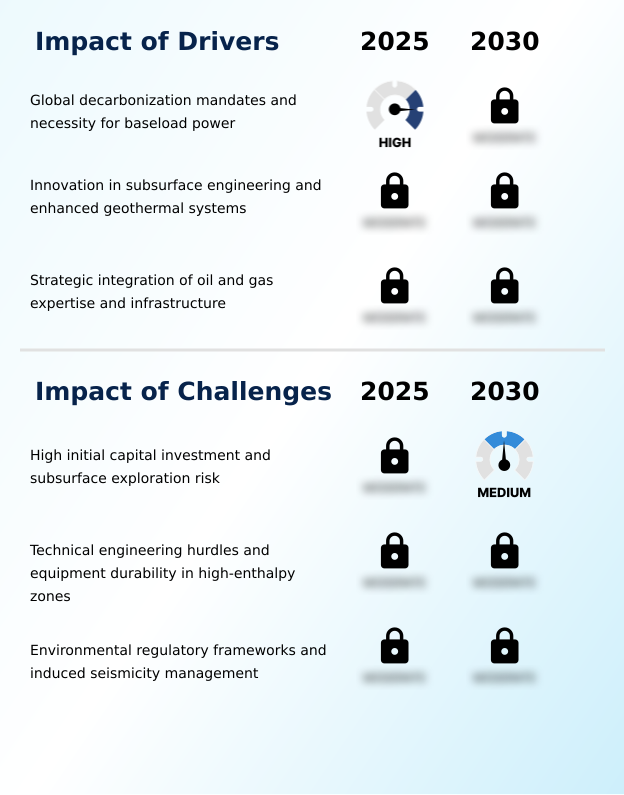
What are the key market drivers leading to the rise in the adoption of Geothermal Drilling For Power Generation Industry?
- The market is primarily driven by global decarbonization mandates and the increasing necessity for reliable, continuous baseload power.
- Global decarbonization mandates and the need for baseload renewable energy are primary drivers for the geothermal power generation market.
- Enhanced geothermal systems (EGS) are expanding viability beyond traditional hydrothermal reservoirs, enabled by the strategic integration of oil and gas expertise in directional drilling and advanced subsurface modeling.
- These technologies improve geothermal energy extraction efficiency, providing essential grid stability solutions with capacity factors often exceeding 90%. This reliability makes geothermal a critical source of baseload power, unlike intermittent renewables.
- Repurposing existing oil and gas infrastructure for geothermal applications further accelerates deployment, potentially reducing initial project capital by up to 40% and supporting a faster transition to clean energy.
What are the market trends shaping the Geothermal Drilling For Power Generation Industry?
- A key market trend is the integration of high-temperature resilient materials and next-generation sensors, which enables drilling operations in extreme thermal environments.
- A transformative trend in geothermal drilling for power generation is the move toward deep geothermal drilling to access unconventional geothermal resources. This involves the development of non-mechanical drilling methods like millimeter-wave drilling and plasma drilling, which promise to penetrate hard rock at rates up to 300% faster than conventional techniques.
- Cross-industry technological convergence is fueling advancements in high pressure high temperature (HPHT) environments, particularly with next-generation sensors and downhole electronics capable of withstanding extreme conditions. The objective is to tap into supercritical fluids, unlocking immense energy potential and fundamentally altering the economics of sustainable energy infrastructure.
- This push beyond traditional boundaries is critical for making baseload renewable energy a globally scalable solution.
What challenges does the Geothermal Drilling For Power Generation Industry face during its growth?
- High initial capital investment and significant subsurface exploration risk present a key challenge to industry growth.
- The sector faces significant hurdles, primarily the high initial capital investment and subsurface exploration risk associated with unproven fields, where success rates can be below 50%. Securing geothermal project financing is complicated by these uncertainties and complex environmental regulatory frameworks.
- Technical challenges persist in high-enthalpy geothermal zones, where aggressive geothermal fluid chemistry necessitates the use of expensive corrosion resistant alloys and advanced cementing technology to ensure long-term wellbore stability.
- Furthermore, managing public perception and regulatory compliance around induced seismicity monitoring adds layers of cost and time, with permitting processes in some regions extending project timelines by multiple years, impacting both flash steam power plants and newer EGS projects.
Exclusive Technavio Analysis on Customer Landscape
The geothermal drilling for power generation market forecasting report includes the adoption lifecycle of the market, covering from the innovator’s stage to the laggard’s stage. It focuses on adoption rates in different regions based on penetration. Furthermore, the geothermal drilling for power generation market report also includes key purchase criteria and drivers of price sensitivity to help companies evaluate and develop their market growth analysis strategies.

Customer Landscape of Geothermal Drilling For Power Generation Industry
Competitive Landscape
Companies are implementing various strategies, such as strategic alliances, geothermal drilling for power generation market forecast, partnerships, mergers and acquisitions, geographical expansion, and product/service launches, to enhance their presence in the industry.
Baker Hughes Co. - Offers integrated solutions for geothermal well construction, specializing in advanced directional drilling and high-temperature fluid management for enhanced geothermal systems (EGS).
The industry research and growth report includes detailed analyses of the competitive landscape of the market and information about key companies, including:
- Baker Hughes Co.
- Deep Rock Manufacturing Co.
- Eavor Technologies Inc.
- Fervo Energy
- Fraste Spa
- GA Drilling AS
- Geotech Drilling Services Ltd.
- Gill Rock Drill Co. Inc.
- Halliburton Co.
- Huisman Equipment BV
- Marton Geotechnical Services Ltd
- Ormat Technologies Inc.
- PT Pertamina Persero
- Quaise Energy Inc.
- Schlumberger Ltd.
- SIMCO Drilling Equipment Inc.
- STDS Jantz GmbH and Co.
- Versa Drill
Qualitative and quantitative analysis of companies has been conducted to help clients understand the wider business environment as well as the strengths and weaknesses of key industry players. Data is qualitatively analyzed to categorize companies as pure play, category-focused, industry-focused, and diversified; it is quantitatively analyzed to categorize companies as dominant, leading, strong, tentative, and weak.
Recent Development and News in Geothermal drilling for power generation market
- In November 2025, GA Drilling conducted a successful field demonstration of its proprietary plasma-drilling technology in a deep-hole test facility in the United Kingdom, penetrating high-strength metamorphic rock significantly faster than conventional methods.
- In August 2025, Fervo Energy collaborated with a major petroleum engineering firm to complete a horizontal drilling campaign in a deep granite formation in Utah, using directional drilling and high-temperature bits to create an artificial fracture network.
- In May 2025, SLB completed a series of high-capacity production wells in the Salton Sea region, employing a proprietary corrosion-resistant casing technology for continuous operation in hyper-saline environments.
- In March 2025, The European Union ratified the Baseload Resilience Act, a policy framework providing significant financial guarantees for deep-well drilling projects aimed at replacing coal-fired facilities with geothermal energy.
Dive into Technavio’s robust research methodology, blending expert interviews, extensive data synthesis, and validated models for unparalleled Geothermal Drilling For Power Generation Market insights. See full methodology.
| Market Scope | |
|---|---|
| Page number | 284 |
| Base year | 2025 |
| Historic period | 2020-2024 |
| Forecast period | 2026-2030 |
| Growth momentum & CAGR | Accelerate at a CAGR of 4.5% |
| Market growth 2026-2030 | USD 243.5 million |
| Market structure | Fragmented |
| YoY growth 2025-2026(%) | 4.3% |
| Key countries | Indonesia, The Philippines, Japan, China, India, Australia, US, Canada, Mexico, Iceland, Italy, Germany, France, Portugal, Greece, Chile, Argentina, Brazil, Turkey, Egypt, Kenya, Ethiopia and Saudi Arabia |
| Competitive landscape | Leading Companies, Market Positioning of Companies, Competitive Strategies, and Industry Risks |
Research Analyst Overview
- The geothermal drilling for power generation market is advancing through critical technological breakthroughs and strategic shifts. Its evolution is defined by the push into deeper, hotter, and more complex geological settings, which necessitates innovations in high-temperature drilling and wellbore stability. The development of enhanced geothermal systems is pivotal, allowing access to vast hot dry rock resources beyond traditional hydrothermal reservoirs.
- This requires sophisticated subsurface modeling and well stimulation techniques. A significant boardroom-level consideration is the budgeting for specialized equipment, such as corrosion resistant alloys and advanced cementing technology, to ensure the longevity of wells in harsh environments. Advanced subsurface modeling has demonstrated the potential to increase exploration success rates by up to 20%, directly impacting capital risk.
- As the industry matures, the focus on efficient reservoir management, including managing thermal breakthrough and optimizing injection well and production well performance, becomes paramount for sustainable geothermal asset management and long-term profitability.
What are the Key Data Covered in this Geothermal Drilling For Power Generation Market Research and Growth Report?
-
What is the expected growth of the Geothermal Drilling For Power Generation Market between 2026 and 2030?
-
USD 243.5 million, at a CAGR of 4.5%
-
-
What segmentation does the market report cover?
-
The report is segmented by Application (Binary plants, and Steam plants), Area (Below 1000m, and 1000-2000m), Type (Production wells, Injection wells, and Slim wells) and Geography (APAC, North America, Europe, South America, Middle East and Africa)
-
-
Which regions are analyzed in the report?
-
APAC, North America, Europe, South America and Middle East and Africa
-
-
What are the key growth drivers and market challenges?
-
Global decarbonization mandates and necessity for baseload power, High initial capital investment and subsurface exploration risk
-
-
Who are the major players in the Geothermal Drilling For Power Generation Market?
-
Baker Hughes Co., Deep Rock Manufacturing Co., Eavor Technologies Inc., Fervo Energy, Fraste Spa, GA Drilling AS, Geotech Drilling Services Ltd., Gill Rock Drill Co. Inc., Halliburton Co., Huisman Equipment BV, Marton Geotechnical Services Ltd, Ormat Technologies Inc., PT Pertamina Persero, Quaise Energy Inc., Schlumberger Ltd., SIMCO Drilling Equipment Inc., STDS Jantz GmbH and Co. and Versa Drill
-
Market Research Insights
- The market dynamics for geothermal power generation are shaped by a push for resilient energy portfolios and technological convergence. The strategic integration of oil and gas expertise is a important factor, as advanced drilling methodologies originally for hydrocarbons are now unlocking unconventional geothermal resources.
- This cross-industry technological convergence allows for more efficient geothermal well construction, with advanced telemetry systems reducing non-productive drilling time by up to 15%. This improves the economic case for deep geothermal drilling. As decarbonization mandates intensify, the value of geothermal as a source of baseload renewable energy increases, providing unique grid stability solutions.
- The focus on sustainable energy infrastructure is compelling a re-evaluation of high initial capital investment against the long-term benefits of energy independence and price stability, with geothermal offering a levelized cost of energy that is becoming increasingly competitive with conventional power sources.
We can help! Our analysts can customize this geothermal drilling for power generation market research report to meet your requirements.