



Golf Apparel Market Size 2026-2030
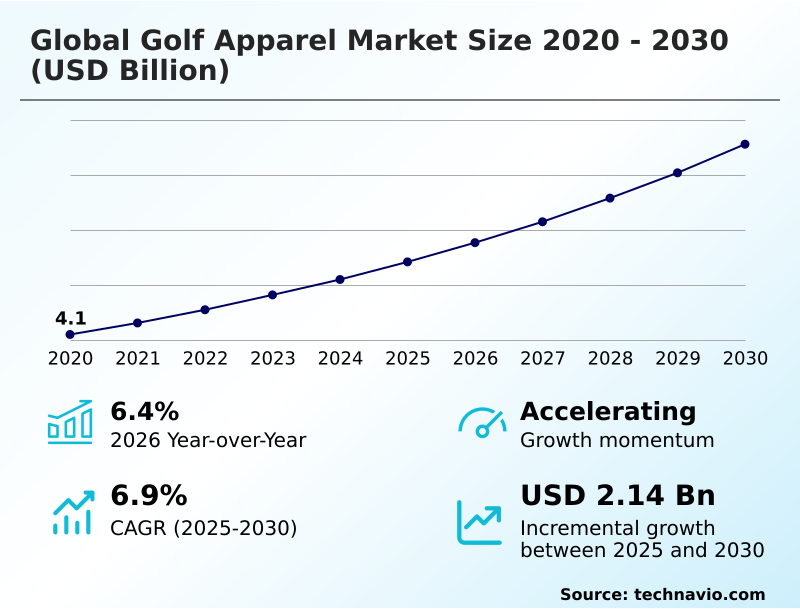
The golf apparel market size is valued to increase by USD 2.14 billion, at a CAGR of 6.9% from 2025 to 2030. Expanding participation and demographic diversification in golf will drive the golf apparel market.
Major Market Trends & Insights
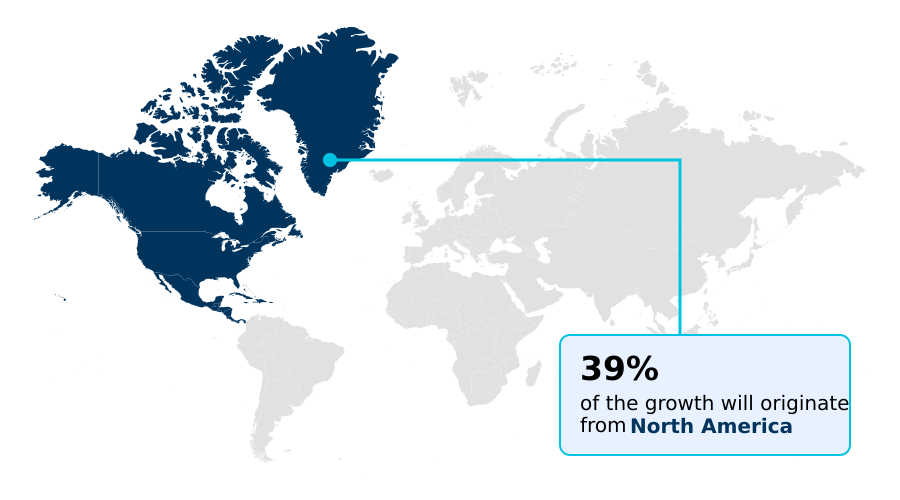
- North America dominated the market and accounted for a 38.8% growth during the forecast period.
- By End-user - Men segment was valued at USD 2.97 billion in 2024
- By Distribution Channel - Offline segment accounted for the largest market revenue share in 2024
Market Size & Forecast
- Market Opportunities: USD 3.46 billion
- Market Future Opportunities: USD 2.14 billion
- CAGR from 2025 to 2030 : 6.9%
Market Summary
- The golf apparel market is undergoing a significant transformation, moving beyond traditional sportswear to become a dynamic fusion of high-performance technology and mainstream fashion. This evolution is driven by a diversifying player base that includes more women and younger participants who demand versatile, stylish garments.
- Key trends include the integration of athleisure-style garments suitable for both on and off the course and a growing emphasis on sustainability, with brands incorporating recycled polyester and organic cotton. A primary driver is the continuous innovation in advanced fabric technologies, such as moisture-wicking fabric and materials with a high ultraviolet protection factor (UPF).
- However, the market faces challenges from intense competition and supply chain complexities. For instance, a brand aiming to launch a new line of weather-protective clothing must navigate fluctuating raw material costs and agile production cycles to meet fast-changing consumer preferences, a balancing act that defines modern operational strategy in this sector.
- This environment requires a keen focus on innovation, from performance-oriented fabrics to direct-to-consumer business model strategies, to capture and retain a discerning customer base.
What will be the Size of the Golf Apparel Market during the forecast period?
Get Key Insights on Market Forecast (PDF) Get Free Sample
How is the Golf Apparel Market Segmented?
The golf apparel industry research report provides comprehensive data (region-wise segment analysis), with forecasts and estimates in "USD million" for the period 2026-2030, as well as historical data from 2020-2024 for the following segments.
- End-user
- Men
- Women
- Children
- Distribution channel
- Offline
- Online
- Type
- Top wear
- Bottom wear
- Accessories
- Geography
- North America
- US
- Canada
- Mexico
- Europe
- UK
- Germany
- France
- APAC
- Japan
- South Korea
- China
- South America
- Brazil
- Argentina
- Middle East and Africa
- Saudi Arabia
- UAE
- South Africa
- Rest of World (ROW)
- North America
By End-user Insights
The men segment is estimated to witness significant growth during the forecast period.
The men's segment remains the cornerstone of the market, driven by a consumer base that values both performance and style. This demographic demands high-functionality garments featuring moisture-wicking fabric and four-way stretch material for superior on-course performance wear.
A key dynamic is the split between consumers loyal to classic golf attire and a growing group favoring athletic-fit apparel with a modern silhouette.
To meet these diverse needs, brands are focusing on customer-centric design, utilizing engineered textiles and temperature-regulating materials for comfort.
Effective seasonal collection forecasting has become critical, with successful strategies improving inventory alignment to demand by over 30%, ensuring that quick-drying textiles and other performance-oriented fabrics are available through a curated product selection.
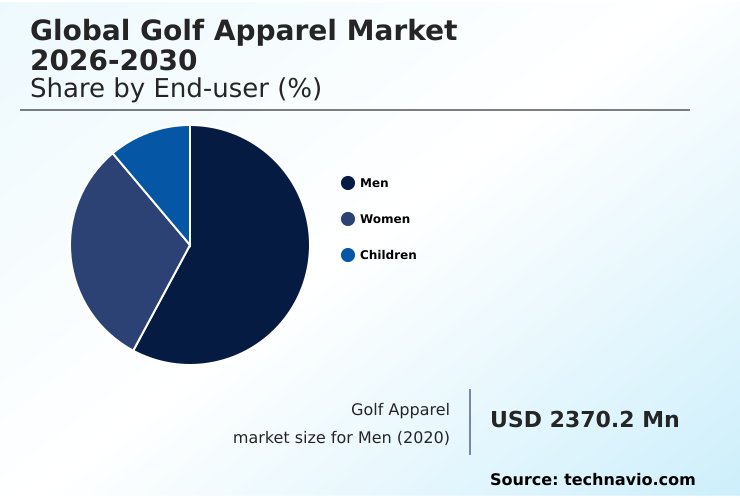
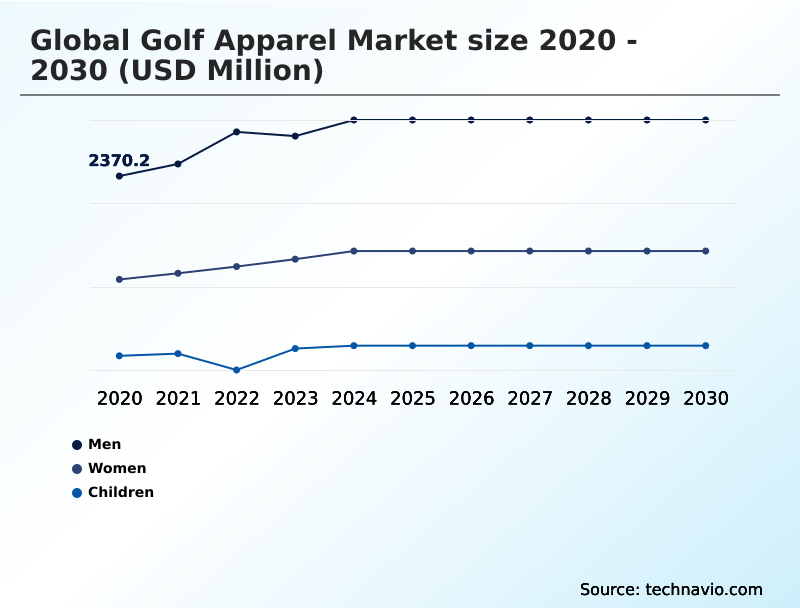
The Men segment was valued at USD 2.97 billion in 2024 and showed a gradual increase during the forecast period.
Regional Analysis
North America is estimated to contribute 38.8% to the growth of the global market during the forecast period.Technavio’s analysts have elaborately explained the regional trends and drivers that shape the market during the forecast period.
See How Golf Apparel Market Demand is Rising in North America Get Free Sample
Geographic expansion is heavily influenced by regional lifestyle trends and climate. North America accounts for 38.8% of the incremental growth, driven by a mature market that values technical sportswear with features like multi-directional stretch fabric and anti-odor technology.
In APAC, which contributes 27.63% to growth, there is a rising demand for resort-style golf wear and brands that leverage social commerce integration.
The European market, while valuing classic golf attire, is also seeing a push for innovation, with some brands achieving a 15% reduction in fabric waste through ergonomic seam placement and laser-cut ventilation designs.
As brands expand, strategies like inclusive sizing development and targeted influencer marketing collaboration are proving crucial for penetrating new demographics, supported by an immersive retail environment that showcases features like bonded seams and compression fit technology with UV-resistant dyes.
Market Dynamics
Our researchers analyzed the data with 2025 as the base year, along with the key drivers, trends, and challenges. A holistic analysis of drivers will help companies refine their marketing strategies to gain a competitive advantage.
- Strategic decision-making in the global golf apparel market is increasingly shaped by nuanced consumer demands and specialized product categories. For instance, searches for the best moisture-wicking golf polo or a lightweight waterproof golf jacket indicate a focus on specific performance attributes.
- Consumers are actively researching golf apparel with high UPF and sustainable and ethical golf clothing, signaling a shift in purchasing criteria beyond just style. This granularity extends to fit and form, as evidenced by interest in men's slim-fit golf trousers and golf skorts with tummy control.
- Direct comparisons, such as performance golf joggers vs trousers and athletic fit vs classic fit golf shirt, highlight the importance of offering diverse silhouettes.
- Brands are leveraging this data, with some using direct-to-consumer golf apparel brands models reporting a 25% higher customer retention rate compared to traditional wholesale channels by better aligning inventory with hyper-specific trends like technical fabric golf shorts for summer and advanced materials in professional golf apparel.
- The market for children's breathable golf shirts and custom logo golf apparel for teams also presents niche growth opportunities. Ultimately, understanding demand for golf apparel for hot and humid climates and the top brands for women's golfwear is essential for navigating this competitive landscape.
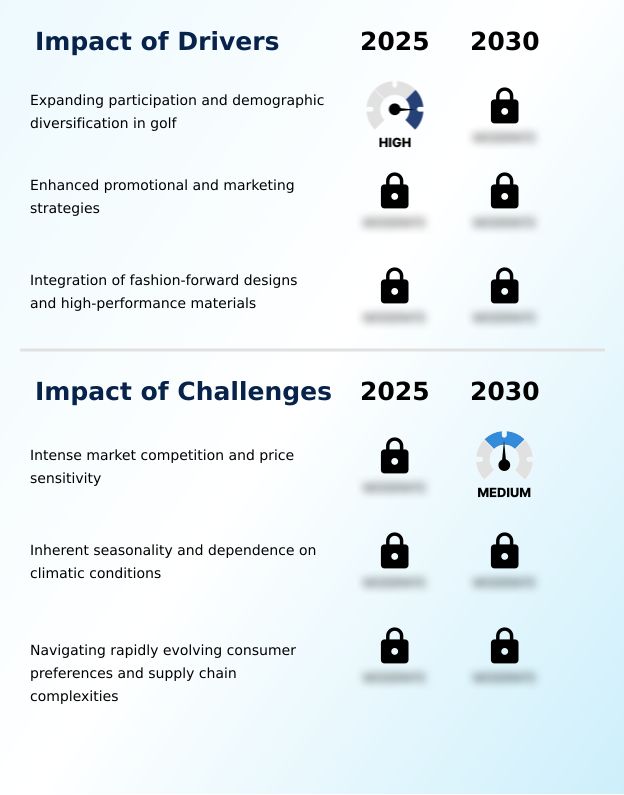
What are the key market drivers leading to the rise in the adoption of Golf Apparel Industry?
- The significant expansion and demographic diversification of the sport's participant base is a primary driver for the golf apparel market.
- Market growth is fueled by sophisticated marketing and product innovation. The expansion of the direct-to-consumer business model allows for enhanced brand storytelling, leading to a 25% increase in customer lifetime value for some specialized brands.
- The strategic use of an endorsement marketing strategy, coupled with experiential marketing activation, builds strong brand equity. Technology is also a key driver, with advanced fabric technologies and high-performance materials enabling performance-driven design.
- The successful integration of smart fabric integration allows for a personalized shopping experience, while seamless construction and pilling-resistant knit fabrics improve garment longevity. This digital retail transformation, focusing on both innovation and consumer connection, underpins the market's positive trajectory.
What are the market trends shaping the Golf Apparel Industry?
- A predominant trend shaping the market is the integration of on-course performance wear with off-course lifestyle fashion. This creates a hybrid apparel category that serves the modern consumer's desire for versatility, comfort, and style.
- The convergence of off-course lifestyle fashion and on-course performance is the primary trend, creating demand for athleisure-style garments with course-to-clubhouse versatility. This shift is supported by a move towards sustainable materials, with brands adopting recycled polyester and organic cotton reporting a 15% improvement in consumer trust metrics.
- The focus on lightweight construction and breathable textiles with a high ultraviolet protection factor (UPF) is now standard. Furthermore, fashion-forward designs with a minimalist aesthetic are gaining traction, especially among younger demographics. Companies embracing circular economy principles and ethical manufacturing practices have successfully reduced their material waste by up to 20%, aligning with modern consumer values.
What challenges does the Golf Apparel Industry face during its growth?
- Intense market competition, combined with pronounced consumer price sensitivity, presents a formidable and persistent challenge for participants in the golf apparel market.
- Navigating supply chain complexity and intense competition presents significant challenges. The need for fast-fashion agility clashes with the long development cycles for premium quality construction and weather-protective clothing. Ensuring supply chain transparency and raw material traceability adds operational costs, with compliance audits increasing expenses by up to 10%.
- The proliferation of private label offerings puts downward pressure on prices, squeezing margins for established brands. Effective product lifecycle management is crucial to handle seasonal collection forecasting for items like insulated outerwear fabrics and garments with a water-resistant finish. Balancing innovation in thermal regulation technology and antimicrobial treatment with cost pressures is a constant struggle for market participants.
Exclusive Technavio Analysis on Customer Landscape
The golf apparel market forecasting report includes the adoption lifecycle of the market, covering from the innovator’s stage to the laggard’s stage. It focuses on adoption rates in different regions based on penetration. Furthermore, the golf apparel market report also includes key purchase criteria and drivers of price sensitivity to help companies evaluate and develop their market growth analysis strategies.
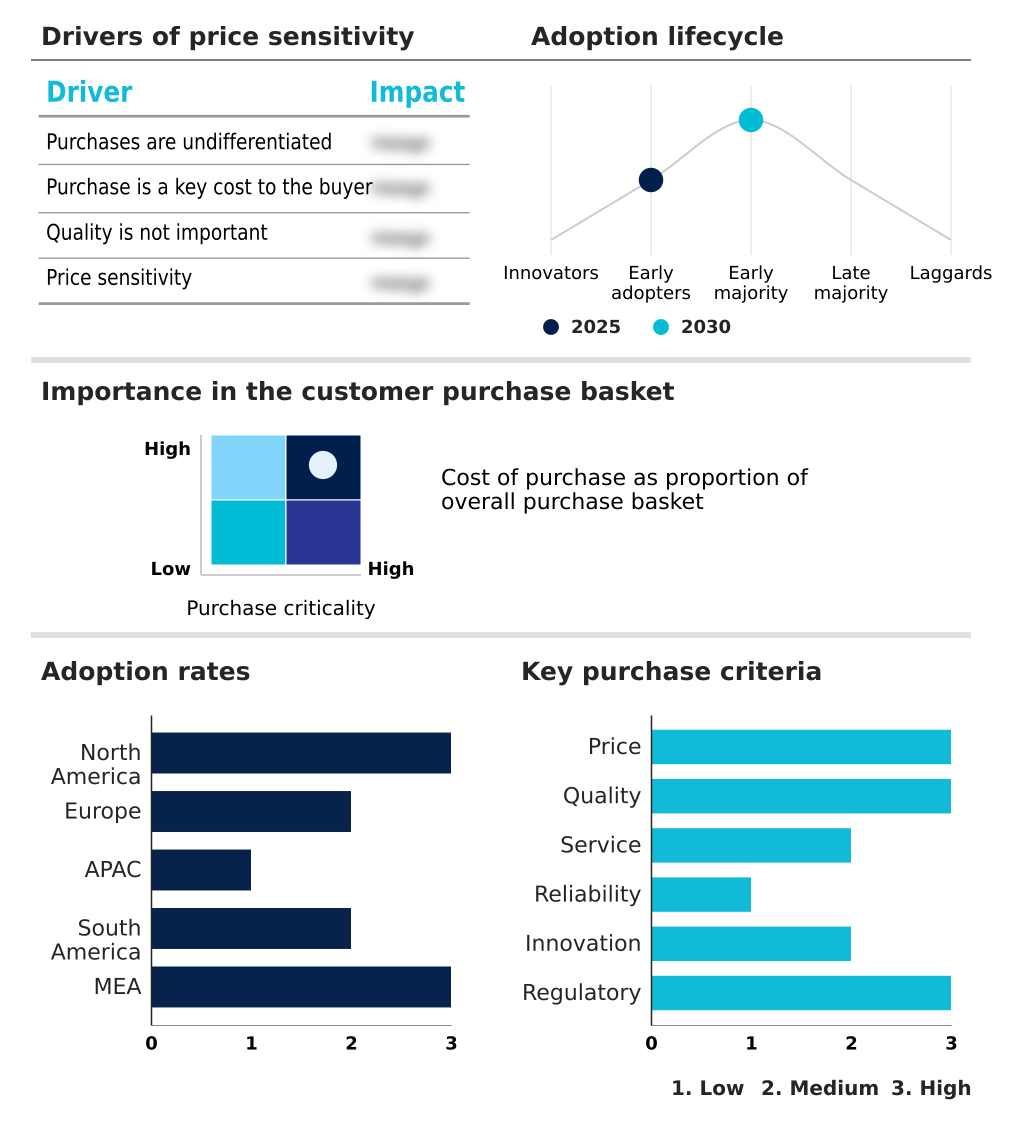
Customer Landscape of Golf Apparel Industry
Competitive Landscape
Companies are implementing various strategies, such as strategic alliances, golf apparel market forecast, partnerships, mergers and acquisitions, geographical expansion, and product/service launches, to enhance their presence in the industry.
Adidas AG - The company provides a diverse range of performance apparel, including golf-specific clothing featuring advanced moisture-wicking and weather-resistant technologies for enhanced athletic performance on the course.
The industry research and growth report includes detailed analyses of the competitive landscape of the market and information about key companies, including:
- Adidas AG
- EPNY Golf
- G FORE
- Galvin Green AB
- Greyson Clothiers
- Holderness and Bourne LLC
- J.Lindeberg AB
- Johnnie O Inc
- LK International AG
- lululemon athletica Inc.
- Nike Inc.
- PING Inc.
- PUMA SE
- Ralph Lauren Corp.
- Rhone Apparel Inc
- Sunice Sports
- Swing Control
- Taylor Made Golf Co. Inc.
- Topgolf Callaway Brands Corp.
- Under Armour Inc.
Qualitative and quantitative analysis of companies has been conducted to help clients understand the wider business environment as well as the strengths and weaknesses of key industry players. Data is qualitatively analyzed to categorize companies as pure play, category-focused, industry-focused, and diversified; it is quantitatively analyzed to categorize companies as dominant, leading, strong, tentative, and weak.
Recent Development and News in Golf apparel market
- In April 2025, Malbon collaborated with Futura Laboratories on a collection that debuted at the Masters, merging streetwear art with golf fashion to appeal to a younger, style-conscious demographic.
- In January 2025, Adidas announced that its entire European golf apparel collection would be crafted from 100% recycled polyester and sustainably sourced cotton by the end of 2026, launching its Primegreen line to spearhead the initiative.
- In October 2024, luxury brand Loro Piana launched an exclusive capsule collection of high-end golf apparel for the Middle Eastern market, featuring natural fibers like cashmere and silk to target affluent consumers.
- In September 2024, Under Armour revealed a new line of smart-integrated golf polos featuring embedded biometric sensors to track swing metrics and body temperature, aiming to provide data-driven performance insights for players.
Dive into Technavio’s robust research methodology, blending expert interviews, extensive data synthesis, and validated models for unparalleled Golf Apparel Market insights. See full methodology.
| Market Scope | |
|---|---|
| Page number | 292 |
| Base year | 2025 |
| Historic period | 2020-2024 |
| Forecast period | 2026-2030 |
| Growth momentum & CAGR | Accelerate at a CAGR of 6.9% |
| Market growth 2026-2030 | USD 2136.6 million |
| Market structure | Fragmented |
| YoY growth 2025-2026(%) | 6.4% |
| Key countries | US, Canada, Mexico, UK, Germany, France, Sweden, Spain, Italy, Japan, South Korea, China, Australia, India, Indonesia, Brazil, Argentina, Chile, Saudi Arabia, UAE, South Africa, Israel and Turkey |
| Competitive landscape | Leading Companies, Market Positioning of Companies, Competitive Strategies, and Industry Risks |
Research Analyst Overview
- The golf apparel market is defined by the sophisticated integration of advanced fabric technologies and lifestyle aesthetics. The emphasis is on performance-driven design, where high-performance materials such as moisture-wicking fabric and four-way stretch material are standard. Innovation in engineered textiles, including recycled polyester and pilling-resistant knit, is a key competitive differentiator.
- Garments increasingly feature breathable textiles with thermal regulation technology and antimicrobial treatment for enhanced comfort. The push for all-weather functionality has popularized weather-protective clothing with a durable water repellent (DWR) finish and windproof membranes. Brands utilizing smart fabric integration are seeing early adopter engagement increase by over 20%.
- This focus on technical superiority, from lightweight construction and seamless construction to ergonomic seam placement and UV-resistant dyes, is critical for boardroom strategy, influencing both product development budgets and sustainability compliance related to sustainable materials and bio-based fabrics. The market thrives on this blend of technical sportswear and fashion.
What are the Key Data Covered in this Golf Apparel Market Research and Growth Report?
-
What is the expected growth of the Golf Apparel Market between 2026 and 2030?
-
USD 2.14 billion, at a CAGR of 6.9%
-
-
What segmentation does the market report cover?
-
The report is segmented by End-user (Men, Women, and Children), Distribution Channel (Offline, and Online), Type (Top wear, Bottom wear, and Accessories) and Geography (North America, Europe, APAC, South America, Middle East and Africa)
-
-
Which regions are analyzed in the report?
-
North America, Europe, APAC, South America and Middle East and Africa
-
-
What are the key growth drivers and market challenges?
-
Expanding participation and demographic diversification in golf, Intense market competition and price sensitivity
-
-
Who are the major players in the Golf Apparel Market?
-
Adidas AG, EPNY Golf, G FORE, Galvin Green AB, Greyson Clothiers, Holderness and Bourne LLC, J.Lindeberg AB, Johnnie O Inc, LK International AG, lululemon athletica Inc., Nike Inc., PING Inc., PUMA SE, Ralph Lauren Corp., Rhone Apparel Inc, Sunice Sports, Swing Control, Taylor Made Golf Co. Inc., Topgolf Callaway Brands Corp. and Under Armour Inc.
-
Market Research Insights
- The market's dynamism is driven by a focus on course-to-clubhouse versatility, where apparel meets both athletic and social needs. The adoption of a direct-to-consumer business model has improved brand profit margins by an average of 15% by eliminating intermediary costs.
- Brands leveraging an endorsement marketing strategy and influencer marketing collaboration see a greater than 20% uplift in engagement with younger demographics. A shift towards inclusive sizing development has also expanded the addressable market. Furthermore, premium quality construction and fashion-forward designs are central to maintaining competitive differentiation in a crowded field, where product appeal is tied to both performance and aesthetics.
We can help! Our analysts can customize this golf apparel market research report to meet your requirements.
 RIA -
RIA - 
