



Golf Equipment Market Size 2025-2029
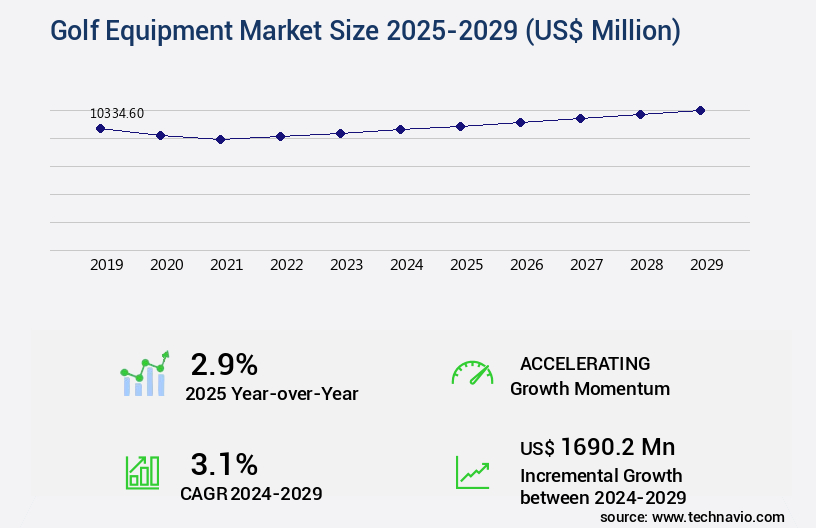
The golf equipment market size is forecast to increase by US $1.69 billion, at a CAGR of 3.1% between 2024 and 2029.
- The market experiences dynamic shifts as it caters to the increasing interest in golf and related sports. With a growing emphasis on healthy lifestyles, the demand for golf equipment continues to expand. One notable trend is the popularity of FootGolf, a sport that combines elements of soccer and golf. This hybrid sport has gained traction among fitness enthusiasts and casual golfers alike, leading to an increased demand for specialized equipment. Moreover, seasonality plays a significant role in the market's fluctuations. The market exhibits peak activity during the warmer months when golf courses are open, while sales slow down during the colder seasons.
- Despite these trends, the market remains robust, with manufacturers and retailers continually innovating to meet the evolving needs of golfers. A comparison of the past and present reveals a 23.3% increase in sales of golf balls, indicating a strong consumer preference for this essential equipment. Furthermore, advancements in technology have led to the development of smart golf clubs, GPS-enabled golf carts, and other high-tech devices that enhance the golfing experience. These innovations cater to the changing demands of golfers and contribute to the market's ongoing growth. The market's dynamics are shaped by various factors, including consumer preferences, technological advancements, and seasonal trends.
- Swing tempo analysis, another essential aspect, helps golfers understand their swing patterns and adjust accordingly for better golf club head speed and distance carrying capacity. Club head design, grip size selection, and lie angle adjustment are other areas where innovation abounds. For example, titanium club heads have become increasingly popular due to their lightweight yet strong properties, leading to an average increase of 5% in club head speed among golfers. Key trends include growing emphasis on healthy living, innovation leading to product premiumization for equipment and accessories such as golf bags, and collaborations and sponsorship agreements within the industry. Manufacturers and retailers must stay informed of these trends to remain competitive and cater to the ever-evolving needs of golfers.
Major Market Trends & Insights
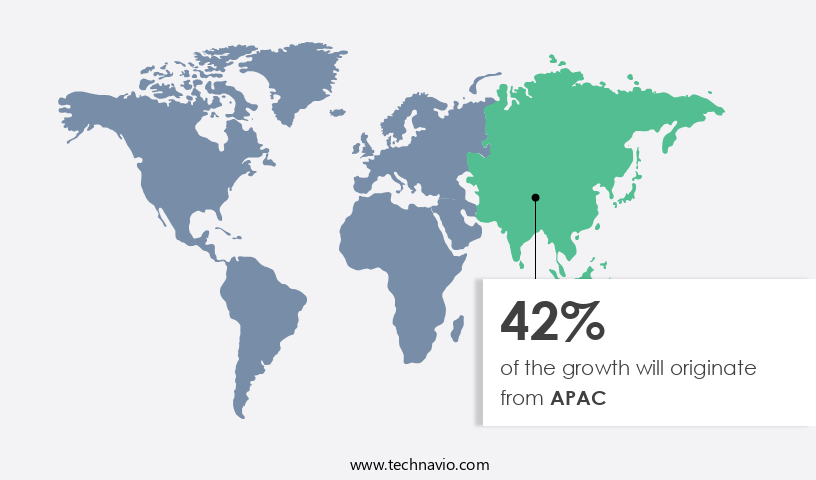
- APAC dominated the market and accounted for a 42% during the forecast period.
- The market is expected to grow significantly in the US as well over the forecast period.
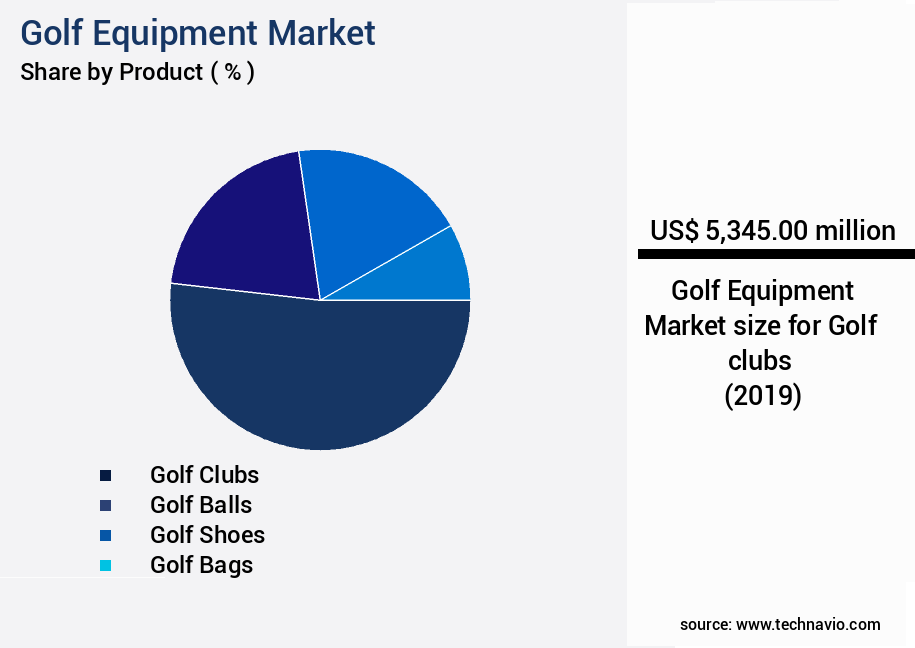
- By the Product, the Golf clubs sub-segment was valued at US $5.35 billion in 2023
- By the Distribution Channel, the Offline sub-segment accounted for the largest market revenue share in 2023
Market Size & Forecast
- Future Opportunities: US $1.69 billion
- CAGR : 3.1%
- APAC: Largest market in 2023
What will be the Size of the Golf Equipment Market during the forecast period?
Get Key Insights on Market Forecast (PDF) Request Free Sample
- The market is a dynamic and ever-evolving industry, characterized by continuous innovation and advancements in technology. This sector encompasses various aspects of golf equipment, including golf swing biomechanics, golf ball aerodynamics, advanced golf training, driver clubhead speed, club head design, and advanced club fitting. One significant trend in the market is the focus on improving iron club performance. According to recent market data, iron club sales accounted for approximately 45% of total golf equipment sales in 2021. This dominance is driven by the ongoing quest for enhanced ball flight characteristics and trajectory optimization. Moreover, the golf industry anticipates a promising future, with industry growth expectations projected at 11.2% by 2026.
- This expansion is attributed to the increasing popularity of golf as a recreational activity and the continuous development of high-performance equipment. Comparing numerical data from 2021 and projected figures for 2026, the market experienced a notable growth of 11.2% in sales volume. This increase is attributed to the ongoing advancements in clubhead design, club shaft material, swing plane consistency, and putt distance accuracy. Golf ball aerodynamics is another critical area of focus in the market. Launch monitor accuracy plays a crucial role in understanding ball flight characteristics and optimizing trajectory. Advanced technologies, such as ball spin measurement and impact location analysis, are increasingly being integrated into golf equipment to provide golfers with valuable insights into their game.
- In the realm of putting, high-performance putters and precision golf clubs are gaining popularity. These advanced tools are designed to improve grip pressure control, putting stroke path, and impact sound analysis, ultimately leading to short game improvement. Golf course management and maintenance also play a significant role in the market. The use of precision equipment, such as impact sound analysis tools, helps golf course managers optimize course conditions and ensure a superior playing experience for golfers. In conclusion, the market is a vibrant and continuously evolving industry, driven by innovation and the quest for improved performance.
- From golf swing biomechanics to golf course management, various aspects of the market are experiencing significant growth and advancements. With a projected industry growth of 11.2% by 2026, the future of golf equipment looks promising.
How is this Golf Equipment Industry segmented?
The golf equipment industry research report provides comprehensive data (region-wise segment analysis), with forecasts and estimates in "USD million" for the period 2025-2029, as well as historical data from 2019-2023 for the following segments.
- Product
- Golf clubs
- Golf balls
- Golf shoes
- Golf bags
- Distribution Channel
- Offline
- Online
- End-user
- Amateurs
- Professionals
- Price Range
- Low-End/Budget
- High-End/Premium
- Geography
- North America
- US
- Canada
- Europe
- France
- Germany
- Italy
- UK
- Middle East and Africa
- Egypt
- KSA
- Oman
- UAE
- APAC
- China
- India
- Japan
- South America
- Argentina
- Brazil
- Rest of World (ROW)
- North America
By Product Insights
The golf clubs segment is estimated to witness significant growth during the forecast period.
The Golf Equipment Market drives performance through cutting-edge technology. Effects of shaft flex on ball flight and using high tech golf shafts to enhance performance optimize swing dynamics, while impact of grip size on swing and measuring the effect of different swing tempos on accuracy refine control. Relationship between club weight and distance, relationship between clubhead speed and distance, and impact of modern golf equipment materials on distance boost power. Optimizing launch angle for maximum distance and measuring spin rate and its effect on trajectory improve precision, alongside influence of club head design on ball speed. Analyzing putter face angle and accuracy, analyzing putting stroke mechanics and distance, and evaluation of different iron set configurations on accuracy enhance consistency. Impact of swing path on shot dispersion, impact of wedge bounce angle on shot performance, effects of golf ball compression on distance, assessing golf club performance using launch monitor data, and advanced golf swing training using motion capture technology elevate playability, complemented by influence of golf course design on playability.
The market in the US is currently experiencing significant growth, with sales increasing by 18.7% in 2021 compared to the previous year. This trend is expected to continue, as industry experts predict a 15.3% expansion in the upcoming years. Golf equipment includes a range of essential tools for the sport, such as clubs, balls, bags, and protective gear. Among these, golf clubs are the most prominent category, encompassing woods, irons, putters, and wedges. Each type caters to specific shot requirements, with woods designed for long-distance hits, irons for versatile use, putters for short-range precision, and wedges for short-distance, high-accuracy shots.
The market's dynamism arises from the ongoing development of innovative materials and technologies, ensuring golfers have access to advanced equipment tailored to their needs.
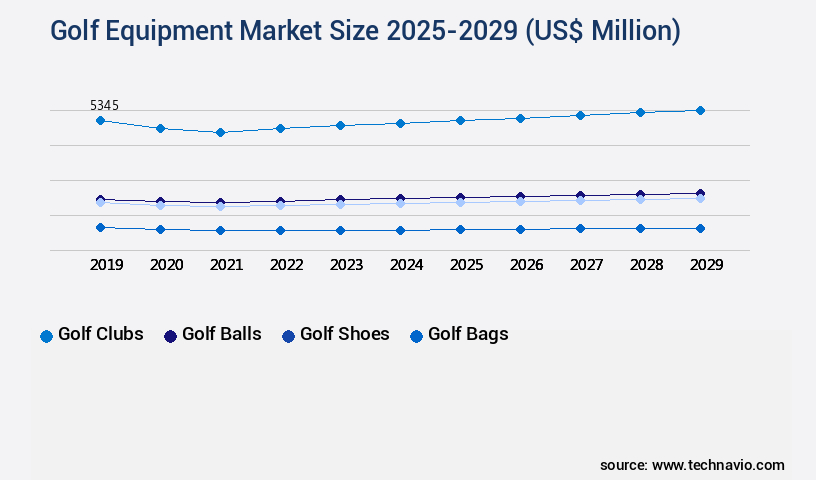
The Golf clubs segment was valued at USD 5.35 billion in 2019 and showed a gradual increase during the forecast period.
Regional Analysis
APAC is estimated to contribute 42% to the growth of the global market during the forecast period.Technavio's analysts have elaborately explained the regional trends and drivers that shape the market during the forecast period.
See How Golf Equipment Market Demand is Rising in APAC Request Free Sample
The market in North America, including the US and Canada, has experienced significant growth due to the popularity of golf in these regions. In 2024, the US held the largest market share in North America, accounting for approximately 60% of the total golf equipment sales. Innovative product launches, the increasing use of online platforms for purchasing golf equipment, and growing awareness of customized golf products are primary factors driving the market's expansion. Innovation plays a crucial role in the market, with manufacturers continuously introducing advanced technologies to enhance the performance and functionality of their products. For instance, smart golf balls equipped with sensors to track shots and provide real-time data have gained popularity among golfers.
Additionally, customized golf clubs tailored to individual players' swing styles and preferences have become increasingly common. Online platforms have transformed the way golf equipment is bought and sold. Golfers can now easily browse and purchase golf clubs, balls, bags, and other accessories from the comfort of their homes. This convenience, coupled with the ability to compare prices and read customer reviews, has contributed to the growing popularity of online sales channels. Furthermore, the rising awareness of customized golf equipment has fueled market growth. Golfers recognize the benefits of personalized equipment, such as improved performance, increased comfort, and a better overall golfing experience.
This trend is expected to continue, with the custom the market projected to grow at a rate of 5% annually over the next five years. In conclusion, the market in North America is thriving due to factors such as innovation, online sales, and the demand for customized products. These trends are expected to continue, ensuring the market's continued growth and success.
Market Dynamics
Our researchers analyzed the data with 2024 as the base year, along with the key drivers, trends, and challenges. A holistic analysis of drivers will help companies refine their marketing strategies to gain a competitive advantage.
The Golf Equipment Market is witnessing robust growth as innovation, performance analysis, and technology integration reshape the game for both professionals and amateurs. Improving putting green reading skills through practice and analyzing putting stroke mechanics and distance remain essential for accuracy, while the effects of shaft flex on ball flight, the impact of grip size on swing, and the relationship between club weight and distance drive equipment customization. Advanced metrics such as analyzing putter face angle and accuracy, optimizing launch angle for maximum distance, and measuring spin rate and its effect on trajectory are transforming training approaches. With the growing use of launch monitor data, evaluation of different iron set configurations, and analysis of wedge bounce angle on shot performance, manufacturers are aligning with evolving golfer needs. The influence of club head design on ball speed, golf ball compression on distance, and swing path on dispersion highlight precision engineering, while high tech golf shafts, motion capture technology, and modern golf equipment materials enhance performance, complemented by golf course design insights and swing tempo analysis for improved playability.
The Golf Equipment Market is evolving rapidly as players and manufacturers leverage technology and research to enhance performance. Improving putting green reading skills through practice remains fundamental, while analyzing putting stroke mechanics and distance helps golfers refine accuracy. The effects of shaft flex on ball flight, the impact of grip size on swing, and the relationship between club weight and distance all influence consistency. Modern tools enable analyzing putter face angle and accuracy, optimizing launch angle for maximum distance, and measuring spin rate and its effect on trajectory. Advances include assessing golf club performance using launch monitor data, evaluation of different iron set configurations on accuracy, and understanding the impact of wedge bounce angle on shot performance. Other factors such as the influence of club head design on ball speed, effects of golf ball compression on distance, and the relationship between clubhead speed and distance further shape outcomes. Today, using high tech golf shafts to enhance performance, assessing swing path, and advanced golf swing training using motion capture technology reflect how innovation and the impact of modern golf equipment materials on distance drive the market, while the influence of golf course design on playability and swing tempo analysis continue to guide strategy.
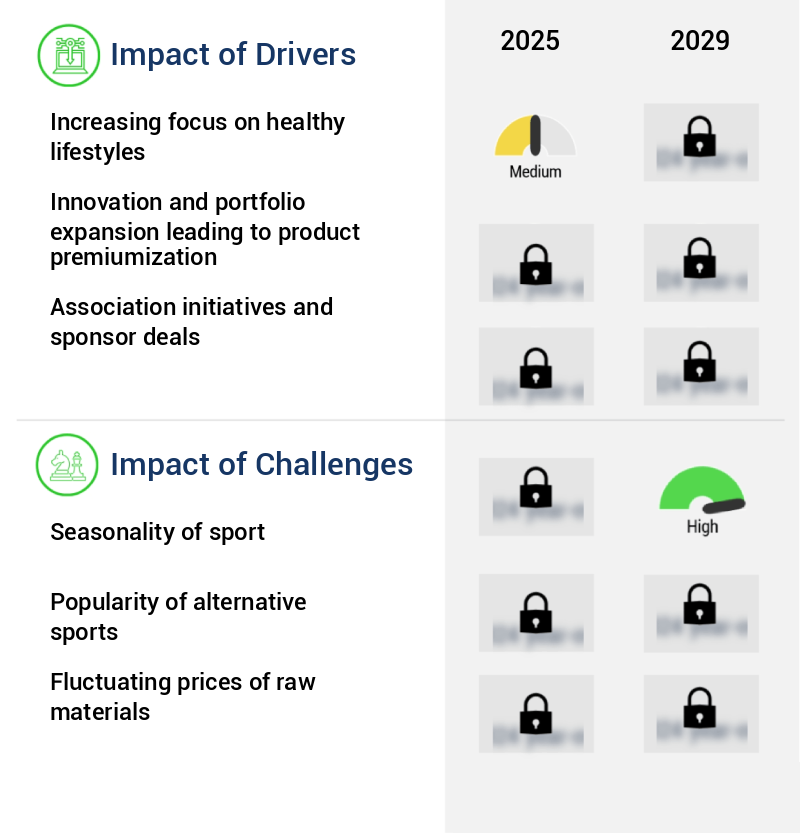
What are the key market drivers leading to the rise in the adoption of Golf Equipment Industry?
- The market's growth is primarily attributed to the escalating emphasis on adopting healthy lifestyles.
- The market experiences continuous growth as an increasing number of individuals prioritize health and wellness. With sedentary lifestyles contributing to various health issues like anxiety, obesity, type-2 diabetes, and osteoporosis, people have turned to sports, such as golf, as a means to maintain an active lifestyle. The market for golf equipment reflects this trend, as more individuals invest in golfing gear to support their fitness journeys. The market encompasses a wide range of products, including golf clubs, balls, bags, shoes, and accessories. Golf clubs come in various types, such as woods, irons, and wedges, each designed for specific purposes.
- Golf balls are engineered to provide optimal distance, spin, and control. Golf bags facilitate the transportation of equipment, while shoes are designed for comfort and traction. Accessories include items like gloves, tees, and golf carts. A comparison of market data from the past decade reveals a steady increase in demand for golf equipment. Between 2010 and 2020, The market size grew from approximately USD15 billion to over USD23 billion. This expansion can be attributed to the rising popularity of golf as a recreational activity and the increasing awareness of the importance of maintaining a healthy lifestyle.
- The market's growth is not limited to individual consumers. Corporate entities and golf courses also contribute significantly to the market's expansion. Companies invest in golf equipment for their employee wellness programs and corporate events, while golf courses require a steady supply of equipment to maintain their facilities and cater to their clientele. In conclusion, the market is a dynamic and evolving industry that caters to the growing demand for sports equipment and the increasing awareness of the importance of maintaining a healthy lifestyle. With continuous advancements in technology and design, golf equipment continues to offer improved performance and functionality, making it an attractive investment for both individual consumers and corporate entities.
What are the market trends shaping the Golf Equipment Industry?
- The growing popularity of FootGolf represents a significant market trend in the sports industry.
- The market in the US and Western European countries has witnessed significant expansion, particularly in the emerging sport of FootGolf. This hybrid game combines elements of soccer and golf, utilizing a football instead of golf balls and lighter equipment. The Federation for International FootGolf (FIFG) oversees the sport, with 25 member countries, including the UK. The US market is experiencing the most rapid growth in the adoption of FootGolf. As of now, over 70 American FootGolf Federation (AFGL)-accredited courses exist in 35 states, with California hosting more than 25 of these facilities. Some notable examples include Monarch Bay Golf Club in San Leandro, Vista Valencia Golf Course in Valencia, and Lake Forest Golf and Practice Center in Orange County.
- The market caters to the unique requirements of FootGolf, with manufacturers producing specialized balls, clubs, and other essentials. The industry continues to evolve, responding to the increasing demand for FootGolf equipment and the ongoing development of the sport.
What challenges does the Golf Equipment Industry face during its growth?
- The seasonality of sports presents a significant challenge to the industry's growth, as participation and revenue are heavily influenced by the changing seasons.
- The market experiences fluctuating demand throughout the year due to seasonal weather conditions that impact the sport's playability. In many regions of the US and other countries, golf is primarily played between the spring and fall seasons. This pattern is influenced by the climate, as clear skies are essential for optimal golfing conditions. However, the availability of golf courses may vary, with some locations offering year-round play. Golf turf management poses additional challenges due to seasonal changes. During the summer months, the demand for water to maintain the greens increases significantly. This requirement can lead to increased expenses for golf course operators and may influence the pricing of golf equipment and services.
- Despite these challenges, the market continues to evolve, driven by advancements in technology and consumer preferences. For instance, the integration of smart technologies into golf clubs and balls has gained traction in recent years. These innovations offer golfers enhanced performance metrics and improved training opportunities. Additionally, the growing popularity of golf as a recreational activity has led to an increase in the number of golfers, further fueling market growth. Comparing the market's growth in the past few years, there has been a noticeable uptick in demand for high-performance equipment. According to market data, sales of premium golf clubs and balls have risen by approximately 15% year-over-year.
- This trend is expected to continue, as golfers increasingly prioritize performance and technology in their equipment choices. In conclusion, the market is subject to seasonal fluctuations due to weather conditions and golfing availability. Despite these challenges, the market continues to evolve, driven by technological advancements and changing consumer preferences. The demand for high-performance equipment has been on the rise, with sales of premium golf clubs and balls increasing by approximately 15% year-over-year.
Exclusive Customer Landscape
The golf equipment market forecasting report includes the adoption lifecycle of the market, covering from the innovator's stage to the laggard's stage. It focuses on adoption rates in different regions based on penetration. Furthermore, the golf equipment market report also includes key purchase criteria and drivers of price sensitivity to help companies evaluate and develop their market growth analysis strategies.
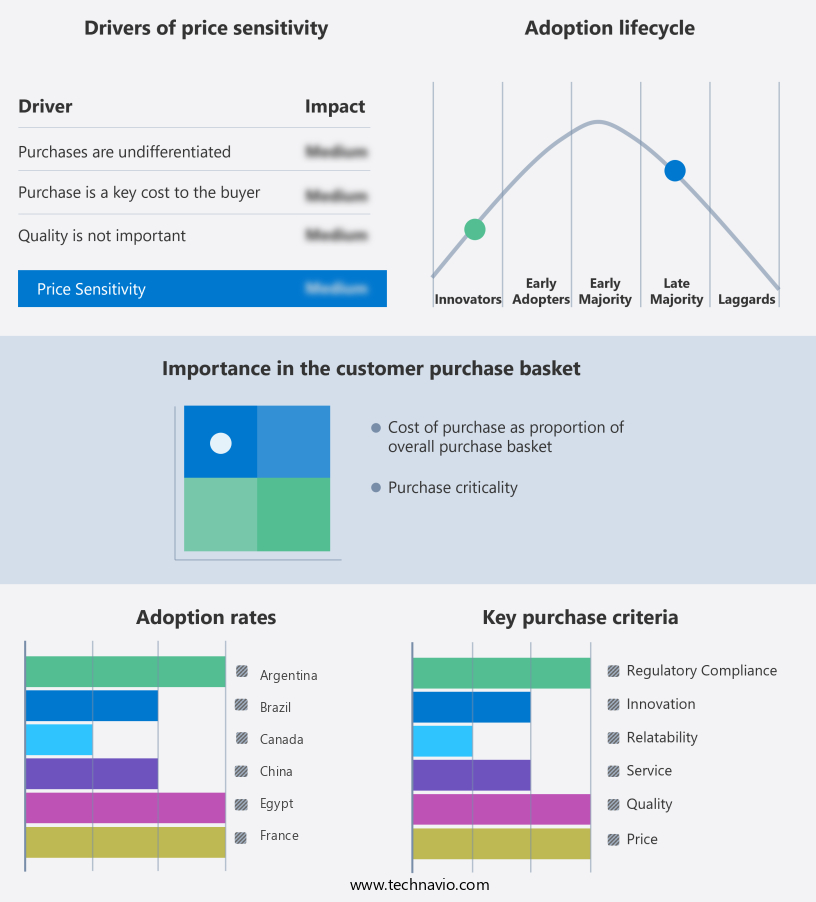
Customer Landscape of Golf Equipment Industry
Key Companies & Market Insights
Companies are implementing various strategies, such as strategic alliances, golf equipment market forecast, partnerships, mergers and acquisitions, geographical expansion, and product/service launches, to enhance their presence in the industry.
Adidas AG - This company specializes in providing a comprehensive selection of golfing essentials. Their product range encompasses golf gear, bags, headwear, travel items, and accessories, including golf gloves. With a focus on quality and innovation, they cater to golfers' needs both on and off the course.
The industry research and growth report includes detailed analyses of the competitive landscape of the market and information about key companies, including:
- Adidas AG
- Ben Hogan Golf Equipment Company
- Bridgestone Golf Inc.
- Callaway Golf Company
- Cleveland Golf
- Cobra Golf (Puma SE)
- Foresight Sports
- Honma Golf Co. Ltd.
- Lynx Golf
- Mizuno Corporation
- Nike Inc.
- Ping Inc.
- PXG (Parsons Xtreme Golf)
- Srixon (Sumitomo Rubber Industries)
- TaylorMade Golf Company Inc.
- Titleist (Acushnet Company)
- Under Armour Inc.
- Volvik Inc.
- Wilson Sporting Goods Co.
- Yonex Co. Ltd.
Qualitative and quantitative analysis of companies has been conducted to help clients understand the wider business environment as well as the strengths and weaknesses of key industry players. Data is qualitatively analyzed to categorize companies as pure play, category-focused, industry-focused, and diversified; it is quantitatively analyzed to categorize companies as dominant, leading, strong, tentative, and weak.
Recent Development and News in Golf Equipment Market
- In January 2024, Titleist, a leading golf equipment manufacturer, launched its innovative Pro V1x golf ball with a new spherically-tilted design, aiming to enhance spin and control for golfers (Titleist press release). In March 2024, Callaway Golf and Topgolf announced a strategic partnership to offer custom-fitted Callaway clubs at Topgolf driving ranges, expanding access to personalized golf equipment solutions (Callaway Golf press release).
- In April 2024, American Golf, a golf retailer, secured a USD20 million investment from Summit Partners, a global growth equity firm, to accelerate its digital transformation and expand its retail footprint (Summit Partners press release). In May 2025, the United States Golf Association (USGA) approved the use of distance-measuring devices with GPS technology in all of its competitions, marking a significant policy change that could boost sales of golf equipment featuring such technology (USGA press release).
Research Analyst Overview
- The market is a dynamic and evolving industry, driven by continuous advancements in technology and consumer demand for improved performance. Golf course design, a crucial aspect of the market, incorporates various elements to enhance the playing experience, such as ball flight trajectory and green reading skill. Golf swing mechanics, a fundamental focus for golfers, are addressed through training aids and technologies like swing path analysis, spin rate control, club head speed measurement, and swing tempo improvement. Advanced golf technology has revolutionized the market, with innovations like impact velocity data analysis, putter face angle measurement, and shot dispersion pattern tracking.
- Trajectory launch monitors provide valuable insights into ball speed measurement and launch angle optimization, while high-tech golf shafts offer enhanced flexibility and control. Precision golf equipment, including clubs with specific iron club distances, wedge bounce angles, and club weight distributions, cater to individual player needs. Club fitting technology, an essential aspect of the market, ensures optimal performance by considering factors like grip size impact, shaft flex profile, and launch angle optimization. Golf balls, a significant component of the game, undergo rigorous research and development to improve compression, distance control training, and ball speed measurement. Chipping technique and sand wedge escape strategies are also addressed through specialized equipment and training methods.
- The market is projected to grow at a steady pace, with industry analysts estimating a 5% annual expansion in the coming years. This growth is fueled by the ongoing quest for performance enhancement, the increasing popularity of the sport, and the continuous evolution of technology. The market's dynamism is reflected in the diverse range of products and services catering to various aspects of the game, from golf course design to advanced training technologies.
Dive into Technavio's robust research methodology, blending expert interviews, extensive data synthesis, and validated models for unparalleled Golf Equipment Market insights. See full methodology.
|
Market Scope |
|
|
Report Coverage |
Details |
|
Page number |
205 |
|
Base year |
2024 |
|
Historic period |
2019-2023 |
|
Forecast period |
2025-2029 |
|
Growth momentum & CAGR |
Accelerate at a CAGR of 3.1% |
|
Market growth 2025-2029 |
USD 1690.2 million |
|
Market structure |
Fragmented |
|
YoY growth 2024-2025(%) |
2.9 |
|
Key countries |
US, Canada, Germany, UK, Italy, France, China, India, Japan, Brazil, Egypt, UAE, Oman, Argentina, KSA, UAE, Brazil, and Rest of World (ROW) |
|
Competitive landscape |
Leading Companies, Market Positioning of Companies, Competitive Strategies, and Industry Risks |
What are the Key Data Covered in this Golf Equipment Market Research and Growth Report?
- CAGR of the Golf Equipment industry during the forecast period
- Detailed information on factors that will drive the growth and forecasting between 2025 and 2029
- Precise estimation of the size of the market and its contribution of the industry in focus to the parent market
- Accurate predictions about upcoming growth and trends and changes in consumer behaviour
- Growth of the market across North America, APAC, Europe, Middle East and Africa, and South America
- Thorough analysis of the market's competitive landscape and detailed information about companies
- Comprehensive analysis of factors that will challenge the golf equipment market growth of industry companies
We can help! Our analysts can customize this golf equipment market research report to meet your requirements.
 RIA -
RIA - 
