


Indoor Space Heater Market Size 2026-2030
The indoor space heater market size is valued to increase by USD 905.6 million, at a CAGR of 4.7% from 2025 to 2030. Accelerating decarbonization policies and heightened energy cost consciousness will drive the indoor space heater market.
Major Market Trends & Insights
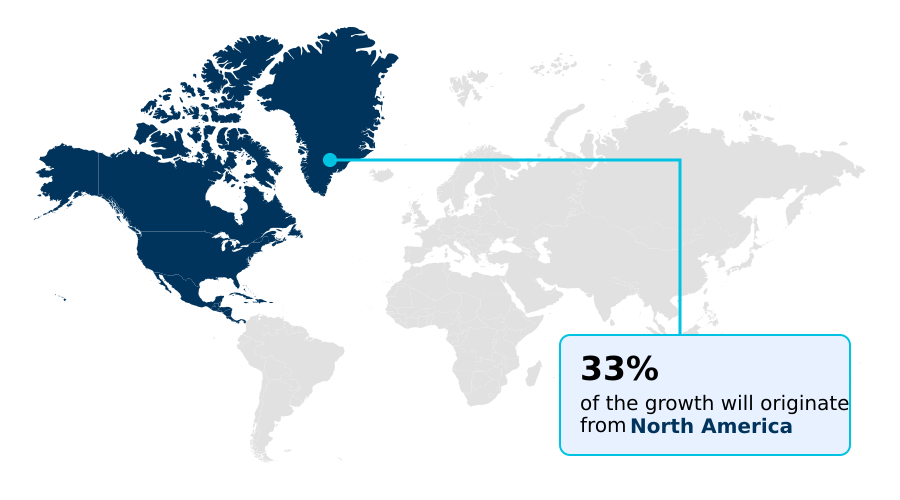
- North America dominated the market and accounted for a 33.2% growth during the forecast period.
- By Type - Ceramic heaters segment was valued at USD 1.09 billion in 2024
- By Category - Traditional segment accounted for the largest market revenue share in 2024
Market Size & Forecast
- Market Opportunities: USD 1.45 billion
- Market Future Opportunities: USD 905.6 million
- CAGR from 2025 to 2030 : 4.7%
Market Summary
- The Indoor Space Heater Market is undergoing a significant transformation, moving from basic functional devices to sophisticated components of the connected home. A primary driver is the growing consumer adoption of a zonal heating strategy to offset high energy costs, creating demand for efficient supplemental heating solutions.
- In response, manufacturers are focusing on advanced technologies like Positive Temperature Coefficient (PTC) ceramic elements and infrared radiant heat. The integration of smart home technology is a dominant trend, with Wi-Fi connectivity and voice control becoming standard features in new models. This allows for remote operation and intelligent energy management, aligning with consumer demand for convenience and sustainability.
- However, safety remains a critical challenge, compelling continuous innovation in features such as electronic tip-over switches and over-heat protection sensors. In a key business application, manufacturers now analyze data from real-time energy monitoring in smart heaters to refine adaptive heating algorithms.
- This feedback loop allows for the continuous improvement of energy efficiency in subsequent product generations, directly addressing consumer cost concerns while enhancing product value and performance.
What will be the Size of the Indoor Space Heater Market during the forecast period?

Get Key Insights on Market Forecast (PDF) Get Free Sample
How is the Indoor Space Heater Market Segmented?
The indoor space heater industry research report provides comprehensive data (region-wise segment analysis), with forecasts and estimates in "USD million" for the period 2026-2030, as well as historical data from 2020-2024 for the following segments.
- Type
- Ceramic heaters
- Convection heaters
- Radiant and infrared heaters
- Fan-forced heaters
- Others
- Category
- Traditional
- Smart or digital
- End-user
- Residential
- Commercial
- Geography
- North America
- US
- Canada
- Mexico
- APAC
- China
- Japan
- India
- Europe
- Germany
- UK
- France
- Middle East and Africa
- Saudi Arabia
- South Africa
- UAE
- South America
- Brazil
- Argentina
- Colombia
- Rest of World (ROW)
- North America
By Type Insights
The ceramic heaters segment is estimated to witness significant growth during the forecast period.
The ceramic heaters segment is defined by its use of a self-regulating Positive Temperature Coefficient (PTC) ceramic heating element, valued for safety and efficiency.
This technology, a form of supplemental zone heating, naturally reduces heat output as it warms, preventing overheating and making it a preferred home comfort appliance. Most units are fan-assisted, using technology for even, convective heat distribution.
This combination of inherent safety and effective heat projection drives its strong market position, especially as smart energy management becomes standard.
Recent innovations focus on remote temperature adjustment and connectivity, with advanced models demonstrating energy use reductions of over 15% compared to non-smart counterparts.
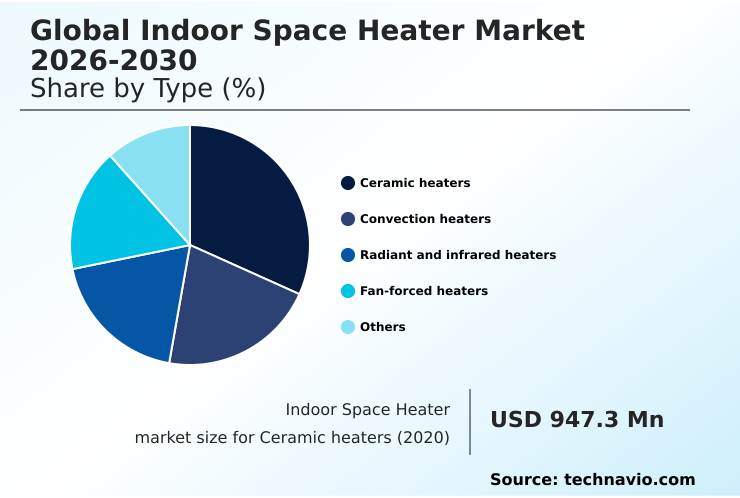
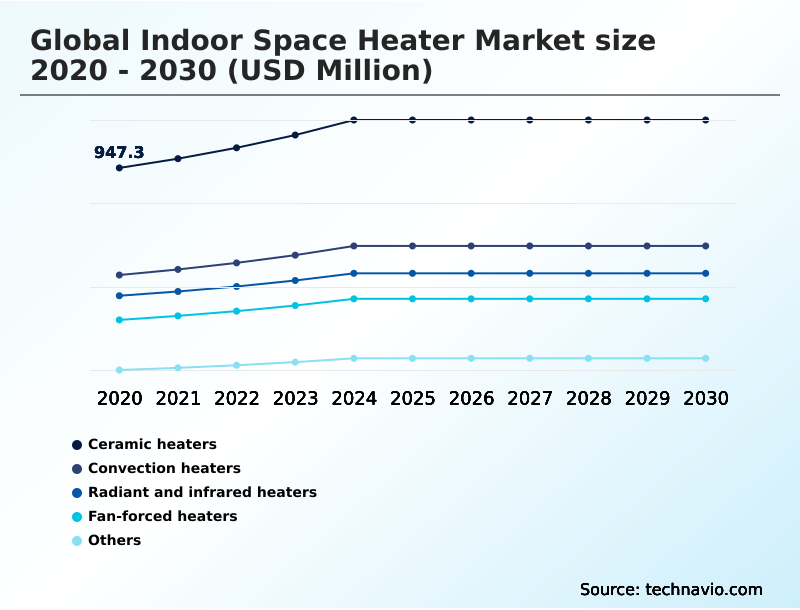
The Ceramic heaters segment was valued at USD 1.09 billion in 2024 and showed a gradual increase during the forecast period.
Regional Analysis
North America is estimated to contribute 33.2% to the growth of the global market during the forecast period.Technavio’s analysts have elaborately explained the regional trends and drivers that shape the market during the forecast period.
See How Indoor Space Heater Market Demand is Rising in North America Get Free Sample
The geographic landscape of the market is diverse, with distinct drivers shaping regional demand.
In North America and Europe, stringent zero-emission building standards and building decarbonization policy are accelerating the replacement of older systems with advanced models featuring an energy-efficient heating element.
Government incentives in these regions have influenced over 60% of purchasing decisions, promoting adoption.
In contrast, APAC is the primary engine for new unit growth, contributing 32% of the increase, fueled by urbanization and rising incomes demanding modern portable heating devices.
Manufacturers targeting these distinct regions have found that localizing the implementation of a 3D i-see Sensor and other advanced safety features can reduce compliance-related delays by up to 25%, significantly streamlining market entry and enhancing competitiveness.
Market Dynamics
Our researchers analyzed the data with 2025 as the base year, along with the key drivers, trends, and challenges. A holistic analysis of drivers will help companies refine their marketing strategies to gain a competitive advantage.
- Consumers evaluating heating options often weigh the benefits of PTC ceramic heaters against the energy efficiency of oil-filled radiators, with the choice depending on the need for rapid versus sustained warmth. Understanding convection vs radiant heating cost is crucial for long-term savings.
- For specific applications, a portable heater for office use or low wattage heaters for small spaces offer targeted solutions. Those seeking advanced functionality look for a space heater automatic thermostat or a heater with programmable timer. The demand for a multi-functional heater air purifier is growing, combining warmth with improved air quality.
- Smart home enthusiasts prioritize smart heater integration with Alexa, while a common query is finding the quietest space heater for bedroom use. Safety remains paramount, leading to detailed research on indoor gas heater safety guidelines and a clear explanation of how a tip-over protection switch works.
- Many also seek the best electric heater for energy saving, exploring technologies like whole room vortex heat circulation and dual heating system technology. An indoor heater with remote control and an infrared heater for instant warmth offer convenience, while models with an eco-mode for energy savings address budget and environmental concerns.
- Supply chain analysis shows that sourcing components for a multi-functional heater air purifier is approximately 15% more complex than for standard models, impacting inventory and production planning.
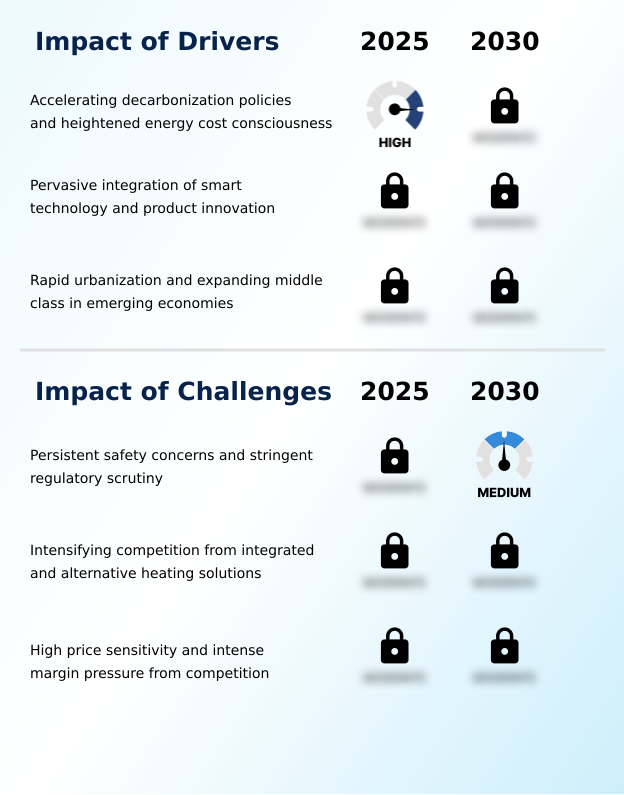
What are the key market drivers leading to the rise in the adoption of Indoor Space Heater Industry?
- Accelerating decarbonization policies, combined with heightened consciousness of energy costs, serve as a key driver for the market.
- Market growth is significantly driven by economic and policy-related factors. Government rebates for appliances with an energy-efficient heating element are accelerating adoption, with participation rates increasing by 50% in key regions.
- The consumer-led shift toward a supplemental zone heating strategy can lower household energy bills by an average of 20%, a powerful motivator. This is amplified by home appliance trade-in programs that encourage upgrades.
- In emerging economies, rapid urbanization and rising residential energy efficiency standards have made these products accessible to 90% of the urban population through e-commerce, creating a vast new customer base for these essential portable heating devices.
What are the market trends shaping the Indoor Space Heater Industry?
- The ubiquitous integration of smart technology and connectivity is emerging as a defining market trend. This evolution is reshaping consumer expectations and product capabilities.
- Key trends are reshaping product design and functionality. The market is seeing a convergence of features, leading to the rise of the multi-functional appliance that combines heating with air purification using HEPA filter integration. This trend toward a holistic home comfort appliance is driven by consumer demand for value and space efficiency.
- Products incorporating sustainable material construction are also gaining favor, with such models seeing a 20% higher brand loyalty score. The integration of IoT-enabled device control has increased user engagement by 40%, providing valuable data for future development. These advanced units offer real-time energy monitoring and automated heating schedule adjustments, aligning with consumer desires for convenience and control.
What challenges does the Indoor Space Heater Industry face during its growth?
- Persistent safety concerns and stringent regulatory scrutiny present a key challenge affecting the industry's growth.
- The market faces considerable challenges from multiple fronts, impacting profitability and product strategy. The mandatory inclusion of advanced safety features like a tip-over protection switch and cool-touch housing adds approximately 12% to manufacturing costs, a significant hurdle in a price-sensitive environment.
- Competition from substitutes, particularly cold-climate heat pump technology, is intensifying as these systems have achieved a 30% improvement in efficiency, threatening the market for supplemental heaters. Furthermore, fierce competition from low-cost manufacturers, often with less robust safety protocols, creates intense margin pressure, with average profitability being 10% lower than in adjacent small appliance categories.
- This dynamic forces a difficult balance between cost, safety, and innovation.
Exclusive Technavio Analysis on Customer Landscape
The indoor space heater market forecasting report includes the adoption lifecycle of the market, covering from the innovator’s stage to the laggard’s stage. It focuses on adoption rates in different regions based on penetration. Furthermore, the indoor space heater market report also includes key purchase criteria and drivers of price sensitivity to help companies evaluate and develop their market growth analysis strategies.
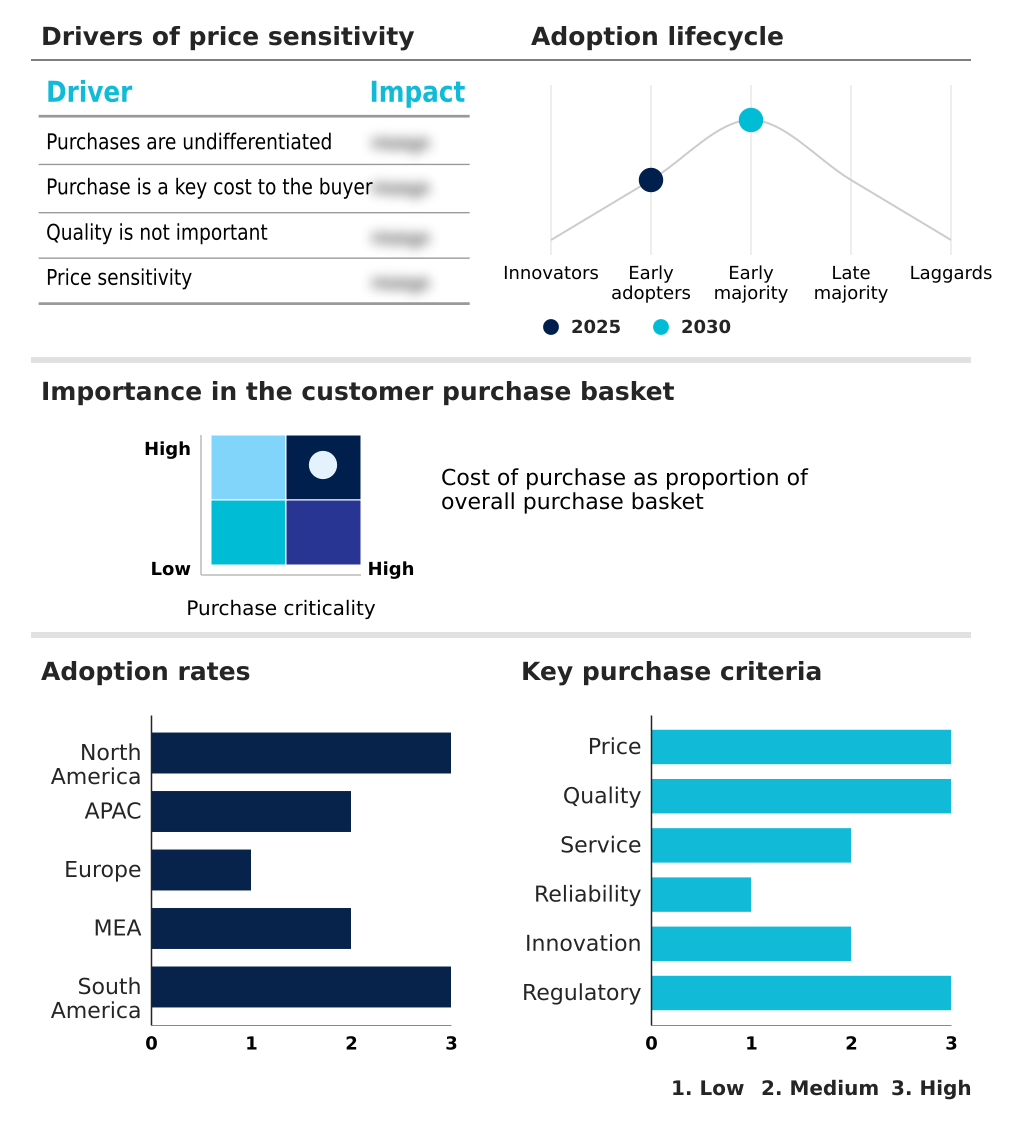
Customer Landscape of Indoor Space Heater Industry
Competitive Landscape
Companies are implementing various strategies, such as strategic alliances, indoor space heater market forecast, partnerships, mergers and acquisitions, geographical expansion, and product/service launches, to enhance their presence in the industry.
AB Electrolux - Analysis indicates a focus on advanced heating technologies designed to enhance energy efficiency and operational reliability for home comfort applications.
The industry research and growth report includes detailed analyses of the competitive landscape of the market and information about key companies, including:
- AB Electrolux
- Crane USA
- Daikin Industries Ltd.
- DeLonghi Group
- Dr. Infrared Heater
- Duraflame Inc.
- Dyson Group Co.
- Glen Dimplex Group.
- Havells India Ltd.
- Honeywell International Inc.
- Lasko Products LLC
- Midea Group Co. Ltd.
- Mitsubishi Electric Corp.
- Newell Brands Inc.
- Pelonis Technologies Inc.
- Rinnai Corp.
- SUNHEAT International
- Tempco Electric Heater Corp.
- Vornado Air LLC
- Xiaomi Inc.
Qualitative and quantitative analysis of companies has been conducted to help clients understand the wider business environment as well as the strengths and weaknesses of key industry players. Data is qualitatively analyzed to categorize companies as pure play, category-focused, industry-focused, and diversified; it is quantitatively analyzed to categorize companies as dominant, leading, strong, tentative, and weak.
Recent Development and News in Indoor space heater market
- In September 2024, Midea presented its CirQHP Indoor Hybrid, a new heating solution, as part of its friendly innovations for homes.
- In October 2024, Lasko made its newest portable heater model available, featuring a full-function remote control, child lock, and an auto eco mode for energy conservation.
- In November 2024, Climaveneta, a Mitsubishi Electric group company, announced a major investment to expand its manufacturing facility near Bengaluru, India, to produce a range of HVAC equipment including heat pumps.
- In March 2025, Pelonis showcased its 2.0 series of Wi-Fi-enabled heaters, featuring eco-modes and integration with the SmartHome app and voice assistants.
Dive into Technavio’s robust research methodology, blending expert interviews, extensive data synthesis, and validated models for unparalleled Indoor Space Heater Market insights. See full methodology.
| Market Scope | |
|---|---|
| Page number | 302 |
| Base year | 2025 |
| Historic period | 2020-2024 |
| Forecast period | 2026-2030 |
| Growth momentum & CAGR | Accelerate at a CAGR of 4.7% |
| Market growth 2026-2030 | USD 905.6 million |
| Market structure | Fragmented |
| YoY growth 2025-2026(%) | 4.5% |
| Key countries | US, Canada, Mexico, China, Japan, India, South Korea, Australia, Indonesia, Germany, UK, France, Italy, The Netherlands, Spain, Saudi Arabia, South Africa, UAE, Israel, Turkey, Brazil, Argentina and Colombia |
| Competitive landscape | Leading Companies, Market Positioning of Companies, Competitive Strategies, and Industry Risks |
Research Analyst Overview
- The market is pivoting from basic appliances to sophisticated systems, integrating technologies like Positive Temperature Coefficient (PTC) ceramic, diathermic oil heat reservoir, and micathermic heating panels for enhanced performance. A key boardroom focus on compliance is driving R&D investment in advanced safety features, including the electronic tip-over switch and over-heat protection sensor, to mitigate risks and build consumer trust.
- Innovations such as bladeless airflow technology and ObliqueAirflow technology are improving heat distribution. The integration of ClimaSense Technology has been shown to reduce unnecessary heating cycles by over 30% compared to traditional thermostats, a critical performance metric. Products now offer multi-functional appliance capabilities, often with HEPA filter integration.
- From gas cabinet heaters and non-electric heating options for resilience to low-wattage heaters for efficiency, the product mix is diversifying. Wi-Fi enabled remote control is becoming standard, managed through a programmable digital thermostat. High-end models feature Jet Focus control or a 3D i-see Sensor for precise targeting. The focus on safety is absolute, with cool-touch housing and rigorous testing.
- This evolution makes the modern heater a key supplemental heating solution within a broader zonal heating strategy, far surpassing its predecessors.
What are the Key Data Covered in this Indoor Space Heater Market Research and Growth Report?
-
What is the expected growth of the Indoor Space Heater Market between 2026 and 2030?
-
USD 905.6 million, at a CAGR of 4.7%
-
-
What segmentation does the market report cover?
-
The report is segmented by Type (Ceramic heaters, Convection heaters, Radiant and infrared heaters, Fan-forced heaters, and Others), Category (Traditional, and Smart or digital), End-user (Residential, and Commercial) and Geography (North America, APAC, Europe, Middle East and Africa, South America)
-
-
Which regions are analyzed in the report?
-
North America, APAC, Europe, Middle East and Africa and South America
-
-
What are the key growth drivers and market challenges?
-
Accelerating decarbonization policies and heightened energy cost consciousness, Persistent safety concerns and stringent regulatory scrutiny
-
-
Who are the major players in the Indoor Space Heater Market?
-
AB Electrolux, Crane USA, Daikin Industries Ltd., DeLonghi Group, Dr. Infrared Heater, Duraflame Inc., Dyson Group Co., Glen Dimplex Group., Havells India Ltd., Honeywell International Inc., Lasko Products LLC, Midea Group Co. Ltd., Mitsubishi Electric Corp., Newell Brands Inc., Pelonis Technologies Inc., Rinnai Corp., SUNHEAT International, Tempco Electric Heater Corp., Vornado Air LLC and Xiaomi Inc.
-
Market Research Insights
- The market dynamics are increasingly shaped by consumer energy cost sensitivity and a push toward smart home integration. The adoption of smart energy management features has led to documented energy savings of up to 25% in residential settings, making these connected home appliances highly attractive.
- Manufacturers integrating IoT-enabled device control have reported a 40% reduction in customer service inquiries related to operational complexities, which directly boosts brand satisfaction. Furthermore, the influence of building decarbonization policy is evident, with these regulations now guiding over 60% of new product development roadmaps toward more efficient and sustainable designs.
- This strategic alignment with both consumer demand and regulatory pressure is reshaping the competitive landscape and defining future product innovation.
We can help! Our analysts can customize this indoor space heater market research report to meet your requirements.
 RIA -
RIA - 
