



Laboratory Balances Scales Market Size 2026-2030
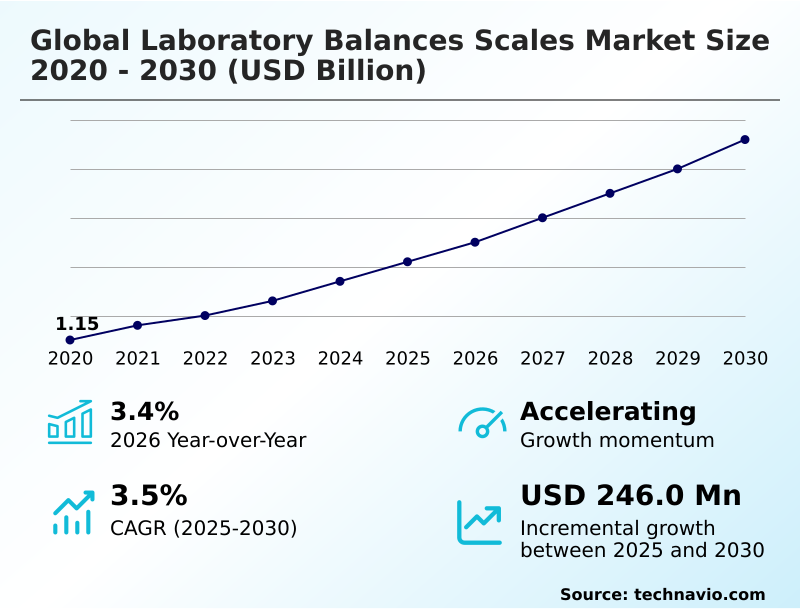
The laboratory balances scales market size is valued to increase by USD 246 million, at a CAGR of 3.5% from 2025 to 2030. Integration of internet of things and laboratory automation will drive the laboratory balances scales market.
Major Market Trends & Insights
- Asia dominated the market and accounted for a 35.7% growth during the forecast period.
- By Product - Analytical balance segment was valued at USD 512.5 million in 2024
- By Capacity - Medium capacity segment accounted for the largest market revenue share in 2024
Market Size & Forecast
- Market Opportunities: USD 401.6 million
- Market Future Opportunities: USD 246 million
- CAGR from 2025 to 2030 : 3.5%
Market Summary
- The laboratory balances scales market is defined by a relentless push for precision, regulatory adherence, and operational efficiency. The core of the market is driven by expanding research and development pipelines in pharmaceuticals and biotechnology, where accurate gravimetric analysis is foundational. Instruments using technologies like electromagnetic force restoration and tuning-fork sensor technology are critical.
- A major trend is the integration of advanced connectivity, transforming standalone devices into nodes within a laboratory information management systems (LIMS) network. This shift to the 'Lab of the Future' supports stringent data integrity compliance, driven by ALCOA+ principles.
- For example, a contract research organization handling high-potency active ingredients can leverage automated weighing systems with touchless sensor operation to eliminate cross-contamination risks and ensure operator safety, while built-in internal calibration routines and predictive maintenance sensors guarantee consistent instrument performance verification and minimize downtime.
- However, the high capital cost of instruments with features like static elimination technology and the need for skilled operators present significant adoption hurdles, especially for smaller labs. Equipment longevity also creates a challenge, as labs may delay upgrades, impacting the replacement cycle for new sales.
What will be the Size of the Laboratory Balances Scales Market during the forecast period?
Get Key Insights on Market Forecast (PDF) Get Free Sample
How is the Laboratory Balances Scales Market Segmented?
The laboratory balances scales industry research report provides comprehensive data (region-wise segment analysis), with forecasts and estimates in "USD million" for the period 2026-2030, as well as historical data from 2020-2024 for the following segments.
- Product
- Analytical balance
- Micro balance
- Compact scale
- Moisture balance
- Others
- Capacity
- Medium capacity
- High capacity
- Micro capacity
- End-user
- Manufacturers
- Research and diagnostic lab
- Academic institutes
- Geography
- North America
- US
- Canada
- Mexico
- Asia
- Europe
- Germany
- UK
- France
- Rest of World (ROW)
- North America
By Product Insights
The analytical balance segment is estimated to witness significant growth during the forecast period.
The global laboratory balances scales market 2026-2030 is segmented by product, capacity, end-user, and geography. Analytical balances, crucial for quantitative chemical analysis, represent a cornerstone segment.
These instruments primarily leverage electromagnetic force restoration for superior accuracy in gravimetric analysis, essential for formulation process control and analytical method validation.
Modern units feature advanced digital filtering algorithms to ensure stability, while software supports user management features and comprehensive audit trail documentation to meet stringent data integrity compliance standards.
The integration of these balances into sample preparation automation protocols has streamlined quality control workflows, with some labs reporting a 30% reduction in manual data entry errors.
This focus on compliance and efficiency, backed by robust instrument performance verification, defines the segment's trajectory, ensuring precision in critical scientific and industrial applications.
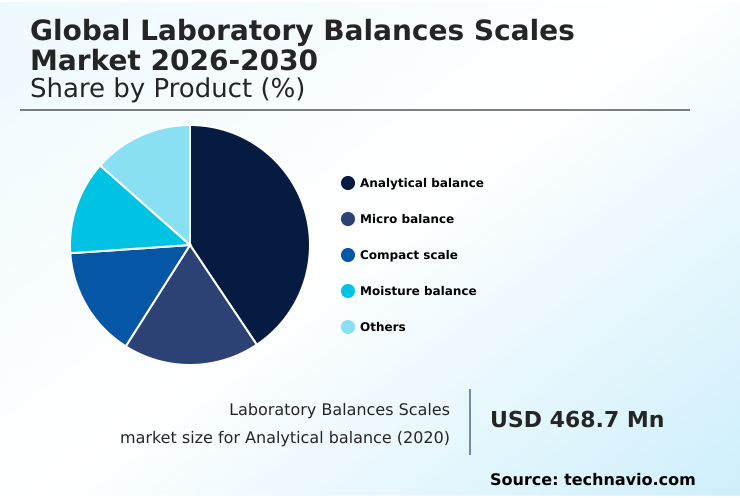
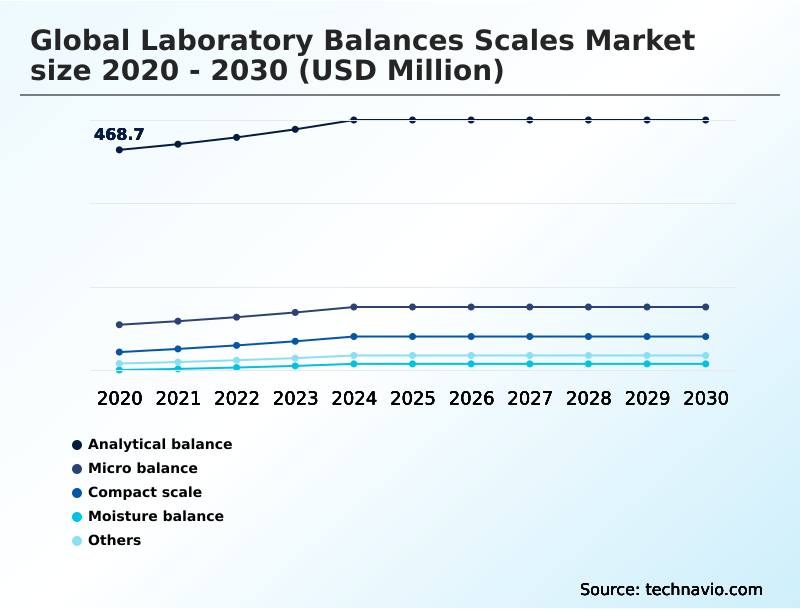
The Analytical balance segment was valued at USD 512.5 million in 2024 and showed a gradual increase during the forecast period.
Regional Analysis
Asia is estimated to contribute 35.7% to the growth of the global market during the forecast period.Technavio’s analysts have elaborately explained the regional trends and drivers that shape the market during the forecast period.

See How Laboratory Balances Scales Market Demand is Rising in Asia Get Free Sample
The geographic landscape is shifting, with North America's mature market focused on upgrading to systems compliant with FDA 21 CFR Part 11, while Asia emerges as the fastest-growing region, contributing over 35% of the incremental growth.
This is driven by supply chain diversification and the expansion of manufacturing, which requires robust raw material tracking and finished product verification.
In Europe, the emphasis is on integration into the smart factory ecosystem, with weigh modules integration into automated lines improving efficiency.
In contrast, emerging economies often prioritize versatile instruments like the moisture balance and those using durable strain gauge load cells for essential quality control.
This regional divergence highlights different adoption priorities, from high-end automation to fundamental adherence to mass metrology standards.
Market Dynamics
Our researchers analyzed the data with 2025 as the base year, along with the key drivers, trends, and challenges. A holistic analysis of drivers will help companies refine their marketing strategies to gain a competitive advantage.
- The global laboratory balances scales market 2026-2030 is increasingly defined by specialized applications and user requirements. For instance, laboratory balances for pharmaceutical qc must provide flawless data integrity, making scales with lims integration capabilities essential for compliance. When selecting balances for university labs, durability and ease of use are prioritized over microgram precision.
- In advanced research, preventing static in micro-weighing is a critical challenge, driving demand for balances with built-in ionizers, especially for microbalance for hpapi handling. The food sector relies on the moisture analyzer for food industry to ensure product quality and shelf-life. In contrast, industrial applications often require a high capacity balance for pilot plants.
- The path to procurement is also evolving; many organizations now favor comprehensive balance calibration and service contracts to ensure long-term performance and regulatory adherence. For high-tech applications, the focus is on deploying automated powder dosing systems and finding usp compliant weighing solutions.
- The use of portable scales for field research is growing in environmental science, while the core of gravimetric analysis in materials science continues to demand high-precision instruments. Weighing solutions for biotech startups often need to be scalable and cost-effective.
- Ultimately, understanding the nuances of balance performance qualification process and how environmental factors affecting weighing impact accuracy is crucial for reducing error in analytical weighing and ensuring reliable data integrity in weighing records.
- Organizations adopting smart balances for industry 4.0 report up to a 15% improvement in process consistency compared to those using non-integrated systems, highlighting a strategic shift toward connected metrology.
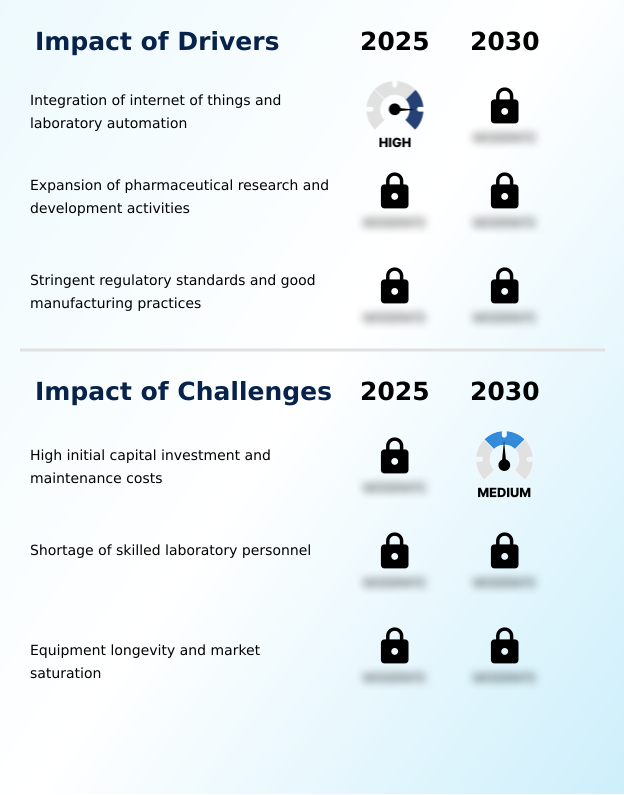
What are the key market drivers leading to the rise in the adoption of Laboratory Balances Scales Industry?
- The integration of the Internet of Things and laboratory automation is a key driver, enabling connected ecosystems that improve data accuracy and operational throughput.
- The expansion of research and development pipelines, particularly in personalized medicine research, is a major driver. This growth, amplified by contract research organizations and contract manufacturing organizations, necessitates strict regulatory standard adherence.
- Compliance with good manufacturing practice (GMP) and good laboratory practice (GLP), guided by ALCOA+ principles and standards like the united states pharmacopeia, compels investment in compliant hardware.
- Many labs are seeking ISO 17025 accreditation, driving demand for instruments with advanced technologies like the super hybrid sensor and unibloc mass sensor. These drivers also support greater supply chain resilience, as accurate weighing is critical for quality control.
- Instruments that automate compliance checks can accelerate product release times by up to 15%.
What are the market trends shaping the Laboratory Balances Scales Industry?
- The integration of advanced connectivity is transforming laboratory weighing. This evolution toward interconnected systems enhances data integrity and operational efficiency.
- A primary trend is the focus on enhanced precision for high-potency active ingredients and biopharmaceutical formulation. This drives demand for advanced weighing cell technology with integrated static elimination technology to ensure accuracy in high-throughput screening.
- The adoption of smart features, such as internal calibration routines and real-time monitoring of environmental conditions, supports preventative instrument maintenance, with some labs reducing unscheduled downtime by 20%. These capabilities, including remote troubleshooting capabilities, enhance operational uptime enhancement and contribute to better equipment lifecycle management.
- Another significant trend is the use of specialized instruments for thermogravimetric analysis that are fully integrated into automated laboratory workflow optimization systems.
What challenges does the Laboratory Balances Scales Industry face during its growth?
- High initial capital investment and subsequent maintenance costs present a key challenge, potentially limiting the adoption of advanced weighing technologies for budget-constrained organizations.
- A key challenge is the high total cost of ownership, which includes not only the initial investment but also maintenance and calibration. Another hurdle is the shortage of skilled personnel with sufficient hands-on instrumental analysis training to operate complex robotic weighing systems or correctly perform minimum weight determination. Equipment longevity also slows replacement cycles.
- While advanced features like touchless sensor operation and weigh modules integration into a smart factory ecosystem offer efficiency, labs with stable workflows may not see the ROI. For example, a lab focused on basic raw material tracking using parts counting functionality might defer upgrading, impacting new sales.
- This dynamic pushes manufacturers to justify upgrades that support finished product verification and other high-value tasks.
Exclusive Technavio Analysis on Customer Landscape
The laboratory balances scales market forecasting report includes the adoption lifecycle of the market, covering from the innovator’s stage to the laggard’s stage. It focuses on adoption rates in different regions based on penetration. Furthermore, the laboratory balances scales market report also includes key purchase criteria and drivers of price sensitivity to help companies evaluate and develop their market growth analysis strategies.
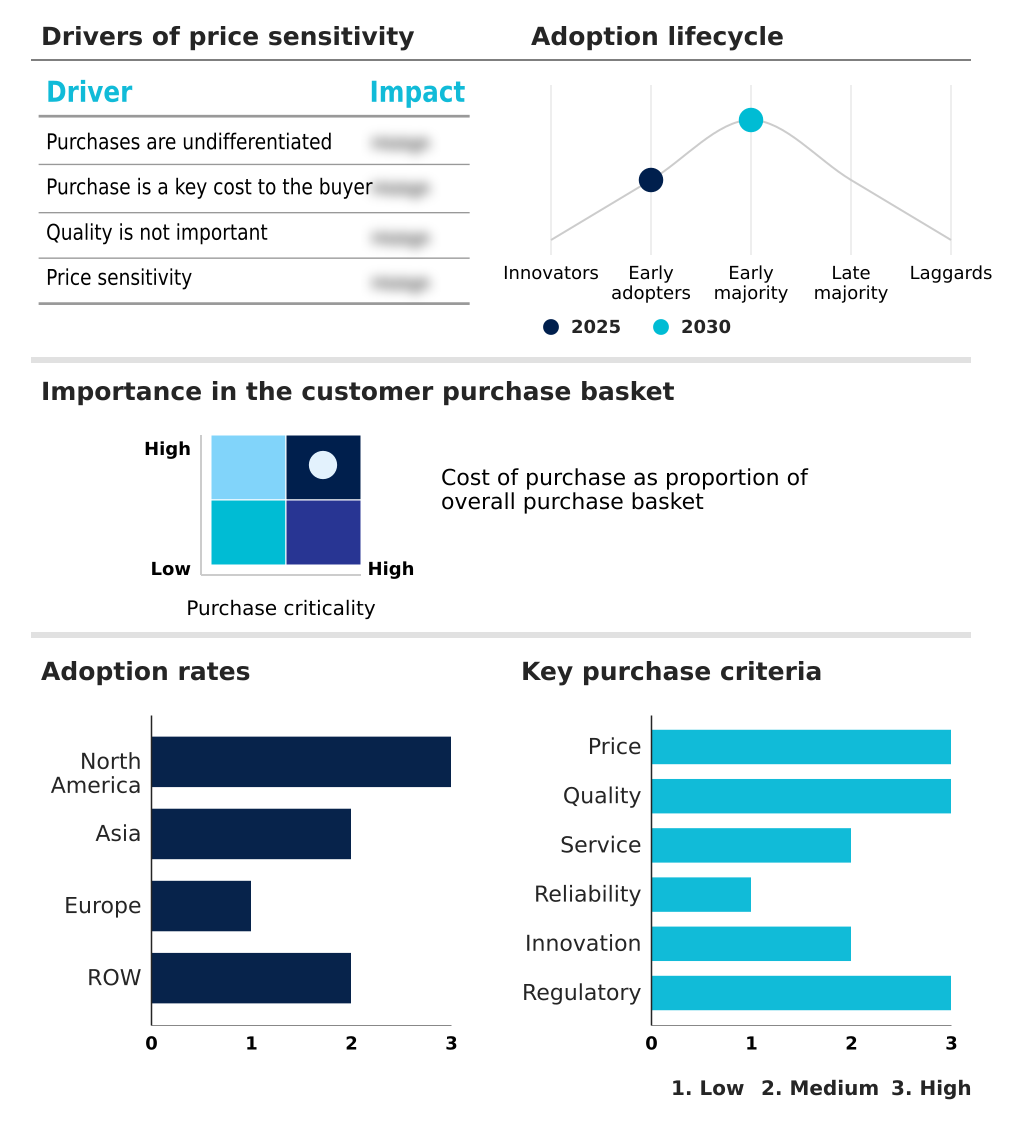
Customer Landscape of Laboratory Balances Scales Industry
Competitive Landscape
Companies are implementing various strategies, such as strategic alliances, laboratory balances scales market forecast, partnerships, mergers and acquisitions, geographical expansion, and product/service launches, to enhance their presence in the industry.
A and D HOLON HC Ltd. - Patented sensor technology offers rapid stabilization and high durability for a range of precision and analytical weighing applications.
The industry research and growth report includes detailed analyses of the competitive landscape of the market and information about key companies, including:
- A and D HOLON HC Ltd.
- Adam Equipment Inc.
- Avantor Inc.
- AXIS
- BEL Engineering srl
- Cole Parmer
- Gibertini Elettronica s.r.l.
- GRAM GROUP
- KERN and SOHN GmbH
- METTLER TOLEDO
- OHAUS Corp.
- PCE Holding GmbH
- Precisa Gravimetrics AG
- Radwag Wagi Elektroniczne
- Rice Lake weighing systems
- Sartorius AG
- Scientific Industries Inc.
- Setra Systems
- Shimadzu Corp.
- Shinko Denshi Co. Ltd
Qualitative and quantitative analysis of companies has been conducted to help clients understand the wider business environment as well as the strengths and weaknesses of key industry players. Data is qualitatively analyzed to categorize companies as pure play, category-focused, industry-focused, and diversified; it is quantitatively analyzed to categorize companies as dominant, leading, strong, tentative, and weak.
Recent Development and News in Laboratory balances scales market
- In November, 2024, Novo Nordisk announced a major investment in expanding its manufacturing facilities, requiring extensive procurement of quality control equipment, including industrial and laboratory scales.
- In February, 2025, Mettler Toledo launched a new iteration of its XPR micro-analytical balances with advanced static detection systems to support the handling of small, potent compounds in biotech.
- In March, 2025, Sartorius expanded its Cubis II portfolio with new software features enabling bi-directional communication with various LIMS providers for software-defined weighing hardware.
- In May, 2025, Mettler Toledo showcased advancements in its LabX software, emphasizing secure data handling and instrument management for regulated laboratory environments.
Dive into Technavio’s robust research methodology, blending expert interviews, extensive data synthesis, and validated models for unparalleled Laboratory Balances Scales Market insights. See full methodology.
| Market Scope | |
|---|---|
| Page number | 304 |
| Base year | 2025 |
| Historic period | 2020-2024 |
| Forecast period | 2026-2030 |
| Growth momentum & CAGR | Accelerate at a CAGR of 3.5% |
| Market growth 2026-2030 | USD 246.0 million |
| Market structure | Fragmented |
| YoY growth 2025-2026(%) | 3.4% |
| Key countries | US, Canada, Mexico, China, India, Japan, South Korea, Indonesia, Thailand, Singapore, Germany, UK, France, The Netherlands, Italy, Spain, Russia, Australia, Brazil, South Africa, UAE, Saudi Arabia and Turkey |
| Competitive landscape | Leading Companies, Market Positioning of Companies, Competitive Strategies, and Industry Risks |
Research Analyst Overview
- The laboratory balances scales market is shaped by the convergence of advanced instrumentation and stringent data management requirements. Core technologies like electromagnetic force restoration and the tuning-fork sensor technology continue to evolve, offering greater precision in gravimetric analysis.
- The market's trajectory is heavily influenced by the need for compliance with standards such as good manufacturing practice and good laboratory practice, which mandate rigorous minimum weight determination and traceable mass metrology standards.
- A key trend is the integration with laboratory information management systems and electronic laboratory notebooks, which transforms instruments from standalone devices to critical data points in a connected ecosystem. This shift addresses the ALCOA+ principles by enabling features like user management and automated weighing systems.
- For instance, laboratories implementing systems with predictive maintenance sensors have seen a 20% reduction in unscheduled downtime. Boardroom decisions are now centered on the total cost of ownership, where investments in modular instrument design and robotic weighing systems are justified by long-term gains in throughput, data integrity, and compliance, moving beyond the initial capital expense.
What are the Key Data Covered in this Laboratory Balances Scales Market Research and Growth Report?
-
What is the expected growth of the Laboratory Balances Scales Market between 2026 and 2030?
-
USD 246 million, at a CAGR of 3.5%
-
-
What segmentation does the market report cover?
-
The report is segmented by Product (Analytical balance, Micro balance, Compact scale, Moisture balance, and Others), Capacity (Medium capacity, High capacity, and Micro capacity), End-user (Manufacturers, Research and diagnostic lab, and Academic institutes) and Geography (North America, Asia, Europe, Rest of World (ROW))
-
-
Which regions are analyzed in the report?
-
North America, Asia, Europe and Rest of World (ROW)
-
-
What are the key growth drivers and market challenges?
-
Integration of internet of things and laboratory automation, High initial capital investment and maintenance costs
-
-
Who are the major players in the Laboratory Balances Scales Market?
-
A and D HOLON HC Ltd., Adam Equipment Inc., Avantor Inc., AXIS, BEL Engineering srl, Cole Parmer, Gibertini Elettronica s.r.l., GRAM GROUP, KERN and SOHN GmbH, METTLER TOLEDO, OHAUS Corp., PCE Holding GmbH, Precisa Gravimetrics AG, Radwag Wagi Elektroniczne, Rice Lake weighing systems, Sartorius AG, Scientific Industries Inc., Setra Systems, Shimadzu Corp. and Shinko Denshi Co. Ltd
-
Market Research Insights
- Market dynamics are shaped by the convergence of stringent regulatory demands and the pursuit of operational excellence. Adherence to evolving standards is paramount, driving investment in instruments that facilitate analytical method validation and ensure robust data integrity compliance.
- This focus on compliance has led to a 40% increase in the adoption of systems with integrated audit trail documentation over the last three years. In parallel, the expansion of contract research organizations and contract manufacturing organizations is fueling demand for high-throughput solutions. Implementing laboratory workflow optimization through connected devices can reduce sample processing times by up to 25%.
- This push for efficiency and compliance underscores the market's trajectory toward smarter, more integrated weighing solutions that enhance research and development pipelines.
We can help! Our analysts can customize this laboratory balances scales market research report to meet your requirements.
 RIA -
RIA - 
