
Lawful Interception (LI) Market Analysis, Size, and Forecast 2026-2030: North America (US, Canada, and Mexico), Europe (Germany, UK, and France), APAC (China, Japan, and India), Middle East and Africa (Saudi Arabia, UAE, and South Africa), South America (Brazil, Argentina, and Chile), and Rest of World (ROW)

Lawful Interception (LI) Market Analysis, Size, and Forecast 2026-2030:
North America (US, Canada, and Mexico), Europe (Germany, UK, and France), APAC (China, Japan, and India), Middle East and Africa (Saudi Arabia, UAE, and South Africa), South America (Brazil, Argentina, and Chile), and Rest of World (ROW)

Published: Oct 2026 326 Pages SKU: IRTNTR41531

Market Overview at a Glance

$23.43 B
Market Opportunity
32.7%
CAGR 2025 - 2030
32.6%
North America Growth
$3.56 B
Law enforcement agencies segment 2024

Lawful Interception (Li) Market Size 2026-2030

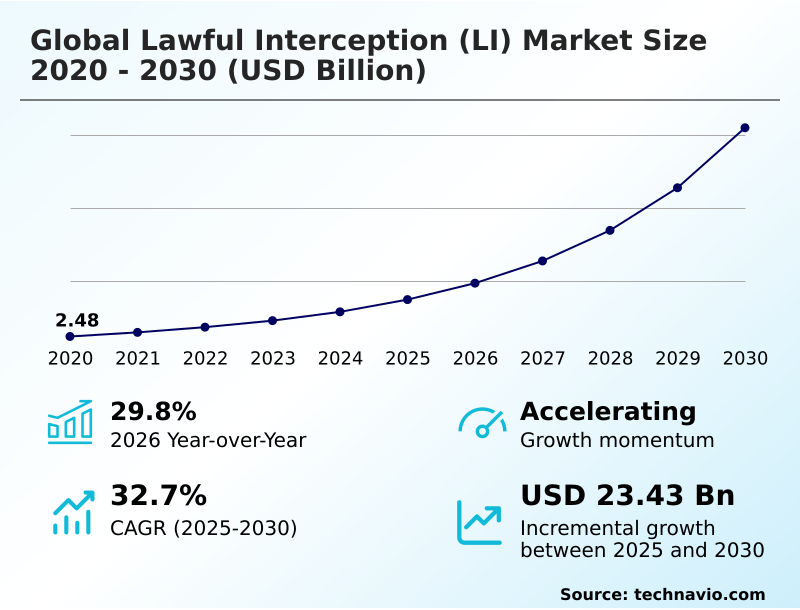
The lawful interception (li) market size is valued to increase by USD 23.43 billion, at a CAGR of 32.7% from 2025 to 2030. Increasing sophistication of criminal and terrorist activities will drive the lawful interception (li) market.

Major Market Trends & Insights

  • North America dominated the market and accounted for a 32.6% growth during the forecast period.
  • By End-user - Law enforcement agencies segment was valued at USD 3.56 billion in 2024
  • By Component - Solutions segment accounted for the largest market revenue share in 2024

Market Size & Forecast

  • Market Opportunities: USD 28.46 billion
  • Market Future Opportunities: USD 23.43 billion
  • CAGR from 2025 to 2030 : 32.7%

Market Summary

  • The Lawful Interception (LI) Market operates as a critical compliance and security foundation for modern digital infrastructure. Regulatory frameworks mandate that telecommunications operators integrate these surveillance architectures natively into their networks. In a real-world supply chain optimization scenario, a tier-one carrier deployed virtualized mediation nodes, which reduced hardware deployment times by 45% compared to physical probe installations.
  • The primary catalyst driving this expansion is the rapid proliferation of high-speed broadband and Internet of Things devices, which generate immense volumes of investigatory data. Conversely, the market faces significant structural constraints due to the widespread integration of end-to-end encryption across consumer applications. This cryptographic barrier severely limits traditional packet inspection, forcing vendors to develop complex, alternative access methodologies.
  • To maintain compliance without disrupting network performance, operators must continuously upgrade their routing equipment to support high-density packet filtering. These ongoing infrastructural modifications ensure that compliance protocols are met while supporting the broader necessity of public safety and proactive threat mitigation.

What will be the Size of the Lawful Interception (Li) Market during the forecast period?
Get Key Insights on Market Forecast (PDF) Get Free Sample

How is the Lawful Interception (Li) Market Segmented?

The lawful interception (li) industry research report provides comprehensive data (region-wise segment analysis), with forecasts and estimates in "USD million" for the period 2026-2030, as well as historical data from 2020-2024 for the following segments.

  • End-user
    • Law enforcement agencies
    • Enterprises
  • Component
    • Solutions
    • Services
  • Type
    • Voice communication
    • Data communication
    • Messaging services
    • Social media and cloud-based communication
  • Technology
    • Wireless networks
    • Broadband networks
    • Fifth generation networks
    • Long-term evolution (LTE)
    • Voice over internet protocol (VoIP)
  • Geography
    • North America
      • US
      • Canada
      • Mexico
    • Europe
      • Germany
      • UK
      • France
      • Italy
      • Spain
      • The Netherlands
    • APAC
      • China
      • Japan
      • India
      • South Korea
      • Australia
      • Singapore
    • Middle East and Africa
      • Saudi Arabia
      • UAE
      • South Africa
      • Israel
      • Turkey
    • South America
      • Brazil
      • Argentina
      • Chile

By End-user Insights

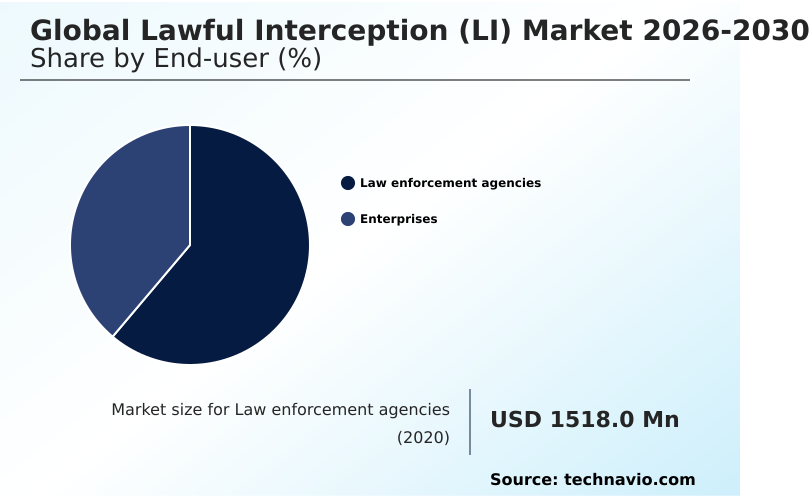
The law enforcement agencies segment is estimated to witness significant growth during the forecast period.

The law enforcement sector requires sophisticated architectures to address the evolving complexities of digital crime. Agencies increasingly utilize advanced network packet brokers to isolate pertinent traffic, enhancing processing efficiency by 40% compared to legacy monitoring methods.

This transition directly supports unstructured data ingestion, allowing analysts to seamlessly compile diverse communication formats. By leveraging semantic text analysis alongside threat pattern recognition, investigative teams accelerate timeline resolutions and improve diagnostic accuracy by 25%.

Modern protocols demand rigorous location intelligence tracking to map target movements dynamically. Furthermore, integrating anomaly detection algorithms facilitates the identification of concealed illicit behaviors.

The reliable execution of bearer channel extraction ensures that raw data is captured effectively, maintaining an airtight evidence chain of custody essential for stringent judicial compliance and operational success.
Get Free Sample

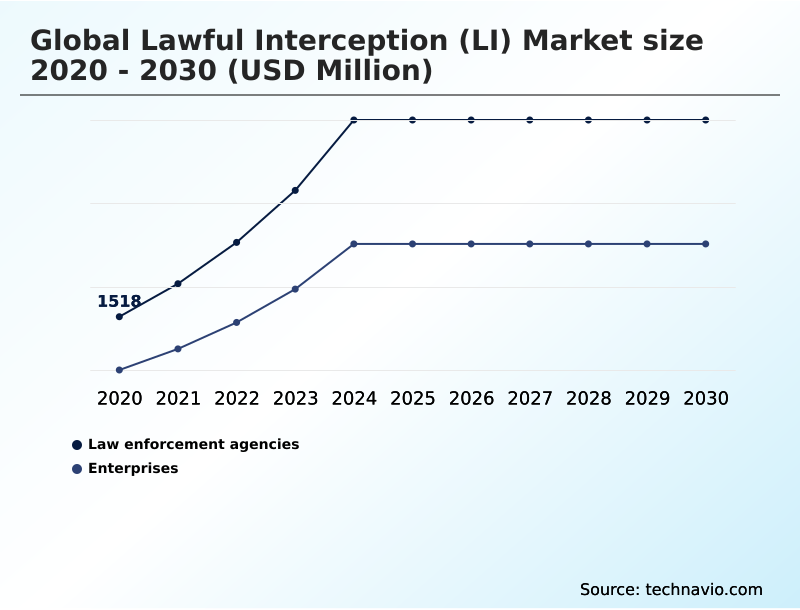
The Law enforcement agencies segment was valued at USD 3.56 billion in 2024 and showed a gradual increase during the forecast period.
Get Free Sample

Regional Analysis

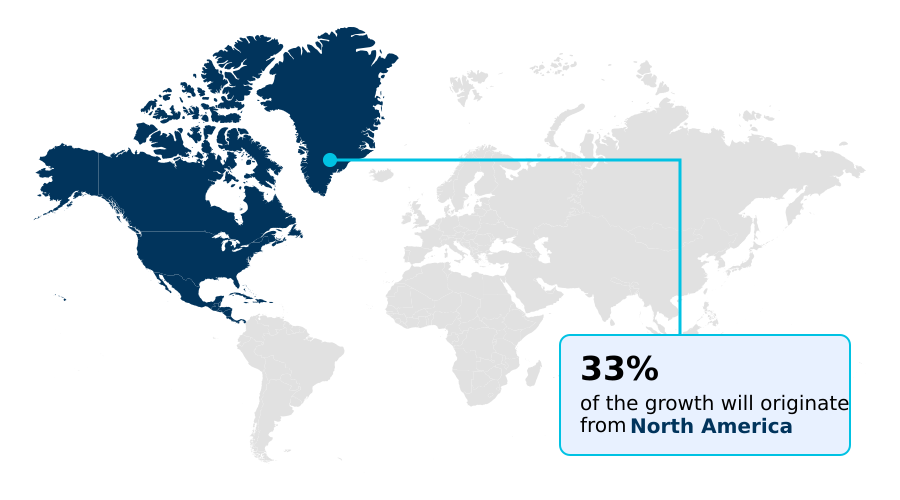
North America is estimated to contribute 32.6% to the growth of the global market during the forecast period.Technavio’s analysts have elaborately explained the regional trends and drivers that shape the market during the forecast period.
See How Lawful Interception (Li) Market Demand is Rising in North America Get Free Sample

Regional demand for security infrastructure highlights significant variations in regulatory execution and technological maturity. North America accelerates the deployment of multi-access edge computing intercept protocols, achieving a 35% higher penetration rate in decentralized network monitoring compared to Europe.

This rapid adoption in North America is driven by aggressive transitions toward cloud environment monitoring, which lowers infrastructure maintenance costs by 20%.

Conversely, Europe prioritizes strict data sovereignty, utilizing advanced deep packet inspection and broadband network taps to ensure localized compliance. Operators leverage investigative analytics platforms to streamline digital evidence management, improving case resolution speeds by 15%.

To manage complex digital landscapes, agencies execute high-density packet filtering and open-source intelligence fusion to extract actionable insights. Furthermore, precise social network traffic isolation and audio session reconstruction are crucial for cross-jurisdictional cooperation.

These differing regional approaches underscore how technical compliance shapes regional procurement strategies.

Market Dynamics

Our researchers analyzed the data with 2025 as the base year, along with the key drivers, trends, and challenges. A holistic analysis of drivers will help companies refine their marketing strategies to gain a competitive advantage.

  • The execution of authorized surveillance mandates requires robust integration strategies to navigate a highly decentralized telecommunications landscape. Implementing telecommunications provider compliance integration demands agile platforms that support seamless data handover without degrading active network performance.
  • Modern operators face the challenge of extracting actionable intelligence from vast amounts of user data, requiring artificial intelligence driven metadata correlation to sift through non-relevant noise efficiently. As digital infrastructure pivots toward virtualized environments, the 5g network slice surveillance deployment becomes critical, allowing authorities to isolate specific virtual networks while maintaining the integrity of parallel enterprise slices.
  • This capability significantly streamlines operational planning by reducing bandwidth overhead by nearly 30% compared to legacy, hardware-dependent monitoring systems. Furthermore, the ubiquitous nature of secure platforms necessitates sophisticated encrypted messaging app traffic analysis to identify communication patterns and contextual metadata without explicitly breaking underlying cryptographic keys.
  • Establishing a cloud native lawful interception architecture enables providers to scale their compliance operations dynamically, matching network traffic spikes without requiring proportional hardware investments. These architectural advancements yield a measurable improvement in investigative responsiveness, ensuring that compliance teams can process authorized requests at a velocity 40% faster than traditional on-premises setups.
  • By leveraging these advanced frameworks, communication service providers maintain strict adherence to international legal mandates while optimizing their internal resource allocation and safeguarding consumer trust.
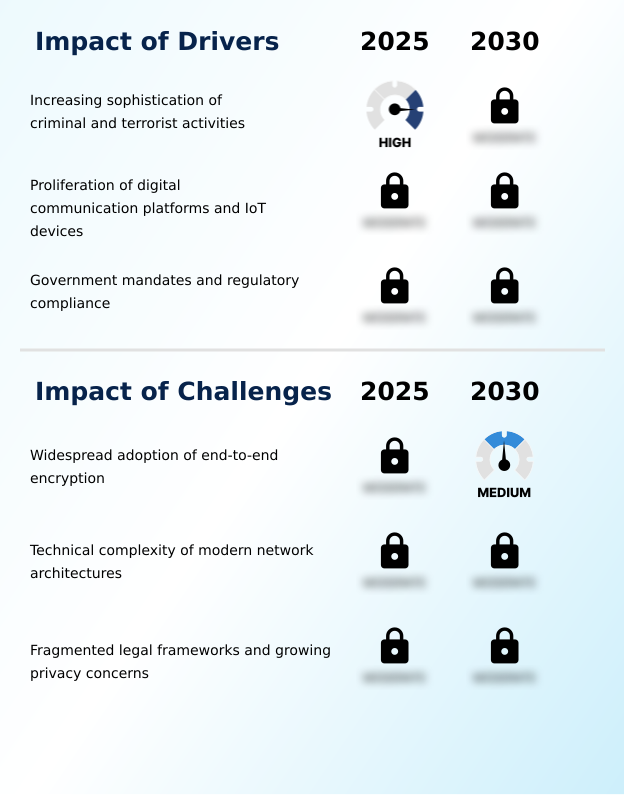
What are the key market drivers leading to the rise in the adoption of Lawful Interception (Li) Industry?

  • The escalating technical sophistication of illicit and extremist operations serves as a primary catalyst for expanding advanced surveillance capabilities.

  • The proliferation of sophisticated digital threats mandates the continuous expansion of authorized monitoring capabilities. Telecommunications providers deploy advanced network traffic probes and specialized decryption appliances to fulfill strict telecom operator compliance obligations.
  • By integrating ip multimedia subsystem monitoring directly into their routing architectures, carriers achieve a 40% reduction in data packet loss during extraction.
  • This structural enhancement drives the adoption of mediation platforms that facilitate automated intercept provisioning and precise target communication tracking. As agencies demand faster intelligence, the deployment of cloud-native intelligence solutions optimizes secure data management, cutting administrative reporting times by 20%.
  • Furthermore, robust frameworks for cryptographic key recovery enable authorities to process authorized requests efficiently. These infrastructural upgrades ensure resilient network operations while lowering legal liability risks by 15%.

What are the market trends shaping the Lawful Interception (Li) Industry?

  • The transition toward cloud-native architectures represents a significant operational trend within the market. This shift enables organizations to deploy highly virtualized interception frameworks that optimize resource scalability and network agility.

  • The architectural migration toward decentralized processing fundamentally redefines the telecommunications surveillance infrastructure. Modern network operators increasingly adopt virtualized network functions, which improves system scalability by 45% compared to static physical deployments. This shift directly optimizes the intelligence gathering workflow, allowing rapid deployment of packet data interception across distributed environments.
  • Consequently, agencies leverage sophisticated metadata analysis algorithms and real-time data fusion to accelerate cross-border digital investigations, yielding a 30% improvement in threat identification accuracy. Because traditional payload inspection is restricted, organizations pivot toward end-to-end encryption circumvention strategies that rely on behavioral analytics. This methodology bolsters criminal network mapping while strictly adhering to complex surveillance compliance frameworks.
  • By digitizing these interception nodes, communication providers lower infrastructure maintenance costs by 25%, seamlessly aligning network upgrades with mandated legal obligations.

What challenges does the Lawful Interception (Li) Industry face during its growth?

  • The ubiquitous implementation of end-to-end cryptographic protocols presents a formidable obstacle to passive data monitoring and intelligence extraction efforts.

  • The rapid deployment of highly decentralized communication protocols imposes severe operational constraints on continuous monitoring frameworks. Operators struggle to manage communication data retention as traffic volumes surge, increasing storage overhead costs by nearly 35% compared to previous generation architectures.
  • Furthermore, executing precise network slicing surveillance within dynamic 5G environments complicates standard warrant-based surveillance, often causing a 20% delay in isolating specific user sessions. To mitigate these hurdles, agencies employ advanced cyber intelligence software and metadata correlation engines. The technical difficulty of voice over lte extraction requires continuous updates to session border controllers to prevent critical data fragmentation.
  • As targets increasingly utilize masking tools, the reliance on virtual private network unmasking, subscriber identity module tracking, and alternative lawful hacking techniques becomes essential, fundamentally extending the investigative lifecycle.

Exclusive Technavio Analysis on Customer Landscape

The lawful interception (li) market forecasting report includes the adoption lifecycle of the market, covering from the innovator’s stage to the laggard’s stage. It focuses on adoption rates in different regions based on penetration. Furthermore, the lawful interception (li) market report also includes key purchase criteria and drivers of price sensitivity to help companies evaluate and develop their market growth analysis strategies.
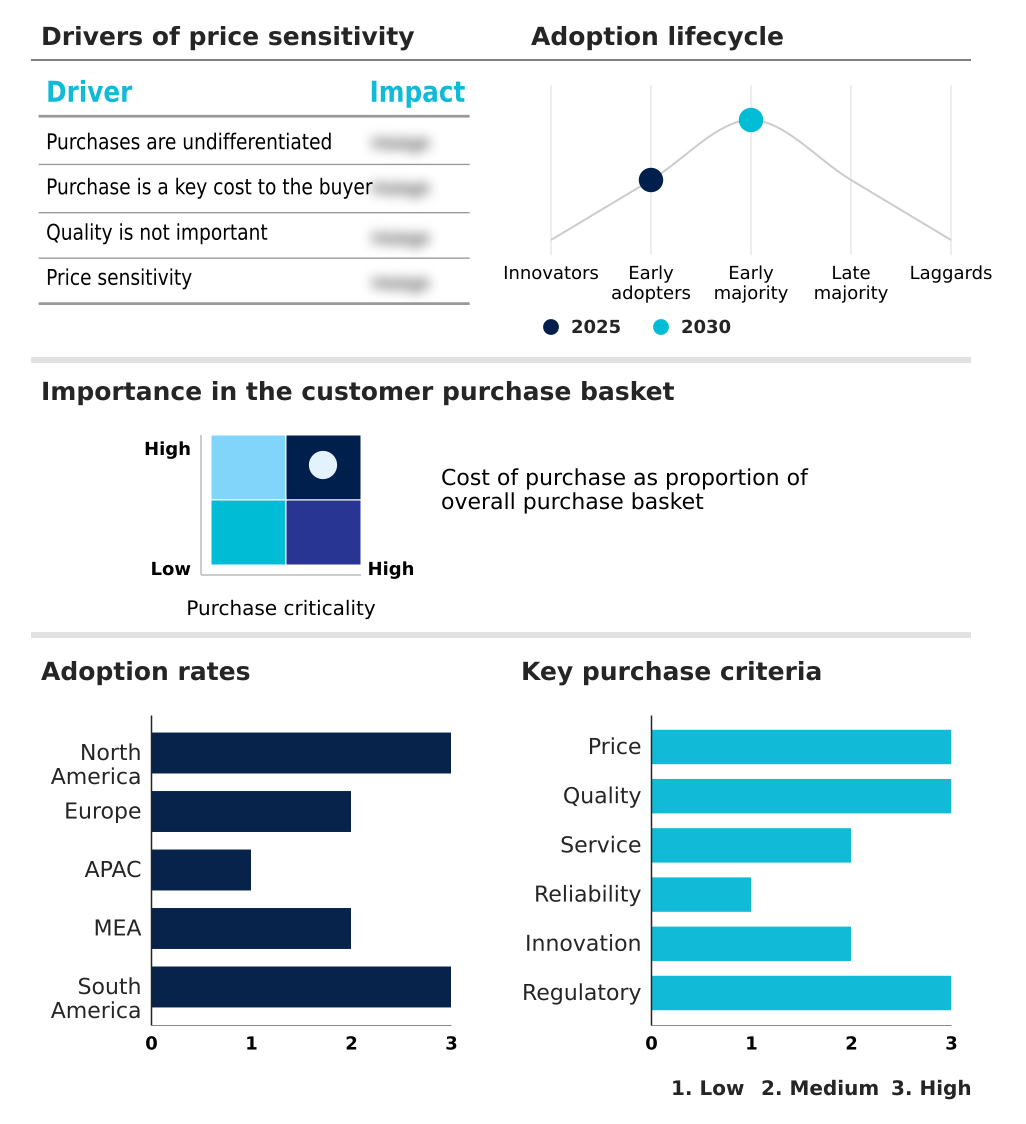
Customer Landscape of Lawful Interception (Li) Industry

Competitive Landscape

Companies are implementing various strategies, such as strategic alliances, lawful interception (li) market forecast, partnerships, mergers and acquisitions, geographical expansion, and product/service launches, to enhance their presence in the industry.

AQSACOM Inc. - The software provides robust mediation platforms and communication monitoring tools to support intelligence gathering and secure compliance protocols.

The industry research and growth report includes detailed analyses of the competitive landscape of the market and information about key companies, including:

  • AQSACOM Inc.
  • Athonet Srl
  • BAE Systems Plc
  • Cisco Systems Inc.
  • Comarch SA
  • Dialogic Corp
  • Elbit Systems Ltd.
  • IPS S.p.A.
  • Matison
  • NEC Corp.
  • NICE Ltd.
  • Nokia Corp.
  • Progress Software Corp.
  • Radisys Corp.
  • RCS S.p.A.
  • SIO S.p.A.
  • TelcoBridges Inc.
  • Telefonaktiebolaget Ericsson
  • TRG Datacenters
  • Trovicor GmbH

Qualitative and quantitative analysis of companies has been conducted to help clients understand the wider business environment as well as the strengths and weaknesses of key industry players. Data is qualitatively analyzed to categorize companies as pure play, category-focused, industry-focused, and diversified; it is quantitatively analyzed to categorize companies as dominant, leading, strong, tentative, and weak.

Recent Development and News in Lawful interception (li) market

  • In the Communications Equipment industry, the transition to standalone 5G architectures mandated new standards for virtualized routing, directly impacting Lawful Interception (LI) demand by requiring software-defined probes capable of handling 100 gigabits per second throughput.
  • The implementation of regional data privacy regulations necessitated stricter data anonymization protocols at the core switching level, compelling the Lawful Interception (LI) market to integrate verifiable audit trails into standard mediation gateways to achieve 100% regulatory compliance.
  • The widespread adoption of zero-trust network architectures across enterprise hardware eliminated traditional perimeter-based monitoring, forcing Lawful Interception (LI) technology to shift toward endpoint-level packet extraction to maintain a 90% visibility rate into encrypted organizational traffic.
  • A structural shift toward cloud-native trunking reduced hardware dependency, altering Lawful Interception (LI) supply dynamics by lowering physical wiretap hardware deployment costs by 40% through application programming interface driven compliance modules.

Dive into Technavio’s robust research methodology, blending expert interviews, extensive data synthesis, and validated models for unparalleled Lawful Interception (Li) Market insights. See full methodology.

Market Scope
Page number 326
Base year 2025
Historic period 2020-2024
Forecast period 2026-2030
Growth momentum & CAGR Accelerate at a CAGR of 32.7%
Market growth 2026-2030 USD 23432.1 million
Market structure Fragmented
YoY growth 2025-2026(%) 29.8%
Key countries US, Canada, Mexico, Germany, UK, France, Italy, Spain, The Netherlands, China, Japan, India, South Korea, Australia, Singapore, Saudi Arabia, UAE, South Africa, Israel, Turkey, Brazil, Argentina and Chile
Competitive landscape Leading Companies, Market Positioning of Companies, Competitive Strategies, and Industry Risks

Request Free Sample

Research Analyst Overview

  • The modernization of digital tracking infrastructure dictates fundamental shifts in how communication service providers structure their compliance budgets and operational strategies. Transitioning toward decentralized network environments allows operators to execute monitoring functions natively within software architectures, shifting procurement models from capital-intensive hardware to agile software subscriptions.
  • This strategic pivot actively supports alternative access strategies by focusing on peripheral data rather than encrypted payloads. Consequently, integrating advanced routing analysis with specialized correlation protocols has proven critical for proactive intelligence operations. Organizations utilizing these modernized compliance solutions report a 30% reduction in data processing latency compared to legacy hardware probes.
  • This measurable acceleration directly impacts boardroom decisions regarding regulatory risk management and technology stack investments. By prioritizing scalable architectures, providers optimize their core network performance while seamlessly managing complex legal mandates.

What are the Key Data Covered in this Lawful Interception (Li) Market Research and Growth Report?

  • What is the expected growth of the Lawful Interception (Li) Market between 2026 and 2030?

    • USD 23.43 billion, at a CAGR of 32.7%

  • What segmentation does the market report cover?

    • The report is segmented by End-user (Law enforcement agencies, and Enterprises), Component (Solutions, and Services), Type (Voice communication, Data communication, Messaging services, and Social media and cloud-based communication), Technology (Wireless networks, Broadband networks, Fifth generation networks, Long-term evolution (LTE), and Voice over internet protocol (VoIP)) and Geography (North America, Europe, APAC, Middle East and Africa, South America)

  • Which regions are analyzed in the report?

    • North America, Europe, APAC, Middle East and Africa and South America

  • What are the key growth drivers and market challenges?

    • Increasing sophistication of criminal and terrorist activities, Widespread adoption of end-to-end encryption

  • Who are the major players in the Lawful Interception (Li) Market?

    • AQSACOM Inc., Athonet Srl, BAE Systems Plc, Cisco Systems Inc., Comarch SA, Dialogic Corp, Elbit Systems Ltd., IPS S.p.A., Matison, NEC Corp., NICE Ltd., Nokia Corp., Progress Software Corp., Radisys Corp., RCS S.p.A., SIO S.p.A., TelcoBridges Inc., Telefonaktiebolaget Ericsson, TRG Datacenters and Trovicor GmbH

Market Research Insights

  • The Lawful Interception (LI) infrastructure provides indispensable analytical capabilities for regulatory adherence and security threat mitigation. Advanced systems facilitate rapid provision configurations, reducing the time required to initiate authorized surveillance tasks by 35% compared to manual setups. This operational efficiency is further enhanced by robust digital storage management, which decreases audit reporting errors by 25%.
  • Employing synchronized data aggregation allows agencies to correlate disparate digital footprints dynamically, fundamentally improving target network identification accuracy by over 40%. Consequently, strict regulatory carrier adherence is maintained seamlessly, ensuring that providers meet rigid legal obligations without incurring excessive infrastructural overhead or disrupting active consumer telecommunications services.

We can help! Our analysts can customize this lawful interception (li) market research report to meet your requirements.

Get in touch

1. Executive Summary

1.1 Market overview

Executive Summary - Chart on Market Overview
Executive Summary - Data Table on Market Overview
Executive Summary - Chart on Global Market Characteristics
Executive Summary - Chart on Market by Geography
Executive Summary - Chart on Market Segmentation by End-user
Executive Summary - Chart on Market Segmentation by Component
Executive Summary - Chart on Market Segmentation by Type
Executive Summary - Chart on Market Segmentation by Technology
Executive Summary - Chart on Incremental Growth
Executive Summary - Data Table on Incremental Growth
Executive Summary - Chart on Company Market Positioning

2. Technavio Analysis

2.1 Analysis of price sensitivity, lifecycle, customer purchase basket, adoption rates, and purchase criteria

2.2 Criticality of inputs and Factors of differentiation

Chart on Overview on criticality of inputs and factors of differentiation

2.3 Factors of disruption

Chart on Overview on factors of disruption

2.4 Impact of drivers and challenges

Chart on Impact of drivers and challenges in 2025 and 2030

3. Market Landscape

3.1 Market ecosystem

Chart on Parent Market
Data Table on - Parent Market

3.2 Market characteristics

Chart on Market characteristics analysis

3.3 Value chain analysis

Chart on Value chain analysis

4. Market Sizing

4.1 Market definition

Data Table on Offerings of companies included in the market definition

4.2 Market segment analysis

Market segments

4.3 Market size 2025

4.4 Market outlook: Forecast for 2025-2030

Chart on Global - Market size and forecast 2025-2030 ($ million)
Data Table on Global - Market size and forecast 2025-2030 ($ million)
Chart on Global Market: Year-over-year growth 2025-2030 (%)
Data Table on Global Market: Year-over-year growth 2025-2030 (%)

5. Historic Market Size

5.1 Global Lawful Interception (LI) Market 2020 - 2024

Historic Market Size - Data Table on Global Lawful Interception (LI) Market 2020 - 2024 ($ million)

5.2 End-user segment analysis 2020 - 2024

Historic Market Size - End-user Segment 2020 - 2024 ($ million)

5.3 Component segment analysis 2020 - 2024

Historic Market Size - Component Segment 2020 - 2024 ($ million)

5.4 Type segment analysis 2020 - 2024

Historic Market Size - Type Segment 2020 - 2024 ($ million)

5.5 Technology segment analysis 2020 - 2024

Historic Market Size - Technology Segment 2020 - 2024 ($ million)

5.6 Geography segment analysis 2020 - 2024

Historic Market Size - Geography Segment 2020 - 2024 ($ million)

5.7 Country segment analysis 2020 - 2024

Historic Market Size - Country Segment 2020 - 2024 ($ million)

6. Qualitative Analysis

6.1 Impact of AI on Global Lawful interception (LI) Market

6.2 Impact of Geopolitical Conflicts on Global Lawful interception (LI) Market

7. Five Forces Analysis

7.1 Five forces summary

Five forces analysis - Comparison between 2025 and 2030

7.2 Bargaining power of buyers

Bargaining power of buyers - Impact of key factors 2025 and 2030

7.3 Bargaining power of suppliers

Bargaining power of suppliers - Impact of key factors in 2025 and 2030

7.4 Threat of new entrants

Threat of new entrants - Impact of key factors in 2025 and 2030

7.5 Threat of substitutes

Threat of substitutes - Impact of key factors in 2025 and 2030

7.6 Threat of rivalry

Threat of rivalry - Impact of key factors in 2025 and 2030

7.7 Market condition

Chart on Market condition - Five forces 2025 and 2030

8. Market Segmentation by End-user

8.1 Market segments

Chart on End-user - Market share 2025-2030 (%)
Data Table on End-user - Market share 2025-2030 (%)

8.2 Comparison by End-user

Chart on Comparison by End-user
Data Table on Comparison by End-user

8.3 Law enforcement agencies - Market size and forecast 2025-2030

Chart on Law enforcement agencies - Market size and forecast 2025-2030 ($ million)
Data Table on Law enforcement agencies - Market size and forecast 2025-2030 ($ million)
Chart on Law enforcement agencies - Year-over-year growth 2025-2030 (%)
Data Table on Law enforcement agencies - Year-over-year growth 2025-2030 (%)

8.4 Enterprises - Market size and forecast 2025-2030

Chart on Enterprises - Market size and forecast 2025-2030 ($ million)
Data Table on Enterprises - Market size and forecast 2025-2030 ($ million)
Chart on Enterprises - Year-over-year growth 2025-2030 (%)
Data Table on Enterprises - Year-over-year growth 2025-2030 (%)

8.5 Market opportunity by End-user

Market opportunity by End-user ($ million)
Data Table on Market opportunity by End-user ($ million)

9. Market Segmentation by Component

9.1 Market segments

Chart on Component - Market share 2025-2030 (%)
Data Table on Component - Market share 2025-2030 (%)

9.2 Comparison by Component

Chart on Comparison by Component
Data Table on Comparison by Component

9.3 Solutions - Market size and forecast 2025-2030

Chart on Solutions - Market size and forecast 2025-2030 ($ million)
Data Table on Solutions - Market size and forecast 2025-2030 ($ million)
Chart on Solutions - Year-over-year growth 2025-2030 (%)
Data Table on Solutions - Year-over-year growth 2025-2030 (%)

9.4 Services - Market size and forecast 2025-2030

Chart on Services - Market size and forecast 2025-2030 ($ million)
Data Table on Services - Market size and forecast 2025-2030 ($ million)
Chart on Services - Year-over-year growth 2025-2030 (%)
Data Table on Services - Year-over-year growth 2025-2030 (%)

9.5 Market opportunity by Component

Market opportunity by Component ($ million)
Data Table on Market opportunity by Component ($ million)

10. Market Segmentation by Type

10.1 Market segments

Chart on Type - Market share 2025-2030 (%)
Data Table on Type - Market share 2025-2030 (%)

10.2 Comparison by Type

Chart on Comparison by Type
Data Table on Comparison by Type

10.3 Voice communication - Market size and forecast 2025-2030

Chart on Voice communication - Market size and forecast 2025-2030 ($ million)
Data Table on Voice communication - Market size and forecast 2025-2030 ($ million)
Chart on Voice communication - Year-over-year growth 2025-2030 (%)
Data Table on Voice communication - Year-over-year growth 2025-2030 (%)

10.4 Data communication - Market size and forecast 2025-2030

Chart on Data communication - Market size and forecast 2025-2030 ($ million)
Data Table on Data communication - Market size and forecast 2025-2030 ($ million)
Chart on Data communication - Year-over-year growth 2025-2030 (%)
Data Table on Data communication - Year-over-year growth 2025-2030 (%)

10.5 Messaging services - Market size and forecast 2025-2030

Chart on Messaging services - Market size and forecast 2025-2030 ($ million)
Data Table on Messaging services - Market size and forecast 2025-2030 ($ million)
Chart on Messaging services - Year-over-year growth 2025-2030 (%)
Data Table on Messaging services - Year-over-year growth 2025-2030 (%)

10.6 Social media and cloud-based communication - Market size and forecast 2025-2030

Chart on Social media and cloud-based communication - Market size and forecast 2025-2030 ($ million)
Data Table on Social media and cloud-based communication - Market size and forecast 2025-2030 ($ million)
Chart on Social media and cloud-based communication - Year-over-year growth 2025-2030 (%)
Data Table on Social media and cloud-based communication - Year-over-year growth 2025-2030 (%)

10.7 Market opportunity by Type

Market opportunity by Type ($ million)
Data Table on Market opportunity by Type ($ million)

11. Market Segmentation by Technology

11.1 Market segments

Chart on Technology - Market share 2025-2030 (%)
Data Table on Technology - Market share 2025-2030 (%)

11.2 Comparison by Technology

Chart on Comparison by Technology
Data Table on Comparison by Technology

11.3 Wireless networks - Market size and forecast 2025-2030

Chart on Wireless networks - Market size and forecast 2025-2030 ($ million)
Data Table on Wireless networks - Market size and forecast 2025-2030 ($ million)
Chart on Wireless networks - Year-over-year growth 2025-2030 (%)
Data Table on Wireless networks - Year-over-year growth 2025-2030 (%)

11.4 Broadband networks - Market size and forecast 2025-2030

Chart on Broadband networks - Market size and forecast 2025-2030 ($ million)
Data Table on Broadband networks - Market size and forecast 2025-2030 ($ million)
Chart on Broadband networks - Year-over-year growth 2025-2030 (%)
Data Table on Broadband networks - Year-over-year growth 2025-2030 (%)

11.5 Fifth generation networks - Market size and forecast 2025-2030

Chart on Fifth generation networks - Market size and forecast 2025-2030 ($ million)
Data Table on Fifth generation networks - Market size and forecast 2025-2030 ($ million)
Chart on Fifth generation networks - Year-over-year growth 2025-2030 (%)
Data Table on Fifth generation networks - Year-over-year growth 2025-2030 (%)

11.6 Long-term evolution (LTE) - Market size and forecast 2025-2030

Chart on Long-term evolution (LTE) - Market size and forecast 2025-2030 ($ million)
Data Table on Long-term evolution (LTE) - Market size and forecast 2025-2030 ($ million)
Chart on Long-term evolution (LTE) - Year-over-year growth 2025-2030 (%)
Data Table on Long-term evolution (LTE) - Year-over-year growth 2025-2030 (%)

11.7 Voice over internet protocol (VoIP) - Market size and forecast 2025-2030

Chart on Voice over internet protocol (VoIP) - Market size and forecast 2025-2030 ($ million)
Data Table on Voice over internet protocol (VoIP) - Market size and forecast 2025-2030 ($ million)
Chart on Voice over internet protocol (VoIP) - Year-over-year growth 2025-2030 (%)
Data Table on Voice over internet protocol (VoIP) - Year-over-year growth 2025-2030 (%)

11.8 Market opportunity by Technology

Market opportunity by Technology ($ million)
Data Table on Market opportunity by Technology ($ million)

12. Customer Landscape

12.1 Customer landscape overview

Analysis of price sensitivity, lifecycle, customer purchase basket, adoption rates, and purchase criteria

13. Geographic Landscape

13.1 Geographic segmentation

Chart on Market share by geography 2025-2030 (%)
Data Table on Market share by geography 2025-2030 (%)

13.2 Geographic comparison

Chart on Geographic comparison
Data Table on Geographic comparison

13.3 North America - Market size and forecast 2025-2030

Chart on North America - Market size and forecast 2025-2030 ($ million)
Data Table on North America - Market size and forecast 2025-2030 ($ million)
Chart on North America - Year-over-year growth 2025-2030 (%)
Data Table on North America - Year-over-year growth 2025-2030 (%)
Chart on Regional Comparison - North America
Data Table on Regional Comparison - North America

13.3.1 US - Market size and forecast 2025-2030

Chart on US - Market size and forecast 2025-2030 ($ million)
Data Table on US - Market size and forecast 2025-2030 ($ million)
Chart on US - Year-over-year growth 2025-2030 (%)
Data Table on US - Year-over-year growth 2025-2030 (%)

13.3.2 Canada - Market size and forecast 2025-2030

Chart on Canada - Market size and forecast 2025-2030 ($ million)
Data Table on Canada - Market size and forecast 2025-2030 ($ million)
Chart on Canada - Year-over-year growth 2025-2030 (%)
Data Table on Canada - Year-over-year growth 2025-2030 (%)

13.3.3 Mexico - Market size and forecast 2025-2030

Chart on Mexico - Market size and forecast 2025-2030 ($ million)
Data Table on Mexico - Market size and forecast 2025-2030 ($ million)
Chart on Mexico - Year-over-year growth 2025-2030 (%)
Data Table on Mexico - Year-over-year growth 2025-2030 (%)

13.4 Europe - Market size and forecast 2025-2030

Chart on Europe - Market size and forecast 2025-2030 ($ million)
Data Table on Europe - Market size and forecast 2025-2030 ($ million)
Chart on Europe - Year-over-year growth 2025-2030 (%)
Data Table on Europe - Year-over-year growth 2025-2030 (%)
Chart on Regional Comparison - Europe
Data Table on Regional Comparison - Europe

13.4.1 Germany - Market size and forecast 2025-2030

Chart on Germany - Market size and forecast 2025-2030 ($ million)
Data Table on Germany - Market size and forecast 2025-2030 ($ million)
Chart on Germany - Year-over-year growth 2025-2030 (%)
Data Table on Germany - Year-over-year growth 2025-2030 (%)

13.4.2 UK - Market size and forecast 2025-2030

Chart on UK - Market size and forecast 2025-2030 ($ million)
Data Table on UK - Market size and forecast 2025-2030 ($ million)
Chart on UK - Year-over-year growth 2025-2030 (%)
Data Table on UK - Year-over-year growth 2025-2030 (%)

13.4.3 France - Market size and forecast 2025-2030

Chart on France - Market size and forecast 2025-2030 ($ million)
Data Table on France - Market size and forecast 2025-2030 ($ million)
Chart on France - Year-over-year growth 2025-2030 (%)
Data Table on France - Year-over-year growth 2025-2030 (%)

13.4.4 Italy - Market size and forecast 2025-2030

Chart on Italy - Market size and forecast 2025-2030 ($ million)
Data Table on Italy - Market size and forecast 2025-2030 ($ million)
Chart on Italy - Year-over-year growth 2025-2030 (%)
Data Table on Italy - Year-over-year growth 2025-2030 (%)

13.4.5 Spain - Market size and forecast 2025-2030

Chart on Spain - Market size and forecast 2025-2030 ($ million)
Data Table on Spain - Market size and forecast 2025-2030 ($ million)
Chart on Spain - Year-over-year growth 2025-2030 (%)
Data Table on Spain - Year-over-year growth 2025-2030 (%)

13.4.6 The Netherlands - Market size and forecast 2025-2030

Chart on The Netherlands - Market size and forecast 2025-2030 ($ million)
Data Table on The Netherlands - Market size and forecast 2025-2030 ($ million)
Chart on The Netherlands - Year-over-year growth 2025-2030 (%)
Data Table on The Netherlands - Year-over-year growth 2025-2030 (%)

13.5 APAC - Market size and forecast 2025-2030

Chart on APAC - Market size and forecast 2025-2030 ($ million)
Data Table on APAC - Market size and forecast 2025-2030 ($ million)
Chart on APAC - Year-over-year growth 2025-2030 (%)
Data Table on APAC - Year-over-year growth 2025-2030 (%)
Chart on Regional Comparison - APAC
Data Table on Regional Comparison - APAC

13.5.1 China - Market size and forecast 2025-2030

Chart on China - Market size and forecast 2025-2030 ($ million)
Data Table on China - Market size and forecast 2025-2030 ($ million)
Chart on China - Year-over-year growth 2025-2030 (%)
Data Table on China - Year-over-year growth 2025-2030 (%)

13.5.2 Japan - Market size and forecast 2025-2030

Chart on Japan - Market size and forecast 2025-2030 ($ million)
Data Table on Japan - Market size and forecast 2025-2030 ($ million)
Chart on Japan - Year-over-year growth 2025-2030 (%)
Data Table on Japan - Year-over-year growth 2025-2030 (%)

13.5.3 India - Market size and forecast 2025-2030

Chart on India - Market size and forecast 2025-2030 ($ million)
Data Table on India - Market size and forecast 2025-2030 ($ million)
Chart on India - Year-over-year growth 2025-2030 (%)
Data Table on India - Year-over-year growth 2025-2030 (%)

13.5.4 South Korea - Market size and forecast 2025-2030

Chart on South Korea - Market size and forecast 2025-2030 ($ million)
Data Table on South Korea - Market size and forecast 2025-2030 ($ million)
Chart on South Korea - Year-over-year growth 2025-2030 (%)
Data Table on South Korea - Year-over-year growth 2025-2030 (%)

13.5.5 Australia - Market size and forecast 2025-2030

Chart on Australia - Market size and forecast 2025-2030 ($ million)
Data Table on Australia - Market size and forecast 2025-2030 ($ million)
Chart on Australia - Year-over-year growth 2025-2030 (%)
Data Table on Australia - Year-over-year growth 2025-2030 (%)

13.5.6 Singapore - Market size and forecast 2025-2030

Chart on Singapore - Market size and forecast 2025-2030 ($ million)
Data Table on Singapore - Market size and forecast 2025-2030 ($ million)
Chart on Singapore - Year-over-year growth 2025-2030 (%)
Data Table on Singapore - Year-over-year growth 2025-2030 (%)

13.6 Middle East and Africa - Market size and forecast 2025-2030

Chart on Middle East and Africa - Market size and forecast 2025-2030 ($ million)
Data Table on Middle East and Africa - Market size and forecast 2025-2030 ($ million)
Chart on Middle East and Africa - Year-over-year growth 2025-2030 (%)
Data Table on Middle East and Africa - Year-over-year growth 2025-2030 (%)
Chart on Regional Comparison - Middle East and Africa
Data Table on Regional Comparison - Middle East and Africa

13.6.1 Saudi Arabia - Market size and forecast 2025-2030

Chart on Saudi Arabia - Market size and forecast 2025-2030 ($ million)
Data Table on Saudi Arabia - Market size and forecast 2025-2030 ($ million)
Chart on Saudi Arabia - Year-over-year growth 2025-2030 (%)
Data Table on Saudi Arabia - Year-over-year growth 2025-2030 (%)

13.6.2 UAE - Market size and forecast 2025-2030

Chart on UAE - Market size and forecast 2025-2030 ($ million)
Data Table on UAE - Market size and forecast 2025-2030 ($ million)
Chart on UAE - Year-over-year growth 2025-2030 (%)
Data Table on UAE - Year-over-year growth 2025-2030 (%)

13.6.3 South Africa - Market size and forecast 2025-2030

Chart on South Africa - Market size and forecast 2025-2030 ($ million)
Data Table on South Africa - Market size and forecast 2025-2030 ($ million)
Chart on South Africa - Year-over-year growth 2025-2030 (%)
Data Table on South Africa - Year-over-year growth 2025-2030 (%)

13.6.4 Israel - Market size and forecast 2025-2030

Chart on Israel - Market size and forecast 2025-2030 ($ million)
Data Table on Israel - Market size and forecast 2025-2030 ($ million)
Chart on Israel - Year-over-year growth 2025-2030 (%)
Data Table on Israel - Year-over-year growth 2025-2030 (%)

13.6.5 Turkey - Market size and forecast 2025-2030

Chart on Turkey - Market size and forecast 2025-2030 ($ million)
Data Table on Turkey - Market size and forecast 2025-2030 ($ million)
Chart on Turkey - Year-over-year growth 2025-2030 (%)
Data Table on Turkey - Year-over-year growth 2025-2030 (%)

13.7 South America - Market size and forecast 2025-2030

Chart on South America - Market size and forecast 2025-2030 ($ million)
Data Table on South America - Market size and forecast 2025-2030 ($ million)
Chart on South America - Year-over-year growth 2025-2030 (%)
Data Table on South America - Year-over-year growth 2025-2030 (%)
Chart on Regional Comparison - South America
Data Table on Regional Comparison - South America

13.7.1 Brazil - Market size and forecast 2025-2030

Chart on Brazil - Market size and forecast 2025-2030 ($ million)
Data Table on Brazil - Market size and forecast 2025-2030 ($ million)
Chart on Brazil - Year-over-year growth 2025-2030 (%)
Data Table on Brazil - Year-over-year growth 2025-2030 (%)

13.7.2 Argentina - Market size and forecast 2025-2030

Chart on Argentina - Market size and forecast 2025-2030 ($ million)
Data Table on Argentina - Market size and forecast 2025-2030 ($ million)
Chart on Argentina - Year-over-year growth 2025-2030 (%)
Data Table on Argentina - Year-over-year growth 2025-2030 (%)

13.7.3 Chile - Market size and forecast 2025-2030

Chart on Chile - Market size and forecast 2025-2030 ($ million)
Data Table on Chile - Market size and forecast 2025-2030 ($ million)
Chart on Chile - Year-over-year growth 2025-2030 (%)
Data Table on Chile - Year-over-year growth 2025-2030 (%)

13.8 Market opportunity by geography

Market opportunity by geography ($ million)
Data Tables on Market opportunity by geography ($ million)

14. Drivers, Challenges, and Opportunity

14.1 Market drivers

Increasing sophistication of criminal and terrorist activities
Proliferation of digital communication platforms and IoT devices
Government mandates and regulatory compliance

14.2 Market challenges

Widespread adoption of end-to-end encryption
Technical complexity of modern network architectures
Fragmented legal frameworks and growing privacy concerns

14.3 Impact of drivers and challenges

Impact of drivers and challenges in 2025 and 2030

14.4 Market opportunities

Shift toward cloud-native and virtualized lawful interception
Integration of AI for advanced data analytics
Focus on metadata analysis and open-source intelligence

15. Competitive Landscape

15.1 Overview

15.2

Overview on criticality of inputs and factors of differentiation

15.3 Landscape disruption

Overview on factors of disruption

15.4 Industry risks

Impact of key risks on business

16. Competitive Analysis

16.1 Companies profiled

Companies covered

16.2 Company ranking index

16.3 Market positioning of companies

Matrix on companies position and classification

16.4 AQSACOM Inc.

AQSACOM Inc. - Overview
AQSACOM Inc. - Product / Service
AQSACOM Inc. - Key offerings
SWOT

16.5 BAE Systems Plc

BAE Systems Plc - Overview
BAE Systems Plc - Business segments
BAE Systems Plc - Key offerings
BAE Systems Plc - Segment focus
SWOT

16.6 Cisco Systems Inc.

Cisco Systems Inc. - Overview
Cisco Systems Inc. - Business segments
Cisco Systems Inc. - Key news
Cisco Systems Inc. - Key offerings
Cisco Systems Inc. - Segment focus
SWOT

16.7 Comarch SA

Comarch SA - Overview
Comarch SA - Product / Service
Comarch SA - Key offerings
SWOT

16.8 Elbit Systems Ltd.

Elbit Systems Ltd. - Overview
Elbit Systems Ltd. - Business segments
Elbit Systems Ltd. - Key offerings
Elbit Systems Ltd. - Segment focus
SWOT

16.9 IPS S.p.A.

IPS S.p.A. - Overview
IPS S.p.A. - Product / Service
IPS S.p.A. - Key offerings
SWOT

16.10 NEC Corp.

NEC Corp. - Overview
NEC Corp. - Business segments
NEC Corp. - Key offerings
NEC Corp. - Segment focus
SWOT

16.11 NICE Ltd.

NICE Ltd. - Overview
NICE Ltd. - Business segments
NICE Ltd. - Key offerings
NICE Ltd. - Segment focus
SWOT

16.12 Nokia Corp.

Nokia Corp. - Overview
Nokia Corp. - Business segments
Nokia Corp. - Key offerings
Nokia Corp. - Segment focus
SWOT

16.13 Progress Software Corp.

Progress Software Corp. - Overview
Progress Software Corp. - Product / Service
Progress Software Corp. - Key offerings
SWOT

16.14 RCS S.p.A.

RCS S.p.A. - Overview
RCS S.p.A. - Product / Service
RCS S.p.A. - Key offerings
SWOT

16.15 SIO S.p.A.

SIO S.p.A. - Overview
SIO S.p.A. - Product / Service
SIO S.p.A. - Key offerings
SWOT

16.16 Telefonaktiebolaget Ericsson

Telefonaktiebolaget Ericsson - Overview
Telefonaktiebolaget Ericsson - Business segments
Telefonaktiebolaget Ericsson - Key offerings
Telefonaktiebolaget Ericsson - Segment focus
SWOT

16.17 TRG Datacenters

TRG Datacenters - Overview
TRG Datacenters - Product / Service
TRG Datacenters - Key offerings
SWOT

16.18 Trovicor GmbH

Trovicor GmbH - Overview
Trovicor GmbH - Product / Service
Trovicor GmbH - Key offerings
SWOT

17. Appendix

17.1 Scope of the report

Market definition
Objectives
Notes and caveats

17.2 Inclusions and exclusions checklist

Inclusions checklist
Exclusions checklist

17.3 Currency conversion rates for US$

17.4 Research methodology

17.5 Data procurement

Information sources

17.6 Data validation

17.7 Validation techniques employed for market sizing

17.8 Data synthesis

17.9 360 degree market analysis

17.10 List of abbreviations

Research Methodology

Technavio presents a detailed picture of the market by way of study, synthesis, and summation of data from multiple sources. The analysts have presented the various facets of the market with a particular focus on identifying the key industry influencers. The data thus presented is comprehensive, reliable, and the result of extensive research, both primary and secondary.

INFORMATION SOURCES

Primary sources

  • Manufacturers and suppliers
  • Channel partners
  • Industry experts
  • Strategic decision makers

Secondary sources

  • Industry journals and periodicals
  • Government data
  • Financial reports of key industry players
  • Historical data
  • Press releases

DATA ANALYSIS

Data Synthesis

  • Collation of data
  • Estimation of key figures
  • Analysis of derived insights

Data Validation

  • Triangulation with data models
  • Reference against proprietary databases
  • Corroboration with industry experts

REPORT WRITING

Qualitative

  • Market drivers
  • Market challenges
  • Market trends
  • Five forces analysis

Quantitative

  • Market size and forecast
  • Market segmentation
  • Geographical insights
  • Competitive landscape

Interested in this report?

Get your sample now to see our research methodology and insights!

Download Now

Frequently Asked Questions

Lawful Interception (Li) market growth will increase by USD 23432.1 million during 2026-2030.

The Lawful Interception (Li) market is expected to grow at a CAGR of 32.7% during 2026-2030.

Lawful Interception (Li) market is segmented by End-user (Law enforcement agencies, Enterprises) Component (Solutions, Services) Type (Voice communication, Data communication, Messaging services, Social media and cloud-based communication) Technology (Wireless networks, Broadband networks, Fifth generation networks, Long-term evolution (LTE), Voice over internet protocol (VoIP))

AQSACOM Inc., Athonet Srl, BAE Systems Plc, Cisco Systems Inc., Comarch SA, Dialogic Corp, Elbit Systems Ltd., IPS S.p.A., Matison, NEC Corp., NICE Ltd., Nokia Corp., Progress Software Corp., Radisys Corp., RCS S.p.A., SIO S.p.A., TelcoBridges Inc., Telefonaktiebolaget Ericsson, TRG Datacenters, Trovicor GmbH are a few of the key vendors in the Lawful Interception (Li) market.

North America will register the highest growth rate of 32.6% among the other regions. Therefore, the Lawful Interception (Li) market in North America is expected to garner significant business opportunities for the vendors during the forecast period.

US, Canada, Mexico, Germany, UK, France, Italy, Spain, The Netherlands, China, Japan, India, South Korea, Australia, Singapore, Saudi Arabia, UAE, South Africa, Israel, Turkey, Brazil, Argentina, Chile

  • Increasing sophistication of criminal and terrorist activities is the driving factor this market.

The Lawful Interception (Li) market vendors should focus on grabbing business opportunities from the End-user segment as it accounted for the largest market share in the base year.
RIA - Research AI Assistant
Ask RIA
