


Motorsport Market Size 2026-2030
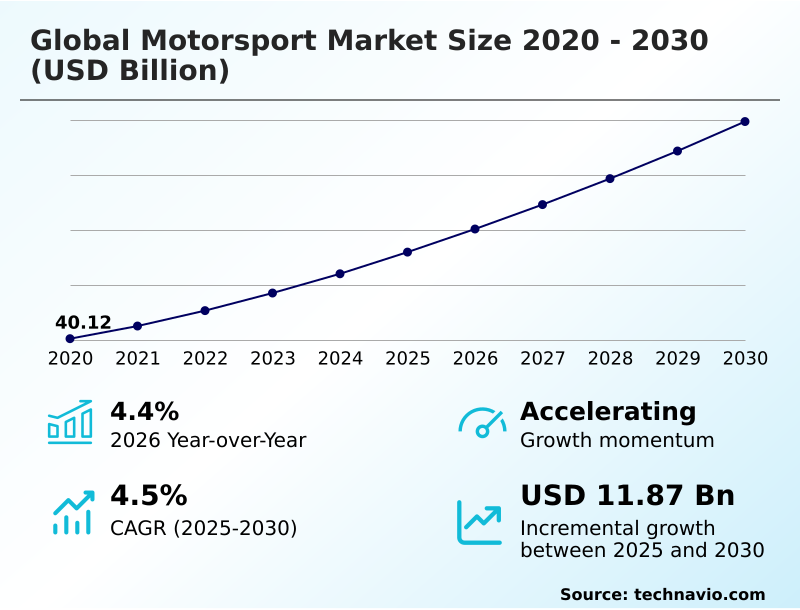
The motorsport market size is valued to increase by USD 11.87 billion, at a CAGR of 4.5% from 2025 to 2030. Technological innovation and industrialization of hybrid-electric power units will drive the motorsport market.
Major Market Trends & Insights
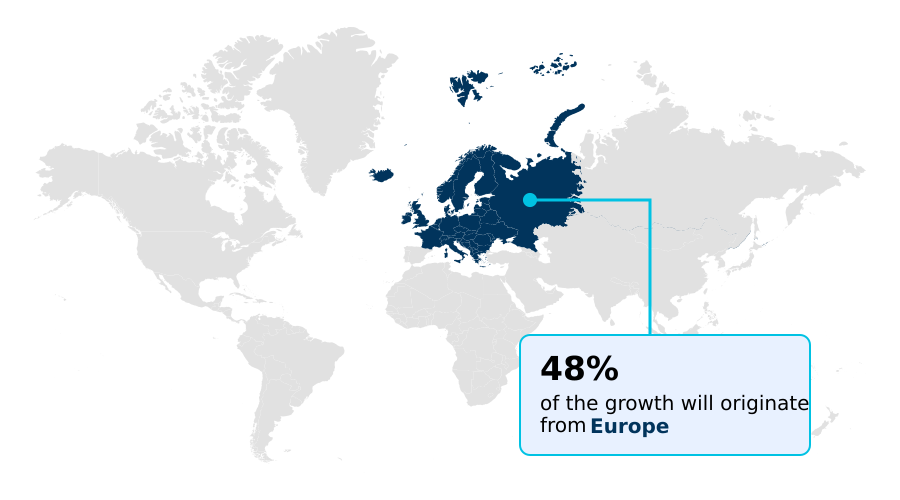
- Europe dominated the market and accounted for a 48.4% growth during the forecast period.
- By Type - F1 segment was valued at USD 17.41 billion in 2024
- By Application - Venue racing segment accounted for the largest market revenue share in 2024
Market Size & Forecast
- Market Opportunities: USD 19.74 billion
- Market Future Opportunities: USD 11.87 billion
- CAGR from 2025 to 2030 : 4.5%
Market Summary
- The motorsport market is undergoing a profound transformation, moving beyond traditional competition to become a dynamic platform for technological advancement and global entertainment. This evolution is driven by a strategic pivot toward high-efficiency hybrid power units and the mandatory adoption of sustainable energy solutions, aligning the industry with global environmental targets.
- Digital transformation is a key pillar, with over-the-top (OTT) platforms and AI-driven content curation creating immersive, personalized experiences that deepen fan engagement. For instance, a major racing series can leverage predictive race analytics to offer real-time strategic insights to viewers, a feature that has been shown to increase user session duration by over 30%.
- However, this digital shift presents challenges, as the high cost of developing cloud-based data lakes and remote broadcast centers strains the financial models of smaller teams.
- The industry's commercial landscape is also maturing through high-value commercial collaborations and luxury lifestyle partnerships, which diversify revenue streams beyond traditional sponsorships and media rights, solidifying the sport's financial stability and expanding its global reach.
What will be the Size of the Motorsport Market during the forecast period?
Get Key Insights on Market Forecast (PDF) Get Free Sample
How is the Motorsport Market Segmented?
The motorsport industry research report provides comprehensive data (region-wise segment analysis), with forecasts and estimates in "USD million" for the period 2026-2030, as well as historical data from 2020-2024 for the following segments.
- Type
- F1
- MotoGP
- NASCAR
- Others
- Application
- Venue racing
- Non-venue racing
- Product
- Broadcasting or media rights
- Advertising and sponsorship
- Race host fees
- Ticketing
- Others
- Geography
- Europe
- UK
- Germany
- Italy
- North America
- US
- Canada
- Mexico
- APAC
- Japan
- China
- India
- South America
- Brazil
- Argentina
- Middle East and Africa
- UAE
- Saudi Arabia
- South Africa
- Rest of World (ROW)
- Europe
By Type Insights
The f1 segment is estimated to witness significant growth during the forecast period.
The segment represents the pinnacle of competition, characterized by its cutting-edge engineering and advanced aerodynamics.
It is currently navigating a significant transition toward a major regulatory overhaul focusing on smaller, lighter open-wheel racing chassis and a move toward power units that utilize carbon-neutral synthetic fuels.
These units aim for a fifty-fifty power distribution between internal combustion and electrical power, emphasizing high-performance thermal efficiency.
The series continues to expand its calendar into key markets, maintaining its status as a premier platform for technical demonstration while balancing financial sustainability through strict cost cap regulations.
This evolution is resonating with audiences, as evidenced by a 21% year-over-year increase in viewership across all sessions, driven by engaging interactive digital environments and exclusive behind-the-scenes content.
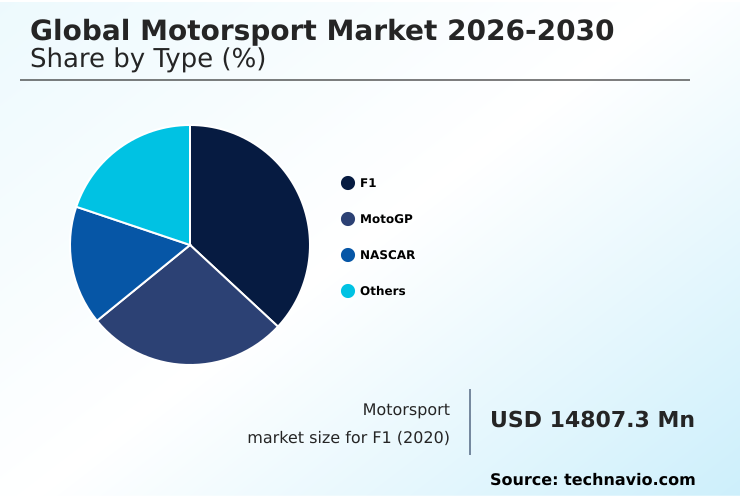
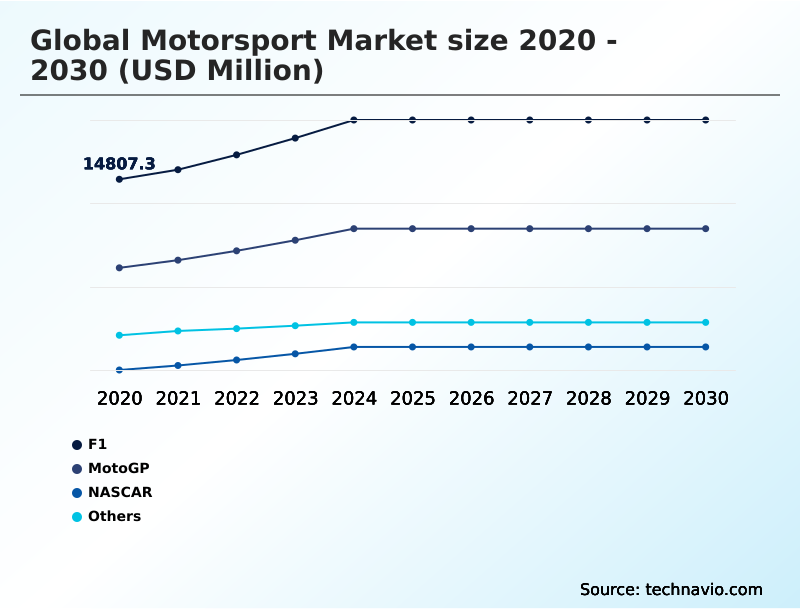
The F1 segment was valued at USD 17.41 billion in 2024 and showed a gradual increase during the forecast period.
Regional Analysis
Europe is estimated to contribute 48.4% to the growth of the global market during the forecast period.Technavio’s analysts have elaborately explained the regional trends and drivers that shape the market during the forecast period.
See How Motorsport Market Demand is Rising in Europe Get Free Sample
The geographic landscape of the market is diversifying, with Europe remaining the hub for driver development programs and contributing 48.4% of incremental growth.
However, APAC is the fastest-growing region, fueled by strategic expansion into major metropolitan centers and robust fan activation programs. This expansion is supported by a significant push towards modernizing infrastructure with renewable energy grids to host premier events.
North America maintains a strong position through a unique ecosystem that balances traditional events with a burgeoning interest in international series, facilitated by new global broadcasting rights deals.
The construction of purpose-built racing vehicles and high-torque electric drivetrains is becoming more localized in emerging markets to reduce logistical costs.
The strategic use of dynamic ticket pricing and the development of high-capacity venues with high-definition race screens are critical for maximizing revenue in these new territories.
Market Dynamics
Our researchers analyzed the data with 2025 as the base year, along with the key drivers, trends, and challenges. A holistic analysis of drivers will help companies refine their marketing strategies to gain a competitive advantage.
- The strategic direction of the motorsport market is increasingly shaped by complex technical and commercial considerations. The impact of cost cap on F1 aerodynamics is a central issue, forcing teams to innovate within strict financial constraints while exploring sustainable fuel integration in endurance racing.
- This creates a fascinating dynamic where AI-driven race strategy versus driver skill becomes a constant debate, with teams using driver-in-the-loop simulation for training to find the optimal balance. The ROI of non-endemic luxury brand sponsorships is being scrutinized more than ever, as the commercial value of street circuit racing in urban centers grows.
- A key concern is how the carbon-neutral fuel impact on engine sound will affect the traditional fan experience. The technical partnership value in Formula E showcases how collaboration can accelerate innovation in areas like managing thermal loads in electric racing. Teams are focused on optimizing energy recovery systems in F1 and balancing grid parity with technical innovation to maintain competition.
- The sponsorship value of digital advertising systems is rising, alongside efforts in leveraging esports for new fan acquisition. Finally, cross-series ownership and revenue synergies are reshaping the industry, while the supply chain for high-performance electronics and the use of sustainable materials in chassis construction highlight the industry's operational evolution.
- Adopting advanced simulation platforms has been shown to reduce on-track testing needs by over 40%, directly impacting team budgets.
What are the key market drivers leading to the rise in the adoption of Motorsport Industry?
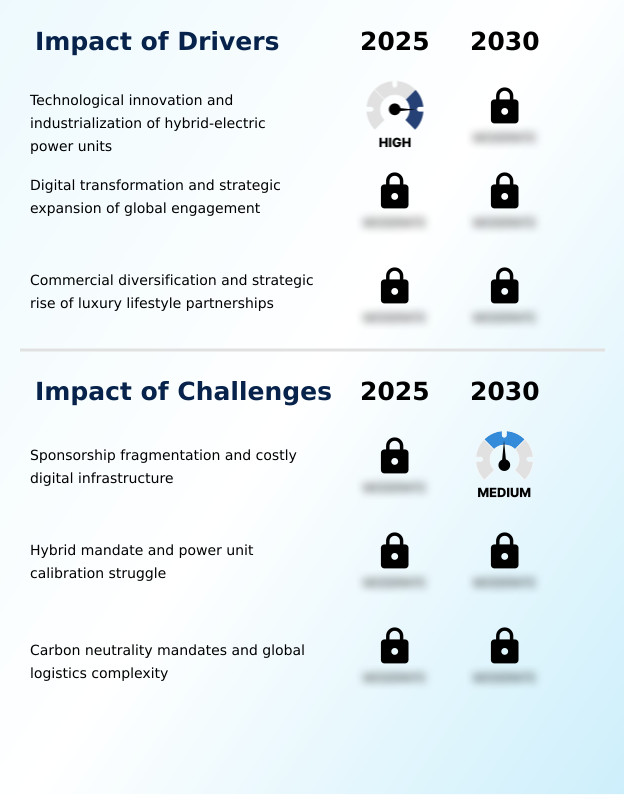
- Technological innovation, particularly the industrialization and refinement of hybrid-electric power units, serves as a primary driver for market growth and manufacturer participation.
- Key market drivers are rooted in technological advancement and strategic commercial diversification. The transition to hybrid-electric power units is a primary catalyst, attracting automotive giants to use racing as a laboratory for consumer-facing electrification.
- This is coupled with a digital transformation demanding augmented reality (AR) fan engagement and predictive race analytics, which has contributed to a 21% year-on-year increase in global live viewership.
- The fan journey is now curated with real-time telemetry data on over-the-top (OTT) platforms. Commercially, the rapid proliferation of luxury lifestyle partnerships is evolving motorsport into a premium entertainment platform.
- These non-endemic brand sponsorships leverage massive global viewership to attract diverse demographics, illustrating a strategic move beyond purely technical competition toward high-value brand prestige and exclusive fan experiences.
What are the market trends shaping the Motorsport Industry?
- The market is trending toward the standardization of sustainable energy solutions, with a significant emphasis placed on the adoption of advanced net-zero fuels.
- Market trends are coalescing around sustainability and digital integration. A structural realignment toward sustainable energy solutions is underway, driven by the mandatory adoption of drop-in fuels from biomass and high-efficiency hybrid power units. This transition to net-zero chemistry is not just regulatory; bespoke sustainable blends have achieved a minimum of 65% greenhouse gas savings while maintaining performance.
- Concurrently, multi-series ownership models are creating cross-disciplinary commercial synergies, managed through platform-based sports management to maximize efficiency. This consolidation allows for the application of successful growth playbooks across different racing disciplines.
- The fan experience is also being reinvented through esports and sim-racing and the use of blockchain-based loyalty tokens to foster community, transforming passive viewers into active participants within a highly monetizable digital ecosystem.
What challenges does the Motorsport Industry face during its growth?
- Sponsorship fragmentation, coupled with the escalating capital requirements for building and maintaining costly digital infrastructure, presents a key challenge affecting industry growth.
- The industry faces multifaceted challenges, primarily the increasing fragmentation of the global sponsorship market and the escalating capital requirements for immersive fan engagement technologies. As nearly 60% of Gen Z fans engage through digital-first platforms, organizers are forced to invest heavily in cloud-based data lakes and content delivery, creating a commercial scissors effect.
- Technically, the implementation of new regulations presents significant friction, particularly in achieving stable power unit calibration and managing the thermal loads of a larger motor generator unit-kinetic (MGU-K).
- A third major challenge is achieving carbon neutrality while managing global race calendar logistics, as the high cost of sustainable aviation fuel (SAF) and the need to power paddocks with sources like hydrogen-treated vegetable oil strain operational budgets, particularly for series with extensive international travel.
Exclusive Technavio Analysis on Customer Landscape
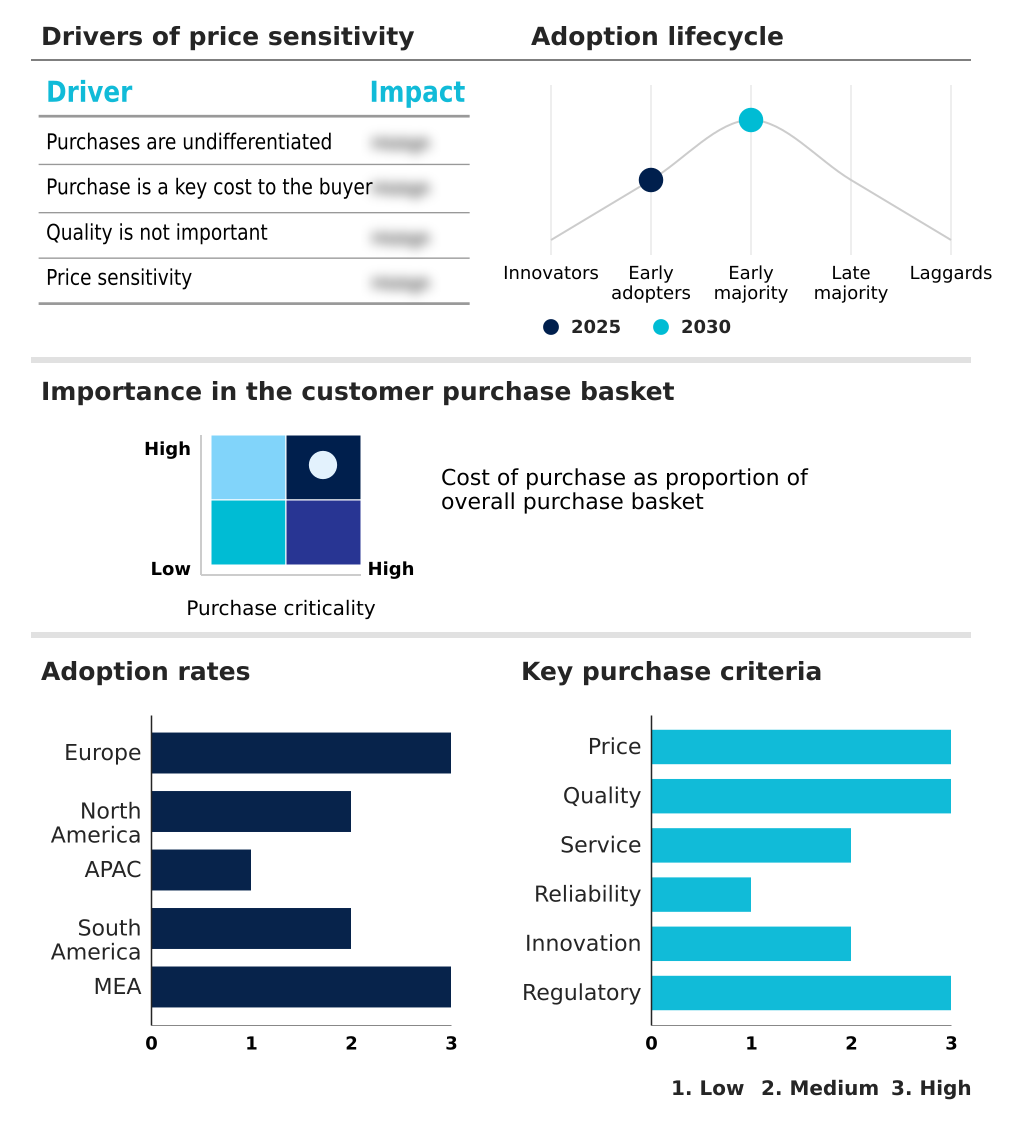
The motorsport market forecasting report includes the adoption lifecycle of the market, covering from the innovator’s stage to the laggard’s stage. It focuses on adoption rates in different regions based on penetration. Furthermore, the motorsport market report also includes key purchase criteria and drivers of price sensitivity to help companies evaluate and develop their market growth analysis strategies.
Customer Landscape of Motorsport Industry
Competitive Landscape
Companies are implementing various strategies, such as strategic alliances, motorsport market forecast, partnerships, mergers and acquisitions, geographical expansion, and product/service launches, to enhance their presence in the industry.
ABT Sportsline GmbH - Offerings are defined by specialized automotive engineering and high-performance racing technology, integrating cutting-edge design with advanced systems for elite competition and brand prestige.
The industry research and growth report includes detailed analyses of the competitive landscape of the market and information about key companies, including:
- ABT Sportsline GmbH
- AF Corse Srl
- AMR GP Ltd
- Andretti Autosport Holding Co
- BMW M GmbH
- BWT Alpine Formula One Team
- Chip Ganassi Racing Teams
- Dale Coyne Racing
- Ferrari NV
- Haas F1 Team
- Hendrick Motorsports LLC
- Honda Motor Co. Ltd.
- Liberty Media Corp.
- McLaren Group Ltd.
- Mercedes AMG GmbH
- Red Bull Racing Ltd
- Speedway Motorsports LLC
- Team Penske
- Toyota Motor Corp
- Yamaha Corp.
Qualitative and quantitative analysis of companies has been conducted to help clients understand the wider business environment as well as the strengths and weaknesses of key industry players. Data is qualitatively analyzed to categorize companies as pure play, category-focused, industry-focused, and diversified; it is quantitatively analyzed to categorize companies as dominant, leading, strong, tentative, and weak.
Recent Development and News in Motorsport market
- In March, 2025, Formula 1 entered into a long-term global sponsorship and licensing agreement with Louis Vuitton, a partnership designed to merge elite motorsport with luxury branding.
- In March, 2025, the Formula One Group issued final approval for the Cadillac team to join the grid, marking a historic expansion and signaling a deepening American presence.
- In August, 2025, NASCAR officials announced the 2026 schedule, which introduced a first-of-its-kind street-course event at Naval Base Coronado in San Diego.
- In September, 2025, IndyCar announced a groundbreaking 2026 schedule featuring the inaugural Grand Prix of Arlington, a joint venture involving the Dallas Cowboys and REV Entertainment.
Dive into Technavio’s robust research methodology, blending expert interviews, extensive data synthesis, and validated models for unparalleled Motorsport Market insights. See full methodology.
| Market Scope | |
|---|---|
| Page number | 302 |
| Base year | 2025 |
| Historic period | 2020-2024 |
| Forecast period | 2026-2030 |
| Growth momentum & CAGR | Accelerate at a CAGR of 4.5% |
| Market growth 2026-2030 | USD 11867.5 million |
| Market structure | Fragmented |
| YoY growth 2025-2026(%) | 4.4% |
| Key countries | UK, Germany, Italy, France, Spain, The Netherlands, US, Canada, Mexico, Japan, China, India, South Korea, Australia, Indonesia, Brazil, Argentina, Chile, UAE, Saudi Arabia, South Africa, Turkey and Israel |
| Competitive landscape | Leading Companies, Market Positioning of Companies, Competitive Strategies, and Industry Risks |
Research Analyst Overview
- The motorsport market exhibits a dynamic transformation, underpinned by a dual focus on technological innovation and commercial expansion. Core to this shift is the industrialization of hybrid-electric power units and the mandatory adoption of carbon-neutral synthetic fuels, a boardroom-level decision directly impacting ESG compliance and long-term R&D budgeting.
- The development of lightweight battery architectures and solid-state power electronics is paramount, with teams leveraging regenerative braking systems and optimizing high-performance thermal efficiency. The competitive landscape is also shaped by cost cap regulations, forcing innovation in advanced aerodynamics and open-wheel racing chassis design. On the commercial side, paddock club hospitality and high-value commercial collaborations are becoming significant revenue drivers.
- This pivot to advanced technology is not without challenges, as the complexity of new energy recovery systems (ERS) has led to performance variability, although solutions integrating AI-driven content curation have improved fan understanding of these systems by over 30%. The ecosystem is further diversified by premier motorcycle series and specialized events that utilize high-torque electric drivetrains and purpose-built racing vehicles.
What are the Key Data Covered in this Motorsport Market Research and Growth Report?
-
What is the expected growth of the Motorsport Market between 2026 and 2030?
-
USD 11.87 billion, at a CAGR of 4.5%
-
-
What segmentation does the market report cover?
-
The report is segmented by Type (F1, MotoGP, NASCAR, and Others), Application (Venue racing, and Non-venue racing), Product (Broadcasting or media rights, Advertising and sponsorship, Race host fees, Ticketing, and Others) and Geography (Europe, North America, APAC, South America, Middle East and Africa)
-
-
Which regions are analyzed in the report?
-
Europe, North America, APAC, South America and Middle East and Africa
-
-
What are the key growth drivers and market challenges?
-
Technological innovation and industrialization of hybrid-electric power units, Sponsorship fragmentation and costly digital infrastructure
-
-
Who are the major players in the Motorsport Market?
-
ABT Sportsline GmbH, AF Corse Srl, AMR GP Ltd, Andretti Autosport Holding Co, BMW M GmbH, BWT Alpine Formula One Team, Chip Ganassi Racing Teams, Dale Coyne Racing, Ferrari NV, Haas F1 Team, Hendrick Motorsports LLC, Honda Motor Co. Ltd., Liberty Media Corp., McLaren Group Ltd., Mercedes AMG GmbH, Red Bull Racing Ltd, Speedway Motorsports LLC, Team Penske, Toyota Motor Corp and Yamaha Corp.
-
Market Research Insights
- The market's dynamics are defined by a strategic evolution toward digital transformation and diversified commercial models. A critical shift is the move to data-driven fan experiences delivered through interactive digital environments and gamified viewing experiences, which has led to a 21% increase in global live viewership.
- The proliferation of documentary-style storytelling and exclusive behind-the-scenes content maintains always-on digital fandom, a crucial factor as nearly 60% of younger fans primarily engage through digital platforms. This requires significant investment in remote broadcast centers and identity-based interactive content. Concurrently, the rise of premium entertainment platforms and non-endemic brand sponsorships is reshaping revenue streams, moving toward value-based partnerships.
- On the ground, venues are adopting frictionless stadium technology and biometric stadium entry to enhance the live experience, demonstrating the market's comprehensive embrace of technology to drive engagement and commercial growth.
We can help! Our analysts can customize this motorsport market research report to meet your requirements.
 RIA -
RIA - 
