


North America Building Automation Systems Market by Application and Technology - Forecast and Analysis 2024-2028

North America Building Automation Systems Market by Application and Technology - Forecast and Analysis 2024-2028

Published: Apr 2024 153 Pages SKU: IRTNTR77839

Market Overview at a Glance

$18.52 B
Market Opportunity
11.8%
CAGR
10.64
YoY growth 2023-2024(%)

North America Building Automation Systems Market Size 2024-2028 

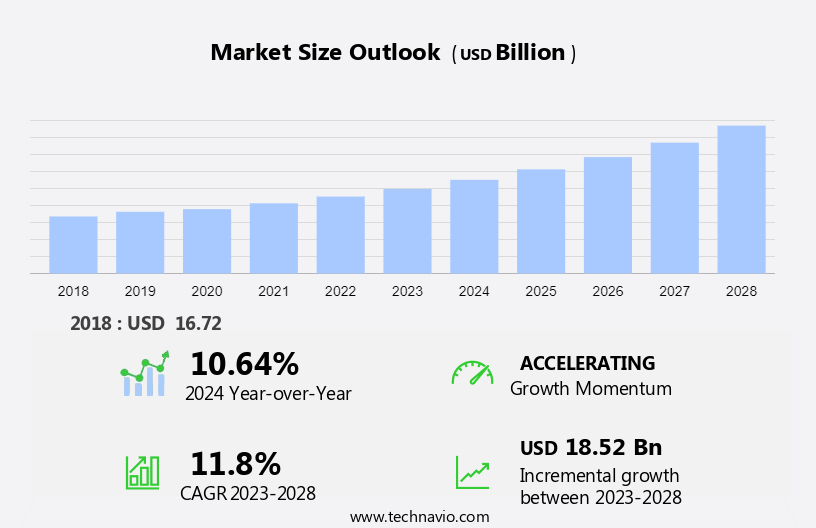
The North America building automation systems market size is forecast to increase by USD 18.52 billion billion at a CAGR of 11.8% between 2023 and 2028.

  • The market in North America is witnessing significant growth due to several key trends. The increasing focus on sustainability and green building practices is driving the adoption of BAS, as these systems enable energy efficiency and reduce carbon footprint. Furthermore, the integration of predictive analytics and artificial intelligence in BAS is revolutionizing the way buildings are managed and maintained, leading to improved operational efficiency and reduced downtime. However, the market also faces challenges, including cybersecurity risks and vulnerabilities associated with BAS. As buildings become increasingly connected, securing these systems against cyber threats is becoming a top priority for building owners and operators. Despite these challenges, the future of the BAS market in North America looks promising, with continued innovation and advancements in technology expected to drive growth.

What will be the size of the North America Building Automation Systems Market during the forecast period?
Building Automation Systems Market in North America Size

 Request Free Sample

  • The North American building automation systems market is experiencing significant growth, driven by the increasing adoption of smart buildings and the integration of advanced technologies. These systems enable the automation and optimization of various building functions, including HVAC, lighting, security, access control, and energy management. Sensors and actuators, coupled with networking technologies such as IoT and 5G, facilitate real-time monitoring and control of building systems, enhancing efficiency, safety, and energy consumption. Building automation solutions encompass a range of electronic, mechanical, and electrical systems, including semiconductor chips, lighting controls, fire detection, and HVAC controls.
  • The market's expansion is fueled by the demand for energy-efficient buildings, integrated systems, and the ongoing digitization of construction activities. Overall, the North American building automation systems market is poised for continued growth, offering opportunities for innovation and improvement in building control and management systems.

How is this market segmented and which is the largest segment?

The market research report provides comprehensive data (region-wise segment analysis), with forecasts and estimates in "USD billion" for the period 2024-2028, as well as historical data from 2018-2022 for the following segments.

  • Application
    • Commercial
    • Industrial
    • Residential
  • Technology
    • Wired
    • Wireless
  • Geography
    • North America
      • US
      • Canada
      • Mexico

By Application Insights

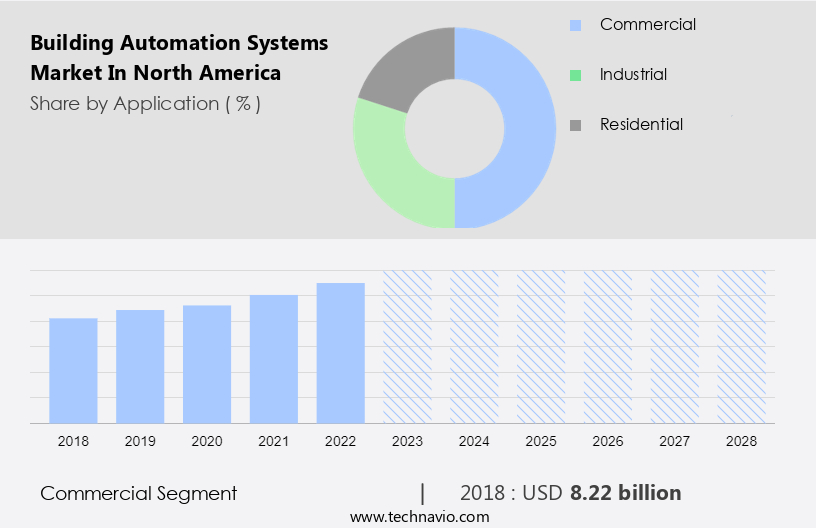
The commercial segment is estimated to witness significant growth during the forecast period. The North American market for Building Automation Systems (BAS) is experiencing significant growth due to the increasing adoption of smart buildings. These intelligent structures prioritize data-driven building management solutions to optimize occupant comfort, boost operational efficiency, and promote sustainability. Urbanization and commercial construction projects, such as offices, retail spaces, hospitality venues, and healthcare facilities, present ample opportunities for BAS implementation in both new builds and retrofits. Financial incentives, including government grants, utility rebates, tax credits, and financing programs, encourage building owners to invest in energy-efficient technologies, including BAS. These incentives help offset upfront costs and expedite the adoption of BAS In the commercial sector.
Building Automation Systems Market in North America Size

Get a glance at the market share of various segments Request Free Sample

The commercial segment was valued at  USD 8.22 billion in 2018 and showed a gradual increase during the forecast period.

Market Dynamics

Our researchers analyzed the data with 2023 as the base year, along with the key drivers, trends, and challenges. A holistic analysis of drivers will help companies refine their marketing strategies to gain a competitive advantage.

What are the key market drivers leading to the rise in adoption of North America Building Automation Systems Market?

  • Growing focus on sustainability and green building practices is the key driver of the market. Sustainability regulations, energy codes, and green building certifications, including LEED, fuel the demand for Building Automation Systems (BAS) in North America. These solutions optimize energy usage and reduce carbon emissions by providing precise control and monitoring of building systems such as HVAC, lighting, and ventilation. The integration of renewable energy sources like solar PV and wind power is a key aspect of green building practices, and BAS plays a pivotal role in managing and optimizing their generation, storage, and distribution. Smart control strategies enable BAS to balance energy supply and demand, maximize self-consumption of renewable energy, and support grid interaction.
  • Additionally, sensors, actuators, and networking technologies facilitate the integration of IoT, IP-based devices, and SaaS platforms, enhancing building efficiency and enabling real-time monitoring and analysis of energy usage. Safety concerns, including security breaches, employee tampering, and safety issues such as gas leaks, fires, and air quality, are addressed through advanced safety systems, access control management, and machine learning algorithms. BAS solutions encompass a range of systems, including HVAC, lighting, security, access control, and energy management, and are essential for facility management in commercial, industrial, and residential buildings. The adoption of 5G technology and integrated systems further enhances the capabilities of energy-efficient buildings, enabling seamless communication between various building systems and improving overall building performance.

What are the market trends shaping the North America Building Automation Systems Market?

  • Integration of predictive analytics and AI with BAS is the upcoming trend In the market. Building Automation Systems (BAS) in North America leverage predictive analytics and artificial intelligence (AI) algorithms to optimize building performance and energy consumption. These technologies analyze historical data from sensors, equipment, and IT data to identify patterns and predict potential issues, enabling proactive maintenance and extending asset lifespan. BAS can optimize energy usage by analyzing building usage patterns, weather forecasts, and energy demand data, dynamically adjusting HVAC settings, lighting controls, and other systems to minimize energy waste while maintaining comfort levels. This results in significant cost savings and reduced environmental impact for various building types, including commercial, industrial, and residential structures.
  • Additionally, BAS can enhance safety by integrating with security systems, access control, fire systems, and environmental systems to mitigate risks related to employee tampering, security breaches, gas leaks, fires, and air quality concerns. The Internet of Things (IoT) and network-connected devices, such as IP-based sensors and actuators, enable remote monitoring and management of BAS, further enhancing efficiency and waste minimization. The integration of 5G technology and SaaS solutions offers opportunities for real-time data processing and advanced analytics, driving the growth of the BAS market in North America.

What challenges does North America Building Automation Systems Market face during the growth?

  • Cybersecurity risks and vulnerabilities associated with BAS is a key challenge affecting the market growth. Building Automation Systems (BAS) in North America are essential for optimizing construction activities in commercial, industrial, and residential buildings. These systems utilize sensors, actuators, and networking technologies to manage HVAC, lighting, security, access control, energy management, and building efficiency. IoT and IP-based devices enable remote monitoring and SaaS solutions, while machine learning enhances building systems' interface and performance. However, BAS systems face cybersecurity challenges. Malicious actors can exploit vulnerabilities in network infrastructure, software applications, and communication protocols, leading to unauthorized access and control, system manipulation, and operational disruptions.
  • Malware, ransomware, and Denial-of-Service (DoS) attacks pose significant risks, compromising system functionality, encrypting critical data, and causing downtime, resulting in financial losses. Building owners and operators must prioritize cybersecurity measures to protect against these threats and ensure building safety and efficiency.

Exclusive North America Building Automation Systems Market Customer Landscape

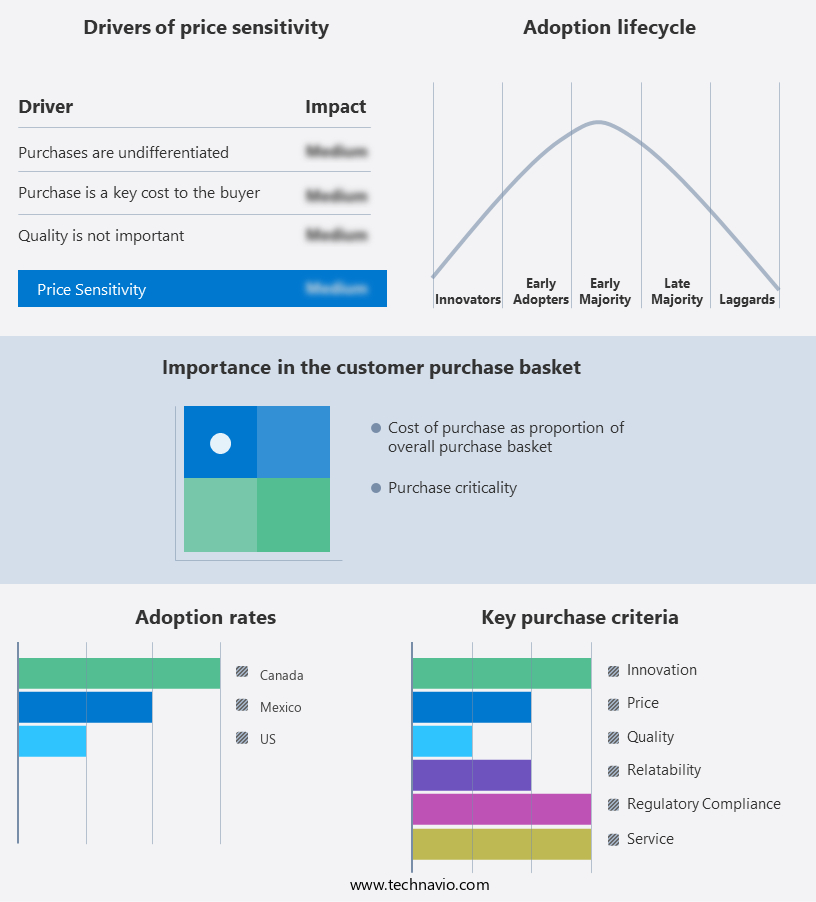
The market forecasting report includes the adoption lifecycle of the market, covering from the innovator's stage to the laggard's stage. It focuses on adoption rates in different regions based on penetration. Furthermore, the report also includes key purchase criteria and drivers of price sensitivity to help companies evaluate and develop their market growth analysis strategies.
Building Automation Systems Market in North America Share by Geography

 Customer Landscape

Key Companies & Market Insights

Companies are implementing various strategies, such as strategic alliances, market forecast partnerships, mergers and acquisitions, geographical expansion, and product/service launches, to enhance their presence In the market.

The market research and growth report includes detailed analyses of the competitive landscape of the market and information about key companies, including:

  • ABB Ltd.
  • Carrier Global Corp
  • Emerson Electric Co.
  • Honeywell International Inc.
  • Hubbell Inc.
  • Johnson Controls
  • Legrand
  • Mitsubishi Electric Corp.
  • OMRON Corp.
  • Robert Bosch GmbH
  • Schneider Electric SE
  • Siemens AG
  • Texas Instruments Inc.
  • Trane Technologies plc
  • Rockwell Automation Inc.

Qualitative and quantitative analysis of companies has been conducted to help clients understand the wider business environment as well as the strengths and weaknesses of key market players. Data is qualitatively analyzed to categorize companies as pure play, category-focused, industry-focused, and diversified; it is quantitatively analyzed to categorize companies as dominant, leading, strong, tentative, and weak.

Research Analyst Overview

The market is experiencing significant growth due to the increasing adoption of smart buildings and the integration of various technologies. These systems enable the optimization of various building functions, including HVAC, lighting, security, and access control, among others. Sensors and actuators play a crucial role in building automation, allowing for real-time monitoring and control of various environmental and operational conditions. Networking technologies, such as IoT and IP-based devices, facilitate the communication and integration of these systems, enabling remote monitoring and management. Energy management is a key focus area for building automation, with systems designed to optimize energy usage and improve building efficiency.

In addition, building efficiency is becoming increasingly important as energy consumption continues to rise, and the need to minimize waste and reduce environmental impact becomes more pressing. Facility management is another area where building automation is making a significant impact. By automating various building functions, facility managers can more easily monitor and control systems, reducing the need for manual intervention and improving overall operational efficiency. The integration of various building systems, including electrical, electronic, and mechanical systems, is a major trend in building automation. Integrated systems enable more efficient and effective building management, reducing energy consumption and improving safety and security.

Moreover, building automation systems also offer various safety features, such as fire detection and safety systems, ensuring the safety of building occupants and minimizing potential risks. Access control systems and security systems are also important components, providing building owners and managers with greater control over access to their properties and protecting against potential threats, including employee tampering and cyberattacks. The building automation market in North America is expected to continue growing, driven by the increasing adoption of smart buildings and the need to improve building efficiency and safety. The integration of various technologies, including IoT, machine learning, and 5G technology, is also expected to drive growth, enabling more advanced building automation solutions and improving the overall user experience.

Furthermore, building automation systems are being adopted across various sectors, including commercial, industrial, and residential buildings. In the commercial segment, office buildings, institutional facilities, healthcare facilities, hotels and restaurants, retail stores, and IT tech parks are all adopting building automation systems to improve operational efficiency and reduce energy consumption. In the industrial sector, building automation is being used to optimize manufacturing processes and improve safety, while In the residential sector, apartment dwellers are adopting smart door locks, wireless intercom devices, and other network-connected devices to enhance security and convenience. Despite the many benefits of building automation, there are also challenges, including the need for cybersecurity measures to protect against potential cyberattacks and the need for regular system updates and maintenance to ensure optimal performance.

In addition, sanitization systems are also becoming increasingly important, particularly In the wake of the COVID-19 pandemic, to ensure the health and safety of building occupants. The integration of various technologies, including IoT, machine learning, and 5G technology, is enabling more advanced building automation solutions and improving the overall user experience. However, there are also challenges that must be addressed, including cybersecurity and regular system maintenance, to ensure the optimal performance of building automation systems.

Market Scope

Report Coverage

Details

Page number

153

Base year

2023

Historic period

2018-2022

Forecast period

2024-2028

Growth momentum & CAGR

Accelerate at a CAGR of 11.8%

Market growth 2024-2028

USD 18.52 billion

Market structure

Fragmented

YoY growth 2023-2024(%)

10.64

Competitive landscape

Leading Companies, Market Report, Market Positioning of Companies, Competitive Strategies, and Industry Risks

Request Free Sample

What are the Key Data Covered in this Market Research Report?

  • CAGR of the market during the forecast period
  • Detailed information on factors that will drive the market growth and forecasting between 2024 and 2028
  • Precise estimation of the size of the market  and its contribution of the market in focus to the parent market
  • Accurate predictions about upcoming market growth and trends and changes in consumer behaviour
  • Growth of the market across North America
  • Thorough analysis of the market's competitive landscape and detailed information about companies
  • Comprehensive analysis of factors that will challenge the growth of market companies

We can help! Our analysts can customize this market research report to meet your requirements Get in touch

1 Executive Summary

  • 1.1 Market overview
    • Exhibit 01: Executive Summary – Chart on Market Overview
    • Exhibit 02: Executive Summary – Data Table on Market Overview
    • Exhibit 03: Executive Summary – Chart on Country Market Characteristics
    • Exhibit 04: Executive Summary – Chart on Market by Geography
    • Exhibit 05: Executive Summary – Chart on Market Segmentation by Application
    • Exhibit 06: Executive Summary – Chart on Market Segmentation by Technology
    • Exhibit 07: Executive Summary – Chart on Incremental Growth
    • Exhibit 08: Executive Summary – Data Table on Incremental Growth
    • Exhibit 09: Executive Summary – Chart on Vendor Market Positioning

2 Market Landscape

  • 2.1 Market ecosystem
    • Exhibit 10: Parent market
    • Exhibit 11: Market Characteristics

3 Market Sizing

  • 3.1 Market definition
    • Exhibit 12: Offerings of vendors included in the market definition
  • 3.2 Market segment analysis
    • Exhibit 13: Market segments
  • 3.3 Market size 2023
    • 3.4 Market outlook: Forecast for 2023-2028
      • Exhibit 14: Chart on North America - Market size and forecast 2023-2028 ($ billion)
      • Exhibit 15: Data Table on Regional - Market size and forecast 2023-2028 ($ billion)
      • Exhibit 16: Chart on North America: Year-over-year growth 2023-2028 (%)
      • Exhibit 17: Data Table on Regional - Market size and forecast 2023-2028 ($ billion)

    4 Historic Market Size

    • 4.1 Building automation systems market in North America 2018 - 2022
      • Exhibit 18: Historic Market Size – Data Table on building automation systems market in north America 2018 - 2022 ($ billion)
    • 4.2 Application Segment Analysis 2018 - 2022
      • Exhibit 19: Historic Market Size – Application Segment 2018 - 2022 ($ billion)
    • 4.3 Technology Segment Analysis 2018 - 2022
      • Exhibit 20: Historic Market Size – Technology Segment 2018 - 2022 ($ billion)
    • 4.4 Geography Segment Analysis 2018 - 2022
      • Exhibit 21: Historic Market Size – Geography Segment 2018 - 2022 ($ billion)

    5 Five Forces Analysis

    • 5.1 Five forces summary
      • Exhibit 22: Five forces analysis - Comparison between 2023 and 2028
    • 5.2 Bargaining power of buyers
      • Exhibit 23: Chart on Bargaining power of buyers – Impact of key factors 2023 and 2028
    • 5.3 Bargaining power of suppliers
      • Exhibit 24: Bargaining power of suppliers – Impact of key factors in 2023 and 2028
    • 5.4 Threat of new entrants
      • Exhibit 25: Threat of new entrants – Impact of key factors in 2023 and 2028
    • 5.5 Threat of substitutes
      • Exhibit 26: Threat of substitutes – Impact of key factors in 2023 and 2028
    • 5.6 Threat of rivalry
      • Exhibit 27: Threat of rivalry – Impact of key factors in 2023 and 2028
    • 5.7 Market condition
      • Exhibit 28: Chart on Market condition - Five forces 2023 and 2028

    6 Market Segmentation by Application

    • 6.1 Market segments
      • Exhibit 29: Chart on Application - Market share 2023-2028 (%)
      • Exhibit 30: Data Table on Application - Market share 2023-2028 (%)
    • 6.2 Comparison by Application
      • Exhibit 31: Chart on Comparison by Application
      • Exhibit 32: Data Table on Comparison by Application
    • 6.3 Commercial - Market size and forecast 2023-2028
      • Exhibit 33: Chart on Commercial - Market size and forecast 2023-2028 ($ billion)
      • Exhibit 34: Data Table on Commercial - Market size and forecast 2023-2028 ($ billion)
      • Exhibit 35: Chart on Commercial - Year-over-year growth 2023-2028 (%)
      • Exhibit 36: Data Table on Commercial - Year-over-year growth 2023-2028 (%)
    • 6.4 Industrial - Market size and forecast 2023-2028
      • Exhibit 37: Chart on Industrial - Market size and forecast 2023-2028 ($ billion)
      • Exhibit 38: Data Table on Industrial - Market size and forecast 2023-2028 ($ billion)
      • Exhibit 39: Chart on Industrial - Year-over-year growth 2023-2028 (%)
      • Exhibit 40: Data Table on Industrial - Year-over-year growth 2023-2028 (%)
    • 6.5 Residential - Market size and forecast 2023-2028
      • Exhibit 41: Chart on Residential - Market size and forecast 2023-2028 ($ billion)
      • Exhibit 42: Data Table on Residential - Market size and forecast 2023-2028 ($ billion)
      • Exhibit 43: Chart on Residential - Year-over-year growth 2023-2028 (%)
      • Exhibit 44: Data Table on Residential - Year-over-year growth 2023-2028 (%)
    • 6.6 Market opportunity by Application
      • Exhibit 45: Market opportunity by Application ($ billion)
      • Exhibit 46: Data Table on Market opportunity by Application ($ billion)

    7 Market Segmentation by Technology

    • 7.1 Market segments
      • Exhibit 47: Chart on Technology - Market share 2023-2028 (%)
      • Exhibit 48: Data Table on Technology - Market share 2023-2028 (%)
    • 7.2 Comparison by Technology
      • Exhibit 49: Chart on Comparison by Technology
      • Exhibit 50: Data Table on Comparison by Technology
    • 7.3 Wired - Market size and forecast 2023-2028
      • Exhibit 51: Chart on Wired - Market size and forecast 2023-2028 ($ billion)
      • Exhibit 52: Data Table on Wired - Market size and forecast 2023-2028 ($ billion)
      • Exhibit 53: Chart on Wired - Year-over-year growth 2023-2028 (%)
      • Exhibit 54: Data Table on Wired - Year-over-year growth 2023-2028 (%)
    • 7.4 Wireless - Market size and forecast 2023-2028
      • Exhibit 55: Chart on Wireless - Market size and forecast 2023-2028 ($ billion)
      • Exhibit 56: Data Table on Wireless - Market size and forecast 2023-2028 ($ billion)
      • Exhibit 57: Chart on Wireless - Year-over-year growth 2023-2028 (%)
      • Exhibit 58: Data Table on Wireless - Year-over-year growth 2023-2028 (%)
    • 7.5 Market opportunity by Technology
      • Exhibit 59: Market opportunity by Technology ($ billion)
      • Exhibit 60: Data Table on Market opportunity by Technology ($ billion)

    8 Customer Landscape

    • 8.1 Customer landscape overview
      • Exhibit 61: Analysis of price sensitivity, lifecycle, customer purchase basket, adoption rates, and purchase criteria

    9 Geographic Landscape

    • 9.1 Geographic segmentation
      • Exhibit 62: Chart on Market share by geography - 2023-2028 (%)
      • Exhibit 63: Data Table on Market share by geography - 2023-2028 (%)
    • 9.2 Geographic comparison
      • Exhibit 64: Chart on Geographic comparison
      • Exhibit 65: Data Table on Geographic comparison
    • 9.3 US - Market size and forecast 2023-2028
      • Exhibit 66: Chart on US - Market size and forecast 2023-2028 ($ billion)
      • Exhibit 67: Data Table on US - Market size and forecast 2023-2028 ($ billion)
      • Exhibit 68: Chart on US - Year-over-year growth 2023-2028 (%)
      • Exhibit 69: Data Table on US - Year-over-year growth 2023-2028 (%)
    • 9.4 Canada - Market size and forecast 2023-2028
      • Exhibit 70: Chart on Canada - Market size and forecast 2023-2028 ($ billion)
      • Exhibit 71: Data Table on Canada - Market size and forecast 2023-2028 ($ billion)
      • Exhibit 72: Chart on Canada - Year-over-year growth 2023-2028 (%)
      • Exhibit 73: Data Table on Canada - Year-over-year growth 2023-2028 (%)
    • 9.5 Mexico - Market size and forecast 2023-2028
      • Exhibit 74: Chart on Mexico - Market size and forecast 2023-2028 ($ billion)
      • Exhibit 75: Data Table on Mexico - Market size and forecast 2023-2028 ($ billion)
      • Exhibit 76: Chart on Mexico - Year-over-year growth 2023-2028 (%)
      • Exhibit 77: Data Table on Mexico - Year-over-year growth 2023-2028 (%)
    • 9.6 Market opportunity by geography
      • Exhibit 78: Market opportunity by geography ($ billion)
      • Exhibit 79: Data Table on Market opportunity by geography ($ billion)

    10 Drivers, Challenges, and Trends

    • 10.1 Market drivers
      • 10.2 Market challenges
        • 10.3 Impact of drivers and challenges
          • Exhibit 80: Impact of drivers and challenges in 2023 and 2028
        • 10.4 Market trends

          11 Vendor Landscape

          • 11.1 Overview
            • 11.2 Vendor landscape
              • Exhibit 81: Overview on Criticality of inputs and Factors of differentiation
            • 11.3 Landscape disruption
              • Exhibit 82: Overview on factors of disruption
            • 11.4 Industry risks
              • Exhibit 83: Impact of key risks on business

            12 Vendor Analysis

            • 12.1 Vendors covered
              • Exhibit 84: Vendors covered
            • 12.2 Market positioning of vendors
              • Exhibit 85: Matrix on vendor position and classification
            • 12.3 ABB Ltd.
              • Exhibit 86: ABB Ltd. - Overview
              • Exhibit 87: ABB Ltd. - Business segments
              • Exhibit 88: ABB Ltd. - Key news
              • Exhibit 89: ABB Ltd. - Key offerings
              • Exhibit 90: ABB Ltd. - Segment focus
            • 12.4 Carrier Global Corp
              • Exhibit 91: Carrier Global Corp - Overview
              • Exhibit 92: Carrier Global Corp - Business segments
              • Exhibit 93: Carrier Global Corp - Key news
              • Exhibit 94: Carrier Global Corp - Key offerings
              • Exhibit 95: Carrier Global Corp - Segment focus
            • 12.5 Emerson Electric Co.
              • Exhibit 96: Emerson Electric Co. - Overview
              • Exhibit 97: Emerson Electric Co. - Business segments
              • Exhibit 98: Emerson Electric Co. - Key news
              • Exhibit 99: Emerson Electric Co. - Key offerings
              • Exhibit 100: Emerson Electric Co. - Segment focus
            • 12.6 Honeywell International Inc.
              • Exhibit 101: Honeywell International Inc. - Overview
              • Exhibit 102: Honeywell International Inc. - Business segments
              • Exhibit 103: Honeywell International Inc. - Key news
              • Exhibit 104: Honeywell International Inc. - Key offerings
              • Exhibit 105: Honeywell International Inc. - Segment focus
            • 12.7 Hubbell Inc.
              • Exhibit 106: Hubbell Inc. - Overview
              • Exhibit 107: Hubbell Inc. - Business segments
              • Exhibit 108: Hubbell Inc. - Key offerings
              • Exhibit 109: Hubbell Inc. - Segment focus
            • 12.8 Johnson Controls
              • Exhibit 110: Johnson Controls - Overview
              • Exhibit 111: Johnson Controls - Business segments
              • Exhibit 112: Johnson Controls - Key news
              • Exhibit 113: Johnson Controls - Key offerings
              • Exhibit 114: Johnson Controls - Segment focus
            • 12.9 Legrand
              • Exhibit 115: Legrand - Overview
              • Exhibit 116: Legrand - Business segments
              • Exhibit 117: Legrand - Key offerings
              • Exhibit 118: Legrand - Segment focus
            • 12.10 Mitsubishi Electric Corp.
              • Exhibit 119: Mitsubishi Electric Corp. - Overview
              • Exhibit 120: Mitsubishi Electric Corp. - Business segments
              • Exhibit 121: Mitsubishi Electric Corp. - Key news
              • Exhibit 122: Mitsubishi Electric Corp. - Key offerings
              • Exhibit 123: Mitsubishi Electric Corp. - Segment focus
            • 12.11 OMRON Corp.
              • Exhibit 124: OMRON Corp. - Overview
              • Exhibit 125: OMRON Corp. - Business segments
              • Exhibit 126: OMRON Corp. - Key news
              • Exhibit 127: OMRON Corp. - Key offerings
              • Exhibit 128: OMRON Corp. - Segment focus
            • 12.12 Robert Bosch GmbH
              • Exhibit 129: Robert Bosch GmbH - Overview
              • Exhibit 130: Robert Bosch GmbH - Business segments
              • Exhibit 131: Robert Bosch GmbH - Key news
              • Exhibit 132: Robert Bosch GmbH - Key offerings
              • Exhibit 133: Robert Bosch GmbH - Segment focus
            • 12.13 Rockwell Automation Inc.
              • Exhibit 134: Rockwell Automation Inc. - Overview
              • Exhibit 135: Rockwell Automation Inc. - Business segments
              • Exhibit 136: Rockwell Automation Inc. - Key news
              • Exhibit 137: Rockwell Automation Inc. - Key offerings
              • Exhibit 138: Rockwell Automation Inc. - Segment focus
            • 12.14 Schneider Electric SE
              • Exhibit 139: Schneider Electric SE - Overview
              • Exhibit 140: Schneider Electric SE - Business segments
              • Exhibit 141: Schneider Electric SE - Key offerings
              • Exhibit 142: Schneider Electric SE - Segment focus
            • 12.15 Siemens AG
              • Exhibit 143: Siemens AG - Overview
              • Exhibit 144: Siemens AG - Business segments
              • Exhibit 145: Siemens AG - Key news
              • Exhibit 146: Siemens AG - Key offerings
              • Exhibit 147: Siemens AG - Segment focus
            • 12.16 Texas Instruments Inc.
              • Exhibit 148: Texas Instruments Inc. - Overview
              • Exhibit 149: Texas Instruments Inc. - Business segments
              • Exhibit 150: Texas Instruments Inc. - Key news
              • Exhibit 151: Texas Instruments Inc. - Key offerings
              • Exhibit 152: Texas Instruments Inc. - Segment focus
            • 12.17 Trane Technologies plc
              • Exhibit 153: Trane Technologies plc - Overview
              • Exhibit 154: Trane Technologies plc - Business segments
              • Exhibit 155: Trane Technologies plc - Key offerings
              • Exhibit 156: Trane Technologies plc - Segment focus

            13 Appendix

            • 13.1 Scope of the report
              • 13.2 Inclusions and exclusions checklist
                • Exhibit 157: Inclusions checklist
                • Exhibit 158: Exclusions checklist
              • 13.3 Currency conversion rates for US$
                • Exhibit 159: Currency conversion rates for US$
              • 13.4 Research methodology
                • Exhibit 160: Research methodology
                • Exhibit 161: Validation techniques employed for market sizing
                • Exhibit 162: Information sources
              • 13.5 List of abbreviations
                • Exhibit 163: List of abbreviations

              Research Methodology

              Technavio presents a detailed picture of the market by way of study, synthesis, and summation of data from multiple sources. The analysts have presented the various facets of the market with a particular focus on identifying the key industry influencers. The data thus presented is comprehensive, reliable, and the result of extensive research, both primary and secondary.

              INFORMATION SOURCES

              Primary sources

              • Manufacturers and suppliers
              • Channel partners
              • Industry experts
              • Strategic decision makers

              Secondary sources

              • Industry journals and periodicals
              • Government data
              • Financial reports of key industry players
              • Historical data
              • Press releases

              DATA ANALYSIS

              Data Synthesis

              • Collation of data
              • Estimation of key figures
              • Analysis of derived insights

              Data Validation

              • Triangulation with data models
              • Reference against proprietary databases
              • Corroboration with industry experts

              REPORT WRITING

              Qualitative

              • Market drivers
              • Market challenges
              • Market trends
              • Five forces analysis

              Quantitative

              • Market size and forecast
              • Market segmentation
              • Geographical insights
              • Competitive landscape

              Interested in this report?

              Get your sample now to see our research methodology and insights!

              Download Now

              Frequently Asked Questions

              Building Automation Systemsin North America market growth will increase by $ 18.52 bn during 2024-2028 .

              The Building Automation Systemsin North America market is expected to grow at a CAGR of 11.8% during 2024-2028 .

              Building Automation Systemsin North America market is segmented by Application( Commercial, Industrial, Residential) Technology( Wired, Wireless)

              ABB Ltd., Carrier Global Corp, Emerson Electric Co., Honeywell International Inc., Hubbell Inc., Johnson Controls, Legrand, Mitsubishi Electric Corp., OMRON Corp., Robert Bosch GmbH, Schneider Electric SE, Siemens AG, Texas Instruments Inc., Trane Technologies plc, Rockwell Automation Inc. are a few of the key vendors in the Building Automation Systemsin North America market.

              North America will register the highest growth rate of 100% among the other regions. Therefore, the Building Automation Systemsin North America market in North America is expected to garner significant business opportunities for the vendors during the forecast period.

              US, Canada, Mexico

              • Growing focus on sustainability and green building practicesSustainability regulations is the driving factor this market.
              • energy codes is the driving factor this market.
              • and green building certifications such as LEED drive demand for BAS solutions that optimize energy usage and reduce carbon emissions. BAS enables precise control and monitoring of building systems such as HVAC is the driving factor this market.
              • lighting is the driving factor this market.
              • and shading to minimize energy waste and maximize efficiency. Green building practices emphasize the integration of renewable energy sources such as solar photovoltaics (PV) and wind power. BAS plays a crucial role in managing and optimizing renewable energy generation is the driving factor this market.
              • storage is the driving factor this market.
              • and distribution within buildings in North America. Smart control strategies enable BAS to balance energy supply and demand is the driving factor this market.
              • maximize self-consumption of renewable energy is the driving factor this market.
              • and support grid interaction. Additionally is the driving factor this market.
              • sustainable buildings prioritize indoor environmental quality (IEQ) to create healthy is the driving factor this market.
              • comfortable is the driving factor this market.
              • and productive indoor environments for occupants. BAS solutions monitor and control indoor air quality is the driving factor this market.
              • temperature is the driving factor this market.
              • humidity is the driving factor this market.
              • and ventilation to maintain optimal conditions while minimizing energy consumption. Advanced sensors is the driving factor this market.
              • analytics is the driving factor this market.
              • and control algorithms help optimize IEQ parameters based on occupancy patterns and outdoor conditions. Moreover is the driving factor this market.
              • green buildings aim to enhance occupant comfort is the driving factor this market.
              • satisfaction is the driving factor this market.
              • and well-being through intelligent design and operation. BAS enables personalized comfort settings is the driving factor this market.
              • adaptive lighting controls is the driving factor this market.
              • and interactive user interfaces that empower occupants to adjust their environment according to individual preferences in North America. By prioritizing occupant comfort is the driving factor this market.
              • BAS contributes to higher satisfaction levels and increased productivity. Sustainable buildings incorporate water-saving technologies and strategies to minimize water consumption and promote efficient water management. BAS solutions monitor water usage is the driving factor this market.
              • detect leaks is the driving factor this market.
              • and optimize irrigation systems to conserve water resources and reduce operating costs. Smart water management features integrated into BAS help buildings achieve water efficiency goals and comply with green building standards in North America. Furthermore is the driving factor this market.
              • green building practices and sustainable development efforts in North America emphasize waste reduction is the driving factor this market.
              • recycling is the driving factor this market.
              • and sustainable materials management. For instance is the driving factor this market.
              • in November 2023 is the driving factor this market.
              • the U.S. General Services Administration (GSA) announced a $2 billion investment in over 150 federal government building projects that will prioritize the procurement of low-carbon materials. The GSA is investing $384 million in asphalt is the driving factor this market.
              • $767 million for concrete is the driving factor this market.
              • $464 million for glass is the driving factor this market.
              • and $388 million for steel. The projects are expected to reduce greenhouse gas emissions by up to 41 is the driving factor this market.
              • 000 metric tons. Similarly is the driving factor this market.
              • in March 2022 is the driving factor this market.
              • The Canadian government has issued green bonds to fund investments in green infrastructure and other environmental initiatives. The goal of these bonds is to attract capital to support the countrys climate plan and environmental objectives. Canada has also invested over $147 billion in over 95 is the driving factor this market.
              • 000 projects through the initiative Investing in Canada Plan is the driving factor this market.
              • with 94% of these projects completed or underway. These investments are delivered through programs administered by over 20 federal departments and agencies and involve working closely with provinces is the driving factor this market.
              • territories is the driving factor this market.
              • municipalities is the driving factor this market.
              • and Indigenous Peoples. Canada has committed to scaling up existing technologies and developing new solutions to meet its ambitious targets of reducing greenhouse gas emissions by 2030 and achieving net zero emissions by 2050. Canadas investment in sustainability has made it a global leader in green energy incentives. BAS solutions support waste management initiatives by optimizing waste collection schedules is the driving factor this market.
              • monitoring recycling bins is the driving factor this market.
              • and analyzing waste generation patterns. Integration with waste management systems and IoT-enabled sensors enables BAS to streamline waste-handling processes and promote sustainable practices. Thus is the driving factor this market.
              • the growing focus on sustainability and green building practices will propel the growth of the building automation systems market in North America during the forecast period. is the driving factor this market.

              The Building Automation Systemsin North America market vendors should focus on grabbing business opportunities from the Commercial segment as it accounted for the largest market share in the base year.
