



Parcel Sortation Market Size 2026-2030
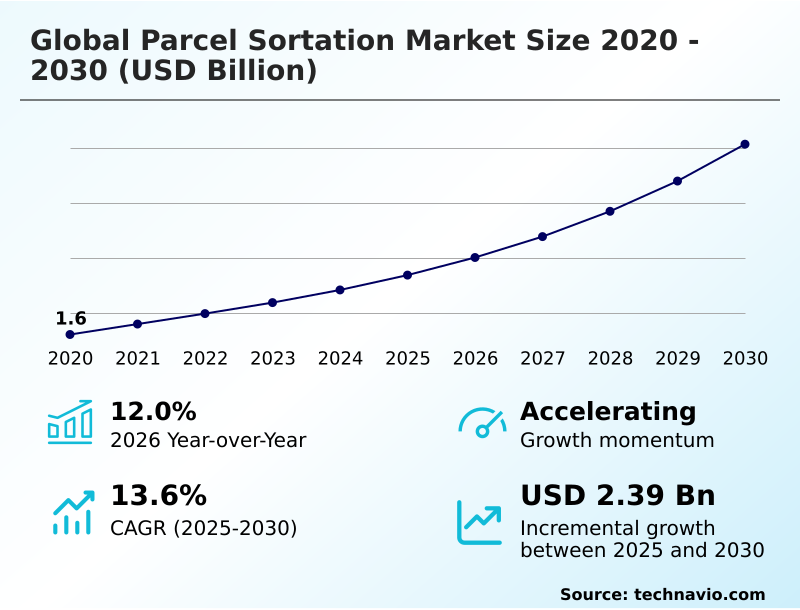
The parcel sortation market size is valued to increase by USD 2.39 billion, at a CAGR of 13.6% from 2025 to 2030. High impact fueling industrial and e-commerce growth will drive the parcel sortation market.
Major Market Trends & Insights
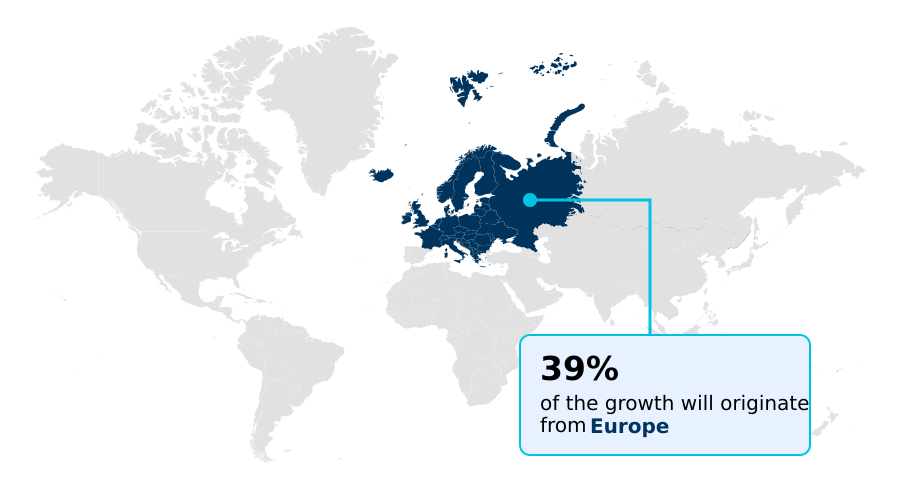
- Europe dominated the market and accounted for a 38.8% growth during the forecast period.
- By Type - Linear sortation system segment was valued at USD 1.59 billion in 2024
- By Service Type - Software segment accounted for the largest market revenue share in 2024
Market Size & Forecast
- Market Opportunities: USD 3.46 billion
- Market Future Opportunities: USD 2.39 billion
- CAGR from 2025 to 2030 : 13.6%
Market Summary
- The parcel sortation market is critical to the backbone of modern commerce, driven by the unrelenting demand for faster and more accurate order fulfillment. As e-commerce continues to reshape consumer expectations, logistics operators are compelled to invest in sophisticated automation to handle escalating parcel volumes.
- This market is characterized by the rapid evolution of technologies such as ai-powered sorting algorithms and robotic sorting arms, which significantly boost sortation throughput and minimize errors. For instance, a third-party logistics (3PL) provider facing seasonal demand spikes can deploy a modular sortation system integrated with an automated storage and retrieval system (asrs) and a warehouse execution system (wes).
- This enables dynamic routing of packages, ensuring service level agreements are met without incurring excessive labor costs. However, the high capital investment for a state-of-the-art cross-belt sorter or loop sortation system and the requirement for skilled technicians for predictive maintenance for sorters remain significant considerations for businesses.
- The integration of iot sensors in logistics for real-time tracking further enhances visibility, turning facilities into highly efficient, data-driven hubs of activity.
What will be the Size of the Parcel Sortation Market during the forecast period?
Get Key Insights on Market Forecast (PDF) Get Free Sample
How is the Parcel Sortation Market Segmented?
The parcel sortation industry research report provides comprehensive data (region-wise segment analysis), with forecasts and estimates in "USD million" for the period 2026-2030, as well as historical data from 2020-2024 for the following segments.
- Type
- Linear sortation system
- Loop sortation system
- Service type
- Software
- Hardware
- Services
- Application
- Logistics
- E-commerce
- Others
- Geography
- Europe
- Germany
- UK
- France
- North America
- US
- Canada
- Mexico
- APAC
- China
- Japan
- India
- South America
- Brazil
- Argentina
- Middle East and Africa
- Saudi Arabia
- UAE
- South Africa
- Rest of World (ROW)
- Europe
By Type Insights
The linear sortation system segment is estimated to witness significant growth during the forecast period.
The linear sortation system segment is fundamental to modern logistics, offering a versatile solution for operations requiring moderate sortation throughput.
These systems, which include advanced roller and belt conveyors, are prized for their smaller footprint and straightforward conveyor system integration, making them ideal for facilities with spatial constraints.
The trend toward modular and scalable designs allows for enhanced sortation system scalability in response to fluctuating demand without major infrastructural changes. A critical component is the parcel induction system, which ensures a consistent flow of items.
For instance, optimized linear systems can improve last-mile delivery sortation accuracy by over 15%, a crucial metric for e-commerce fulfillment technology and broader logistics automation solutions.
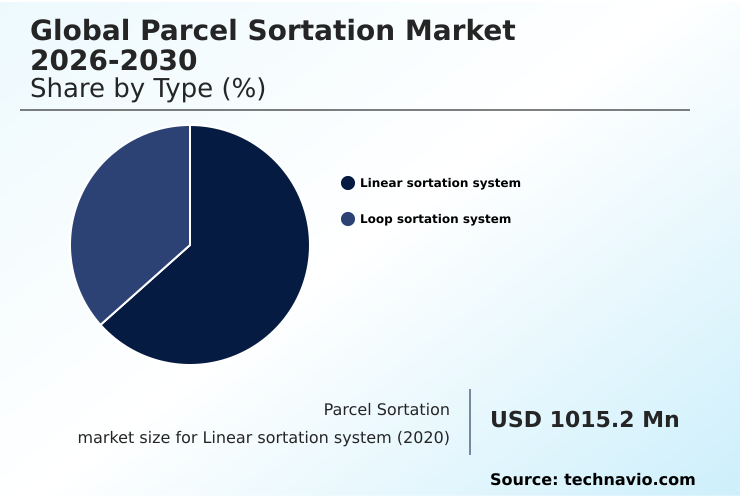
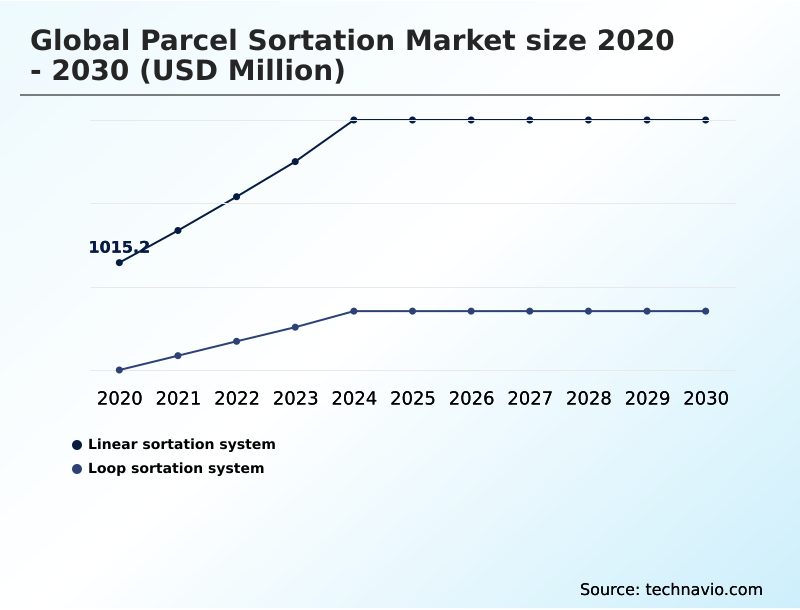
The Linear sortation system segment was valued at USD 1.59 billion in 2024 and showed a gradual increase during the forecast period.
Regional Analysis
Europe is estimated to contribute 38.8% to the growth of the global market during the forecast period.Technavio’s analysts have elaborately explained the regional trends and drivers that shape the market during the forecast period.
See How Parcel Sortation Market Demand is Rising in Europe Get Free Sample
The geographic landscape of the parcel sortation market is characterized by mature adoption in North America and Europe, with rapid expansion across APAC.
Europe leads in market contribution, accounting for nearly 39% of incremental growth, driven by advanced third-party logistics (3pl) automation and cross-border e-commerce logistics.
North America's growth is fueled by major investments in smart warehouse technology and the modernization of postal networks, often incorporating sliding shoe sorter and tilt-tray sorter systems.
In APAC, the rise of e-commerce is spurring demand for autonomous mobile robot sorting and other flexible automated material handling systems.
The integration of a warehouse execution system (wes) with a high-speed diverter improves efficiency in return merchandise authorization (rma) sorting, a critical function globally.
Market Dynamics
Our researchers analyzed the data with 2025 as the base year, along with the key drivers, trends, and challenges. A holistic analysis of drivers will help companies refine their marketing strategies to gain a competitive advantage.
- The decision to modernize a distribution center involves navigating a complex set of strategic considerations, beginning with the cost of implementing automated sortation. This financial analysis must be followed by a detailed projection of the roi of robotic parcel sorting, as stakeholders demand clear payback timelines.
- A pivotal choice in this process is the linear vs loop sortation system comparison, where factors like facility footprint, required throughput, and product mix dictate the optimal solution. The ultimate goal is optimizing throughput in a distribution center, a metric that directly impacts customer satisfaction and operational profitability.
- Facilities that have successfully managed this transition report that combining technologies for integrating ai with parcel sortation systems can more than double the fulfillment speed compared to legacy, non-automated warehouse operations. This enhancement is not just about speed but also about accuracy and the ability to handle diverse package types seamlessly, from induction to final dispatch.
- These advanced systems are becoming essential for maintaining a competitive edge in a market defined by the need for rapid, reliable, and scalable logistics.
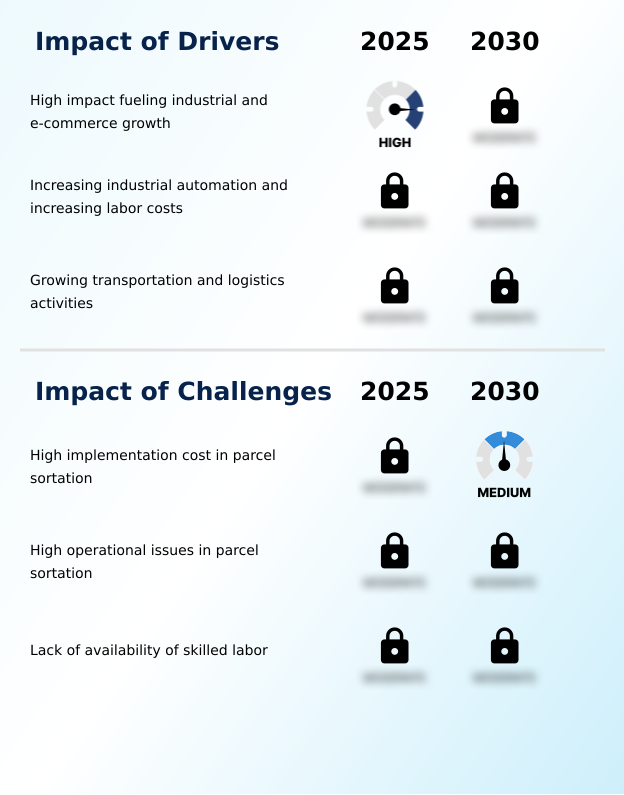
What are the key market drivers leading to the rise in the adoption of Parcel Sortation Industry?
- Significant growth in the industrial and e-commerce sectors is a key driver for the market.
- The primary driver for the parcel sortation market is the relentless growth of e-commerce fulfillment technology, which demands higher levels of order fulfillment automation to meet consumer expectations for speed.
- This pressure compels investment in high-capacity equipment like the loop sortation system and cross-belt sorter to maximize sortation throughput.
- Efficient distribution center automation now hinges on the seamless operation of the entire workflow, from the parcel induction system to integration with an automated storage and retrieval system (asrs).
- Implementing these systems boosts sortation system efficiency, with automated facilities processing volumes up to 200% higher than their manual counterparts.
- Concurrently, a growing focus on sustainability is driving the adoption of energy-efficient sortation technologies, which can lower operational electricity costs by over 15%.
What are the market trends shaping the Parcel Sortation Industry?
- The development of automated sortation systems is an emerging trend. This innovation is reshaping operational efficiencies across the logistics industry.
- Emerging trends in parcel sortation automation are centered on creating more intelligent and resilient systems. The integration of ai-powered sorting algorithms and computer vision for sorting is revolutionizing parcel tracking and sorting, enabling systems to identify and route packages with unprecedented precision.
- This shift toward intelligent sortation solutions improves parcel processing capacity, with some facilities reporting a 40% increase in throughput without expanding their physical footprint. Furthermore, the deployment of iot sensors in logistics facilitates predictive maintenance for sorters, reducing unexpected equipment downtime by nearly 50%.
- The use of robotic sorting arms in automated logistics infrastructure not only enhances speed but also adds a layer of flexibility for handling irregularly shaped items.
What challenges does the Parcel Sortation Industry face during its growth?
- The high implementation cost of parcel sortation systems presents a key challenge to industry growth.
- A key challenge restraining market expansion is the complexity and cost associated with implementing integrated warehouse sortation systems. The initial capital outlay for comprehensive automated parcel handling can be 3-5 times higher than for semi-automated alternatives, posing a significant barrier for smaller operators.
- Moreover, achieving seamless conveyor system integration with a warehouse control system (wcs) to manage high-volume sortation requires specialized expertise. Effective parcel singulation and dynamic routing are critical for performance but add to system complexity.
- While robust supply chain optimization technology offers a clear return on investment, such as a potential 60% reduction in labor-related expenses, concerns about sortation system scalability and achieving flawless real-time tracking remain significant hurdles for many organizations.
Exclusive Technavio Analysis on Customer Landscape
The parcel sortation market forecasting report includes the adoption lifecycle of the market, covering from the innovator’s stage to the laggard’s stage. It focuses on adoption rates in different regions based on penetration. Furthermore, the parcel sortation market report also includes key purchase criteria and drivers of price sensitivity to help companies evaluate and develop their market growth analysis strategies.
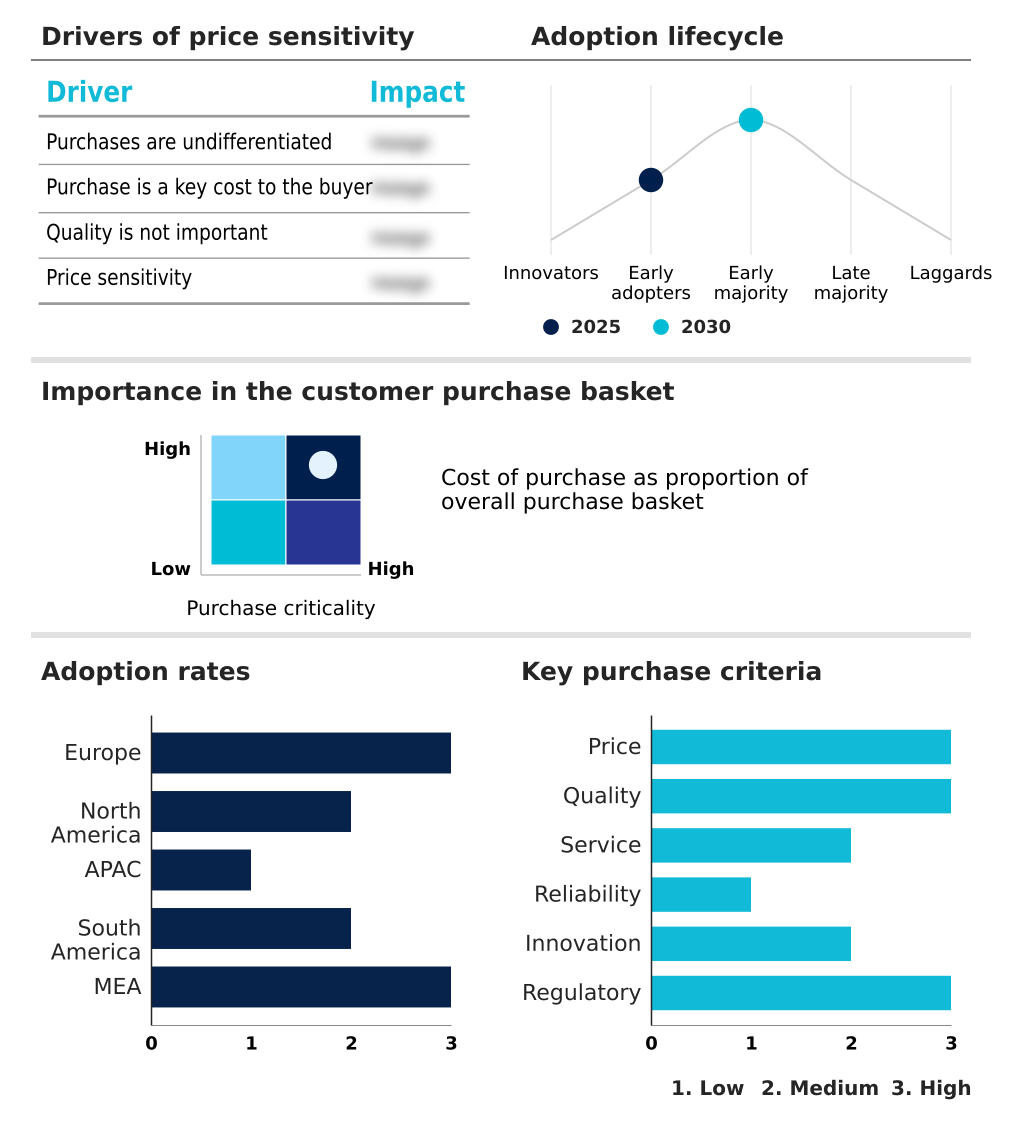
Customer Landscape of Parcel Sortation Industry
Competitive Landscape
Companies are implementing various strategies, such as strategic alliances, parcel sortation market forecast, partnerships, mergers and acquisitions, geographical expansion, and product/service launches, to enhance their presence in the industry.
Alstef Group SAS - Specialized parcel sortation systems are engineered for courier, warehousing, and distribution facilities, optimizing throughput and operational efficiency in complex logistics networks.
The industry research and growth report includes detailed analyses of the competitive landscape of the market and information about key companies, including:
- Alstef Group SAS
- Beumer Group GmbH and Co. KG
- Daifuku Co. Ltd.
- Equinox MHE
- Falcon Autotech Pvt. Ltd.
- FIVES SAS
- GBI Intralogistics Inc.
- Grey Orange Pte. Ltd.
- Honeywell International Inc.
- Interroll Holding AG
- Intralox LLC
- Invata Intralogistics Inc.
- KION GROUP AG
- L. Possehl and Co. mbH
- Murata Machinery Ltd.
- Okura Yusoki Co. Ltd.
- Siemens AG
- Toyota Industries Corp.
Qualitative and quantitative analysis of companies has been conducted to help clients understand the wider business environment as well as the strengths and weaknesses of key industry players. Data is qualitatively analyzed to categorize companies as pure play, category-focused, industry-focused, and diversified; it is quantitatively analyzed to categorize companies as dominant, leading, strong, tentative, and weak.
Recent Development and News in Parcel sortation market
- In August 2025, United States Postal Service revealed plans to launch eleven new sorting and delivery centers as part of its network consolidation strategy.
- In October 2025, DHL Group opened its new Europe Innovation Center in Troisdorf, Germany, a zero-emissions facility focused on developing advancements in robotics and AI for logistics.
- In March 2025, Dematic launched an upgraded Warehouse Execution System featuring real-time machine learning to optimize sorter routing for more adaptive warehouse operations.
- In May 2025, DPD Germany commenced construction of a new distribution hub in Bremen, designed to process 35,000 parcels daily to enhance its network capacity.
Dive into Technavio’s robust research methodology, blending expert interviews, extensive data synthesis, and validated models for unparalleled Parcel Sortation Market insights. See full methodology.
| Market Scope | |
|---|---|
| Page number | 278 |
| Base year | 2025 |
| Historic period | 2020-2024 |
| Forecast period | 2026-2030 |
| Growth momentum & CAGR | Accelerate at a CAGR of 13.6% |
| Market growth 2026-2030 | USD 2385.3 million |
| Market structure | Fragmented |
| YoY growth 2025-2026(%) | 12.0% |
| Key countries | Germany, UK, France, Italy, Spain, The Netherlands, US, Canada, Mexico, China, Japan, India, South Korea, Australia, Indonesia, Brazil, Argentina, Chile, Saudi Arabia, UAE, South Africa, Israel and Turkey |
| Competitive landscape | Leading Companies, Market Positioning of Companies, Competitive Strategies, and Industry Risks |
Research Analyst Overview
- The parcel sortation market is evolving into a highly sophisticated ecosystem where hardware and software converge to meet escalating logistical demands. Boardroom decisions increasingly focus on investing in a flexible modular sortation system that allows for scalability.
- Technologies range from the established linear sortation system and high-capacity loop sortation system to specialized equipment like the cross-belt sorter, tilt-tray sorter, and sliding shoe sorter.
- The integration of a warehouse execution system (wes) and warehouse control system (wcs) is crucial for orchestrating operations, from the parcel induction system and parcel singulation using gapping conveyor technology to final dispatch via a high-speed diverter. Advanced systems leverage ai-powered sorting algorithms and computer vision for sorting to enable dynamic routing and maximize sortation throughput.
- Furthermore, the deployment of robotic sorting arms, autonomous mobile robot sorting, and the pouch sorter system showcases the industry's shift toward comprehensive automation. The use of iot sensors in logistics for real-time tracking facilitates predictive maintenance for sorters, a key strategy for minimizing downtime.
- Such integrated solutions, which combine conveyor system integration with an automated storage and retrieval system (asrs), have enabled operators to achieve up to a 90% reduction in sorting errors.
What are the Key Data Covered in this Parcel Sortation Market Research and Growth Report?
-
What is the expected growth of the Parcel Sortation Market between 2026 and 2030?
-
USD 2.39 billion, at a CAGR of 13.6%
-
-
What segmentation does the market report cover?
-
The report is segmented by Type (Linear sortation system, and Loop sortation system), Service Type (Software, Hardware, and Services), Application (Logistics, E-commerce, and Others) and Geography (Europe, North America, APAC, South America, Middle East and Africa)
-
-
Which regions are analyzed in the report?
-
Europe, North America, APAC, South America and Middle East and Africa
-
-
What are the key growth drivers and market challenges?
-
High impact fueling industrial and e-commerce growth, High implementation cost in parcel sortation
-
-
Who are the major players in the Parcel Sortation Market?
-
Alstef Group SAS, Beumer Group GmbH and Co. KG, Daifuku Co. Ltd., Equinox MHE, Falcon Autotech Pvt. Ltd., FIVES SAS, GBI Intralogistics Inc., Grey Orange Pte. Ltd., Honeywell International Inc., Interroll Holding AG, Intralox LLC, Invata Intralogistics Inc., KION GROUP AG, L. Possehl and Co. mbH, Murata Machinery Ltd., Okura Yusoki Co. Ltd., Siemens AG and Toyota Industries Corp.
-
Market Research Insights
- The dynamics of the parcel sortation market are increasingly defined by the adoption of intelligent logistics automation solutions and advanced e-commerce fulfillment technology. As companies strive for supply chain optimization technology, the focus shifts to measurable performance gains.
- For instance, firms leveraging robotic parcel sorting report up to a 40% reduction in miss-sort rates compared to manual methods, directly improving sortation system efficiency. Moreover, the integration of intelligent sortation solutions within distribution center automation frameworks has been shown to improve parcel processing capacity by over 50% during peak seasons.
- This push toward high-volume sortation and omnichannel retail logistics underscores the market's response to intense consumer demand for speed and accuracy.
We can help! Our analysts can customize this parcel sortation market research report to meet your requirements.
 RIA -
RIA - 
