


Piano Market Size 2026-2030
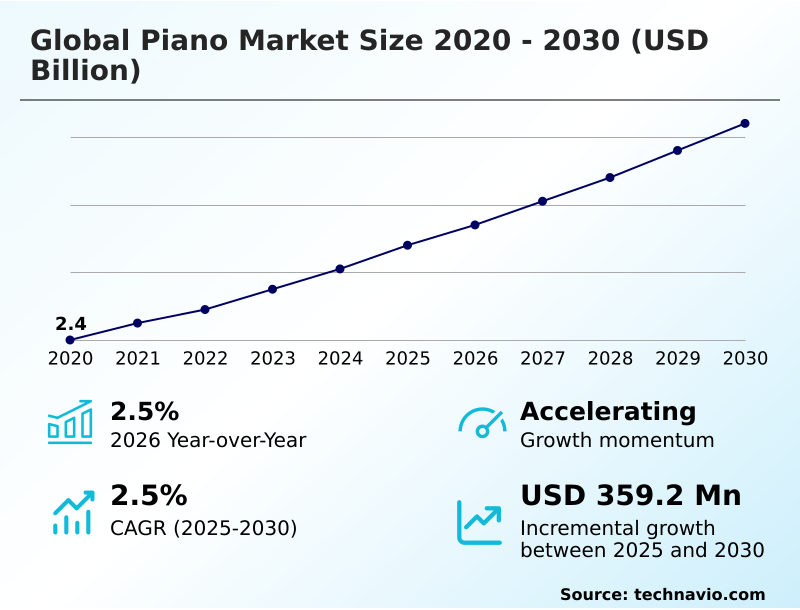
The piano market size is valued to increase by USD 359.2 million, at a CAGR of 2.5% from 2025 to 2030. Heightened emphasis on music education and recognized cognitive development benefits will drive the piano market.
Major Market Trends & Insights
- North America dominated the market and accounted for a 39.7% growth during the forecast period.
- By Distribution Channel - Offline segment was valued at USD 1.92 billion in 2024
- By Product - Acoustic piano segment accounted for the largest market revenue share in 2024
Market Size & Forecast
- Market Opportunities: USD 638.7 million
- Market Future Opportunities: USD 359.2 million
- CAGR from 2025 to 2030 : 2.5%
Market Summary
- The piano market is defined by a dynamic interplay between traditional craftsmanship and technological evolution. Demand is consistently supported by a cultural emphasis on music education and its associated cognitive benefits, positioning the piano as a tool for intellectual development.
- This foundation is expanded by the adoption of digital technologies, which address modern lifestyle constraints such as limited space and the need for quiet practice. Innovations in hybrid instruments and digital pianos integrated with learning platforms are broadening the consumer base to include new learners and tech-savvy hobbyists.
- However, the high cost of acquisition and maintenance for premium acoustic models remains a significant barrier. One manufacturer, for example, is navigating this by optimizing its supply chain to manage both the artisanal sourcing of spruce soundboards for its acoustic line and the procurement of advanced electronic components for its digital and hybrid models.
- This dual approach is essential for catering to a bifurcated market that values both timeless heritage and contemporary convenience, ensuring relevance across diverse consumer segments.
What will be the Size of the Piano Market during the forecast period?
Get Key Insights on Market Forecast (PDF) Get Free Sample
How is the Piano Market Segmented?
The piano industry research report provides comprehensive data (region-wise segment analysis), with forecasts and estimates in "USD million" for the period 2026-2030, as well as historical data from 2020-2024 for the following segments.
- Distribution channel
- Offline
- Online
- Product
- Acoustic piano
- Digital piano
- End-user
- Amateur musicians
- Professional musicians
- Others
- Geography
- North America
- US
- Canada
- Mexico
- Europe
- Germany
- UK
- France
- APAC
- China
- Japan
- South Korea
- South America
- Brazil
- Argentina
- Colombia
- Middle East and Africa
- Saudi Arabia
- UAE
- South Africa
- Rest of World (ROW)
- North America
By Distribution Channel Insights
The offline segment is estimated to witness significant growth during the forecast period.
The offline segment remains integral to the piano market, centered on specialty showrooms where consumers can evaluate the tactile response of a hammer action keybed and the tonal quality of traditional spruce soundboards.
This channel is crucial for high-value purchases, including the acoustic grand piano, where the cast iron plate construction and digital sound generation in hybrid models can be assessed firsthand.
The emphasis on piano music education and the cognitive development benefits it offers drives showroom traffic.
This hands-on experience is vital for the professional musician instrument selection process and aligns with the trend of home-centric leisure, with a single region contributing nearly 40% of the market's incremental growth, underscoring the importance of physical retail in key geographies.
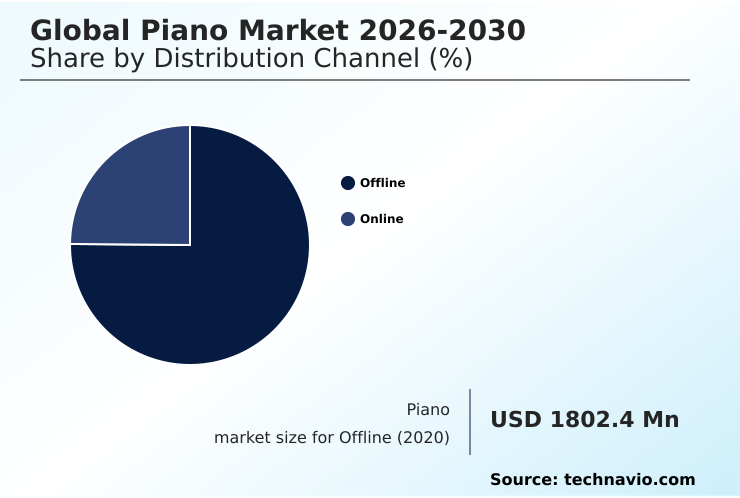
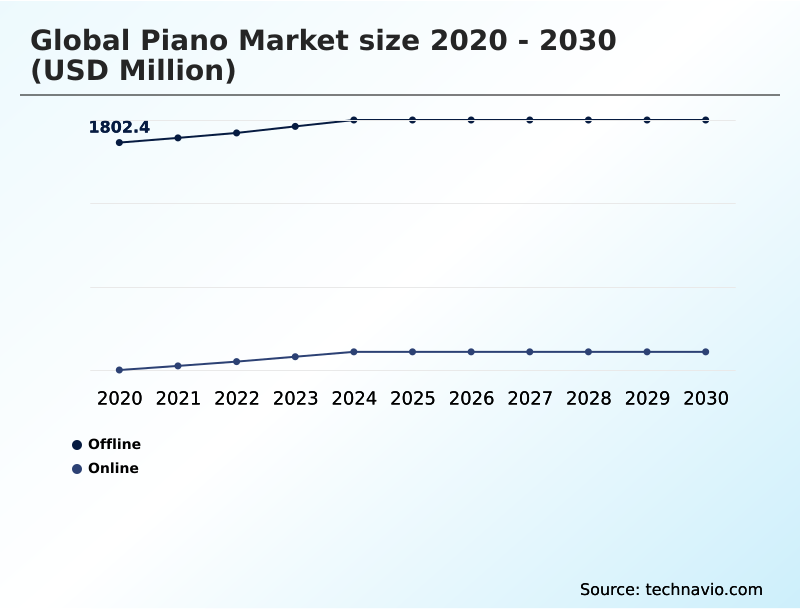
The Offline segment was valued at USD 1.92 billion in 2024 and showed a gradual increase during the forecast period.
Regional Analysis
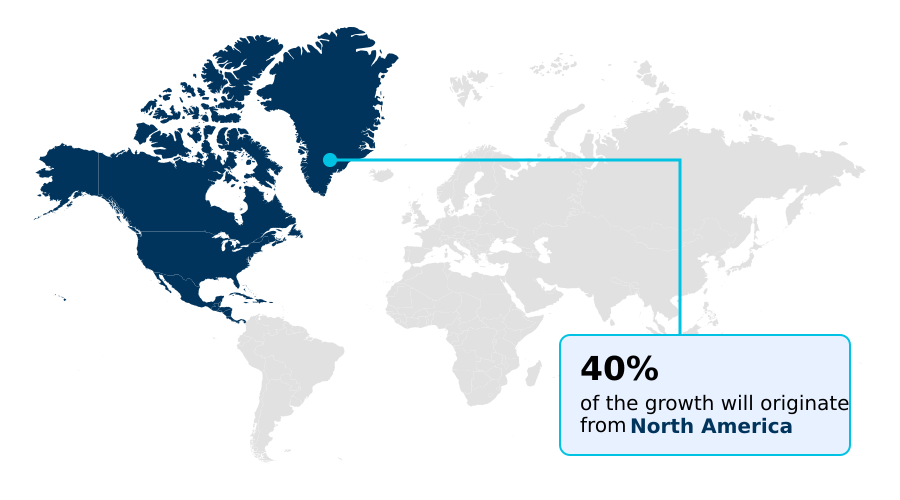
North America is estimated to contribute 39.7% to the growth of the global market during the forecast period.Technavio’s analysts have elaborately explained the regional trends and drivers that shape the market during the forecast period.
See How Piano Market Demand is Rising in North America Get Free Sample
The geographic dynamics of the piano market show a contrast between mature regions and high-growth territories.
The APAC region is expanding at a rate nearly double that of some mature Western markets, driven by a strong cultural emphasis on music education and rising disposable incomes.
This growth creates demand for a wide range of instruments, from entry-level digital pianos with weighted hammer action to aspirational acoustic models.
This makes the region a focal point for manufacturers deploying silent piano systems and hybrid piano technology to cater to urban living.
Meanwhile, North America, while more mature, is projected to account for 39.7% of the market’s incremental growth, fueled by the premium segment and the adoption of advanced digital learning platforms.
Success requires a bifurcated strategy: leveraging advanced sound sampling technology and MIDI controller features for tech-savvy growth markets while focusing on quality and heritage in established ones.
Market Dynamics
Our researchers analyzed the data with 2025 as the base year, along with the key drivers, trends, and challenges. A holistic analysis of drivers will help companies refine their marketing strategies to gain a competitive advantage.
- Strategic decisions in today's piano market hinge on understanding diverse consumer journeys. For those choosing a piano for beginners, the classic debate of acoustic versus digital piano feel is now more complex. The benefits of hybrid piano technology offer a compelling middle ground, providing an authentic playing experience while integrating piano with learning apps.
- This is particularly crucial given the impact of urbanization on piano sales, where finding the best piano for small apartments is a primary concern for many buyers.
- An understanding of the acoustic piano action mechanism explained in the context of touch and response remains vital for the premium segment, yet the practicalities of piano maintenance and tuning costs steer many toward digital alternatives. For manufacturers, this landscape demands a flexible product portfolio.
- Firms that have successfully developed hybrid models addressing urban spatial constraints have seen inventory turnover rates improve by over 20% compared to those focused solely on traditional grand pianos, demonstrating the value of aligning product strategy with modern lifestyle challenges.
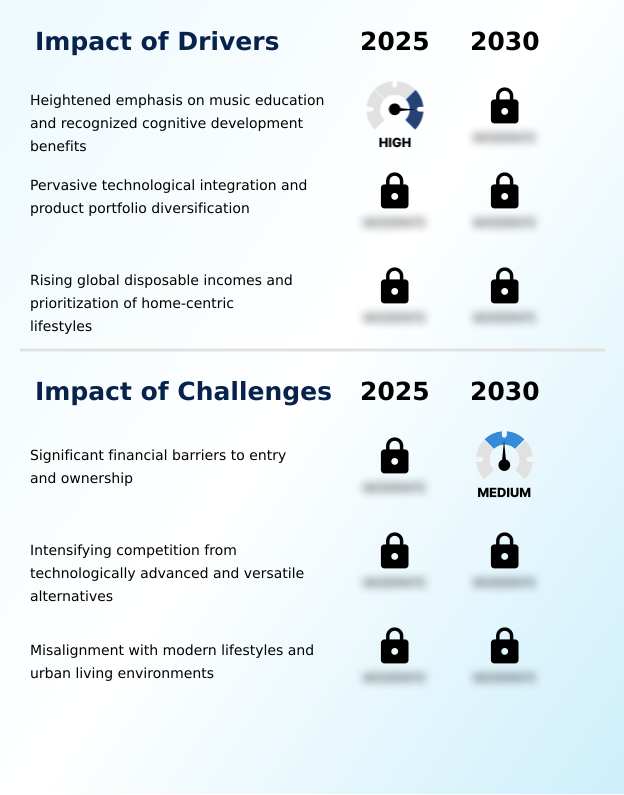
What are the key market drivers leading to the rise in the adoption of Piano Industry?
- The key market driver is the heightened emphasis on music education, which is reinforced by the recognized cognitive development benefits associated with musical training.
- The market's primary driver remains the deep-seated value placed on music education, which is increasingly supported by technological integration. Demand is robust for instruments that function as a music composition tool, extending their utility beyond simple performance.
- This is amplified in the institutional piano sales segment, where instruments must be durable and versatile.
- The evolution of the sound module and keybed sensors has enabled a higher degree of expression, with modern digital pianos achieving a 30% wider dynamic range than models from five years ago.
- This technical improvement, combined with a greater polyphony capacity, supports more complex musical pieces. The need for periodic acoustic piano maintenance is a significant factor pushing many buyers toward digital alternatives.
- The development of advanced features like an authentic escapement mechanism in digital actions has convinced many educators of their viability, with adoption in teaching studios increasing by 25% in recent years.
What are the market trends shaping the Piano Industry?
- The proliferation of hybrid and silent piano technologies is a key market trend. These innovations are reshaping consumer expectations by blending traditional acoustic feel with modern digital flexibility.
- Key market trends are centered on the fusion of traditional playability with digital intelligence. The development of advanced physical modeling and haptic feedback technologies is blurring the lines between acoustic and digital instruments, with some high-end digital models now replicating the tactile response of a traditional mechanical action with over 98% accuracy.
- This premiumization trend is also evident in the proliferation of the player piano system, which transforms the instrument into a home entertainment centerpiece. As consumers increasingly seek guided learning experiences, integration with online tutorials and platforms offering gamified lessons has become a critical differentiator. This has led to a 40% increase in user engagement for connected models.
- The availability of self-paced curriculum options further lowers the barrier to entry, expanding the market to new demographics seeking flexible and interactive musical education.
What challenges does the Piano Industry face during its growth?
- A key challenge affecting industry growth is the significant financial barrier to entry and ownership, which limits market accessibility for many potential consumers.
- Significant market challenges are rooted in the high cost and spatial requirements of traditional instruments. The perception of a piano as a family heirloom investment or a cultural sophistication symbol is challenged by practical concerns.
- The total cost of ownership for an acoustic piano, including specialized features like a sostenuto pedal and periodic touch weight adjustment, can be 50% higher over a decade compared to a digital model. Furthermore, the use of premium materials, from an authentic duplex scale design to synthetic ivory keytops, maintains a high price point.
- Urban residential units have shrunk by an average of 15% over the last two decades, making even upright pianos impractical for many. This spatial constraint directly benefits digital models.
- The growing adult learner market, while possessing financial means, often prioritizes convenience, creating a challenge for manufacturers to communicate the long-term brand heritage value of acoustic instruments against their more practical counterparts.
Exclusive Technavio Analysis on Customer Landscape
The piano market forecasting report includes the adoption lifecycle of the market, covering from the innovator’s stage to the laggard’s stage. It focuses on adoption rates in different regions based on penetration. Furthermore, the piano market report also includes key purchase criteria and drivers of price sensitivity to help companies evaluate and develop their market growth analysis strategies.
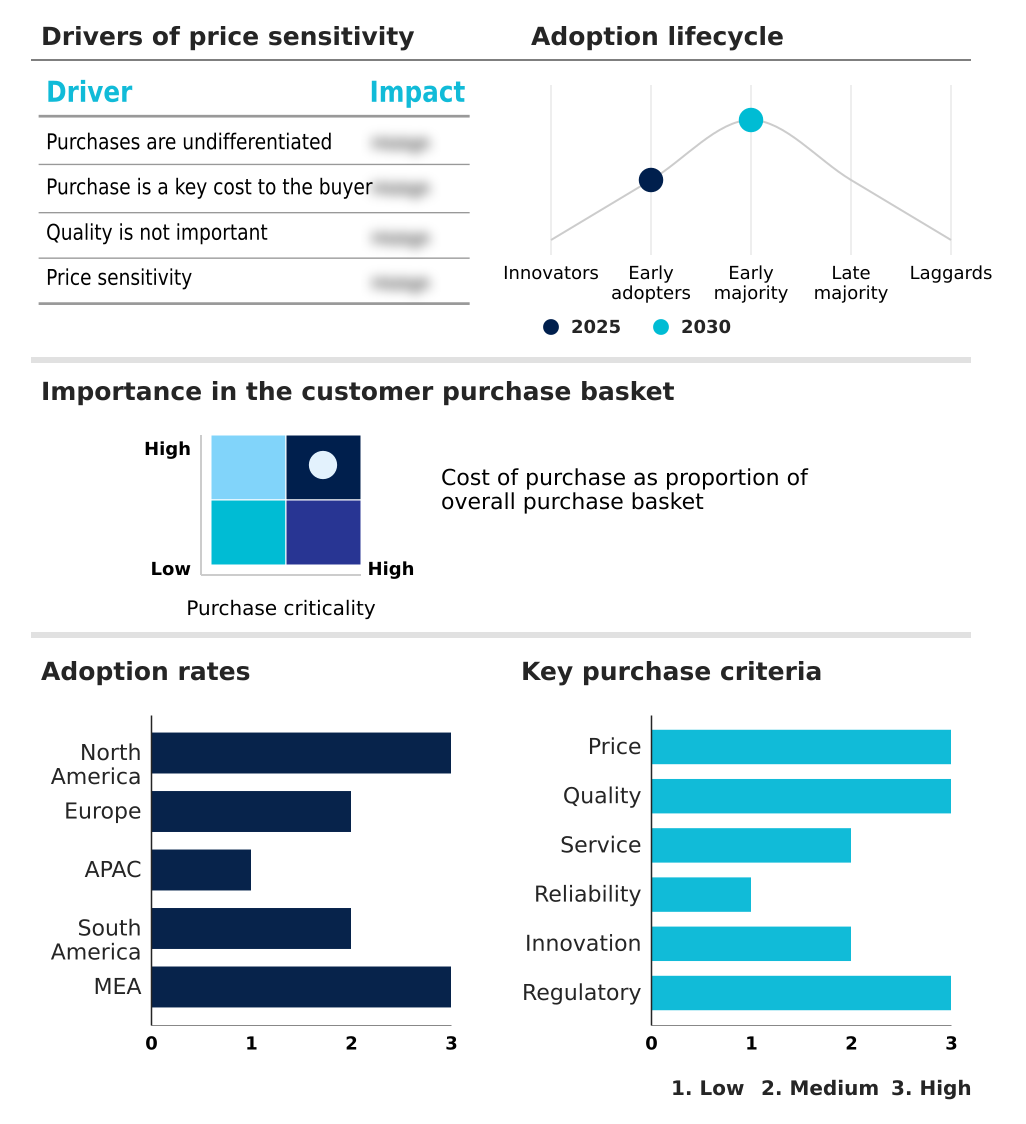
Customer Landscape of Piano Industry
Competitive Landscape
Companies are implementing various strategies, such as strategic alliances, piano market forecast, partnerships, mergers and acquisitions, geographical expansion, and product/service launches, to enhance their presence in the industry.
AUGUST FORSTER GmbH - Expertise in handcrafted piano construction is demonstrated through proprietary acoustic structures, defining a legacy of premium instrument manufacturing.
The industry research and growth report includes detailed analyses of the competitive landscape of the market and information about key companies, including:
- AUGUST FORSTER GmbH
- C. Bechstein Pianoforte AG
- Carl Sauter Pianofortemanufaktur
- CASIO Computer Co. Ltd.
- Fazioli Pianoforti spa
- Julius Bluthner Pianofortefabrik
- Kawai Musical Instruments Mfg.
- KORG Inc.
- Mason and Hamlin Piano Co.
- Pearl River Piano Group
- PETROF Spol s.r.o.
- Roland Corp.
- Samick Music Corp.
- SCHULZE POLLMANN
- Steingraeber and Sohne KG
- Steinway Inc.
- Stuart and Sons
- Wilhelm Schimmel
- Yamaha Corp.
Qualitative and quantitative analysis of companies has been conducted to help clients understand the wider business environment as well as the strengths and weaknesses of key industry players. Data is qualitatively analyzed to categorize companies as pure play, category-focused, industry-focused, and diversified; it is quantitatively analyzed to categorize companies as dominant, leading, strong, tentative, and weak.
Recent Development and News in Piano market
- In September, 2024, CASIO Computer Co. Ltd. launched its new Celviano digital piano series, including the flagship AP-750 model featuring a Grandphonic sound system and a Smart Hybrid Hammer Action keyboard.
- In October, 2024, Yamaha Corp. announced a strategic partnership with a leading educational software company to integrate its proprietary digital learning platform directly into its next-generation digital pianos, enhancing the interactive learning experience for students.
- In January, 2025, Steinway Inc. acquired a boutique European manufacturer specializing in innovative carbon fiber soundboards, signaling a strategic move to incorporate advanced materials into its traditional craftsmanship to enhance instrument durability and performance.
- In April, 2025, Pearl River Piano Group announced the completion of its new manufacturing facility in Southeast Asia, aimed at better serving the rapidly growing demand in the APAC region and reducing logistical costs for its expanding product line.
Dive into Technavio’s robust research methodology, blending expert interviews, extensive data synthesis, and validated models for unparalleled Piano Market insights. See full methodology.
| Market Scope | |
|---|---|
| Page number | 293 |
| Base year | 2025 |
| Historic period | 2020-2024 |
| Forecast period | 2026-2030 |
| Growth momentum & CAGR | Accelerate at a CAGR of 2.5% |
| Market growth 2026-2030 | USD 359.2 million |
| Market structure | Fragmented |
| YoY growth 2025-2026(%) | 2.5% |
| Key countries | US, Canada, Mexico, Germany, UK, France, Italy, Spain, The Netherlands, China, Japan, South Korea, India, Australia, Indonesia, Brazil, Argentina, Colombia, Saudi Arabia, UAE, South Africa, Egypt and Israel |
| Competitive landscape | Leading Companies, Market Positioning of Companies, Competitive Strategies, and Industry Risks |
Research Analyst Overview
- The piano market's current state is characterized by the tension between heritage craftsmanship and digital innovation. Boardroom decisions increasingly center on capital allocation: whether to deepen investments in traditional skills required for instruments with authentic soundboard resonance and escapement mechanism features, or to pivot toward R&D in digital audio workstation compatibility and advanced keybed sensors.
- The rise of hybrid piano technology, which merges a traditional mechanical action with digital sound generation, exemplifies this crossroads. Products now incorporate sophisticated physical modeling and even haptic feedback to replicate the acoustic experience with high fidelity. This technological push is not limited to high-end models; features like high polyphony capacity and weighted hammer action are becoming standard.
- This allows for a tiered product strategy, from entry-level digital pianos to premium player piano system installations. Companies that successfully integrate a player piano system into high-end acoustic models have reported a customer lifetime value that is up to 25% higher, validating the strategy of embedding modern functionality within traditional forms.
What are the Key Data Covered in this Piano Market Research and Growth Report?
-
What is the expected growth of the Piano Market between 2026 and 2030?
-
USD 359.2 million, at a CAGR of 2.5%
-
-
What segmentation does the market report cover?
-
The report is segmented by Distribution Channel (Offline, and Online), Product (Acoustic piano, and Digital piano), End-user (Amateur musicians, Professional musicians, and Others) and Geography (North America, Europe, APAC, South America, Middle East and Africa)
-
-
Which regions are analyzed in the report?
-
North America, Europe, APAC, South America and Middle East and Africa
-
-
What are the key growth drivers and market challenges?
-
Heightened emphasis on music education and recognized cognitive development benefits, Significant financial barriers to entry and ownership
-
-
Who are the major players in the Piano Market?
-
AUGUST FORSTER GmbH, C. Bechstein Pianoforte AG, Carl Sauter Pianofortemanufaktur, CASIO Computer Co. Ltd., Fazioli Pianoforti spa, Julius Bluthner Pianofortefabrik, Kawai Musical Instruments Mfg., KORG Inc., Mason and Hamlin Piano Co., Pearl River Piano Group, PETROF Spol s.r.o., Roland Corp., Samick Music Corp., SCHULZE POLLMANN, Steingraeber and Sohne KG, Steinway Inc., Stuart and Sons, Wilhelm Schimmel and Yamaha Corp.
-
Market Research Insights
- The piano market is undergoing a significant transformation, driven by the convergence of technology and tradition. The demand for instruments that function as an interactive learning hub is reshaping product development, with manufacturers that integrate gamified lessons into their platforms reporting user engagement rates up to 25% higher than those without.
- This shift complements the enduring appeal of the piano as a tool for personal enrichment, supported by the recognized cognitive development benefits of piano music education.
- While the aspirational purchase of a high-end acoustic piano remains a key market segment, the focus on the premiumization trend has enabled niche manufacturers to achieve profit margins up to 15% higher than mass-market producers. The market's evolution reflects a dual focus on making music education more accessible through technology and catering to the high-value segment seeking superior craftsmanship.
We can help! Our analysts can customize this piano market research report to meet your requirements.
 RIA -
RIA - 
