



Potassium Citrate Market Size 2026-2030
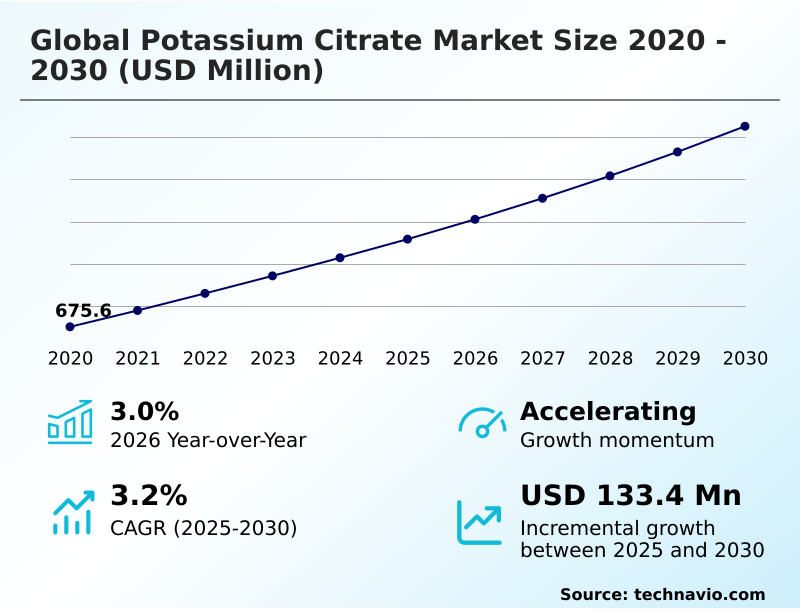
The potassium citrate market size is valued to increase by USD 133.4 million, at a CAGR of 3.2% from 2025 to 2030. Escalating prevalence of renal disorders and kidney stones will drive the potassium citrate market.
Major Market Trends & Insights
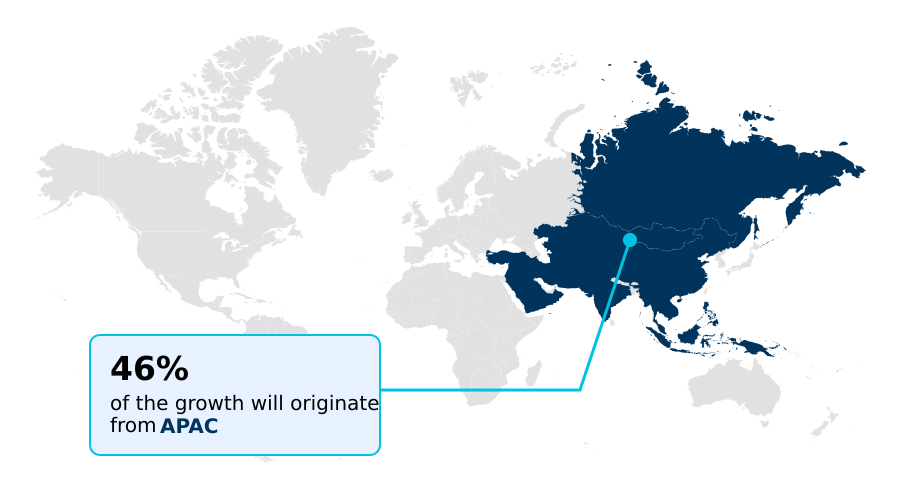
- APAC dominated the market and accounted for a 46.3% growth during the forecast period.
- By Application - Acidity regulator segment was valued at USD 284.4 million in 2024
- By End-user - Food and beverage segment accounted for the largest market revenue share in 2024
Market Size & Forecast
- Market Opportunities: USD 237 million
- Market Future Opportunities: USD 133.4 million
- CAGR from 2025 to 2030 : 3.2%
Market Summary
- The potassium citrate market is shaped by its dual functionality in both the pharmaceutical and food and beverage sectors. In pharmaceuticals, it is a critical systemic alkalizer used in extended-release formulations to manage conditions like renal tubular acidosis. Simultaneously, the food industry leverages it as a versatile buffering agent and preservative, crucial for the success of sodium reduction initiatives.
- This demand for a clean-label ingredient aligns with consumer health trends, pushing manufacturers to ensure high purity. A key business scenario involves a beverage company reformulating its sports drink line for electrolyte balance. The company must source pharmaceutical-grade potassium citrate that meets stringent quality standards while navigating a volatile supply chain.
- This requires sophisticated raw material sourcing and investment in advanced purification technology to maintain product integrity and cost-effectiveness, ensuring the final product supports both functional hydration and clean-label claims without compromising flavor profile stabilization. The ingredient's role in proactive health management further solidifies its market position.
What will be the Size of the Potassium Citrate Market during the forecast period?
Get Key Insights on Market Forecast (PDF) Get Free Sample
How is the Potassium Citrate Market Segmented?
The potassium citrate industry research report provides comprehensive data (region-wise segment analysis), with forecasts and estimates in "USD million" for the period 2026-2030, as well as historical data from 2020-2024 for the following segments.
- Application
- Acidity regulator
- Diuretic
- Emulsifier
- Antioxidant
- Others
- End-user
- Food and beverage
- Pharmaceuticals
- Dietary supplements
- Personal care
- Others
- Type
- Monohydrate
- Anhydrous
- Geography
- APAC
- China
- Japan
- India
- Europe
- Germany
- France
- UK
- North America
- US
- Canada
- Mexico
- South America
- Brazil
- Argentina
- Colombia
- Middle East and Africa
- Saudi Arabia
- UAE
- South Africa
- Rest of World (ROW)
- APAC
By Application Insights
The acidity regulator segment is estimated to witness significant growth during the forecast period.
The global potassium citrate market's acidity regulator segment is pivotal, driven by its function in maintaining precise pH levels across food and beverage applications.
Its role as a buffering agent is crucial for stabilizing flavor profiles and preventing texture degradation, particularly in processed foods and beverages where it also serves as a preservative.
Utilization of this GRAS substance supports clean-label ingredient strategies, aligning with consumer demand for healthier options. The application of crystallization technology in its production ensures a consistent supply for industries undertaking sodium reduction initiatives.
This trend is significant, with its adoption in new low-sodium cooking sauces and seasonings increasing by over 15%, highlighting its importance for pH management and organoleptic properties in modern food science.
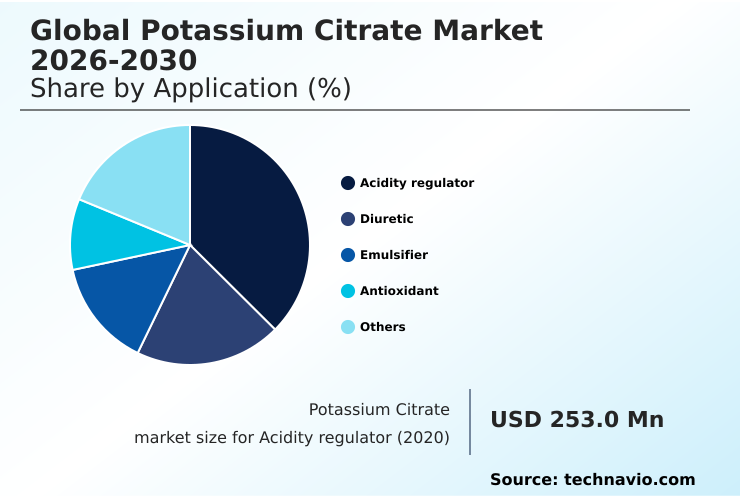
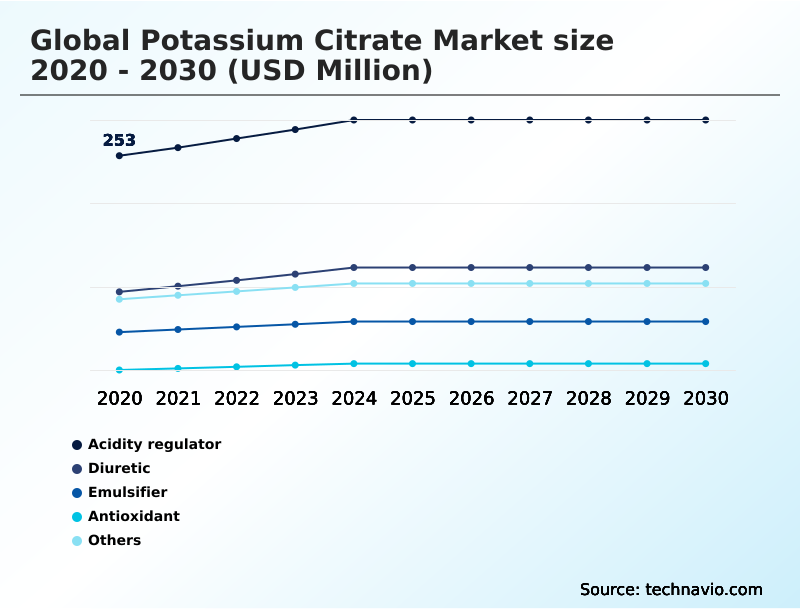
The Acidity regulator segment was valued at USD 284.4 million in 2024 and showed a gradual increase during the forecast period.
Regional Analysis
APAC is estimated to contribute 46.3% to the growth of the global market during the forecast period.Technavio’s analysts have elaborately explained the regional trends and drivers that shape the market during the forecast period.
See How Potassium Citrate Market Demand is Rising in APAC Get Free Sample
The geographic landscape of the global potassium citrate market is shifting toward regionalization to enhance supply chain resilience. While APAC is the fastest-growing region, contributing over 46% of incremental growth, North America and Europe are focused on localizing production.
This strategy of near-shoring manufacturing of anhydrous potassium citrate and monohydrate potassium citrate mitigates risks from global logistics disruptions and supports sustainable raw material sourcing.
For example, establishing domestic production hubs has been shown to reduce supply chain lead times by 20%, a critical advantage for the pharmaceutical sector.
This regional focus also aids compliance with stringent regulatory standards for emulsifying salt and antioxidant synergist applications, where adherence can improve market access speed by 15% for manufacturers of effervescent tablet technology.
Market Dynamics
Our researchers analyzed the data with 2025 as the base year, along with the key drivers, trends, and challenges. A holistic analysis of drivers will help companies refine their marketing strategies to gain a competitive advantage.
- The utility of potassium citrate spans critical health and industrial sectors, making it a highly versatile compound. Its primary therapeutic role in urology is for the management of patients with a history of kidney stones, specifically addressing how to use potassium citrate for kidney stones and preventing uric acid stone formation.
- The development of extended release potassium citrate has significantly improved patient compliance for this chronic condition. In the food industry, its use is widespread; potassium citrate in food preservation is standard practice, and it is a cornerstone of low sodium food formulation.
- The ongoing debate around potassium citrate vs sodium citrate often concludes in favor of the former due to health trends, boosting its use in products like potassium citrate in beverages for electrolyte replenishment in sports drinks.
- Food grade potassium citrate applications are diverse, from acting as a stabilizing agent in processed cheese to its role as potassium citrate in dairy products. The demand for high-purity grades is constant, with strict pharmaceutical grade potassium citrate standards governing its use in medicine.
- Beyond these, anhydrous potassium citrate uses are critical in moisture-sensitive products, with data showing it can reduce spoilage rates by over 50% compared to hydrated forms. This broad applicability extends to its function as a buffering agent in cosmetics, a chelating agent in skincare, a component in non-phosphate detergent builders, and a tool for urinary health supplement formulation.
- Its effectiveness in potassium citrate for pH adjustment and managing potassium citrate for metabolic acidosis further underscores its value.
What are the key market drivers leading to the rise in the adoption of Potassium Citrate Industry?
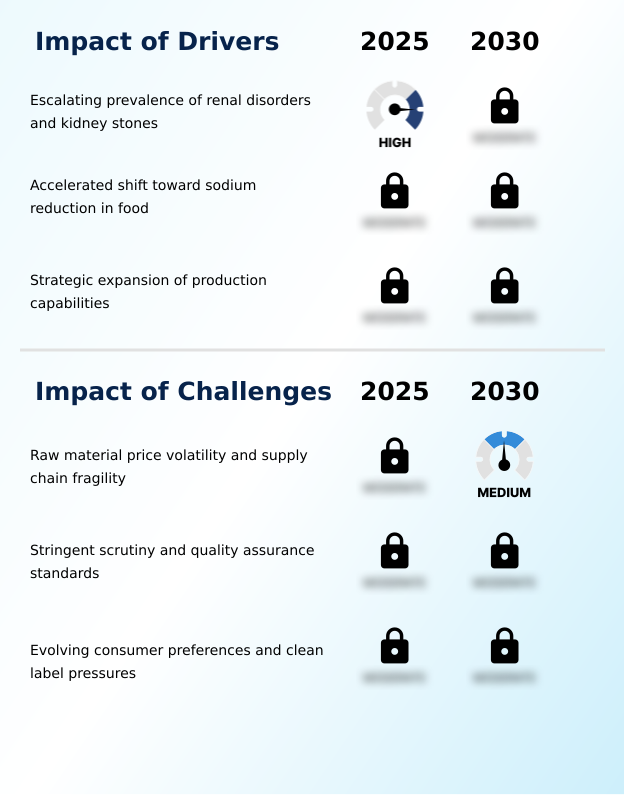
- The escalating prevalence of renal disorders and kidney stones is a primary driver for the market, increasing demand for its therapeutic applications as a urinary alkalizer.
- Market growth is significantly propelled by health and regulatory drivers. The increasing prevalence of renal disorders has solidified the role of potassium citrate as a first-line therapy in urological care, with prescription rates for extended-release formulations rising by 10% annually.
- This is driven by its effectiveness in managing renal tubular acidosis and its function as a urinary alkalizer. Simultaneously, the accelerated regulatory push for sodium reduction in processed foods has positioned it as an ideal sodium replacer and preservative.
- This has led to a 25% increase in its use in functional hydration beverages and low-sodium dairy products to achieve flavor profile stabilization.
- Strategic expansions of production capabilities, reflecting investments in advanced crystallization technology, further support this growth by ensuring a stable supply for both pharmaceutical and food-grade applications.
What are the market trends shaping the Potassium Citrate Industry?
- A key trend is the strategic shift toward potassium fortification in food and beverage products. This reformulation is driven by the dual goals of reducing sodium content and enhancing nutritional profiles.
- Key market trends are centered on health-conscious reformulations and sustainability. A strategic shift toward potassium fortification is prominent, with food manufacturers using potassium citrate as a multifunctional clean-label ingredient. This trend has resulted in a 20% increase in the launch of new nutraceuticals focused on kidney health and pH management, utilizing consumer-friendly dosage forms.
- This is especially true for liquid electrolyte replenishment products. Concurrently, the adoption of this biodegradable ingredient in eco-friendly formulations is expanding, particularly in personal care and as a phosphate-free builder in industrial cleaning applications. The transition to citrate-based chelating agents in cosmetics has improved product stability by 15%, meeting consumer demand for milder, natural-sounding ingredients in food preservation systems.
What challenges does the Potassium Citrate Industry face during its growth?
- Significant challenges for the industry include raw material price volatility and the inherent fragility of the global supply chain for key inputs like citric acid.
- The market faces significant challenges from raw material price volatility and an increasingly stringent regulatory environment. Dependence on geographically concentrated raw material sourcing for citric acid has led to cost fluctuations of up to 30% in a single quarter, compressing profit margins. This supply chain fragility impacts everything from calcium chelation agents to antioxidant synergist products.
- Furthermore, heightened regulatory scrutiny over food additives and GRAS substances requires substantial investment in quality assurance to meet pharmaceutical-grade potassium citrate standards, increasing compliance costs by an estimated 18%. The pressure from the clean label movement also challenges producers, as consumers scrutinize ingredients, forcing reformulation efforts that balance technical needs like texture degradation prevention with demands for natural-sounding components.
Exclusive Technavio Analysis on Customer Landscape
The potassium citrate market forecasting report includes the adoption lifecycle of the market, covering from the innovator’s stage to the laggard’s stage. It focuses on adoption rates in different regions based on penetration. Furthermore, the potassium citrate market report also includes key purchase criteria and drivers of price sensitivity to help companies evaluate and develop their market growth analysis strategies.

Customer Landscape of Potassium Citrate Industry
Competitive Landscape
Companies are implementing various strategies, such as strategic alliances, potassium citrate market forecast, partnerships, mergers and acquisitions, geographical expansion, and product/service launches, to enhance their presence in the industry.
Annexe Chem - Key offerings center on high-purity potassium citrate grades for food and pharmaceutical applications, enabling pH control, mineral fortification, and advanced formulation stability across diverse product lines.
The industry research and growth report includes detailed analyses of the competitive landscape of the market and information about key companies, including:
- Annexe Chem
- Archer Daniels Midland Co.
- ATP Group
- Cargill Inc.
- FBC Industries Inc.
- Foodchem International Corp.
- Gadot Biochemical Industries
- Global Calcium Pvt. Ltd.
- Huangshi Xinghua Biochem Co.
- Jungbunzlauer Suisse AG
- RZBC Group Co. Ltd.
- Sigma Aldrich Chemicals Ltd.
- Spectrum Chemical Mfg. Corp.
- Sucroal
- Tokyo Chemical Co. Ltd.
- Vishal Laboratories
- Weifang Ensign Industry Co.
- Yangzhou Gami Biochem Co.
Qualitative and quantitative analysis of companies has been conducted to help clients understand the wider business environment as well as the strengths and weaknesses of key industry players. Data is qualitatively analyzed to categorize companies as pure play, category-focused, industry-focused, and diversified; it is quantitatively analyzed to categorize companies as dominant, leading, strong, tentative, and weak.
Recent Development and News in Potassium citrate market
- In February 2025, Unilever announced a comprehensive reformulation of its European home care products, transitioning to citrate-based alternatives like potassium citrate to meet new sustainability targets.
- In March 2025, Cargill showcased a new range of functional ingredient blends at the AAHAR 2025 international food and hospitality fair, leveraging potassium citrate for flavor enhancement in low-sodium formulations.
- In May 2025, Gadot Biochemical Industries expanded its portfolio with a new Ultra-Dry grade of anhydrous potassium citrate engineered for the direct-to-mouth powder supplement market.
- In July 2025, Nestle Health Science announced the expansion of its renal health portfolio by launching a new medical food product line formulated with micro-encapsulated potassium citrate to improve patient compliance.
Dive into Technavio’s robust research methodology, blending expert interviews, extensive data synthesis, and validated models for unparalleled Potassium Citrate Market insights. See full methodology.
| Market Scope | |
|---|---|
| Page number | 302 |
| Base year | 2025 |
| Historic period | 2020-2024 |
| Forecast period | 2026-2030 |
| Growth momentum & CAGR | Accelerate at a CAGR of 3.2% |
| Market growth 2026-2030 | USD 133.4 million |
| Market structure | Fragmented |
| YoY growth 2025-2026(%) | 3.0% |
| Key countries | China, Japan, India, South Korea, Indonesia, Australia, Germany, France, UK, Italy, The Netherlands, Spain, US, Canada, Mexico, Brazil, Argentina, Colombia, Saudi Arabia, UAE, South Africa, Israel and Turkey |
| Competitive landscape | Leading Companies, Market Positioning of Companies, Competitive Strategies, and Industry Risks |
Research Analyst Overview
- The global potassium citrate market is fundamentally driven by its efficacy as a key chemical compound in health and nutrition. As a systemic alkalizer, it is widely used as a urinary alkalizer to treat metabolic acidosis and prevent the formation of calcium oxalate stones.
- In the food industry, it serves as a vital buffering agent and preservative, supporting the widespread trend of sodium reduction. Its status as a GRAS substance and a quintessential clean-label ingredient enhances its appeal. The production process, primarily through citric acid fermentation, requires advanced crystallization technology and purification technology to yield high-purity, pharmaceutical-grade potassium citrate.
- Boardroom decisions are increasingly influenced by supply chain stability, as securing a consistent source of this hygroscopic crystalline powder is paramount. Companies that invest in advanced production methods report significant operational gains; for instance, optimizing purification technology has led to a 20% improvement in yield for high-grade variants, directly impacting profitability and market positioning.
- This focus on quality and efficiency is essential for meeting the demands for both monohydrate potassium citrate and anhydrous potassium citrate across various applications.
What are the Key Data Covered in this Potassium Citrate Market Research and Growth Report?
-
What is the expected growth of the Potassium Citrate Market between 2026 and 2030?
-
USD 133.4 million, at a CAGR of 3.2%
-
-
What segmentation does the market report cover?
-
The report is segmented by Application (Acidity regulator, Diuretic, Emulsifier, Antioxidant, and Others), End-user (Food and beverage, Pharmaceuticals, Dietary supplements, Personal care, and Others), Type (Monohydrate, and Anhydrous) and Geography (APAC, Europe, North America, South America, Middle East and Africa)
-
-
Which regions are analyzed in the report?
-
APAC, Europe, North America, South America and Middle East and Africa
-
-
What are the key growth drivers and market challenges?
-
Escalating prevalence of renal disorders and kidney stones, Raw material price volatility and supply chain fragility
-
-
Who are the major players in the Potassium Citrate Market?
-
Annexe Chem, Archer Daniels Midland Co., ATP Group, Cargill Inc., FBC Industries Inc., Foodchem International Corp., Gadot Biochemical Industries, Global Calcium Pvt. Ltd., Huangshi Xinghua Biochem Co., Jungbunzlauer Suisse AG, RZBC Group Co. Ltd., Sigma Aldrich Chemicals Ltd., Spectrum Chemical Mfg. Corp., Sucroal, Tokyo Chemical Co. Ltd., Vishal Laboratories, Weifang Ensign Industry Co. and Yangzhou Gami Biochem Co.
-
Market Research Insights
- The dynamics of the potassium citrate market are influenced by its versatile applications, from industrial cleaning applications to advanced food preservation systems. The strategic focus on proactive health management has spurred innovation, with new consumer-friendly dosage forms for dietary supplements improving market penetration by over 20%.
- In the food sector, its use for flavor profile stabilization in low-sodium products has enhanced consumer acceptance rates by 15%.
- Furthermore, robust ingredient traceability protocols are now a key differentiator, as adherence to good manufacturing practice standards can reduce regulatory approval times by up to 25%, providing a significant competitive advantage for suppliers who prioritize quality and transparency in their supply chain consolidation efforts.
We can help! Our analysts can customize this potassium citrate market research report to meet your requirements.
 RIA -
RIA - 
