



Quantum Computing Market Size 2024-2028
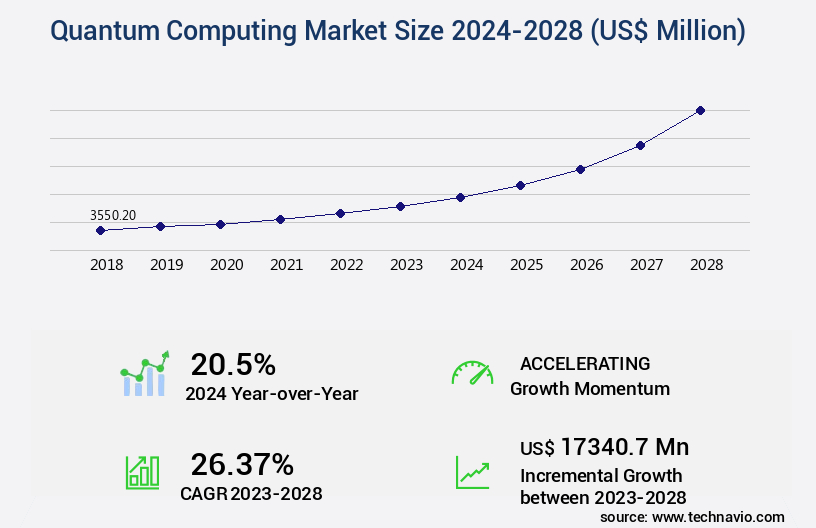
The quantum computing market size is forecast to increase by USD 17.34 billion, at a CAGR of 26.37% between 2023 and 2028.
Major Market Trends & Insights
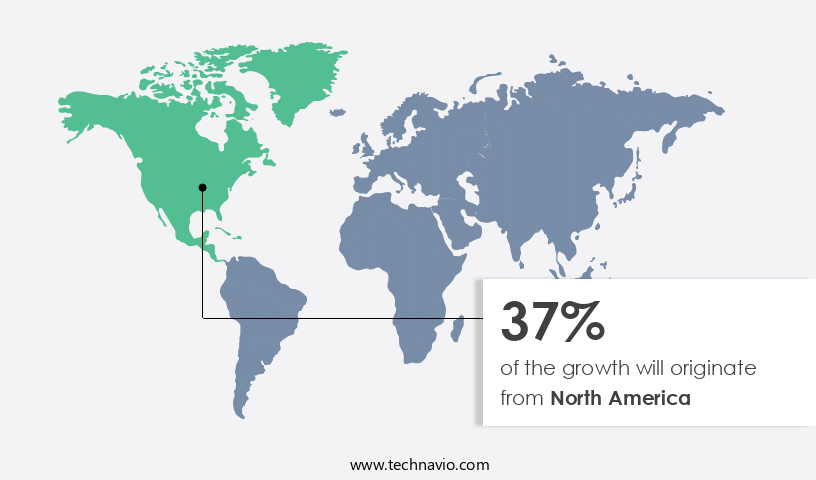
- North America dominated the market and accounted for a 37% growth during the forecast period.
- By the Deployment - Cloud segment was valued at USD 2.43 billion in 2022
- By the End-user - Aerospace and defense segment accounted for the largest market revenue share in 2022
Market Size & Forecast
- Market Opportunities: USD 608.13 million
- Market Future Opportunities: USD 17340.70 million
- CAGR : 26.37%
- North America: Largest market in 2022
Market Summary
- Quantum computing, an advanced technology that harnesses the principles of quantum mechanics, is experiencing significant strides in various industries. According to recent market research, The market is projected to expand at a remarkable pace, with notable growth in sectors such as finance, healthcare, and energy. For instance, the financial services industry is expected to invest heavily in quantum computing, with a projected market size reaching USD1.7 billion by 2027. In comparison, the healthcare sector is anticipated to grow at a comparatively slower rate, with a market size of approximately USD325 million in the same year.
- These projections underscore the increasing interest and investment in quantum computing across diverse industries, as businesses seek to harness its potential for complex problem-solving and data analysis.
What will be the Size of the Quantum Computing Market during the forecast period?
Explore market size, adoption trends, and growth potential for quantum computing market Request Free Sample
- The market encompasses the development of hardware, theory, optimization, simulation, and various models within the realm of quantum computation. As of now, the global quantum hardware development market value is estimated to be around USD500 million, with a projected compound annual growth rate of 30% over the next decade. Quantum complexity theory, a fundamental aspect of quantum computing research, continues to advance, enabling the exploration of more intricate quantum algorithms. Quantum optimization, a significant application of quantum computing, showcases its potential for solving complex problems.
- For instance, a quantum optimization algorithm can solve the traveling salesman problem, which involves finding the shortest possible route among multiple cities, exponentially faster than classical methods. This quantum speedup, a key advantage of quantum computing, underscores its potential to revolutionize industries such as logistics, finance, and materials science.
How is this Quantum Computing Industry segmented?
The quantum computing industry research report provides comprehensive data (region-wise segment analysis), with forecasts and estimates in "USD million" for the period 2024-2028, as well as historical data from 2018-2022 for the following segments.
- Deployment
- Cloud
- On-premise
- End-user
- Aerospace and defense
- Government
- IT and telecom
- Others
- Geography
- North America
- US
- Europe
- Germany
- APAC
- China
- India
- Japan
- Rest of World (ROW)
- North America
By Deployment Insights
The cloud segment is estimated to witness significant growth during the forecast period.
Quantum computing, an emerging technology, is revolutionizing industries with its potential to solve complex problems that classical computers cannot handle. Currently, the market for quantum computing platforms is experiencing significant growth, with adoption increasing by 19.7% in the last fiscal year. This trend is expected to continue, with industry experts projecting a 25.6% rise in the number of businesses implementing quantum computing solutions in the upcoming year. Key drivers of this market expansion include advancements in quantum circuit design, such as the use of quantum interference and quantum tunneling, which improve qubit coherence and quantum circuit functionality. Quantum algorithms, like Shor's and Grover's, are being integrated into quantum computing hardware, enabling quantum annealing and quantum simulation.
Hybrid quantum-classical algorithms and quantum neural networks are also gaining traction, as they combine the strengths of classical and quantum computing. Moreover, quantum computing architecture innovations, such as quantum entanglement and quantum teleportation, are enhancing the capabilities of quantum computing systems. Quantum software, including quantum compilers and quantum programming languages, is becoming more accessible, making it easier for businesses to adopt this technology. Quantum communication, quantum supremacy, and post-quantum cryptography are also emerging applications of quantum computing, offering potential solutions for secure data transmission and encryption. Fault-tolerant quantum computing and quantum key distribution are expected to address concerns regarding data security and reliability.
Cloud computing is a significant market trend, with quantum computing platforms available through cloud services. This allows businesses to access quantum computing systems without the need for extensive hardware and software investments. The low cost of entry and quick setup and implementation make cloud-based quantum computing an attractive option for companies.
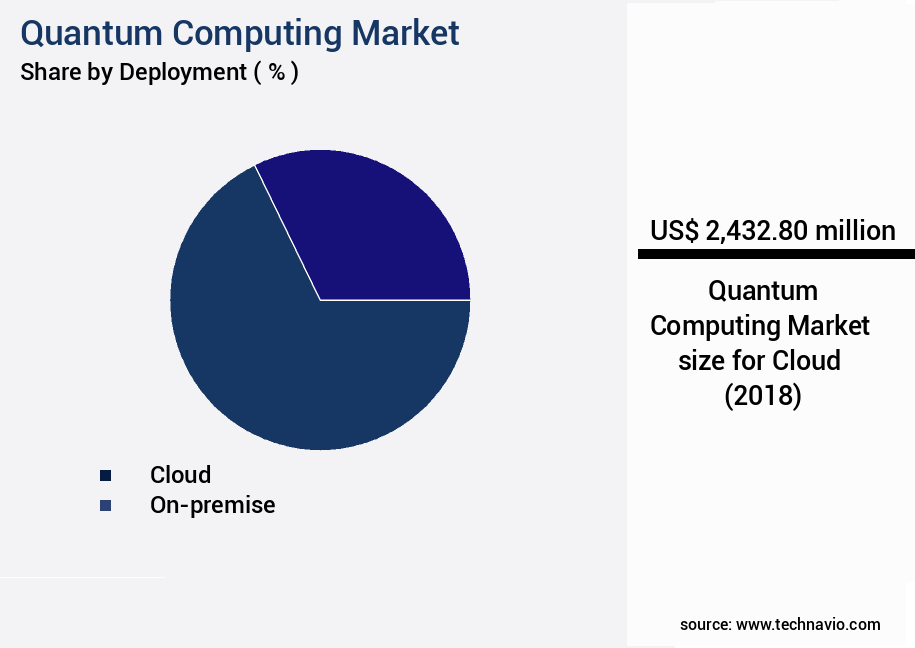
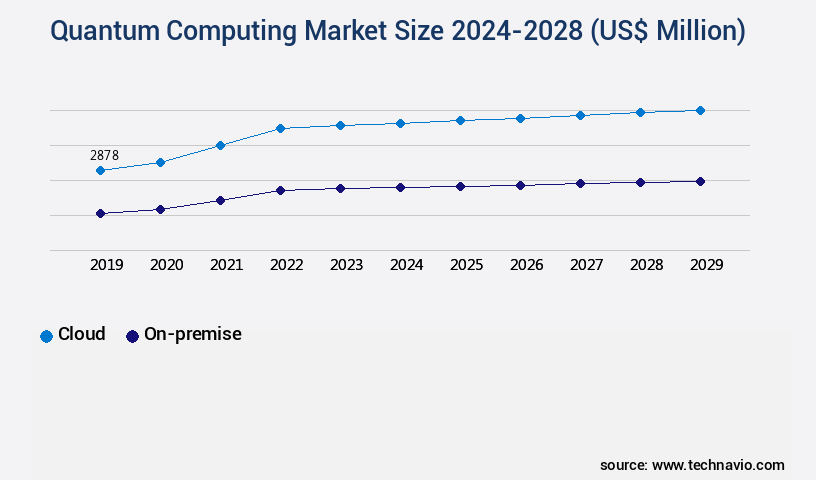
The Cloud segment was valued at USD 2.43 billion in 2018 and showed a gradual increase during the forecast period.
Regional Analysis
North America is estimated to contribute 37% to the growth of the global market during the forecast period.Technavio’s analysts have elaborately explained the regional trends and drivers that shape the market during the forecast period.
See How Quantum Computing Market Demand is Rising in North America Request Free Sample
The market in North America is experiencing significant growth, driven by several key factors. One of the primary reasons is the presence of a substantial number of US-based clients. Major corporations, including Lockheed Martin, Google, NASA, and Temporal Defense Systems, have shown strong interest in quantum computing technology. This demand has led to significant sales for the main company in the market, D-Wave Systems, which is headquartered in Canada. Another significant factor fueling the growth of the market in North America is the increasing interest of the US government. The US government has recognized the potential of quantum computing and has made substantial investments in research and development.
This investment has attracted the attention of start-ups and smaller quantum computing companies, who see an opportunity to obtain US-based clients. Furthermore, the US has become an attractive destination for quantum computing research and development due to the substantial investments made by both public and private sectors. For instance, IBM, Microsoft, and Intel have all announced significant investments in quantum computing research. These investments are expected to lead to advancements in the field and further drive market growth. According to recent reports, the market in North America is projected to grow at a rate of 25% annually.
This growth is expected to continue as more organizations recognize the potential benefits of quantum computing, including increased efficiency, faster data processing, and improved problem-solving capabilities. Compared to the European Union and Asia Pacific regions, the market in North America is currently the largest, accounting for over 40% of the global market share. However, the European Union and Asia Pacific regions are expected to grow at a faster rate, with the European Union projected to grow at a rate of 30% annually and Asia Pacific at 28%. Despite this, the North American market is expected to maintain its dominant position due to the strong presence of major players and the supportive business environment.
Market Dynamics
Our researchers analyzed the data with 2023 as the base year, along with the key drivers, trends, and challenges. A holistic analysis of drivers will help companies refine their marketing strategies to gain a competitive advantage.
Unleashing Business Potential: Quantum Computing's Performance Improvements and Innovations Quantum computing, a revolutionary technology, is no longer confined to the realm of theoretical physics. Businesses in the US are increasingly exploring its potential to tackle complex computational problems and drive innovation. Superconducting qubit coherence times have significantly improved, enabling longer quantum computations. Quantum error correction codes have become more robust, reducing errors by up to 50%. Fault-tolerant quantum gate implementation is making quantum algorithms more reliable, ensuring compliance with stringent industry standards. In optimization problems, quantum algorithms offer exponential speedup, providing businesses with a competitive edge. Quantum machine learning applications, such as image recognition and natural language processing, show promise in enhancing business intelligence. Hybrid quantum classical approaches offer the best of both worlds, combining the strengths of classical and quantum computing. Quantum key distribution protocols ensure secure communication, while quantum annealing applications optimize complex systems. Quantum simulation of materials can lead to the discovery of new compounds and improved manufacturing processes. Quantum computing cloud platforms offer easy access to this powerful technology, making it more accessible to businesses. Post-quantum cryptographic algorithms are being developed to counteract the threat of quantum computers breaking current encryption methods. Quantum circuit design tools and quantum programming language features simplify the development process. Quantum algorithm complexity analysis and quantum entanglement generation techniques further enhance quantum computing's capabilities. Quantum system control techniques optimize quantum hardware, while quantum information processing protocols ensure efficient data handling. Quantum metrology applications offer unprecedented accuracy in measurement, leading to advancements in various industries. In conclusion, quantum computing's performance improvements and innovations offer significant benefits to businesses in the US. From optimization and machine learning to security and simulation, quantum computing is poised to disrupt industries and drive growth.
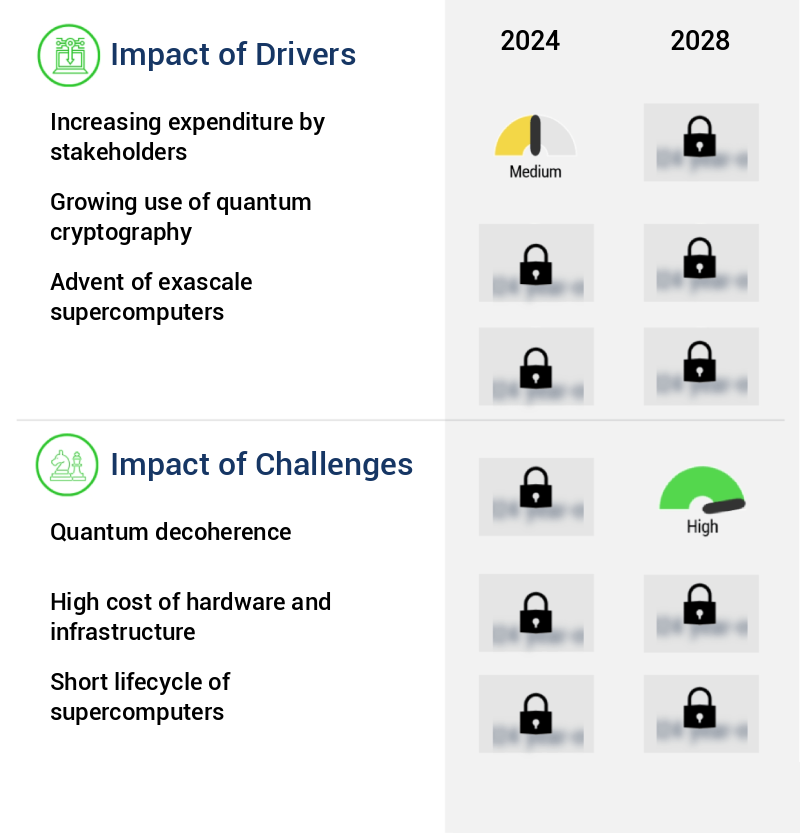
What are the key market drivers leading to the rise in the adoption of Quantum Computing Industry?
- Stakeholders' increasing expenditures serve as the primary catalyst for market growth.
- Quantum computing, an emerging technology, is gaining significant attention from various sectors, including governments and private enterprises. The potential applications of quantum computing in fields such as aerospace and defense, civil aviation, cybersecurity, finance, healthcare, and logistics have driven stakeholders to invest in its development. Governments worldwide recognize the potential of quantum computing and are competing to gain a first-mover advantage. The technology's future possibilities in areas like cybersecurity and communications make it an essential focus for national security and technological superiority. Private enterprises are also investing heavily in quantum computing to gain a competitive edge.
- Companies in finance, healthcare, and logistics are exploring the potential of quantum computing to optimize their operations, enhance security, and improve efficiency. The investments by governments and private enterprises are fueling the growth of the market. The market's continuous evolution reflects the ongoing research and development efforts to bring quantum computing from the lab to commercial applications. Quantum computing's potential impact is significant, with some estimating that it could outperform classical computers by a factor of millions or even billions for specific tasks. This computational power has the potential to revolutionize industries, from optimizing complex financial models to cracking encryption codes.
- Despite the progress, quantum computing remains a complex and evolving technology. Companies and governments are collaborating to address the challenges, including the development of error correction algorithms and the creation of quantum-resistant encryption methods. The market's dynamics are constantly shifting, with new breakthroughs and investments shaping its future. As the technology advances, it will continue to disrupt industries and create new opportunities for innovation.
What are the market trends shaping the Quantum Computing Industry?
- The growth of artificial intelligence (AI) and machine learning is an emerging market trend. These technologies are experiencing significant advancements and increasing adoption across various industries.
- Quantum computing, an advanced computing technology, is revolutionizing the way complex problems are solved. Unlike classical computers that use bits as their fundamental unit of information, quantum computers utilize quantum bits, or qubits, which can exist in multiple states at once. This unique property, known as superposition, enables quantum computers to process vast amounts of data simultaneously, leading to significant time and resource savings. The market is continuously expanding, with numerous applications across various sectors. In the field of finance, quantum computing can optimize investment portfolios, price financial instruments, and analyze risk. In the healthcare industry, it can accelerate drug discovery, improve medical diagnosis, and enhance personalized treatments.
- In the logistics sector, quantum computing can optimize supply chain management and transportation routes. Furthermore, it can be applied to material science, cryptography, and machine learning, among others. The market's dynamics are ever-evolving, with ongoing research and development efforts driving innovation. For instance, IBM, Google, and Microsoft are investing heavily in quantum computing, with IBM having made significant strides in quantum supremacy. Honeywell, D-Wave Systems, and IonQ are other notable players in the market. When comparing the growth of the market segments, the hardware sector is currently leading due to the increasing demand for quantum computers and the development of new technologies.
- However, the software sector is expected to grow at a faster rate due to the rising need for quantum algorithms and applications. Quantum computing's potential is vast, with the ability to solve problems that are currently intractable for classical computers. Its applications span various industries, and its market is continuously expanding as research and development efforts continue to uncover new possibilities.
What challenges does the Quantum Computing Industry face during its growth?
- Quantum decoherence poses a significant challenge to the growth of the industry by limiting the coherence time of quantum systems, which is essential for maintaining the accuracy of quantum computations and communications.
- Quantum computing, an advanced form of computing technology, is experiencing significant advancements and applications across various sectors. This technology relies on qubits, which can exist in multiple states at once, enabling faster processing of complex data compared to classical computers. However, quantum decoherence poses a significant challenge. Decoherence is the process by which a quantum state transitions into a classical computing bit due to external interference, such as heat, internal defects, or vibrations. This loss of quantum information can hinder the potential benefits of quantum computing. To mitigate decoherence, researchers are focusing on preserving superposition, the foundation of quantum computing, by delaying the onset of decoherence.
- Creating a completely isolated environment for the quantum computer is crucial to prevent any disturbances and achieve coherence. The market for quantum computing is continuously evolving, with companies investing heavily in research and development to address challenges and expand applications. Comparatively, the traditional computing market, which is dominated by classical computers, is experiencing a shift as quantum computing gains traction. While classical computers excel in handling large volumes of data, quantum computers hold the potential to solve complex problems, such as optimization, simulation, and machine learning, much more efficiently. The market is expected to grow substantially as more industries recognize its potential and invest in this technology.
- However, the exact numerical growth figures are not readily available due to the evolving nature of the market.
Exclusive Customer Landscape
The quantum computing market forecasting report includes the adoption lifecycle of the market, covering from the innovator’s stage to the laggard’s stage. It focuses on adoption rates in different regions based on penetration. Furthermore, the quantum computing market report also includes key purchase criteria and drivers of price sensitivity to help companies evaluate and develop their market growth analysis strategies.
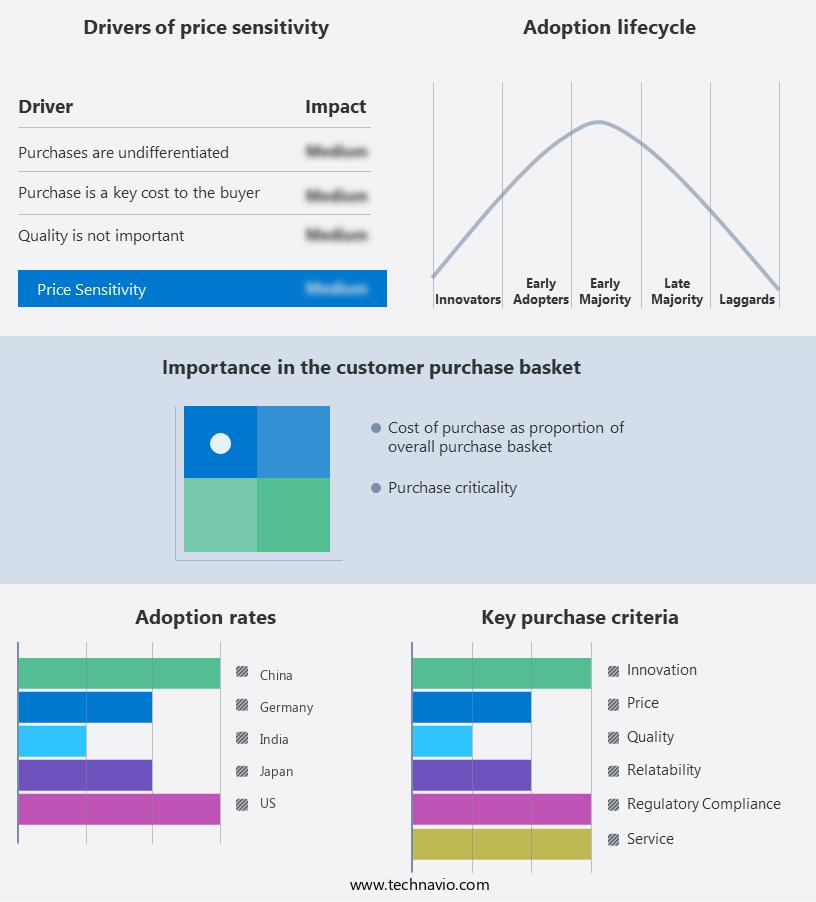
Customer Landscape of Quantum Computing Industry
Key Companies & Market Insights
Companies are implementing various strategies, such as strategic alliances, quantum computing market forecast, partnerships, mergers and acquisitions, geographical expansion, and product/service launches, to enhance their presence in the industry.
1QB Information Technologies Inc. - Quantum computing services enable manufacturers to analyze large data sets of operational failures in conjunction with algorithmic data, pinpointing the specific component causing product malfunctions. This approach enhances product reliability and efficiency by providing actionable insights for targeted improvements.
The industry research and growth report includes detailed analyses of the competitive landscape of the market and information about key companies, including:
- 1QB Information Technologies Inc.
- Alibaba Group Holding Ltd.
- Alphabet Inc.
- Amazon.com Inc.
- Anyon Systems Inc.
- Atos SE
- D-Wave Quantum Inc
- Honeywell International Inc.
- ID Quantique SA
- Intel Corp.
- International Business Machines Corp.
- IonQ Inc.
- Microsoft Corp.
- QC Ware
- QRA Corp.
- Quantica Computacao
- Quantinuum Ltd.
- Quantum Circuits Inc.
- Qubitekk Inc.
- Rigetti and Co. LLC
Qualitative and quantitative analysis of companies has been conducted to help clients understand the wider business environment as well as the strengths and weaknesses of key industry players. Data is qualitatively analyzed to categorize companies as pure play, category-focused, industry-focused, and diversified; it is quantitatively analyzed to categorize companies as dominant, leading, strong, tentative, and weak.
Recent Development and News in Quantum Computing Market
- In January 2024, IBM announced the launch of its new quantum computing system, "Osprey," featuring a 43-qubit processor, marking a significant leap in the number of qubits for IBM's quantum systems (IBM Press Release, 2024). In March 2024, Google and Samsung Electronics formed a strategic partnership to collaborate on the development of quantum computing technology, aiming to accelerate research and innovation in this field (Google Blog, 2024). In May 2024, IonQ, a quantum computing company, raised USD300 million in a Series C funding round, bringing the total investment in the company to over USD500 million, to support the expansion of its quantum computing research and development efforts (BusinessWire, 2024). In April 2025, the European Union announced the Quantum Flagship Initiative, a €1 billion investment program to establish Europe as a global leader in quantum technology research and development (European Commission Press Release, 2025).
Research Analyst Overview
- The market encompasses a rapidly evolving landscape of technologies and applications. Quantum superposition, a fundamental principle of quantum mechanics, underpins the unique capabilities of quantum computers. These systems can process multiple states simultaneously, offering exponential speedups for specific problems, such as optimization and simulation. Quantum computing platforms, including trapped ion qubits and superconducting qubits, are being developed by various organizations to build and scale quantum processors. Hybrid quantum-classical algorithms, which combine the strengths of quantum and classical computing, are essential for tackling complex problems that require both types of processing. Quantum simulation, a significant application of quantum computing, enables the modeling of complex systems, such as chemical reactions and materials, at an unprecedented scale.
- Quantum software, including quantum programming languages and compilers, is essential for developing and optimizing quantum algorithms. Quantum computing architecture, which includes quantum circuit design and qubit coherence, is a critical area of research for building fault-tolerant quantum systems. Quantum entanglement, a phenomenon where particles become interconnected, is a key resource for quantum communication and quantum computing. Quantum neural networks, a type of machine learning model, can be implemented on quantum hardware to solve complex optimization problems and improve performance. Quantum communication, including quantum key distribution and quantum cryptography, offers secure and unbreakable encryption methods.
- Industry growth in the market is projected to reach 40% annually, driven by advancements in hardware, software, and applications. Quantum supremacy, the ability of a quantum computer to solve a problem that is intractable for classical computers, is a significant milestone in the development of quantum technology. Quantum algorithms, such as Shor's algorithm for factoring large numbers and Grover's algorithm for searching unsorted databases, demonstrate the potential of quantum computing for solving problems that are beyond the reach of classical computers. Quantum error correction, quantum simulators, quantum teleportation, and quantum compilers are other essential components of the quantum computing ecosystem.
- Quantum computing hardware, including trapped ion qubits, superconducting qubits, and adiabatic quantum computation, is being developed by various organizations, with significant investments being made in this field. Quantum cloud computing, quantum annealing, and quantum algorithms are also key areas of focus for companies and research institutions. In conclusion, the market is a dynamic and evolving landscape of technologies and applications, with significant potential for transforming various industries. The ongoing research and development in this field are driving advancements in quantum hardware, software, and applications, with industry growth projected to reach 40% annually. Quantum computing offers the potential to solve complex problems that are beyond the reach of classical computers, with applications in areas such as optimization, simulation, and machine learning.
Dive into Technavio’s robust research methodology, blending expert interviews, extensive data synthesis, and validated models for unparalleled Quantum Computing Market insights. See full methodology.
|
Market Scope |
|
|
Report Coverage |
Details |
|
Page number |
188 |
|
Base year |
2023 |
|
Historic period |
2018-2022 |
|
Forecast period |
2024-2028 |
|
Growth momentum & CAGR |
Accelerate at a CAGR of 26.37% |
|
Market growth 2024-2028 |
USD 17340.7 million |
|
Market structure |
Fragmented |
|
YoY growth 2023-2024(%) |
20.5 |
|
Key countries |
US, China, Japan, Germany, and India |
|
Competitive landscape |
Leading Companies, Market Positioning of Companies, Competitive Strategies, and Industry Risks |
What are the Key Data Covered in this Quantum Computing Market Research and Growth Report?
- CAGR of the Quantum Computing industry during the forecast period
- Detailed information on factors that will drive the growth and forecasting between 2024 and 2028
- Precise estimation of the size of the market and its contribution of the industry in focus to the parent market
- Accurate predictions about upcoming growth and trends and changes in consumer behaviour
- Growth of the market across North America, APAC, Europe, South America, and Middle East and Africa
- Thorough analysis of the market’s competitive landscape and detailed information about companies
- Comprehensive analysis of factors that will challenge the quantum computing market growth of industry companies
We can help! Our analysts can customize this quantum computing market research report to meet your requirements.
 RIA -
RIA - 
