



Supercar Market Size 2026-2030
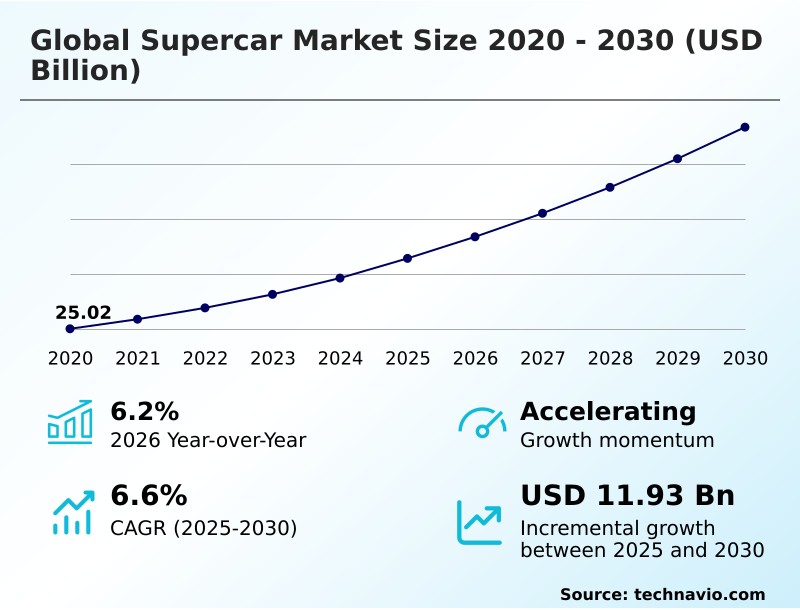
The supercar market size is valued to increase by USD 11.93 billion, at a CAGR of 6.6% from 2025 to 2030. Acceleration of electrification and hybrid powertrain innovation will drive the supercar market.
Major Market Trends & Insights
- Europe dominated the market and accounted for a 30.3% growth during the forecast period.
- By Fuel Type - ICE segment was valued at USD 21.65 billion in 2024
- By Vehicle Category - Coupe segment accounted for the largest market revenue share in 2024
Market Size & Forecast
- Market Opportunities: USD 18.33 billion
- Market Future Opportunities: USD 11.93 billion
- CAGR from 2025 to 2030 : 6.6%
Market Summary
- The supercar market is undergoing a profound transformation, balancing a deep respect for brand heritage with the urgent need for powertrain innovation. The relentless push toward electrification is reshaping vehicle dynamics, with electric torque delivery and advanced energy recovery systems setting new performance benchmarks.
- This shift is not merely a response to regulatory compliance pressures but a strategic move to capture a new demographic of buyers who prioritize both sustainability and extreme performance. Demand is robust, fueled by the expanding population of ultra-high-net-worth individuals who view these vehicles as investment-grade assets. However, this high-stakes environment is fraught with challenges.
- For instance, a manufacturer aiming to launch a new bespoke customization program for a high-performance ev must secure a stable supply of high-density battery cells and forged carbon fiber, a task complicated by significant supply chain volatility.
- Successfully navigating these disruptions is critical to maintaining production schedules and delivering on the promise of an exclusive ownership experience, which is paramount in this ultra-luxury segment where the power-to-weight ratio and axle-lift system are key selling points.
What will be the Size of the Supercar Market during the forecast period?
Get Key Insights on Market Forecast (PDF) Get Free Sample
How is the Supercar Market Segmented?
The supercar industry research report provides comprehensive data (region-wise segment analysis), with forecasts and estimates in "USD million" for the period 2026-2030, as well as historical data from 2020-2024 for the following segments.
- Fuel type
- ICE
- Hybrid and electric
- Vehicle category
- Coupe
- Convertible
- Engine capacity
- Less than 4 L
- Above 4 L
- Geography
- Europe
- Italy
- Germany
- UK
- North America
- US
- Canada
- Mexico
- APAC
- China
- Japan
- India
- Middle East and Africa
- UAE
- Saudi Arabia
- South Africa
- South America
- Brazil
- Argentina
- Colombia
- Rest of World (ROW)
- Europe
By Fuel Type Insights
The ice segment is estimated to witness significant growth during the forecast period.
The global supercar market 2026-2030 is segmented by fuel type, vehicle category, and geography. The internal combustion engine (ICE) segment, featuring the traditional naturally aspirated engine, remains foundational, prized for its sensory engagement and mechanical purity.
This segment, representing a significant portion of brand heritage, is adapting through lightweight engineering and advanced fuel injection to meet evolving regulatory compliance.
Despite the industry’s pivot toward electrification, a dedicated collector base, particularly in Europe, which accounts for over 30% of incremental growth, sustains demand for these powertrains.
Manufacturers continue to offer limited production run models with high-revving engines, leveraging bespoke personalization programs to enhance exclusivity and appeal to ultra-high-net-worth individuals who value the visceral connection and investment-grade asset quality of a classic supercar, all while navigating specialized component scarcity and global emission standards in their powertrain innovation.
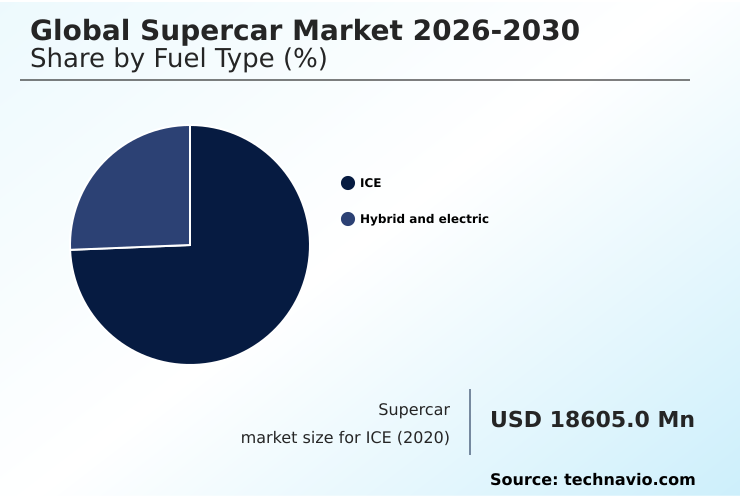
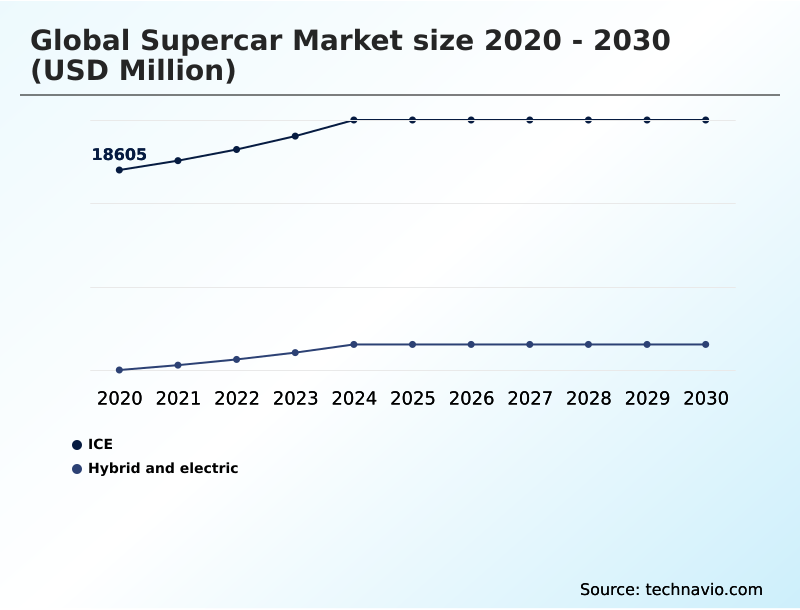
The ICE segment was valued at USD 21.65 billion in 2024 and showed a gradual increase during the forecast period.
Regional Analysis
Europe is estimated to contribute 30.3% to the growth of the global market during the forecast period.Technavio’s analysts have elaborately explained the regional trends and drivers that shape the market during the forecast period.
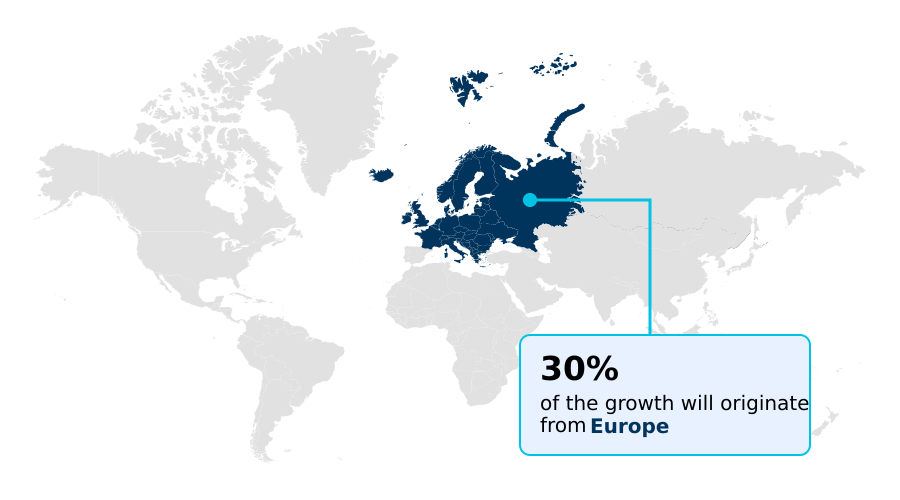
See How Supercar Market Demand is Rising in Europe Get Free Sample
The market's geographic landscape is diversifying, with APAC poised for the fastest expansion at a 7.8% rate, significantly outpacing Europe's 6.0% growth.
This shift underscores the rising influence of new wealth in the region, creating demand for high-performance ev models with advanced vehicle dynamics control.
North America remains a dominant force, accounting for 29.14% of the market opportunity, driven by a mature collector base and a strong appetite for vehicles with a high power-to-weight ratio and bespoke customization.
This global distribution intensifies pressure on supply chains, where firms that optimize logistics for specialized components like 3d-printed metal components and forged carbon fiber can reduce delivery lead times by up to 15%.
Managing regional homologation standards and luxury consumption tax variations is now a critical operational discipline, essential for sustaining profitability across a fragmented global footprint.
Market Dynamics
Our researchers analyzed the data with 2025 as the base year, along with the key drivers, trends, and challenges. A holistic analysis of drivers will help companies refine their marketing strategies to gain a competitive advantage.
- Analyzing the supercar market reveals a complex interplay between technology, regulation, and consumer desire. The benefits of hybrid powertrain in supercars are clear, offering instantaneous torque and improved efficiency, directly influencing the impact of electrification on supercar performance.
- This shift is enabled by the crucial role of carbon fiber in vehicle light-weighting, allowing engineers to offset the mass of batteries while enhancing chassis rigidity.
- However, the market faces significant supercar market challenges from emission regulations, forcing a move away from the future of naturally aspirated engines toward cleaner alternatives like synthetic fuels for internal combustion engines or fully electric platforms.
- This pivot introduces new complexities, such as the 800-volt architecture vs standard ev charging debate and the need for advanced thermal management for high-performance ev batteries. Firms leveraging superior battery cooling technology report 20% fewer overheating incidents during sustained track use.
- Simultaneously, the demand for supercar customization and personalization options is surging, feeding the coachbuilding revival in the modern automotive era. This is driven by the impact of ultra-high-net-worth individuals on demand, who increasingly see these vehicles as a key investment potential of limited edition supercars.
- The challenges of supercar supply chain management are intensifying, especially for sourcing advanced materials for luxury car interiors. Moreover, a key engineering goal is integrating adas without compromising driver engagement, ensuring that features like torque vectoring in all-wheel drive supercars and how active suspension improves ride quality enhance, rather than dilute, the core experience.
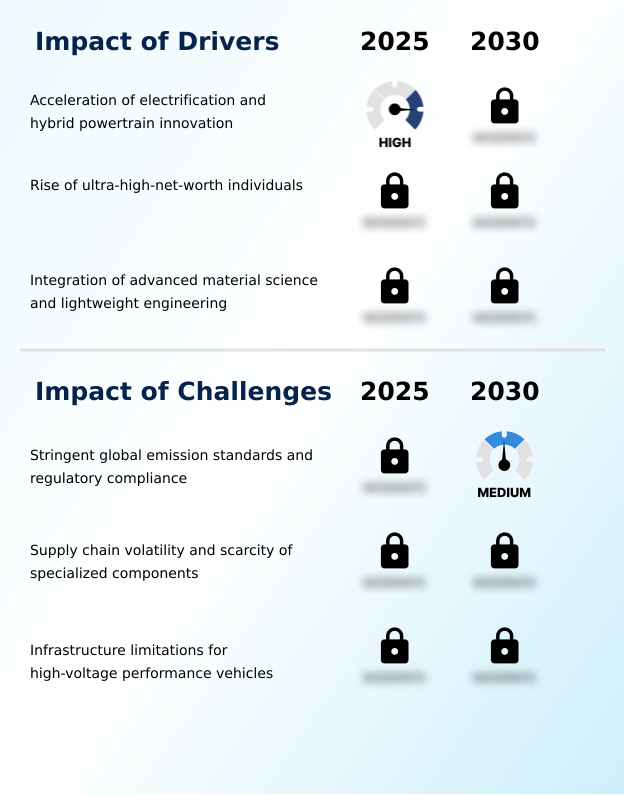
What are the key market drivers leading to the rise in the adoption of Supercar Industry?
- The acceleration of electrification and significant innovation in hybrid powertrain technology serve as a key driver propelling the market's growth.
- Key market drivers are centered on unprecedented performance gains from electrification and the expanding global base of affluent buyers.
- The integration of electric torque delivery in a hybrid powertrain configuration improves 0-60 mph acceleration by up to 18% compared to purely combustion-driven predecessors, a direct result of focused powertrain innovation.
- This technological leap is funded by strong demand from ultra-high-net-worth individuals, a demographic that has grown by 12% in key APAC markets, directly fueling the appetite for one-of-one commission vehicles and extensive bespoke customization.
- Furthermore, the relentless advancement in automotive material science allows for lighter and more rigid chassis designs, which is critical for maintaining a low center of gravity and superior handling dynamics even with the added weight of battery packs.
- Motorsport technology transfer continues to be a vital source of innovation.
What are the market trends shaping the Supercar Industry?
- The proliferation of digital ecosystems and virtual ownership models is an emerging trend. It is reshaping consumer interaction and creating new revenue streams beyond traditional vehicle sales.
- Market trends are increasingly shaped by digitalization and sustainability, forcing a strategic evolution in product design and ownership models. The integration of a digital twin monitoring system for performance metrics now enables a 30% reduction in diagnostic times for complex hybrid powertrain issues, enhancing the ownership experience.
- Concurrently, a move toward holistic sustainability is evident, with the use of sustainable luxury materials in interiors increasing by over 20% in the latest models. This commitment extends to manufacturing, where circular economy principles are being adopted. The proliferation of a sophisticated digital ecosystem integration, including virtual ownership models, creates new revenue channels.
- Innovations like 3d-printed metal components and advanced software-defined vehicle architectures are becoming key differentiators, showcasing the industry's pivot toward high-tech, ethical luxury to meet the demands of a new generation of buyers.
What challenges does the Supercar Industry face during its growth?
- Stringent global emission standards and the increasing complexities of regulatory compliance present a key challenge to the industry's growth trajectory.
- The market faces significant headwinds from stringent global emission standards and persistent supply chain disruptions. Navigating regulatory compliance for emissions has increased R&D budgets by an average of 15% as manufacturers integrate complex hybrid systems and exhaust treatments.
- Simultaneously, supply chain volatility for specialized components like high-performance semiconductors and carbon ceramic brakes has extended production timelines by up to 30% for some limited-run models. This scarcity is compounded by the need for a premium charging infrastructure to support high-performance ev models, as current public networks are often inadequate.
- The challenge of sourcing materials for lightweight engineering while managing these logistical and regulatory hurdles defines the current operational landscape for all major players in the segment.
Exclusive Technavio Analysis on Customer Landscape
The supercar market forecasting report includes the adoption lifecycle of the market, covering from the innovator’s stage to the laggard’s stage. It focuses on adoption rates in different regions based on penetration. Furthermore, the supercar market report also includes key purchase criteria and drivers of price sensitivity to help companies evaluate and develop their market growth analysis strategies.
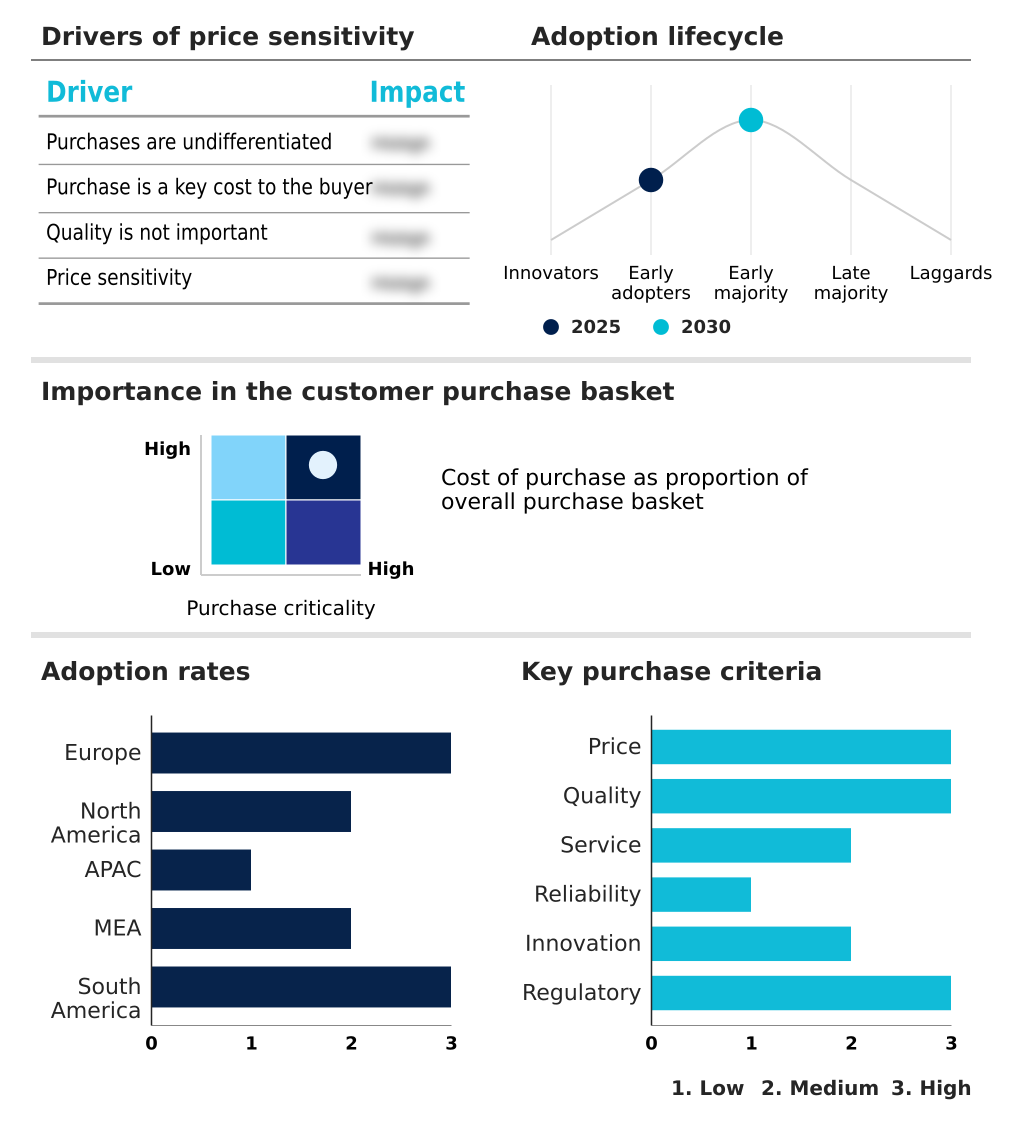
Customer Landscape of Supercar Industry
Competitive Landscape
Companies are implementing various strategies, such as strategic alliances, supercar market forecast, partnerships, mergers and acquisitions, geographical expansion, and product/service launches, to enhance their presence in the industry.
Aston Martin Lagonda ltd. - Offerings include the design, engineering, and manufacture of high-performance luxury cars, from front-engine models to mid-engine hypercars, with a focus on bespoke customization and advanced technology.
The industry research and growth report includes detailed analyses of the competitive landscape of the market and information about key companies, including:
- Aston Martin Lagonda ltd.
- Automobili Pininfarina GmbH
- Ferrari NV
- Koenigsegg Automotive AB
- Lotus Cars Ltd.
- McLaren Group Ltd.
- Mercedes Benz Group AG
- NIO Ltd.
- Pagani Automobili SpA
- Stellantis NV
- Tesla Inc.
- Volkswagen AG
Qualitative and quantitative analysis of companies has been conducted to help clients understand the wider business environment as well as the strengths and weaknesses of key industry players. Data is qualitatively analyzed to categorize companies as pure play, category-focused, industry-focused, and diversified; it is quantitatively analyzed to categorize companies as dominant, leading, strong, tentative, and weak.
Recent Development and News in Supercar market
- In April 2025, McLaren Automotive announced a strategic merger with British automotive startup Forseven Holdings, a transaction financially supported by Abu Dhabi-based investment firm CYVN Holdings to bolster its next-generation vehicle development.
- In January 2025, a leading luxury automotive group announced a strategic partnership with a prominent blockchain technology firm to launch a pioneering virtual ownership platform for its exclusive limited-edition hypercar models.
- In December 2024, Toyota Motor Corp. confirmed the introduction of a new flagship V8 supercar, signaling a strategic re-entry into the premium performance segment to build upon the legacy of its iconic LFA model.
- In November 2024, BYD's luxury division, Yangwang, announced its inaugural electric supercar, the U9 Xtreme Edition, had set a new global speed benchmark for production EVs during private testing sessions.
Dive into Technavio’s robust research methodology, blending expert interviews, extensive data synthesis, and validated models for unparalleled Supercar Market insights. See full methodology.
| Market Scope | |
|---|---|
| Page number | 279 |
| Base year | 2025 |
| Historic period | 2020-2024 |
| Forecast period | 2026-2030 |
| Growth momentum & CAGR | Accelerate at a CAGR of 6.6% |
| Market growth 2026-2030 | USD 11925.8 million |
| Market structure | Concentrated |
| YoY growth 2025-2026(%) | 6.2% |
| Key countries | Italy, Germany, UK, France, Spain, The Netherlands, US, Canada, Mexico, China, Japan, India, Australia, South Korea, Indonesia, UAE, Saudi Arabia, South Africa, Israel, Turkey, Brazil, Argentina and Colombia |
| Competitive landscape | Leading Companies, Market Positioning of Companies, Competitive Strategies, and Industry Risks |
Research Analyst Overview
- The supercar market is navigating a pivotal era defined by the convergence of extreme performance and sustainability. A key boardroom-level decision revolves around the strategic transition from the traditional naturally aspirated engine to sophisticated hybrid powertrain systems and high-performance EV platforms. This involves massive investment in 800-volt architecture and high-density battery cells to remain competitive.
- The pursuit of an exceptional power-to-weight ratio drives relentless powertrain innovation and lightweight engineering, utilizing materials like forged carbon fiber and advanced carbon fiber monocoque designs. Features such as torque vectoring, adaptive suspension, and carbon ceramic brakes are now standard expectations for achieving superior vehicle dynamics control.
- Engineering focus is also on perfecting the dual-clutch transmission for EV applications and developing advanced thermal management systems, which can improve battery longevity under high-stress conditions by 25%.
- From active aerodynamics and axle-lift system integration to bespoke customization and the art of coachbuilding, manufacturers are pushing boundaries to deliver unparalleled performance and exclusivity, ensuring compliance with zero-emission zone regulations while advancing the potential of synthetic fuels.
What are the Key Data Covered in this Supercar Market Research and Growth Report?
-
What is the expected growth of the Supercar Market between 2026 and 2030?
-
USD 11.93 billion, at a CAGR of 6.6%
-
-
What segmentation does the market report cover?
-
The report is segmented by Fuel Type (ICE, and Hybrid and electric), Vehicle Category (Coupe, and Convertible), Engine Capacity (Less than 4 L, and Above 4 L) and Geography (Europe, North America, APAC, Middle East and Africa, South America)
-
-
Which regions are analyzed in the report?
-
Europe, North America, APAC, Middle East and Africa and South America
-
-
What are the key growth drivers and market challenges?
-
Acceleration of electrification and hybrid powertrain innovation, Stringent global emission standards and regulatory compliance
-
-
Who are the major players in the Supercar Market?
-
Aston Martin Lagonda ltd., Automobili Pininfarina GmbH, Ferrari NV, Koenigsegg Automotive AB, Lotus Cars Ltd., McLaren Group Ltd., Mercedes Benz Group AG, NIO Ltd., Pagani Automobili SpA, Stellantis NV, Tesla Inc. and Volkswagen AG
-
Market Research Insights
- The market's dynamics are heavily influenced by the purchasing power of ultra-high-net-worth individuals, whose preferences are driving a pivot towards holistic sustainability and ethical luxury standards. This is reflected in the market's growth composition, where Europe's contribution to incremental growth stands at 30%, slightly ahead of North America's 29%, showcasing the continent's deep-rooted brand prestige reinforcement.
- Firms are leveraging motorsport technology transfer to enhance the exclusive ownership experience, with advanced driver-assistance systems (ADAS) now a key differentiator. The adoption of circular economy principles in manufacturing has improved material reutilization by over 15%, aligning with consumer values without compromising performance.
- This focus on an advanced bespoke personalization program and driver-centric cockpit design is critical for maintaining relevance and attracting a discerning global clientele.
We can help! Our analysts can customize this supercar market research report to meet your requirements.
 RIA -
RIA - 
