



Truffle Oil Market Size 2026-2030
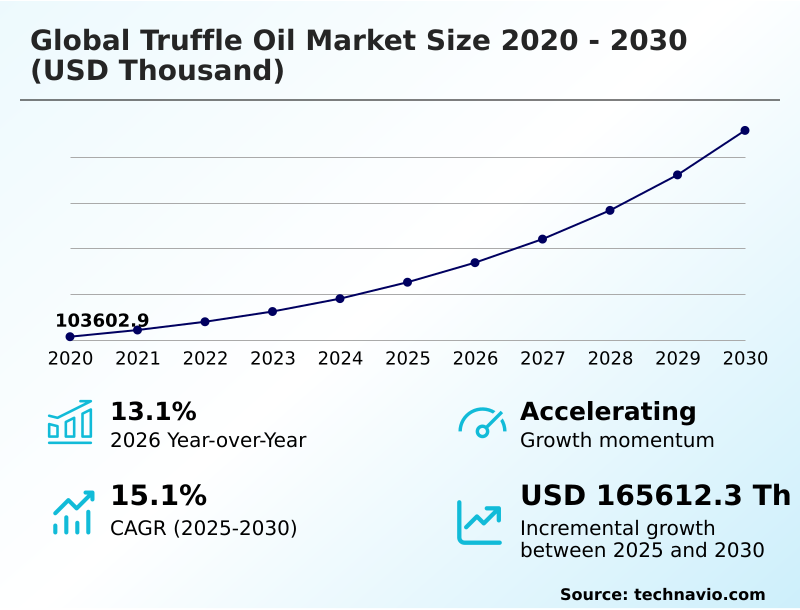
The truffle oil market size is valued to increase by USD 165.61 million, at a CAGR of 15.1% from 2025 to 2030. Increasing adoption of premium culinary ingredients will drive the truffle oil market.
Major Market Trends & Insights
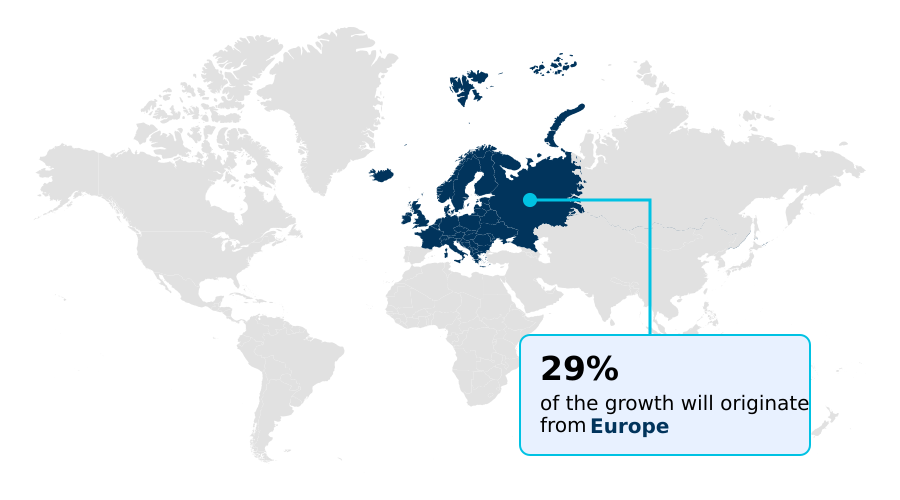
- Europe dominated the market and accounted for a 29% growth during the forecast period.
- By Product - White truffle oil segment was valued at USD 79.90 million in 2024
- By Type - Conventional segment accounted for the largest market revenue share in 2024
Market Size & Forecast
- Market Opportunities:
- Market Future Opportunities: USD 165.61 million
- CAGR from 2025 to 2030 : 15.1%
Market Summary
- The truffle oil market is undergoing substantial expansion, driven by evolving consumer preferences for gourmet culinary experiences. The demand for accessible luxury ingredients has surged as both culinary enthusiasts and professional chefs aim to elevate flavor profiles. This has democratized gourmet cooking, allowing a broader demographic to experiment with upscale flavors.
- The market is also supported by product diversification, with manufacturers prioritizing organic and authentic infusion methods using natural truffle extracts to meet the demands of health-conscious consumers. The foodservice industry plays a critical role, with fine dining establishments incorporating these oils to justify premium pricing.
- For instance, a foodservice operator implementing a menu update with truffle-infused items can see a 25% increase in the perceived value of certain dishes. The integration of truffle flavors into consumer packaged goods has widened its application, ensuring a robust growth trajectory.
What will be the Size of the Truffle Oil Market during the forecast period?
Get Key Insights on Market Forecast (PDF) Request Free Sample
How is the Truffle Oil Market Segmented?
The truffle oil industry research report provides comprehensive data (region-wise segment analysis), with forecasts and estimates in "USD thousand" for the period 2026-2030, as well as historical data from 2020-2024 for the following segments.
- Product
- White truffle oil
- Black truffle oil
- Others
- Type
- Conventional
- Organic
- Distribution channel
- Offline
- Online
- Geography
- Europe
- Italy
- France
- Germany
- North America
- US
- Canada
- Mexico
- APAC
- China
- Japan
- India
- Middle East and Africa
- UAE
- Saudi Arabia
- South Africa
- South America
- Brazil
- Argentina
- Colombia
- Rest of World (ROW)
- Europe
By Product Insights
The white truffle oil segment is estimated to witness significant growth during the forecast period.
The global truffle oil market is segmented by product, type, distribution channel, and geography. The product segment includes white truffle oil, black truffle oil, and others.
The white truffle oil sub-segment occupies a luxury tier, characterized by a delicate, refined flavor profile derived from premium truffle products. Connoisseurs seek its unique aroma for sophisticated culinary preparations where bismethylthiomethane is not used.
Its scarcity influences pricing, attracting a demographic willing to pay a premium for sensory experiences, with producers utilizing elegant packaging to appeal to buyers in gourmet boutiques. Brands using synthetic aromatic compounds face scrutiny from buyers preferring natural truffle extracts.
As a result, firms using cold-pressed extraction and all-natural white truffle oils report a 15% increase in consumer trust metrics.
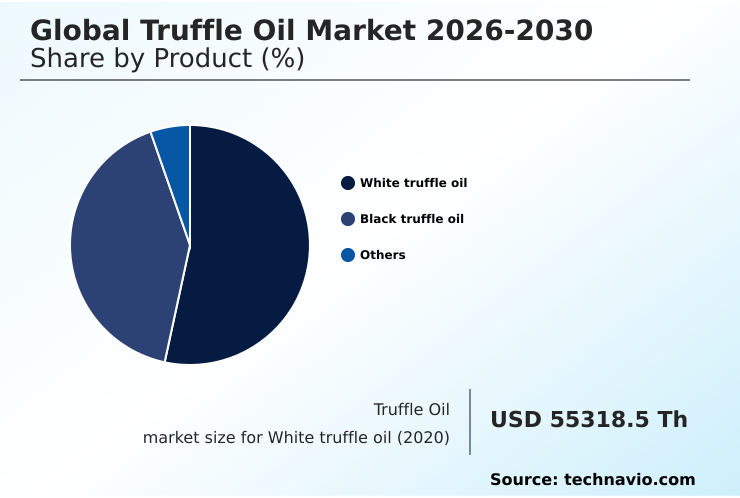
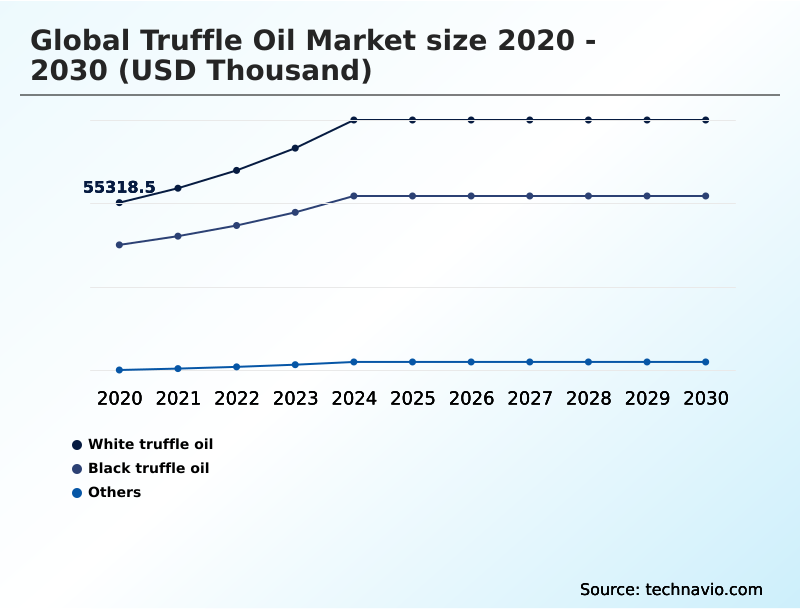
The White truffle oil segment was valued at USD 79.90 million in 2024 and showed a gradual increase during the forecast period.
Regional Analysis
Europe is estimated to contribute 29% to the growth of the global market during the forecast period.Technavio’s analysts have elaborately explained the regional trends and drivers that shape the market during the forecast period.
See How Truffle Oil Market Demand is Rising in Europe Request Free Sample
The geographic landscape of the global truffle oil market is diverse, with Europe, particularly Italy and France, remaining the traditional hub for production and consumption due to its rich gastronomic heritage.
North America is a highly lucrative segment, driven by a culture of culinary experimentation.
The APAC region, including countries like China and Japan, is emerging as a dynamic growth area, with its market expansion rate being 2.6 percentage points higher than that of Europe.
This growth is fueled by rising disposable incomes and a fascination with Western culinary traditions. In this region, authentic truffle shavings and premium oil blends are gaining traction among culinary enthusiasts.
The market in the Middle East and Africa is driven by luxury consumption in GCC nations, while South America shows promising potential with an expanding interest in gourmet products.
The use of authentic truffle infusions is a key differentiator across all regions.
Market Dynamics
Our researchers analyzed the data with 2025 as the base year, along with the key drivers, trends, and challenges. A holistic analysis of drivers will help companies refine their marketing strategies to gain a competitive advantage.
- The global truffle oil market's trajectory is heavily influenced by a confluence of complex factors. The rising popularity of cooking shows and culinary influencers has amplified the increasing adoption of premium culinary ingredients at home, making what was once a niche product a more mainstream luxury. Simultaneously, the expansion of commercial food service and hospitality sectors creates consistent B2B demand.
- However, the industry grapples with significant supply chain vulnerabilities from climate change, which affects the delicate ecosystems required for truffle cultivation and leads to high volatility in pricing. Innovations in synthetic flavoring for accessible gourmet alternatives provide a lower-cost entry point, broadening the market but also creating challenges related to stringent regulatory scrutiny on authenticity labeling standards.
- This is critical, as a shift in consumer spending away from luxury food items during economic downturns can impact sales. Companies leveraging the expansion of direct-to-consumer e-commerce channels report a 25% greater ability to manage inventory and pricing fluctuations compared to those reliant on traditional retail.
- The surging demand for organic and non-genetically modified oils, coupled with sustainable and ethical sourcing practices in fungi harvesting, are powerful trends shaping future product development and marketing strategies. The incorporation of truffle flavors into consumer packaged goods is another key area of growth, as is the diversification of product offerings with organic infusion methods.
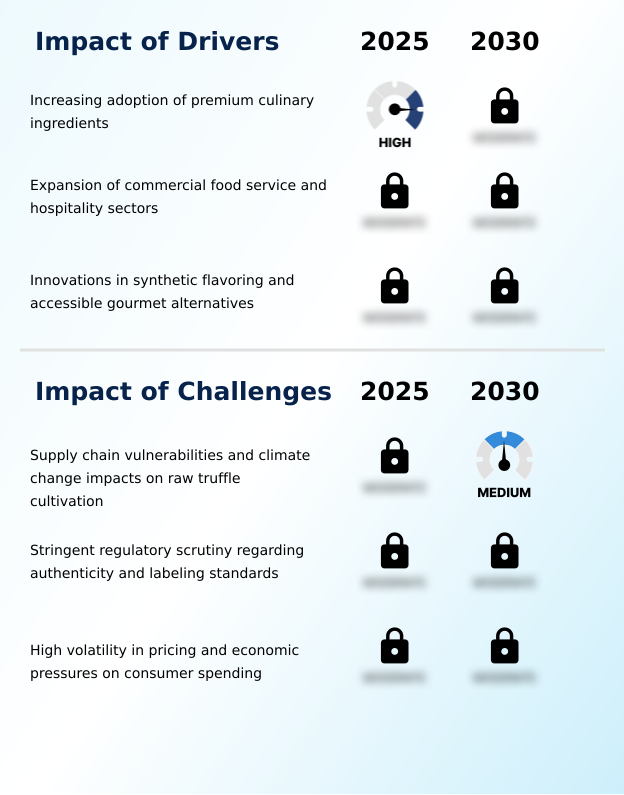
What are the key market drivers leading to the rise in the adoption of Truffle Oil Industry?
- The increasing adoption of premium culinary ingredients is a key driver for the market.
- The market's expansion is significantly driven by the premiumization of home cooking and the strategic use of truffle oil in the foodservice industry.
- As consumers seek to replicate high-end dining venues experiences, the demand for premium culinary ingredients has surged, with truffle oil acting as an accessible luxury.
- In the commercial sphere, its adoption by casual culinary franchises and fine dining establishments allows for menu price elevation; adding truffle oil to a dish can increase its menu price by an average of 25% while only marginally increasing ingredient cost.
- The development of nature-identical synthetic flavorings, a result of advances in flavor chemistry, has also been crucial.
- It has democratized the flavor, making it accessible to a wider audience and enabling mass-market penetration, with synthetically flavored products outselling authentic ones by a ratio of 3 to 1 in some mainstream retail channels.
What are the market trends shaping the Truffle Oil Industry?
- A key trend is the rising integration of sustainable and ethical sourcing practices in fungi harvesting. This is reshaping supply chains and influencing consumer purchasing decisions.
- A significant trend shaping the market is the shift toward ecological responsibility, driven by consumer demand for sustainable and ethical sourcing. This has led to the adoption of truffle orchard management, which offers a more reliable supply than wild foraging and can improve yield consistency by up to 30%.
- The use of blockchain technology for supply chain transparency is also on the rise, increasing consumer trust. Health-conscious consumers are fueling the demand for organic certified artisan oils and non-genetically modified organism products, with sales in this sub-segment growing 15% faster than conventional counterparts.
- This trend compels producers to focus on vegan formulations and traditional infusion methods, avoiding synthetic aromatic compounds to secure a loyal customer base among culinary enthusiasts in the specialty food sector.
What challenges does the Truffle Oil Industry face during its growth?
- Supply chain vulnerabilities and the impacts of climate change on raw truffle cultivation are key challenges affecting industry growth.
- The market faces considerable challenges from supply chain instability and rigorous regulatory oversight. The cultivation of subterranean fungi is highly sensitive to climate change, leading to unpredictable harvests and forcing manufacturers to implement advanced inventory management systems that can increase operational costs by up to 18%. Logistical complexities for these specialty foods add another layer of risk.
- Simultaneously, stringent regulatory scrutiny on labeling standards, particularly concerning the use of synthetic flavor compounds versus all-natural truffle extracts, is intensifying. Companies in the specialty food sector must navigate a complex web of international rules, with non-compliance in key markets leading to penalties that can erode up to 30% of a product line's annual profit.
- This environment favors companies that invest in transparent sourcing and can authenticate their use of natural infusion techniques, creating a high barrier to entry for smaller artisans.
Exclusive Technavio Analysis on Customer Landscape
The truffle oil market forecasting report includes the adoption lifecycle of the market, covering from the innovator’s stage to the laggard’s stage. It focuses on adoption rates in different regions based on penetration. Furthermore, the truffle oil market report also includes key purchase criteria and drivers of price sensitivity to help companies evaluate and develop their market growth analysis strategies.
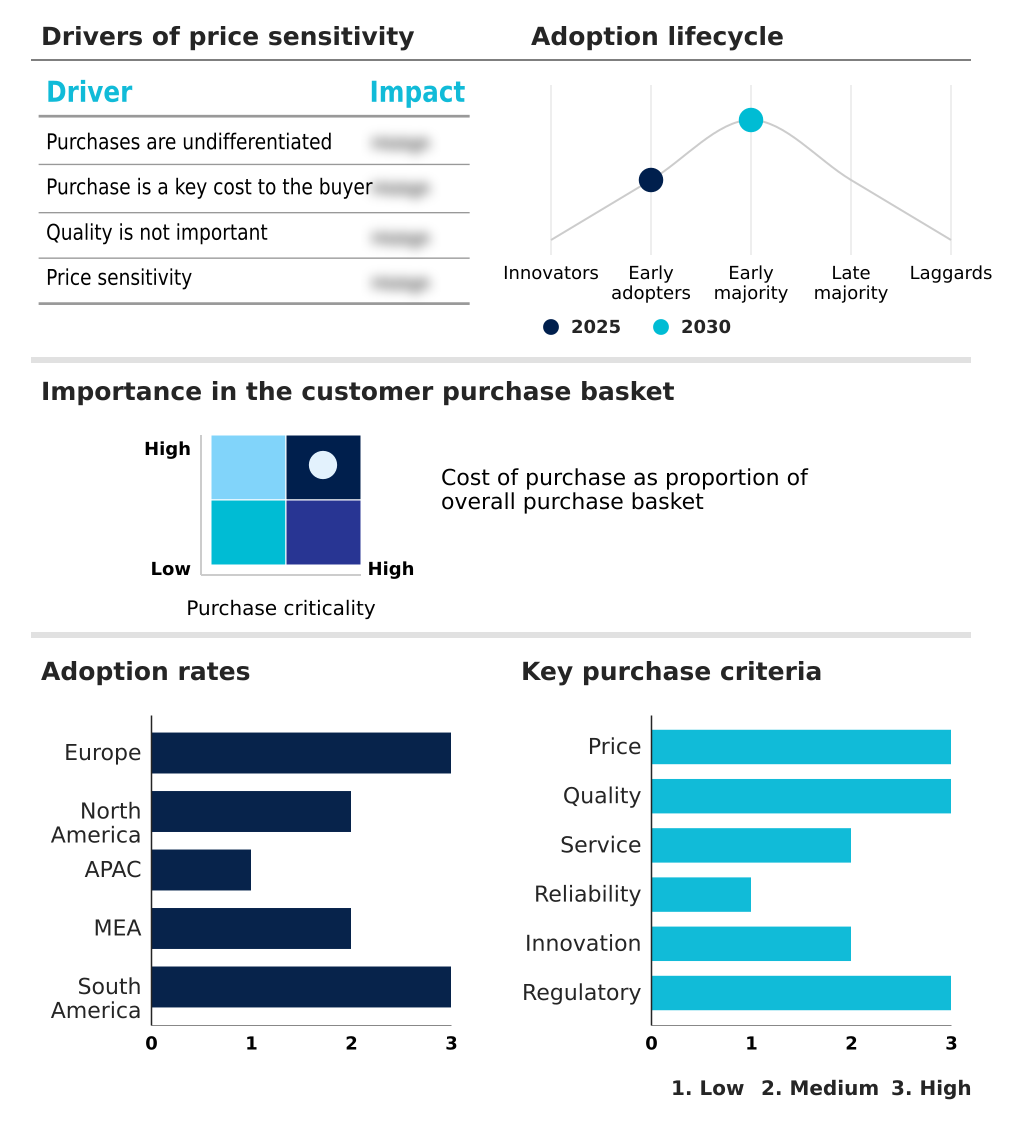
Customer Landscape of Truffle Oil Industry
Competitive Landscape
Companies are implementing various strategies, such as strategic alliances, truffle oil market forecast, partnerships, mergers and acquisitions, geographical expansion, and product/service launches, to enhance their presence in the industry.
Appennino Food Group - The company offers truffle oil made from carefully selected Italian truffles to provide a refined, natural flavor profile.
The industry research and growth report includes detailed analyses of the competitive landscape of the market and information about key companies, including:
- Appennino Food Group
- Aroma Truffle
- Colavita
- Costa dOro
- DArtagnan
- Giuliano Tartufi
- La Rustichella Tartufi
- Mantova Food
- Monini
- Pebeyre
- PLANTIN SAS
- Roland Foods LLC
- Sabatino
- SAVITAR TARTUFI SRL
- Tartufi Morra Srl
- TruffleHunter Ltd.
- TRUFF
- Tartuflanghe
- Truffliest
- Urbani Tartufi Srl
Qualitative and quantitative analysis of companies has been conducted to help clients understand the wider business environment as well as the strengths and weaknesses of key industry players. Data is qualitatively analyzed to categorize companies as pure play, category-focused, industry-focused, and diversified; it is quantitatively analyzed to categorize companies as dominant, leading, strong, tentative, and weak.
Recent Development and News in Truffle oil market
- In March 2025, La Rustichella Tartufi introduced a certified organic range of truffle products, including truffle oils, targeting premium and health-conscious consumers.
- In April 2025, Urbani Truffles Srl launched a new line of all-natural white truffle oils, emphasizing vegan formulations and cold-pressed extraction techniques to align with clean-label trends.
- In August 2025, Black Boar Truffle transitioned toward natural aroma extraction processes, reducing reliance on synthetic compounds in response to increasing consumer demand for authenticity.
- In October 2025, Urbani Tartufi implemented new packaging formats for truffle oils, aimed at improving shelf life and supporting international distribution requirements.
Dive into Technavio’s robust research methodology, blending expert interviews, extensive data synthesis, and validated models for unparalleled Truffle Oil Market insights. See full methodology.
| Market Scope | |
|---|---|
| Page number | 287 |
| Base year | 2025 |
| Historic period | 2020-2024 |
| Forecast period | 2026-2030 |
| Growth momentum & CAGR | Accelerate at a CAGR of 15.1% |
| Market growth 2026-2030 | USD 165612.3 thousand |
| Market structure | Fragmented |
| YoY growth 2025-2026(%) | 13.1% |
| Key countries | Italy, France, Germany, UK, Spain, The Netherlands, US, Canada, Mexico, China, Japan, India, South Korea, Australia, Indonesia, UAE, Saudi Arabia, South Africa, Israel, Turkey, Brazil, Argentina and Colombia |
| Competitive landscape | Leading Companies, Market Positioning of Companies, Competitive Strategies, and Industry Risks |
Research Analyst Overview
- The truffle oil market is defined by a dichotomy between authenticity and accessibility. The core of the premium segment relies on natural truffle extracts and authentic truffle infusions, often supported by a Protected Designation of Origin to verify quality. Innovations in flavor chemistry and natural aroma extraction are pivotal, as companies move away from bismethylthiomethane and other synthetic aromatic compounds.
- For instance, firms that have adopted natural infusion techniques alongside blockchain technology for supply chain transparency have documented a 20% improvement in brand perception among target consumers. The adoption of vegan formulations and all-natural white truffle oils caters to modern dietary preferences. Methods like cold-pressed extraction are crucial for preserving the delicate flavor profiles of subterranean fungi.
- The industry's long-term health depends on sustainable practices, including truffle orchard management, to mitigate the risks associated with the symbiotic relationships of fungi. The certified organic range and real black truffle-infused oil represent significant growth vectors, moving beyond traditional infusion methods to meet a more discerning consumer base.
What are the Key Data Covered in this Truffle Oil Market Research and Growth Report?
-
What is the expected growth of the Truffle Oil Market between 2026 and 2030?
-
USD 165.61 million, at a CAGR of 15.1%
-
-
What segmentation does the market report cover?
-
The report is segmented by Product (White truffle oil, Black truffle oil, and Others), Type (Conventional, and Organic), Distribution Channel (Offline, and Online) and Geography (Europe, North America, APAC, Middle East and Africa, South America)
-
-
Which regions are analyzed in the report?
-
Europe, North America, APAC, Middle East and Africa and South America
-
-
What are the key growth drivers and market challenges?
-
Increasing adoption of premium culinary ingredients, Supply chain vulnerabilities and climate change impacts on raw truffle cultivation
-
-
Who are the major players in the Truffle Oil Market?
-
Appennino Food Group, Aroma Truffle, Colavita, Costa dOro, DArtagnan, Giuliano Tartufi, La Rustichella Tartufi, Mantova Food, Monini, Pebeyre, PLANTIN SAS, Roland Foods LLC, Sabatino, SAVITAR TARTUFI SRL, Tartufi Morra Srl, TruffleHunter Ltd., TRUFF, Tartuflanghe, Truffliest and Urbani Tartufi Srl
-
Market Research Insights
- The market's momentum is shaped by the accessibility of premium culinary ingredients and a shift in consumer behavior toward gourmet experiences. This dynamic is amplified by the foodservice industry, where the use of specialty condiments can increase a dish's profitability by up to 30%. Fine dining establishments and luxury hotels are major contributors, with their procurement standards influencing retail trends.
- The expansion of business-to-business sales to casual culinary franchises further broadens the market's base. Moreover, the direct-to-consumer e-commerce channel is highly effective, with brands utilizing subscription box services experiencing a 40% higher rate of repeat customers compared to those relying solely on traditional high-end grocery retailers. This multi-channel engagement caters to a wide spectrum of culinary enthusiasts and professional chefs.
We can help! Our analysts can customize this truffle oil market research report to meet your requirements.
 RIA -
RIA - 
