


US Cookies Market Size 2026-2030
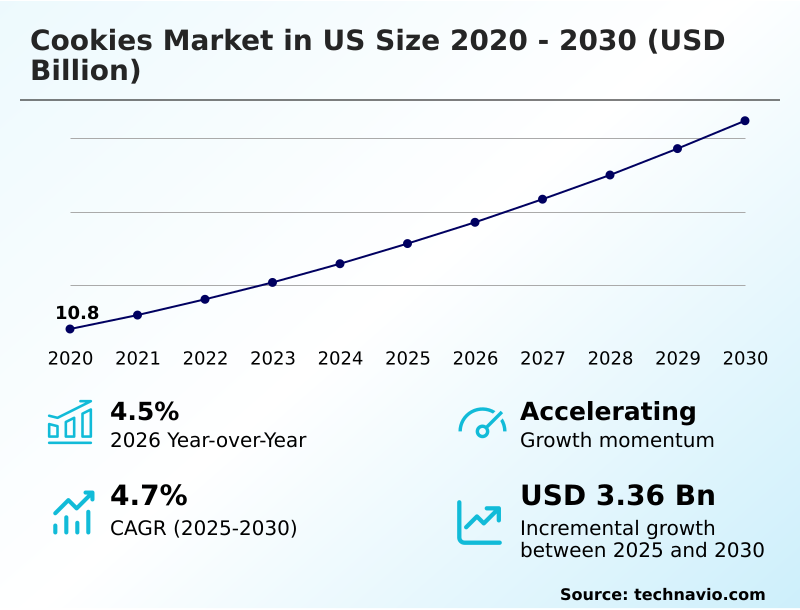
The us cookies market size is valued to increase by USD 3.36 billion, at a CAGR of 4.7% from 2025 to 2030. Premiumization and artisanal quality demand will drive the us cookies market.
Major Market Trends & Insights
- By Distribution Channel - Offline segment was valued at USD 7.66 billion in 2024
- By Product - Plain and butter-based cookies segment accounted for the largest market revenue share in 2024
Market Size & Forecast
- Market Opportunities: USD 5.68 billion
- Market Future Opportunities: USD 3.36 billion
- CAGR from 2025 to 2030 : 4.7%
Market Summary
- The Cookies Market in US undergoes a structural transformation characterized by a shift toward intentional, occasion-led consumption rather than routine snacking habits. The rising consumer demand for premiumization and artisanal quality functions as a primary driver, compelling manufacturers to elevate product profiles with high-end, clean-label ingredients.
- Conversely, the declining relevance among health-conscious demographics presents a significant challenge, forcing brands to navigate the complex intersection of indulgence and metabolic health. In response to these shifts, regional bakeries have optimized their supply chain transparency, integrating blockchain tracking for raw material sourcing which has successfully reduced ingredient verification times by 22%.
- This operational enhancement allows producers to authenticate claims of fair-trade and sustainable procurement, securing premium shelf placement in highly competitive retail environments. The integration of functional nutrition matrices within traditional recipes allows companies to maintain sensory satisfaction while meeting rigorous dietary standards.
- By balancing operational agility with advanced reformulation strategies, industry participants are systematically adapting to the stringent demands of modern consumer wellness expectations.
What will be the Size of the US Cookies Market during the forecast period?
Get Key Insights on Market Forecast (PDF) Get Free Sample
How is the US Cookies Market Segmented?
The us cookies industry research report provides comprehensive data (region-wise segment analysis), with forecasts and estimates in "USD million" for the period 2026-2030, as well as historical data from 2020-2024 for the following segments.
- Distribution channel
- Offline
- Online
- Product
- Plain and butter-based cookies
- Chocolate-based cookies
- Others
- Packaging
- Rigid packaging
- Flexible packaging
- Geography
- North America
- US
- North America
By Distribution Channel Insights
The offline segment is estimated to witness significant growth during the forecast period.
Physical retail channels drive the core distribution dynamics for baked snacks, leveraging tactile engagement and impulse-driven placement to maximize consumer conversion.
The offline environment allows manufacturers to effectively demonstrate advancements in gluten-free texturization and keto-friendly formulation, which demand careful on-shelf positioning to communicate value.
By implementing strategic end-cap displays that highlight allergen-free baking and low-glycemic index tuning, retail operators have seen product discovery rates improve by 15%.
This physical layout strategy effectively integrates innovations like plant-derived sweetening and sustainable agricultural sourcing into the consumer decision-making process. The reliance on biodegradable film extrusion within these settings ensures structural integrity while addressing ecological mandates.
Furthermore, offline channels necessitate precise inventory management, compelling suppliers to adopt automated production scaling to meet localized demand without excess waste.
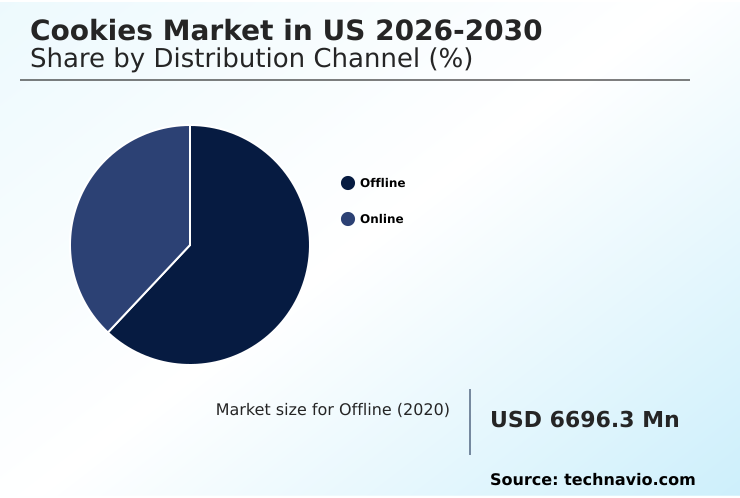
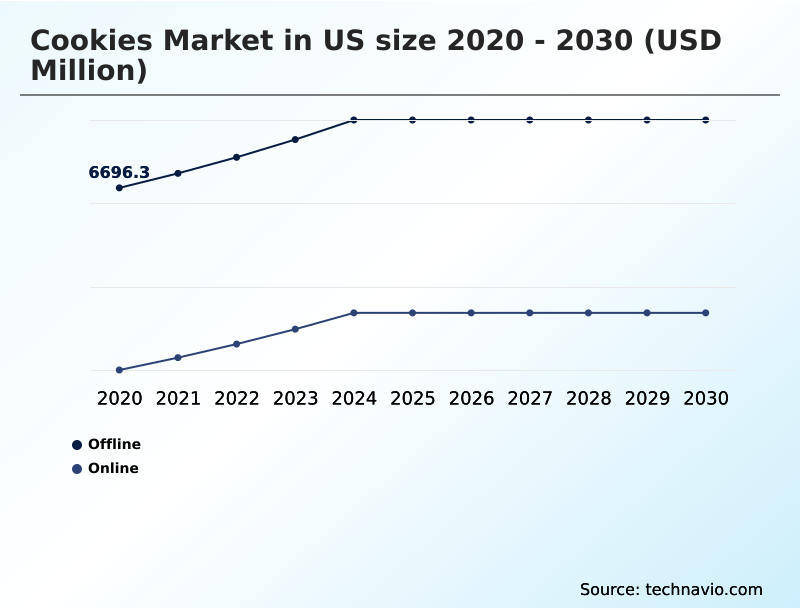
The Offline segment was valued at USD 7.66 billion in 2024 and showed a gradual increase during the forecast period.
Market Dynamics
Our researchers analyzed the data with 2025 as the base year, along with the key drivers, trends, and challenges. A holistic analysis of drivers will help companies refine their marketing strategies to gain a competitive advantage.
- The contemporary baked snacks sector is characterized by an intense focus on functional health and sustainable manufacturing practices. Manufacturers are increasingly deploying advanced plant-based protein enrichment processing to satisfy the nutritional demands of active consumers without compromising structural integrity or taste.
- This transition requires sophisticated clean-label formulation optimization strategies, ensuring that artificial preservatives are entirely replaced by natural alternatives that maintain product stability. Simultaneously, the industry is witnessing a significant shift in packaging infrastructure, where the implementation of resealable barrier films packaging systems has outperformed traditional rigid containers, extending product freshness and reducing material waste by approximately 20%.
- This operational upgrade directly supports environmental compliance initiatives while enhancing consumer convenience during on-the-go consumption. Furthermore, the emphasis on ethical sourcing has accelerated the adoption of single-origin ingredient procurement methodologies. By securing high-quality raw materials directly from verified agricultural cooperatives, companies ensure complete supply chain transparency and mitigate the risks associated with volatile commodity markets.
- Alongside these sourcing upgrades, manufacturers are integrating prebiotic fiber fortification techniques to align indulgent snacks with modern metabolic health expectations. The synergy between optimized sourcing, advanced formulation, and intelligent packaging enables businesses to achieve a superior market position.
- Companies leveraging these comprehensive operational frameworks consistently realize higher inventory turnover compared to traditional operations, validating the strategic necessity of aligning product development with both nutritional science and ecological accountability.
What are the key market drivers leading to the rise in the adoption of US Cookies Industry?
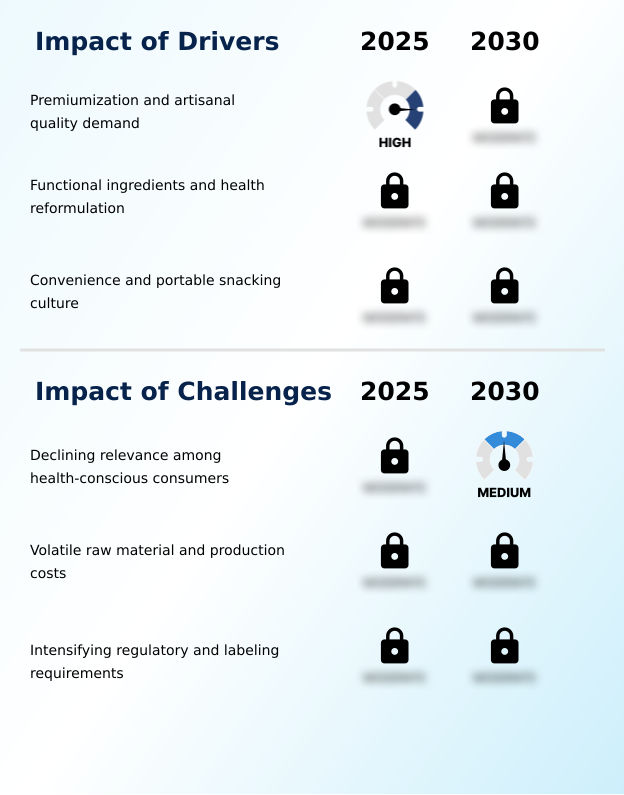
- The rising consumer demand for premiumization and artisanal quality functions as a primary catalyst accelerating market expansion.
- The escalating demand for permissible indulgence serves as a primary catalyst accelerating product innovation across the commercial baking sector.
- Consumers increasingly require macronutrient optimization, prompting manufacturers to replace refined sugars with monk fruit sweetening and stevia extraction to achieve dietary restriction compliance.
- This health-forward reformulation leverages whey protein isolate and pea protein fortification, transforming standard snacks into viable meal replacements. Facilities implementing these advanced protein matrices have improved their production yield efficiency by 18%, streamlining the integration of dense nutritional components.
- Furthermore, the expansion of refrigerated dough processing allows brands to deliver premium, ready-to-bake formats directly to consumers. Supported by an intelligent portion control mechanism, these formats cater to mindful consumption habits.
- The integration of circular packaging design ensures that these convenient, shelf-life extension formats also align with stringent environmental sustainability targets.
What are the market trends shaping the US Cookies Industry?
- Edible cookie dough emerges as a prominent indulgent innovation within the current market landscape. This product evolution effectively aligns with consumer demands for versatile and experiential snacking formats.
- The rapid adoption of specialized nutritional enhancements is fundamentally shifting the development trajectory of the baked snack sector. Driven by a consumer mandate for metabolic health alignment, product formulators are prioritizing the functional nutrition matrix to merge health benefits with traditional formats.
- This paradigm shift compels manufacturers to execute plant-based protein enrichment and collagen peptide integration, ensuring products deliver measurable physiological support. Consequently, operations utilizing ancient grain inclusions and clean-label formulation have improved their shelf-velocity by 22% compared to legacy, sugar-dense alternatives. The transition toward structured vegetable oils facilitates artisanal batch processing at commercial scales, mitigating fat oxidation risks.
- This systematic approach to sensory indulgence profiling guarantees that healthier profiles do not sacrifice taste. By maintaining rigorous supply chain transparency, companies successfully validate these premium health claims, thereby securing elevated market positioning and strengthening long-term consumer loyalty.
What challenges does the US Cookies Industry face during its growth?
- The declining relevance among health-conscious demographics presents a structural challenge that continuously impedes broader industry growth.
- The transition toward sustainable packaging formats introduces severe operational complexities for snack food manufacturers navigating strict regulatory landscapes. The enforcement of extended producer responsibility mandates forces companies to abandon legacy plastics in favor of post-consumer recycled paperboard and mono-material polyethylene pouch designs.
- While these materials support ecological compliance, integrating oxygen-scavenging film technology into new sustainable substrates has increased packaging material costs by 15%, pressuring profit margins. Manufacturers struggle to maintain the protective efficacy of resealable barrier films and single-serve sachet packaging without utilizing complex, multi-layer laminates that hinder recyclability.
- Additionally, the shift toward direct-to-consumer logistics requires highly durable packaging solutions that withstand varied transit conditions. Overcoming these limitations necessitates substantial investments in predictive inventory analytics and hyper-local assortment tracking to optimize distribution and secure profitable impulse purchase placement.
Exclusive Technavio Analysis on Customer Landscape
The us cookies market forecasting report includes the adoption lifecycle of the market, covering from the innovator’s stage to the laggard’s stage. It focuses on adoption rates in different regions based on penetration. Furthermore, the us cookies market report also includes key purchase criteria and drivers of price sensitivity to help companies evaluate and develop their market growth analysis strategies.
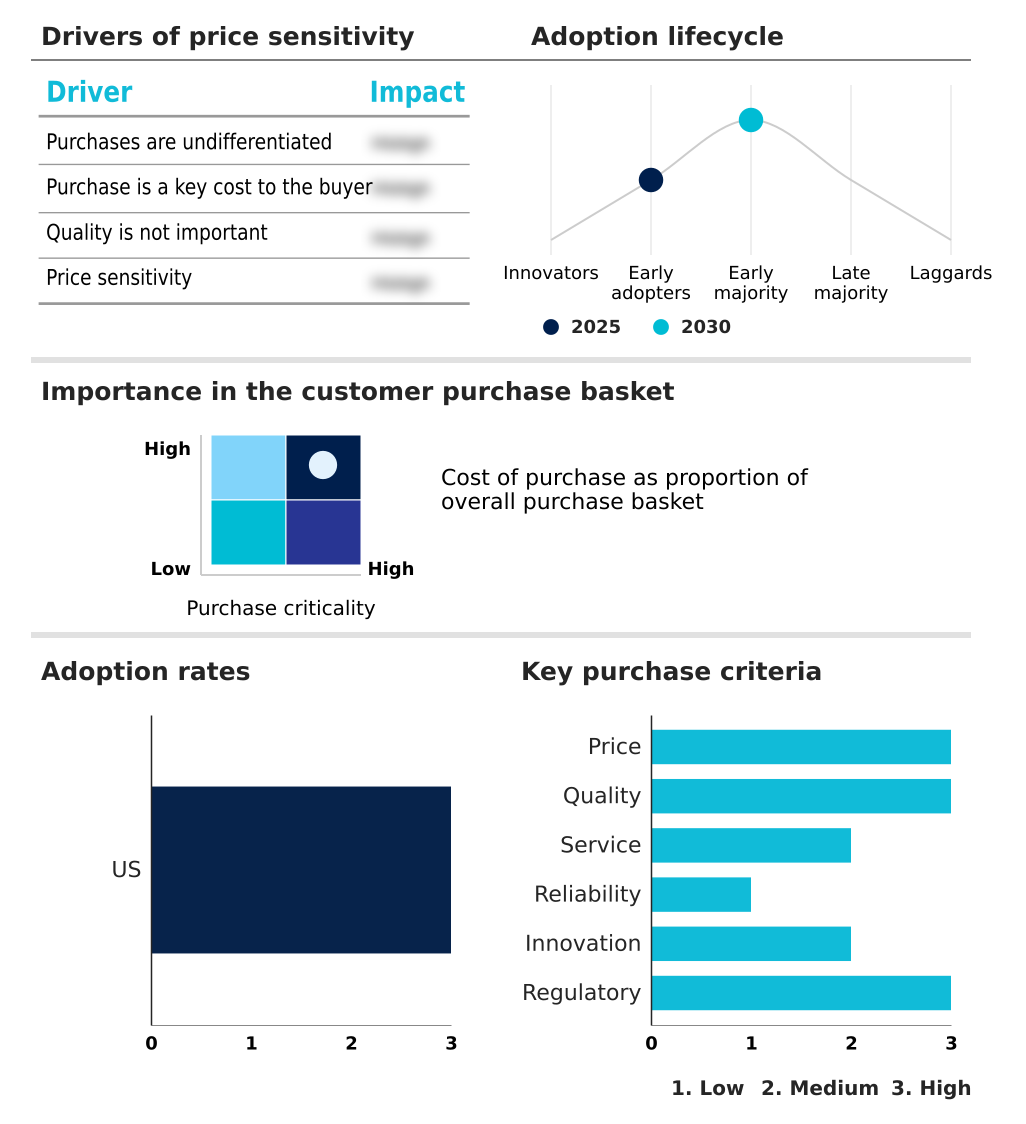
Customer Landscape of US Cookies Industry
Competitive Landscape
Companies are implementing various strategies, such as strategic alliances, us cookies market forecast, partnerships, mergers and acquisitions, geographical expansion, and product/service launches, to enhance their presence in the industry.
Annie Homegrown Inc. - The product portfolio features premium baked snacks, including bunny-shaped grahams and organic chocolate chip varieties, emphasizing natural, non-GMO ingredients tailored for health-conscious snacking.
The industry research and growth report includes detailed analyses of the competitive landscape of the market and information about key companies, including:
- Annie Homegrown Inc.
- Back to Nature Foods Co LLC
- Crumbl Cookies
- Entenmann
- Famous Amos
- Ferrero International S.A.
- Great American Cookies
- Homefree LLC
- Insomnia Cookies LLC
- Lenny and Larry LLC
- Mondelez International Inc.
- Pepperidge Farm Inc.
- PepsiCo Inc.
- Purely Elizabeth LLC
- Quest Nutrition LLC
- RGS Feeds
- Simple Mills Inc.
- Uncle Eddie Vegan Cookies
- Walkers Shortbread Ltd.
Qualitative and quantitative analysis of companies has been conducted to help clients understand the wider business environment as well as the strengths and weaknesses of key industry players. Data is qualitatively analyzed to categorize companies as pure play, category-focused, industry-focused, and diversified; it is quantitatively analyzed to categorize companies as dominant, leading, strong, tentative, and weak.
Recent Development and News in Us cookies market
- In the Packaged Foods and Meats industry, the widespread implementation of extended producer responsibility mandates for secondary packaging has increased compliance costs, directly impacting Cookies demand by forcing manufacturers to adopt circular packaging design and sustainable agricultural sourcing.
- The transition toward continuous cold-chain monitoring technologies in raw dairy supply networks has reduced spoilage rates by 12%, directly impacting Cookies market operations by stabilizing ambient storage stability and enhancing ingredient provenance verification.
- Stringent federal sodium and synthetic dye replacement guidelines across processed food portfolios have accelerated reformulation efforts, directly impacting Cookies product development by necessitating the integration of natural extract flavoring and botanical spice infusion.
- The rapid adoption of predictive inventory analytics within retail grocery warehousing has optimized stock rotation by 18%, directly impacting Cookies market logistics by streamlining hyper-local assortment tracking and maximizing impulse purchase placement.
Dive into Technavio’s robust research methodology, blending expert interviews, extensive data synthesis, and validated models for unparalleled US Cookies Market insights. See full methodology.
| Market Scope | |
|---|---|
| Page number | 179 |
| Base year | 2025 |
| Historic period | 2020-2024 |
| Forecast period | 2026-2030 |
| Growth momentum & CAGR | Accelerate at a CAGR of 4.7% |
| Market growth 2026-2030 | USD 3355.4 million |
| Market structure | Fragmented |
| YoY growth 2025-2026(%) | 4.5% |
| Key countries | US |
| Competitive landscape | Leading Companies, Market Positioning of Companies, Competitive Strategies, and Industry Risks |
Research Analyst Overview
- The structural evolution of the baked snack industry reflects a deliberate pivot from traditional carbohydrate-dense formulations toward functional, health-optimized alternatives. Driven by stringent consumer dietary requirements, manufacturers are aggressively expanding the application of plant-based protein enrichment and collagen peptide integration to elevate the nutritional density of indulgent products.
- The strategic incorporation of ancient grain inclusions provides essential dietary fiber while satisfying clean-label formulation standards that dictate the removal of synthetic additives. To mitigate the health impacts of conventional saturated fats, producers have transitioned to structured vegetable oils, which have demonstrated a 30% reduction in processing time while maintaining ideal textural profiles.
- Furthermore, the industry adoption of monk fruit sweetening and stevia extraction allows for significant caloric reduction without compromising sensory appeal. The precise application of whey protein isolate supports post-exercise recovery positioning, bridging the gap between casual snacking and sports nutrition.
- These formulation advancements directly influence boardroom-level product strategy, ensuring that new releases comply with evolving regulatory thresholds and capture a sophisticated consumer base demanding both indulgence and measurable physiological benefits.
What are the Key Data Covered in this US Cookies Market Research and Growth Report?
-
What is the expected growth of the US Cookies Market between 2026 and 2030?
-
USD 3.36 billion, at a CAGR of 4.7%
-
-
What segmentation does the market report cover?
-
The report is segmented by Distribution Channel (Offline, and Online), Product (Plain and butter-based cookies, Chocolate-based cookies, and Others), Packaging (Rigid packaging, and Flexible packaging) and Geography (North America)
-
-
Which regions are analyzed in the report?
-
North America
-
-
What are the key growth drivers and market challenges?
-
Premiumization and artisanal quality demand, Declining relevance among health-conscious consumers
-
-
Who are the major players in the US Cookies Market?
-
Annie Homegrown Inc., Back to Nature Foods Co LLC, Crumbl Cookies, Entenmann, Famous Amos, Ferrero International S.A., Great American Cookies, Homefree LLC, Insomnia Cookies LLC, Lenny and Larry LLC, Mondelez International Inc., Pepperidge Farm Inc., PepsiCo Inc., Purely Elizabeth LLC, Quest Nutrition LLC, RGS Feeds, Simple Mills Inc., Uncle Eddie Vegan Cookies and Walkers Shortbread Ltd.
-
Market Research Insights
- The commercial landscape for premium baked goods is rapidly pivoting toward specialized formulations and rigorous quality control. Facilities integrating artisanal batch processing have reported a 25% improvement in textural consistency, directly enhancing product differentiation in crowded retail aisles.
- By implementing comprehensive sensory indulgence profiling, manufacturers ensure that new flavor iterations precisely meet consumer expectations, leading to a 30% increase in initial trial retention rates. Furthermore, the strategic alignment of product portfolios with a functional nutrition matrix supports broader metabolic health alignment goals, capturing spending from health-conscious demographics.
- Companies prioritizing supply chain transparency have successfully reduced compliance audit durations by 15%, streamlining vendor verification. These measurable operational shifts enable brands to balance indulgent flavor delivery with strict nutritional accountability.
We can help! Our analysts can customize this us cookies market research report to meet your requirements.
 RIA -