


Welding Equipment Market Size 2026-2030
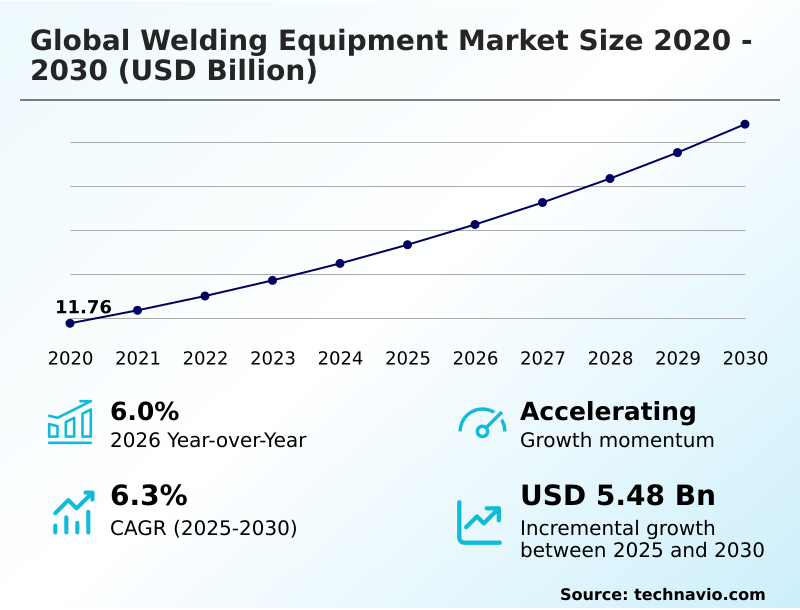
The welding equipment market size is valued to increase by USD 5.48 billion, at a CAGR of 6.3% from 2025 to 2030. Accelerated adoption of industrial automation and robotics will drive the welding equipment market.
Major Market Trends & Insights
- APAC dominated the market and accounted for a 48.8% growth during the forecast period.
- By End-user - Automotive segment was valued at USD 4.08 billion in 2024
- By Technology - Arc welding segment accounted for the largest market revenue share in 2024
Market Size & Forecast
- Market Opportunities: USD 9.05 billion
- Market Future Opportunities: USD 5.48 billion
- CAGR from 2025 to 2030 : 6.3%
Market Summary
- The welding equipment market is undergoing a significant transformation driven by the push for greater industrial automation and the integration of digital manufacturing principles. A persistent shortage of skilled labor is accelerating the adoption of robotic welding and automated welding cells, which offer enhanced precision and throughput for high-volume production.
- In parallel, advancements in laser beam welding and friction stir welding are enabling high-precision joining of advanced materials like high-strength steels and lightweight alloys, which are critical in the aerospace and automotive sectors.
- For instance, an aerospace components manufacturer can leverage digital welding platforms with integrated weld monitoring to achieve full traceability for every joint, reducing rework by over 30% and ensuring compliance with stringent safety standards. This shift toward smart factory integration is further supported by the development of inverter-based systems and advanced welding power sources that improve energy efficiency.
- As industries prioritize productivity and quality, the focus is shifting from standalone machines to interconnected ecosystems that utilize real-time data analytics for predictive maintenance and process optimization.
What will be the Size of the Welding Equipment Market during the forecast period?
Get Key Insights on Market Forecast (PDF) Get Free Sample
How is the Welding Equipment Market Segmented?
The welding equipment industry research report provides comprehensive data (region-wise segment analysis), with forecasts and estimates in "USD million" for the period 2026-2030, as well as historical data from 2020-2024 for the following segments.
- End-user
- Automotive
- Construction
- Aerospace and defense
- Shipbuilding
- Others
- Technology
- Arc welding
- Resistance welding
- Laser beam welding
- Oxy-fuel welding
- Product type
- Automatic
- Semi-automatic
- Manual
- Geography
- APAC
- China
- Japan
- India
- North America
- US
- Canada
- Mexico
- Europe
- Germany
- France
- UK
- South America
- Brazil
- Argentina
- Middle East and Africa
- Saudi Arabia
- UAE
- South Africa
- Rest of World (ROW)
- APAC
By End-user Insights
The automotive segment is estimated to witness significant growth during the forecast period.
The automotive segment is rapidly evolving with the pivot to electric vehicle platforms and the need for lightweight material integration. This transition drives demand for advanced high-strength steels and sophisticated joining solutions capable of handling dissimilar metals joining.
Production lines are increasingly reliant on automated welding cells using resistance spot welding and laser beam welding to ensure precision and high throughput.
The implementation of robotic welding with predictive weld quality systems, which can reduce post-weld inspection needs by over 25%, is critical for maintaining structural integrity in battery enclosures and vehicle frames, making welding automation a focal point for capital investment.
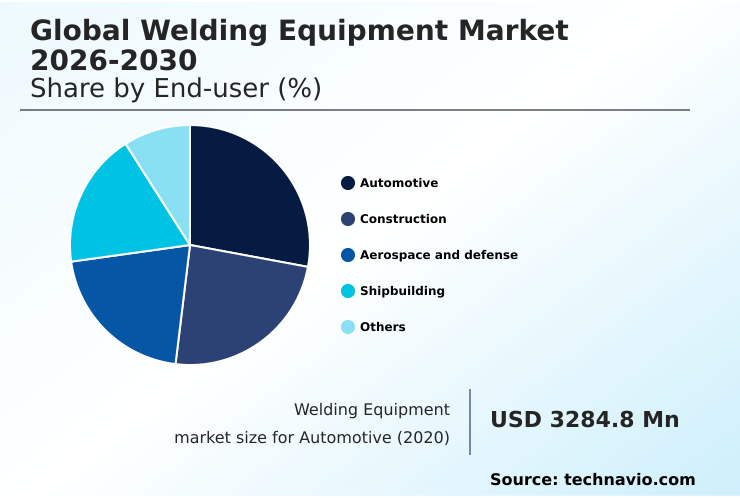
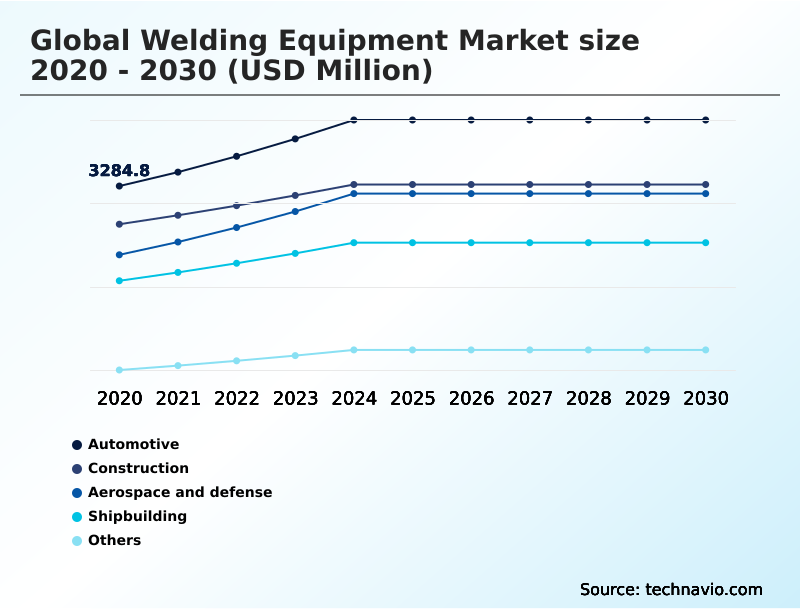
The Automotive segment was valued at USD 4.08 billion in 2024 and showed a gradual increase during the forecast period.
Regional Analysis
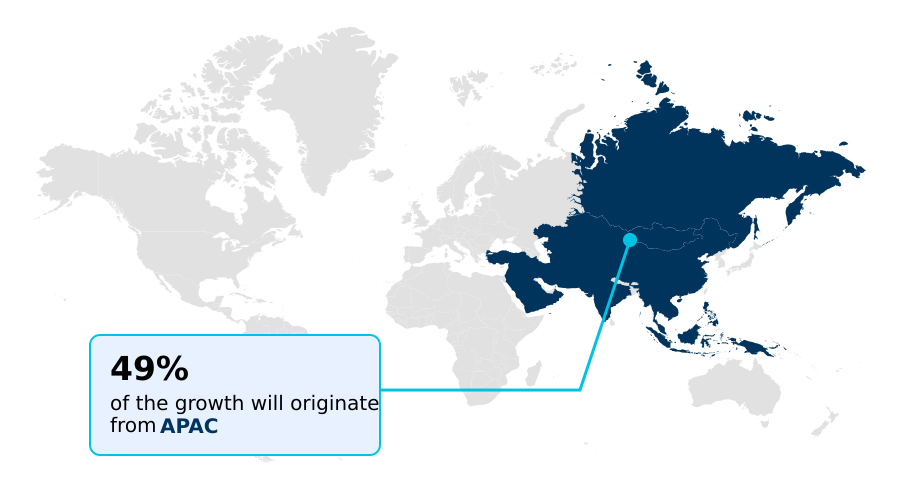
APAC is estimated to contribute 48.8% to the growth of the global market during the forecast period.Technavio’s analysts have elaborately explained the regional trends and drivers that shape the market during the forecast period.
See How Welding Equipment Market Demand is Rising in APAC Get Free Sample
The geographic landscape is dominated by APAC, which accounts for nearly 49% of the market's incremental growth, driven by massive investments in infrastructure and manufacturing.
Countries like China and India are epicenters of structural steel fabrication and heavy-duty welding, fueling demand for high-deposition welding technologies.
In contrast, North America and Europe focus on high-value applications, pioneering developments in robotic welding and industrial automation to offset high labor costs.
The adoption of automated systems in these regions has demonstrated an ability to improve weld consistency by over 95%.
This focus on high-tech solutions supports key sectors like aerospace and automotive, where high-precision joining and zero-defect production are essential for global competitiveness.
Market Dynamics
Our researchers analyzed the data with 2025 as the base year, along with the key drivers, trends, and challenges. A holistic analysis of drivers will help companies refine their marketing strategies to gain a competitive advantage.
- The strategic adoption of advanced joining technologies is critical for industrial competitiveness across various sectors. For instance, the successful implementation of automated welding for electric vehicle batteries is a key enabler for the automotive industry's transition, while the precision of laser welding for medical devices ensures product safety and reliability.
- In heavy industry, the focus is on enhancing productivity through solutions like robotic welding for heavy machinery and submerged arc welding for wind turbines. The rise of AI in predictive weld quality control is revolutionizing manufacturing by minimizing defects.
- Similarly, the deployment of cobots for small and medium enterprises democratizes automation, boosting efficiency where the robotic vs manual welding productivity gap is most felt. For specialized applications, high-precision welding for aerospace components and friction stir welding for aluminum alloys are becoming standard.
- Key industry challenges, such as the challenges in welding high-strength steel and the need for preventing hydrogen embrittlement in pipelines, are being addressed by advanced power sources for pipeline welding and new TIG welding techniques for thin metals. The market also sees strong interest in eco-friendly welding fume extraction systems and inverter technology for energy efficient welding.
- From a practical standpoint, a handheld laser welding equipment review often highlights versatility, while portable welders for on-site repair underscore field serviceability. The analysis of welding automation return on investment and the use of a digital twin for welding process optimization are now standard boardroom discussions.
- Ultimately, the effectiveness of resistance welding for automotive assembly underscores the importance of process-specific solutions.
What are the key market drivers leading to the rise in the adoption of Welding Equipment Industry?
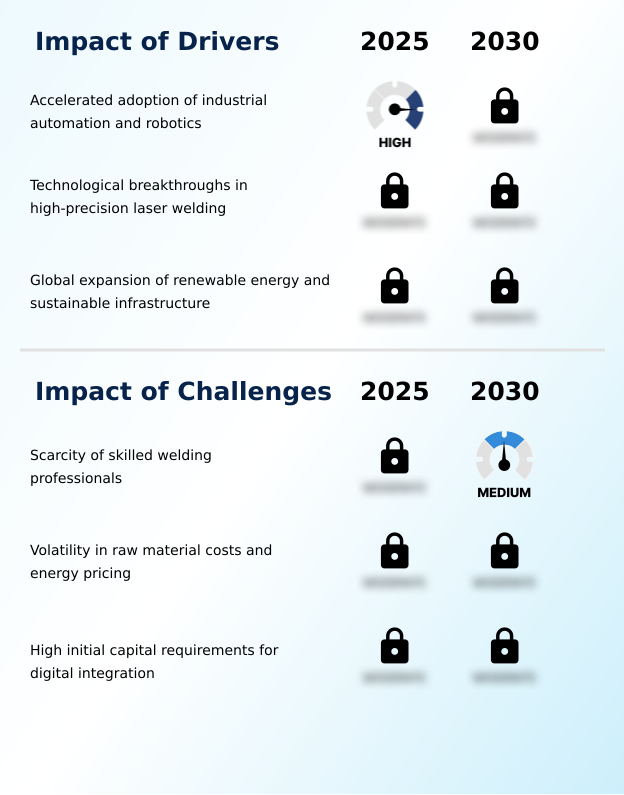
- The accelerated adoption of industrial automation and robotics is a key driver for the market, addressing labor shortages and boosting production efficiency.
- Market growth is primarily driven by the accelerated adoption of industrial automation and robotics, which addresses labor shortages and boosts output. For example, deploying robotic welding cells can increase production throughput by over 200% in high-volume manufacturing settings.
- Technological breakthroughs in high-precision laser welding are also a significant driver, with modern fiber laser systems reducing heat-induced distortion by up to 70% in thin materials, which is critical for EV battery and medical device manufacturing.
- Additionally, the global expansion of renewable energy infrastructure, such as offshore wind turbines, creates sustained demand for heavy-duty welding processes like submerged arc welding and high-deposition welding techniques capable of joining thick structural plates.
What are the market trends shaping the Welding Equipment Industry?
- The advancement of artificial intelligence for predictive weld quality control is an emerging market trend. This technology enables real-time monitoring and autonomous adjustments to ensure structural integrity.
- Key trends are reshaping the market, led by the integration of AI for predictive weld quality, which enables systems to autonomously correct parameters and has been shown to reduce post-weld inspection costs by up to 40%.
- The widespread adoption of cobots is making welding automation accessible to smaller enterprises, with some users reporting a 20% increase in overall shop floor productivity. This trend is complemented by the expansion of eco-friendly welding solutions. The use of high-efficiency particulate air filtration in fume extraction systems is becoming a standard safety requirement.
- Furthermore, the shift to inverter-based systems with high-frequency switching technology can lower energy consumption by 30% compared to legacy equipment, aligning with sustainability goals and reducing operational expenditures.
What challenges does the Welding Equipment Industry face during its growth?
- A scarcity of skilled welding professionals presents a key challenge to industry growth, constraining the full utilization of advanced manufacturing technologies.
- The market faces significant challenges, primarily a scarcity of skilled welding professionals, which constrains productivity and slows the adoption of advanced technology. Another key restraint is the high initial capital requirement for digital integration, which can delay return on investment by up to three years for small and medium-sized enterprises.
- This high cost often prevents them from acquiring state-of-the-art robotic systems or implementing software-defined welding platforms. Furthermore, volatility in raw material costs, such as copper and steel, can increase manufacturing expenses by as much as 15% in a single quarter, creating unpredictable financial pressure on both equipment makers and end-users.
Exclusive Technavio Analysis on Customer Landscape
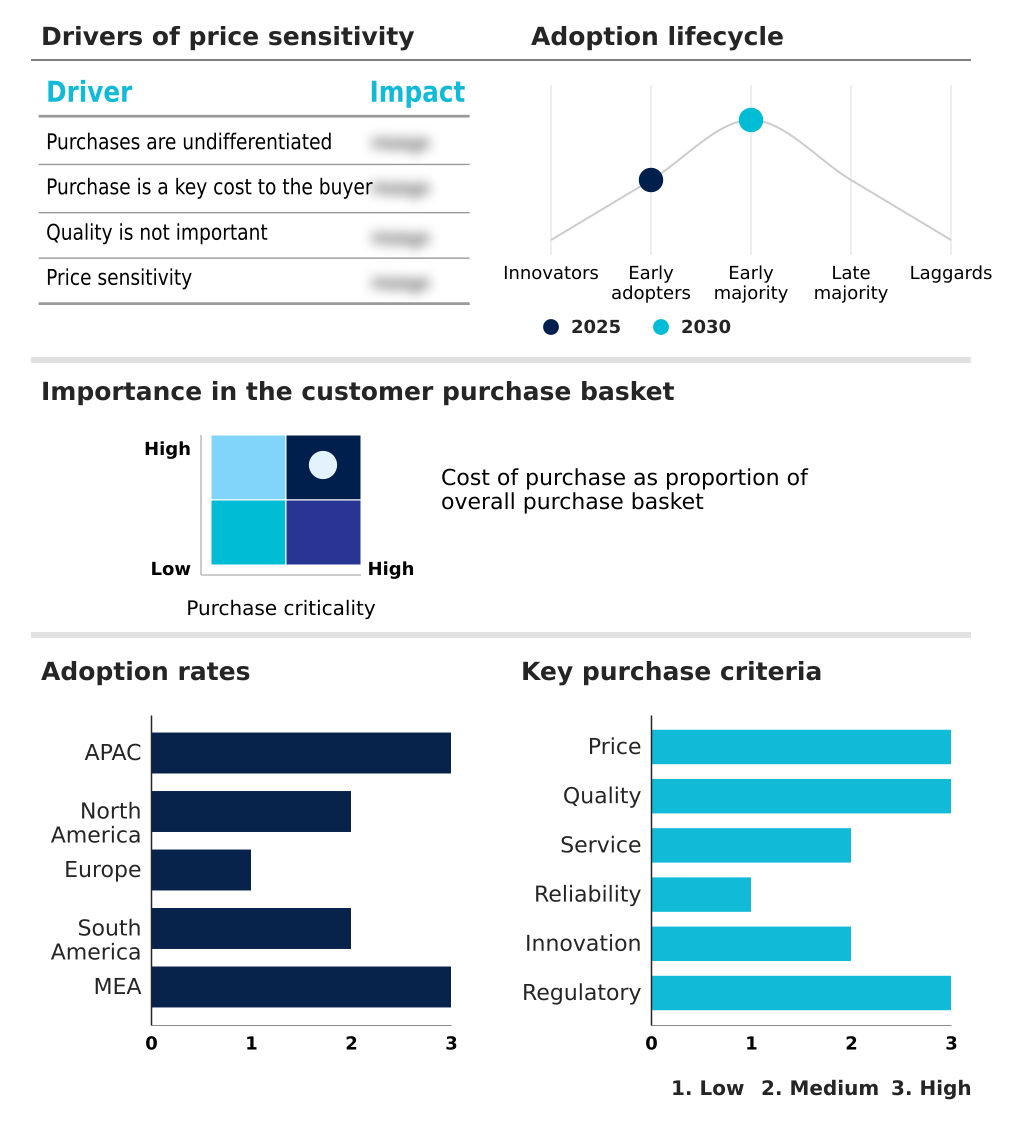
The welding equipment market forecasting report includes the adoption lifecycle of the market, covering from the innovator’s stage to the laggard’s stage. It focuses on adoption rates in different regions based on penetration. Furthermore, the welding equipment market report also includes key purchase criteria and drivers of price sensitivity to help companies evaluate and develop their market growth analysis strategies.
Customer Landscape of Welding Equipment Industry
Competitive Landscape
Companies are implementing various strategies, such as strategic alliances, welding equipment market forecast, partnerships, mergers and acquisitions, geographical expansion, and product/service launches, to enhance their presence in the industry.
AMADA WELD TECH Inc. - Core offerings encompass a spectrum of advanced arc, laser, and resistance welding systems designed for industrial manufacturing and fabrication applications.
The industry research and growth report includes detailed analyses of the competitive landscape of the market and information about key companies, including:
- AMADA WELD TECH Inc.
- Carl Cloos Schweibtechnik GmbH
- Coherent Corp.
- Daihen Corp.
- ESAB Corp.
- EWM AG
- Fronius International GmbH
- Hypertherm Inc.
- IPG Photonics Corp.
- Kemppi Oy
- Lorch Schweibtechnik GmbH
- MEGMEET Welding Technology Co.
- Miller Electric Mfg. LLC
- Panasonic Holdings Corp.
- Polysoude SAS
- The Lincoln Electric Co.
- TRUMPF SE Co. KG
- voestalpine AG
- Weld Tooling Corp
Qualitative and quantitative analysis of companies has been conducted to help clients understand the wider business environment as well as the strengths and weaknesses of key industry players. Data is qualitatively analyzed to categorize companies as pure play, category-focused, industry-focused, and diversified; it is quantitatively analyzed to categorize companies as dominant, leading, strong, tentative, and weak.
Recent Development and News in Welding equipment market
- In March, 2025, The Lincoln Electric Company unveiled its proprietary WeldVision AI platform, which utilizes deep learning algorithms to provide a ninety-nine percent accuracy rate in detecting discontinuities during high-speed robotic applications.
- In August, 2025, ESAB Corporation launched the Cobot-Go series, a portable collaborative welding system that permits operators to program complex seam paths using a simple hand-guided interface and a mobile application.
- In May, 2025, Yaskawa Electric Corporation launched the Motoman AR3120, a specialized long-reach arc welding robot designed to handle the fabrication of large structural components with enhanced path accuracy.
- In June, 2025, the American Welding Society launched a new global certification standard specifically designed for cobot operators to address the lack of standardized training for collaborative robotic welding systems.
Dive into Technavio’s robust research methodology, blending expert interviews, extensive data synthesis, and validated models for unparalleled Welding Equipment Market insights. See full methodology.
| Market Scope | |
|---|---|
| Page number | 307 |
| Base year | 2025 |
| Historic period | 2020-2024 |
| Forecast period | 2026-2030 |
| Growth momentum & CAGR | Accelerate at a CAGR of 6.3% |
| Market growth 2026-2030 | USD 5479.2 million |
| Market structure | Fragmented |
| YoY growth 2025-2026(%) | 6.0% |
| Key countries | China, Japan, India, South Korea, Indonesia, Australia, US, Canada, Mexico, Germany, France, UK, Italy, Spain, The Netherlands, Brazil, Argentina, Chile, Saudi Arabia, UAE, South Africa, Turkey and Israel |
| Competitive landscape | Leading Companies, Market Positioning of Companies, Competitive Strategies, and Industry Risks |
Research Analyst Overview
- The welding equipment market is defined by a technological shift from traditional methods to advanced, digitally integrated systems. Core processes like arc welding, TIG welding, and MIG/MAG welding are being enhanced with inverter welding machines and sophisticated welding power sources that offer greater control and efficiency.
- The primary driver of innovation is the widespread adoption of welding automation, including robotic welding, robotic arc welding, and collaborative cobots, which address labor shortages and increase productivity in automated welding cells. Specialized technologies such as resistance welding, particularly resistance spot welding with servo-driven actuators, dominate automotive manufacturing.
- In high-value sectors, laser beam welding, friction stir welding, and electron beam welding provide unparalleled precision. The market for support equipment is also growing, with a focus on advanced fume extraction systems, high-quality welding consumables, and precise shielding gas controllers. Key equipment includes welding torches, orbital welding systems, multi-process welders, and welding positioners.
- For heavy fabrication, submerged arc welding and plasma cutting remain essential. The integration of weld quality control and weld monitoring systems, coupled with non-destructive testing, is becoming standard. In one notable application, a heavy machinery manufacturer achieved a 30% reduction in production cycle times by transitioning to a fully automated workflow incorporating high-frequency induction welding and custom weld tooling fixtures.
What are the Key Data Covered in this Welding Equipment Market Research and Growth Report?
-
What is the expected growth of the Welding Equipment Market between 2026 and 2030?
-
USD 5.48 billion, at a CAGR of 6.3%
-
-
What segmentation does the market report cover?
-
The report is segmented by End-user (Automotive, Construction, Aerospace and defense, Shipbuilding, and Others), Technology (Arc welding, Resistance welding, Laser beam welding, and Oxy-fuel welding), Product Type (Automatic, Semi-automatic, and Manual) and Geography (APAC, North America, Europe, South America, Middle East and Africa)
-
-
Which regions are analyzed in the report?
-
APAC, North America, Europe, South America and Middle East and Africa
-
-
What are the key growth drivers and market challenges?
-
Accelerated adoption of industrial automation and robotics, Scarcity of skilled welding professionals
-
-
Who are the major players in the Welding Equipment Market?
-
AMADA WELD TECH Inc., Carl Cloos Schweibtechnik GmbH, Coherent Corp., Daihen Corp., ESAB Corp., EWM AG, Fronius International GmbH, Hypertherm Inc., IPG Photonics Corp., Kemppi Oy, Lorch Schweibtechnik GmbH, MEGMEET Welding Technology Co., Miller Electric Mfg. LLC, Panasonic Holdings Corp., Polysoude SAS, The Lincoln Electric Co., TRUMPF SE Co. KG, voestalpine AG and Weld Tooling Corp
-
Market Research Insights
- Market dynamics are shaped by a strong push toward smart factory integration, where operational efficiency is paramount. The adoption of real-time data analytics for process optimization has been shown to improve first-pass weld quality by up to 15%, directly reducing material waste and rework costs.
- Concurrently, implementing predictive maintenance protocols, informed by data from connected equipment, can lower unplanned downtime by over 25%. This focus on data-driven improvement is critical for heavy industrial fabrication and managing complex multi-pass welds.
- Furthermore, the emphasis on supply chain localization is compelling manufacturers to invest in flexible automation solutions that enhance productivity and enable zero-defect manufacturing, aligning with the need for high-strength steel fabrication in critical infrastructure projects.
We can help! Our analysts can customize this welding equipment market research report to meet your requirements.
 RIA -
RIA - 
