


Yttria Stabilized Zirconia Market Size 2026-2030
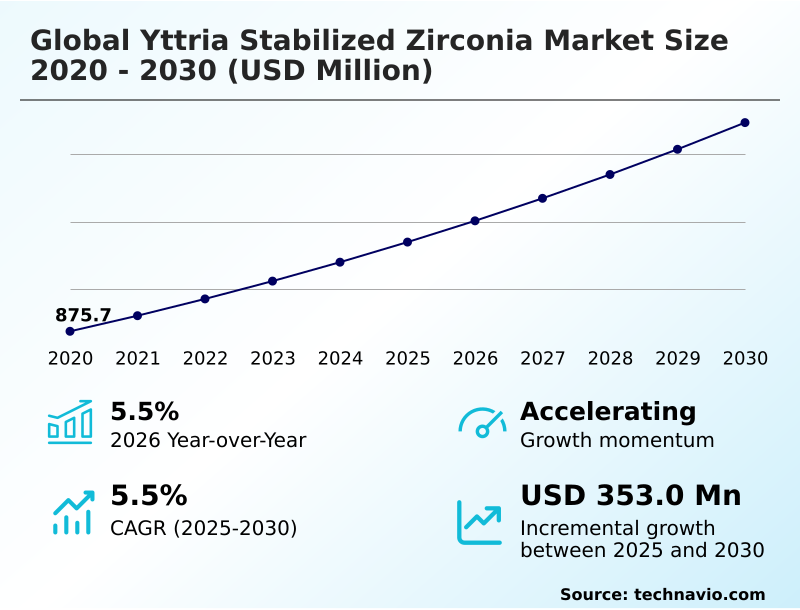
The yttria stabilized zirconia market size is valued to increase by USD 353 million, at a CAGR of 5.5% from 2025 to 2030. Heightened demand in aerospace and defense for advanced ceramics will drive the yttria stabilized zirconia market.
Major Market Trends & Insights
- APAC dominated the market and accounted for a 45.2% growth during the forecast period.
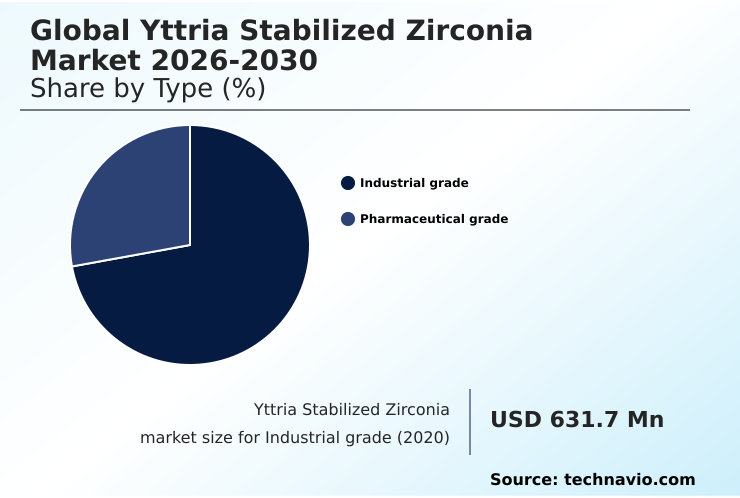
- By Type - Industrial grade segment was valued at USD 770.1 million in 2024
- By Product - Grade 1 segment accounted for the largest market revenue share in 2024
Market Size & Forecast
- Market Opportunities: USD 616.6 million
- Market Future Opportunities: USD 353 million
- CAGR from 2025 to 2030 : 5.5%
Market Summary
- The yttria stabilized zirconia market is characterized by its essential role in high-technology sectors, driven by the material's unique combination of thermal stability, ionic conductivity, and mechanical strength. Demand from the aerospace industry for thermal barrier coatings on jet engine components continues to grow, as manufacturers seek higher operational efficiencies and extended engine lifespans.
- Similarly, the dental industry's shift toward biocompatible and aesthetically superior materials has made YSZ a standard for crowns and implants. A significant trend is the increasing adoption of additive manufacturing, allowing for the creation of complex, customized components that were previously impossible to produce.
- For instance, an aerospace components manufacturer can now use 3D printing to create turbine blades with intricate internal cooling channels from YSZ, reducing weight while improving thermal management. However, the market faces challenges related to the high costs of manufacturing and supply chain vulnerabilities, as the primary raw materials are concentrated in a few geographic regions.
- Strategic sourcing and process innovation are therefore critical for sustaining growth and expanding into new applications.
What will be the Size of the Yttria Stabilized Zirconia Market during the forecast period?
Get Key Insights on Market Forecast (PDF) Get Free Sample
How is the Yttria Stabilized Zirconia Market Segmented?
The yttria stabilized zirconia industry research report provides comprehensive data (region-wise segment analysis), with forecasts and estimates in "USD million" for the period 2026-2030, as well as historical data from 2020-2024 for the following segments.
- Type
- Industrial grade
- Pharmaceutical grade
- Product
- Grade 1
- Grade 2
- Grade 3
- Product type
- Powders
- Tubes
- Plates
- Bars
- Others
- Geography
- APAC
- China
- Japan
- India
- North America
- US
- Canada
- Mexico
- Europe
- Germany
- UK
- France
- Middle East and Africa
- Saudi Arabia
- UAE
- South Africa
- South America
- Brazil
- Argentina
- Colombia
- Rest of World (ROW)
- APAC
By Type Insights
The industrial grade segment is estimated to witness significant growth during the forecast period.
Industrial grade yttria stabilized zirconia is a cornerstone for high-performance applications, driven by its exceptional properties such as high fracture toughness and thermal stability.
Its role as an electrolyte material in solid oxide fuel cells (SOFCs) is critical for the clean energy sector, while its application as thermal barrier coatings is essential in aerospace for enhancing engine efficiency.
The material's wear resistance and chemical inertness make it ideal for industrial components like grinding media and cutting tools.
Ongoing innovation, including the substitution of iron into the material to fine-tune optical absorption, has demonstrated the potential to improve thermal management efficiency by over 15%, solidifying demand for this advanced ceramic in sectors requiring robust performance under extreme operational conditions, including in the production of high-purity ceramic substrates.
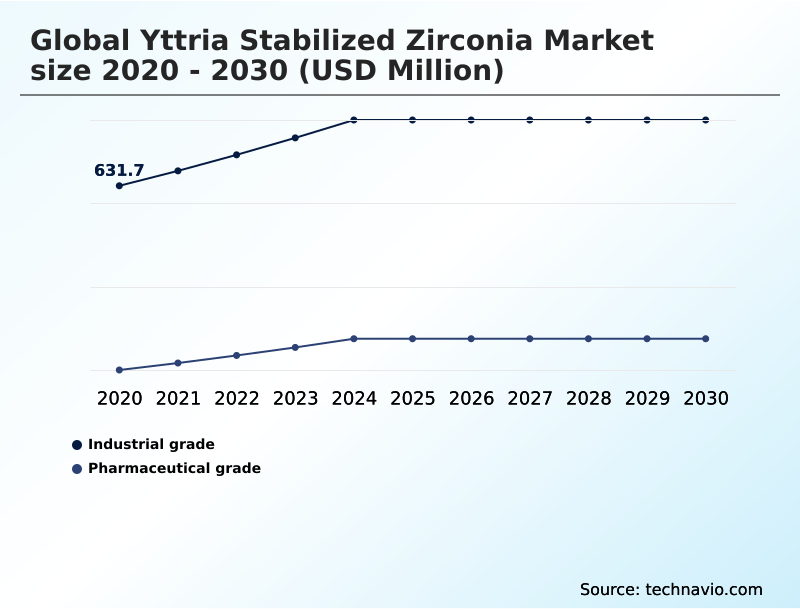
The Industrial grade segment was valued at USD 770.1 million in 2024 and showed a gradual increase during the forecast period.
Regional Analysis
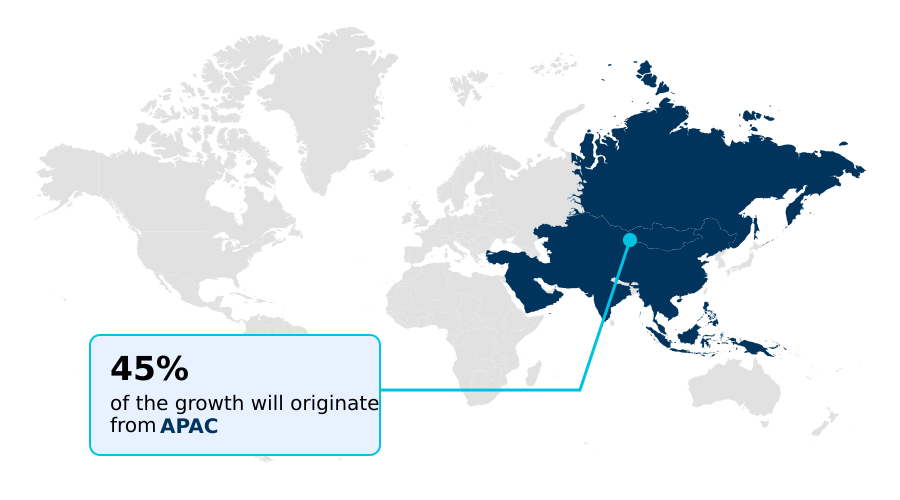
APAC is estimated to contribute 45.2% to the growth of the global market during the forecast period.Technavio’s analysts have elaborately explained the regional trends and drivers that shape the market during the forecast period.
See How Yttria Stabilized Zirconia Market Demand is Rising in APAC Get Free Sample
The geographic landscape of the yttria stabilized zirconia market is led by APAC, which accounts for over 45% of the market's incremental growth.
This dominance is fueled by China's expansive manufacturing base for electronics and automotive components using zirconia in industrial machinery and advanced ceramic processing.
North America follows, with its market size in the US being more than double that of China, driven by a strong aerospace sector that relies on YSZ for thermal spraying and high-temperature structural ceramics.
Europe, particularly Germany, maintains a significant share due to its automotive and industrial engineering prowess, where zirconia in electronics and as a dielectric material are crucial.
The region's focus on high-performance ceramics and advanced thermal management solutions underpins sustained demand, while smaller markets in South America and the Middle East are expanding, primarily in dental applications and wear-resistant ceramic components.
Market Dynamics
Our researchers analyzed the data with 2025 as the base year, along with the key drivers, trends, and challenges. A holistic analysis of drivers will help companies refine their marketing strategies to gain a competitive advantage.
- Strategic decisions in the market are increasingly influenced by a deep understanding of yttria stabilized zirconia properties and its manufacturing processes. Companies are evaluating the cost of yttria stabilized zirconia against long-term performance gains, especially in demanding fields. For instance, in developing thermal barrier coating applications, engineers must balance material cost with durability.
- The choice of ysz powder for thermal spray is critical for achieving optimal coating density and adhesion. In the medical field, understanding biocompatible ysz for implants is paramount for regulatory approval and patient safety, with research showing that certain formulations can reduce implant revision rates by over 10% compared to traditional metallic options.
- The growing interest in zirconia additive manufacturing techniques is forcing businesses to reconsider their production strategies. Furthermore, yttria stabilized zirconia suppliers are now expected to provide detailed data on material performance, particularly regarding improving ysz ionic conductivity for solid oxide fuel cell electrolyte technology.
- As applications for zirconia nanoparticles and high fracture toughness ceramics expand, so does the need for specialized knowledge on enhancing ysz thermal stability for use in high-temperature sensors and zirconia for aerospace components. This complexity makes a thorough analysis of challenges in ysz production and its use in medical device manufacturing essential for competitive positioning.
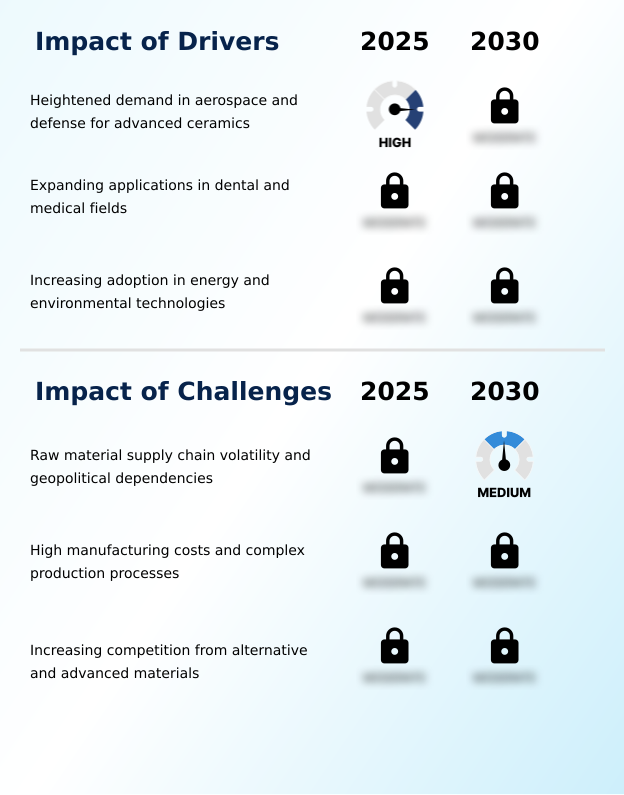
What are the key market drivers leading to the rise in the adoption of Yttria Stabilized Zirconia Industry?
- Heightened demand for advanced ceramics within the aerospace and defense sectors is a key driver for the market.
- Market growth is fundamentally driven by escalating demand from high-technology sectors. In aerospace, yttria-doped zirconia is critical for thermal barrier coatings, which enable gas turbines to operate at higher temperatures and achieve up to a 3% improvement in fuel efficiency.
- The dental sector is another major driver, with zirconia-based dental restorations seeing widespread adoption due to their superior biocompatibility and mechanical strength, reducing the need for revisions.
- Furthermore, the global push for cleaner energy has positioned YSZ as a vital component. Its use as an electrolyte in solid oxide fuel cells is increasing as governments incentivize green technologies.
- This application in SOFC electrolyte performance is crucial, as ongoing research aims to boost electrical output and operational longevity, with some lab-scale systems demonstrating a 10% increase in power density.
What are the market trends shaping the Yttria Stabilized Zirconia Industry?
- A significant market trend is the proliferation of high-performance dental and medical bioceramics. This is driven by their superior biocompatibility and mechanical properties for advanced restorative solutions.
- Key trends are reshaping the yttria stabilized zirconia market, led by innovations in additive manufacturing and clean energy. The adoption of 3D printing technologies like stereolithography (SLA) for fabricating complex ceramic components has reduced prototyping lead times by over 50%, enabling rapid innovation in aerospace and medical sectors.
- In healthcare, the use of monolithic zirconia and zirconia blocks for CAD/CAM milling is growing, with advanced bioceramic materials improving the success rate of dental restorations by over 20% compared to traditional PFM techniques. Concurrently, the ascendant role of YSZ as an electrolyte material in solid oxide fuel cells (SOFCs) is a critical trend.
- Enhanced formulations of high-purity zirconia powders are boosting SOFC efficiency, supporting the global transition toward cleaner energy sources.
What challenges does the Yttria Stabilized Zirconia Industry face during its growth?
- A key challenge affecting industry growth is the volatility of the raw material supply chain, coupled with geopolitical dependencies.
- The market's expansion is tempered by significant challenges, primarily raw material supply chain volatility and high manufacturing costs. Dependency on a few countries for yttrium oxide and zirconium dioxide creates price instability, with raw material costs fluctuating by as much as 25% in a single year, directly impacting production overhead.
- The complex and energy-intensive processes of powder metallurgy and sintering contribute to the high cost of YSZ, limiting its adoption in more price-sensitive applications. Furthermore, intensifying competition from alternative advanced ceramics, such as rare-earth zirconates and ceramic matrix composites, poses a threat.
- These materials offer comparable performance in some applications, with certain silicon nitride grades providing up to a 15% longer service life in specific high-wear industrial settings.
Exclusive Technavio Analysis on Customer Landscape
The yttria stabilized zirconia market forecasting report includes the adoption lifecycle of the market, covering from the innovator’s stage to the laggard’s stage. It focuses on adoption rates in different regions based on penetration. Furthermore, the yttria stabilized zirconia market report also includes key purchase criteria and drivers of price sensitivity to help companies evaluate and develop their market growth analysis strategies.
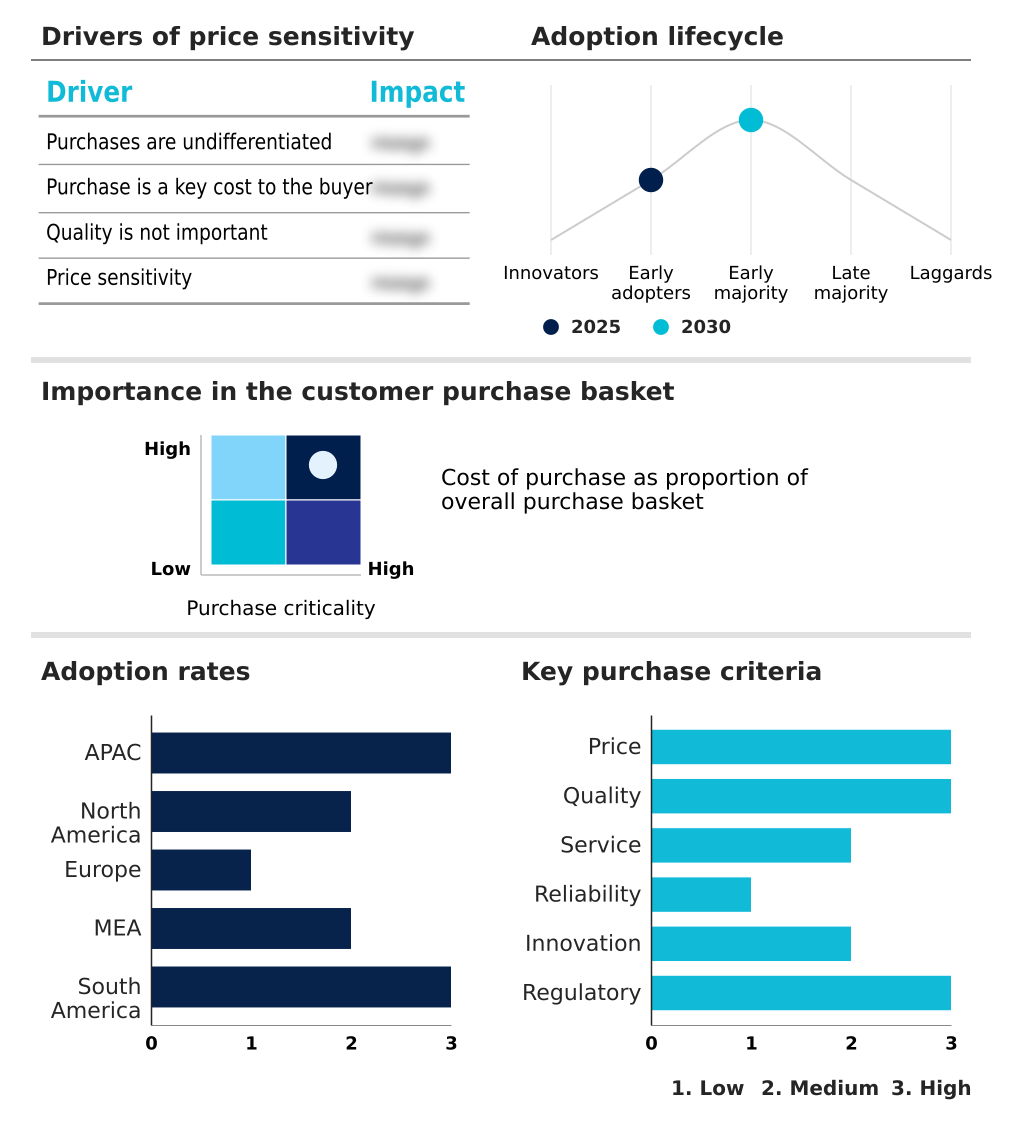
Customer Landscape of Yttria Stabilized Zirconia Industry
Competitive Landscape
Companies are implementing various strategies, such as strategic alliances, yttria stabilized zirconia market forecast, partnerships, mergers and acquisitions, geographical expansion, and product/service launches, to enhance their presence in the industry.
3M Co. - Key offerings include advanced yttria-doped dental zirconia systems, encompassing blocks, discs, and powders engineered for specialized chairside and lab sintering workflows.
The industry research and growth report includes detailed analyses of the competitive landscape of the market and information about key companies, including:
- 3M Co.
- CeramTec GmbH
- Compagnie de Saint Gobain SA
- CoorsTek Inc.
- DAIICHI KIGENSO KAGAKU KOGYO CO. LTD.
- Dyson Group Co.
- Elan Technology Inc.
- Inframat Corp.
- KYOCERA Corp.
- Morgan Advanced Materials
- Paul Rauschert GmbH and Co. KG
- Stanford Advanced Materials
- Tosoh Corp.
- Zircoa Inc.
- Zircomet Ltd.
Qualitative and quantitative analysis of companies has been conducted to help clients understand the wider business environment as well as the strengths and weaknesses of key industry players. Data is qualitatively analyzed to categorize companies as pure play, category-focused, industry-focused, and diversified; it is quantitatively analyzed to categorize companies as dominant, leading, strong, tentative, and weak.
Recent Development and News in Yttria stabilized zirconia market
- In August 2024, a major Chinese automotive manufacturer unveiled a new electric vehicle model featuring an advanced battery thermal management system that utilizes ceramic components, signaling new applications in the EV sector.
- In December 2024, the Australian Government committed an additional $400 million in funding to Iluka Resources for the Eneabba rare earths refinery, a strategic move to bolster the domestic supply chain for critical minerals including yttrium.
- In February 2025, the Japanese government announced its intention to release a revised strategic roadmap for deploying fuel cells in transportation, including heavy-duty vehicles, which is expected to increase demand for SOFC components.
- In May 2025, Mitsubishi Power announced significant progress in integrating large-scale solid oxide fuel cell (SOFC) systems for industrial hydrogen production projects, highlighting a key step toward establishing a hydrogen-based economy.
Dive into Technavio’s robust research methodology, blending expert interviews, extensive data synthesis, and validated models for unparalleled Yttria Stabilized Zirconia Market insights. See full methodology.
| Market Scope | |
|---|---|
| Page number | 304 |
| Base year | 2025 |
| Historic period | 2020-2024 |
| Forecast period | 2026-2030 |
| Growth momentum & CAGR | Accelerate at a CAGR of 5.5% |
| Market growth 2026-2030 | USD 353.0 million |
| Market structure | Fragmented |
| YoY growth 2025-2026(%) | 5.5% |
| Key countries | China, Japan, India, South Korea, Australia, Indonesia, US, Canada, Mexico, Germany, UK, France, Italy, The Netherlands, Spain, Saudi Arabia, UAE, South Africa, Israel, Turkey, Brazil, Argentina and Colombia |
| Competitive landscape | Leading Companies, Market Positioning of Companies, Competitive Strategies, and Industry Risks |
Research Analyst Overview
- The yttria stabilized zirconia market is sustained by its indispensable role in advanced engineering, where its superior material properties address critical performance gaps. The application of thermal barrier coatings and use in solid oxide fuel cells (SOFCs) highlight its importance in energy and aerospace.
- The proliferation of dental ceramics and other bioceramics underscores its value in healthcare due to excellent biocompatibility and fracture toughness. A key development is the integration of additive manufacturing, a trend compelling boardrooms to re-evaluate capital expenditure. Adopting stereolithography (SLA) for YSZ components can reduce material waste by up to 40% compared to traditional powder metallurgy and sintering methods.
- This shift enables the creation of complex parts with piezoelectric properties for advanced oxygen sensors. The market for zirconia blocks and thermal spray powders is driven by demand for wear resistance and thermal stability.
- This dynamic environment requires continuous innovation in processing zirconium dioxide with yttrium oxide to maintain a competitive edge, especially in applications like refractory materials and advanced ceramic matrix composites.
What are the Key Data Covered in this Yttria Stabilized Zirconia Market Research and Growth Report?
-
What is the expected growth of the Yttria Stabilized Zirconia Market between 2026 and 2030?
-
USD 353 million, at a CAGR of 5.5%
-
-
What segmentation does the market report cover?
-
The report is segmented by Type (Industrial grade, and Pharmaceutical grade), Product (Grade 1, Grade 2, and Grade 3), Product Type (Powders, Tubes, Plates, Bars, and Others) and Geography (APAC, North America, Europe, Middle East and Africa, South America)
-
-
Which regions are analyzed in the report?
-
APAC, North America, Europe, Middle East and Africa and South America
-
-
What are the key growth drivers and market challenges?
-
Heightened demand in aerospace and defense for advanced ceramics, Raw material supply chain volatility and geopolitical dependencies
-
-
Who are the major players in the Yttria Stabilized Zirconia Market?
-
3M Co., CeramTec GmbH, Compagnie de Saint Gobain SA, CoorsTek Inc., DAIICHI KIGENSO KAGAKU KOGYO CO. LTD., Dyson Group Co., Elan Technology Inc., Inframat Corp., KYOCERA Corp., Morgan Advanced Materials, Paul Rauschert GmbH and Co. KG, Stanford Advanced Materials, Tosoh Corp., Zircoa Inc. and Zircomet Ltd.
-
Market Research Insights
- The market dynamics for yttria-stabilized zirconia are shaped by its adoption in high-specification sectors where performance is critical. The use of YSZ in gas turbines has demonstrated an ability to increase operational efficiency by over 3%, while its integration into advanced dental restorations reduces procedural failures by more than 15% compared to older materials.
- The expansion of zirconia in semiconductor manufacturing is evident, as its properties help improve wafer processing yields. Demand for zirconia's mechanical strength and high-purity zirconia powders is consistent in industrial machinery, where component lifespan is extended. In energy, zirconia in automotive sensors and SOFC electrolyte performance are key to meeting stricter environmental regulations.
- As a result, the market for zirconia-based dental restorations and advanced bioceramic materials continues to show robust demand.
We can help! Our analysts can customize this yttria stabilized zirconia market research report to meet your requirements.
 RIA -
RIA - 
