



Fintech Software Market Size 2025-2029
The fintech software market size is valued to increase USD 25.56 billion, at a CAGR of 8.2% from 2024 to 2029. Need to improve business efficiency will drive the fintech software market.
Major Market Trends & Insights
- APAC dominated the market and accounted for a 38% growth during the forecast period.
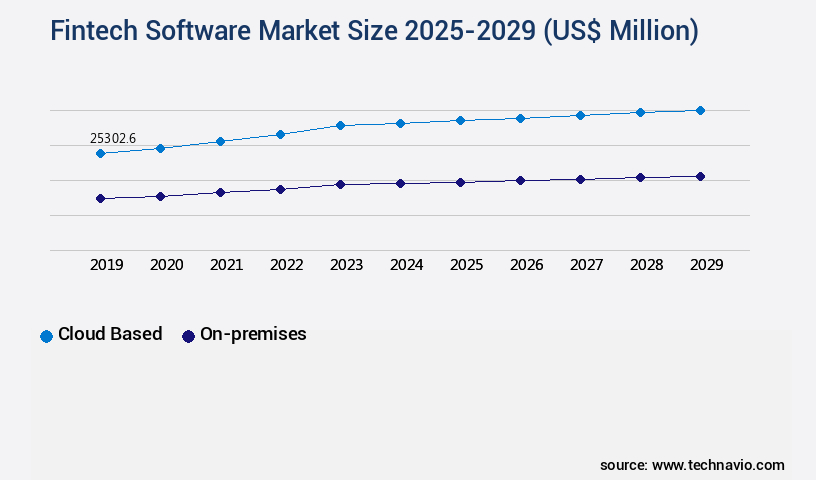
- By Deployment - Cloud based segment was valued at USD 25.3 billion in 2023
- By End-user - Banking segment accounted for the largest market revenue share in 2023
Market Size & Forecast
- Market Opportunities: USD 103.42 million
- Market Future Opportunities: USD 25555.90 million
- CAGR : 8.2%
- APAC: Largest market in 2023
Market Summary
- The market represents a dynamic and continually evolving landscape, driven by the increasing adoption of advanced technologies and applications. Core technologies, such as artificial intelligence (AI) and machine learning (ML), are revolutionizing financial services by enabling more efficient business processes and enhanced customer experiences. Meanwhile, applications like robo-advisory, digital payments, and mobile banking are gaining significant traction, with the robo-advisory segment projected to account for over 30% of the total assets under management in the asset management industry by 2027.
- However, the market also faces challenges, including data privacy and security concerns, which necessitate robust compliance with regulations such as GDPR and CCPA. In the face of these evolving trends, service types like Software-as-a-Service (SaaS) and Platform-as-a-Service (PaaS) are increasingly popular, offering scalability and flexibility for businesses looking to improve their operational efficiency.
What will be the Size of the Fintech Software Market during the forecast period?
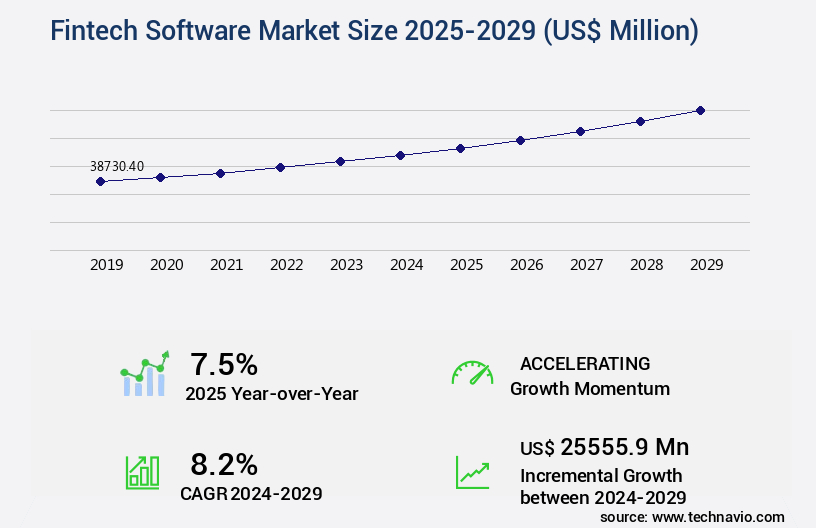
Get Key Insights on Market Forecast (PDF) Request Free Sample
How is the Fintech Software Market Segmented and what are the key trends of market segmentation?
The fintech software industry research report provides comprehensive data (region-wise segment analysis), with forecasts and estimates in "USD million" for the period 2025-2029, as well as historical data from 2019-2023 for the following segments.
- Deployment
- Cloud based
- On-premises
- End-user
- Banking
- Insurance
- Securities
- Service
- Money transfer and payments
- Savings and investments
- Digital lending and lending marketplaces
- Online insurance and insurance marketplaces
- Others
- Geography
- North America
- US
- Canada
- Europe
- France
- Germany
- Italy
- UK
- APAC
- China
- India
- Japan
- South Korea
- Rest of World (ROW)
- North America
By Deployment Insights
The cloud based segment is estimated to witness significant growth during the forecast period.
In the dynamic the market, several trends are shaping its evolution. Blockchain technology is increasingly being adopted for secure transaction processing and data security, ensuring financial data encryption and kyc/aml compliance. Security protocols are being strengthened through machine learning algorithms and user authentication, safeguarding against fraud detection and credit scoring models. Algorithmic trading and personal financial management applications are gaining traction, offering real-time payments and investment management solutions. Open banking APIs enable peer-to-peer lending and account management, while regulatory technology streamlines compliance regulations. Software development lifecycle improvements facilitate customer onboarding and digital wallet integration. The market is expected to grow significantly, with transaction processing and portfolio management solutions witnessing a substantial increase.
Insurtech integration and financial modeling are also becoming essential, driving the demand for api integration and loan origination systems. The use of data analytics dashboards and risk management tools is on the rise, providing valuable insights for businesses. Furthermore, the integration of cryptocurrency exchanges and payment gateways is expanding the market's reach. The adoption of cloud-based deployment models is growing, with 35% of businesses opting for this solution due to its flexibility and cost-effectiveness. By 2025, it is anticipated that 45% of the market will be dominated by cloud-based solutions. The future of the market holds immense potential, with ongoing advancements in technology and evolving business needs.
These trends underscore the market's continuous growth and adaptability across various sectors.
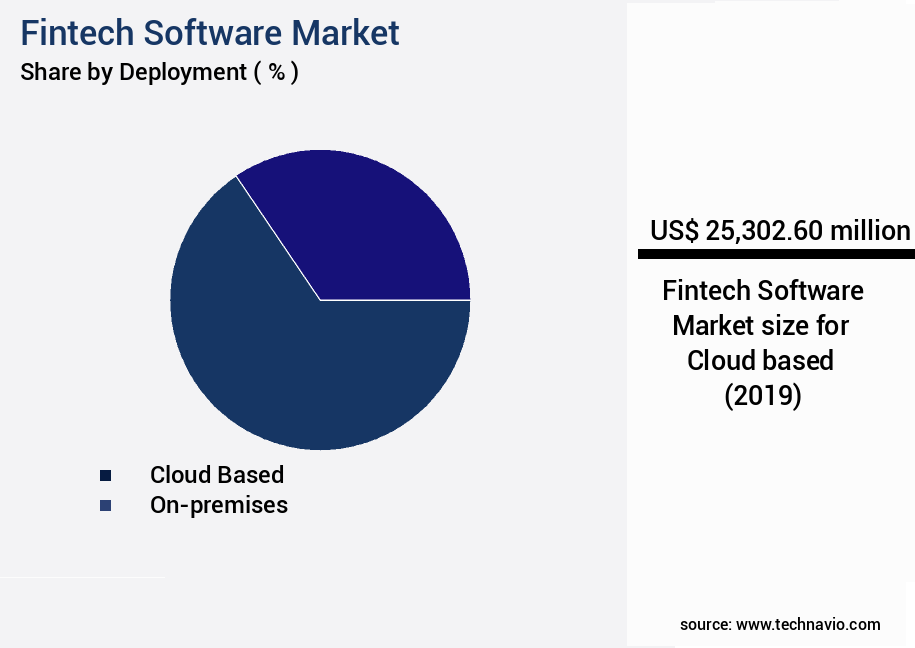
The Cloud based segment was valued at USD 25.3 billion in 2019 and showed a gradual increase during the forecast period.
Regional Analysis
APAC is estimated to contribute 38% to the growth of the global market during the forecast period.Technavio’s analysts have elaborately explained the regional trends and drivers that shape the market during the forecast period.
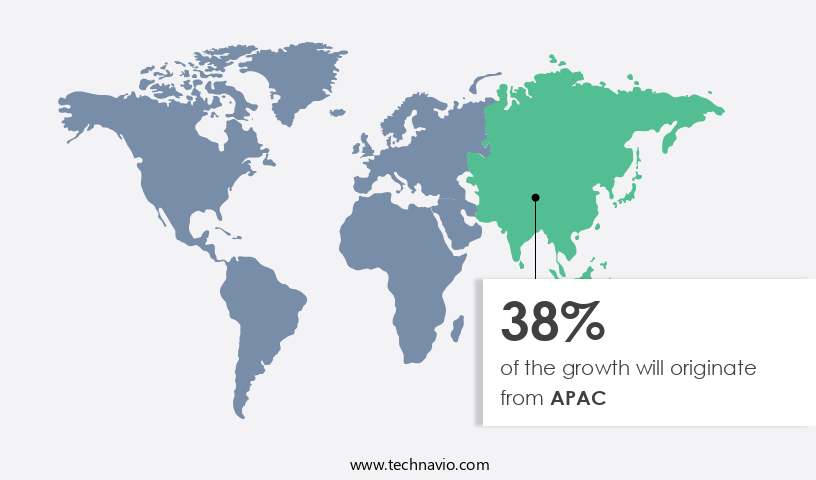
See How Fintech Software Market Demand is Rising in APAC Request Free Sample
The market in North America is characterized by its technological maturity and significant growth. The US and Canada are major contributors to this market's expansion, with the US leading as an early adopter of advanced technologies in banking and financial institutions. Silicon Valley's attractiveness to fintech startups further bolsters the market's momentum. The increasing competition from the non-banking sector necessitates the adoption of advanced technologies, resulting in increased fintech investments. According to recent studies, there are over 8,000 fintech companies in North America, and this number is projected to reach 12,000 by 2025.
Additionally, the market's total funding has grown from USD19 billion in 2010 to USD111.8 billion in 2018. These figures underscore the market's continuous evolution and the significant opportunities it presents for businesses.
Market Dynamics
Our researchers analyzed the data with 2024 as the base year, along with the key drivers, trends, and challenges. A holistic analysis of drivers will help companies refine their marketing strategies to gain a competitive advantage.
The market is witnessing significant growth as financial institutions and businesses increasingly adopt technology-driven solutions to enhance efficiency, security, and customer experience. Key components of this market include secure payment gateway integration, real-time fraud detection systems, AI-driven risk management platforms, and blockchain-based KYC compliance. Open banking API integration for fintech is a major trend, enabling seamless data sharing and customer onboarding automation. Moreover, personalized financial management tools, algorithmic trading strategies implementation, and robust security protocols for financial data are essential elements of the market. Regulatory technology compliance solutions and mobile payment processing security measures are critical in addressing regulatory requirements and ensuring secure transactions.
Loan origination system integration and advanced data analytics dashboards offer valuable insights for lending institutions. Secure digital wallet integration, peer-to-peer lending platforms, cryptocurrency exchange software, financial data encryption and security, and AI-powered credit scoring models are additional features shaping the market. In comparison, research indicates that over 80% of fintech innovation is focused on enhancing customer experience and operational efficiency, while only 20% is dedicated to regulatory compliance. The market's dynamics are influenced by various factors, including technological advancements, changing consumer preferences, and regulatory frameworks. As the market continues to evolve, investment management software solutions, microservices architecture for fintech, and the integration of advanced technologies like AI and machine learning are expected to play a pivotal role in driving growth.
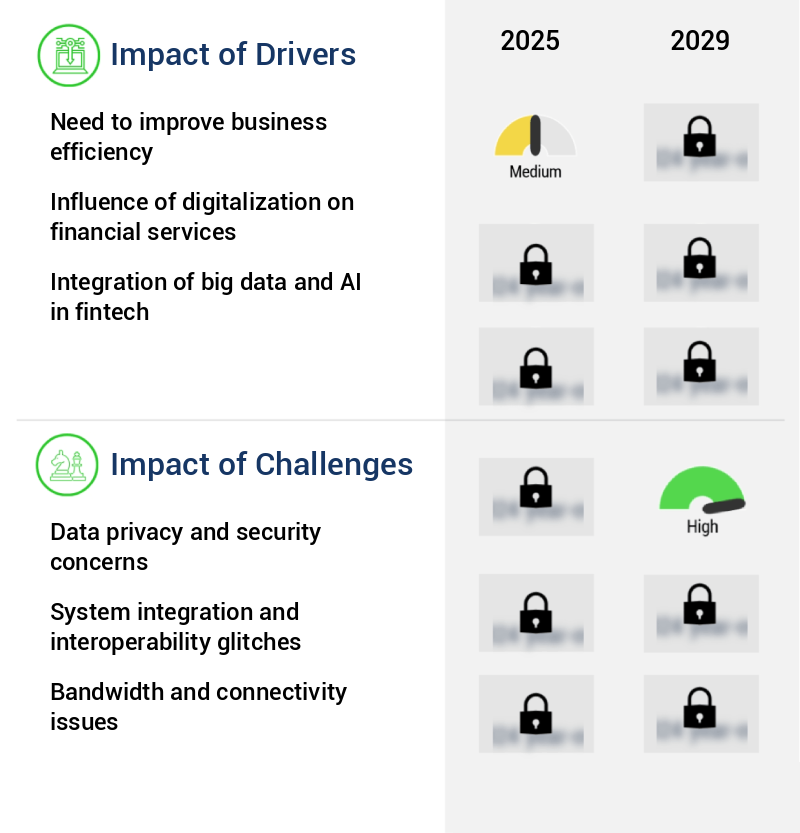
What are the key market drivers leading to the rise in the adoption of Fintech Software Industry?
- To enhance business efficiency is the primary motivator in today's competitive marketplace. By continually seeking ways to streamline operations and optimize resources, businesses can maintain a competitive edge and better serve their customers.
- The proliferation of connected devices in various industries has resulted in an influx of data generation. Businesses have recognized the potential of utilizing this data to enhance operational efficiency, enhance services, and augment revenues. Traditional banking systems, for example, have seen a significant reduction in costs due to digitalization and innovative financial technologies like MobileFirst banking. In the retail sector, companies are embracing digital payments and mobile wallets to expand their market presence.
- These advancements not only streamline processes but also open new avenues for businesses to adapt and thrive in the evolving market landscape. The integration of data-driven strategies and cutting-edge technologies is shaping the business world, enabling organizations to stay competitive and responsive to consumer demands.
What are the market trends shaping the Fintech Software Industry?
- The increasing demand for data integration and visual analytics represents a significant market trend. This trend reflects the growing importance of effectively managing and analyzing complex data sets to gain valuable insights.
- Enterprises face mounting challenges in managing the increasing complexity and volume of data. To address these issues, they are turning to data integration solutions. Fintech software plays a crucial role in this regard, providing on-demand accessibility for real-time data synthesis. This empowers businesses to analyze data effectively, enabling informed decision-making processes. Data integration solutions enable enterprises to monitor, transform, and deliver data, bridging the gap between businesses and IT. They help integrate technical and business processes from various sources and convert them into valuable information. The exponential growth in data volume necessitates the need for efficient data management and analysis.
- Fintech software offers numerous advantages, including real-time analysis and improved operational efficiency. It allows businesses to understand their processes better and respond promptly to market trends. Furthermore, it ensures data accuracy and consistency across different systems, reducing errors and minimizing the risk of data loss. The benefits of data integration solutions extend to financial organizations as well. They enable effective risk management, fraud detection, and compliance with regulatory requirements. By providing a single, consolidated view of data, these solutions facilitate better collaboration and communication within organizations, ultimately driving growth and innovation. In conclusion, data integration solutions are essential for enterprises seeking to manage the complexities and volatilities of today's data landscape.
- Fintech software plays a pivotal role in this process, offering real-time data synthesis, improved operational efficiency, and enhanced data accuracy and consistency.
What challenges does the Fintech Software Industry face during its growth?
- Data privacy and security concerns represent a significant challenge to the industry's growth, necessitating rigorous measures to protect sensitive information and maintain trust with customers.
- Fintech software adoption in organizations faces significant challenges due to data privacy and security risks. Big data and artificial intelligence (AI) technologies, which are integral to fintech, have the power to track, retrieve, and analyze vast amounts of data from connected servers. However, these technologies also manipulate server algorithms using AI capabilities, raising concerns about data security. Organizational data must be safeguarded from unauthorized access to IT infrastructure. IT infrastructure is often a patchwork of open-source code, which can lead to system vulnerabilities. Cloud infrastructure is particularly susceptible due to glitches in source codes, as clouds host multiple applications in their environment.
- According to recent studies, over 80% of companies reported experiencing at least one data breach in the past year. The financial sector experienced the highest number of data breaches, with 32% of all breaches targeting financial institutions. These breaches can lead to significant financial losses, reputational damage, and legal consequences. To mitigate these risks, organizations are investing in advanced security measures such as multi-factor authentication, encryption, and access control. They are also adopting a zero-trust security model, which assumes that every user and device is a potential threat and requires verification before access is granted.
- Despite these challenges, the fintech market continues to evolve, with new technologies and innovations emerging regularly. Organizations must stay informed and adapt to these changes to remain competitive in the digital landscape.
Exclusive Customer Landscape
The fintech software market forecasting report includes the adoption lifecycle of the market, covering from the innovator’s stage to the laggard’s stage. It focuses on adoption rates in different regions based on penetration. Furthermore, the fintech software market report also includes key purchase criteria and drivers of price sensitivity to help companies evaluate and develop their market growth analysis strategies.
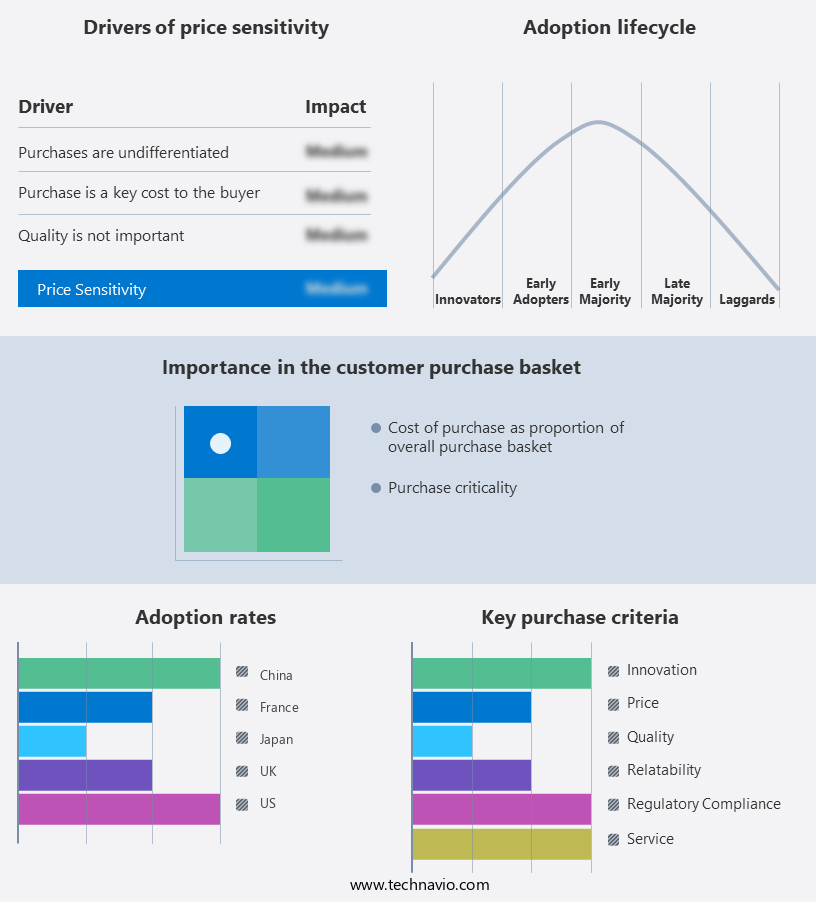
Customer Landscape of Fintech Software Industry
Competitive Landscape & Market Insights
Companies are implementing various strategies, such as strategic alliances, fintech software market forecast, partnerships, mergers and acquisitions, geographical expansion, and product/service launches, to enhance their presence in the industry.
Accenture PLC - This company specializes in providing fintech software solutions, including the FinTech Innovation Lab and Accenture Digital Banking Solutions, enhancing financial institutions' digital capabilities and driving innovation in the financial sector.
The industry research and growth report includes detailed analyses of the competitive landscape of the market and information about key companies, including:
- Accenture PLC
- Bankable Domain Inc.
- Blockstream Corp. Inc.
- DXC Technology Co.
- EPAM Systems Inc.
- Fingent
- Fiserv Inc.
- Hyland Software Inc.
- Infosys Ltd.
- Intellectsoft LLC
- International Business Machines Corp.
- LeewayHertz
- Microsoft Corp.
- Oracle Corp.
- Praxent LLC
- SAP SE
- SAS Institute Inc.
- Serokell OU
- Stripe Inc.
- Vention
Qualitative and quantitative analysis of companies has been conducted to help clients understand the wider business environment as well as the strengths and weaknesses of key industry players. Data is qualitatively analyzed to categorize companies as pure play, category-focused, industry-focused, and diversified; it is quantitatively analyzed to categorize companies as dominant, leading, strong, tentative, and weak.
Recent Development and News in Fintech Software Market
- In January 2024, PayPal announced the launch of its new open banking platform, Braintree Open Banking, enabling merchants to offer account-to-account payments to their customers in Europe (PayPal Press Release, 2024). In March 2024, Mastercard and Nets, a leading European payments provider, entered into a strategic partnership to expand Mastercard's open banking offerings in Europe, aiming to reach over 100 million European consumers (Mastercard Newsroom, 2024).
- In April 2025, Visa made a significant investment of USD5.3 billion in Plaid, a leading fintech company specializing in financial data access and transfer, to strengthen its position in the open banking market (Visa Investor Relations, 2025). In May 2025, the European Banking Authority (EBA) approved the revised Regulatory Technical Standards (RTS) on Strong Customer Authentication and Common and Secure Communication under the Payment Services Directive 2 (PSD2), ensuring a more secure and efficient open banking environment in Europe (EBA, 2025).
Dive into Technavio’s robust research methodology, blending expert interviews, extensive data synthesis, and validated models for unparalleled Fintech Software Market insights. See full methodology.
|
Market Scope |
|
|
Report Coverage |
Details |
|
Page number |
230 |
|
Base year |
2024 |
|
Historic period |
2019-2023 |
|
Forecast period |
2025-2029 |
|
Growth momentum & CAGR |
Accelerate at a CAGR of 8.2% |
|
Market growth 2025-2029 |
USD 25555.9 million |
|
Market structure |
Fragmented |
|
YoY growth 2024-2025(%) |
7.5 |
|
Key countries |
US, Canada, China, UK, Germany, Japan, India, Italy, South Korea, and France |
|
Competitive landscape |
Leading Companies, Market Positioning of Companies, Competitive Strategies, and Industry Risks |
Research Analyst Overview
- In the dynamic and innovative realm of fintech software, several key trends are shaping the industry's trajectory. One significant area of focus is the integration of blockchain technology, which brings enhanced security through decentralized, immutable ledgers. This technology's adoption is escalating, with algorithmic trading firms embracing its potential for increased transparency and efficiency. Another trend is the rise of personal financial management solutions, which leverage open banking APIs to offer real-time account management and data analytics dashboards. Peer-to-peer lending platforms have also gained traction, enabling users to bypass traditional financial institutions for loans. Risk management and regulatory technology are increasingly crucial components of the market.
- Regulatory compliance, including KYC/AML checks, user authentication, and data encryption, is a priority for financial institutions. Machine learning algorithms are employed to enhance fraud detection and credit scoring models, ensuring robust security protocols. Software development lifecycles are evolving, with API integration and transaction processing becoming essential elements. Digital wallets and payment gateways facilitate real-time payments, while insurtech integration offers seamless insurance solutions. Financial modeling and portfolio management tools provide valuable insights for investment management. Cryptocurrency exchanges are transforming the financial landscape, offering new opportunities for trading and investment. Loan origination systems streamline the lending process, and compliance regulations continue to shape the market.
- The market is a vibrant, ever-evolving ecosystem, with continuous innovation and growth. From blockchain technology and algorithmic trading to personal financial management and regulatory technology, the sector's potential is vast and exciting.
What are the Key Data Covered in this Fintech Software Market Research and Growth Report?
-
What is the expected growth of the Fintech Software Market between 2025 and 2029?
-
USD 25.56 billion, at a CAGR of 8.2%
-
-
What segmentation does the market report cover?
-
The report segmented by Deployment (Cloud based and On-premises), End-user (Banking, Insurance, and Securities), Service (Money transfer and payments, Savings and investments, Digital lending and lending marketplaces, Online insurance and insurance marketplaces, and Others), and Geography (North America, APAC, Europe, South America, and Middle East and Africa)
-
-
Which regions are analyzed in the report?
-
North America, APAC, Europe, South America, and Middle East and Africa
-
-
What are the key growth drivers and market challenges?
-
Need to improve business efficiency, Data privacy and security concerns
-
-
Who are the major players in the Fintech Software Market?
-
Key Companies Accenture PLC, Bankable Domain Inc., Blockstream Corp. Inc., DXC Technology Co., EPAM Systems Inc., Fingent, Fiserv Inc., Hyland Software Inc., Infosys Ltd., Intellectsoft LLC, International Business Machines Corp., LeewayHertz, Microsoft Corp., Oracle Corp., Praxent LLC, SAP SE, SAS Institute Inc., Serokell OU, Stripe Inc., and Vention
-
Market Research Insights
- The market encompasses a diverse range of solutions designed to address the unique needs of financial institutions and businesses. Two significant areas of focus within this market are fraud prevention and compliance monitoring. According to industry estimates, the global fraud prevention market is projected to reach USD60 billion by 2025, growing at a compound annual growth rate of 15%. In contrast, the compliance monitoring market is expected to expand at a CAGR of 12% during the same period, reaching USD12 billion. Microservices architecture, user interface design, and big data processing are essential components of modern fintech software. These technologies enable scalability, agility, and efficient data management.
- Compliance with cybersecurity measures, data governance, and network security is paramount, as financial data is a prime target for cybercriminals. AI-powered solutions, such as risk assessment models and process automation, are increasingly adopted to enhance transaction security and streamline operations. Database management, application security, software testing, and system integration are crucial elements of fintech software development. DevOps practices, cloud infrastructure, and payment processing systems are essential for ensuring seamless deployment and operation. Business intelligence and data visualization tools provide valuable insights for decision-making, while application programming interfaces (APIs) facilitate system integration and streamline workflows. Financial services software must be designed with robust data warehousing capabilities to accommodate vast amounts of financial data.
- Cybersecurity measures, including identity verification and multi-factor authentication, are essential to protect sensitive financial information. Adherence to agile development methodologies and adopting the latest software architecture trends, such as containerization and serverless computing, are vital for staying competitive in the ever-evolving fintech landscape.
We can help! Our analysts can customize this fintech software market research report to meet your requirements.
 RIA -
RIA - 
