



AI Agents In Enterprise Workflows Market Size 2026-2030
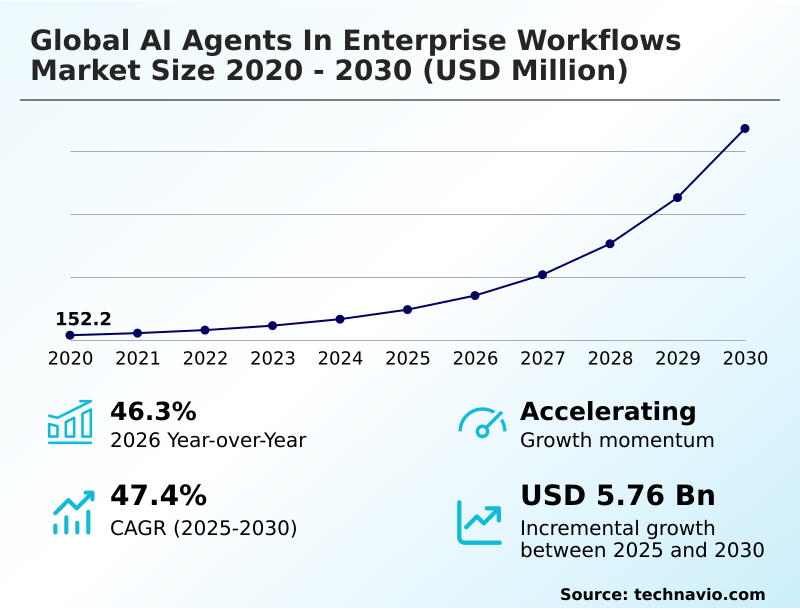
The ai agents in enterprise workflows market size is valued to increase by USD 5.76 billion, at a CAGR of 47.4% from 2025 to 2030. Transition toward autonomous agentic orchestration will drive the ai agents in enterprise workflows market.
Major Market Trends & Insights
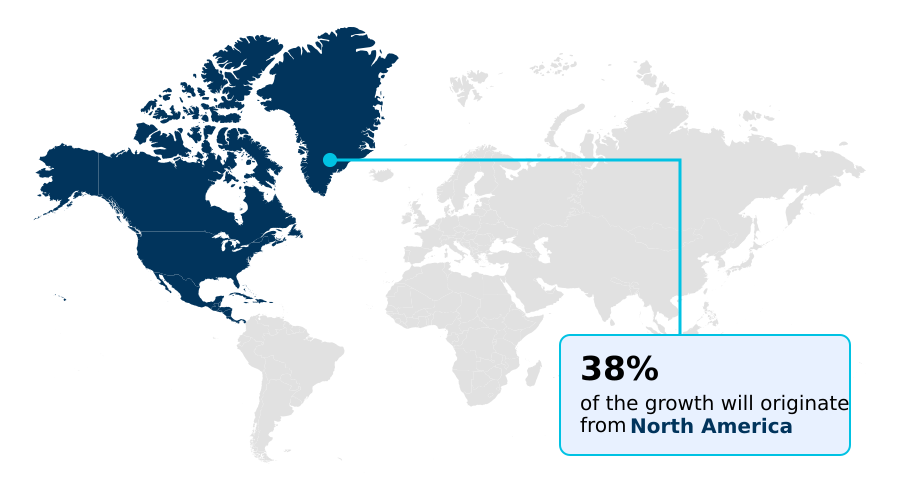
- North America dominated the market and accounted for a 38.5% growth during the forecast period.
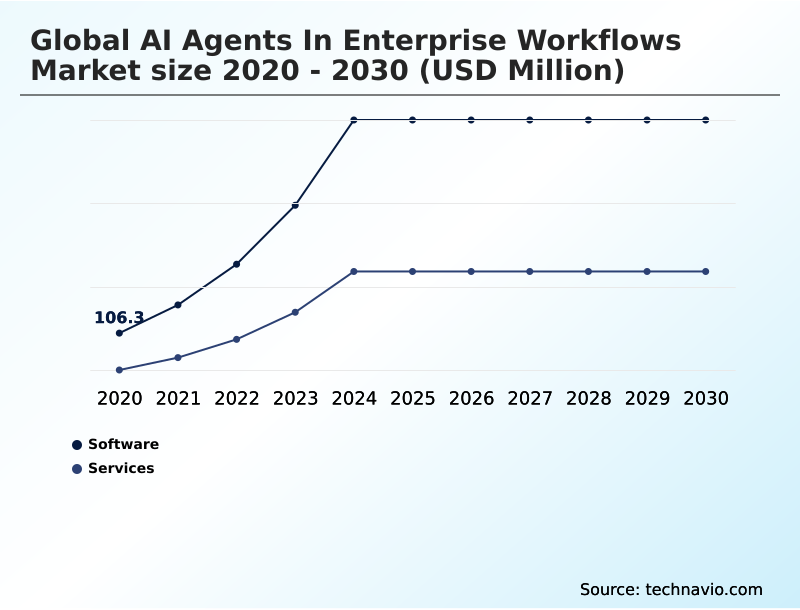
- By Component - Software segment was valued at USD 455.5 million in 2024
- By Deployment - Cloud based segment accounted for the largest market revenue share in 2024
Market Size & Forecast
- Market Opportunities: USD 6.58 billion
- Market Future Opportunities: USD 5.76 billion
- CAGR from 2025 to 2030 : 47.4%
Market Summary
- The AI agents in enterprise workflows market represents a significant evolution from traditional automation, leveraging advanced large language models to create autonomous systems capable of reasoning and executing complex, goal-oriented tasks. These agents are not just tools but digital colleagues, designed to manage multi-step processes across various software environments with minimal human intervention.
- Key applications are emerging in sectors requiring high efficiency and data accuracy, such as supply chain management, where an agent can autonomously identify a logistics bottleneck, evaluate alternative shipping routes, and execute the change within the ERP system. This shift toward autonomous orchestration helps alleviate cognitive overload on employees and addresses persistent skilled labor shortages.
- However, successful integration is contingent upon overcoming challenges related to data security, the reliability of autonomous decisions, and interoperability with fragmented legacy systems. As organizations prioritize operational resilience, the demand for intelligent agents that can provide consistent, high-quality performance in dynamic business environments continues to accelerate, defining the next frontier of enterprise productivity and strategic agility.
What will be the Size of the AI Agents In Enterprise Workflows Market during the forecast period?
Get Key Insights on Market Forecast (PDF) Get Free Sample
How is the AI Agents In Enterprise Workflows Market Segmented?
The ai agents in enterprise workflows industry research report provides comprehensive data (region-wise segment analysis), with forecasts and estimates in "USD million" for the period 2026-2030, as well as historical data from 2020-2024 for the following segments.
- Component
- Software
- Services
- Deployment
- Cloud based
- On premises
- Business segment
- Large enterprises
- Small and medium enterprises
- Geography
- North America
- US
- Canada
- Mexico
- Europe
- UK
- Germany
- France
- APAC
- China
- Japan
- India
- South America
- Brazil
- Argentina
- Middle East and Africa
- UAE
- Saudi Arabia
- South Africa
- Rest of World (ROW)
- North America
By Component Insights
The software segment is estimated to witness significant growth during the forecast period.
The software segment is the core of the AI agents in enterprise workflows market, providing the foundational platforms for autonomous execution. These solutions, enabled by agentic orchestration frameworks, facilitate complex enterprise workflow automation and are moving toward collaborative multi-agent systems.
Key offerings include the agent development kit for creating bespoke agents that understand enterprise context. A critical focus is on agentic governance frameworks and explainability layers to address the non-deterministic nature of AI and ensure data sovereignty.
These platforms improve process accuracy by reducing manual errors by over 30%, incorporating human-in-the-loop-at-scale for oversight and robust data leakage mitigation strategies to secure corporate assets. This evolution in agentic process automation underpins the market's strategic value.
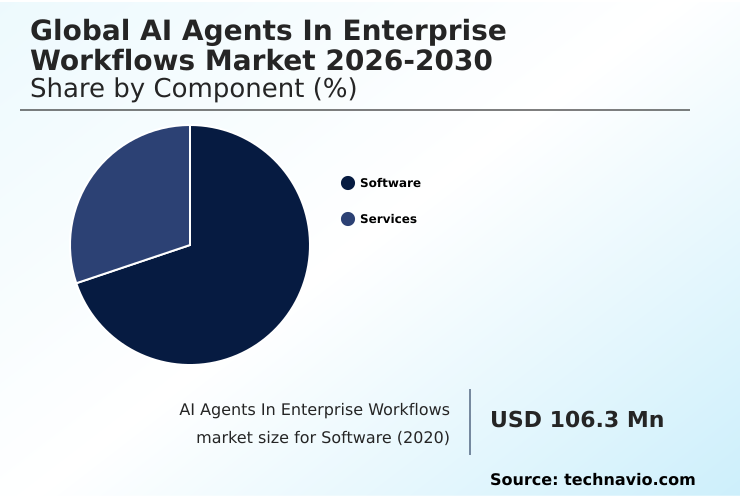
The Software segment was valued at USD 455.5 million in 2024 and showed a gradual increase during the forecast period.
Regional Analysis
North America is estimated to contribute 38.5% to the growth of the global market during the forecast period.Technavio’s analysts have elaborately explained the regional trends and drivers that shape the market during the forecast period.
See How AI Agents In Enterprise Workflows Market Demand is Rising in North America Get Free Sample
The geographic landscape is led by North America, which accounts for 38.5% of incremental growth, driven by its high concentration of technology leaders pioneering agentic frameworks and enterprise-grade AI solutions.
This region excels in developing autonomous code generation and automated quality assurance tools. APAC is the fastest-growing region, with a projected CAGR of 48.2%, as nations there rapidly adopt autonomous reasoning to enhance manufacturing and logistics.
In Europe, the focus is on data privacy and sovereign autonomous reasoning features.
Across all regions, enterprises are deploying an agentic process fabric to connect disparate systems, leveraging agents with specialized agent skills and deep enterprise context awareness to solve localized business challenges.
Market Dynamics
Our researchers analyzed the data with 2025 as the base year, along with the key drivers, trends, and challenges. A holistic analysis of drivers will help companies refine their marketing strategies to gain a competitive advantage.
- The strategic implementation of AI agents is reshaping core business operations, moving beyond isolated tasks to full workflow orchestration. The use of AI agents for supply chain logistics is a prime example, where systems autonomously manage inventory, predict disruptions, and coordinate with suppliers, demonstrating efficiency gains of over 70% compared to manual processes.
- In parallel, autonomous agents in financial auditing are transforming compliance by continuously monitoring transactions and identifying anomalies in real time. Building trust in autonomous agents is crucial, which is why advancements in agentic governance for data privacy and human-in-the-loop for agentic AI are paramount.
- The ability to manage hallucinations in enterprise agents through rigorous validation is a key focus for ensuring reliability. Organizations are also leveraging AI agent interoperability standards to create cohesive ecosystems. For instance, autonomous agents for sales lead qualification can seamlessly pass information to systems managing AI agents for IT operations, ensuring a smooth customer journey.
- This interconnectedness is critical for scaling agentic teams in enterprises. The application of computer vision for agentic automation allows interaction with legacy systems, while autonomous agents for resource management optimize workforce and asset allocation.
- Ultimately, the successful deployment of agentic AI for operational efficiency hinges on mitigating the security risks of autonomous agents and fostering a culture that supports business process orchestration.
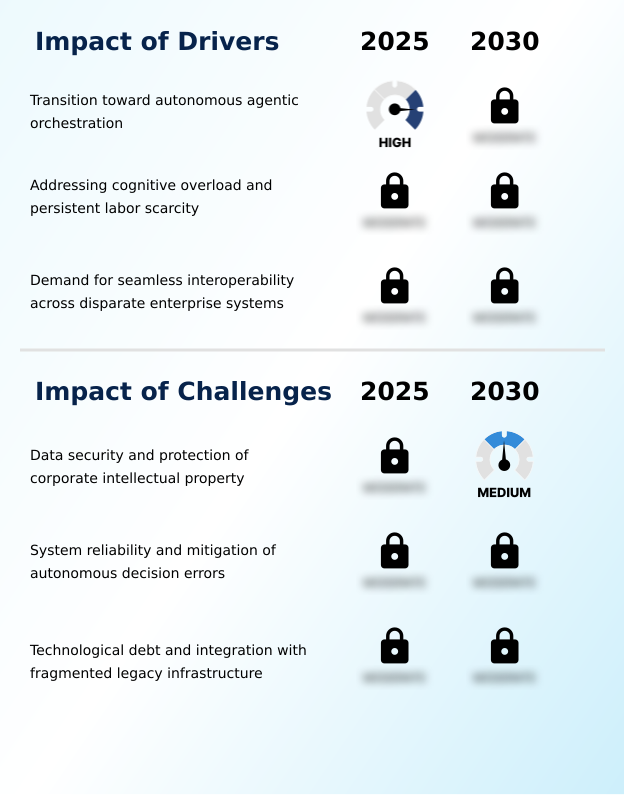
What are the key market drivers leading to the rise in the adoption of AI Agents In Enterprise Workflows Industry?
- A key market driver is the fundamental transition from generative assistance to autonomous agentic orchestration, enabling systems to independently execute complex workflows.
- The market is driven by the move toward autonomous agentic orchestration to manage end-to-end business functions. AI agents act as a digital colleague, alleviating employee cognitive overload from repetitive tasks, which boosts productivity by over 25%.
- A major factor is the need for seamless interoperability across fragmented technology stacks. Agents serve as an intelligent connective tissue to create unified workflows between enterprise resource planning systems and other applications, enabling cross-platform action.
- This automation of the cognitive middle layer enhances operational resilience. The shift towards a flexible API-driven infrastructure, supported by agent-as-a-service models, further accelerates adoption, as it allows organizations to bridge disparate systems without costly custom coding.
What are the market trends shaping the AI Agents In Enterprise Workflows Industry?
- The market is witnessing a significant trend toward the emergence of multi-agent orchestration and collaborative ecosystems. This shift moves beyond solitary digital assistants to interconnected, specialized agents working in tandem.
- A primary trend is the shift toward multi-agent orchestration, where specialized agents collaborate on goal-oriented task execution. This form of digital labor relies on multi-step reasoning and advanced process reasoning engine technology. The emergence of agents with computer-use capabilities allows for visual interface navigation across legacy systems, expanding automation possibilities significantly.
- For instance, systems with these capabilities automate tasks 40% faster than API-only integrations. Concurrently, strengthening agentic governance is critical, with transparent reasoning traces and auditability features becoming standard. These reasoning traces ensure autonomous decision-making is verifiable, building trust in complex agentic process automation and multi-step task automation scenarios.
What challenges does the AI Agents In Enterprise Workflows Industry face during its growth?
- A primary challenge affecting industry growth is ensuring robust data security and the protection of corporate intellectual property when deploying autonomous agents.
- Significant challenges temper market adoption, primarily concerning security and reliability. The prompt injection risk poses a serious threat, as malicious inputs can lead to autonomous decision errors with severe financial consequences. Furthermore, model hallucinations remain a barrier, impacting system trustworthiness in up to 10% of complex queries without guardrails.
- This necessitates strong human-agent collaboration and oversight, which can be managed through an agentic workforce platform. Another major obstacle is technological debt, where integrating agents with aging legacy systems is complex.
- While solutions like a legacy agent bridge exist, they cannot fully overcome the limitations of outdated infrastructure, which affects over 50% of large enterprises, hampering the seamless deployment of an advanced agentic workforce platform.
Exclusive Technavio Analysis on Customer Landscape
The ai agents in enterprise workflows market forecasting report includes the adoption lifecycle of the market, covering from the innovator’s stage to the laggard’s stage. It focuses on adoption rates in different regions based on penetration. Furthermore, the ai agents in enterprise workflows market report also includes key purchase criteria and drivers of price sensitivity to help companies evaluate and develop their market growth analysis strategies.
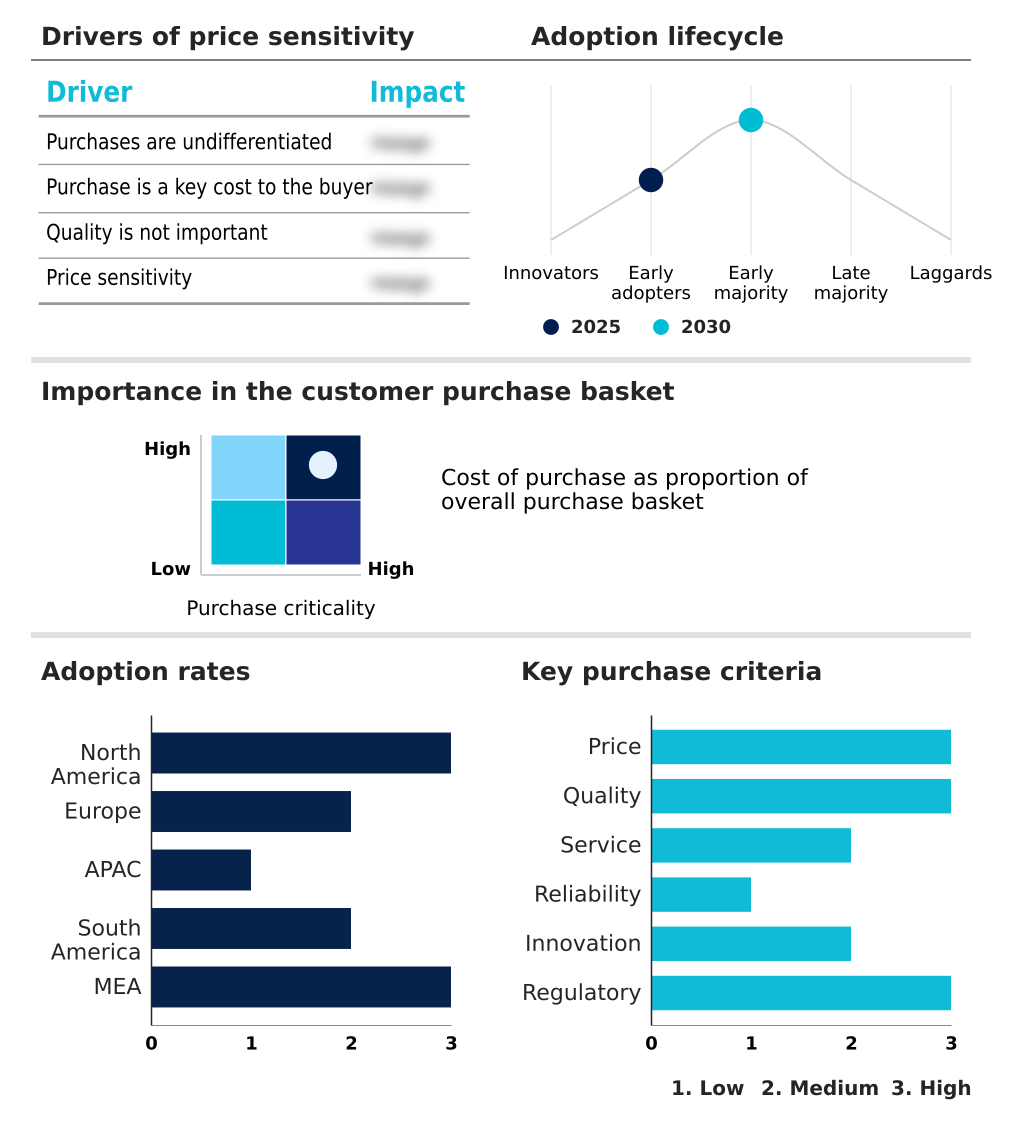
Customer Landscape of AI Agents In Enterprise Workflows Industry
Competitive Landscape
Companies are implementing various strategies, such as strategic alliances, ai agents in enterprise workflows market forecast, partnerships, mergers and acquisitions, geographical expansion, and product/service launches, to enhance their presence in the industry.
Amazon Web Services Inc. - Offerings center on advanced agentic frameworks and orchestration platforms, enabling autonomous execution of complex, multi-step business functions across diverse enterprise software environments.
The industry research and growth report includes detailed analyses of the competitive landscape of the market and information about key companies, including:
- Amazon Web Services Inc.
- Anthropic
- Appian Corp.
- Automation Anywhere Inc.
- Cognigy GmbH
- Cohere
- Glean Technologies Inc.
- Google LLC
- IBM Corp.
- Microsoft Corp.
- NICE Ltd.
- OpenAI OpCo LLC
- Pegasystems Inc.
- Salesforce Inc.
- SAP SE
- ServiceNow Inc.
- UiPath Inc.
- Workday Inc.
- Writer
- Zendesk Inc.
Qualitative and quantitative analysis of companies has been conducted to help clients understand the wider business environment as well as the strengths and weaknesses of key industry players. Data is qualitatively analyzed to categorize companies as pure play, category-focused, industry-focused, and diversified; it is quantitatively analyzed to categorize companies as dominant, leading, strong, tentative, and weak.
Recent Development and News in Ai agents in enterprise workflows market
- In January 2025, OpenAI OpCo LLC announced the research preview of Operator, an autonomous tool designed to navigate and interact with desktop and web applications on a user's behalf to execute complex tasks.
- In February 2025, Salesforce Inc. initiated a major expansion of its Agentforce platform, introducing specialized autonomous agents for sales lead qualification and independent management of complex customer service inquiries.
- In April 2025, SAP SE launched the Legacy Agent Bridge toolkit, a suite of integration services specifically designed to connect modern autonomous agents with on-premise ERP systems that lack native cloud connectivity.
- In May 2025, Microsoft Corp. introduced enhanced auditability features within its Copilot Studio, providing a comprehensive reasoning log for every action taken by an enterprise agent to improve transparency and governance.
Dive into Technavio’s robust research methodology, blending expert interviews, extensive data synthesis, and validated models for unparalleled AI Agents In Enterprise Workflows Market insights. See full methodology.
| Market Scope | |
|---|---|
| Page number | 293 |
| Base year | 2025 |
| Historic period | 2020-2024 |
| Forecast period | 2026-2030 |
| Growth momentum & CAGR | Accelerate at a CAGR of 47.4% |
| Market growth 2026-2030 | USD 5763.5 million |
| Market structure | Fragmented |
| YoY growth 2025-2026(%) | 46.3% |
| Key countries | US, Canada, Mexico, UK, Germany, France, The Netherlands, Italy, Spain, China, Japan, India, South Korea, Australia, Singapore, Brazil, Argentina, Chile, UAE, Saudi Arabia, South Africa, Israel and Turkey |
| Competitive landscape | Leading Companies, Market Positioning of Companies, Competitive Strategies, and Industry Risks |
Research Analyst Overview
- The AI agents in enterprise workflows market is defined by a strategic shift from assistive AI to autonomous execution, where agentic frameworks orchestrate complex, end-to-end business functions. This evolution is driven by the need to manage cognitive overload and achieve seamless interoperability across siloed enterprise resource planning systems.
- The core technology enables multi-step reasoning, allowing agents to perform digital labor with minimal human intervention. A critical focus for boardroom-level strategy involves balancing the adoption of autonomous agentic orchestration with robust agentic governance to manage risks like data sovereignty and the non-deterministic nature of AI.
- Early adopters leveraging a cohesive agentic process fabric have demonstrated a reduction in process errors by up to 40%. Success in this market depends on integrating explainability layers and ensuring the API-driven infrastructure can support multi-agent systems.
- The development of a comprehensive agent development kit is essential for creating agents with deep enterprise context and specialized skills, ultimately enabling a more resilient and efficient agentic workforce.
What are the Key Data Covered in this AI Agents In Enterprise Workflows Market Research and Growth Report?
-
What is the expected growth of the AI Agents In Enterprise Workflows Market between 2026 and 2030?
-
USD 5.76 billion, at a CAGR of 47.4%
-
-
What segmentation does the market report cover?
-
The report is segmented by Component (Software, and Services), Deployment (Cloud based, and On premises), Business Segment (Large enterprises, and Small and medium enterprises) and Geography (North America, Europe, APAC, South America, Middle East and Africa)
-
-
Which regions are analyzed in the report?
-
North America, Europe, APAC, South America and Middle East and Africa
-
-
What are the key growth drivers and market challenges?
-
Transition toward autonomous agentic orchestration, Data security and protection of corporate intellectual property
-
-
Who are the major players in the AI Agents In Enterprise Workflows Market?
-
Amazon Web Services Inc., Anthropic, Appian Corp., Automation Anywhere Inc., Cognigy GmbH, Cohere, Glean Technologies Inc., Google LLC, IBM Corp., Microsoft Corp., NICE Ltd., OpenAI OpCo LLC, Pegasystems Inc., Salesforce Inc., SAP SE, ServiceNow Inc., UiPath Inc., Workday Inc., Writer and Zendesk Inc.
-
Market Research Insights
- Market dynamics are shaped by a fundamental transition from simple assistance to autonomous execution, compelling organizations to adopt sophisticated agentic orchestration frameworks. Enterprises leveraging these frameworks report a 30% reduction in manual hand-offs between siloed departments, creating unified workflows that enhance operational resilience.
- The use of a digital colleague to manage routine cognitive tasks has demonstrated a 15% improvement in knowledge worker productivity. This shift is driven by the urgent need for seamless interoperability across fragmented technology stacks, where agents act as an intelligent connective tissue.
- By enabling real-time data synthesis and cross-platform action, these systems provide leadership with a holistic operational view, ensuring strategic alignment and fostering a more agile response to market changes.
We can help! Our analysts can customize this ai agents in enterprise workflows market research report to meet your requirements.
 RIA -
RIA - 
