APAC Automotive OEM Coatings Market Analysis, Size, and Forecast 2026-2030: APAC (China, Japan, and India)

APAC Automotive OEM Coatings Market Analysis, Size, and Forecast 2026-2030:
APAC (China, Japan, and India)

Published: Oct 2026 225 Pages SKU: IRTNTR75306

Market Overview at a Glance

$748.5 Mn
Market Opportunity
3.2%
CAGR 2025 - 2030
3.2%
YoY growth 2025-2026(%)
$1.54 B
Water-borne segment 2024

APAC Automotive Oem Coatings Market Size 2026-2030

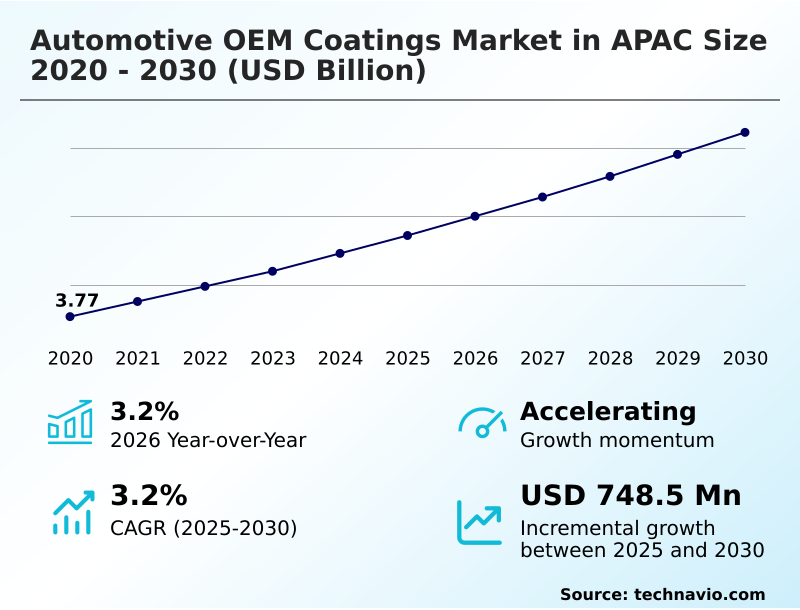
The apac automotive oem coatings market size is valued to increase by USD 748.5 million, at a CAGR of 3.2% from 2025 to 2030. Robust vehicle production volumes and industrial expansion will drive the apac automotive oem coatings market.

Major Market Trends & Insights

  • By Technology - Water-borne segment was valued at USD 1.54 billion in 2024
  • By Vehicle Type - Passenger cars segment accounted for the largest market revenue share in 2024

Market Size & Forecast

  • Market Opportunities: USD 1.34 billion
  • Market Future Opportunities: USD 748.5 million
  • CAGR from 2025 to 2030 : 3.2%

Market Summary

  • The Automotive OEM Coatings Market in APAC demonstrates robust operational momentum, driven by surging passenger vehicle production and the accelerating transition toward electric mobility. Robust vehicle production volumes and industrial expansion act as the primary catalyst, compelling manufacturers to operate assembly plants at maximum throughput while demanding high-performance surface protection.
  • To accommodate this demand, major manufacturing entities implement supply chain analytics and automated robotic spraying to optimize paint transfer efficiency and minimize material waste. Facilities upgrading to ultraviolet curable chemistries report up to a 40% improvement in energy efficiency compared to traditional thermal baking ovens.
  • However, raw material price volatility and supply chain vulnerabilities challenge industry stability, as fluctuations in petrochemical costs directly compress operational margins for chemical formulators. Strict environmental compliance further accelerates the shift toward waterborne basecoats and low emission formulations. Consequently, sustained industrial expansion across emerging economies continuously redefines product development strategies, ensuring that sustainability and high-performance material science remain inextricably linked.

What will be the Size of the APAC Automotive Oem Coatings Market during the forecast period?
Get Key Insights on Market Forecast (PDF) Get Free Sample

How is the APAC Automotive Oem Coatings Market Segmented?

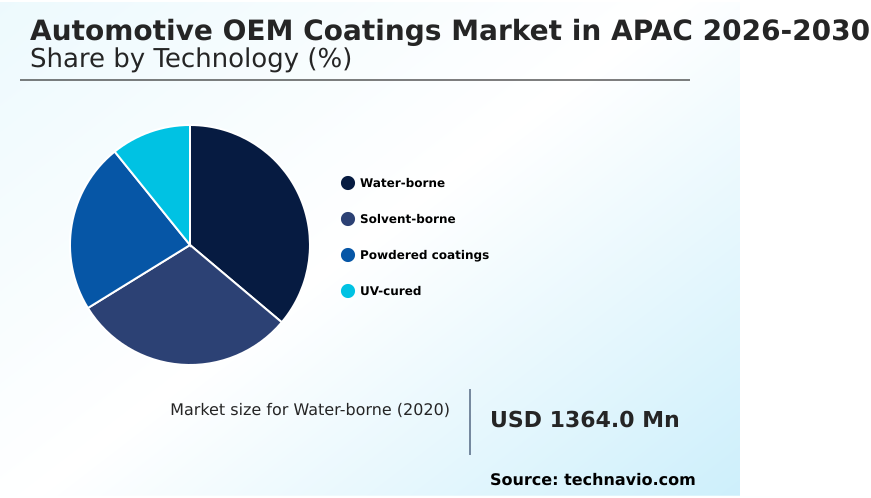
The apac automotive oem coatings industry research report provides comprehensive data (region-wise segment analysis), with forecasts and estimates in "USD million" for the period 2026-2030, as well as historical data from 2020-2024 for the following segments.

  • Technology
    • Water-borne
    • Solvent-borne
    • Powdered coatings
    • UV-cured
  • Vehicle type
    • Passenger cars
    • Light commercial vehicles
    • Heavy commercial vehicles
  • Product type
    • Basecoat
    • Clearcoat
    • Electrocoat
    • Primer
  • Geography
    • APAC
      • China
      • Japan
      • India
      • South Korea

By Technology Insights

The water-borne segment is estimated to witness significant growth during the forecast period.

The water-borne segmentation within the Automotive OEM Coatings Market in APAC highlights a fundamental operational shift toward sustainable manufacturing practices.

Utilizing aqueous dispersions instead of hazardous solvents, these low emission formulations enable a 99% reduction in volatile organic compounds reduction during factory application.

This transition directly aligns with stringent factory emission mandates targeting hazardous air pollutants while delivering exceptional cathodic electrophoretic deposition. Assembly plants adopting waterborne basecoats achieve faster curing times and superior environmental degradation resistance.

By optimizing paint transfer efficiency, manufacturers reduce material waste, supporting efficient operations.

The integration of advanced bio derived resin additives and renewable chemical inputs ensures that water-based systems meet the rigorous durability requirements essential for modern passenger and commercial vehicle production.
Get Free Sample

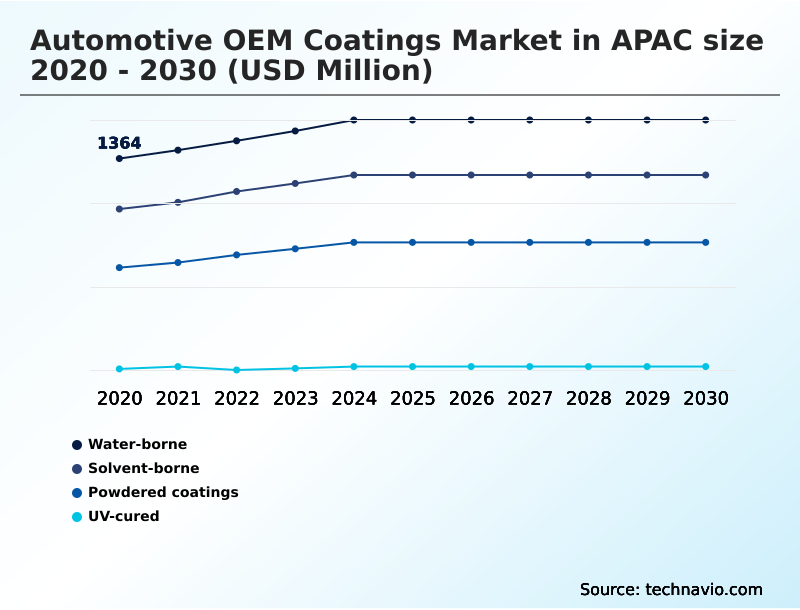
The Water-borne segment was valued at USD 1.54 billion in 2024 and showed a gradual increase during the forecast period.
Get Free Sample

Market Dynamics

Our researchers analyzed the data with 2025 as the base year, along with the key drivers, trends, and challenges. A holistic analysis of drivers will help companies refine their marketing strategies to gain a competitive advantage.

  • The Automotive OEM Coatings Market in APAC relies heavily on continuous material science innovations to support expanding vehicle manufacturing infrastructures. As original equipment manufacturers transition toward specialized platforms, the demand for automotive structural anti corrosion coatings has surged, ensuring the long-term durability of metallic frames against harsh environmental conditions.
  • Concurrently, the rise of electric mobility requires lightweight composite substrate protective finishes, which protect sensitive battery housings without adding unnecessary weight to the vehicle chassis. By implementing waterborne factory surface treatment systems, assembly plants successfully navigate stringent environmental regulations, achieving an approximate 35% reduction in volatile emissions compared to legacy solvent-based processes.
  • This shift in operational planning is further reinforced by the deployment of automated high volume application coatings, which ensure consistent film thickness and superior edge protection across vast production runs. To manage internal cabin temperatures and improve energy efficiency, manufacturers integrate advanced thermal management vehicle exterior solutions into their multi-layer paint architectures.
  • These innovations collectively optimize the supply chain by standardizing procurement around high-efficiency, sustainable materials, thereby reducing hazardous waste disposal costs and streamlining factory compliance protocols across the region.
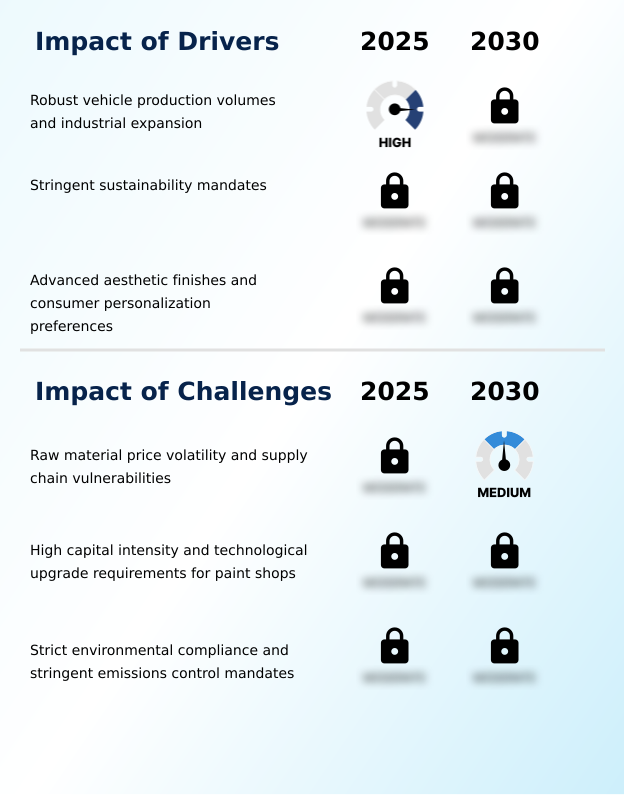
What are the key market drivers leading to the rise in the adoption of APAC Automotive Oem Coatings Industry?

  • Robust vehicle production volumes and rapid industrial expansion act as the primary drivers propelling market growth.

  • Surging vehicle production volumes and rapid industrialization fundamentally propel the Automotive OEM Coatings Market in APAC. As passenger vehicle ownership expands, assembly plants must maintain high throughput assembly to satisfy demand.
  • This manufacturing momentum requires robust electrocoat primers and wet on wet primer surfacers that streamline multi-layer application. By adopting these advanced formulations, factory operators have decreased thermal curing processes by 20%, significantly optimizing energy use.
  • The integration of distinct image clarity clearcoats and precise spectrophotometric color matching elevates exterior aesthetics, leading to a 15% increase in premium finish adoption rates.
  • The push for reliable galvanic corrosion mitigation on lightweight composite substrates ensures continuous volume consumption of specialized treatments, while adherence to circular economy principles improves overall chemical formulation stability.

What are the market trends shaping the APAC Automotive Oem Coatings Industry?

  • The transition toward sustainable bio-based and low-emission coating technologies represents a defining trend in the market. Manufacturers are increasingly integrating renewable resources to enhance environmental compliance and operational efficiency.

  • The transition toward smart functional surface treatments defines the contemporary trajectory of the Automotive OEM Coatings Market in APAC. Automotive manufacturers are rapidly integrating conductive coating layers and radar transparent clearcoats to accommodate advanced driver assistance sensors. This product strategy allows assembly lines to improve signal transmission reliability by 25%.
  • Furthermore, the deployment of thermosetting powder coatings via automated robotic spraying has minimized liquid overspray, reducing hazardous waste generation by 40% and aiding carbon footprint minimization. The growing consumer demand for custom color collections and bespoke color collections forces chemical formulators to utilize ultraviolet curable chemistries and self healing polymer technologies in industrial surface finishing.
  • These technological adaptations accelerate curing times and cut energy consumption by 30%, ensuring modern vehicle exteriors serve as active electronic interfaces.

What challenges does the APAC Automotive Oem Coatings Industry face during its growth?

  • Raw material price volatility and supply chain vulnerabilities present significant challenges to industry stability and operational profitability.

  • Navigating material cost fluctuations and complex infrastructural upgrade requirements severely constrains the Automotive OEM Coatings Market in APAC. The inherent price volatility of polyurethane precursors and epoxy resin backbones frequently compresses supplier profit margins, forcing companies to absorb a 12% increase in base operational costs.
  • Furthermore, transitioning legacy paint shops to accommodate high solid systems and scratch resistant nanoceramics demands massive capital expenditure. Installing specialized energy efficient baking ovens and advanced flash off zones requires extensive retrofitting, which can increase initial factory setup costs by up to 35%.
  • These financial hurdles disrupt strategic expansion planning, as manufacturers struggle to balance the need for raw material stockpiling and sophisticated supply chain analytics against strict return-on-investment timelines, placing immense stress on regional formulators.

Exclusive Technavio Analysis on Customer Landscape

The apac automotive oem coatings market forecasting report includes the adoption lifecycle of the market, covering from the innovator’s stage to the laggard’s stage. It focuses on adoption rates in different regions based on penetration. Furthermore, the apac automotive oem coatings market report also includes key purchase criteria and drivers of price sensitivity to help companies evaluate and develop their market growth analysis strategies.
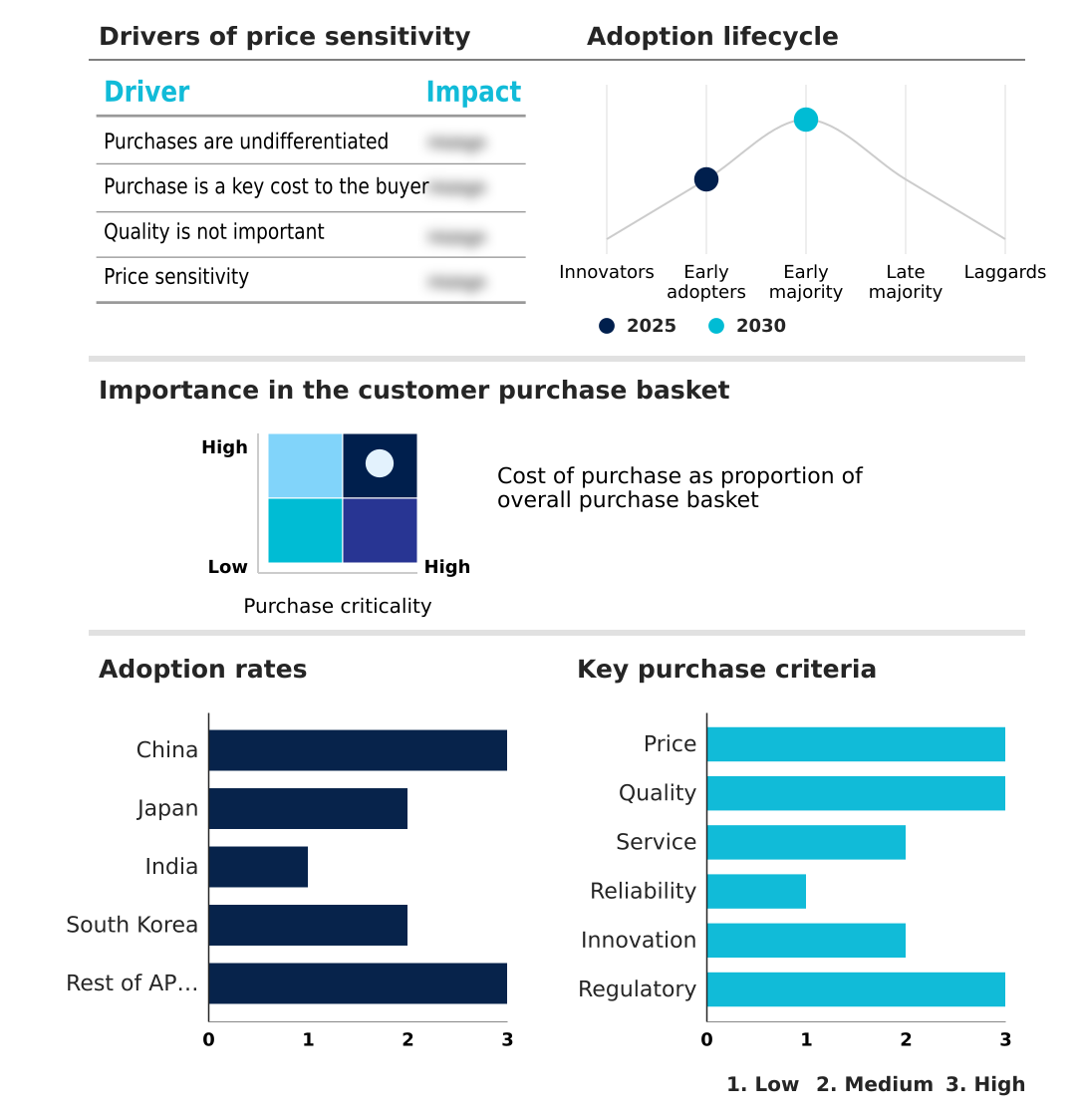
Customer Landscape of APAC Automotive Oem Coatings Industry

Competitive Landscape

Companies are implementing various strategies, such as strategic alliances, apac automotive oem coatings market forecast, partnerships, mergers and acquisitions, geographical expansion, and product/service launches, to enhance their presence in the industry.

Akzo Nobel NV - The company provides advanced automotive OEM coatings, including high-performance electrocoat primers, durable clearcoats, and waterborne basecoats designed to enhance corrosion resistance and aesthetic finish for high-volume vehicle manufacturing.

The industry research and growth report includes detailed analyses of the competitive landscape of the market and information about key companies, including:

  • Akzo Nobel NV
  • Axalta Coating Systems Ltd.
  • BASF SE
  • Berger Paints India Ltd.
  • Covestro AG
  • Dai Nippon Toryo Co. Ltd.
  • Grand Polycoats Co. Pvt. Ltd.
  • Kansai Paint Co. Ltd.
  • KAPCI Coating
  • KCC Co. Ltd.
  • Nippon Paint Holdings Co Ltd.
  • NOROO Automotive Coatings
  • PPG Asian Paints Pvt. Ltd.
  • PPG Industries Inc.
  • Rock Paint Co. Ltd.
  • Rust Oleum Corp.
  • Solvay SA
  • Tara Paints and Chemicals
  • The Sherwin Williams Co.
  • YATU Advanced Materials Co. Ltd.

Qualitative and quantitative analysis of companies has been conducted to help clients understand the wider business environment as well as the strengths and weaknesses of key industry players. Data is qualitatively analyzed to categorize companies as pure play, category-focused, industry-focused, and diversified; it is quantitatively analyzed to categorize companies as dominant, leading, strong, tentative, and weak.

Recent Development and News in Apac automotive oem coatings market

  • In the Commodity Chemicals industry, the transition toward hydrometallurgical recycling and renewable chemical inputs has reduced reliance on traditional petrochemical solvents by 35%, directly impacting Automotive OEM Coatings demand for sustainable bio-based resins.
  • Strict environmental regulations enforcing a 50% cut in volatile compound emissions have accelerated the adoption of automated robotic spraying technologies, compelling paint formulators to redesign waterborne basecoats for high-throughput assembly lines.
  • The adoption of circular economy principles in raw material processing has improved epoxy resin stability, driving a 20% increase in the production efficiency of electrocoat primers used to meet factory emission mandates.
  • Disruptions in crude oil supply chains caused a 15% fluctuation in polyurethane precursor availability, prompting automotive manufacturers to invest in raw material stockpiling and alternative supply chain analytics for resilient operations.

Dive into Technavio’s robust research methodology, blending expert interviews, extensive data synthesis, and validated models for unparalleled APAC Automotive Oem Coatings Market insights. See full methodology.

Market Scope
Page number 225
Base year 2025
Historic period 2020-2024
Forecast period 2026-2030
Growth momentum & CAGR Accelerate at a CAGR of 3.2%
Market growth 2026-2030 USD 748.5 million
Market structure Fragmented
YoY growth 2025-2026(%) 3.2%
Key countries China, Japan, India, South Korea and Rest of APAC
Competitive landscape Leading Companies, Market Positioning of Companies, Competitive Strategies, and Industry Risks

Request Free Sample

Research Analyst Overview

  • The Automotive OEM Coatings Market in APAC is undergoing a profound structural transformation as corporate boardrooms prioritize sustainability and advanced material science. Strategic decision-making increasingly centers on integrating bio derived resin additives and low emission formulations to comply with tightening regional environmental mandates.
  • By transitioning to high solid systems and waterborne architectures, manufacturers have achieved a 30% reduction in processing time and significantly lowered energy consumption. Executive teams leverage self healing polymer technologies and scratch resistant nanoceramics to differentiate their luxury vehicle portfolios, enhancing consumer satisfaction and brand equity.
  • Furthermore, the adoption of spectrophotometric color matching ensures absolute consistency across massive production batches, directly impacting product quality control. To safeguard lightweight composite substrates, formulators are engineering specialized cathodic electrophoretic deposition processes that provide exceptional moisture tolerance parameters.
  • These targeted investments in advanced multi layer coating architectures ensure that automotive producers can maintain rigorous production throughput while achieving critical carbon reduction milestones.

What are the Key Data Covered in this APAC Automotive Oem Coatings Market Research and Growth Report?

  • What is the expected growth of the APAC Automotive Oem Coatings Market between 2026 and 2030?

    • USD 748.5 million, at a CAGR of 3.2%

  • What segmentation does the market report cover?

    • The report is segmented by Technology (Water-borne, Solvent-borne, Powdered coatings, and UV-cured), Vehicle Type (Passenger cars, Light commercial vehicles, and Heavy commercial vehicles), Product Type (Basecoat, Clearcoat, Electrocoat, and Primer) and Geography (APAC)

  • Which regions are analyzed in the report?

    • APAC

  • What are the key growth drivers and market challenges?

    • Robust vehicle production volumes and industrial expansion, Raw material price volatility and supply chain vulnerabilities

  • Who are the major players in the APAC Automotive Oem Coatings Market?

    • Akzo Nobel NV, Axalta Coating Systems Ltd., BASF SE, Berger Paints India Ltd., Covestro AG, Dai Nippon Toryo Co. Ltd., Grand Polycoats Co. Pvt. Ltd., Kansai Paint Co. Ltd., KAPCI Coating, KCC Co. Ltd., Nippon Paint Holdings Co Ltd., NOROO Automotive Coatings, PPG Asian Paints Pvt. Ltd., PPG Industries Inc., Rock Paint Co. Ltd., Rust Oleum Corp., Solvay SA, Tara Paints and Chemicals, The Sherwin Williams Co. and YATU Advanced Materials Co. Ltd.

Market Research Insights

  • The Automotive OEM Coatings Market in APAC is rapidly evolving as vehicle manufacturers prioritize carbon footprint minimization and operational resilience. Implementing automated robotic spraying systems has enabled assembly plants to increase paint transfer efficiency by 22%, significantly reducing overspray waste. Simultaneously, investments in advanced climate control booths have improved chemical formulation stability, driving a 15% reduction in application defects.
  • Manufacturers are increasingly adopting high throughput assembly practices to meet escalating domestic vehicle demand. By leveraging supply chain analytics, companies maintain continuous production flows despite fluctuating raw material costs, enhancing overall output consistency by 18%.

We can help! Our analysts can customize this apac automotive oem coatings market research report to meet your requirements.

Get in touch

1. Executive Summary

1.1 Market overview

Executive Summary - Chart on Market Overview
Executive Summary - Data Table on Market Overview
Executive Summary - Chart on Country Market Characteristics
Executive Summary - Chart on Market by Geography
Executive Summary - Chart on Market Segmentation by Technology
Executive Summary - Chart on Market Segmentation by Vehicle Type
Executive Summary - Chart on Market Segmentation by Product Type
Executive Summary - Chart on Incremental Growth
Executive Summary - Data Table on Incremental Growth
Executive Summary - Chart on Company Market Positioning

2. Technavio Analysis

2.1 Analysis of price sensitivity, lifecycle, customer purchase basket, adoption rates, and purchase criteria

2.2 Criticality of inputs and Factors of differentiation

Overview on criticality of inputs and factors of differentiation

2.3 Factors of disruption

Overview on factors of disruption

2.4 Impact of drivers and challenges

Impact of drivers and challenges in 2025 and 2030

3. Market Landscape

3.1 Market ecosystem

Chart on Parent Market
Data Table on - Parent Market

3.2 Market characteristics

Chart on Market characteristics analysis

3.3 Value chain analysis

Chart on Value chain analysis

4. Market Sizing

4.1 Market definition

Data Table on Offerings of companies included in the market definition

4.2 Market segment analysis

Market segments

4.3 Market size 2025

4.4 Market outlook: Forecast for 2025-2030

Chart on APAC - Market size and forecast 2025-2030 ($ million)
Data Table on Regional - Market size and forecast 2025-2030 ($ million)
Chart on APAC: Year-over-year growth 2025-2030 (%)
Data Table on Regional - Market size and forecast 2025-2030 ($ million)

5. Historic Market Size

5.1 Automotive OEM Coatings Market in APAC 2020 - 2024

Historic Market Size - Data Table on Automotive OEM Coatings Market in APAC 2020 - 2024 ($ million)

5.2 Technology segment analysis 2020 - 2024

Historic Market Size - Technology Segment 2020 - 2024 ($ million)

5.3 Vehicle Type segment analysis 2020 - 2024

Historic Market Size - Vehicle Type Segment 2020 - 2024 ($ million)

5.4 Product Type segment analysis 2020 - 2024

Historic Market Size - Product Type Segment 2020 - 2024 ($ million)

5.5 Geography segment analysis 2020 - 2024

Historic Market Size - Geography Segment 2020 - 2024 ($ million)

6. Qualitative Analysis

6.1 Impact of AI on automotive OEM coatings market in APAC

6.2 Impact of geopolitical conflicts on automotive OEM coatings market in APAC

7. Five Forces Analysis

7.1 Five forces summary

Five forces analysis - Comparison between 2025 and 2030

7.2 Bargaining power of buyers

Bargaining power of buyers - Impact of key factors 2025 and 2030

7.3 Bargaining power of suppliers

Bargaining power of suppliers - Impact of key factors in 2025 and 2030

7.4 Threat of new entrants

Threat of new entrants - Impact of key factors in 2025 and 2030

7.5 Threat of substitutes

Threat of substitutes - Impact of key factors in 2025 and 2030

7.6 Threat of rivalry

Threat of rivalry - Impact of key factors in 2025 and 2030

7.7 Market condition

Chart on Market condition - Five forces 2025 and 2030

8. Market Segmentation by Technology

8.1 Market segments

Chart on Technology - Market share 2025-2030 (%)
Data Table on Technology - Market share 2025-2030 (%)

8.2 Comparison by Technology

Chart on Comparison by Technology
Data Table on Comparison by Technology

8.3 Water-borne - Market size and forecast 2025-2030

Chart on Water-borne - Market size and forecast 2025-2030 ($ million)
Data Table on Water-borne - Market size and forecast 2025-2030 ($ million)
Chart on Water-borne - Year-over-year growth 2025-2030 (%)
Data Table on Water-borne - Year-over-year growth 2025-2030 (%)

8.4 Solvent-borne - Market size and forecast 2025-2030

Chart on Solvent-borne - Market size and forecast 2025-2030 ($ million)
Data Table on Solvent-borne - Market size and forecast 2025-2030 ($ million)
Chart on Solvent-borne - Year-over-year growth 2025-2030 (%)
Data Table on Solvent-borne - Year-over-year growth 2025-2030 (%)

8.5 Powdered coatings - Market size and forecast 2025-2030

Chart on Powdered coatings - Market size and forecast 2025-2030 ($ million)
Data Table on Powdered coatings - Market size and forecast 2025-2030 ($ million)
Chart on Powdered coatings - Year-over-year growth 2025-2030 (%)
Data Table on Powdered coatings - Year-over-year growth 2025-2030 (%)

8.6 UV-cured - Market size and forecast 2025-2030

Chart on UV-cured - Market size and forecast 2025-2030 ($ million)
Data Table on UV-cured - Market size and forecast 2025-2030 ($ million)
Chart on UV-cured - Year-over-year growth 2025-2030 (%)
Data Table on UV-cured - Year-over-year growth 2025-2030 (%)

8.7 Market opportunity by Technology

Market opportunity by Technology ($ million)
Data Table on Market opportunity by Technology ($ million)

9. Market Segmentation by Vehicle Type

9.1 Market segments

Chart on Vehicle Type - Market share 2025-2030 (%)
Data Table on Vehicle Type - Market share 2025-2030 (%)

9.2 Comparison by Vehicle Type

Chart on Comparison by Vehicle Type
Data Table on Comparison by Vehicle Type

9.3 Passenger cars - Market size and forecast 2025-2030

Chart on Passenger cars - Market size and forecast 2025-2030 ($ million)
Data Table on Passenger cars - Market size and forecast 2025-2030 ($ million)
Chart on Passenger cars - Year-over-year growth 2025-2030 (%)
Data Table on Passenger cars - Year-over-year growth 2025-2030 (%)

9.4 Light commercial vehicles - Market size and forecast 2025-2030

Chart on Light commercial vehicles - Market size and forecast 2025-2030 ($ million)
Data Table on Light commercial vehicles - Market size and forecast 2025-2030 ($ million)
Chart on Light commercial vehicles - Year-over-year growth 2025-2030 (%)
Data Table on Light commercial vehicles - Year-over-year growth 2025-2030 (%)

9.5 Heavy commercial vehicles - Market size and forecast 2025-2030

Chart on Heavy commercial vehicles - Market size and forecast 2025-2030 ($ million)
Data Table on Heavy commercial vehicles - Market size and forecast 2025-2030 ($ million)
Chart on Heavy commercial vehicles - Year-over-year growth 2025-2030 (%)
Data Table on Heavy commercial vehicles - Year-over-year growth 2025-2030 (%)

9.6 Market opportunity by Vehicle Type

Market opportunity by Vehicle Type ($ million)
Data Table on Market opportunity by Vehicle Type ($ million)

10. Market Segmentation by Product Type

10.1 Market segments

Chart on Product Type - Market share 2025-2030 (%)
Data Table on Product Type - Market share 2025-2030 (%)

10.2 Comparison by Product Type

Chart on Comparison by Product Type
Data Table on Comparison by Product Type

10.3 Basecoat - Market size and forecast 2025-2030

Chart on Basecoat - Market size and forecast 2025-2030 ($ million)
Data Table on Basecoat - Market size and forecast 2025-2030 ($ million)
Chart on Basecoat - Year-over-year growth 2025-2030 (%)
Data Table on Basecoat - Year-over-year growth 2025-2030 (%)

10.4 Clearcoat - Market size and forecast 2025-2030

Chart on Clearcoat - Market size and forecast 2025-2030 ($ million)
Data Table on Clearcoat - Market size and forecast 2025-2030 ($ million)
Chart on Clearcoat - Year-over-year growth 2025-2030 (%)
Data Table on Clearcoat - Year-over-year growth 2025-2030 (%)

10.5 Electrocoat - Market size and forecast 2025-2030

Chart on Electrocoat - Market size and forecast 2025-2030 ($ million)
Data Table on Electrocoat - Market size and forecast 2025-2030 ($ million)
Chart on Electrocoat - Year-over-year growth 2025-2030 (%)
Data Table on Electrocoat - Year-over-year growth 2025-2030 (%)

10.6 Primer - Market size and forecast 2025-2030

Chart on Primer - Market size and forecast 2025-2030 ($ million)
Data Table on Primer - Market size and forecast 2025-2030 ($ million)
Chart on Primer - Year-over-year growth 2025-2030 (%)
Data Table on Primer - Year-over-year growth 2025-2030 (%)

10.7 Market opportunity by Product Type

Market opportunity by Product Type ($ million)
Data Table on Market opportunity by Product Type ($ million)

11. Customer Landscape

11.1 Customer landscape overview

Analysis of price sensitivity, lifecycle, customer purchase basket, adoption rates, and purchase criteria

12. Geographic Landscape

12.1 Geographic segmentation

Chart on Market share by geography - 2025-2030 (%)
Data Table on Market share by geography - 2025-2030 (%)

12.2 Geographic comparison

Chart on Geographic comparison
Data Table on Geographic comparison

12.3 China - Market size and forecast 2025-2030

Chart on China - Market size and forecast 2025-2030 ($ million)
Data Table on China - Market size and forecast 2025-2030 ($ million)
Chart on China - Year-over-year growth 2025-2030 (%)
Data Table on China - Year-over-year growth 2025-2030 (%)

12.4 Japan - Market size and forecast 2025-2030

Chart on Japan - Market size and forecast 2025-2030 ($ million)
Data Table on Japan - Market size and forecast 2025-2030 ($ million)
Chart on Japan - Year-over-year growth 2025-2030 (%)
Data Table on Japan - Year-over-year growth 2025-2030 (%)

12.5 India - Market size and forecast 2025-2030

Chart on India - Market size and forecast 2025-2030 ($ million)
Data Table on India - Market size and forecast 2025-2030 ($ million)
Chart on India - Year-over-year growth 2025-2030 (%)
Data Table on India - Year-over-year growth 2025-2030 (%)

12.6 South Korea - Market size and forecast 2025-2030

Chart on South Korea - Market size and forecast 2025-2030 ($ million)
Data Table on South Korea - Market size and forecast 2025-2030 ($ million)
Chart on South Korea - Year-over-year growth 2025-2030 (%)
Data Table on South Korea - Year-over-year growth 2025-2030 (%)

12.7 Rest of APAC - Market size and forecast 2025-2030

Chart on Rest of APAC - Market size and forecast 2025-2030 ($ million)
Data Table on Rest of APAC - Market size and forecast 2025-2030 ($ million)
Chart on Rest of APAC - Year-over-year growth 2025-2030 (%)
Data Table on Rest of APAC - Year-over-year growth 2025-2030 (%)

12.8 Market opportunity by geography

Market opportunity by geography ($ million)
Data Table on Market opportunity by geography ($ million)

13. Drivers, Challenges, and Opportunity

13.1 Market drivers

Robust vehicle production volumes and industrial expansion
Stringent sustainability mandates
Advanced aesthetic finishes and consumer personalization preferences

13.2 Market challenges

Raw material price volatility and supply chain vulnerabilities
High capital intensity and technological upgrade requirements for paint shops
Strict environmental compliance and stringent emissions control mandates

13.3 Impact of drivers and challenges

Impact of drivers and challenges in 2025 and 2030

13.4 Market opportunities

Transition toward sustainable bio-based and low-emission coating technologies
Integration of smart functional coatings and thermal management solutions
Advanced color personalization and digital color matching innovations

14. Competitive Landscape

14.1 Overview

14.2

Overview on criticality of inputs and factors of differentiation

14.3 Landscape disruption

Overview on factors of disruption

14.4 Industry risks

Impact of key risks on business

15. Competitive Analysis

15.1 Companies profiled

Companies covered

15.2 Company ranking index

15.3 Market positioning of companies

Matrix on companies position and classification

15.4 Akzo Nobel NV

Akzo Nobel NV - Overview
Akzo Nobel NV - Business segments
Akzo Nobel NV - Key offerings
Akzo Nobel NV - Segment focus
SWOT

15.5 Axalta Coating Systems Ltd.

Axalta Coating Systems Ltd. - Overview
Axalta Coating Systems Ltd. - Business segments
Axalta Coating Systems Ltd. - Key offerings
Axalta Coating Systems Ltd. - Segment focus
SWOT

15.6 BASF SE

BASF SE - Overview
BASF SE - Business segments
BASF SE - Key news
BASF SE - Key offerings
BASF SE - Segment focus
SWOT

15.7 Berger Paints India Ltd.

Berger Paints India Ltd. - Overview
Berger Paints India Ltd. - Product / Service
Berger Paints India Ltd. - Key offerings
SWOT

15.8 Covestro AG

Covestro AG - Overview
Covestro AG - Business segments
Covestro AG - Key news
Covestro AG - Key offerings
Covestro AG - Segment focus
SWOT

15.9 Dai Nippon Toryo Co. Ltd.

Dai Nippon Toryo Co. Ltd. - Overview
Dai Nippon Toryo Co. Ltd. - Business segments
Dai Nippon Toryo Co. Ltd. - Key offerings
Dai Nippon Toryo Co. Ltd. - Segment focus
SWOT

15.10 Kansai Paint Co. Ltd.

Kansai Paint Co. Ltd. - Overview
Kansai Paint Co. Ltd. - Business segments
Kansai Paint Co. Ltd. - Key offerings
Kansai Paint Co. Ltd. - Segment focus
SWOT

15.11 KAPCI Coating

KAPCI Coating - Overview
KAPCI Coating - Product / Service
KAPCI Coating - Key offerings
SWOT

15.12 KCC Co. Ltd.

KCC Co. Ltd. - Overview
KCC Co. Ltd. - Product / Service
KCC Co. Ltd. - Key offerings
SWOT

15.13 Nippon Paint Holdings Co Ltd.

Nippon Paint Holdings Co Ltd. - Overview
Nippon Paint Holdings Co Ltd. - Business segments
Nippon Paint Holdings Co Ltd. - Key offerings
Nippon Paint Holdings Co Ltd. - Segment focus
SWOT

15.14 NOROO Automotive Coatings

NOROO Automotive Coatings - Overview
NOROO Automotive Coatings - Product / Service
NOROO Automotive Coatings - Key offerings
SWOT

15.15 PPG Industries Inc.

PPG Industries Inc. - Overview
PPG Industries Inc. - Business segments
PPG Industries Inc. - Key offerings
PPG Industries Inc. - Segment focus
SWOT

15.16 Rust Oleum Corp.

Rust Oleum Corp. - Overview
Rust Oleum Corp. - Product / Service
Rust Oleum Corp. - Key offerings
SWOT

15.17 Solvay SA

Solvay SA - Overview
Solvay SA - Business segments
Solvay SA - Key offerings
Solvay SA - Segment focus
SWOT

15.18 The Sherwin Williams Co.

The Sherwin Williams Co. - Overview
The Sherwin Williams Co. - Business segments
The Sherwin Williams Co. - Key offerings
The Sherwin Williams Co. - Segment focus
SWOT

16. Appendix

16.1 Scope of the report

Market definition
Objectives
Notes and caveats

16.2 Inclusions and exclusions checklist

Inclusions checklist
Exclusions checklist

16.3 Currency conversion rates for US$

16.4 Research methodology

16.5 Data procurement

Information sources

16.6 Data validation

16.7 Validation techniques employed for market sizing

16.8 Data synthesis

16.9 360 degree market analysis

16.10 List of abbreviations

Research Methodology

Technavio presents a detailed picture of the market by way of study, synthesis, and summation of data from multiple sources. The analysts have presented the various facets of the market with a particular focus on identifying the key industry influencers. The data thus presented is comprehensive, reliable, and the result of extensive research, both primary and secondary.

INFORMATION SOURCES

Primary sources

  • Manufacturers and suppliers
  • Channel partners
  • Industry experts
  • Strategic decision makers

Secondary sources

  • Industry journals and periodicals
  • Government data
  • Financial reports of key industry players
  • Historical data
  • Press releases

DATA ANALYSIS

Data Synthesis

  • Collation of data
  • Estimation of key figures
  • Analysis of derived insights

Data Validation

  • Triangulation with data models
  • Reference against proprietary databases
  • Corroboration with industry experts

REPORT WRITING

Qualitative

  • Market drivers
  • Market challenges
  • Market trends
  • Five forces analysis

Quantitative

  • Market size and forecast
  • Market segmentation
  • Geographical insights
  • Competitive landscape

Interested in this report?

Get your sample now to see our research methodology and insights!

Download Now

Frequently Asked Questions

APAC Automotive Oem Coatings market growth will increase by USD 748.5 million during 2026-2030.

The APAC Automotive Oem Coatings market is expected to grow at a CAGR of 3.2% during 2026-2030.

APAC Automotive Oem Coatings market is segmented by Technology (Water-borne, Solvent-borne, Powdered coatings, UV-cured) Vehicle type (Passenger cars, Light commercial vehicles, Heavy commercial vehicles) Product type (Basecoat, Clearcoat, Electrocoat, Primer)

Akzo Nobel NV, Axalta Coating Systems Ltd., BASF SE, Berger Paints India Ltd., Covestro AG, Dai Nippon Toryo Co. Ltd., Grand Polycoats Co. Pvt. Ltd., Kansai Paint Co. Ltd., KAPCI Coating, KCC Co. Ltd., Nippon Paint Holdings Co Ltd., NOROO Automotive Coatings, PPG Asian Paints Pvt. Ltd., PPG Industries Inc., Rock Paint Co. Ltd., Rust Oleum Corp., Solvay SA, Tara Paints and Chemicals, The Sherwin Williams Co., YATU Advanced Materials Co. Ltd. are a few of the key vendors in the APAC Automotive Oem Coatings market.

APAC will register the highest growth rate of 100% among the other regions. Therefore, the APAC Automotive Oem Coatings market in APAC is expected to garner significant business opportunities for the vendors during the forecast period.

China, Japan, India, South Korea, Rest of APAC

  • Robust vehicle production volumes and industrial expansion is the driving factor this market.

The APAC Automotive Oem Coatings market vendors should focus on grabbing business opportunities from the Technology segment as it accounted for the largest market share in the base year.
RIA - Research AI Assistant
Ask RIA
