



Plastic Market Size 2026-2030
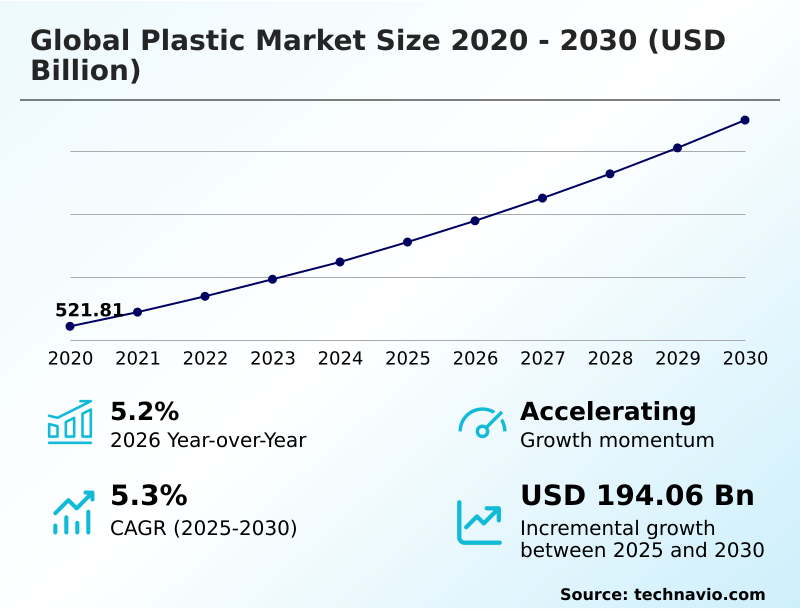
The plastic market size is valued to increase by USD 194.06 billion, at a CAGR of 5.3% from 2025 to 2030. Expansion of flexible and protective packaging demand will drive the plastic market.
Major Market Trends & Insights
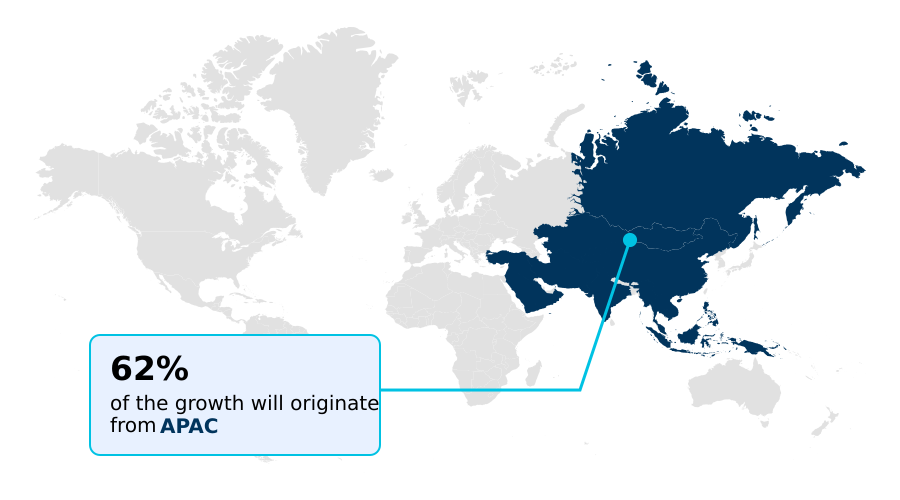
- APAC dominated the market and accounted for a 61.6% growth during the forecast period.
- By Technique - Injection molding segment was valued at USD 291.34 billion in 2024
- By End-user - Packaging segment accounted for the largest market revenue share in 2024
Market Size & Forecast
- Market Opportunities: USD 328.06 billion
- Market Future Opportunities: USD 194.06 billion
- CAGR from 2025 to 2030 : 5.3%
Market Summary
- The plastic market is defined by its integral role across global manufacturing, with its growth propelled by relentless demand for durable, lightweight, and versatile materials like thermoplastic polymers. Key applications in packaging, automotive, and construction rely on the unique properties of different polymer resin types to achieve cost efficiency and high performance.
- A significant driver is the expansion of protective packaging, where innovations in polymer processing are crucial for developing high-barrier multilayer films. Concurrently, the industry is navigating a transformative shift towards sustainability. This involves a transition to circular economy models, emphasizing chemical recycling and the adoption of bio-based polymers.
- A key business scenario involves an automotive OEM integrating advanced polymer composites and engineering plastics for vehicle lightweighting; this strategy not only improves energy efficiency but also forces the OEM to re-evaluate its supply chain to comply with new mandates on post-consumer recycled (pcr) content, impacting both cost structures and material sourcing.
- This balance between performance and sustainability is a central dynamic, compounded by challenges like petrochemical feedstock volatility and the technical complexities of mechanical recycling for materials such as thermosetting resins.
What will be the Size of the Plastic Market during the forecast period?
Get Key Insights on Market Forecast (PDF) Get Free Sample
How is the Plastic Market Segmented?
The plastic industry research report provides comprehensive data (region-wise segment analysis), with forecasts and estimates in "USD million" for the period 2026-2030, as well as historical data from 2020-2024 for the following segments.
- Technique
- Injection molding
- Blow molding
- Roto molding
- Casting
- Others
- End-user
- Packaging
- Consumer goods
- Automotive
- Electrical and electronics
- Others
- Product type
- Polyethylene
- Polypropylene
- Polyurethane
- Polyvinyl chloride
- Others
- Geography
- APAC
- China
- Japan
- India
- North America
- US
- Canada
- Mexico
- Europe
- Germany
- UK
- France
- Middle East and Africa
- Saudi Arabia
- UAE
- South Africa
- South America
- Brazil
- Argentina
- Rest of World (ROW)
- APAC
By Technique Insights
The injection molding segment is estimated to witness significant growth during the forecast period.
Injection molding remains a cornerstone of the global plastic market, valued for its efficiency and precision in high-volume production.
This polymer processing technique involves injecting molten thermoplastic polymers, often mixed with masterbatches to achieve specific colors or properties, into a mold cavity.
The process is ideal for creating complex components with tight tolerances, making it indispensable in automotive and electronics.
Smart production systems and digital manufacturing tools are enhancing this technique, with some operators reporting a 15% reduction in energy consumption through the adoption of energy-efficient manufacturing.
This evolution supports eco-design initiatives, enabling the use of high-performance thermoplastics like polycarbonate (PC) and high-density polyethylene (hdpe) while optimizing the polymer resin use.
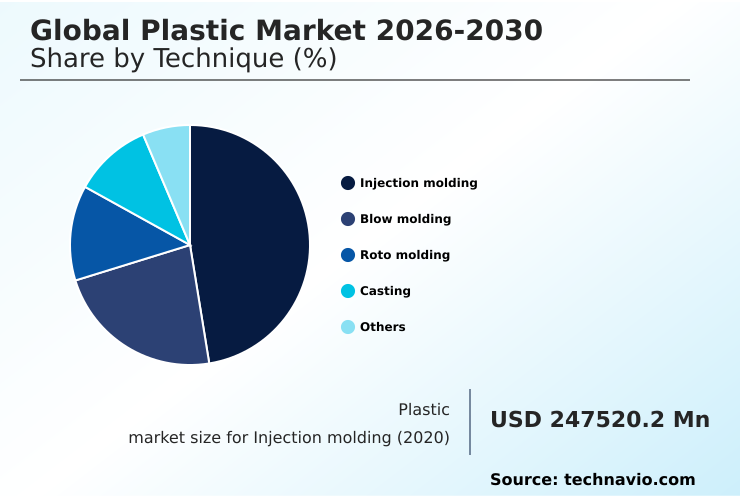
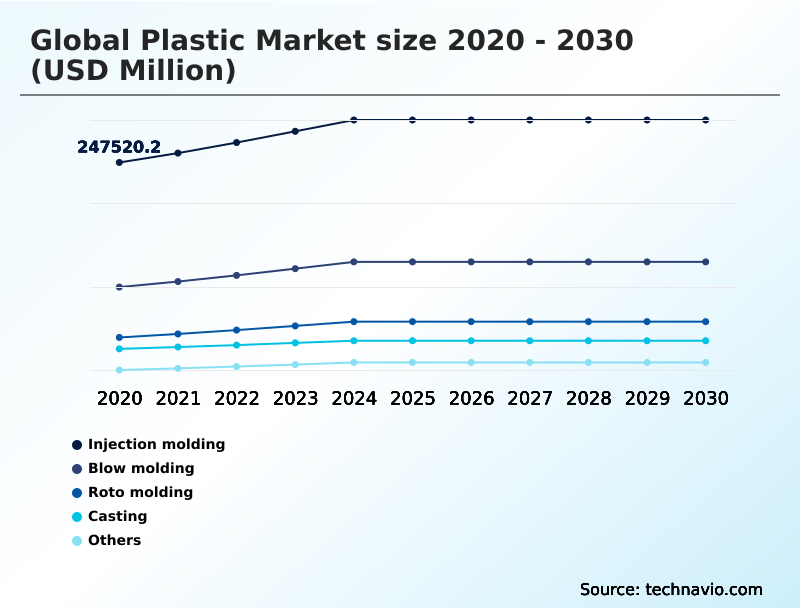
The Injection molding segment was valued at USD 291.34 billion in 2024 and showed a gradual increase during the forecast period.
Regional Analysis
APAC is estimated to contribute 61.6% to the growth of the global market during the forecast period.Technavio’s analysts have elaborately explained the regional trends and drivers that shape the market during the forecast period.
See How Plastic Market Demand is Rising in APAC Get Free Sample
The geographic landscape is dominated by the APAC region, which accounts for over 61% of the market's incremental growth, with North America contributing approximately 16%.
This growth is fueled by robust manufacturing sectors demanding materials like acrylonitrile butadiene styrene (abs) for electronics and polyurethane foams for construction. In these regions, the use of engineering plastics in high-value applications is expanding.
Innovations in polymer chemistry are enabling the production of fire-resistant polymers for infrastructure projects. Demand for thermoforming and rotational molding techniques is also rising. The expansion is also seen in specialized areas like medical-grade polymers, where material consistency is paramount.
For example, some advanced facilities have achieved a 5% reduction in material waste through optimized processes, highlighting the focus on efficiency across key geographies.
Market Dynamics
Our researchers analyzed the data with 2025 as the base year, along with the key drivers, trends, and challenges. A holistic analysis of drivers will help companies refine their marketing strategies to gain a competitive advantage.
- A critical debate in the industry is the comparison of bio-based polymers vs petrochemical plastics, as companies weigh environmental benefits against production costs and performance metrics. This ties into the broader analysis of chemical vs mechanical plastic recycling, where the former offers a path to virgin-quality resin from mixed waste but at a higher energy cost.
- The impact of feedstock volatility on polymers remains a primary concern for businesses heavily reliant on traditional supply chains, pushing for innovation. In contrast, companies diversifying their portfolios are seeing tangible benefits; for instance, those exploring biodegradable polymers for agricultural use have reported a supply chain risk profile that is nearly 20% more stable than peers dependent solely on petrochemicals.
- The role of plastic in electric vehicle batteries is a high-growth area, demanding lightweight plastics in automotive applications and advanced polymer composites for aerospace-grade durability. Trends in smart plastic manufacturing are driven by the need for digital tools for polymer process optimization. This is evident in applications like polyethylene for flexible packaging solutions and advancements in rotational molding technology.
- Key challenges include overcoming hurdles in multilayer plastic recycling and meeting new sustainable plastic packaging regulations.
- Meanwhile, sectors are finding new value in established materials, such as PVC applications in the construction industry, ABS plastic in consumer electronics, and HDPE applications in industrial containers, while high-performance plastics for medical devices and polyurethane foam for building insulation continue to see specialized growth.
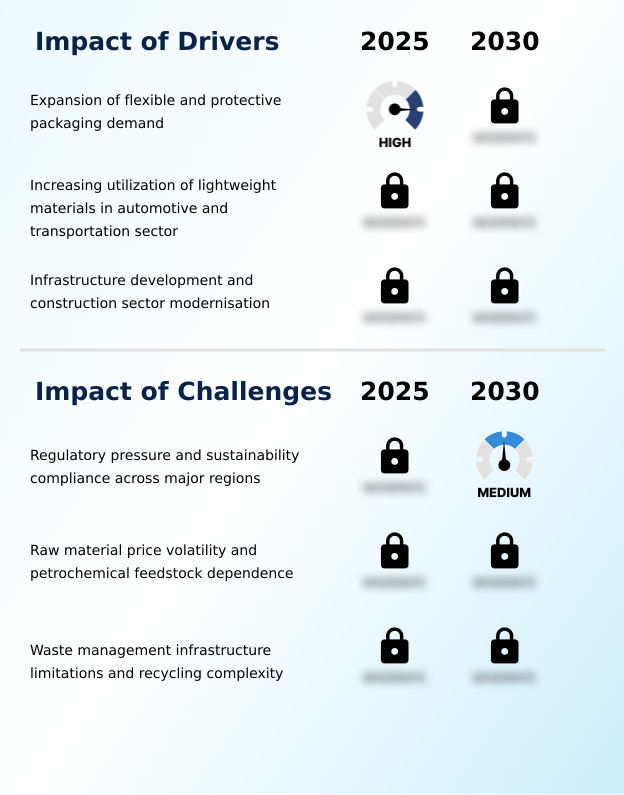
What are the key market drivers leading to the rise in the adoption of Plastic Industry?
- The expanding demand for flexible and protective packaging solutions across various end-user industries serves as a primary driver for market growth.
- Key market drivers are rooted in material innovation and expanding end-user applications. Lightweight material engineering is paramount, with vehicle lightweighting strategies leveraging fiber-reinforced polymers to enhance fuel efficiency by as much as 8%.
- The packaging sector's demand for materials like polypropylene (pp) and polyethylene terephthalate (pet) in food-grade plastic packaging continues to grow.
- Innovations in extrusion molding and blow molding have led to multilayer films with high barrier performance, extending product shelf life by over 20%. In construction, the use of corrosion-resistant piping and thermal insulation materials, often produced via pultrusion, is expanding.
- These advancements underscore the material's versatility and its role in improving efficiency and performance across industries.
What are the market trends shaping the Plastic Industry?
- The market is undergoing an accelerated transition toward a circular economy, driven by the increasing integration of advanced recycling systems to enhance material sustainability.
- A dominant trend is the accelerated shift toward circular economy models, propelled by innovations in both chemical recycling and mechanical recycling. This transition focuses on developing sustainable polymer materials and advanced recycling technologies to manage waste. Companies integrating post-consumer recycled (pcr) content into their products have noted a 12% improvement in brand perception among environmentally conscious consumers.
- The development of mono-material packaging, including new elastomers, is crucial for creating recyclable polymer structures. For example, pilot programs using modular recycling facilities have demonstrated the potential to increase the recovery rate of certain plastics by up to 25%. This move is supported by polymer compounding advancements that create high-quality bio-based polymers and biodegradable plastics, reshaping the industry's environmental footprint.
What challenges does the Plastic Industry face during its growth?
- Intensifying regulatory pressure and the complexities of ensuring sustainability compliance across major global regions present a significant challenge to industry growth.
- The market faces significant challenges, primarily from raw material price instability and complex regulatory frameworks. Dependence on volatile petrochemical feedstocks can cause production costs to fluctuate by up to 30% within a single quarter, impacting profitability. Stricter extended producer responsibility (epr) regulations and inadequate waste management infrastructure complicate the handling of materials like polyvinyl chloride (pvc) and expanded polystyrene (eps).
- Even with advanced material recovery facilities, the presence of certain plastic additives in thermosetting resins makes recycling difficult. Establishing closed-loop production models requires enhanced raw material traceability and supply chain resilience, yet achieving this at scale remains a hurdle, with current systems capturing less than 15% of complex post-consumer plastics for high-value recycling.
Exclusive Technavio Analysis on Customer Landscape
The plastic market forecasting report includes the adoption lifecycle of the market, covering from the innovator’s stage to the laggard’s stage. It focuses on adoption rates in different regions based on penetration. Furthermore, the plastic market report also includes key purchase criteria and drivers of price sensitivity to help companies evaluate and develop their market growth analysis strategies.
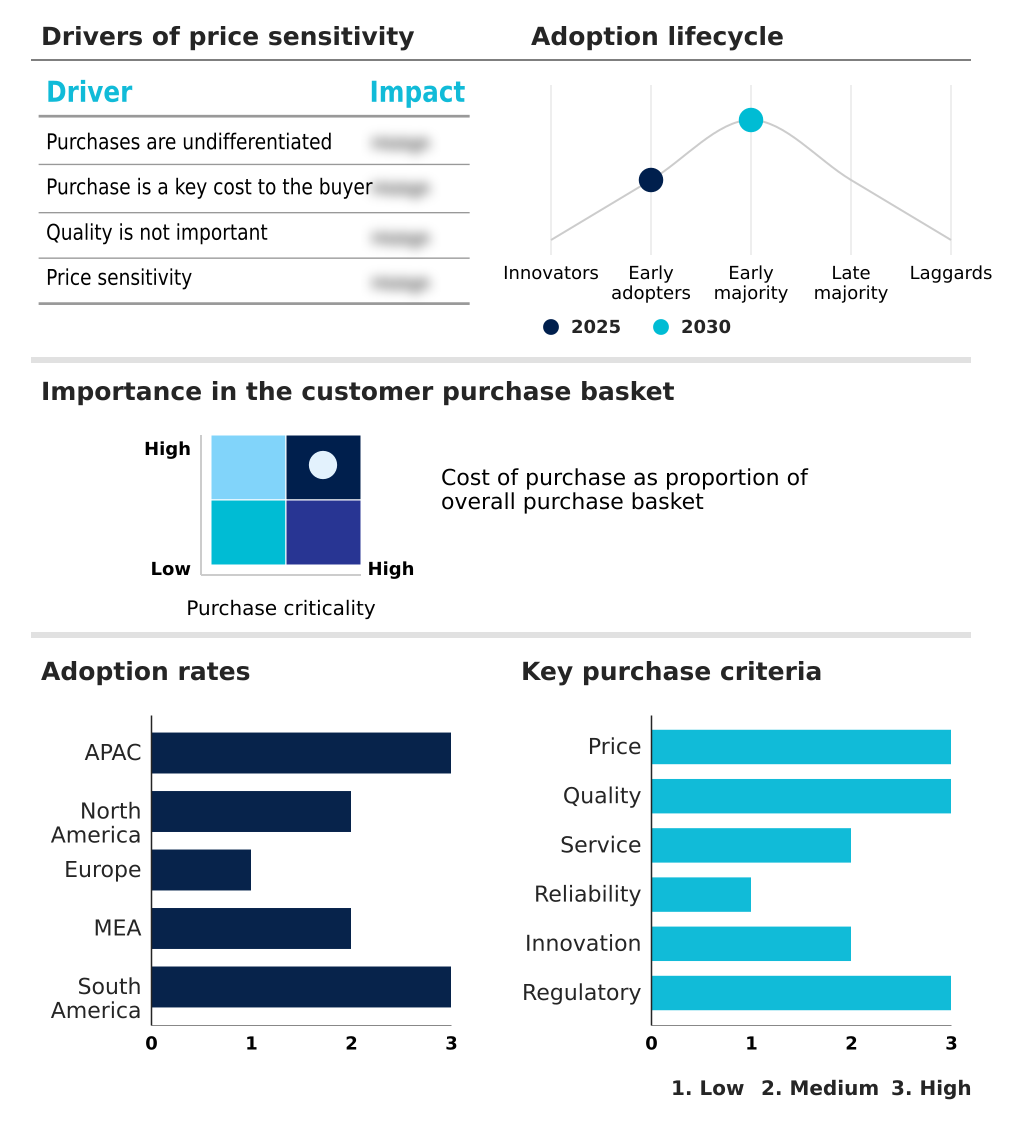
Customer Landscape of Plastic Industry
Competitive Landscape
Companies are implementing various strategies, such as strategic alliances, plastic market forecast, partnerships, mergers and acquisitions, geographical expansion, and product/service launches, to enhance their presence in the industry.
BASF SE - A focused portfolio of engineering plastics and polyurethane materials provides advanced polymer solutions for critical industrial applications.
The industry research and growth report includes detailed analyses of the competitive landscape of the market and information about key companies, including:
- BASF SE
- Borealis AG
- Celanese Corp.
- China Petrochemical Corp.
- Covestro AG
- Dow Chemical Co.
- DuPont de Nemours Inc.
- Eastman Chemical Co.
- Envalior GmbH
- ExxonMobil Chemical Co.
- Formosa Plastics Corp.
- INEOS Group Holdings S.A.
- Lotte Chemical Corp.
- LyondellBasell Industries NV
- Saudi Basic Industries
- Sumitomo Chemical Co. Ltd.
- Toray Plastics Inc.
- TotalEnergies SE
- Trinseo PLC
- Versalis S.p.A
Qualitative and quantitative analysis of companies has been conducted to help clients understand the wider business environment as well as the strengths and weaknesses of key industry players. Data is qualitatively analyzed to categorize companies as pure play, category-focused, industry-focused, and diversified; it is quantitatively analyzed to categorize companies as dominant, leading, strong, tentative, and weak.
Recent Development and News in Plastic market
- In August 2025, LyondellBasell announced progress on commissioning its advanced chemical recycling facility in Wesseling, Germany, designed to process mixed plastic waste into new polymer feedstock.
- In April 2025, Amcor introduced mono-material flexible pouches under its Liquiflex AmPrima product line in Europe, designed to be more compatible with polyethylene recycling streams.
- In March 2025, Lotte Chemical announced the Lotte Chemical Indonesia New Ethylene (LINE) Project in Cilegon, a major petrochemical expansion to increase regional polymer production capacity.
- In February 2025, Hyundai Motor Group announced a strategic materials partnership with Kolon Group to develop advanced polymer composite materials for next-generation electric vehicles.
Dive into Technavio’s robust research methodology, blending expert interviews, extensive data synthesis, and validated models for unparalleled Plastic Market insights. See full methodology.
| Market Scope | |
|---|---|
| Page number | 333 |
| Base year | 2025 |
| Historic period | 2020-2024 |
| Forecast period | 2026-2030 |
| Growth momentum & CAGR | Accelerate at a CAGR of 5.3% |
| Market growth 2026-2030 | USD 194057.3 million |
| Market structure | Fragmented |
| YoY growth 2025-2026(%) | 5.2% |
| Key countries | China, Japan, India, South Korea, Australia, Indonesia, US, Canada, Mexico, Germany, UK, France, Italy, Spain, The Netherlands, Saudi Arabia, UAE, South Africa, Israel, Egypt, Brazil, Argentina and Chile |
| Competitive landscape | Leading Companies, Market Positioning of Companies, Competitive Strategies, and Industry Risks |
Research Analyst Overview
- The plastic market's evolution is defined by a fundamental tension between performance and sustainability. While materials like polyethylene terephthalate (pet) and polypropylene (pp) remain ubiquitous, the focus is shifting to advanced polymer processing and polymer compounding. This is evident in the development of sophisticated multilayer films and fiber-reinforced polymers.
- A major boardroom consideration is the transition to a circular model, driven by the dual pressures of regulation and consumer sentiment. This strategic pivot involves substantial investment in chemical recycling and mechanical recycling infrastructure to process materials from polyvinyl chloride (pvc) to expanded polystyrene (eps).
- Companies are increasingly utilizing bio-based polymers and biodegradable plastics to mitigate dependence on volatile petrochemical feedstocks. For instance, firms integrating advanced polymer resin with high-recycled content have documented a 10% improvement in compliance with new sustainability mandates.
- The industry is also seeing innovation in manufacturing techniques, including injection molding, blow molding, and extrusion molding, alongside specialized methods like pultrusion and thermoforming to create everything from elastomers to complex engineering plastics.
What are the Key Data Covered in this Plastic Market Research and Growth Report?
-
What is the expected growth of the Plastic Market between 2026 and 2030?
-
USD 194.06 billion, at a CAGR of 5.3%
-
-
What segmentation does the market report cover?
-
The report is segmented by Technique (Injection molding, Blow molding, Roto molding, Casting, and Others), End-user (Packaging, Consumer goods, Automotive, Electrical and electronics, and Others), Product Type (Polyethylene, Polypropylene, Polyurethane, Polyvinyl chloride, and Others) and Geography (APAC, North America, Europe, Middle East and Africa, South America)
-
-
Which regions are analyzed in the report?
-
APAC, North America, Europe, Middle East and Africa and South America
-
-
What are the key growth drivers and market challenges?
-
Expansion of flexible and protective packaging demand, Regulatory pressure and sustainability compliance across major regions
-
-
Who are the major players in the Plastic Market?
-
BASF SE, Borealis AG, Celanese Corp., China Petrochemical Corp., Covestro AG, Dow Chemical Co., DuPont de Nemours Inc., Eastman Chemical Co., Envalior GmbH, ExxonMobil Chemical Co., Formosa Plastics Corp., INEOS Group Holdings S.A., Lotte Chemical Corp., LyondellBasell Industries NV, Saudi Basic Industries, Sumitomo Chemical Co. Ltd., Toray Plastics Inc., TotalEnergies SE, Trinseo PLC and Versalis S.p.A
-
Market Research Insights
- Market dynamics are increasingly shaped by the push for sustainable polymer materials and advanced recycling technologies. The adoption of circular economy models is not just a compliance measure; it's a strategic shift, with early adopters reporting up to a 15% reduction in raw material costs by integrating post-consumer recycled (pcr) content.
- Furthermore, the use of digital manufacturing tools in smart production systems has enabled a 10% improvement in product consistency. These eco-design initiatives are critical as industries from food-grade plastic packaging to medical-grade polymers demand greater supply chain resilience and raw material traceability.
- As closed-loop production models become more prevalent, the ability to innovate with recyclable polymer structures will define competitive advantage.
We can help! Our analysts can customize this plastic market research report to meet your requirements.
 RIA -
RIA - 
